
Corporate Social Responsibility Corporate Social Responsibility Friedman Central
Corporate Social Responsibility
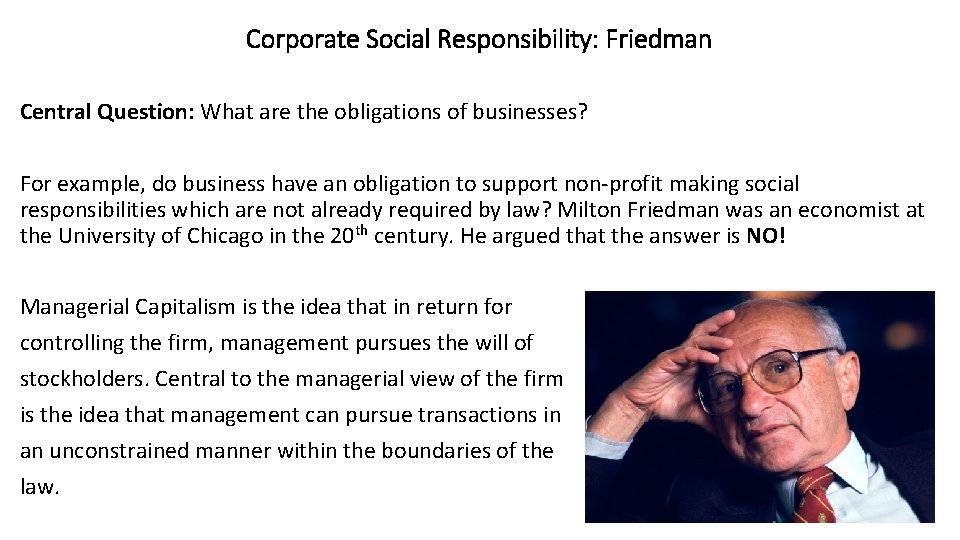
Corporate Social Responsibility: Friedman Central Question: What are the obligations of businesses? For example, do business have an obligation to support non-profit making social responsibilities which are not already required by law? Milton Friedman was an economist at the University of Chicago in the 20 th century. He argued that the answer is NO! Managerial Capitalism is the idea that in return for controlling the firm, management pursues the will of stockholders. Central to the managerial view of the firm is the idea that management can pursue transactions in an unconstrained manner within the boundaries of the law.
Corporate Social Responsibility: Friedman General Examples: • Reducing carbon footprints • Improving labor policies • Participating in fair-trade transactions and production • Charitable giving • Volunteering in the community • Corporate policies that benefit the environment • Socially and environmentally conscious investments
Corporate Social Responsibility: Friedman • Business might have more than one type of obligation from being part of various different social systems. Just as a person can have different sets of responsibilities deriving from different roles, such as parent vs. citizen, a business can have more than one set of responsibilities. • Businesses are abstract, and are not the right kind of thing to even have responsibilities. Only persons have responsibilities; so the question of corporate social responsibility does not even make sense. There are no responsibilities at all that businesses can have. • People in a corporation have responsibilities. Since, the main people who would have social responsibilities that can be analyzed are corporate executives that serve on various boards in the corporation.
Corporate Social Responsibility: Friedman 1. Corporate Social Responsibility requires taking money that either comes from shareholder investment or from profit, and using it for some social end that does not yield a profit. Where did it come from? What is it supposed to be used for? What is the social end it is to be used for?
Corporate Social Responsibility: Friedman 2. Taking money from a shareholder, who invested their money in order to make a return on their investment, without their permission would be an act of taxation.
Corporate Social Responsibility: Friedman 3. Taking money from profit in order to fund a social end without permission from all of those that invested would be an act of taxation.
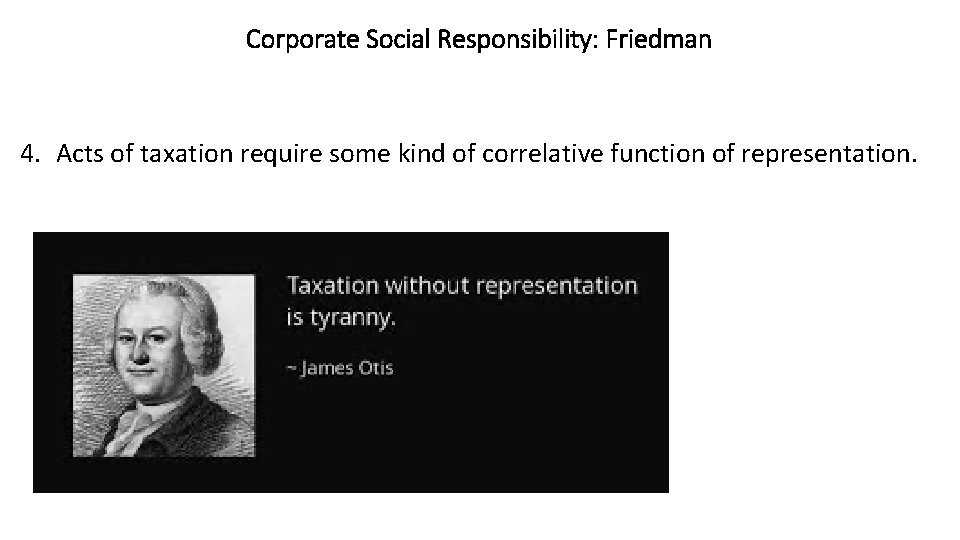
Corporate Social Responsibility: Friedman 4. Acts of taxation require some kind of correlative function of representation.
Corporate Social Responsibility: Friedman 5. Corporations do not typically have a board or individuals that represents the main population of investors with respect to allocating and assigning funds for social ends in a way that takes into consideration the social interests of those involved in the corporation through investment or employment. NO REPRSENTATION
Corporate Social Responsibility: Friedman What can corporate executives do? (i) Do corporate executives actually have any expertise on which social ends to pursue and how to do that well? (i) Do corporate executives have the capacity to solicit input from a wide enough body of individuals that are representative of the public interest as well as shareholder interests?
Corporate Social Responsibility: Friedman Argument: 1. Corporate social responsibility by definition requires taxing stockholders without their consent or representation in order to use money that they explicitly invested for the purposes of making a profit, and using the money instead for some social end perhaps not agreed upon by the total group of stockholders. 2. As long as corporations follow the law, their primary aim is to maximize profits. Business does not have the purpose of engaging in social justice. 3. Government, has a different function from business, it has a function that allows for social justice through voting and representation in a democratic process. 4. So, government and not business should engaging socially responsible activities once they are decided upon by a democratic procedure.
Corporate Social Responsibility: Friedman Whether blameworthy or not, the use of the cloak of social responsibility, and the nonsense spoken in its name by influential and prestigious businessmen, does clearly harm the foundations of a free society. I have been impressed time and again by the schizophrenic character of many businessmen. They are capable of being extremely far-sighted and clear-headed in matters that are internal to their businesses. They are incredibly short-sighted and muddleheaded in matters that are outside their businesses but affect the possible survival of business in general. This shortsightedness is strikingly exemplified in the calls from many businessmen for wage and price guidelines or controls or income policies. There is nothing that could do more in a brief period to destroy a market system and replace it by a centrally controlled system than effective governmental control of prices and wages. Milton Friedman
Corporate Social Responsibility: Friedman The political principle that underlies the market mechanism is unanimity. In an ideal free market resting on private property, no individual can coerce any other, all cooperation is voluntary, all parties to such cooperation benefit or they need not participate. There are no values, no “social” responsibilities in any sense other than the shared values and responsibilities of individuals. Society is a collection of individuals and of the various groups they voluntarily form. The political principle that underlies the political mechanism is conformity. The individual must serve a more general social interest—whether that be determined by a church or a dictator or a majority. The individual may have a vote and say in what is to be done, but if he is overruled, he must conform. It is appropriate for some to require others to contribute to a general social purpose whether they wish to or not. Milton Friedman
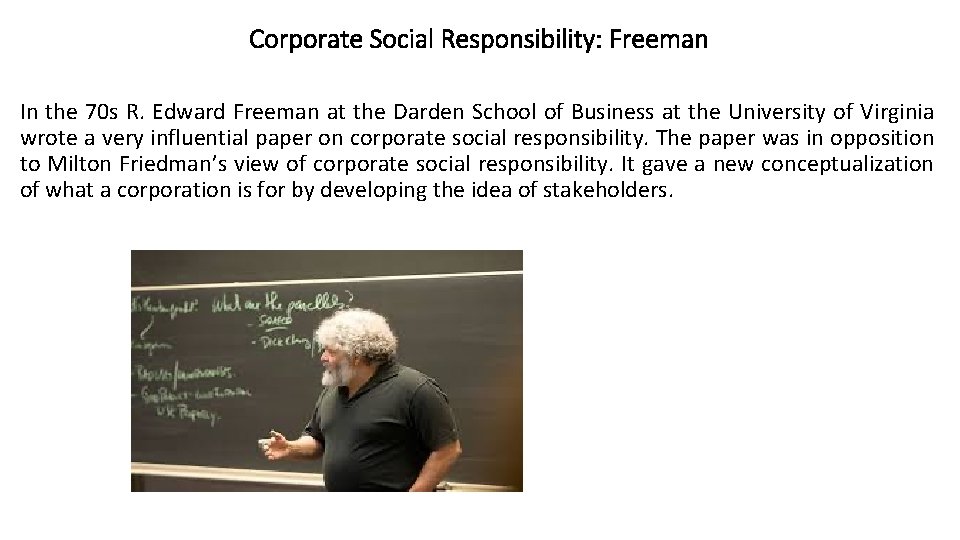
Corporate Social Responsibility: Freeman In the 70 s R. Edward Freeman at the Darden School of Business at the University of Virginia wrote a very influential paper on corporate social responsibility. The paper was in opposition to Milton Friedman’s view of corporate social responsibility. It gave a new conceptualization of what a corporation is for by developing the idea of stakeholders.
Corporate Social Responsibility: Freeman Argument for Stockholder Priority: 1. Stockholders own corporations by buying stock with the expressed interest of getting a return on their investment. 2. Corporate executives are employees of the stockholders. 3. Stockholders want a return on their investment. 4. Corporate social responsibility gives no return on investment. 5. So, stockholders would not authorize corporate social responsibility. Corporations are ultimately in the hands of their stockholders, and corporate executives have a responsibility to stockholders rather than anyone else.
Corporate Social Responsibility: Freeman Central Thesis of Stakeholder Theory: The concept of managerial capitalism can be revitalized by replacing the notion that managers have a duty to stockholders with the concept that managers bear a fiduciary relationship to stakeholders. Stakeholders are those groups who have a stake in or claim on the firm. Specifically this includes: suppliers, customers, employees, stockholders, and the local community, as well as management in its role as agent for these groups.
Corporate Social Responsibility: Freeman Central Question: in whose interest and for whose benefit should the modern corporation be governed? Stockholders or Stakeholders Legal Argument 1. Were the law of corporations to hold that only stockholders mattered, then they would never take into consideration claims made by non-stockholders.
Corporate Social Responsibility: Freeman Legal Argument 2. However, over the 20 th century many times the law has sided with nonstockholders b. Such as in the case of employees through the National Labor Relations Board, The Equal Pay Act, Title VII of the Civil Rights Act. c. Such as in the case of local communities through the Clean Air Act and Clean Water Act.
Corporate Social Responsibility: Freeman Legal Argument 3. So, from a legal standpoint it seems as if the law sides sometimes in favor, not of the stockholders alone, but also non-stockholders when it shows that a firm should be run for the sake of the employees as well as the local communities in which they reside.
Corporate Social Responsibility: Freeman Economic Argument 1. There are externalities, moral hazards, and monopoly power. An externality is a side effect or consequence of an industrial or commercial activity that affects other parties without this being reflected in the cost of the goods or services involved. A moral hazard is present when there is a lack of incentive to guard against risk where one is protected from its consequences, e. g. by insurance. Monopolies form when a company or group has exclusive control over a commodity or service.
Corporate Social Responsibility: Freeman Economic Argument 2. Economically there is no incentive for firms to take on the costs of externalities and moral hazards, and to try to acquire a monopoly. 3. So, economically the government has had to step in through taxation and regulation. 4. So, corporate executives cannot pursue capital for stockholders in an unconstrained way. Stockholder theory is false, since it appears that economically and legally firms are held responsible to stakeholders that are non-stockholders. What does the firm look like under stakeholder theory?
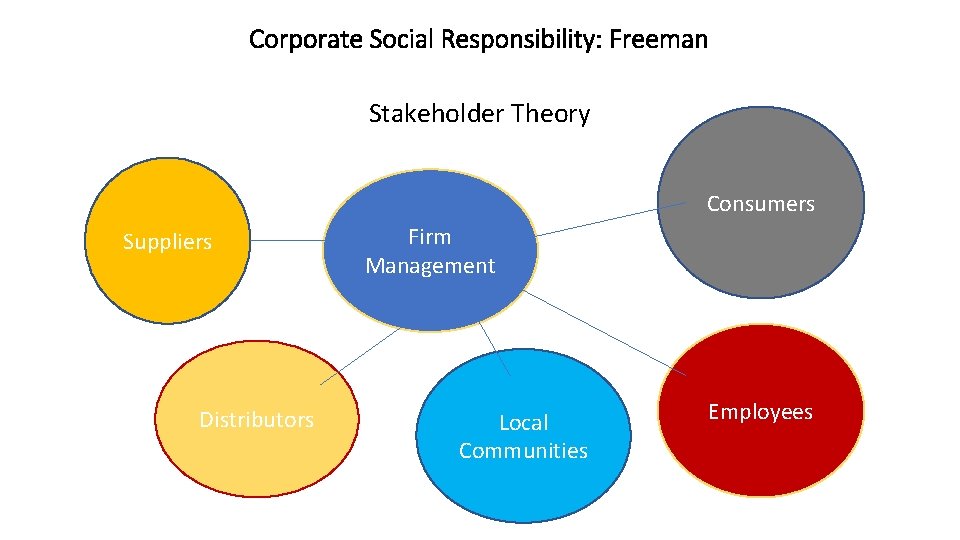
Corporate Social Responsibility: Freeman Stakeholder Theory Consumers Suppliers Distributors Firm Management Local Communities Employees
Corporate Social Responsibility: Freeman Principles: • The Principle of Entry and Exit holds that the corporation must have clearly defined entry, exit, and renegotiation conditions, or at least it must have methods or processes for so defining these conditions. • The Principle of Governance holds that the procedure for changing the rules of the game must be agreed upon by unanimous consent. • The Principle of Externalities holds that if a contract between A and B imposes a cost on C, then C has the option to become a party to the contract, and the terms are renegotiated.
Corporate Social Responsibility: Freeman • The Principle of Contracting Costs holds that all parties to the contract must share in the cost of contracting. • The Agency Principle holds that any agent must serve the interests of all stakeholders. • The Principle of Limited Immortality holds that the corporation shall be managed as if it can continue to serve the interests of stakeholders through time.
Corporate Social Responsibility: Freeman The Stakeholder Enabling Principle: Corporations shall be managed in the interests of its stakeholders, defined as employees, financiers, customers, employees, and communities. The Principle of Director Responsibility: Directors of the corporation shall have a duty of care to use reasonable judgment to define and direct the affairs of the corporation in accordance with the Stakeholder Enabling Principle. The Principle of Stakeholder Recourse: Stakeholders may bring an action against the directors for failure to perform the required duty of care.
- Slides: 25