
CORPORATE SOCIAL RESPONSIBILITY CORPORATE SOCIAL RESPONSIBILITY Also referred
CORPORATE SOCIAL RESPONSIBILITY
CORPORATE SOCIAL RESPONSIBILITY • • Also referred to as CORPORATE CITIZENSHIP (being responsible) or CORPORATE CONSCIENCE (awareness to obligations to society) The actions of an organization that are targeted toward the achievement of a social benefit over and above maximizing profits for its shareholders and meeting all its legal obligations
WHY NOT DO / WHY DO CSR?
ANTI: INSTRUMENTAL APPROACH • • The perspective that the only obligation of a corporation is to maximize profits for its shareholders in the provision of goods and services that meet the needs of its customers The most famous advocate is the Nobel Prize-winning economist Milton Friedman

CSR = PROFIT
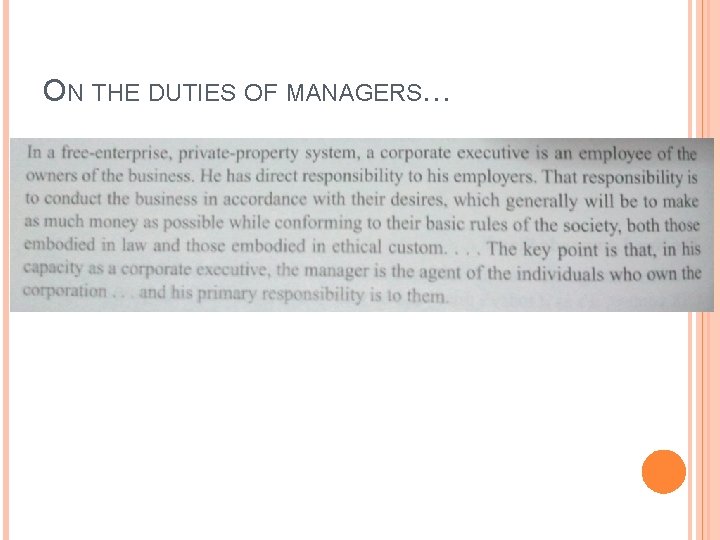
ON THE DUTIES OF MANAGERS…
PRO: SOCIAL CONTRACT APPROACH • The perspective that a corporation has an obligation to society over and above the expectation of its shareholders
DRIVING FORCES BEHIND CSR • Joseph F. Keefe of New. Circle Communications, asserts there are five major trends behind the CSR phenomenon: • • • Transparency Knowledge Sustainability – corporations are under increasing pressure from diverse stakeholder constituencies to demonstrate that business plans and strategies are environmentally sound and contribute to sustainable development Globalization Failure of the public sector
• • Many organizations have found it difficult to make the transition from CSR as a theoretical concept to CSR as an operational policy. Ironically, it’s not the ethical action that causes the problem; it’s how to promote those acts to your stakeholders as proof of your new corporate conscience without appearing to be manipulative or scheming to generate press coverage for policies that could easily be dismissed as “feel-good” initiatives that are simply chasing customer favor.
CORPORATIONS THAT CHOOSE TO EXPERIMENT WITH CSR INITIATIVES RUN RISKS: • • • Employees feel that they are working for an insincere, uncaring organization The public sees little more than a token action – more to do with publicity that community; The organization does not see much benefit of CSR so sees no need to develop the concept.
3 TYPES OF CSR
ETHICAL CSR • Organizations pursue a clearly defined sense of social conscience in managing their financial responsibilities to shareholders, their legal responsibilities to their community and society as a whole, and their ethical responsibilities to “do the right thing” for all their stakeholders
ALTRUISTIC CSR • • Organizations take a philantrophic approach by underwriting specific initiatives to “give back” to the company’s local community or to designated national or international programs Examples In the 1980’s, Richard Branson’s Virgin Group launched “Mates” Condoms in response to growing concern over the spread of HIV/AIDS with the belief that the need for the availability of the product far outweighed the need to make profit • Ronal Mc. Donald houses, and the support of Southwest Airlines for Mc. Donald houses •
STRATEGIC CSR • • Philantrophic activities are targeted toward programs that will generate the most positive publicity or goodwill for the organizations Examples Ford spend millions on ad campaign to raise awareness of the need for booster seats for children over 40 pounds and under 4’ 9” (most 4 -8 year olds) and gave away almost one million seats as part of the campaign • During the PR battle with Firestone Tires over who was to blame for the “rollover” problems with the Ford Explorer, Ford’s CEO at the time, Jacques Nasser, made a public commitment to spend up to $3 billion to replace 13 million Firestone Wilderness AT fires for free on Ford Explorers because he saw them as “unacceptable risks to our customers. ” •
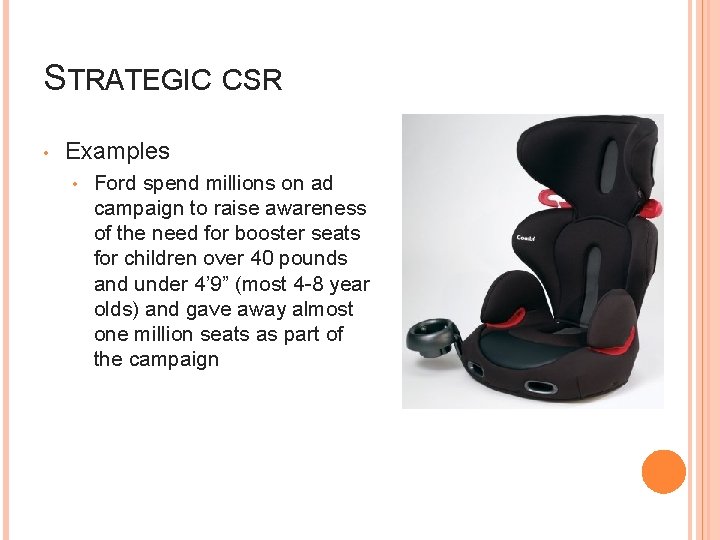
STRATEGIC CSR • Examples • Ford spend millions on ad campaign to raise awareness of the need for booster seats for children over 40 pounds and under 4’ 9” (most 4 -8 year olds) and gave away almost one million seats as part of the campaign
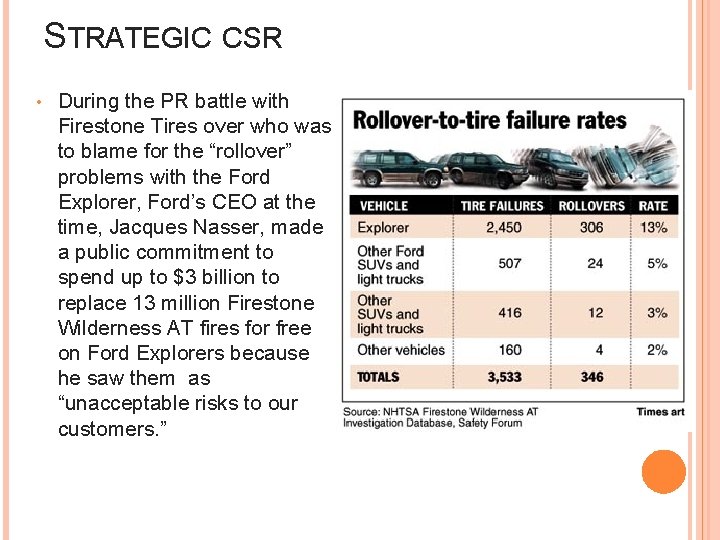
STRATEGIC CSR • During the PR battle with Firestone Tires over who was to blame for the “rollover” problems with the Ford Explorer, Ford’s CEO at the time, Jacques Nasser, made a public commitment to spend up to $3 billion to replace 13 million Firestone Wilderness AT fires for free on Ford Explorers because he saw them as “unacceptable risks to our customers. ”
- Slides: 16