
CORPORATE RESPONSIBILITY concepts CSR Sustainability CG the business
CORPORATE RESPONSIBILITY • concepts • CSR, Sustainability, CG • the business case • stakeholders and their engagement S. Lioukas
What is CSR about ? Definitions 2 Social responsibility is the responsibility of an organization for the impacts of its decisions and activities on society and the environment Including conduct: transparent and ethical behavior including health and the welfare of society Impact: positive or negative change to society, economy or the environment, wholly or partially resulting from an organization's past and present decisions and activities Accountability is the state of being answerable for decisions and activities to the organization's governing bodies, legal authorities and, more broadly, its stakeholders
Definition: Sustainable Development “Development that meets the needs of the people today without compromising the ability of future generations to meet their own needs”
CSR vs Sustainability 4 CSR and Sustainability • CSR: definitions vary across countries • Some include more, e. g. fraud • CSR: an externally imposed concern? • Sustainability: • • Balance ENOCOMIC – ENVIRONMENTAL - SOCIAL /HUMAN It is strategy, internally determined • Metrics: • • International, e. g. GRI, Sustainability indicators, transparency… ESG metrics (Bloomberg, Reuters – Asset 4, …)
WHO ARE THE STAKEHOLDERS Definitions 5 Stakeholder is the individual or group that has an interest in any decision or activity of an organization • refers to any group or individual who can affect or is affected by the achievement of the organization’s purpose (Freeman, 1984). Stakeholder engagement is an activity undertaken to create opportunities for dialogue between an organization and one or more of its stakeholders, with the aim of providing an informed basis for the organization's decisions
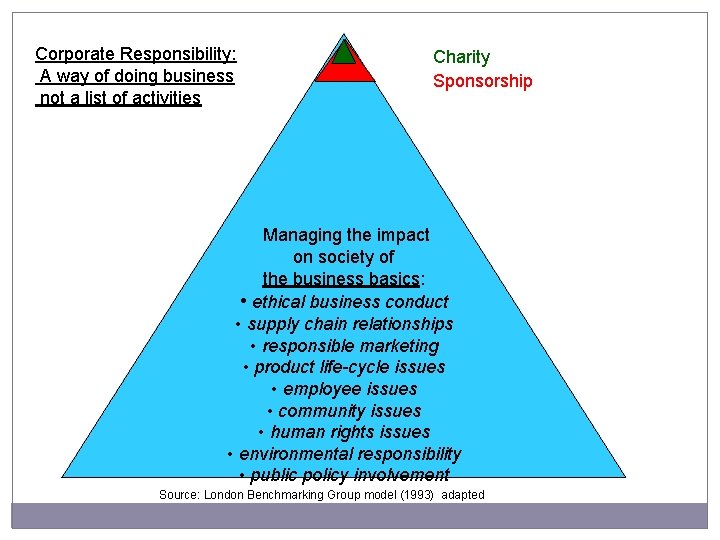
Corporate Responsibility: A way of doing business not a list of activities Charity Sponsorship Managing the impact on society of the business basics: • ethical business conduct • supply chain relationships • responsible marketing • product life-cycle issues • employee issues • community issues • human rights issues • environmental responsibility • public policy involvement Source: London Benchmarking Group model (1993) adapted
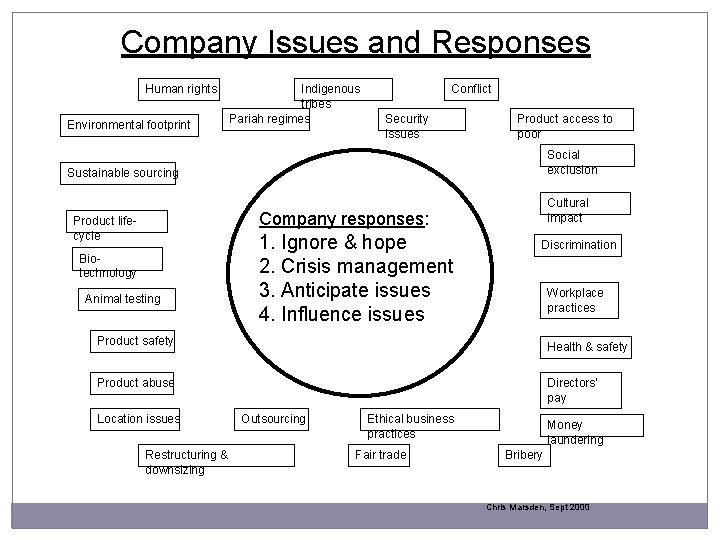
Company Issues and Responses Human rights Environmental footprint Indigenous tribes Pariah regimes Conflict Security issues Product access to poor Social exclusion Sustainable sourcing Cultural impact Company responses: Product lifecycle Biotechnology Animal testing 1. Ignore & hope 2. Crisis management 3. Anticipate issues 4. Influence issues Discrimination Workplace practices Product safety Health & safety Product abuse Directors’ pay Location issues Restructuring & downsizing Outsourcing Ethical business practices Fair trade Money laundering Bribery Chris Marsden, Sept 2000
Sustainability - can business be part of the solution? Social responsibility is inefficient in a global free market and the market will not long abide those who do not avail of the opportunity to shed the inefficient’( David Korten in When corporations rule the world ‘While industry represents perhaps the single biggest threat to the natural world, it can also represent one of our greatest allies in our mission to safeguard it. ’ (Dr. Robin Pellow, Director, WWF -UK).
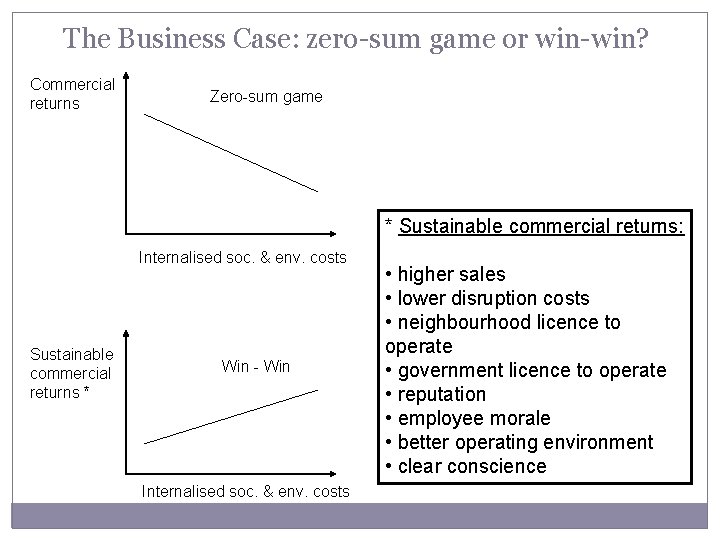
The Business Case: zero-sum game or win-win? Commercial returns Zero-sum game * Sustainable commercial returns: Internalised soc. & env. costs Sustainable commercial returns * Win - Win Internalised soc. & env. costs • higher sales • lower disruption costs • neighbourhood licence to operate • government licence to operate • reputation • employee morale • better operating environment • clear conscience
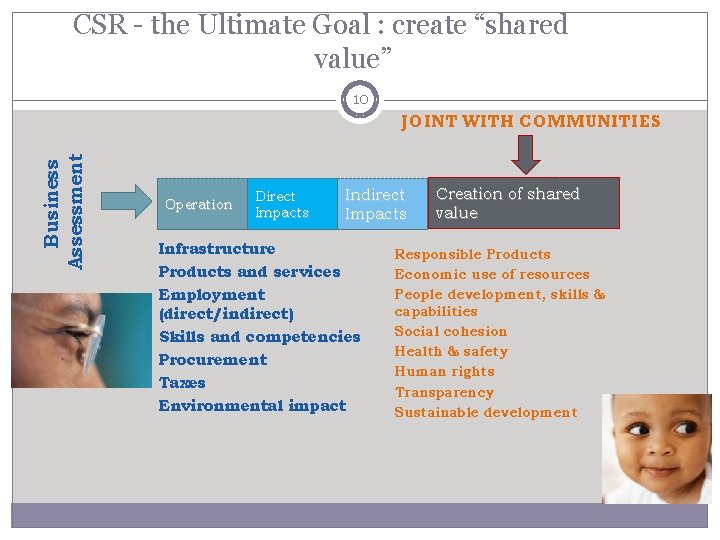
CSR - the Ultimate Goal : create “shared value” 10 Business Assessment JOINT WITH COMMUNITIES Operation Direct Impacts Indirect Impacts Infrastructure Products and services Employment (direct/indirect) Skills and competencies Procurement Taxes Environmental impact Creation of shared value Responsible Products Economic use of resources People development, skills & capabilities Social cohesion Health & safety Human rights Transparency Sustainable development
What is Corporate Governance about? The system that societies use to direct and “control” the conduct of corporations sets the rights & obligations of companies, owners (shareholders), and company obligations against other stakeholders accountability to society and mechanisms to align the company with the “public interest” at large Includes formal laws ®ulations & codes, as well as informal customs and processes
CG and CSR Both concerned with ethics CG is more specific and formalized relative to Corporate Social Responsibility There are more formal, compulsory laws and regulations in CG CSR is more voluntary Metrics and rating is more developed in CG CG scoreboards Ratings industry (agencies, investment institutions…)
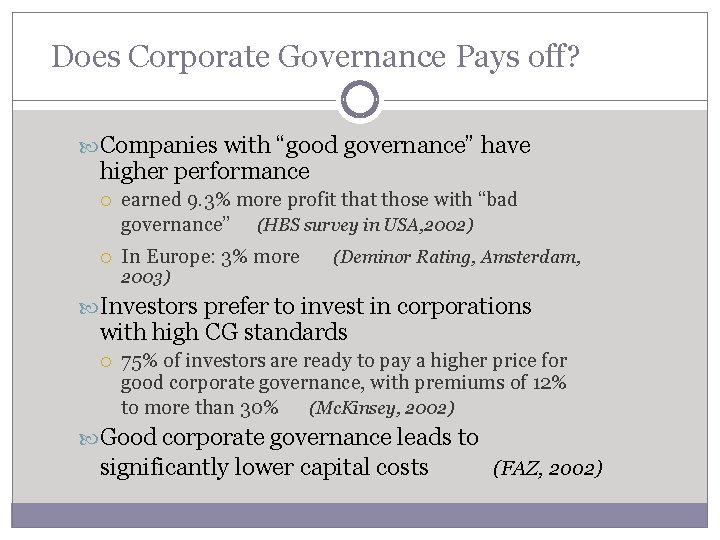
Does Corporate Governance Pays off? Companies with “good governance” have higher performance earned 9. 3% more profit that those with “bad governance” (HBS survey in USA, 2002) In Europe: 3% more (Deminor Rating, Amsterdam, 2003) Investors prefer to invest in corporations with high CG standards 75% of investors are ready to pay a higher price for good corporate governance, with premiums of 12% to more than 30% (Mc. Kinsey, 2002) Good corporate governance leads to significantly lower capital costs (FAZ, 2002)
TITAN CEMENT In the following case study of TITAN cement, identify: • What aspects of CSR are monitored? • Hw the social footprint can be improved and extended? • Getting info from its site, evaluate its corporate governance practices.
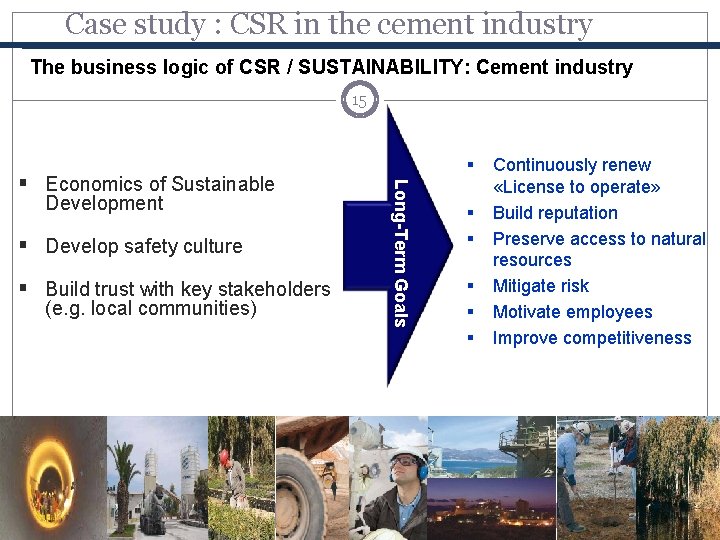
Case study : CSR in the cement industry The business logic of CSR / SUSTAINABILITY: Cement industry 15 Development § Develop safety culture § Build trust with key stakeholders (e. g. local communities) Long-Term Goals § Economics of Sustainable § § § Continuously renew «License to operate» Build reputation Preserve access to natural resources Mitigate risk Motivate employees Improve competitiveness
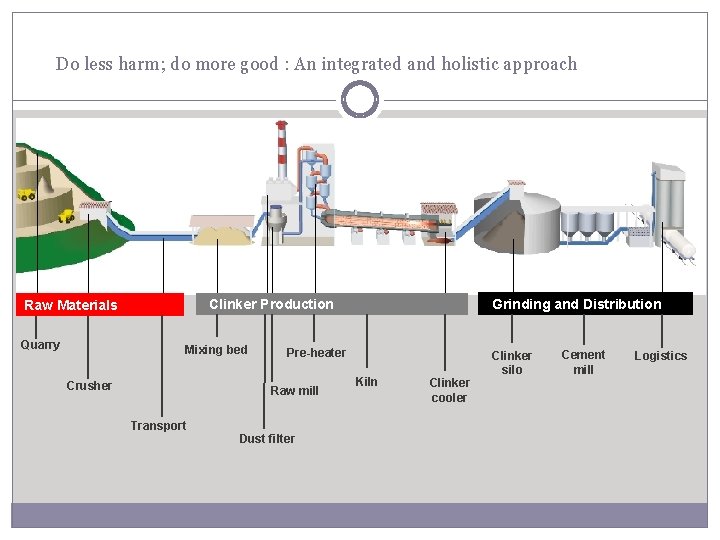
Do less harm; do more good : An integrated and holistic approach Clinker Production Raw Materials Quarry Mixing bed Crusher Pre-heater Raw mill Transport Grinding and Distribution Dust filter Kiln Clinker cooler Clinker silo Cement mill Logistics
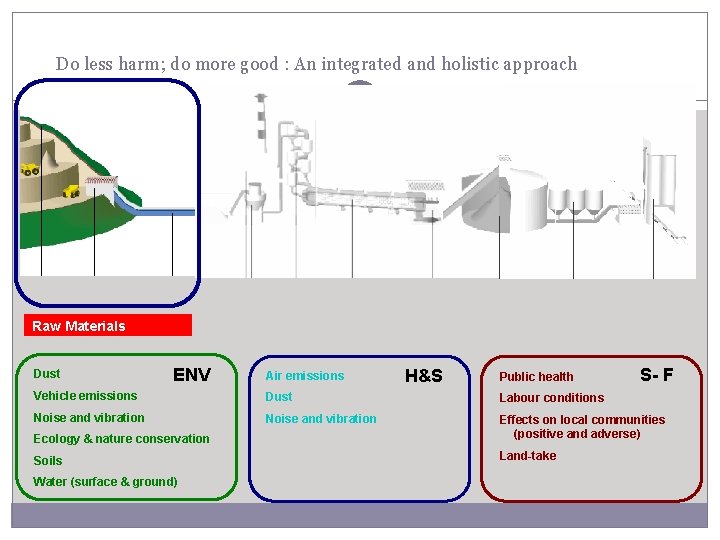
Do less harm; do more good : An integrated and holistic approach Raw Materials Dust ENV Air emissions H&S Public health S- F Vehicle emissions Dust Labour conditions Noise and vibration Ecology & nature conservation Effects on local communities (positive and adverse) Soils Land-take Water (surface & ground)
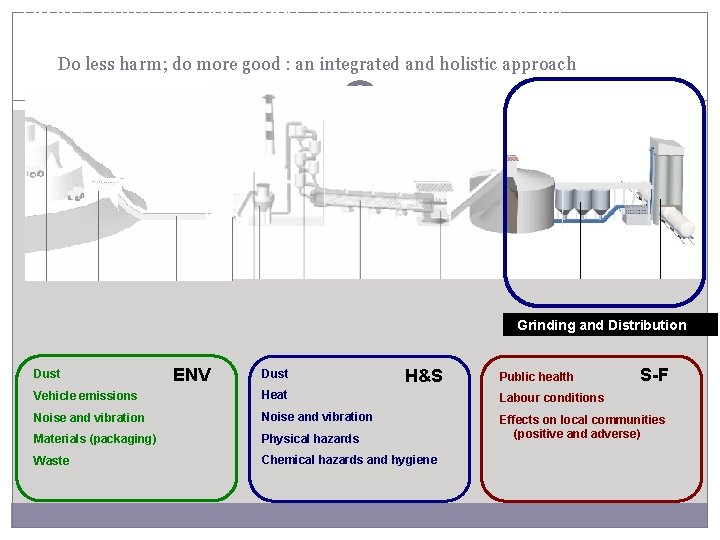
Do less harm; do more good : an integrated and holistic approach Grinding and Distribution Dust ENV Dust H&S Public health S-F Vehicle emissions Heat Labour conditions Noise and vibration Materials (packaging) Physical hazards Effects on local communities (positive and adverse) Waste Chemical hazards and hygiene
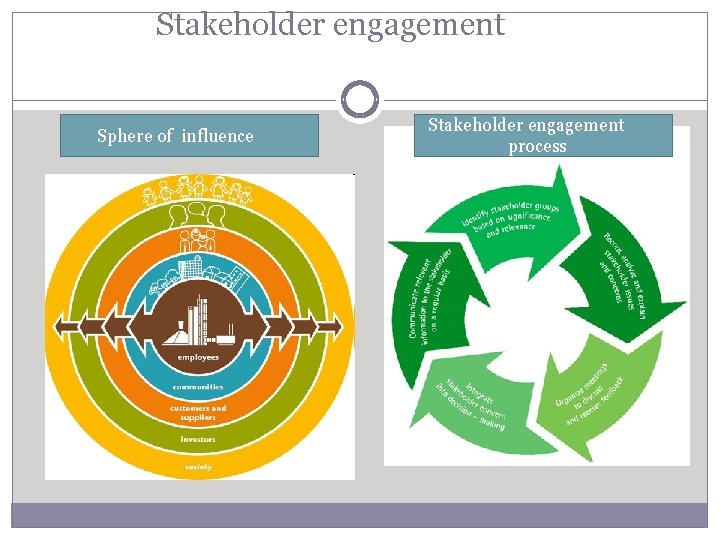
Stakeholder engagement Sphere of influence Stakeholder engagement process
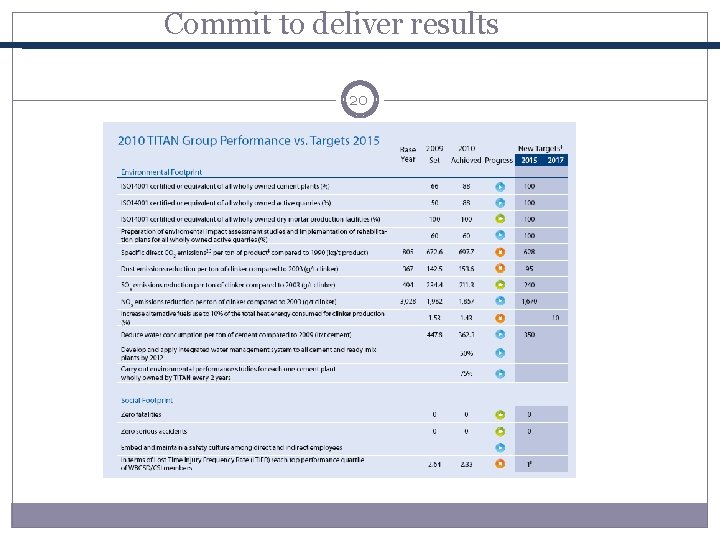
Commit to deliver results 20
- Slides: 20