
Corporate Metrics Risk Management in the Corporate Environment


- Slides: 34
Corporate. Metrics® Risk Management in the Corporate Environment Jongwoo Kim Risk. Metrics Group
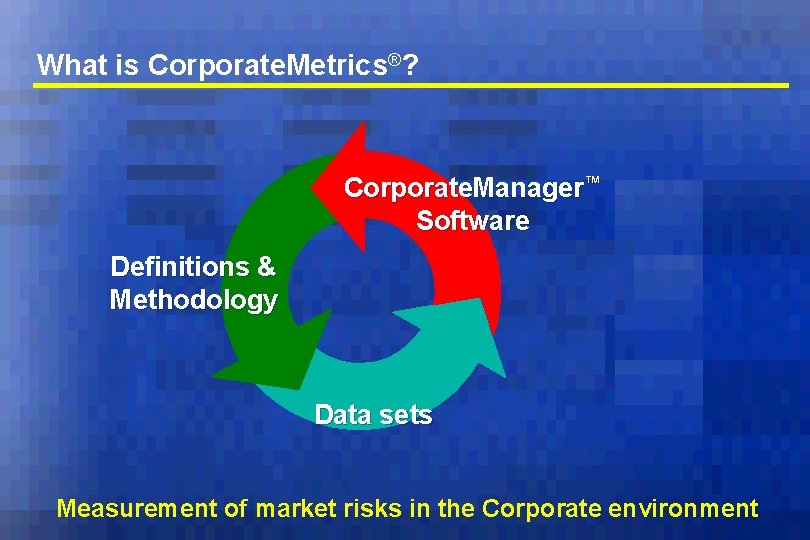
What is Corporate. Metrics®? Corporate. Manager™ Software Definitions & Methodology Data sets Measurement of market risks in the Corporate environment
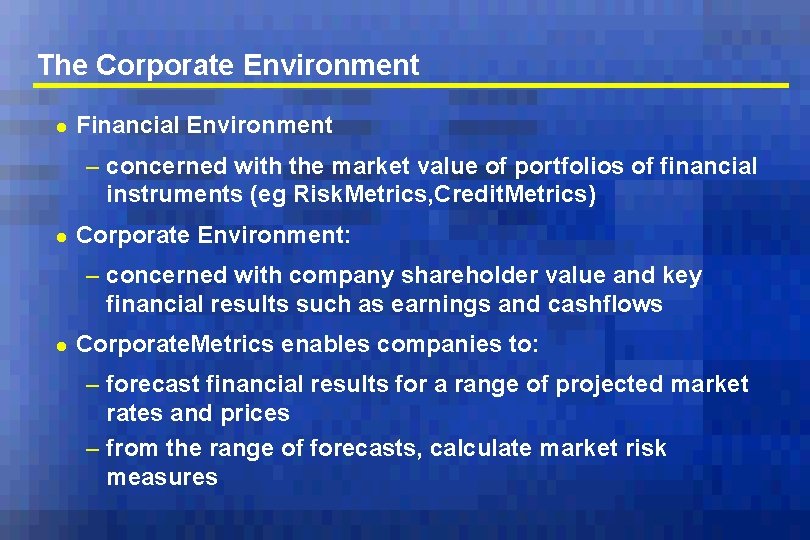
The Corporate Environment l Financial Environment – concerned with the market value of portfolios of financial instruments (eg Risk. Metrics, Credit. Metrics) l Corporate Environment: – concerned with company shareholder value and key financial results such as earnings and cashflows l Corporate. Metrics enables companies to: – forecast financial results for a range of projected market rates and prices – from the range of forecasts, calculate market risk measures
Agenda l Aims and Objectives for Corporate. Metrics l The Risk. Metrics Financial Risk Framework l The Corporate. Metrics Framework l Sample Applications l Implementing Corporate. Metrics What is the aim of Corporate. Metrics?
The Aim of Corporate. Metrics l Create a benchmark approach for market risk measurement in the corporate environment l Promote market risk transparency and better risk management tools l Complement existing market risk management techniques Stimulate a dialog with clients on risk management issues
Why release Corporate. Metrics now? * l Increased focus on earnings volatility as it impacts share valuation and shareholder value l “Globalisation” has increased cross-border market risk, with an impact on earnings l Risk Management practices are increasingly scrutinized by analysts, investors and rating agencies l Increasingly companies interested in using Va. R measures focussed on corporate risks Companies increasingly need transparent risk management to handle external factors and account for. . . *April, 1999
… the trend towards risk-based disclosure l SEC Reporting Guidelines require reporting of activity in “trading” and “non-trading” market risk sensitive instruments l Va. R disclosure expressing the potential loss in future earnings, fair values or cashflows l Corporate. Metrics risk measures and methodology are applicable in relation to SEC Rules. Risk disclosure is well developed in the financial environment, based on accepted risk models
Agenda l Aims and Objectives for Corporate. Metrics l The Risk. Metrics Financial Risk Framework l The Corporate. Metrics Framework l Sample Applications l Implementing Corporate. Metrics How do we measure financial market Value-at-Risk?
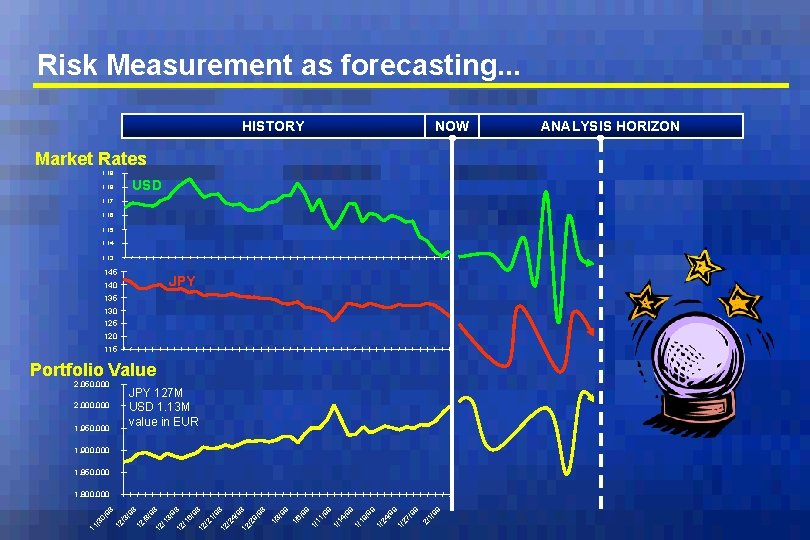
Risk Measurement as forecasting. . . HISTORY NOW Market Rates 1. 19 USD 1. 18 1. 17 1. 16 1. 15 1. 14 1. 13 145 JPY 140 135 130 125 120 115 Portfolio Value 2, 050, 000 JPY 127 M USD 1. 13 M value in EUR 2, 000 1, 950, 000 1, 900, 000 1, 850, 000 1/ 99 2/ /9 9 27 /9 9 1/ 24 /9 9 1/ 19 /9 9 1/ 14 /9 9 1/ 11 1/ 6/ 99 1/ 3/ 99 1/ 9/ 98 /2 4/ 98 12 /2 1/ 98 12 /2 6/ 98 12 /1 3/ 98 /1 12 /8 /9 8 12 /9 8 /3 12 12 11 /3 0/ 98 1, 800, 000 ANALYSIS HORIZON
Stress Testing Approach HISTORY NOW ANALYSIS HORIZON Market Rates 1. 19 USD 1. 18 +10% 1. 17 1. 16 1. 15 1. 14 +16% 1. 13 145 JPY 140 135 130 125 120 115 Portfolio Value 2, 050, 000 JPY 127 M USD 1. 13 M value in EUR 2, 000 1, 950, 000 -13% 1, 900, 000 1, 850, 000 1/ 99 2/ /9 9 27 /9 9 1/ 24 /9 9 1/ 19 /9 9 1/ 14 /9 9 1/ 11 1/ 6/ 99 1/ 3/ 99 1/ 9/ 98 /2 4/ 98 12 /2 1/ 98 12 /2 6/ 98 12 /1 3/ 98 /1 12 /8 /9 8 12 /9 8 /3 12 12 11 /3 0/ 98 1, 800, 000
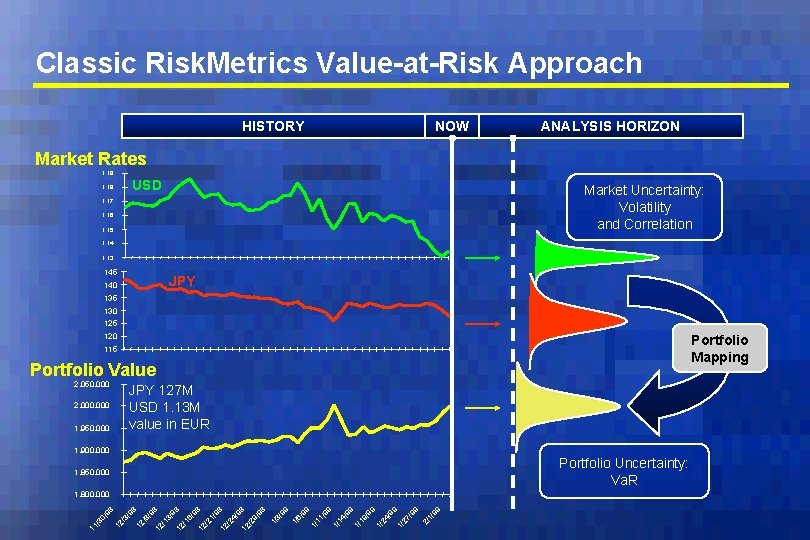
Classic Risk. Metrics Value-at-Risk Approach HISTORY NOW ANALYSIS HORIZON Market Rates 1. 19 USD 1. 18 Market Uncertainty: Volatility and Correlation 1. 17 1. 16 1. 15 1. 14 1. 13 145 JPY 140 135 130 125 120 Portfolio Mapping 115 Portfolio Value 2, 050, 000 JPY 127 M USD 1. 13 M value in EUR 2, 000 1, 950, 000 1, 900, 000 Portfolio Uncertainty: Va. R 1, 850, 000 1/ 99 2/ /9 9 27 /9 9 1/ 24 /9 9 1/ 19 /9 9 1/ 14 /9 9 1/ 11 1/ 6/ 99 1/ 3/ 99 1/ 9/ 98 /2 4/ 98 12 /2 1/ 98 12 /2 6/ 98 12 /1 3/ 98 /1 12 /8 /9 8 12 /9 8 /3 12 12 11 /3 0/ 98 1, 800, 000
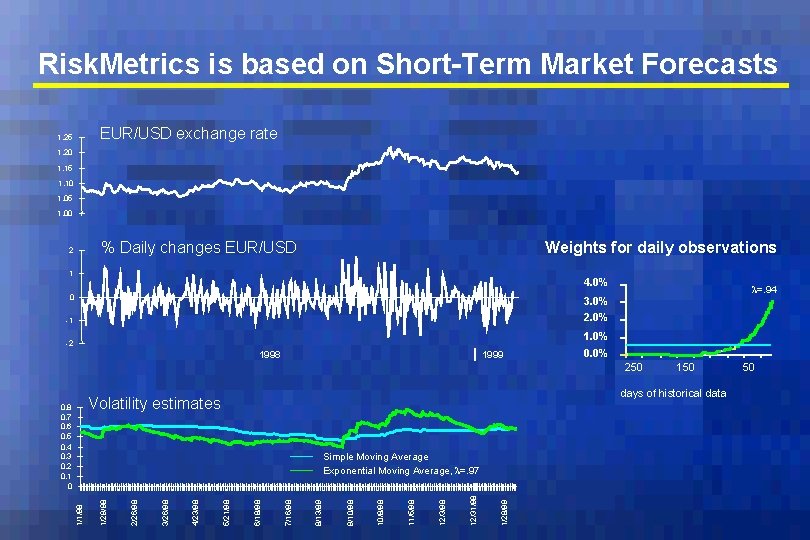
Risk. Metrics is based on Short-Term Market Forecasts EUR/USD exchange rate 1. 25 1. 20 1. 15 1. 10 1. 05 1. 00 Weights for daily observations % Daily changes EUR/USD 2 1 4. 0% 0 3. 0% -1 2. 0% =. 94 1. 0% -2 1998 1999 0. 0% 250 days of historical data Volatility estimates 0. 8 0. 7 0. 6 0. 5 0. 4 0. 3 0. 2 0. 1 0 1/28/99 12/31/98 12/3/98 11/5/98 10/8/98 9/10/98 8/13/89 7/16/98 6/18/98 5/21/98 4/23/98 3/26/98 2/26/98 1/29/98 Simple Moving Average Exponential Moving Average, =. 97 1/1/98 150 50
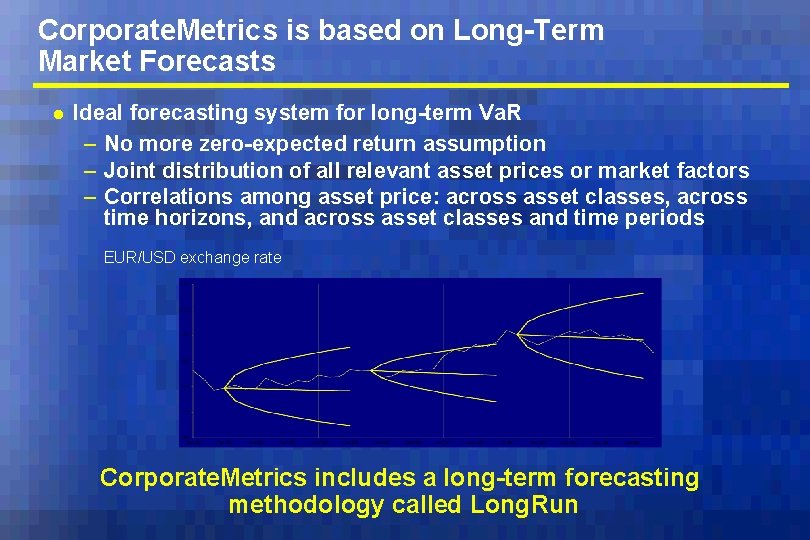
Corporate. Metrics is based on Long-Term Market Forecasts l Ideal forecasting system for long-term Va. R – No more zero-expected return assumption – Joint distribution of all relevant asset prices or market factors – Correlations among asset price: across asset classes, across time horizons, and across asset classes and time periods EUR/USD exchange rate Corporate. Metrics includes a long-term forecasting methodology called Long. Run
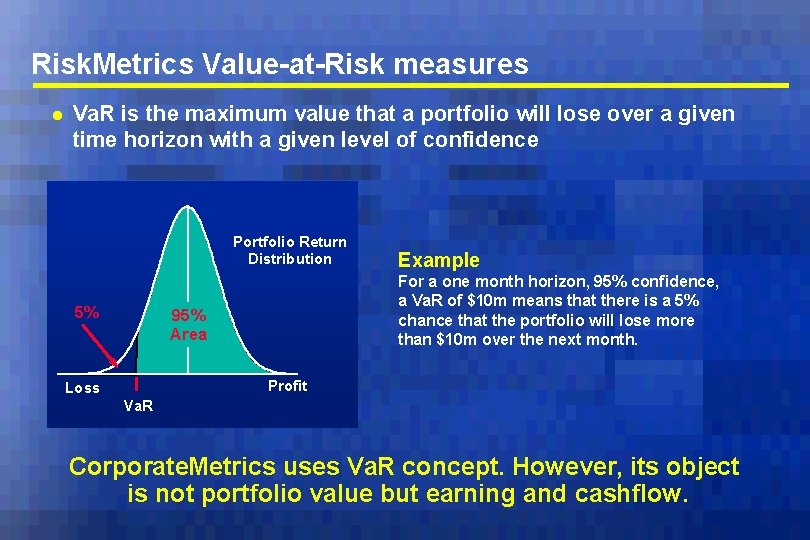
Risk. Metrics Value-at-Risk measures l Va. R is the maximum value that a portfolio will lose over a given time horizon with a given level of confidence Portfolio Return Distribution 5% Example For a one month horizon, 95% confidence, a Va. R of $10 m means that there is a 5% chance that the portfolio will lose more than $10 m over the next month. 95% Area Profit Loss Va. R Corporate. Metrics uses Va. R concept. However, its object is not portfolio value but earning and cashflow.
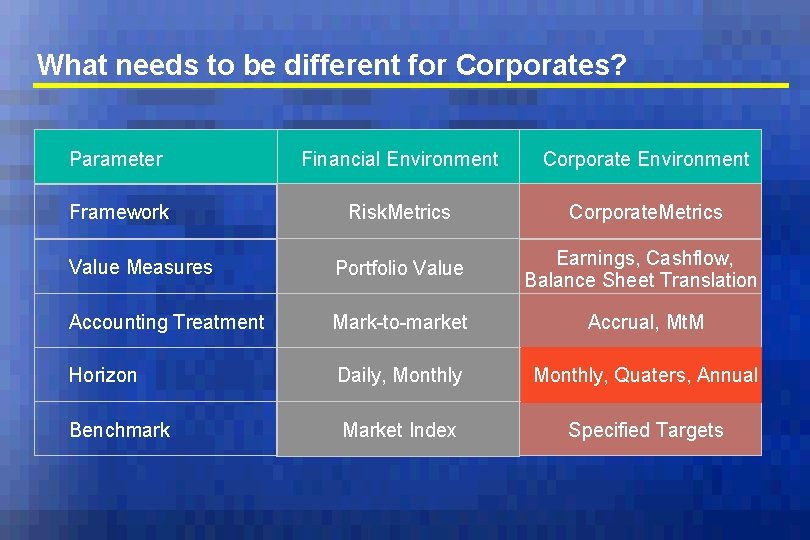
What needs to be different for Corporates? Parameter Financial Environment Corporate Environment Framework Risk. Metrics Corporate. Metrics Value Measures Portfolio Value Earnings, Cashflow, Balance Sheet Translation Accounting Treatment Mark-to-market Accrual, Mt. M Horizon Daily, Monthly, Quaters, Annual Benchmark Market Index Specified Targets
Agenda l Aims and Objectives for Corporate. Metrics l The Risk. Metrics Financial Risk Framework l The Corporate. Metrics Framework l Sample Applications l Implementing Corporate. Metrics How does Corporate. Metrics work?
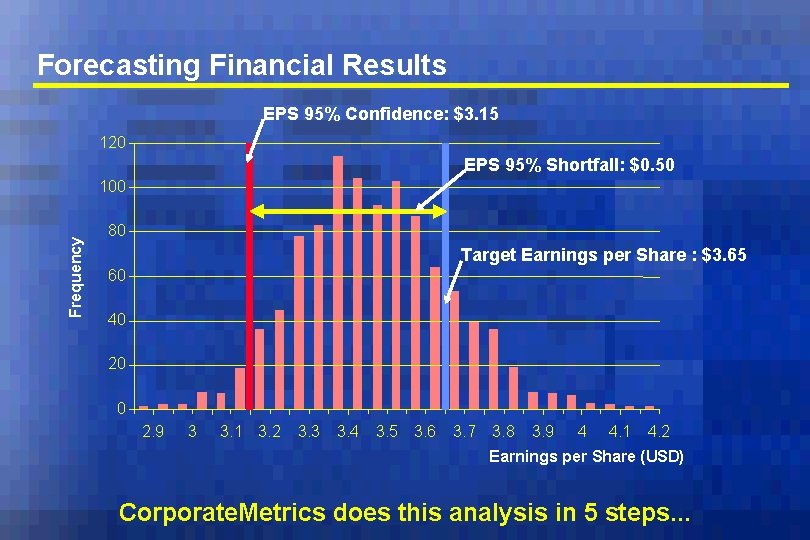
Forecasting Financial Results EPS 95% Confidence: $3. 15 120 EPS 95% Shortfall: $0. 50 Frequency 100 80 Target Earnings per Share : $3. 65 60 40 20 0 2. 9 3 3. 1 3. 2 3. 3 3. 4 3. 5 3. 6 3. 7 3. 8 3. 9 4 4. 1 4. 2 Earnings per Share (USD) Corporate. Metrics does this analysis in 5 steps. . .
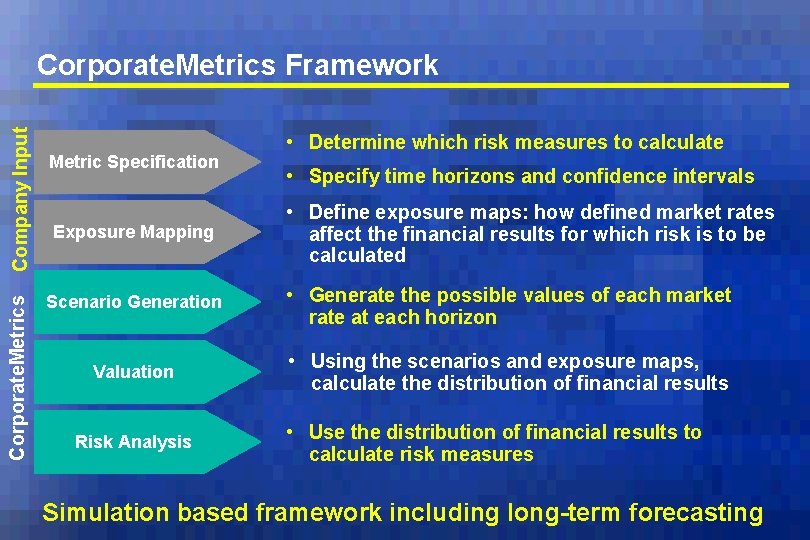
Corporate. Metrics Company Input Corporate. Metrics Framework Metric Specification Exposure Mapping • Determine which risk measures to calculate • Specify time horizons and confidence intervals • Define exposure maps: how defined market rates affect the financial results for which risk is to be calculated Scenario Generation • Generate the possible values of each market rate at each horizon Valuation • Using the scenarios and exposure maps, calculate the distribution of financial results Risk Analysis • Use the distribution of financial results to calculate risk measures Simulation based framework including long-term forecasting
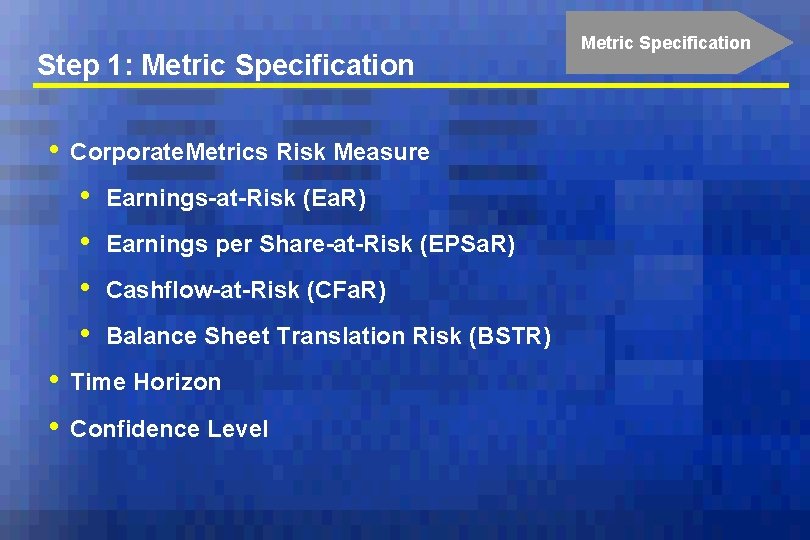
Step 1: Metric Specification • Corporate. Metrics Risk Measure • • • Earnings-at-Risk (Ea. R) Earnings per Share-at-Risk (EPSa. R) Cashflow-at-Risk (CFa. R) Balance Sheet Translation Risk (BSTR) Time Horizon Confidence Level Metric Specification
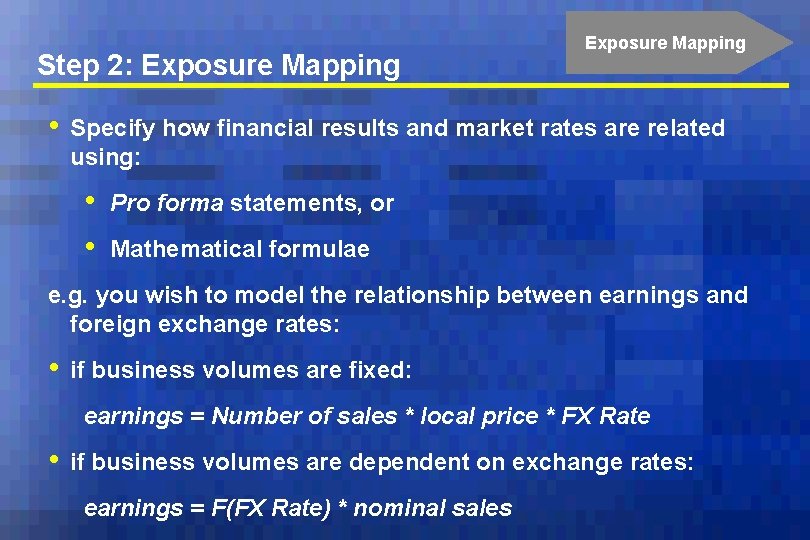
Step 2: Exposure Mapping • Exposure Mapping Specify how financial results and market rates are related using: • • Pro forma statements, or Mathematical formulae e. g. you wish to model the relationship between earnings and foreign exchange rates: • if business volumes are fixed: earnings = Number of sales * local price * FX Rate • if business volumes are dependent on exchange rates: earnings = F(FX Rate) * nominal sales
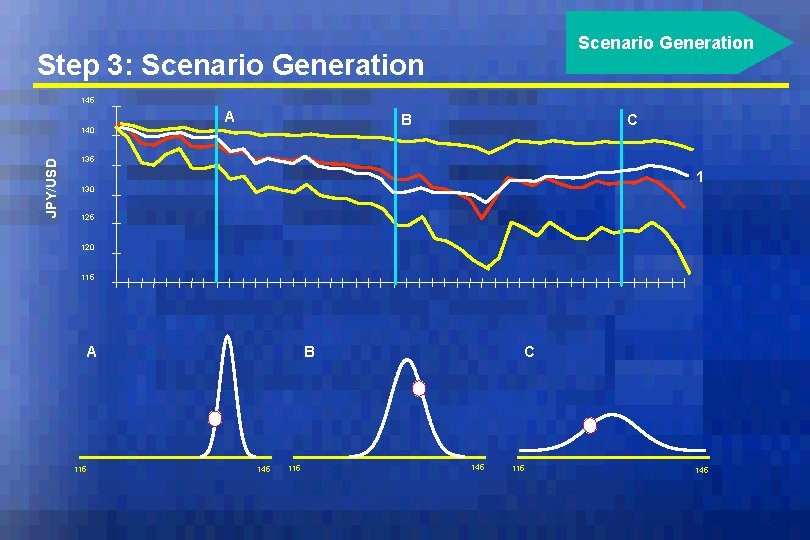
Scenario Generation Step 3: Scenario Generation 145 A B JPY/USD 140 C 135 1 130 125 120 115 A 115 B 145 115 C 145 115 145
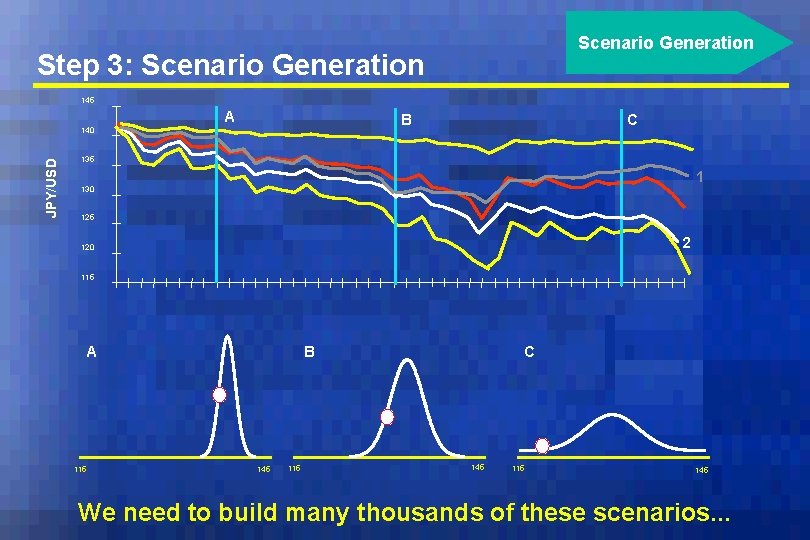
Scenario Generation Step 3: Scenario Generation 145 A B JPY/USD 140 C 135 1 130 125 2 120 115 A 115 B 145 115 C 145 115 145 We need to build many thousands of these scenarios. . .
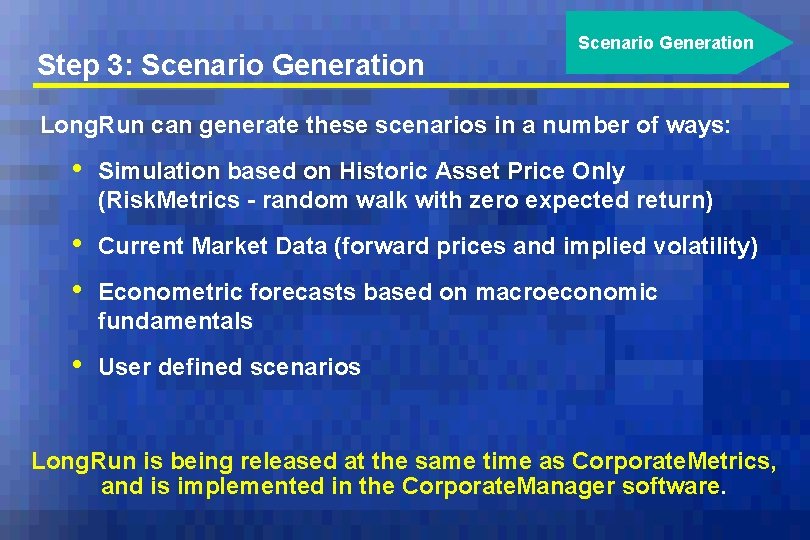
Step 3: Scenario Generation Long. Run can generate these scenarios in a number of ways: • Simulation based on Historic Asset Price Only (Risk. Metrics - random walk with zero expected return) • • Current Market Data (forward prices and implied volatility) • User defined scenarios Econometric forecasts based on macroeconomic fundamentals Long. Run is being released at the same time as Corporate. Metrics, and is implemented in the Corporate. Manager software.
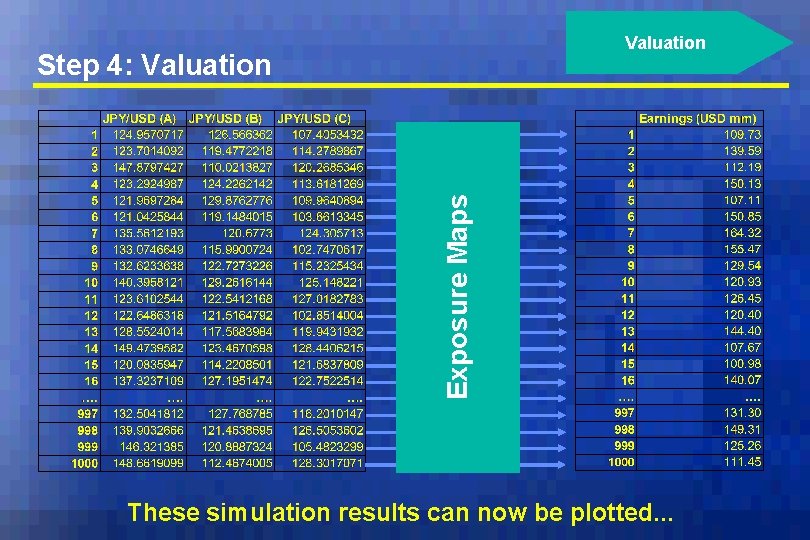
Valuation Exposure Maps Step 4: Valuation These simulation results can now be plotted. . .
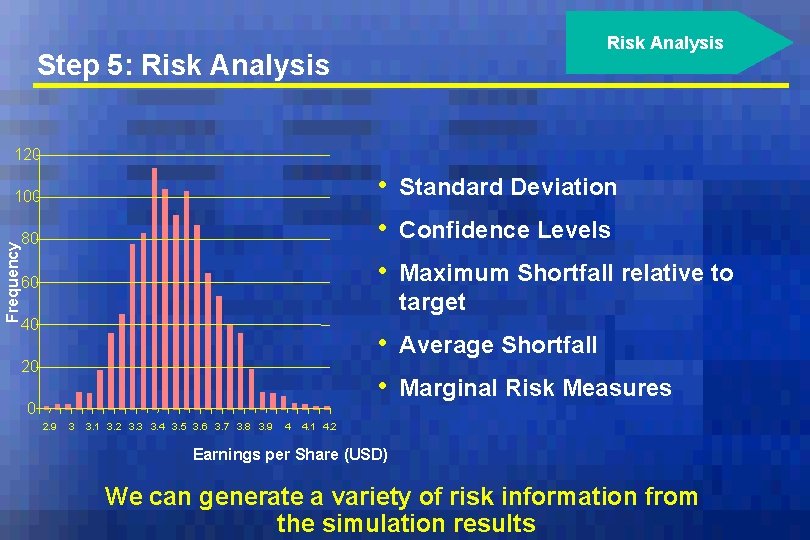
Risk Analysis Step 5: Risk Analysis 120 100 Frequency 80 60 40 20 0 2. 9 3 3. 1 3. 2 3. 3 3. 4 3. 5 3. 6 3. 7 3. 8 3. 9 4 • • • Standard Deviation • • Average Shortfall Confidence Levels Maximum Shortfall relative to target Marginal Risk Measures 4. 1 4. 2 Earnings per Share (USD) We can generate a variety of risk information from the simulation results
Agenda l Aims and Objectives for Corporate. Metrics l The Risk. Metrics Financial Risk Framework l The Corporate. Metrics Framework l Sample Applications l Implementing Corporate. Metrics What can you do with Corporate. Metrics?
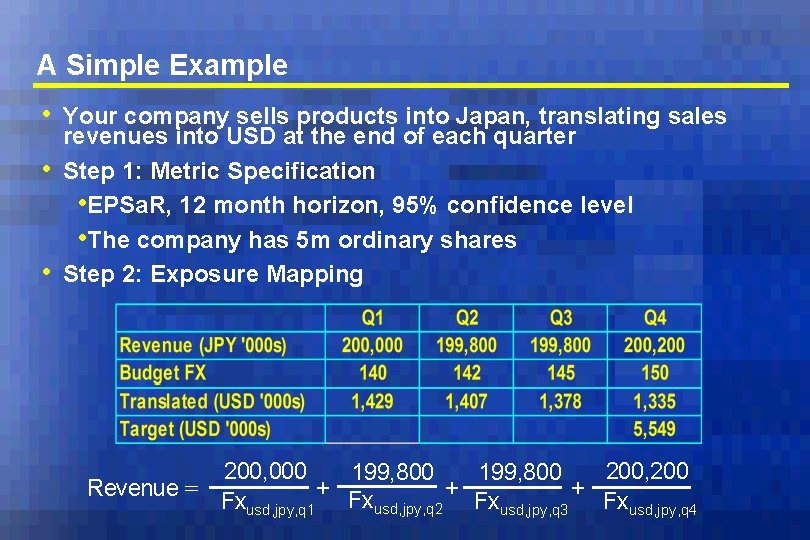
A Simple Example • • • Your company sells products into Japan, translating sales revenues into USD at the end of each quarter Step 1: Metric Specification • EPSa. R, 12 month horizon, 95% confidence level • The company has 5 m ordinary shares Step 2: Exposure Mapping 200, 000 200, 200 199, 800 Revenue = + + + Fxusd, jpy, q 1 Fxusd, jpy, q 2 Fxusd, jpy, q 3 Fxusd, jpy, q 4
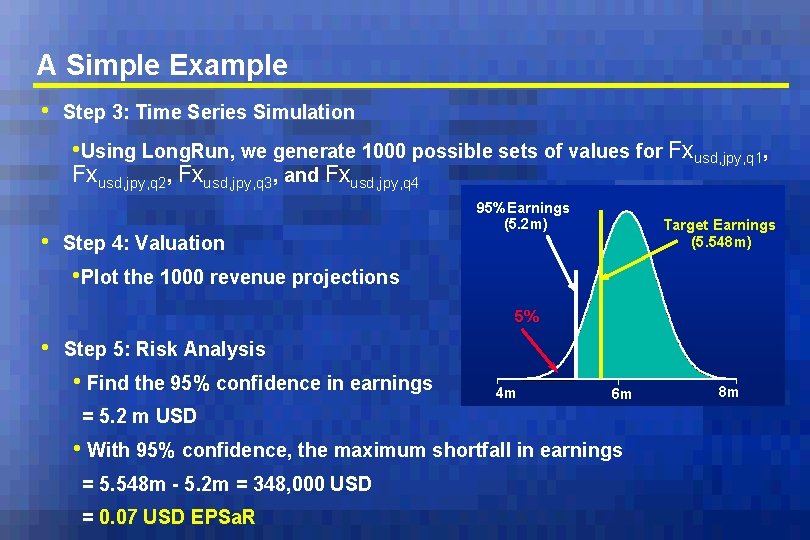
A Simple Example • Step 3: Time Series Simulation • Using Long. Run, we generate 1000 possible sets of values for Fxusd, jpy, q 1, Fxusd, jpy, q 2, Fxusd, jpy, q 3, and Fxusd, jpy, q 4 • Step 4: Valuation 95%Earnings (5. 2 m) Target Earnings (5. 548 m) • Plot the 1000 revenue projections 5% • Step 5: Risk Analysis • Find the 95% confidence in earnings 4 m 6 m = 5. 2 m USD • With 95% confidence, the maximum shortfall in earnings = 5. 548 m - 5. 2 m = 348, 000 USD = 0. 07 USD EPSa. R 8 m
Agenda l Aims and Objectives for Corporate. Metrics l The Risk. Metrics Financial Risk Framework l The Corporate. Metrics Framework l Sample Applications l Implementing Corporate. Metrics What can you do with Corporate. Metrics?
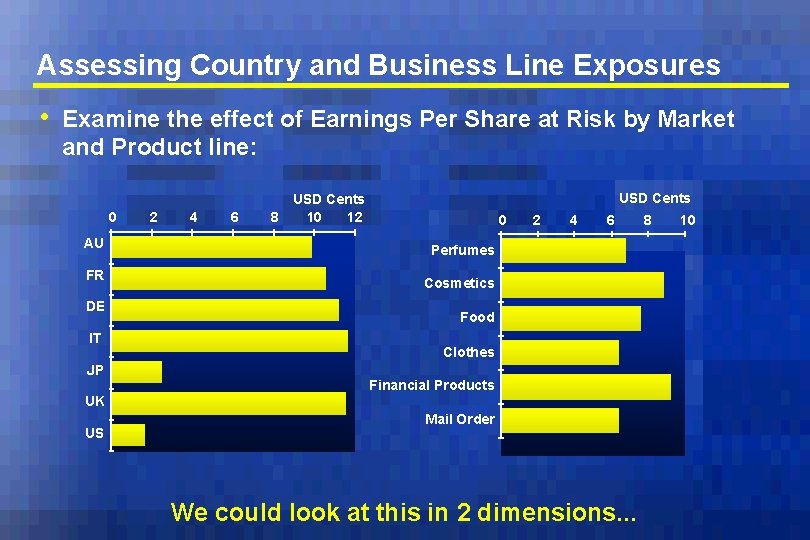
Assessing Country and Business Line Exposures • Examine the effect of Earnings Per Share at Risk by Market and Product line: 0 AU FR DE IT 2 4 6 8 USD Cents 10 12 0 2 4 6 Perfumes Cosmetics Food Clothes JP Financial Products UK US Mail Order We could look at this in 2 dimensions. . . 8 10
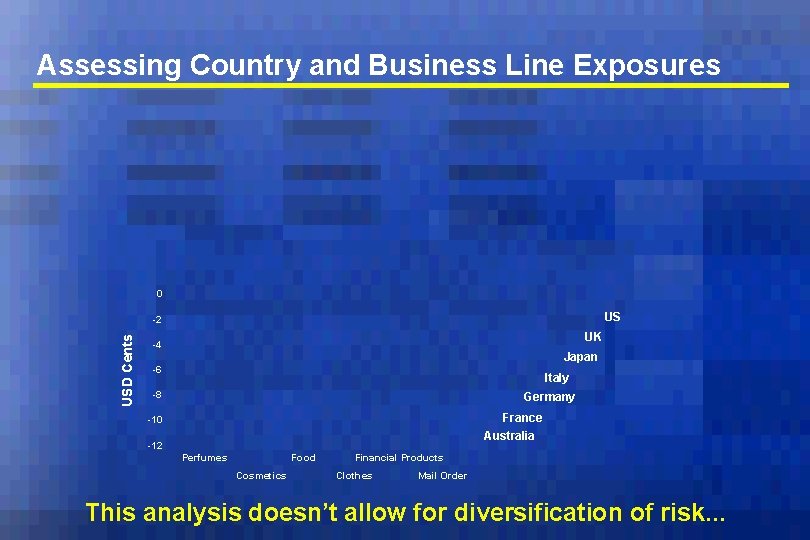
Assessing Country and Business Line Exposures 0 US USD Cents -2 UK -4 Japan -6 Italy -8 Germany France Australia -10 -12 Perfumes Food Cosmetics Financial Products Clothes Mail Order This analysis doesn’t allow for diversification of risk. . .
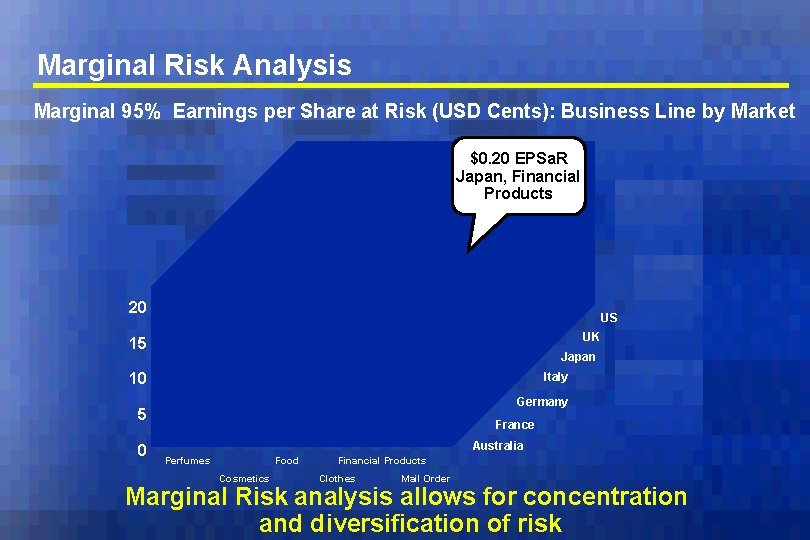
Marginal Risk Analysis Marginal 95% Earnings per Share at Risk (USD Cents): Business Line by Market $0. 20 EPSa. R Japan, Financial Products 20 US UK 15 Japan 10 Italy Germany 5 0 France Australia Perfumes Food Cosmetics Financial Products Clothes Mail Order Marginal Risk analysis allows for concentration and diversification of risk
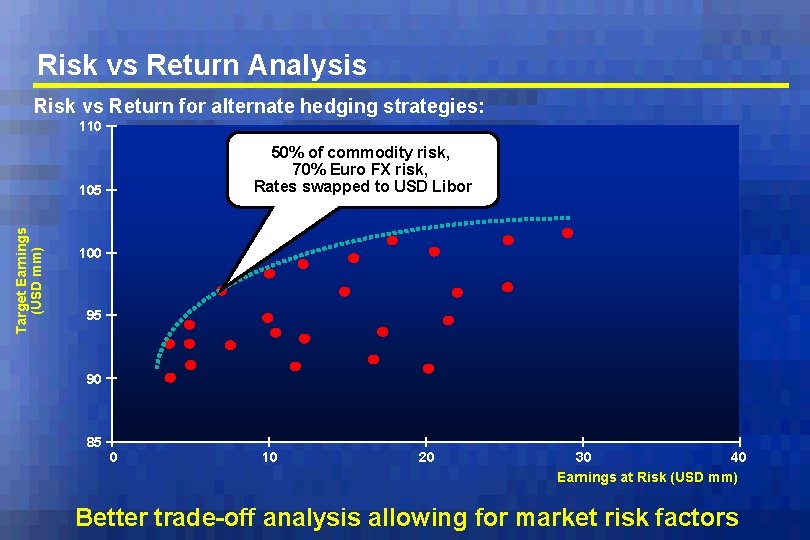
Risk vs Return Analysis Risk vs Return for alternate hedging strategies: 110 50% of commodity risk, 70% Euro FX risk, Rates swapped to USD Libor Target Earnings (USD mm) 105 100 95 90 85 0 10 20 30 40 Earnings at Risk (USD mm) Better trade-off analysis allowing for market risk factors
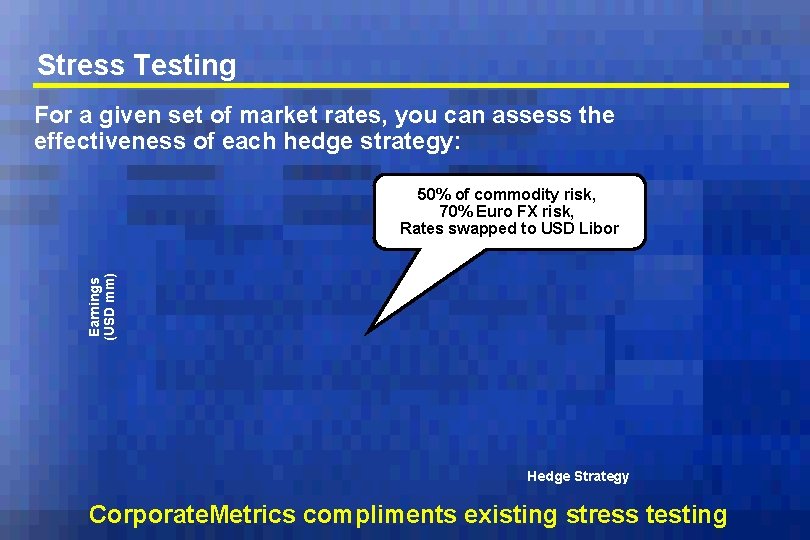
Stress Testing For a given set of market rates, you can assess the effectiveness of each hedge strategy: Earnings (USD mm) 50% of commodity risk, 70% Euro FX risk, Rates swapped to USD Libor Hedge Strategy Corporate. Metrics compliments existing stress testing