
Corporate governance principles and gender equality across Europe
- Slides: 9
Corporate governance principles and gender equality across Europe and Asia: Convergence and Diffusion 4 th European Conference on Politics and Gender (ECPG) 11 -13 June 2015, Uppsala, Sweden Annick Masselot, University of Canterbury, New Zealand Akshaya Kamalnath, Deakins University, Australia
OVERVIEW � Aim: To critically engage with the concepts of gender balanced representation on corporate boards; gender equality and quotas. � Compare and contrast the application of such concepts within the EU legal framework and Asian countries, particularly Malaysia and India. � This provides an opportunity to contribute to theory of diffusion and legal transplant. � Also, to consider and contrast the concept gender equality across Europe and Asia.
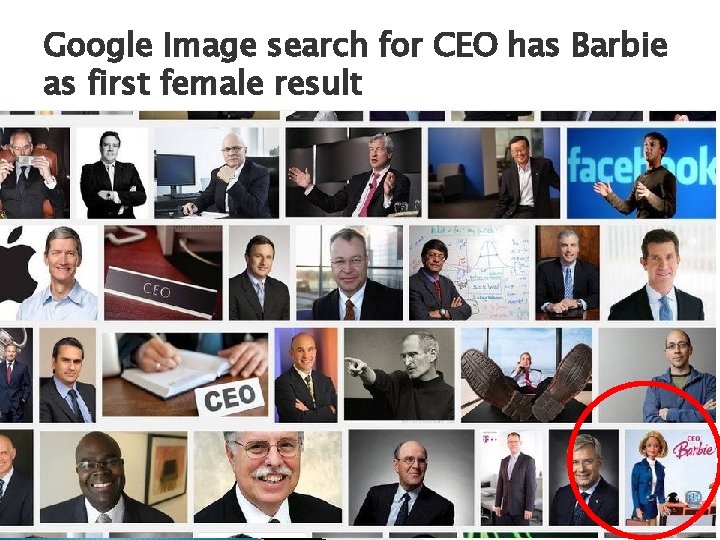
Google Image search for CEO has Barbie as first female result
Corporate quota � Under-representation of women in positions of power is a world-wide phenomenon. � The Financial crisis precipitated the debate about the under-representation of women in corporate boards. � Scholars in the area draw a linkage between gender quotas in politics and in corporate boards. � Political quotas are understood today as substantive equality measures.
BASIS FOR CORPORATE QUOTAS � Business � Equity case arguments based arguments � Democratic legitimacy based arguments
SPREAD OF GENDER QUOTAS � Normative transplants and/or diffusion of laws? � Norway ⇨ Europe ⇨ EU ⇨ Asia � Norway – Public Limited Companies Act (2003 amendment): 40% of each gender. � Europe - Austria, Belgium, Denmark, Finland, France, Iceland, Ireland, Israel, Italy, Norway, Spain, Switzerland, Germany and the Netherlands. � EU proposed directive (2012) – transparent recruitment procedures – goal of 40% women NEDs. Listed companies – training and mentoring � Norwegian model resulted in positive outcomes. � EU –financial crisis and gender equality efforts[economic problem, social dimension].
SPREAD OF GENDER QUOTAS: Malaysia � Malaysia (2011/12) and India (2013/14) – low representation of women. (7. 8%, 4. 7%). � Malaysian Code of Corporate Governance – Companies listed on Bursa Malaysia � steps to ensure women candidates sought, disclosure of gender diversity policies and targets and measures to meet them. � Comply or explain. � Focus on both gender equality and business case. � Training programs and databases.
SPREAD OF GENDER QUOTAS: India � India – Companies Act 2013 – monetary penalty € 600 - 6000. � Appointment of one woman director by Oct, 2014. (Listing agreement). � No guidelines. Worry about appointment of female family members. � ‘To encourage women’s participation in decision making at every level. ’ Business case emphasised by media reports. � Training programs only as private initiatives. � Diffusion of what developed as an EU concept into Asia. Market facilitation to an extent.
GENDER EQUALITY ACROSS EUROPE AND ASIA � Diffusion of EU values? � EU: Corporate gender quotas as part of the larger gender equality project. � Issues of maternity and child care relevant in preventing the leaking pipeline to decisionmaking positions. � Asian cultures – child care and elder care. � Transition in emerging economies – more women entering work force – women on boards would facilitate this.