
CORPORATE GOVERNANCE JANE WAKSMAN International Scandals Slide 1
- Slides: 19
CORPORATE GOVERNANCE JANE WAKSMAN
International Scandals (Slide 1) • • Equitable Life Enron Deutche Bank Tesco 2016 https: //en. wikipedia. org/wiki/List_of_corporate_colla pses_and_scandals 2
Equitable Life Insurance Company Scandal • founded in 1762 in UK • life insurance company which is also world's oldest mutual insurer • it had allowed large unhedged liabilities – to accumulate in respect of guaranteed fixed returns to investors – without making provision for adverse market changes
• paid out high interest rates promised at a time of high inflation - in the 1970 s. • Tried to break a promise on the guaranteed payouts in an attempt to maintain payments to the majority of its million customers who do not hold guarantees. • 800, 000 policyholders have lost money and the company came close to collapse in 2000.
• consequently suffered big losses from 2000 onwards. • There were no takers, because of Equitable's huge liabilities. • has decided to set up a "fair and transparent" scheme whereby the Treasury will make payments to Equitable savers to compensate them for their "relative" losses. • The Equitable is now much smaller than it was, as various parts of the business have been sold by the new management which was installed in 2001
SOME KEY QUESTIONS • Why have such scandals and collapses occurred? • What might be done to prevent them happening again? • How can investor confidence be restored?
Corporate Governance represents a set of principles, systems and processes by which a company is governed. It provides guidelines on how a company can be directed and controlled so as to reach its goals and objective.
Theories Behind Corporate Governance Try to explain why boards do not operate efficiently Try to provide answers to these problems
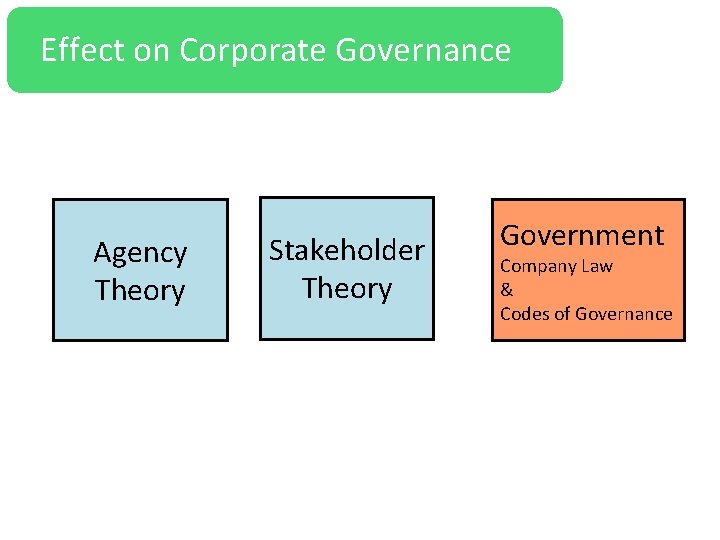
Effect on Corporate Governance Agency Theory Stakeholder Theory Government Company Law & Codes of Governance
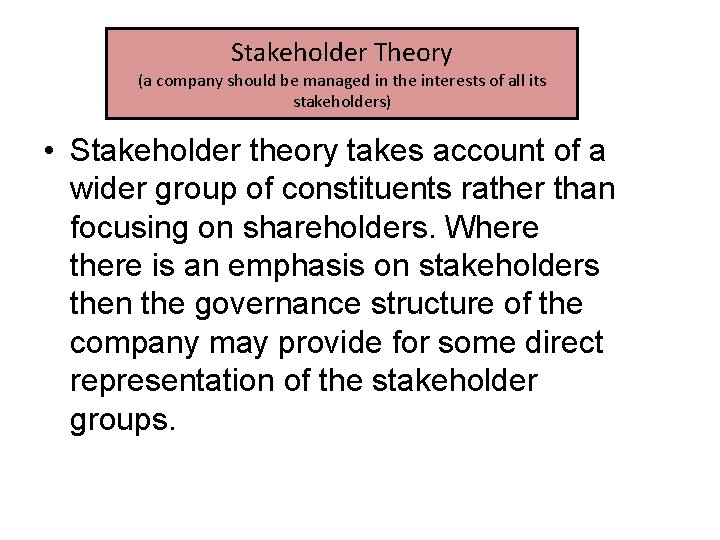
Stakeholder Theory STAKEHOLDER THEORY (a company should be managed in the interests of all its stakeholders) • Stakeholder theory takes account of a wider group of constituents rather than focusing on shareholders. Where there is an emphasis on stakeholders then the governance structure of the company may provide for some direct representation of the stakeholder groups.
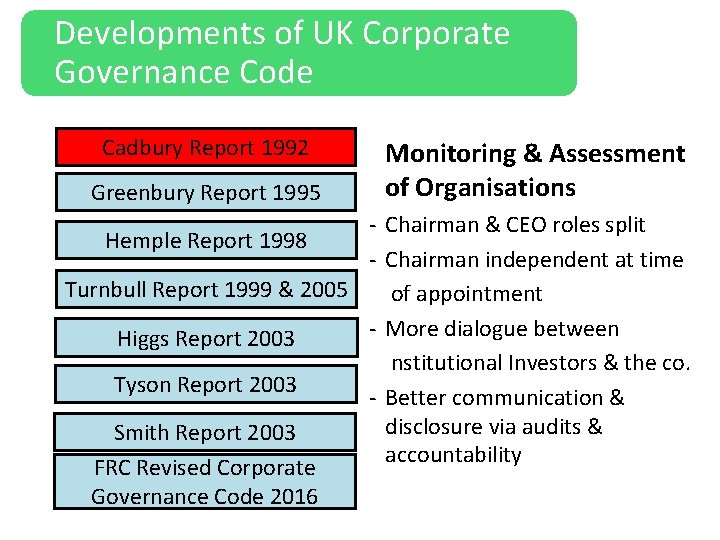
Developments of UK Corporate Governance Code Cadbury Report 1992 Greenbury Report 1995 Monitoring & Assessment of Organisations - Chairman & CEO roles split - Chairman independent at time Turnbull Report 1999 & 2005 of appointment - More dialogue between Higgs Report 2003 nstitutional Investors & the co. Tyson Report 2003 - Better communication & disclosure via audits & Smith Report 2003 accountability FRC Revised Corporate Governance Code 2016 Hemple Report 1998
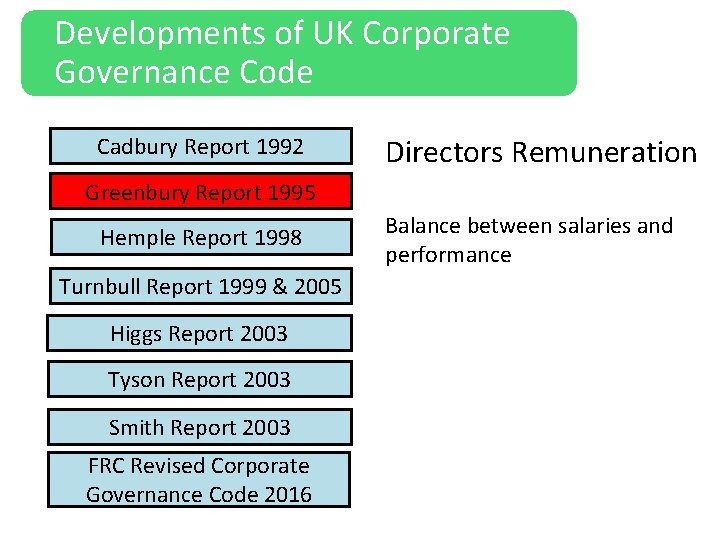
Developments of UK Corporate Governance Code Cadbury Report 1992 Directors Remuneration Greenbury Report 1995 Hemple Report 1998 Turnbull Report 1999 & 2005 Higgs Report 2003 Tyson Report 2003 Smith Report 2003 FRC Revised Corporate Governance Code 2016 Balance between salaries and performance
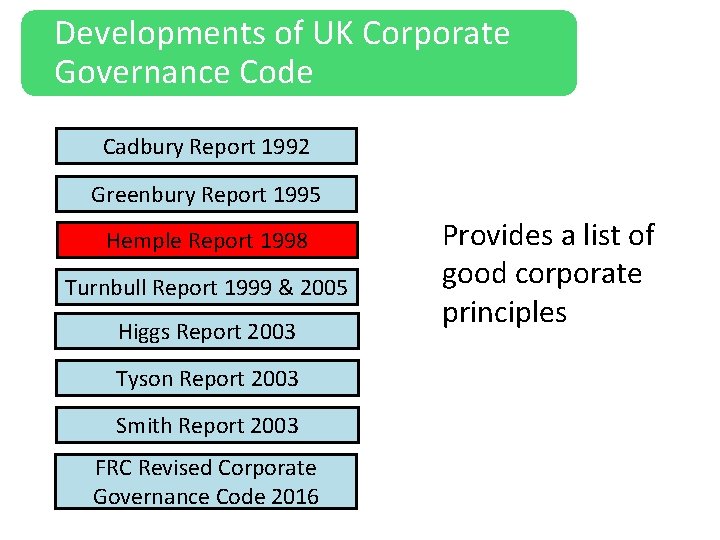
Developments of UK Corporate Governance Code Cadbury Report 1992 Greenbury Report 1995 Hemple Report 1998 Turnbull Report 1999 & 2005 Higgs Report 2003 Tyson Report 2003 Smith Report 2003 FRC Revised Corporate Governance Code 2016 Provides a list of good corporate principles
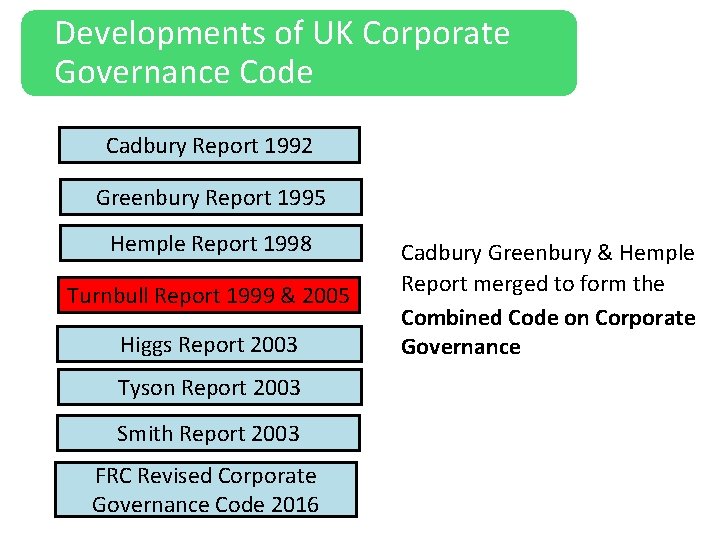
Developments of UK Corporate Governance Code Cadbury Report 1992 Greenbury Report 1995 Hemple Report 1998 Turnbull Report 1999 & 2005 Higgs Report 2003 Tyson Report 2003 Smith Report 2003 FRC Revised Corporate Governance Code 2016 Cadbury Greenbury & Hemple Report merged to form the Combined Code on Corporate Governance
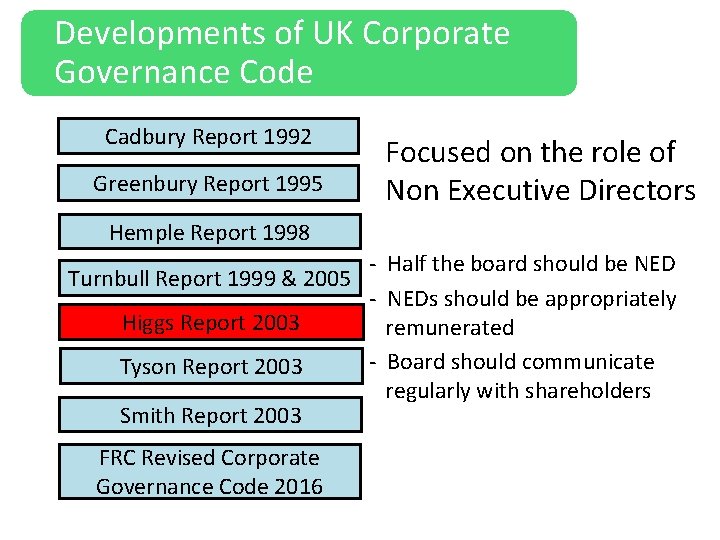
Developments of UK Corporate Governance Code Cadbury Report 1992 Greenbury Report 1995 Focused on the role of Non Executive Directors Hemple Report 1998 - Half the board should be NED Turnbull Report 1999 & 2005 - NEDs should be appropriately Higgs Report 2003 remunerated - Board should communicate Tyson Report 2003 regularly with shareholders Smith Report 2003 FRC Revised Corporate Governance Code 2016
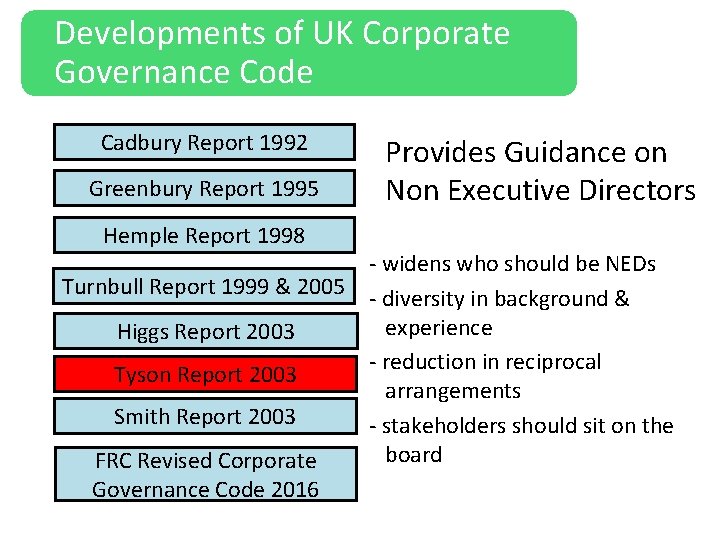
Developments of UK Corporate Governance Code Cadbury Report 1992 Greenbury Report 1995 Hemple Report 1998 Provides Guidance on Non Executive Directors - widens who should be NEDs Turnbull Report 1999 & 2005 - diversity in background & experience Higgs Report 2003 - reduction in reciprocal Tyson Report 2003 arrangements Smith Report 2003 - stakeholders should sit on the board FRC Revised Corporate Governance Code 2016
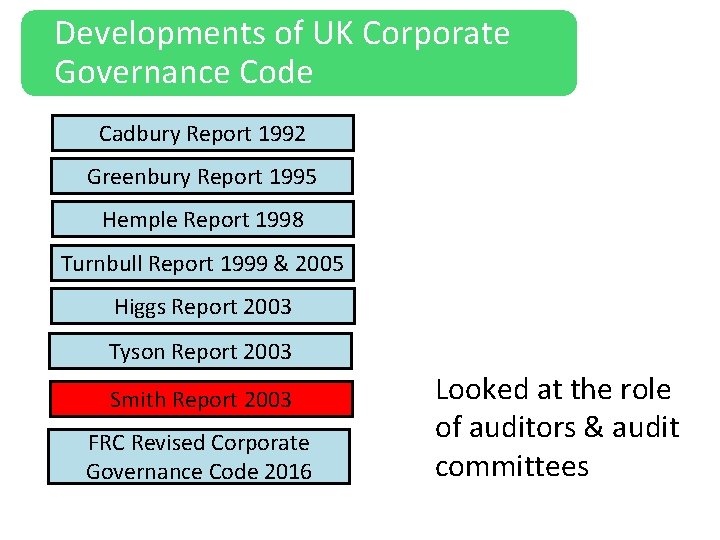
Developments of UK Corporate Governance Code Cadbury Report 1992 Greenbury Report 1995 Hemple Report 1998 Turnbull Report 1999 & 2005 Higgs Report 2003 Tyson Report 2003 Smith Report 2003 FRC Revised Corporate Governance Code 2016 Looked at the role of auditors & audit committees
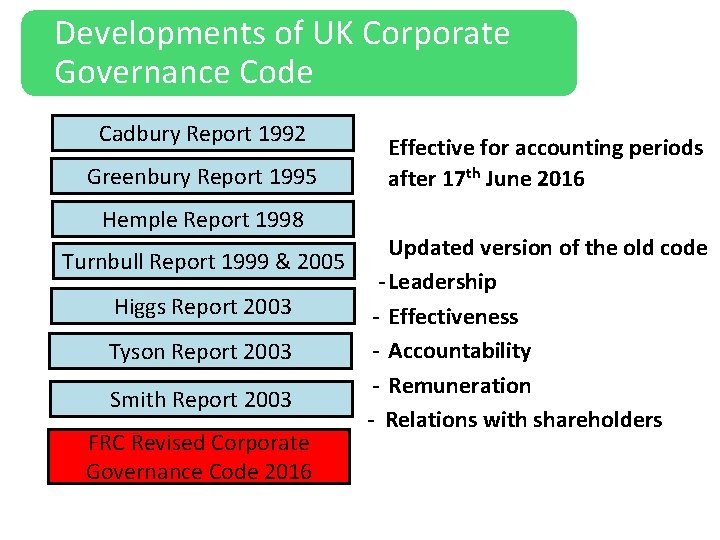
Developments of UK Corporate Governance Code Cadbury Report 1992 Greenbury Report 1995 Hemple Report 1998 Effective for accounting periods after 17 th June 2016 Updated version of the old code Turnbull Report 1999 & 2005 - Leadership Higgs Report 2003 - Effectiveness - Accountability Tyson Report 2003 - Remuneration Smith Report 2003 - Relations with shareholders FRC Revised Corporate Governance Code 2016
ANSWERS TO KEY QUESTIONS • Why DID such scandals and collapses occurred? • What HAS been done to prevent them happening again? • HAS investor confidence be restored?