
Corporate Governance 2 THEORY ShareholderStockholder Theory Milton Friedman
- Slides: 6
Corporate Governance 2. THEORY
Shareholder/Stockholder Theory • Milton Friedman, The Social Responsibility of Business Is to Increase Its Profits, “New York Times Magazine” Sunday, Sept. 13, 1970 – Three crucial questions for business • What to produce? • How to produce it? • To whom to produce? – The goal of business is to bring profit – Resignation from other goals • decrease profit • stealing resources from the owner • additional form of taxes – Egoistic approach of the business boosts the society’s welfare – The should impose obligations by the law – Businessmen are not moral authorities 2
Mission of Auchan Holding • To improve the purchasing power and the quality of life of the greatest number of customers, with responsible, professional, committed and respected employees. [. . . ] • This mission is based on three fundamental values: trust, sharing and progress. 3
Stakeholder Theory • Edward Freeman, Strategic Management: A Stakeholder Approach, Cambridge 1984 – Business decisions influence a wide circle of people, thus have obligations towards them • • • shareholders employees suppliers clients local communities – Six principles of the “rules of the game” 1. The Principle of Entry and Exit 2. The Principle of Governance 3. The Principle of Externalities 4. The Principle of Contracting Costs 5. The Agency Principle 6. The Principle of Limited Immortality 4
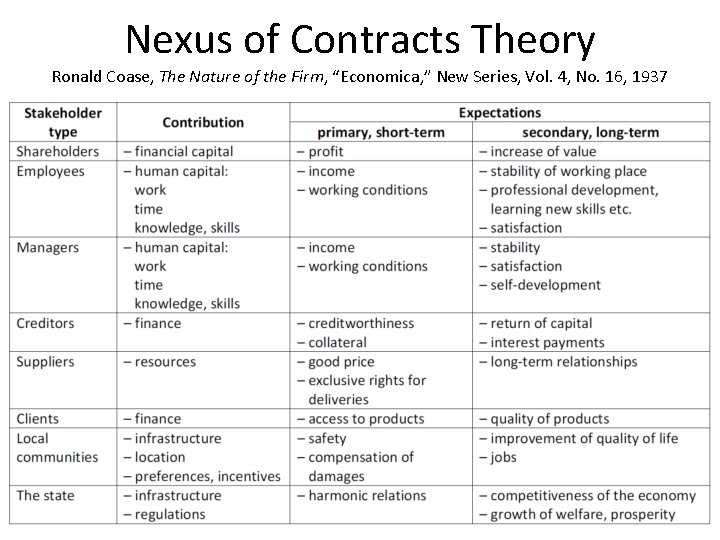
Nexus of Contracts Theory Ronald Coase, The Nature of the Firm, “Economica, ” New Series, Vol. 4, No. 16, 1937 5
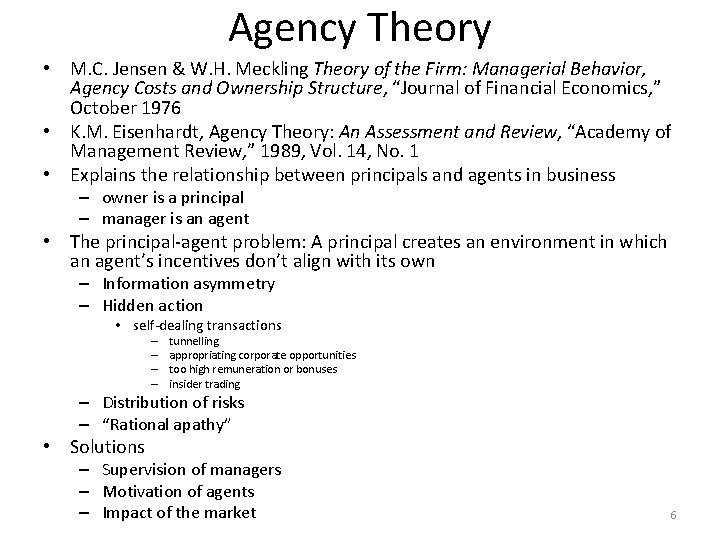
Agency Theory • M. C. Jensen & W. H. Meckling Theory of the Firm: Managerial Behavior, Agency Costs and Ownership Structure, “Journal of Financial Economics, ” October 1976 • K. M. Eisenhardt, Agency Theory: An Assessment and Review, “Academy of Management Review, ” 1989, Vol. 14, No. 1 • Explains the relationship between principals and agents in business – owner is a principal – manager is an agent • The principal-agent problem: A principal creates an environment in which an agent’s incentives don’t align with its own – Information asymmetry – Hidden action • self-dealing transactions – – tunnelling appropriating corporate opportunities too high remuneration or bonuses insider trading – Distribution of risks – “Rational apathy” • Solutions – Supervision of managers – Motivation of agents – Impact of the market 6