Corporate Financial Strategy 4 th edition Dr Ruth
- Slides: 14
Corporate Financial Strategy 4 th edition Dr Ruth Bender Chapter 7 Start-up businesses and venture capital Corporate Financial Strategy
Start-up businesses and venture capital: contents § Learning objectives § Financial strategy for a start-up business § Stages in a start-up § Two ways of accounting for the risk § Real options § Venture capital and business angels § Example of corporate venturing § Deal terms will include… § Pre- and post-money example § Anti-dilution clauses, used in a ‘down’ round § Liquidation preference reduces risk and boosts return Corporate Financial Strategy 2
Learning objectives 1. Explain how the life cycle model is applied to the start-up stage of a business. 2. Contrast the different ways that companies use to account for high business risk. 3. Prepare or appraise a venture capital term sheet, and explain the potential impact of some common investor protection clauses. 4. Distinguish the various different forms of early-stage financing and comment on their strengths and weaknesses. Corporate Financial Strategy 3
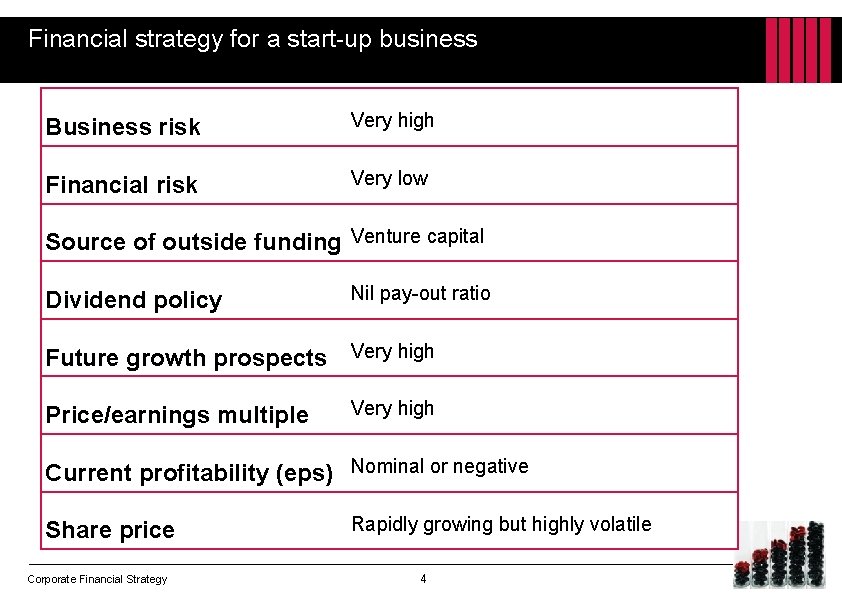
Financial strategy for a start-up business Business risk Very high Financial risk Very low Source of outside funding Venture capital Dividend policy Nil pay-out ratio Future growth prospects Very high Price/earnings multiple Very high Current profitability (eps) Nominal or negative Share price Corporate Financial Strategy Rapidly growing but highly volatile 4
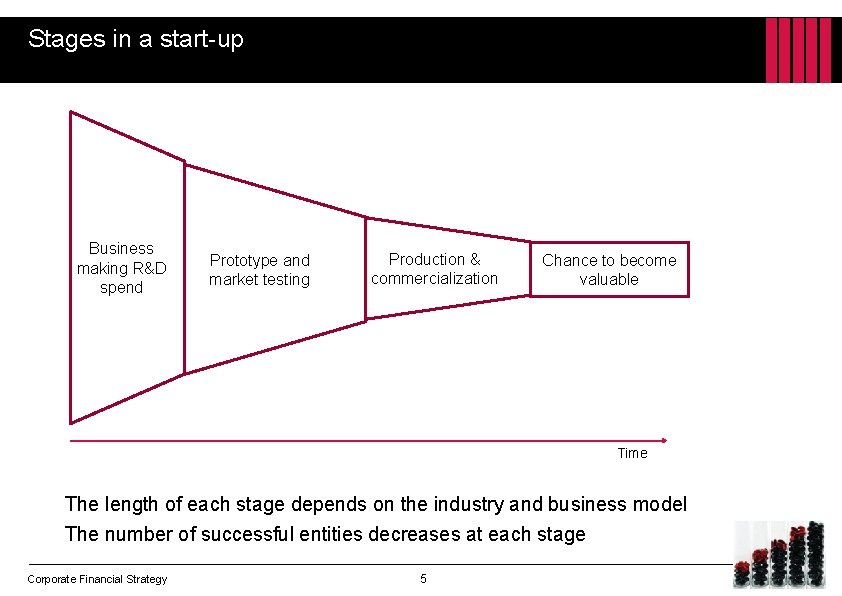
Stages in a start-up Business making R&D spend Prototype and market testing Production & commercialization Chance to become valuable Time The length of each stage depends on the industry and business model The number of successful entities decreases at each stage Corporate Financial Strategy 5
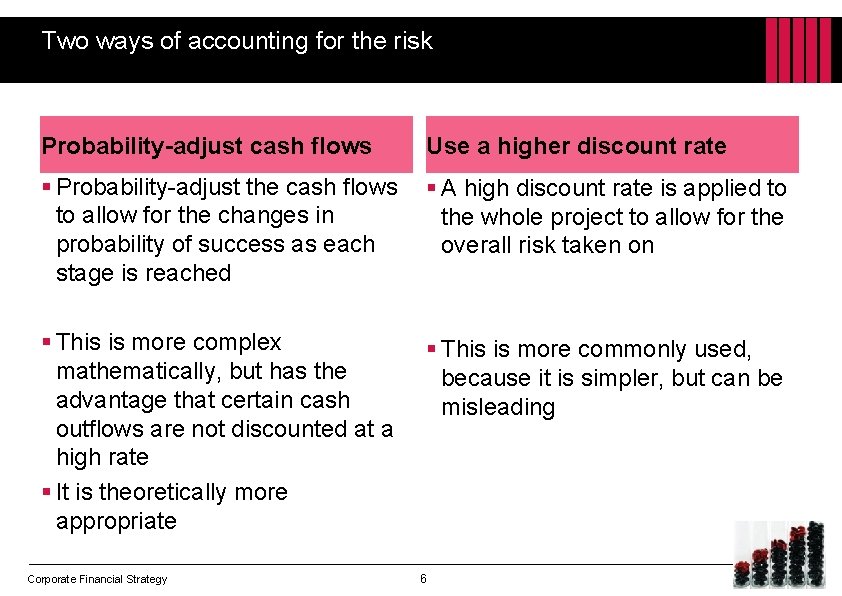
Two ways of accounting for the risk Probability-adjust cash flows Use a higher discount rate § Probability-adjust the cash flows to allow for the changes in probability of success as each stage is reached § A high discount rate is applied to the whole project to allow for the overall risk taken on § This is more complex mathematically, but has the advantage that certain cash outflows are not discounted at a high rate § It is theoretically more appropriate § This is more commonly used, because it is simpler, but can be misleading Corporate Financial Strategy 6
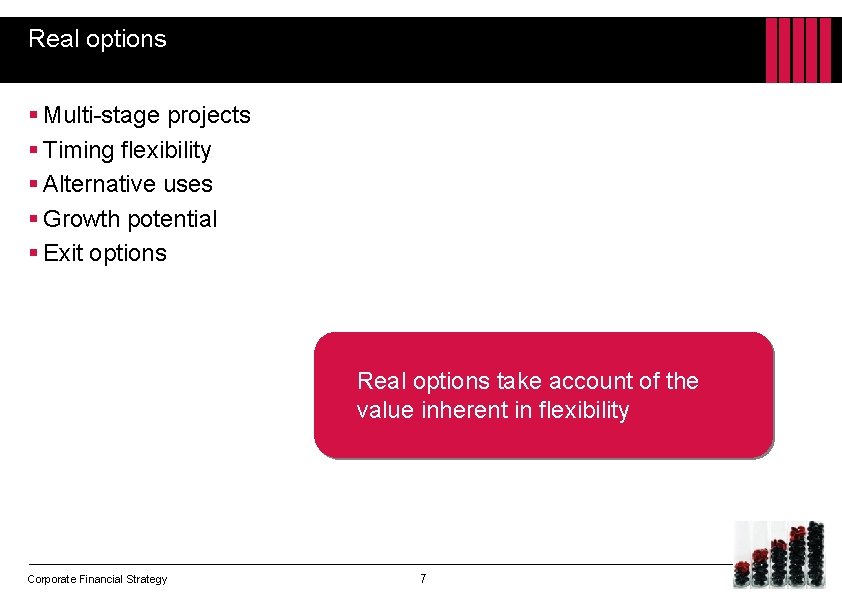
Real options § Multi-stage projects § Timing flexibility § Alternative uses § Growth potential § Exit options Real options take account of the value inherent in flexibility Corporate Financial Strategy 7
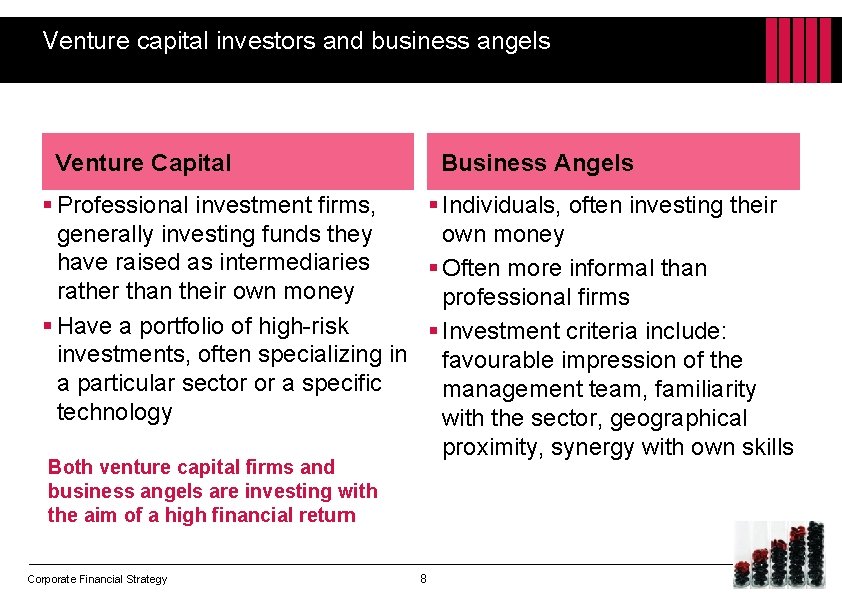
Venture capital investors and business angels Venture Capital Business Angels § Professional investment firms, § Individuals, often investing their generally investing funds they own money have raised as intermediaries § Often more informal than rather than their own money professional firms § Have a portfolio of high-risk § Investment criteria include: investments, often specializing in favourable impression of the a particular sector or a specific management team, familiarity technology with the sector, geographical proximity, synergy with own skills Both venture capital firms and business angels are investing with the aim of a high financial return Corporate Financial Strategy 8
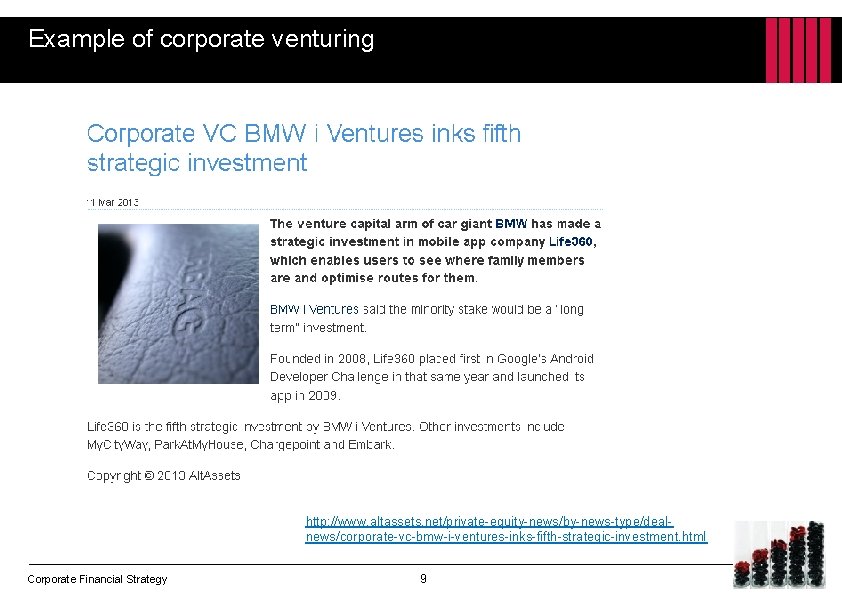
Example of corporate venturing http: //www. altassets. net/private-equity-news/by-news-type/dealnews/corporate-vc-bmw-i-ventures-inks-fifth-strategic-investment. html Corporate Financial Strategy 9
Deal terms will include 1. Company’s constitution 2. Shareholders’ agreement a. Details of the investment and the terms attached to each of the securities – e. g. votes, vetoes, covenants, rights on exit, conversion terms … b. Drag along and tag along rights c. Pre-emption rights d. Board representation rights 3. Fees 4. Representations and warranties 5. Service contracts 6. Banking agreements Corporate Financial Strategy 10
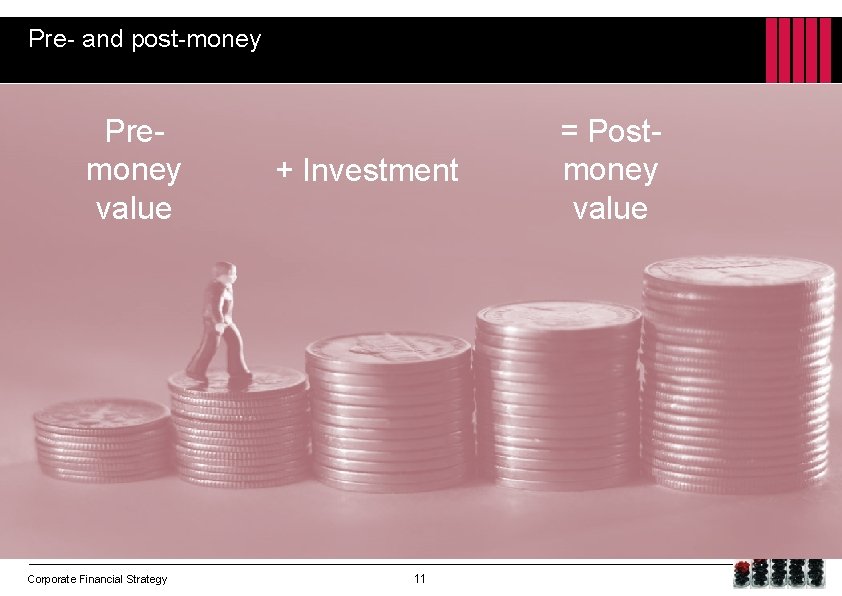
Pre- and post-money Premoney value Corporate Financial Strategy + Investment 11 = Postmoney value
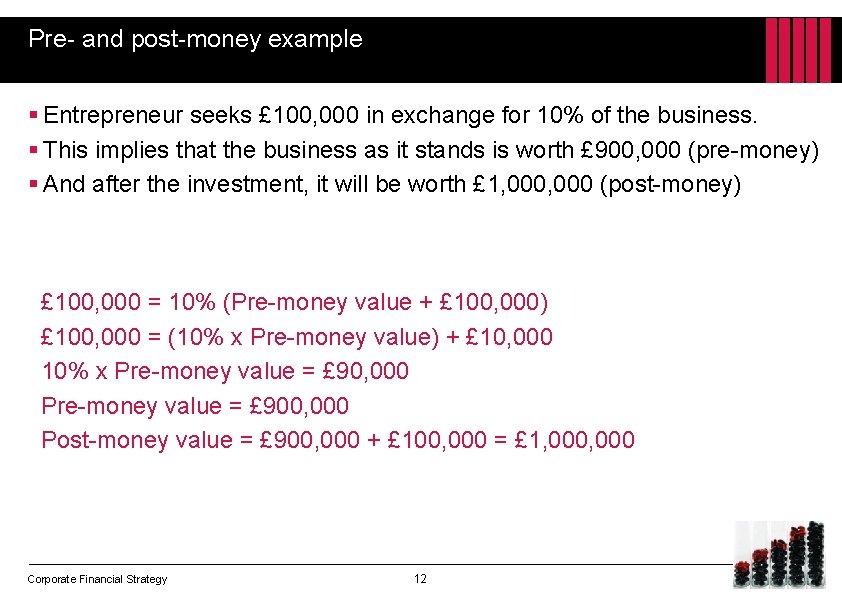
Pre- and post-money example § Entrepreneur seeks £ 100, 000 in exchange for 10% of the business. § This implies that the business as it stands is worth £ 900, 000 (pre-money) § And after the investment, it will be worth £ 1, 000 (post-money) £ 100, 000 = 10% (Pre-money value + £ 100, 000) £ 100, 000 = (10% x Pre-money value) + £ 10, 000 10% x Pre-money value = £ 90, 000 Pre-money value = £ 900, 000 Post-money value = £ 900, 000 + £ 100, 000 = £ 1, 000 Corporate Financial Strategy 12
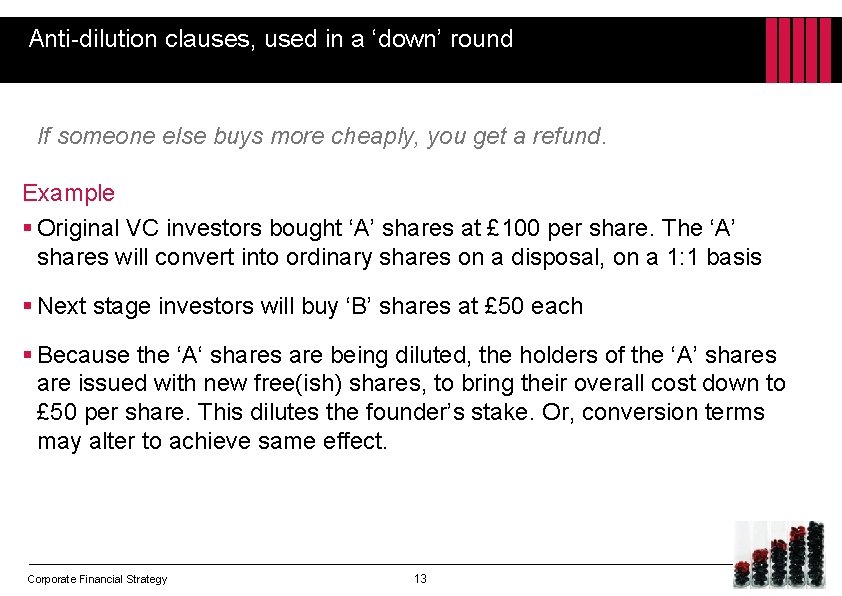
Anti-dilution clauses, used in a ‘down’ round If someone else buys more cheaply, you get a refund. Example § Original VC investors bought ‘A’ shares at £ 100 per share. The ‘A’ shares will convert into ordinary shares on a disposal, on a 1: 1 basis § Next stage investors will buy ‘B’ shares at £ 50 each § Because the ‘A‘ shares are being diluted, the holders of the ‘A’ shares are issued with new free(ish) shares, to bring their overall cost down to £ 50 per share. This dilutes the founder’s stake. Or, conversion terms may alter to achieve same effect. Corporate Financial Strategy 13
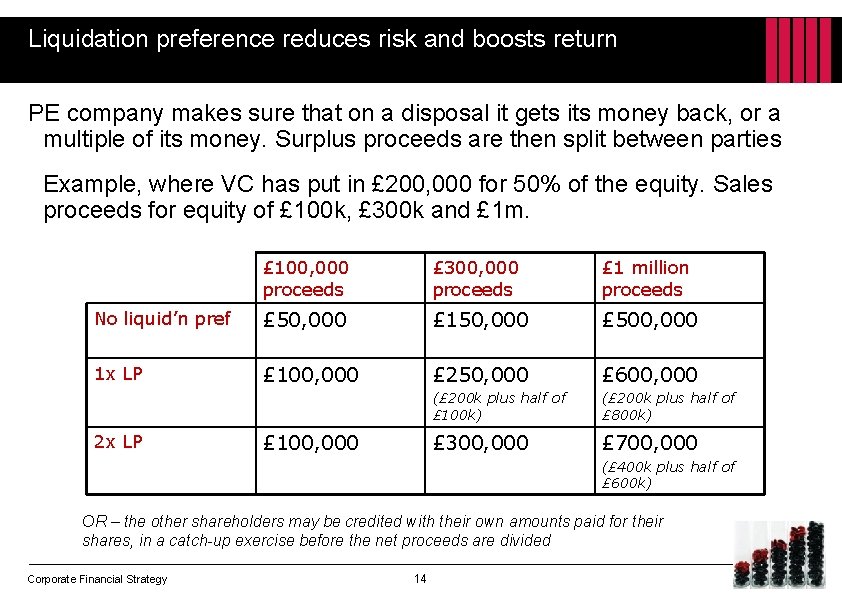
Liquidation preference reduces risk and boosts return PE company makes sure that on a disposal it gets its money back, or a multiple of its money. Surplus proceeds are then split between parties Example, where VC has put in £ 200, 000 for 50% of the equity. Sales proceeds for equity of £ 100 k, £ 300 k and £ 1 m. £ 100, 000 proceeds £ 300, 000 proceeds £ 1 million proceeds No liquid’n pref £ 50, 000 £ 150, 000 £ 500, 000 1 x LP £ 100, 000 £ 250, 000 £ 600, 000 (£ 200 k plus half of £ 100 k) (£ 200 k plus half of £ 800 k) £ 300, 000 £ 700, 000 2 x LP £ 100, 000 (£ 400 k plus half of £ 600 k) OR – the other shareholders may be credited with their own amounts paid for their shares, in a catch-up exercise before the net proceeds are divided Corporate Financial Strategy 14