
Corporate Financial Policy 2007 2008 WACC Professor Andr


- Slides: 24
Corporate Financial Policy 2007 -2008 WACC Professor André Farber Solvay Business School Université Libre de Bruxelles Advanced Finance 2008 03 WACC
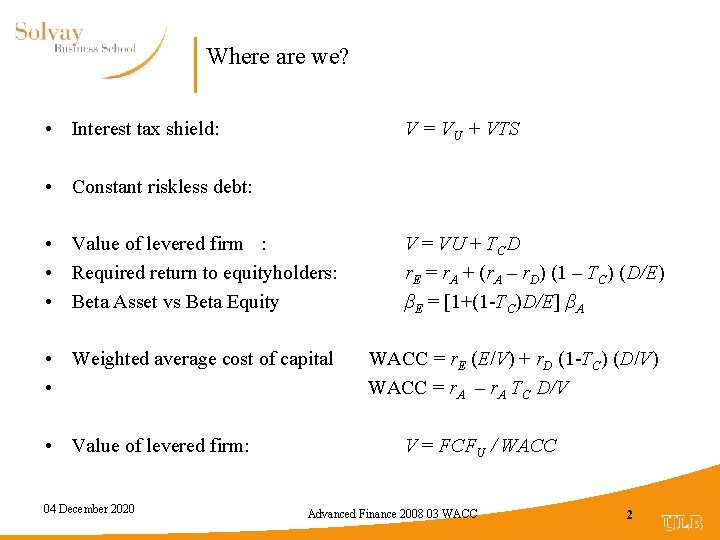
Where are we? • Interest tax shield: V = VU + VTS • Constant riskless debt: • Value of levered firm : • Required return to equityholders: • Beta Asset vs Beta Equity • Weighted average cost of capital • • Value of levered firm: 04 December 2020 V = VU + TCD r. E = r. A + (r. A – r. D) (1 – TC) (D/E) βE = [1+(1 -TC)D/E] βA WACC = r. E (E/V) + r. D (1 -TC) (D/V) WACC = r. A – r. A TC D/V V = FCFU / WACC Advanced Finance 2008 03 WACC 2
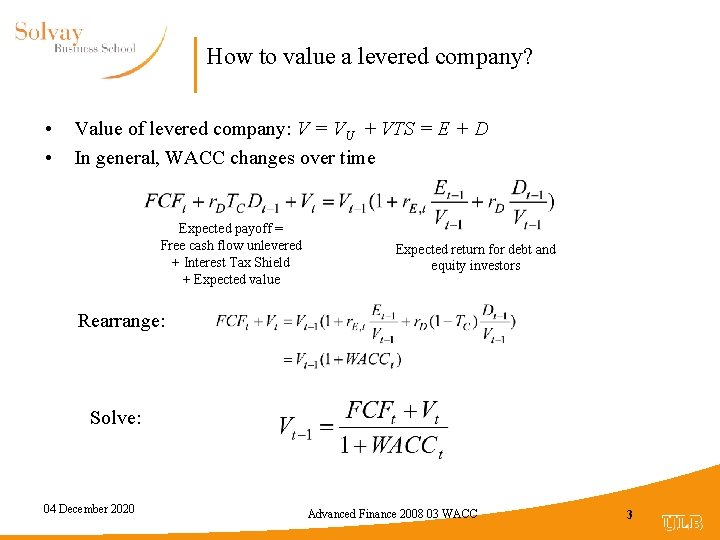
How to value a levered company? • • Value of levered company: V = VU + VTS = E + D In general, WACC changes over time Expected payoff = Free cash flow unlevered + Interest Tax Shield + Expected value Expected return for debt and equity investors Rearrange: Solve: 04 December 2020 Advanced Finance 2008 03 WACC 3
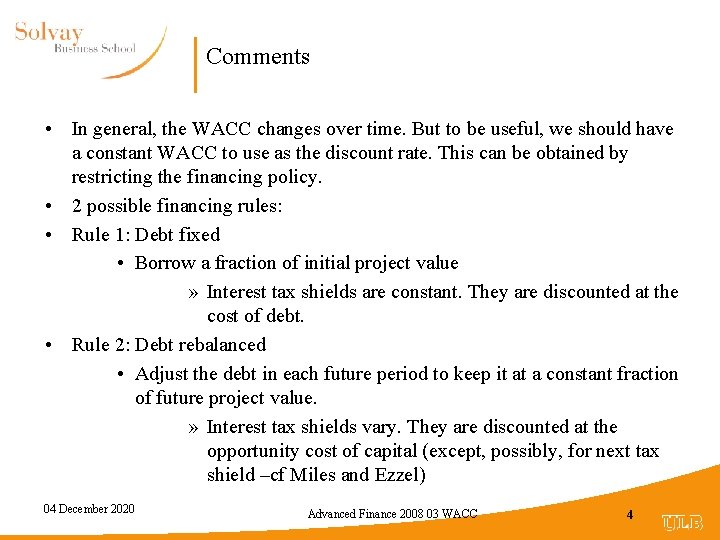
Comments • In general, the WACC changes over time. But to be useful, we should have a constant WACC to use as the discount rate. This can be obtained by restricting the financing policy. • 2 possible financing rules: • Rule 1: Debt fixed • Borrow a fraction of initial project value » Interest tax shields are constant. They are discounted at the cost of debt. • Rule 2: Debt rebalanced • Adjust the debt in each future period to keep it at a constant fraction of future project value. » Interest tax shields vary. They are discounted at the opportunity cost of capital (except, possibly, for next tax shield –cf Miles and Ezzel) 04 December 2020 Advanced Finance 2008 03 WACC 4
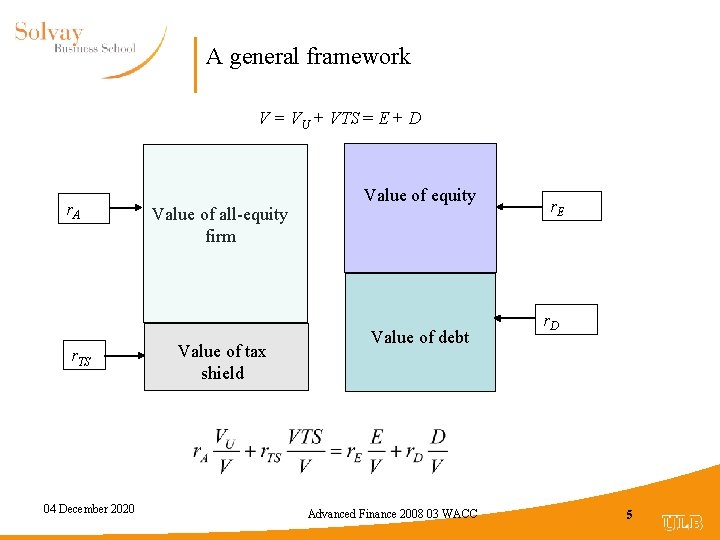
A general framework V = VU + VTS = E + D r. A r. TS 04 December 2020 Value of all-equity firm Value of tax shield Value of equity Value of debt Advanced Finance 2008 03 WACC r. E r. D 5
Cost of equity calculation If r. TS = r. D (MM) and VTS = TCD Similar formulas for beta equity (replace r by β) 04 December 2020 Advanced Finance 2008 03 WACC 6
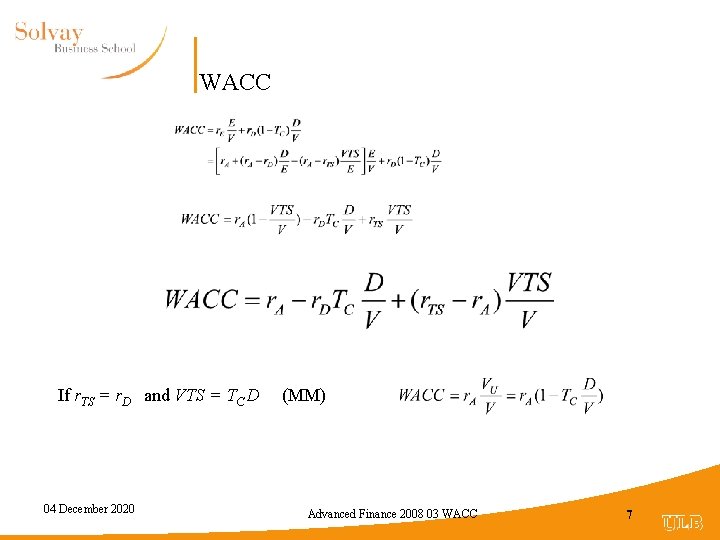
WACC If r. TS = r. D and VTS = TC D 04 December 2020 (MM) Advanced Finance 2008 03 WACC 7
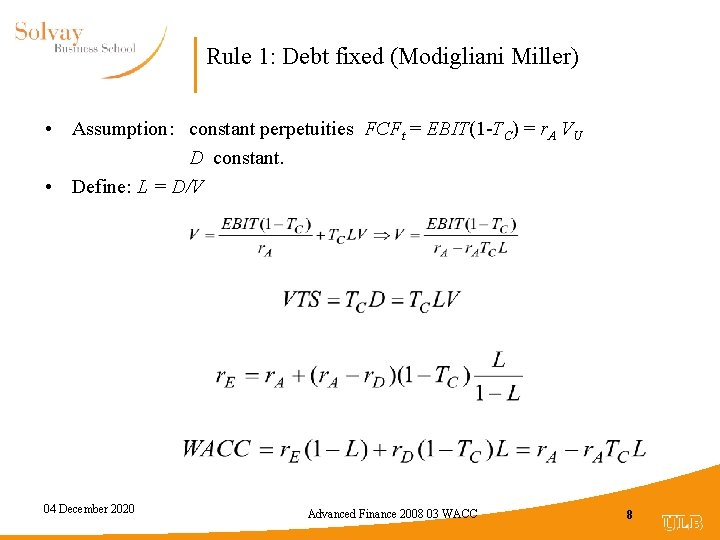
Rule 1: Debt fixed (Modigliani Miller) • Assumption: constant perpetuities FCFt = EBIT(1 -TC) = r. A VU D constant. • Define: L = D/V 04 December 2020 Advanced Finance 2008 03 WACC 8
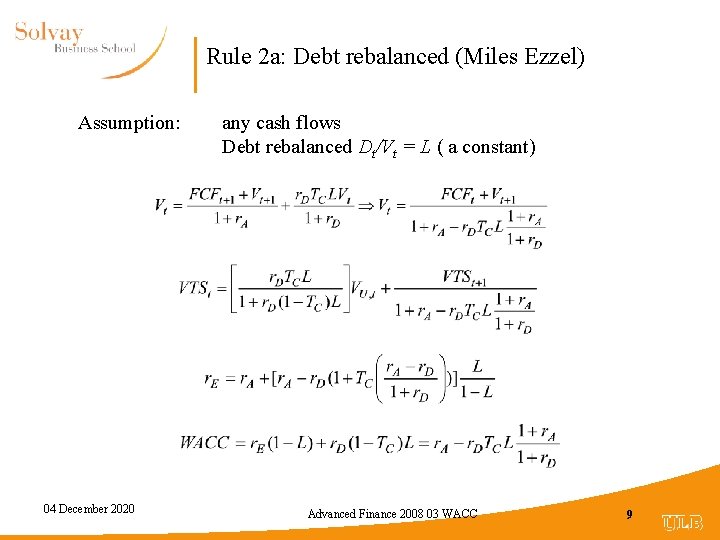
Rule 2 a: Debt rebalanced (Miles Ezzel) Assumption: 04 December 2020 any cash flows Debt rebalanced Dt/Vt = L ( a constant) Advanced Finance 2008 03 WACC 9
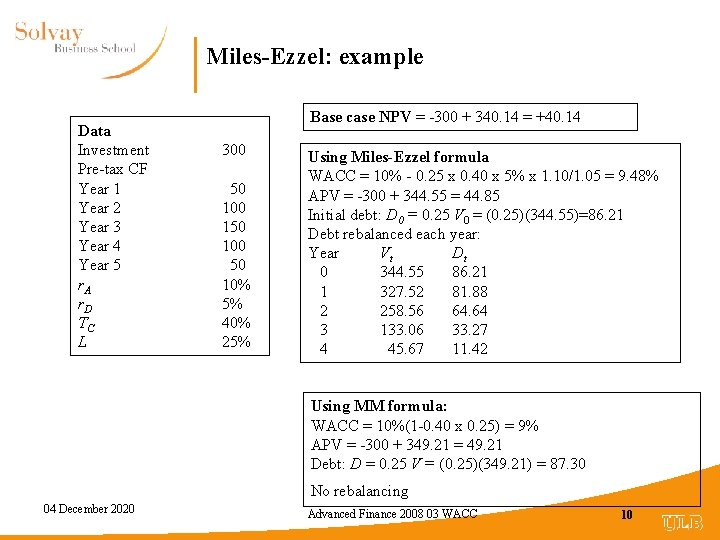
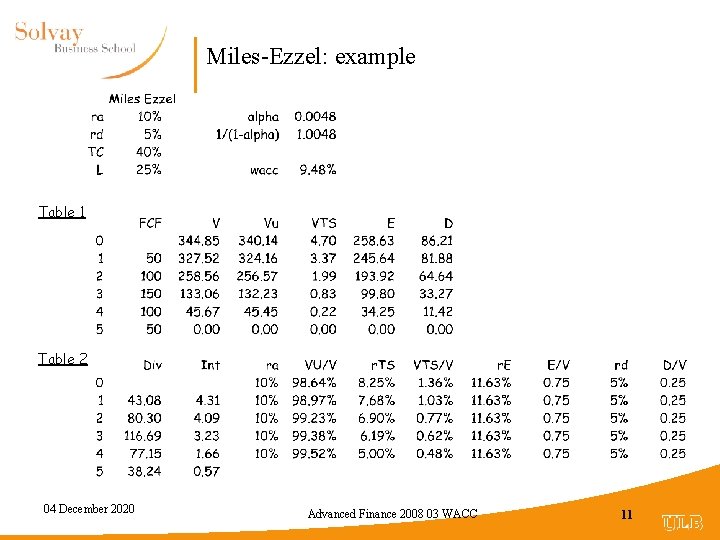
Miles-Ezzel: example Data Investment Pre-tax CF Year 1 Year 2 Year 3 Year 4 Year 5 r. A r. D TC L Base case NPV = -300 + 340. 14 = +40. 14 300 50 100 150 100 50 10% 5% 40% 25% Using Miles-Ezzel formula WACC = 10% - 0. 25 x 0. 40 x 5% x 1. 10/1. 05 = 9. 48% APV = -300 + 344. 55 = 44. 85 Initial debt: D 0 = 0. 25 V 0 = (0. 25)(344. 55)=86. 21 Debt rebalanced each year: Year Vt Dt 0 344. 55 86. 21 1 327. 52 81. 88 2 258. 56 64. 64 3 133. 06 33. 27 4 45. 67 11. 42 Using MM formula: WACC = 10%(1 -0. 40 x 0. 25) = 9% APV = -300 + 349. 21 = 49. 21 Debt: D = 0. 25 V = (0. 25)(349. 21) = 87. 30 No rebalancing 04 December 2020 Advanced Finance 2008 03 WACC 10
Miles-Ezzel: example Table 1 Table 2 04 December 2020 Advanced Finance 2008 03 WACC 11
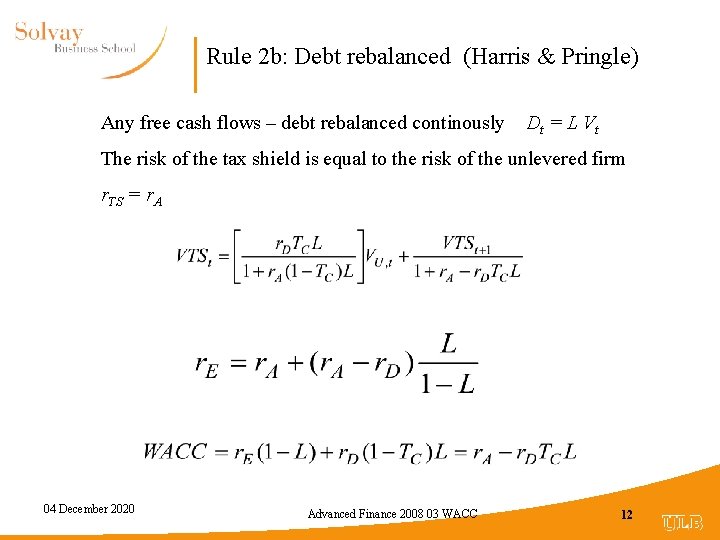
Rule 2 b: Debt rebalanced (Harris & Pringle) Any free cash flows – debt rebalanced continously Dt = L V t The risk of the tax shield is equal to the risk of the unlevered firm r. TS = r. A 04 December 2020 Advanced Finance 2008 03 WACC 12
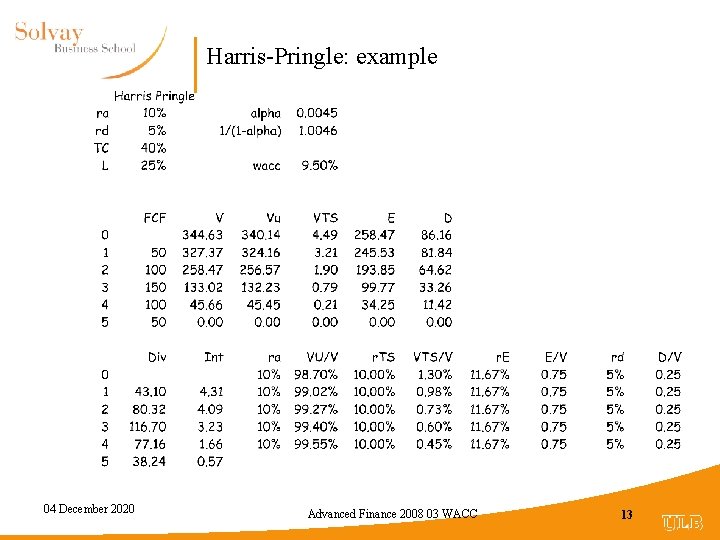
Harris-Pringle: example 04 December 2020 Advanced Finance 2008 03 WACC 13
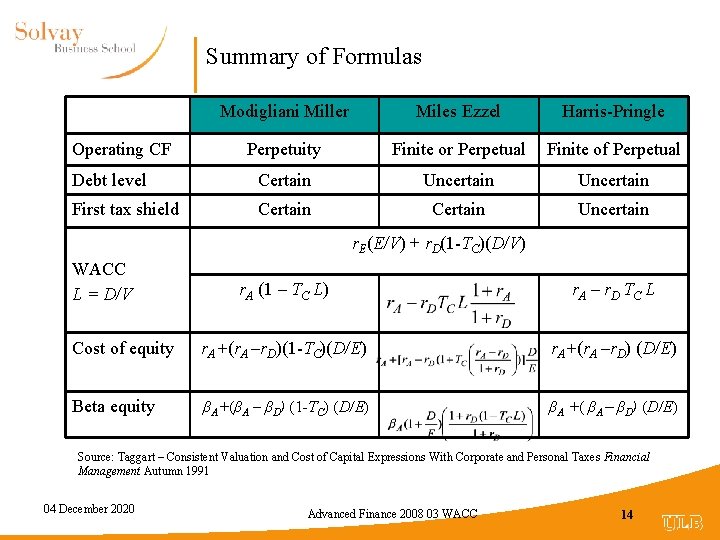
Summary of Formulas Modigliani Miller Miles Ezzel Harris-Pringle Perpetuity Finite or Perpetual Finite of Perpetual Debt level Certain Uncertain First tax shield Certain Uncertain Operating CF r. E(E/V) + r. D(1 -TC)(D/V) WACC L = D/V r. A (1 – TC L) r. A – r. D TC L Cost of equity r. A+(r. A –r. D)(1 -TC)(D/E) r. A+(r. A –r. D) (D/E) Beta equity βA+(βA – βD) (1 -TC) (D/E) βA +( βA – βD) (D/E) Source: Taggart – Consistent Valuation and Cost of Capital Expressions With Corporate and Personal Taxes Financial Management Autumn 1991 04 December 2020 Advanced Finance 2008 03 WACC 14
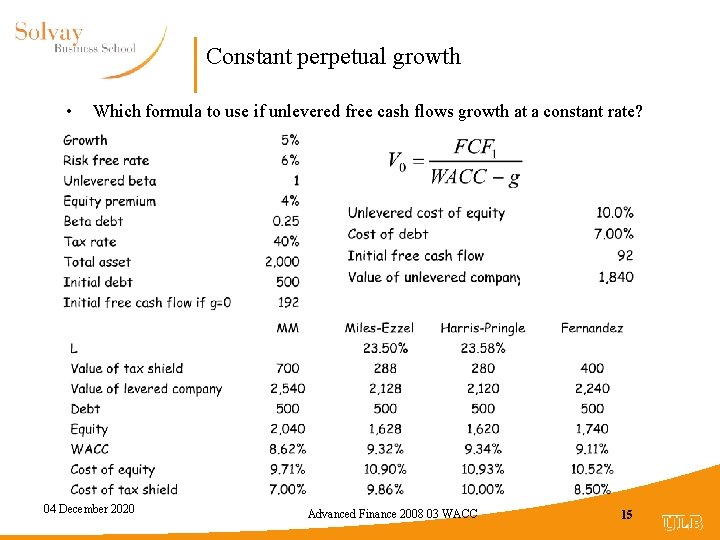
Constant perpetual growth • Which formula to use if unlevered free cash flows growth at a constant rate? 04 December 2020 Advanced Finance 2008 03 WACC 15
Varying debt levels • How to proceed if none of the financing rules applies? • Two important instances: • (i) debt policy defined as an amount of borrowing instead of as a target percentage of value • (ii) the amount of debt changes over time • Use the Capital Cash Flow method suggested by Ruback • (Ruback, Richard A Note on Capital Cash Flow Valuation, Harvard Business School, 9 -295 -069, January 1995) 04 December 2020 Advanced Finance 2008 03 WACC 16
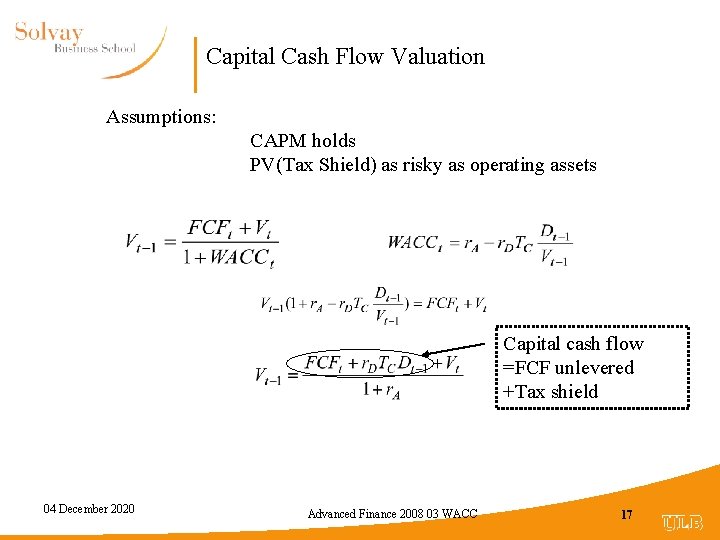
Capital Cash Flow Valuation Assumptions: CAPM holds PV(Tax Shield) as risky as operating assets Capital cash flow =FCF unlevered +Tax shield 04 December 2020 Advanced Finance 2008 03 WACC 17
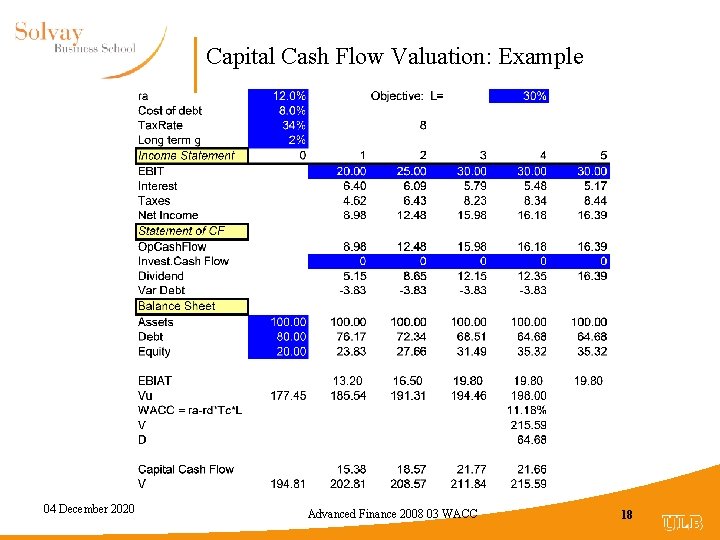
Capital Cash Flow Valuation: Example 04 December 2020 Advanced Finance 2008 03 WACC 18
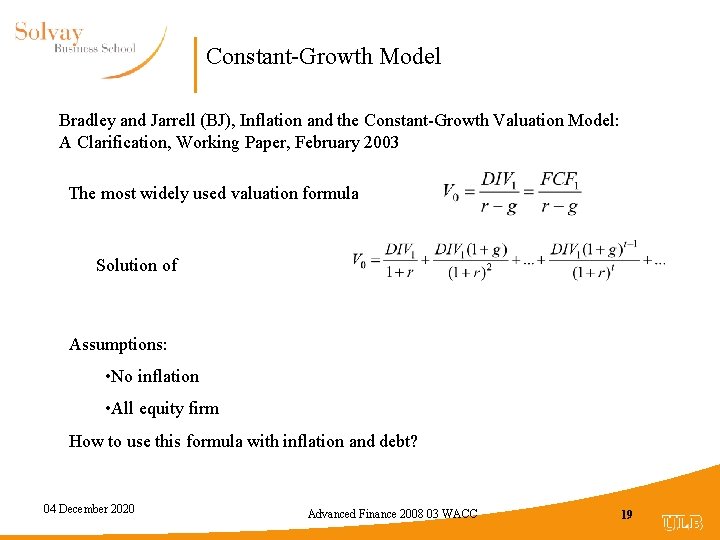
Constant-Growth Model Bradley and Jarrell (BJ), Inflation and the Constant-Growth Valuation Model: A Clarification, Working Paper, February 2003 The most widely used valuation formula Solution of Assumptions: • No inflation • All equity firm How to use this formula with inflation and debt? 04 December 2020 Advanced Finance 2008 03 WACC 19
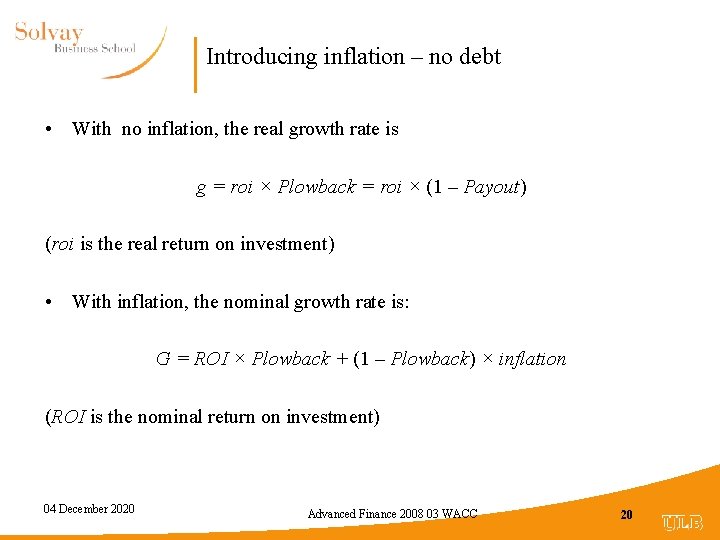
Introducing inflation – no debt • With no inflation, the real growth rate is g = roi × Plowback = roi × (1 – Payout) (roi is the real return on investment) • With inflation, the nominal growth rate is: G = ROI × Plowback + (1 – Plowback) × inflation (ROI is the nominal return on investment) 04 December 2020 Advanced Finance 2008 03 WACC 20
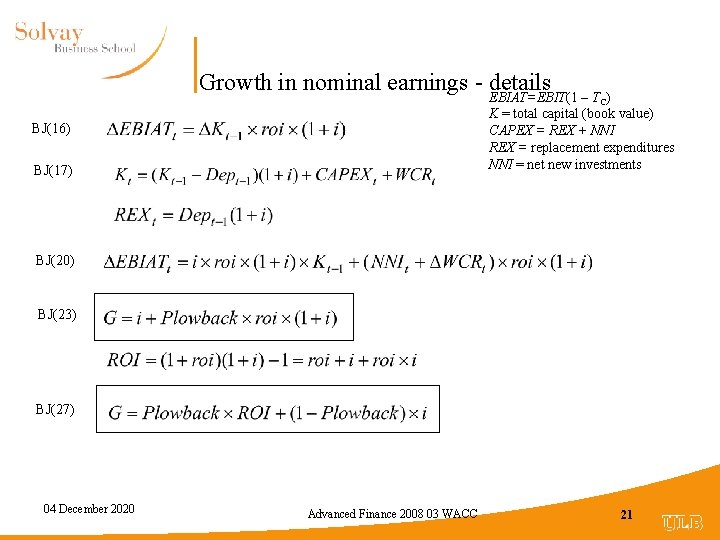
Growth in nominal earnings - details EBIAT=EBIT(1 – T ) C K = total capital (book value) CAPEX = REX + NNI REX = replacement expenditures NNI = net new investments BJ(16) BJ(17) BJ(20) BJ(23) BJ(27) 04 December 2020 Advanced Finance 2008 03 WACC 21
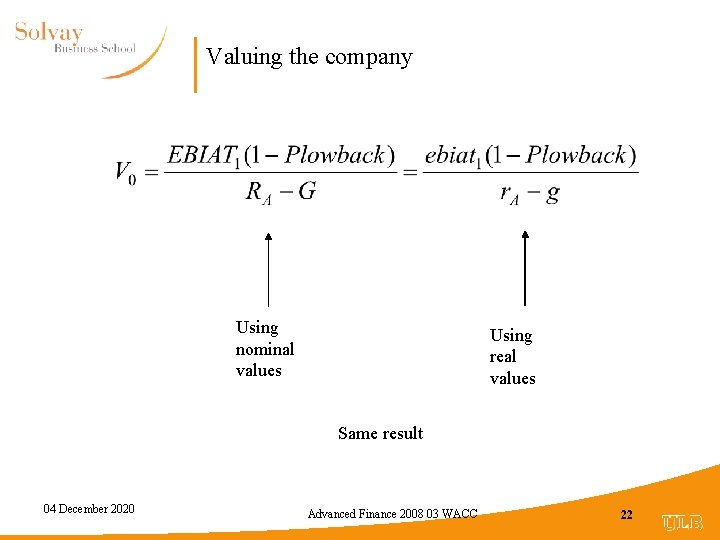
Valuing the company Using nominal values Using real values Same result 04 December 2020 Advanced Finance 2008 03 WACC 22
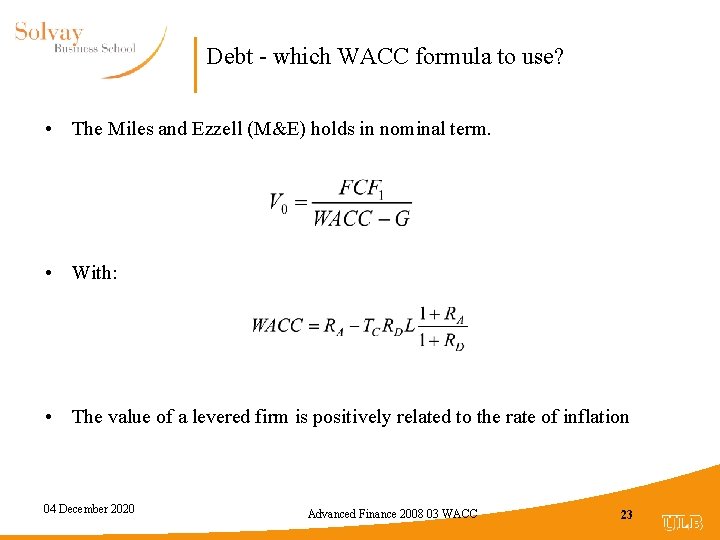
Debt - which WACC formula to use? • The Miles and Ezzell (M&E) holds in nominal term. • With: • The value of a levered firm is positively related to the rate of inflation 04 December 2020 Advanced Finance 2008 03 WACC 23
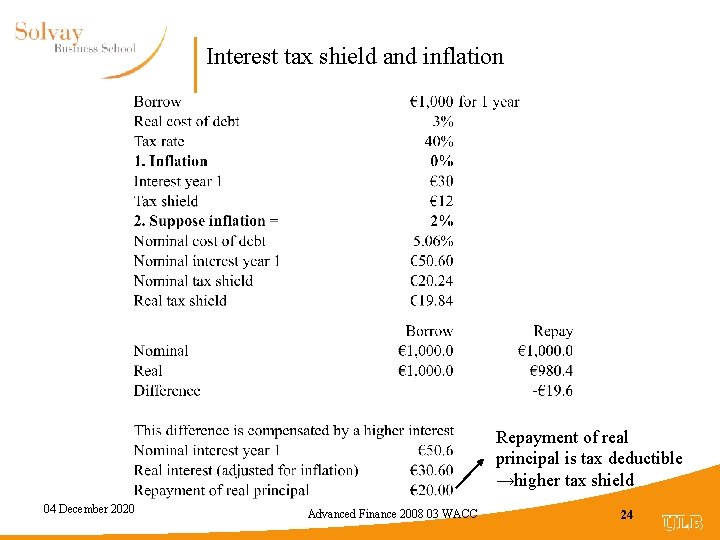
Interest tax shield and inflation Repayment of real principal is tax deductible →higher tax shield 04 December 2020 Advanced Finance 2008 03 WACC 24