
Corporate Finance Lecture 16 INTRODUCTION TO CAPITAL STRUCTURE
- Slides: 14
Corporate Finance Lecture 16 INTRODUCTION TO CAPITAL STRUCTURE Ronald F. Singer FINA 4330 Fall, 2010
THE FIRM'S CAPITAL STRUCTURE IS DEFINED AS: THE MIX OF THE DIFFERENT SECURITIES ISSUED BY THE FIRM THE PROBLEM: WHAT IS THE MIX WHICH MAXIMIZES STOCKHOLDERS' WEALTH
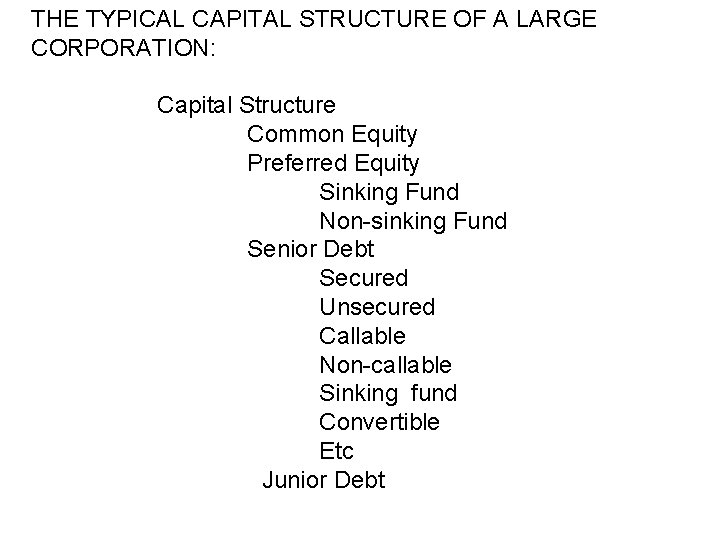
THE TYPICAL CAPITAL STRUCTURE OF A LARGE CORPORATION: Capital Structure Common Equity Preferred Equity Sinking Fund Non-sinking Fund Senior Debt Secured Unsecured Callable Non-callable Sinking fund Convertible Etc Junior Debt
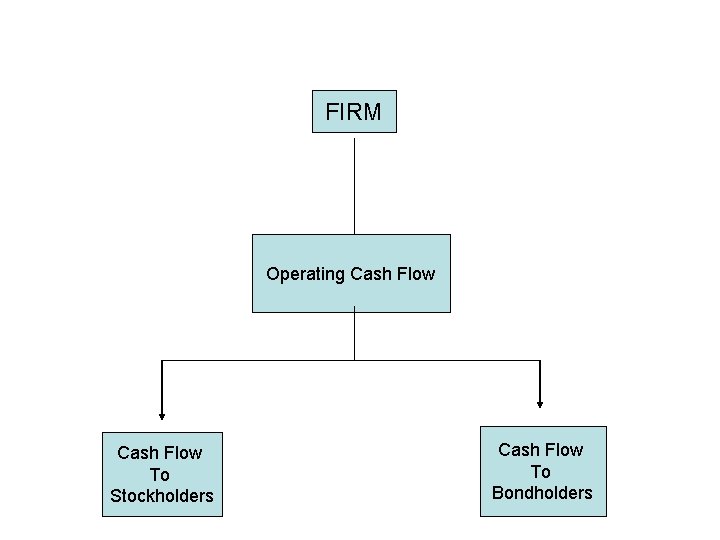
WE ASSUME THAT THE FIRM HAS ONLY COMMON EQUITY AND A SINGLE DEBT ISSUE IN ITS CAPITAL STRUCTURE. THE SAME PRINCIPLES FOLLOW WITH A MORE COMPLEX CAPITAL STRUCTURE. THE CAPITAL STRUCTURE DECISION SHOULD BE THOUGHT OF AS A DECISION WHICH ASKS HOW IS THE OPERATING CASH FLOW OF THE FIRM GOING TO BE SPLIT AMONG THE DIFFERENT SECURITY HOLDERS: THAT tax) flow with IS: The firm as a whole generates (after operating cash flow. How is this cash distributed? That will be in accordance the firm’s capital structure decisions
FIRM Operating Cash Flow To Stockholders Cash Flow To Bondholders
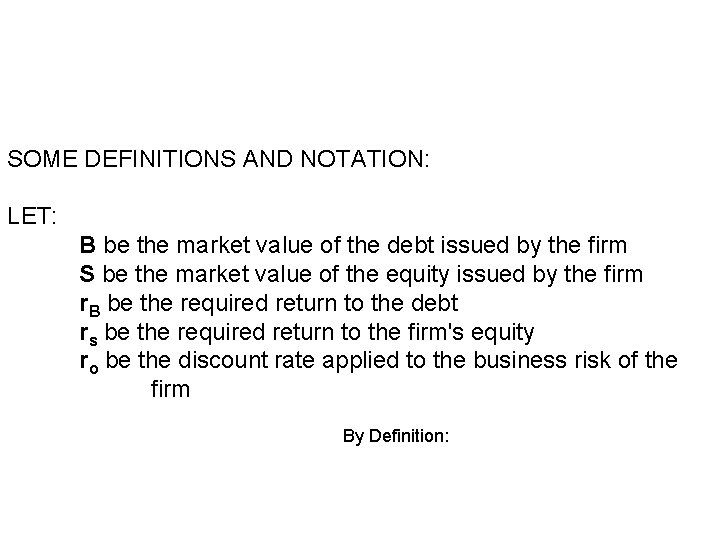
SOME DEFINITIONS AND NOTATION: LET: B be the market value of the debt issued by the firm S be the market value of the equity issued by the firm r. B be the required return to the debt rs be the required return to the firm's equity ro be the discount rate applied to the business risk of the firm By Definition:
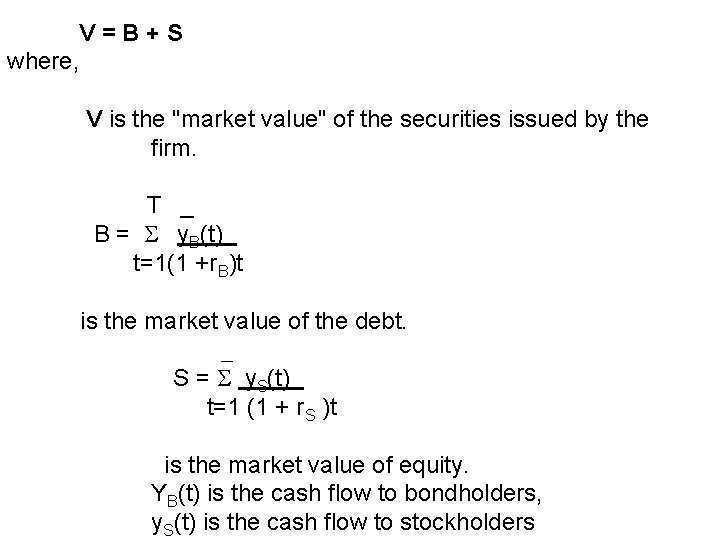
V=B+S where, V is the "market value" of the securities issued by the firm. T _ B = S y. B(t) t=1(1 +r. B)t is the market value of the debt. _ S = S y. S(t) t=1 (1 + r S )t is the market value of equity. YB(t) is the cash flow to bondholders, y. S(t) is the cash flow to stockholders
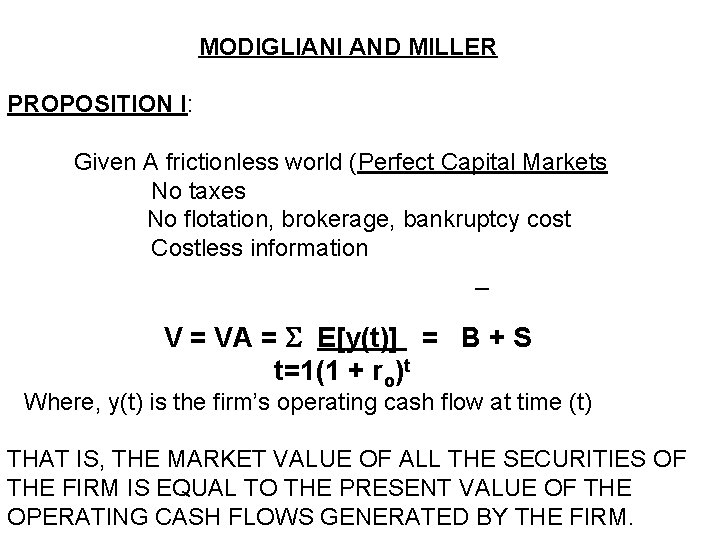
MODIGLIANI AND MILLER PROPOSITION I: Given A frictionless world (Perfect Capital Markets No taxes No flotation, brokerage, bankruptcy cost Costless information _ V = VA = S E[y(t)] = B + S t=1(1 + ro)t Where, y(t) is the firm’s operating cash flow at time (t) THAT IS, THE MARKET VALUE OF ALL THE SECURITIES OF THE FIRM IS EQUAL TO THE PRESENT VALUE OF THE OPERATING CASH FLOWS GENERATED BY THE FIRM.
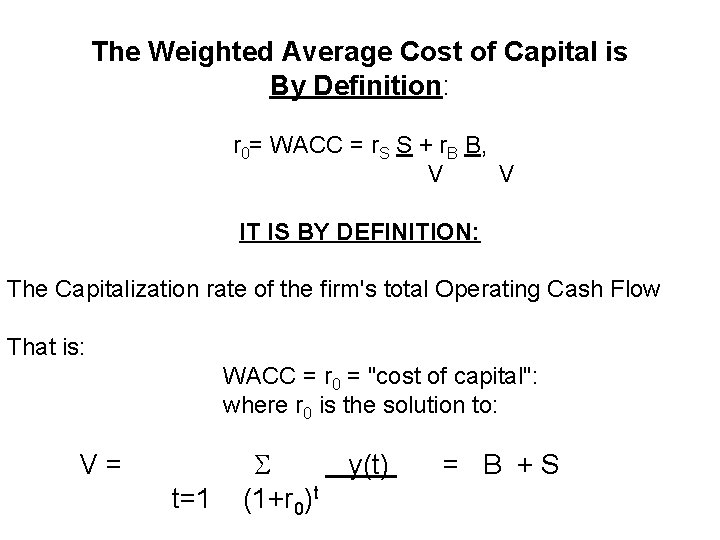
The Weighted Average Cost of Capital is By Definition: r 0= WACC = r. S S + r. B B, V V IT IS BY DEFINITION: The Capitalization rate of the firm's total Operating Cash Flow That is: WACC = r 0 = "cost of capital": where r 0 is the solution to: V= t=1 S (1+r 0)t y(t) = B +S
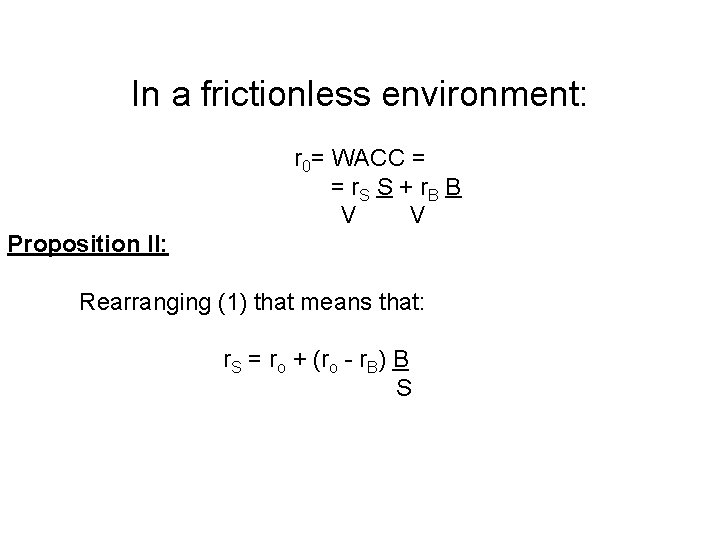
In a frictionless environment: r 0= WACC = = r. S S + r B B V V Proposition II: Rearranging (1) that means that: r. S = ro + (ro - r. B) B S
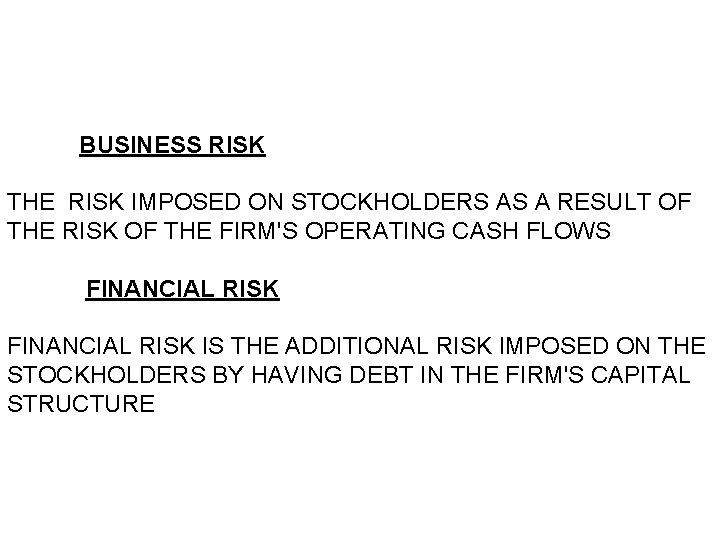
BUSINESS RISK THE RISK IMPOSED ON STOCKHOLDERS AS A RESULT OF THE RISK OF THE FIRM'S OPERATING CASH FLOWS FINANCIAL RISK IS THE ADDITIONAL RISK IMPOSED ON THE STOCKHOLDERS BY HAVING DEBT IN THE FIRM'S CAPITAL STRUCTURE
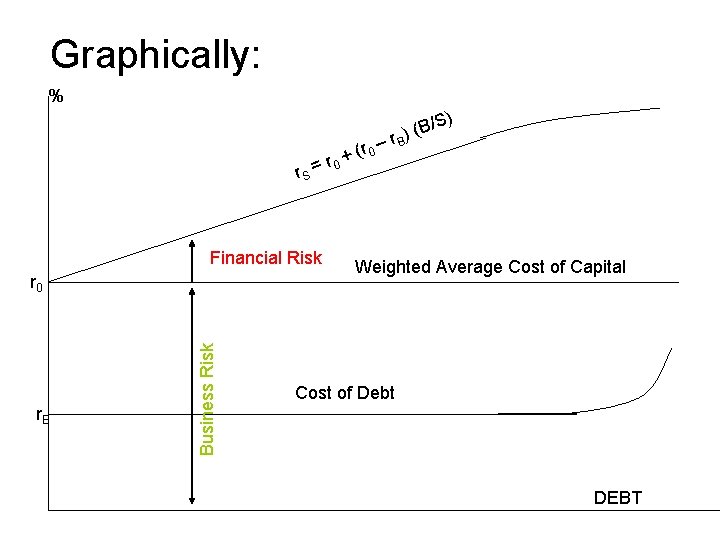
Graphically: % r. S= Financial Risk r. B Business Risk r 0 (r 0 – + r 0 B r B) ( /S) Weighted Average Cost of Capital Cost of Debt DEBT
IN SUMMARY: GIVEN PERFECT CAPITAL MARKETS, THE COST (REQUIRED RETURN) OF EACH SECURITY ISSUED BY THE FIRM MUST BE SUCH THAT: THE WEIGHTED AVERAGE OF THE REQUIRED RETURN OF EACH OF THE SECURITIES MUST BE EQUAL TO THE REQUIRED RETURN ASSOCIATED WITH THE RISK OF THE OPERATING CASH FLOWS OF THE FIRM. THE WEIGHTS ARE THE RELATIVE MARKET VALUES OF EACH OF THE SECURITIES.
So why do firms worry about capital structure? • If capital structure matters then we have to look toward other factors – Taxes – “transaction” costs, here is what some call “contracting” costs especially the costs associated with financial distress – Costly information – Self interest of managers