
Corporate Default Modelling Forecasting defaults and analysing the
- Slides: 32
Corporate Default Modelling Forecasting defaults and analysing the interaction between defaults and the real economy David Tysk Central Bank of Iceland June 16, 2010
Questions to be answered today • What is probability of default (PD)? • Are corporate defaults relevant for financial stability? • Does defaults interact with the real economy? • What data is available to model PD? • How good is the PD model? • Is it possible to make long term forecasts? • What does the crystal ball say?
What is probability of default? • Probability of default (PD) is a quantitative assessment of the likelihood that an obligor (e. g. , a corporation) will default within a specified period of time • Default rate (DR) is the ratio of defaulted corporations over the total number of corporations in a specific period of time • The average PD is an estimate of the default rate
PD – Here and there • PD period – There: The length of the period is often one year; e. g. , in Basel II – Here: Set to one quarter to enable analysis of quarterly variations (results are however sometimes annualised) • Default definition: – There: The Basel II definition of default is – simplified – equal to >90 days past due – Here: A corporation is defined as defaulted if it has filed for bankruptcy
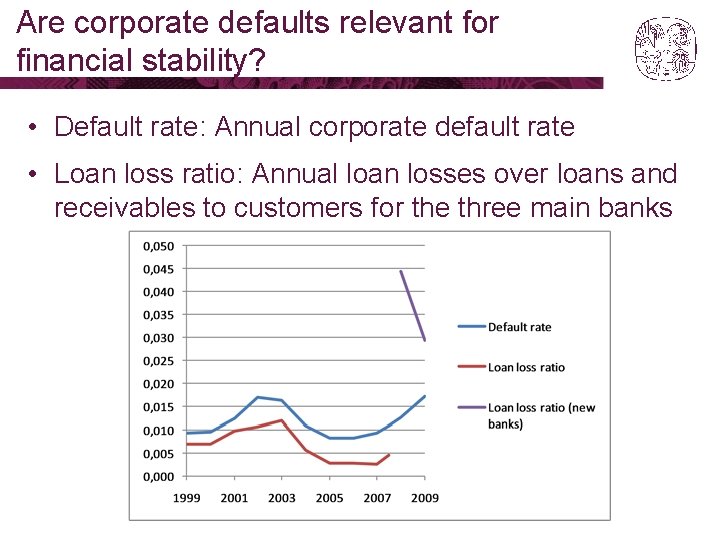
Are corporate defaults relevant for financial stability? • Default rate: Annual corporate default rate • Loan loss ratio: Annual loan losses over loans and receivables to customers for the three main banks
Arguments for the corporate default rate as a measure of the risk of financial instability • The Icelandic corporate sector represents the largest credit risk in the Icelandic banking system • Neither loan losses nor defaults are leading or lagging the other variable • Loan losses are more complex to forecast due to operational risks and changes in accounting rules • Macro prudential – it captures the systematic risk in the banking system
Does the default rate interact with the real economy? • The Icelandic economy is modelled as a small, open economy with a vector autoregressive (VAR) model – Estimated on 1999/Q 1 to 2009/Q 4 data • Variables – Endogenous: lag 1 -2 quarters, output gap, inflation, real exchange rate, CBI monetary policy interest rate – Exogenous: lag 0 -2 quarters, foreign: output gap, inflation, short term interest rate • Test statistics – Stationary (largest |unit root| is 0. 89) – Lag order selection criteria suggest more lags – Residuals are normal and without auto-correlation
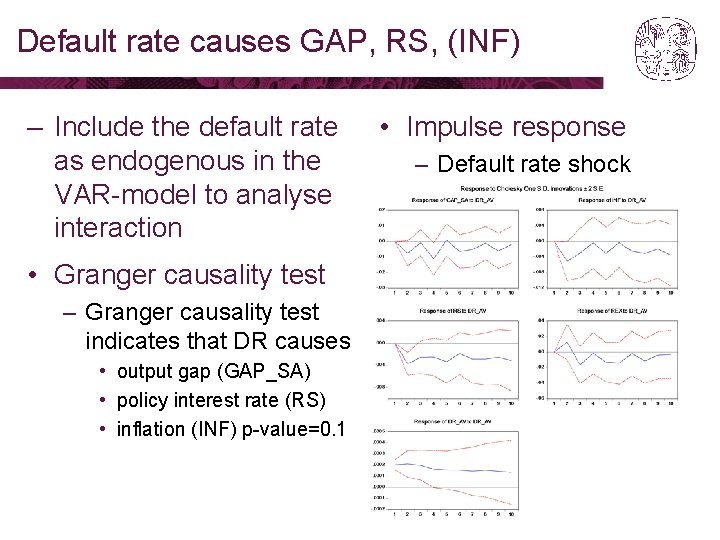
Default rate causes GAP, RS, (INF) – Include the default rate as endogenous in the VAR-model to analyse interaction • Granger causality test – Granger causality test indicates that DR causes • output gap (GAP_SA) • policy interest rate (RS) • inflation (INF) p-value=0. 1 • Impulse response – Default rate shock
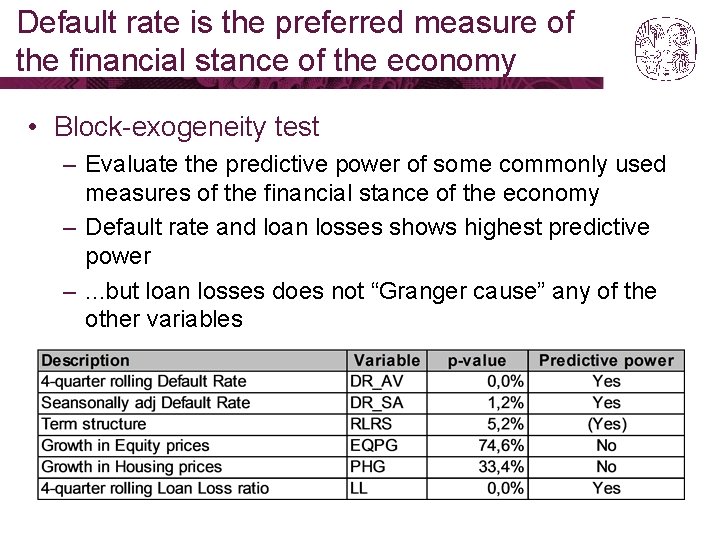
Default rate is the preferred measure of the financial stance of the economy • Block-exogeneity test – Evaluate the predictive power of some commonly used measures of the financial stance of the economy – Default rate and loan losses shows highest predictive power –. . . but loan losses does not “Granger cause” any of the other variables
THE PD MODEL
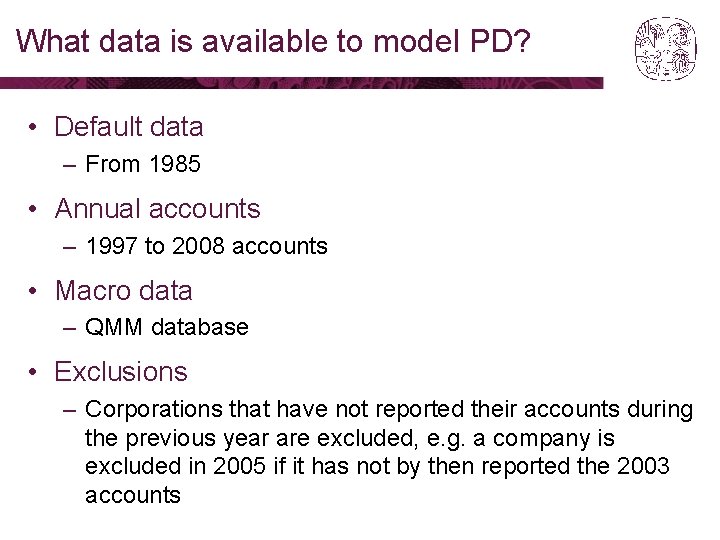
What data is available to model PD? • Default data – From 1985 • Annual accounts – 1997 to 2008 accounts • Macro data – QMM database • Exclusions – Corporations that have not reported their accounts during the previous year are excluded, e. g. a company is excluded in 2005 if it has not by then reported the 2003 accounts
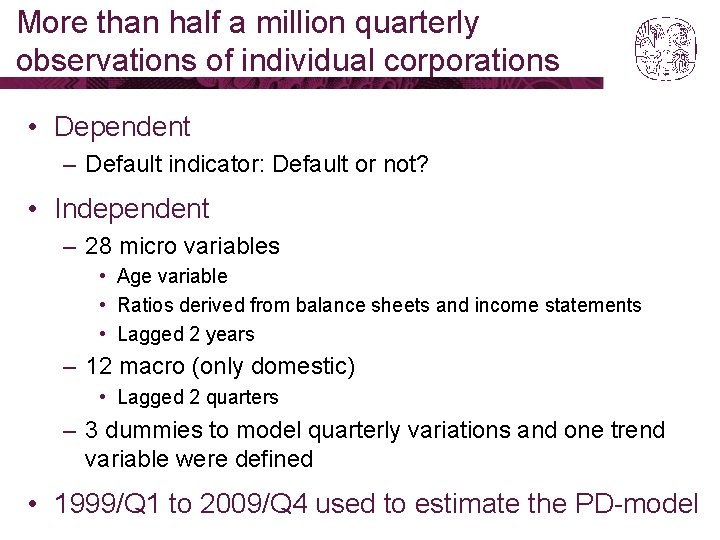
More than half a million quarterly observations of individual corporations • Dependent – Default indicator: Default or not? • Independent – 28 micro variables • Age variable • Ratios derived from balance sheets and income statements • Lagged 2 years – 12 macro (only domestic) • Lagged 2 quarters – 3 dummies to model quarterly variations and one trend variable were defined • 1999/Q 1 to 2009/Q 4 used to estimate the PD-model
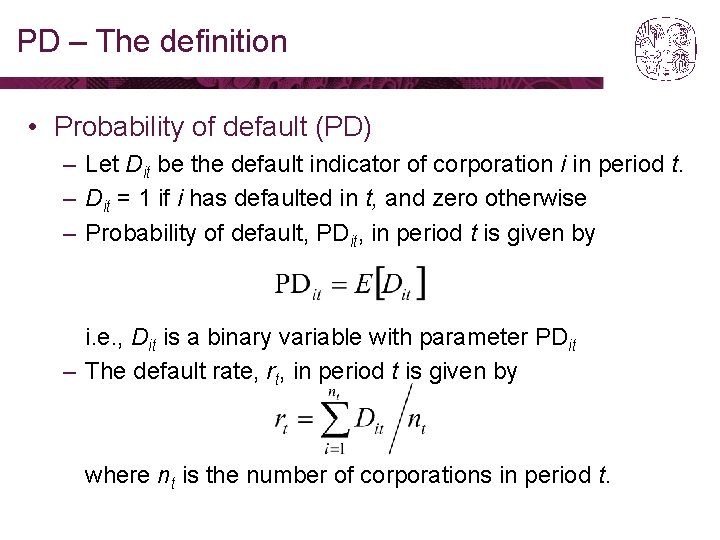
PD – The definition • Probability of default (PD) – Let Dit be the default indicator of corporation i in period t. – Dit = 1 if i has defaulted in t, and zero otherwise – Probability of default, PDit, in period t is given by i. e. , Dit is a binary variable with parameter PDit – The default rate, rt, in period t is given by where nt is the number of corporations in period t.
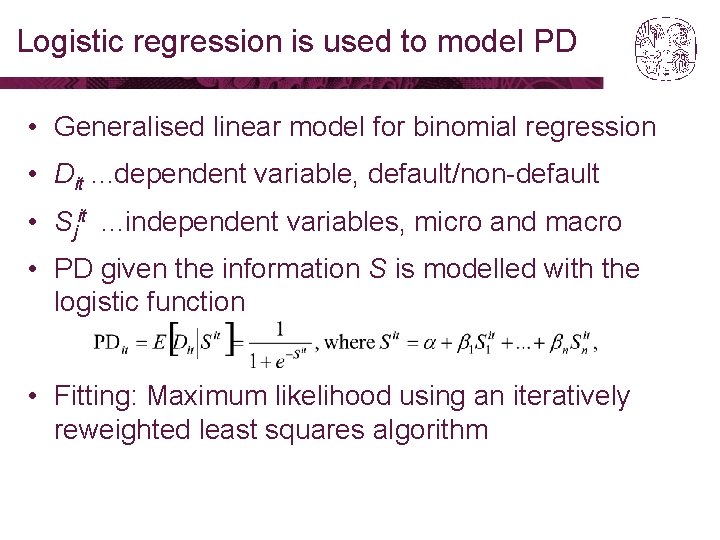
Logistic regression is used to model PD • Generalised linear model for binomial regression • Dit. . . dependent variable, default/non-default • Sjit. . . independent variables, micro and macro • PD given the information S is modelled with the logistic function • Fitting: Maximum likelihood using an iteratively reweighted least squares algorithm
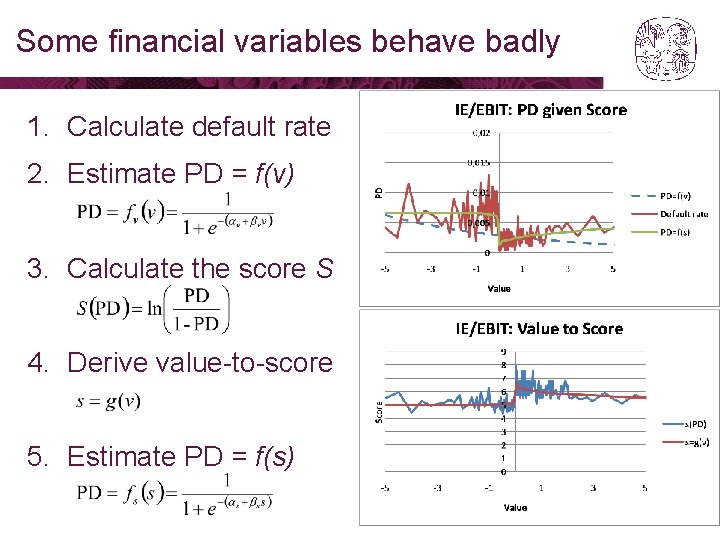
Some financial variables behave badly 1. Calculate default rate 2. Estimate PD = f(v) 3. Calculate the score S 4. Derive value-to-score 5. Estimate PD = f(s)
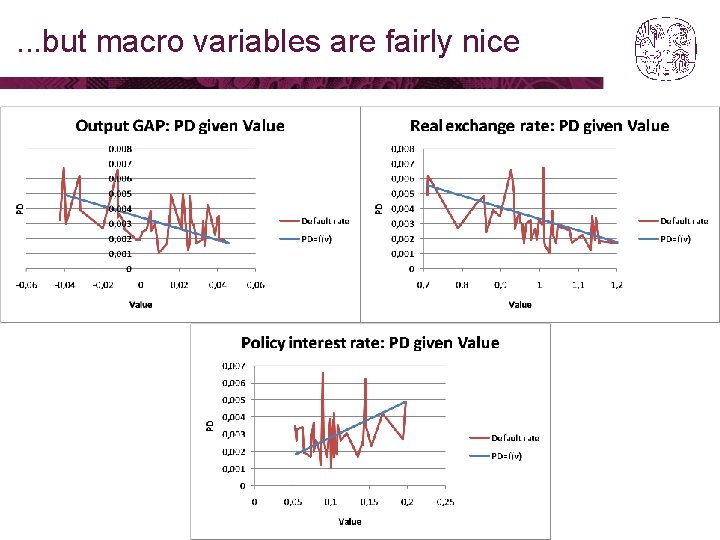
. . . but macro variables are fairly nice
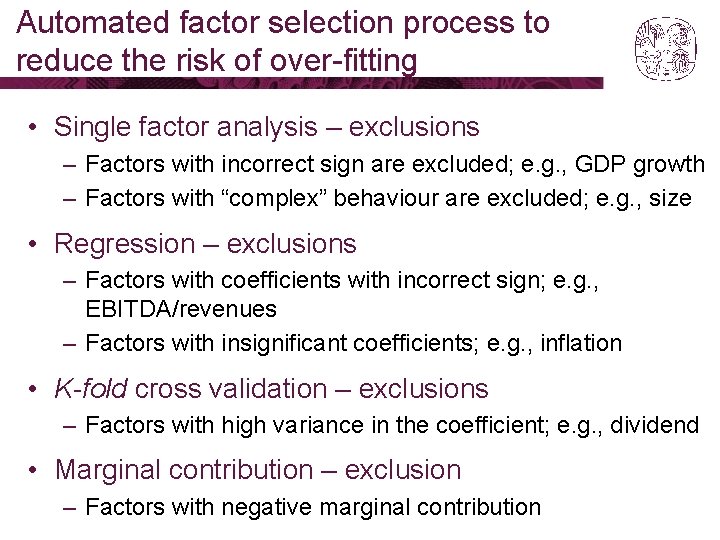
Automated factor selection process to reduce the risk of over-fitting • Single factor analysis – exclusions – Factors with incorrect sign are excluded; e. g. , GDP growth – Factors with “complex” behaviour are excluded; e. g. , size • Regression – exclusions – Factors with coefficients with incorrect sign; e. g. , EBITDA/revenues – Factors with insignificant coefficients; e. g. , inflation • K-fold cross validation – exclusions – Factors with high variance in the coefficient; e. g. , dividend • Marginal contribution – exclusion – Factors with negative marginal contribution
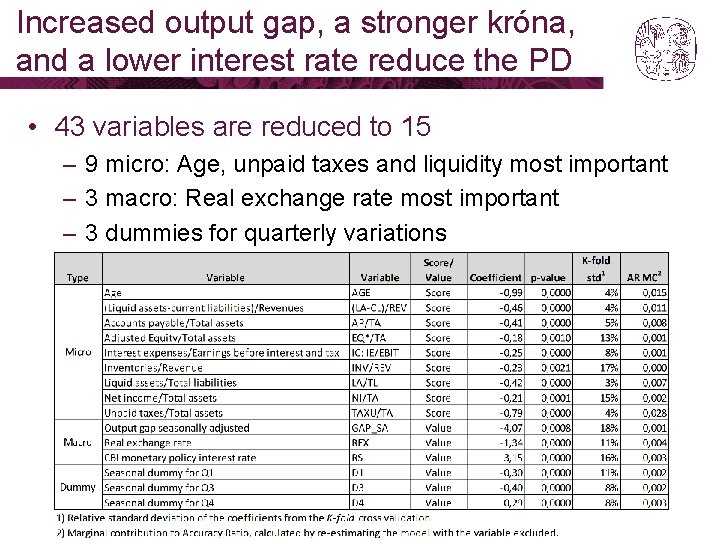
Increased output gap, a stronger króna, and a lower interest rate reduce the PD • 43 variables are reduced to 15 – 9 micro: Age, unpaid taxes and liquidity most important – 3 macro: Real exchange rate most important – 3 dummies for quarterly variations
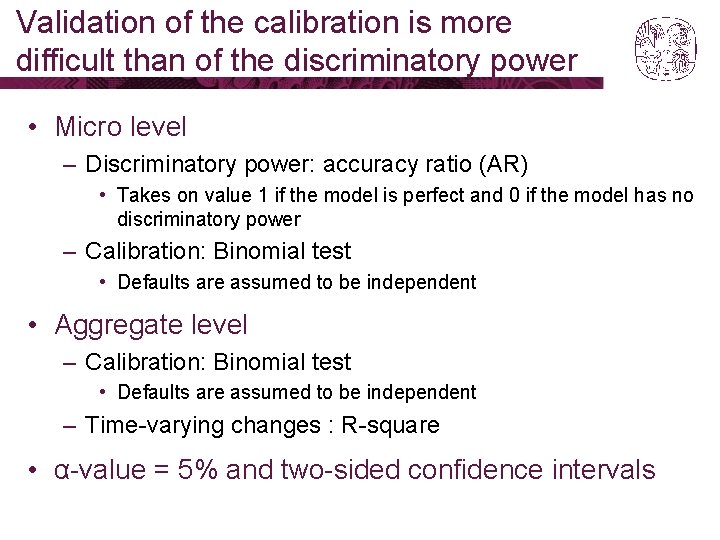
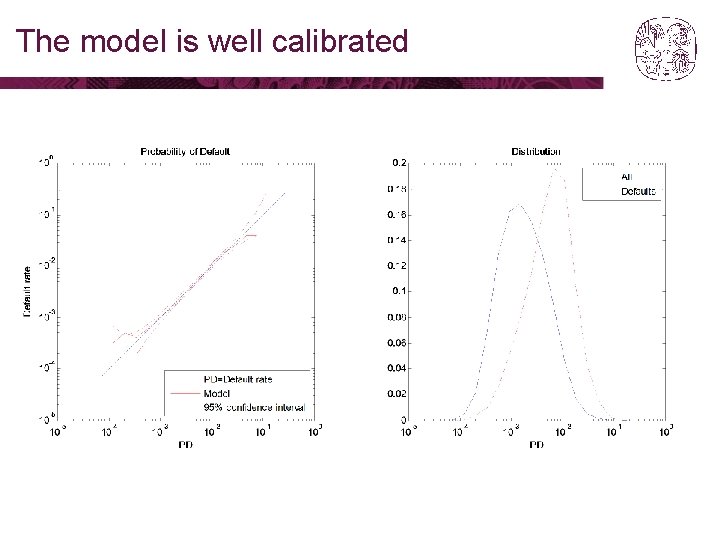
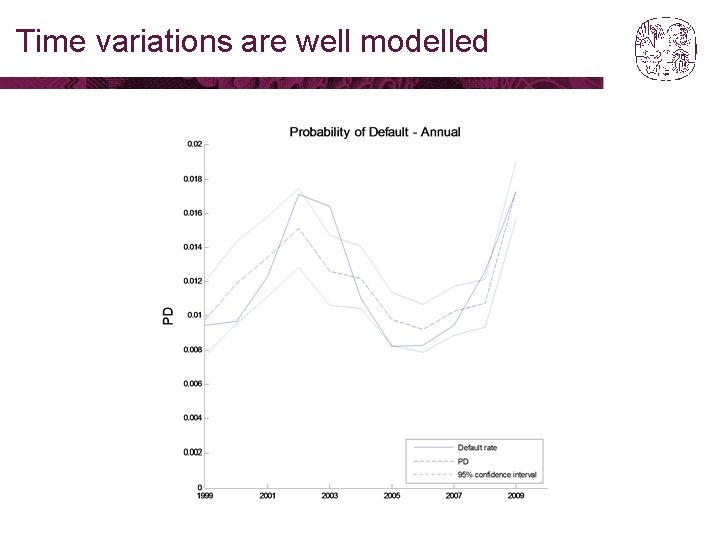
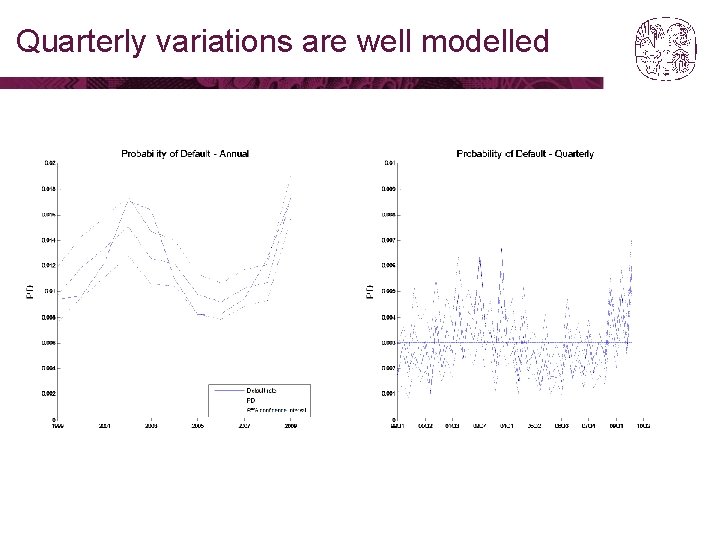
Validation of the calibration is more difficult than of the discriminatory power • Micro level – Discriminatory power: accuracy ratio (AR) • Takes on value 1 if the model is perfect and 0 if the model has no discriminatory power – Calibration: Binomial test • Defaults are assumed to be independent • Aggregate level – Calibration: Binomial test • Defaults are assumed to be independent – Time-varying changes : R-square • α-value = 5% and two-sided confidence intervals
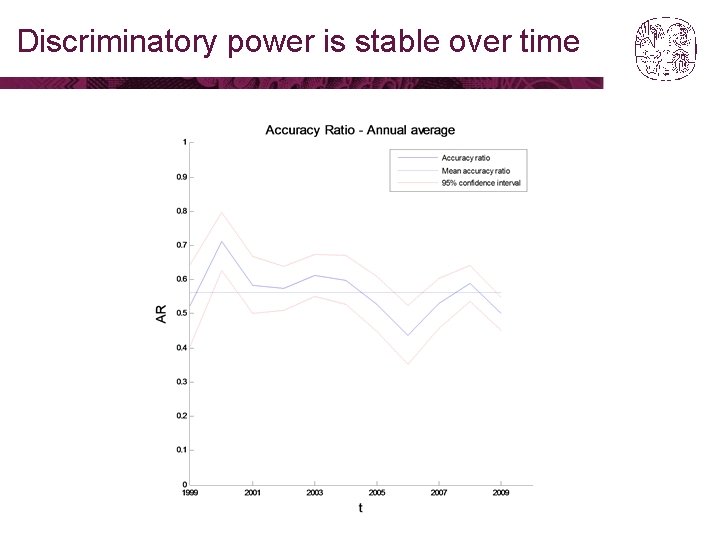
Discriminatory power is stable over time
The model is well calibrated
Time variations are well modelled
Quarterly variations are well modelled
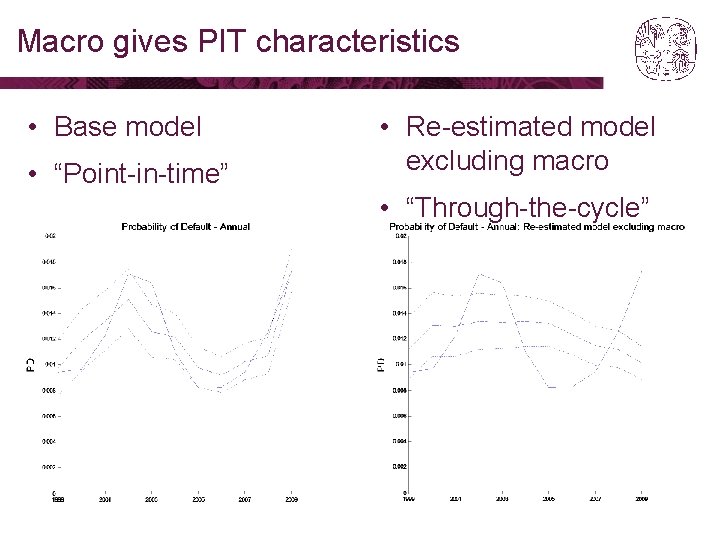
TTC intends to minimise pro-cyclicality • Two canonical approaches to PD-model design • “Point-in-time” (PIT) – PIT will tend to adjust the PD quickly to macro changes – Gives time varying capital requirements – PD is calibrated to the default rate at each point in time • “Through-the-cycle” (TTC) – More-or-less constant even as macro changes over time – Gives less time varying capital requirements – At any time, PD is calibrated to the long-term default rate • Validation of either design requires a long time series of data
Macro gives PIT characteristics • Base model • “Point-in-time” • Re-estimated model excluding macro • “Through-the-cycle”
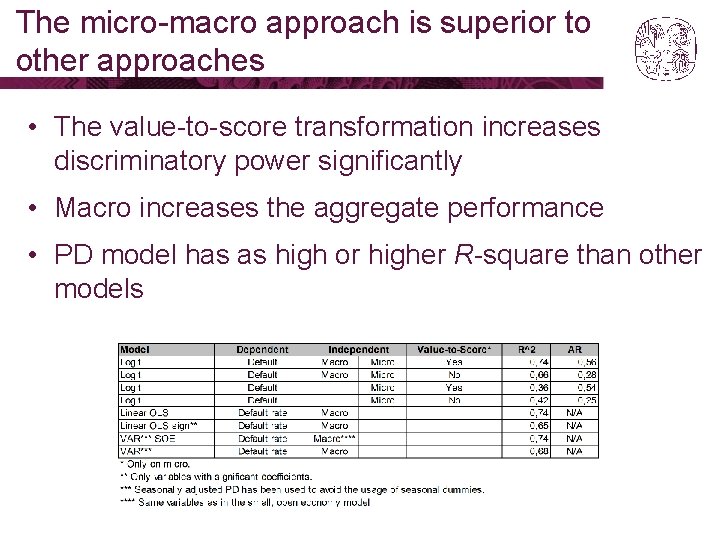
The micro-macro approach is superior to other approaches • The value-to-score transformation increases discriminatory power significantly • Macro increases the aggregate performance • PD model has as high or higher R-square than other models
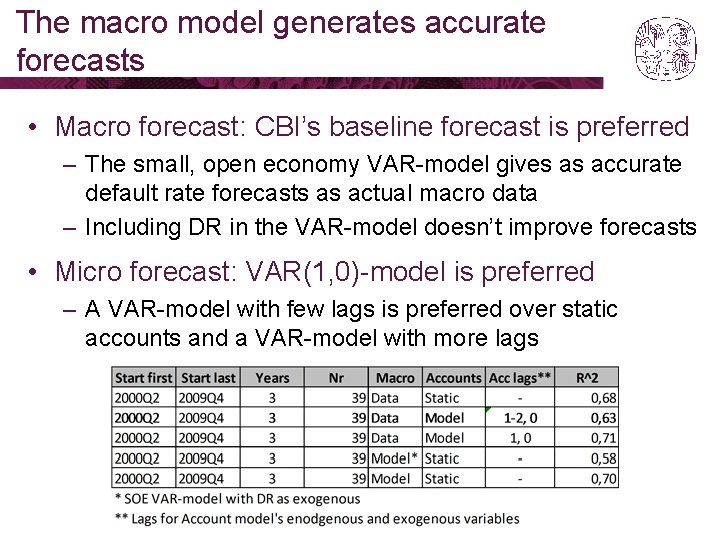
Is it possible to make long term forecasts of the default rate? • Independent variables need to be forecasted • Two options to forecast macro – The SOE VAR-model with/without DR as exogenous – The Central-Bank of Iceland's (CBI) baseline forecast • Forecasting micro is much more challenging – No obvious method – Is the portfolio mix stable? Corporations are born, grow older (and die? ) • Age variable kept constant – Account variables are modelled using a VAR-model • Endogenous: lag 1 -(2) quarters, micro variables • Exogenous: lag 0 quarters, macro variables
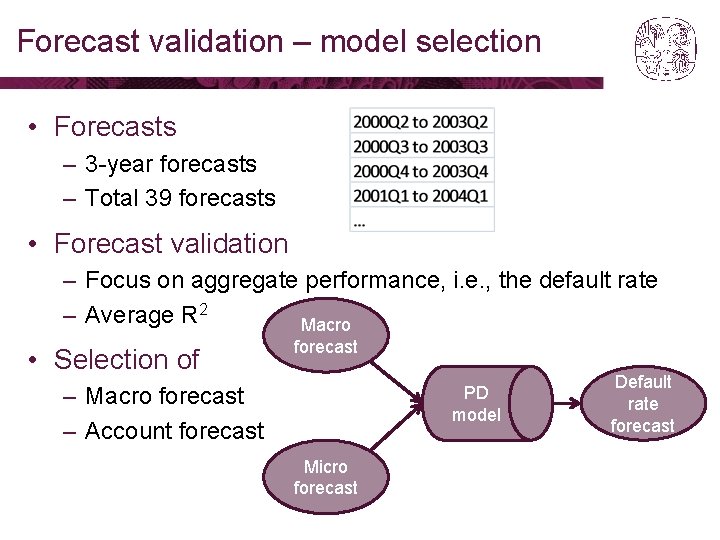
Forecast validation – model selection • Forecasts – 3 -year forecasts – Total 39 forecasts • Forecast validation – Focus on aggregate performance, i. e. , the default rate – Average R 2 Macro • Selection of forecast – Macro forecast – Account forecast PD model Micro forecast Default rate forecast
The macro model generates accurate forecasts • Macro forecast: CBI’s baseline forecast is preferred – The small, open economy VAR-model gives as accurate default rate forecasts as actual macro data – Including DR in the VAR-model doesn’t improve forecasts • Micro forecast: VAR(1, 0)-model is preferred – A VAR-model with few lags is preferred over static accounts and a VAR-model with more lags
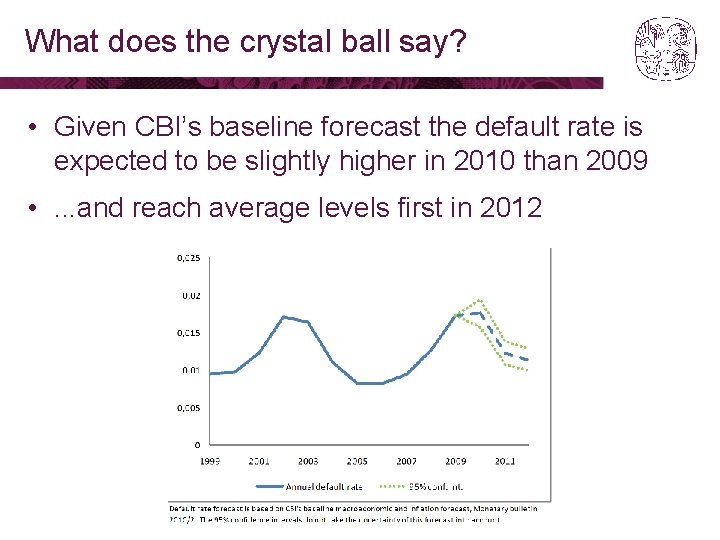
What does the crystal ball say? • Given CBI’s baseline forecast the default rate is expected to be slightly higher in 2010 than 2009 • . . . and reach average levels first in 2012
Main conclusions • Corporate defaults are relevant for financial stability • The default rate shows highly significant predictive power for the real economy • Predictive power increases with the micro-macro approach and the value-to-score transformation • Macro dramatically increase the aggregate performance of the PD model • An increased output gap, a stronger króna, and a lower policy interest rate reduce the PD • The PD model performs well under extraordinary conditions
This is not the end, just the beginning. . . • Applications – Model and stress-test regulatory capital requirements and credit losses – Simulation of the banking sector’s capital position and profitability, especially from a macroprudential perspective – Industry and large exposure analysis • Research – Does the predictive power vary across industries? – Does un-lagged forecasted variables improve the performance? – Further link the default rate and financial stability – Further link monetary policy and financial stability