
Coronary Artery Bypass Graft MODERATOR Dr HARISH NAIR
Coronary Artery Bypass Graft MODERATOR: Dr. HARISH NAIR Dr. RAKESH M. G.
n Prior to 1930’s, heart surgery seen as impossible, with high morbidity and mortality n 1937: Dr. John Gibbon designs heart-lung machine, which enables cardiopulmonary bypass (CPB) n 1955: Vineburg and Buller implant internal mammary artery into myocardium to treat cardiac ischemia and angina n 1958: Longmire, Cannon and Kattus at UCLA perform first open coronary artery endarterectomy without CPB n During 1960’s and 1970’s, CPB and cardioplegic arrest are adopted, allowing Coronary Artery Bypass Graft (CABG) to emerge as a viable surgical treatment
CABG n Dr. Vasil Kolesov in 1964 n Pioneer Dr. Rene Favaloro n Dr. Greene did the 1 st LIMA
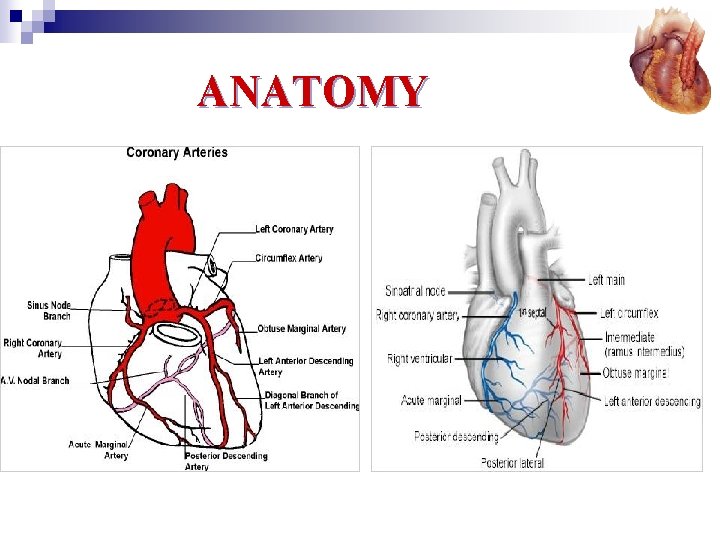
ANATOMY
n n n Chronic angina Unstable angina Acute myocardial infarction Acute failure of percutaneous transluminal coronary angioplasty (PTCA) Severe coronary artery disease
Investigations Routine Blood investigations n RFT, LFT, Coagulation profile n Serum electrolytes n 12 lead ECG n Chest X ray n Stress test n Echocardiogram n Angiogram n
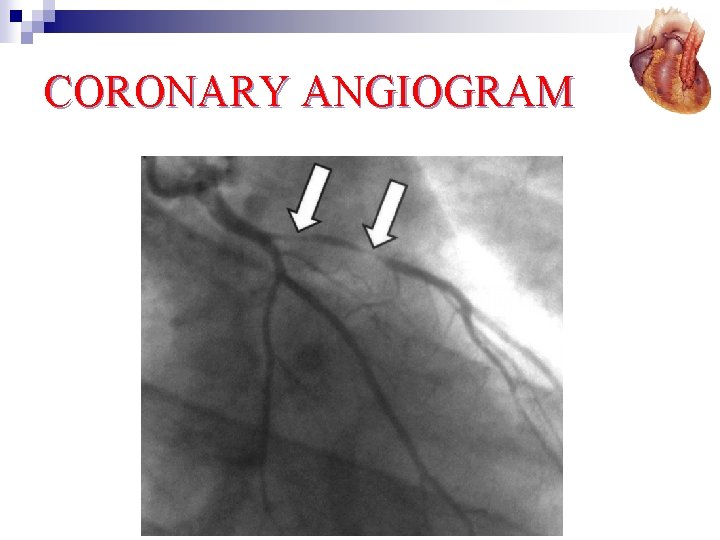
CORONARY ANGIOGRAM
TYPES OF CABG n Off pump CABG (OPCAB) n On pump CABG –(1)Cardioplegia (2)Fibrillating heart n Mid CABG n Robotic surgery
Anaesthesia preparation n ECG leads n Peripheral line n Arterial line n CVP and PA pressure line n Intubation Trans-esophageal endoscopy. n
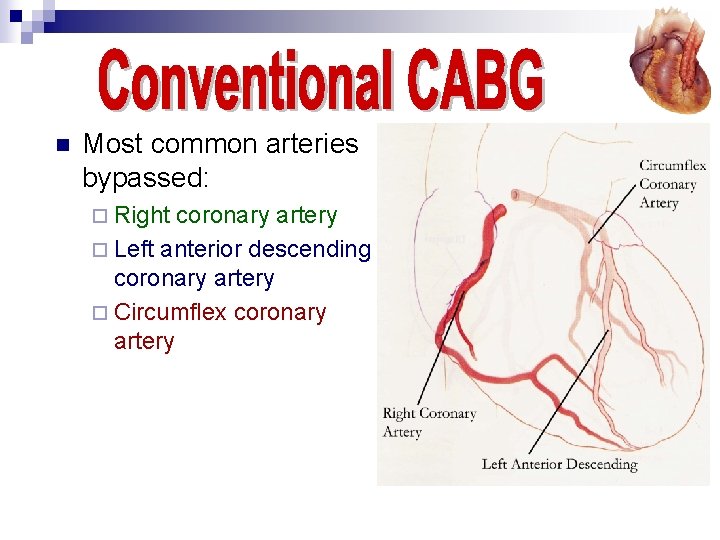
n Most common arteries bypassed: ¨ Right coronary artery ¨ Left anterior descending coronary artery ¨ Circumflex coronary artery
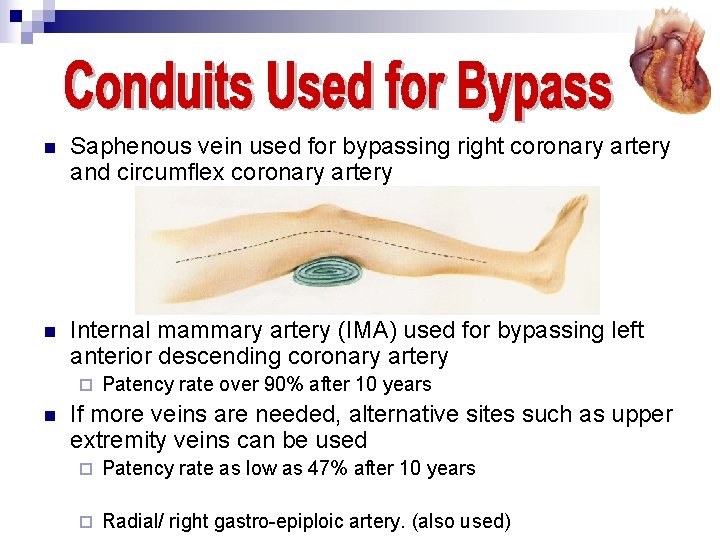
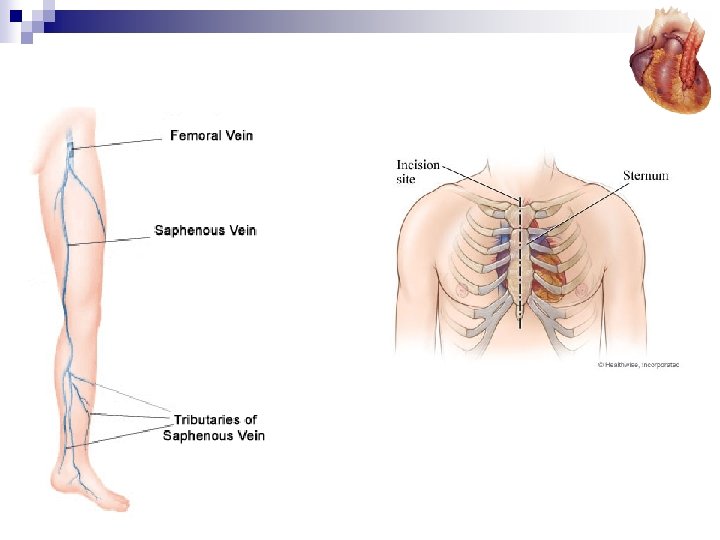
n Saphenous vein used for bypassing right coronary artery and circumflex coronary artery n Internal mammary artery (IMA) used for bypassing left anterior descending coronary artery ¨ n Patency rate over 90% after 10 years If more veins are needed, alternative sites such as upper extremity veins can be used ¨ Patency rate as low as 47% after 10 years ¨ Radial/ right gastro-epiploic artery. (also used)
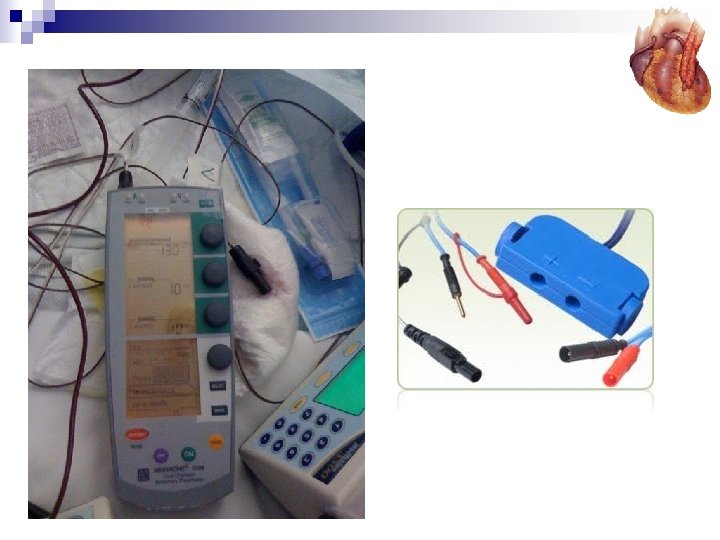
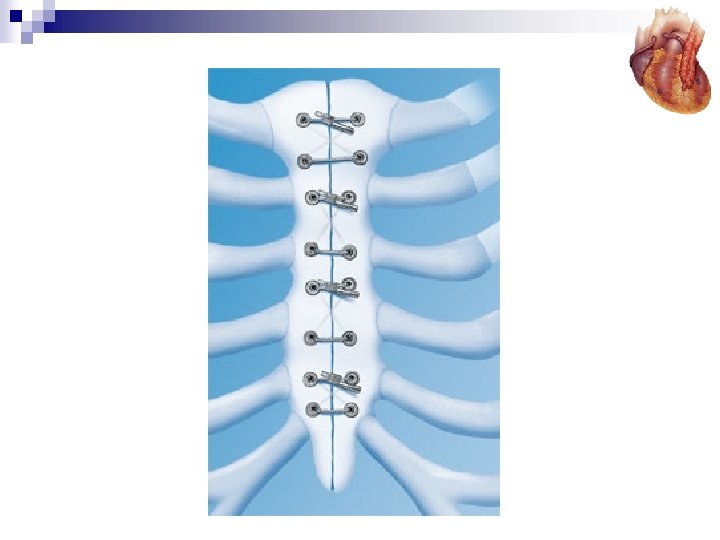
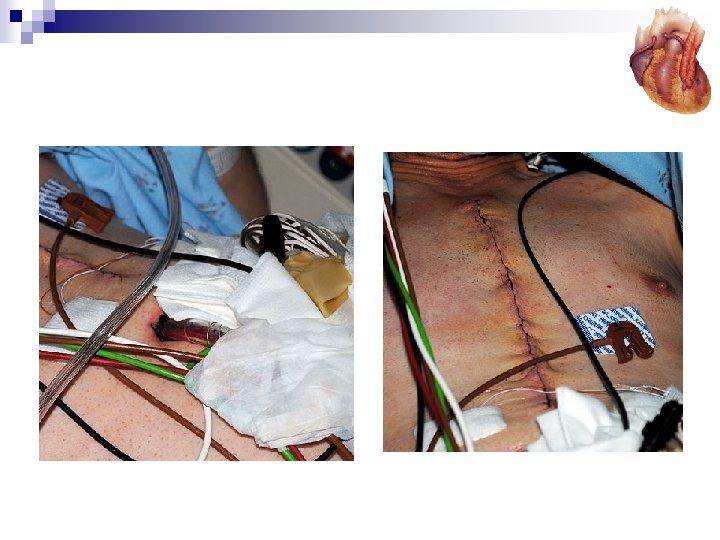
n n Conduit removed Median sternotomy ¨ Sternum n n divided using electric saw Cold potassium cardioplegia Cardiopulmonary bypass ¨ Cannulation n of: Ascending aorta Femoral artery Right atrium ¨ Heparin administered to minimize clotting ¨ Grafting ¨ Pacing wire ¨ Closure
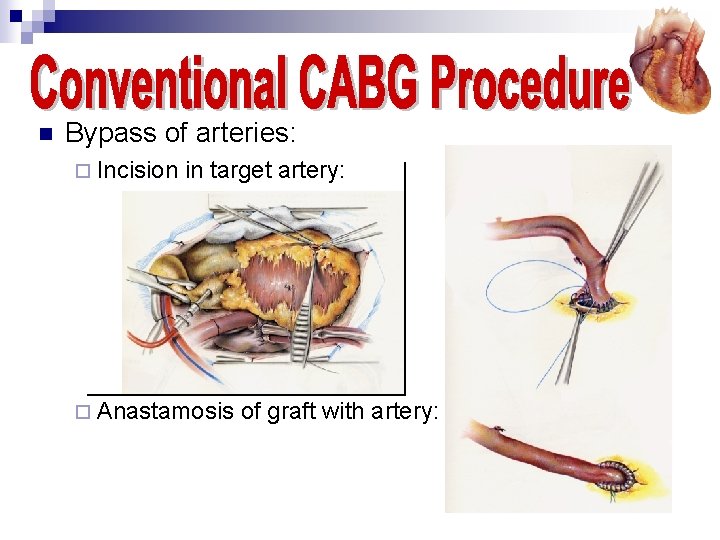
n Bypass of arteries: ¨ Incision in target artery: ¨ Anastamosis of graft with artery:
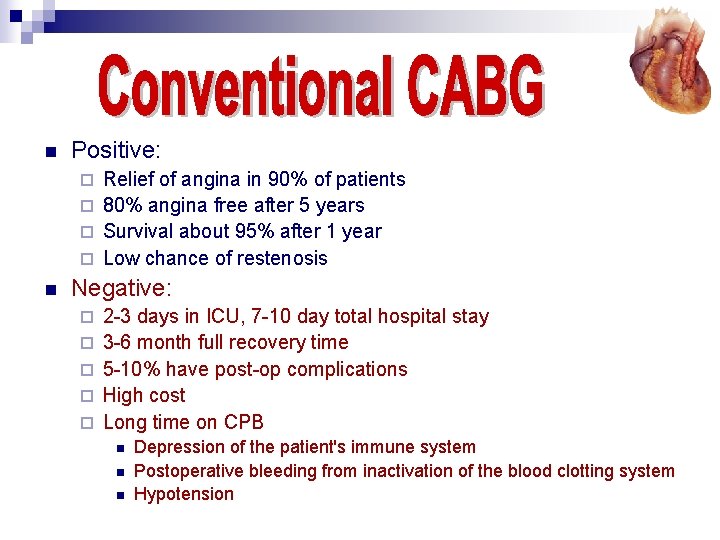
n Positive: Relief of angina in 90% of patients ¨ 80% angina free after 5 years ¨ Survival about 95% after 1 year ¨ Low chance of restenosis ¨ n Negative: ¨ ¨ ¨ 2 -3 days in ICU, 7 -10 day total hospital stay 3 -6 month full recovery time 5 -10% have post-op complications High cost Long time on CPB n n n Depression of the patient's immune system Postoperative bleeding from inactivation of the blood clotting system Hypotension
Minimally invasive surgery does not use CPB n Smaller incision n Emerging as a replacement for conventional CABG n Starting in 1990’s, MIDCAB has gained popularity n Usually conducted for LIMA to LDA grafts n
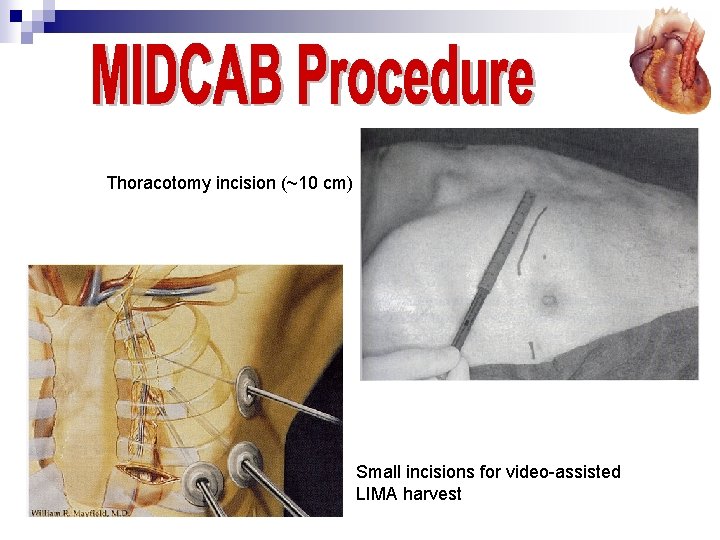
Thoracotomy incision (~10 cm) Small incisions for video-assisted LIMA harvest
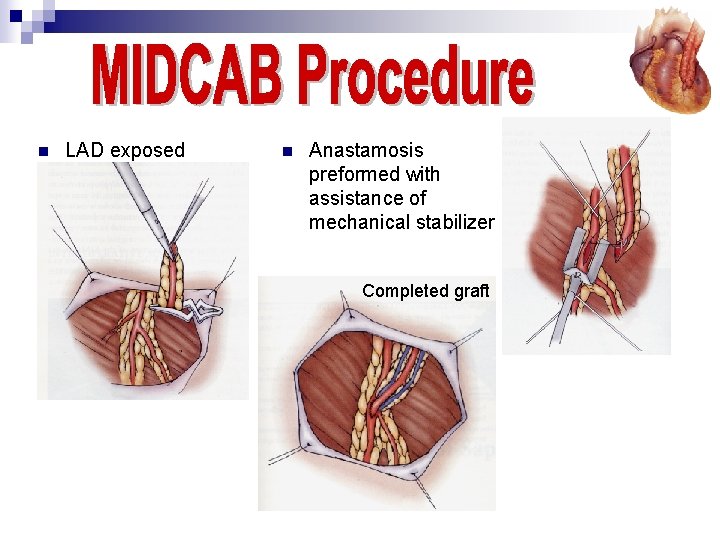
n LAD exposed n Anastamosis preformed with assistance of mechanical stabilizer Completed graft
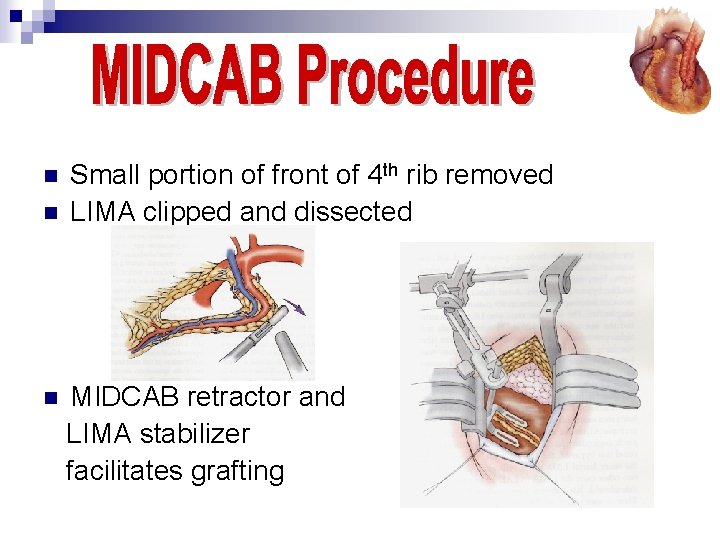
n n n Small portion of front of 4 th rib removed LIMA clipped and dissected MIDCAB retractor and LIMA stabilizer facilitates grafting
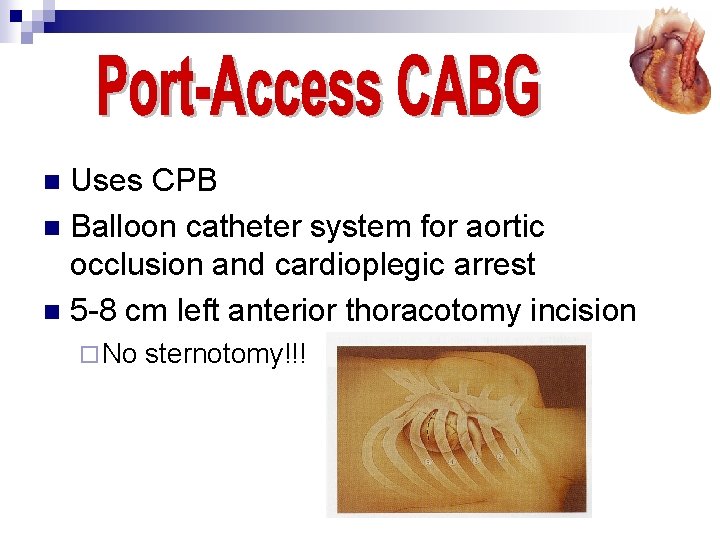
Uses CPB n Balloon catheter system for aortic occlusion and cardioplegic arrest n 5 -8 cm left anterior thoracotomy incision n ¨ No sternotomy!!!
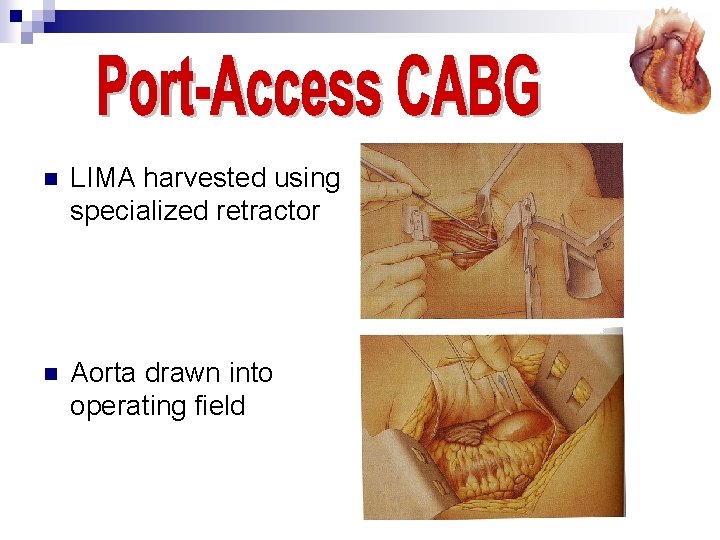
n LIMA harvested using specialized retractor n Aorta drawn into operating field
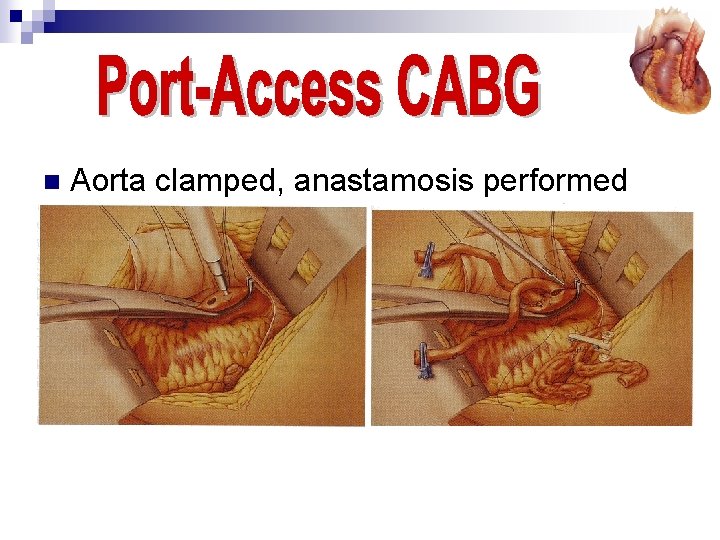
n Aorta clamped, anastamosis performed
n Benefits: ¨ Bloodless field ¨ Heart arrested n allows more accurate anastomoses than MIDCAB ¨ Smaller incision than CABG ¨ No sternotomy n Drawbacks ¨ Uses CPB ¨ Technically very difficult
n Currently, stenting is recommended over surgery for one-vessel disease ¨ In the future, drug-eluting stents will probably be used ¨ Minimally invasive surgeries could be used in place of stents in diabetic, and other high-risk patients n For more than one-vessel disease, surgery is substantially better at preventing restenosis and so will likely continue to be used in the future ¨ Minimally invasive surgeries will expand replace most conventional CABG procedures

THANK YOU
- Slides: 29