
Coronary Arteries Supply arterial blood to heart muscle
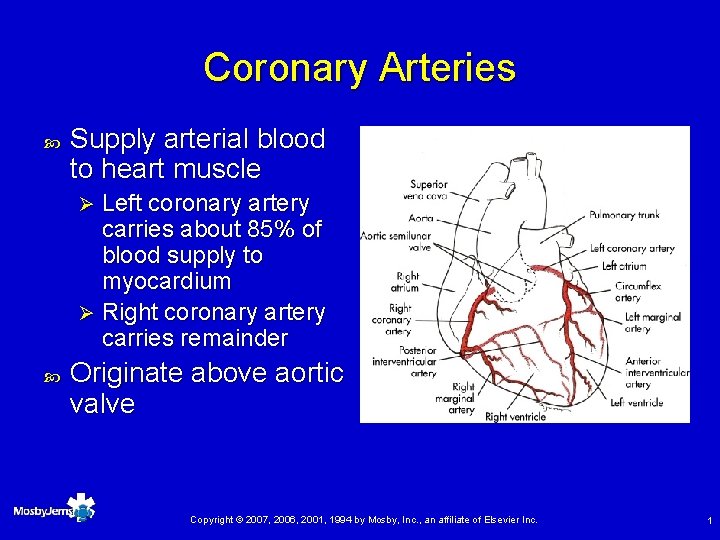
Coronary Arteries Supply arterial blood to heart muscle Left coronary artery carries about 85% of blood supply to myocardium Ø Right coronary artery carries remainder Ø Originate above aortic valve Copyright © 2007, 2006, 2001, 1994 by Mosby, Inc. , an affiliate of Elsevier Inc. 1

Left Coronary Artery Divides into left anterior descending and circumflex arteries Ø Left anterior descending (LAD) supplies: • Anterior wall of left ventricle • Interventricular septum Ø Circumflex supplies: • Lateral and posterior portions of left ventricle • Part of right ventricle Copyright © 2007, 2006, 2001, 1994 by Mosby, Inc. , an affiliate of Elsevier Inc. 2
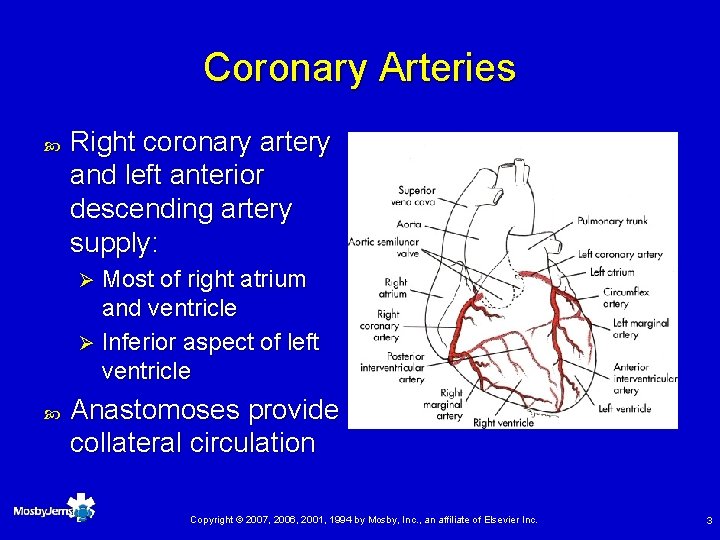
Coronary Arteries Right coronary artery and left anterior descending artery supply: Most of right atrium and ventricle Ø Inferior aspect of left ventricle Ø Anastomoses provide collateral circulation Copyright © 2007, 2006, 2001, 1994 by Mosby, Inc. , an affiliate of Elsevier Inc. 3
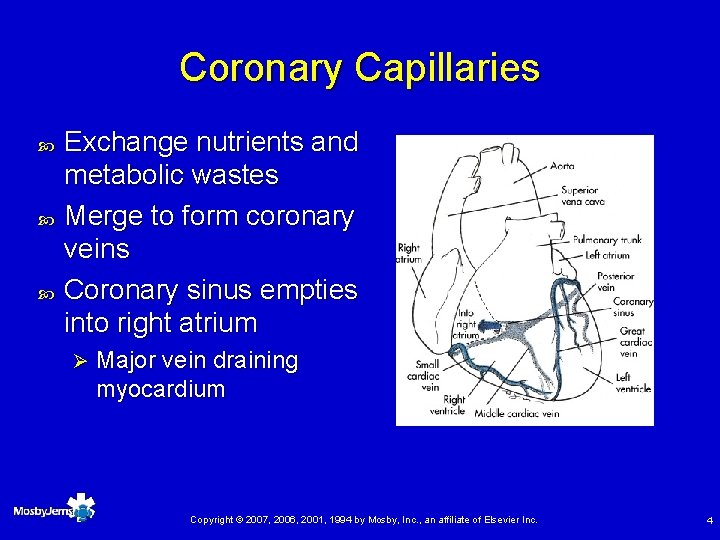
Coronary Capillaries Exchange nutrients and metabolic wastes Merge to form coronary veins Coronary sinus empties into right atrium Ø Major vein draining myocardium Copyright © 2007, 2006, 2001, 1994 by Mosby, Inc. , an affiliate of Elsevier Inc. 4
ECG Leads Two surface electrodes of opposite polarity Bipolar lead • Two electrodes of opposite polarity Ø Unipolar lead • Single positive electrode and reference point Ø Copyright © 2007, 2006, 2001, 1994 by Mosby, Inc. , an affiliate of Elsevier Inc. 5
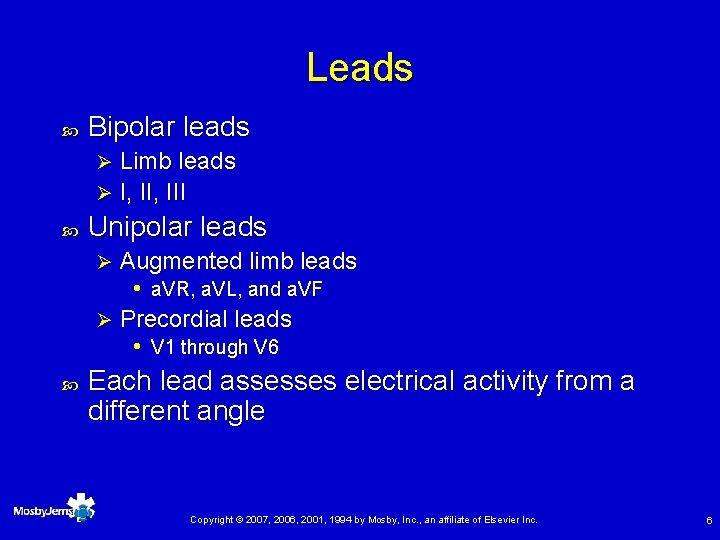
Leads Bipolar leads Limb leads Ø I, III Ø Unipolar leads Augmented limb leads • a. VR, a. VL, and a. VF Ø Precordial leads • V 1 through V 6 Ø Each lead assesses electrical activity from a different angle Copyright © 2007, 2006, 2001, 1994 by Mosby, Inc. , an affiliate of Elsevier Inc. 6

Lead Comparison I, III Limb lead Bipolar a. VR, a. VL, a. VF Limb lead Unipolar V 1 -V 6 Chest lead Unipolar Copyright © 2007, 2006, 2001, 1994 by Mosby, Inc. , an affiliate of Elsevier Inc. 7
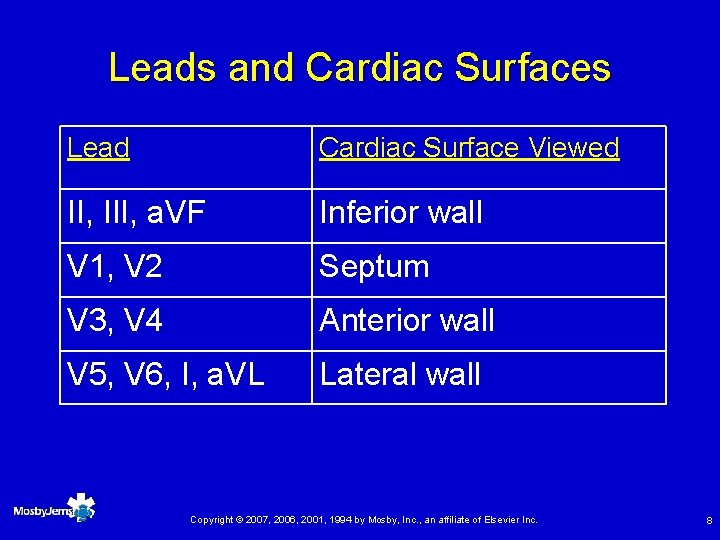
Leads and Cardiac Surfaces Lead Cardiac Surface Viewed II, III, a. VF Inferior wall V 1, V 2 Septum V 3, V 4 Anterior wall V 5, V 6, I, a. VL Lateral wall Copyright © 2007, 2006, 2001, 1994 by Mosby, Inc. , an affiliate of Elsevier Inc. 8
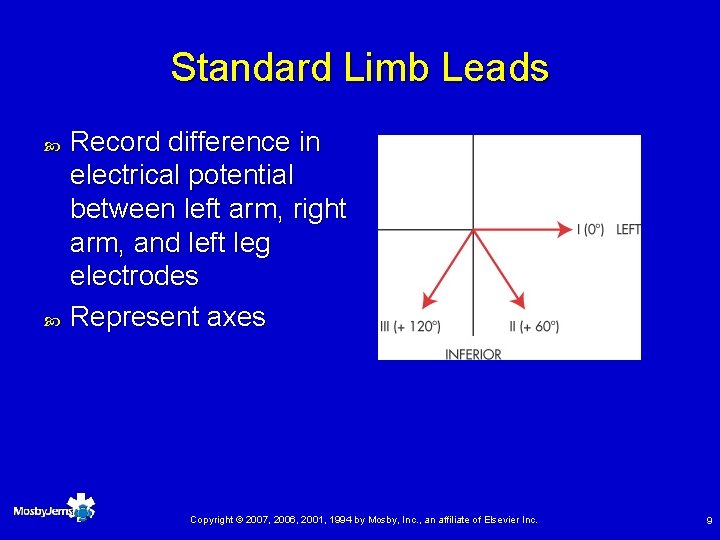
Standard Limb Leads Record difference in electrical potential between left arm, right arm, and left leg electrodes Represent axes Copyright © 2007, 2006, 2001, 1994 by Mosby, Inc. , an affiliate of Elsevier Inc. 9

Axis Average direction of the heart’s electrical activity Triaxial reference system Copyright © 2007, 2006, 2001, 1994 by Mosby, Inc. , an affiliate of Elsevier Inc. 10

Axis Lead I is a lateral (leftward) lead Ø Assesses electrical activity from a viewpoint defined as 0° on a circle divided into an upper negative 180° and a lower positive 180° Copyright © 2007, 2006, 2001, 1994 by Mosby, Inc. , an affiliate of Elsevier Inc. 11

Axis Leads II and III are inferior leads Ø Assess the heart's electrical activity from vantage points of +60° and +120° Copyright © 2007, 2006, 2001, 1994 by Mosby, Inc. , an affiliate of Elsevier Inc. 12
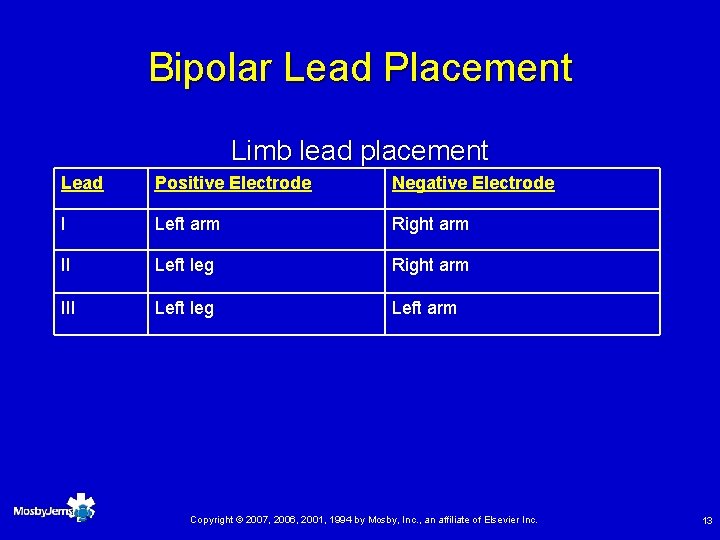
Bipolar Lead Placement Limb lead placement Lead Positive Electrode Negative Electrode I Left arm Right arm II Left leg Right arm III Left leg Left arm Copyright © 2007, 2006, 2001, 1994 by Mosby, Inc. , an affiliate of Elsevier Inc. 13
Augmented Limb Leads Same electrodes as limb leads Record difference in electrical potential between extremity lead sites and a reference point Zero electrical potential Ø At center of the heart’s electrical field Ø Copyright © 2007, 2006, 2001, 1994 by Mosby, Inc. , an affiliate of Elsevier Inc. 14
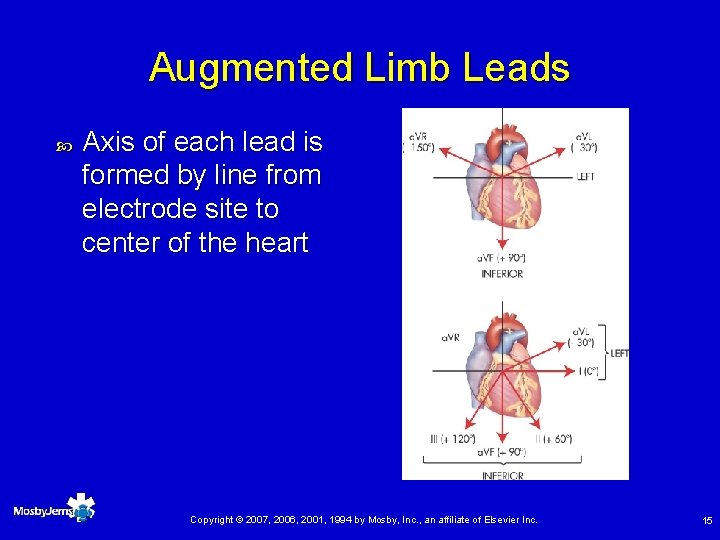
Augmented Limb Leads Axis of each lead is formed by line from electrode site to center of the heart Copyright © 2007, 2006, 2001, 1994 by Mosby, Inc. , an affiliate of Elsevier Inc. 15
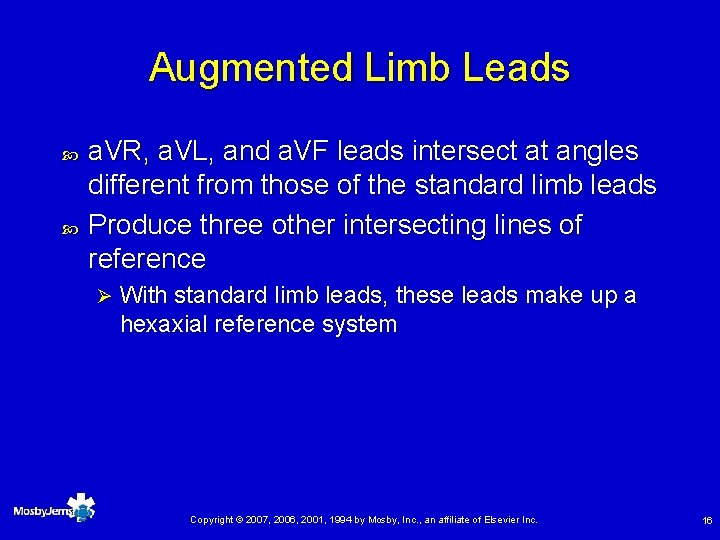
Augmented Limb Leads a. VR, a. VL, and a. VF leads intersect at angles different from those of the standard limb leads Produce three other intersecting lines of reference Ø With standard limb leads, these leads make up a hexaxial reference system Copyright © 2007, 2006, 2001, 1994 by Mosby, Inc. , an affiliate of Elsevier Inc. 16
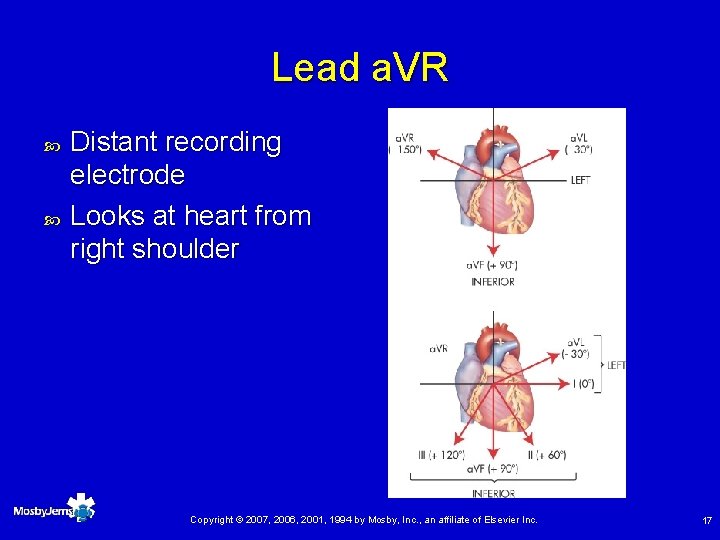
Lead a. VR Distant recording electrode Looks at heart from right shoulder Copyright © 2007, 2006, 2001, 1994 by Mosby, Inc. , an affiliate of Elsevier Inc. 17
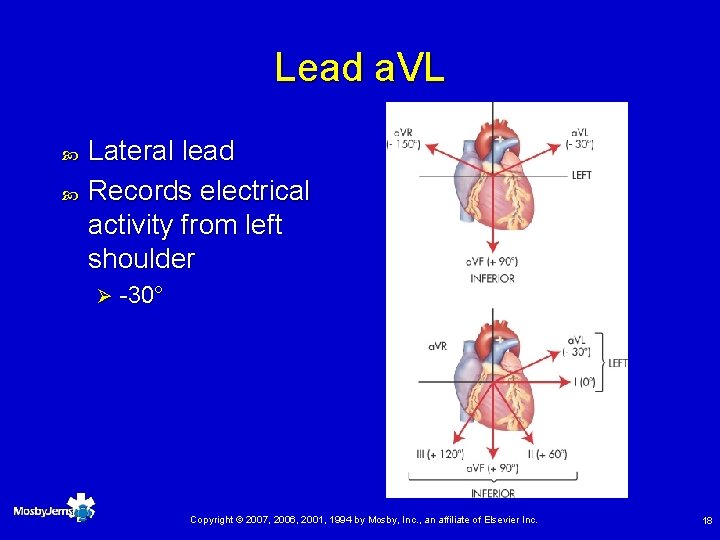
Lead a. VL Lateral lead Records electrical activity from left shoulder Ø -30° Copyright © 2007, 2006, 2001, 1994 by Mosby, Inc. , an affiliate of Elsevier Inc. 18
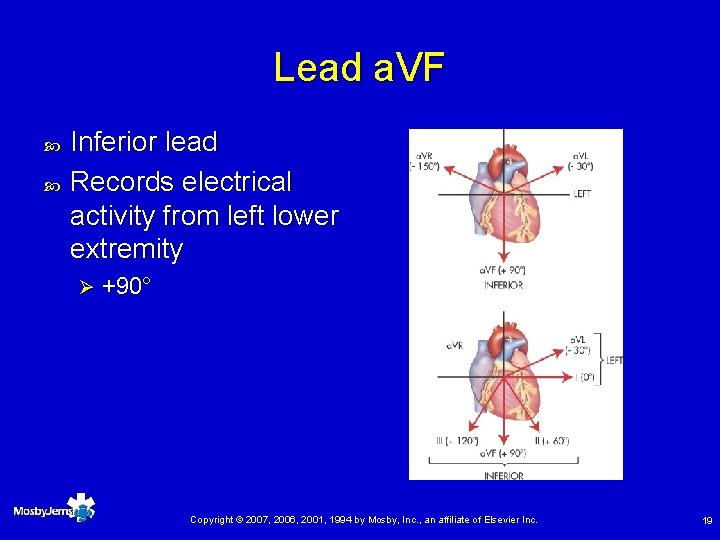
Lead a. VF Inferior lead Records electrical activity from left lower extremity Ø +90° Copyright © 2007, 2006, 2001, 1994 by Mosby, Inc. , an affiliate of Elsevier Inc. 19

Limb Leads II, III, a. VF Ø Inferior leads I, a. VL Ø Lateral leads Copyright © 2007, 2006, 2001, 1994 by Mosby, Inc. , an affiliate of Elsevier Inc. 20

Modified Lead Recording Limb lead placement altered to mimic precordial leads (V 1 through V 6) Modified chest leads Ø MCL 1 to MCL 6 Ø May help: Distinguish between supraventricular tachycardia with aberration and ventricular tachycardia Ø Diagnose bundle branch blocks Ø Copyright © 2007, 2006, 2001, 1994 by Mosby, Inc. , an affiliate of Elsevier Inc. 21
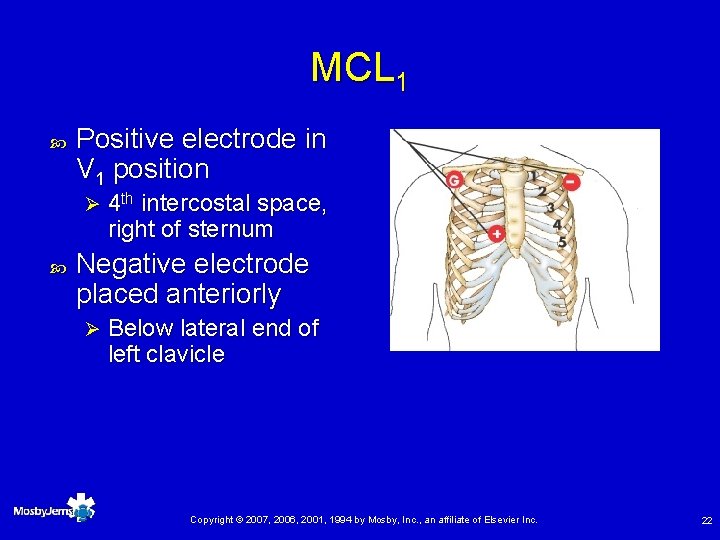
MCL 1 Positive electrode in V 1 position Ø 4 th intercostal space, right of sternum Negative electrode placed anteriorly Ø Below lateral end of left clavicle Copyright © 2007, 2006, 2001, 1994 by Mosby, Inc. , an affiliate of Elsevier Inc. 22
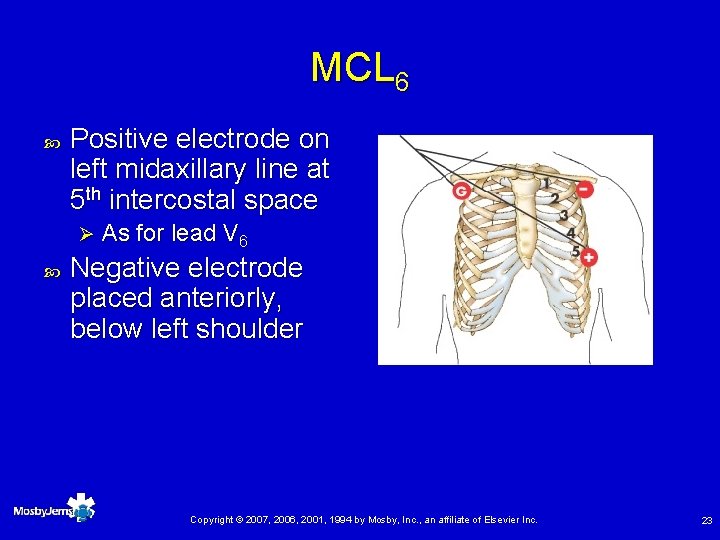
MCL 6 Positive electrode on left midaxillary line at 5 th intercostal space Ø As for lead V 6 Negative electrode placed anteriorly, below left shoulder Copyright © 2007, 2006, 2001, 1994 by Mosby, Inc. , an affiliate of Elsevier Inc. 23
12 -Lead ECG Monitoring 10 electrodes Four limb leads (right arm, right leg, left arm, left leg) • Leads I, II, and III, and a. VF, a. VL, and a. VR Ø Six chest leads • V 1 through V 6 Ø Copyright © 2007, 2006, 2001, 1994 by Mosby, Inc. , an affiliate of Elsevier Inc. 24
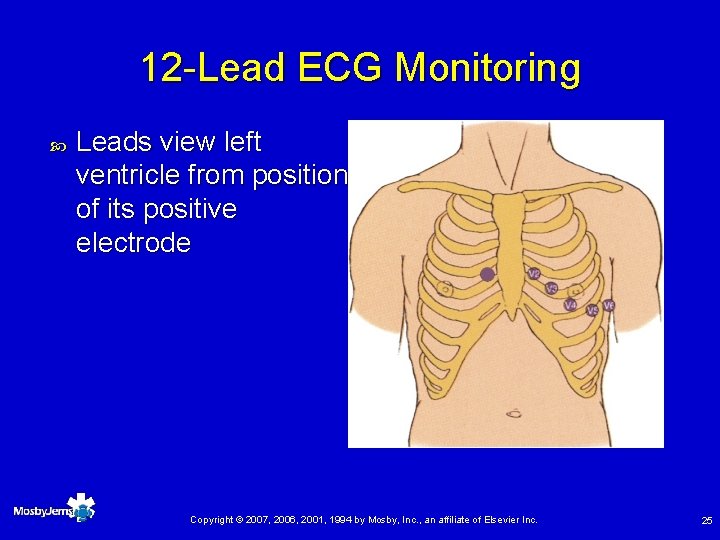
12 -Lead ECG Monitoring Leads view left ventricle from position of its positive electrode Copyright © 2007, 2006, 2001, 1994 by Mosby, Inc. , an affiliate of Elsevier Inc. 25
12 -Lead ECG Monitoring Identifies ST segment and T-wave changes Ø Identifies VT in wide-complex tachycardia Determines electrical axis Ø Myocardial ischemia, injury, and infarction Presence of fascicular blocks Determines presence and location of bundle branch blocks Copyright © 2007, 2006, 2001, 1994 by Mosby, Inc. , an affiliate of Elsevier Inc. 26
Precordial Leads Six precordial leads are projected through anterior chest wall toward back Positive leads are placed on chest in reference to thoracic landmarks Ø Record electrical activity in transverse or horizontal plane Copyright © 2007, 2006, 2001, 1994 by Mosby, Inc. , an affiliate of Elsevier Inc. 27
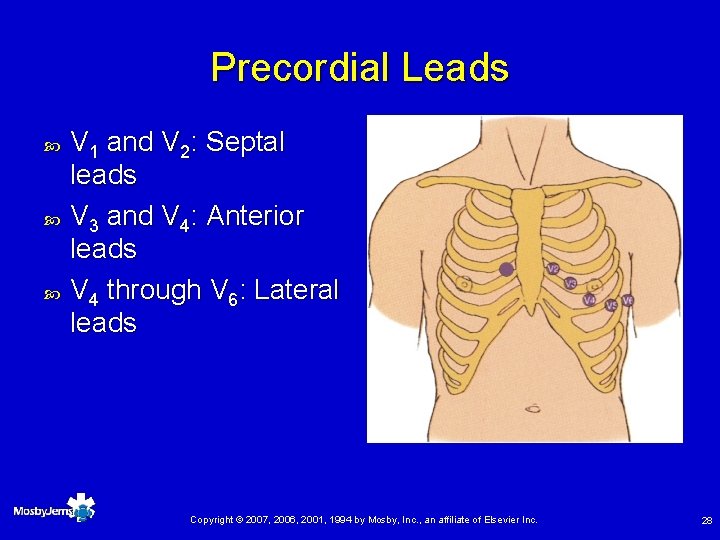
Precordial Leads V 1 and V 2: Septal leads V 3 and V 4: Anterior leads V 4 through V 6: Lateral leads Copyright © 2007, 2006, 2001, 1994 by Mosby, Inc. , an affiliate of Elsevier Inc. 28
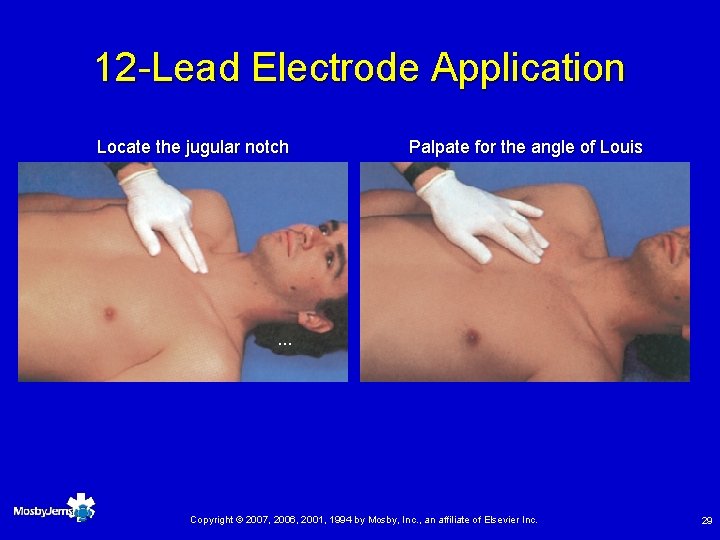
12 -Lead Electrode Application Locate the jugular notch Palpate for the angle of Louis . . . Copyright © 2007, 2006, 2001, 1994 by Mosby, Inc. , an affiliate of Elsevier Inc. 29
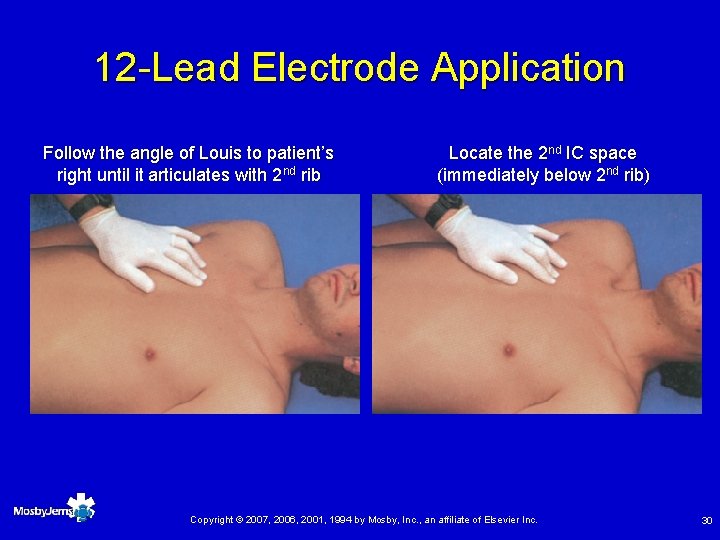
12 -Lead Electrode Application Follow the angle of Louis to patient’s right until it articulates with 2 nd rib Locate the 2 nd IC space (immediately below 2 nd rib) Copyright © 2007, 2006, 2001, 1994 by Mosby, Inc. , an affiliate of Elsevier Inc. 30
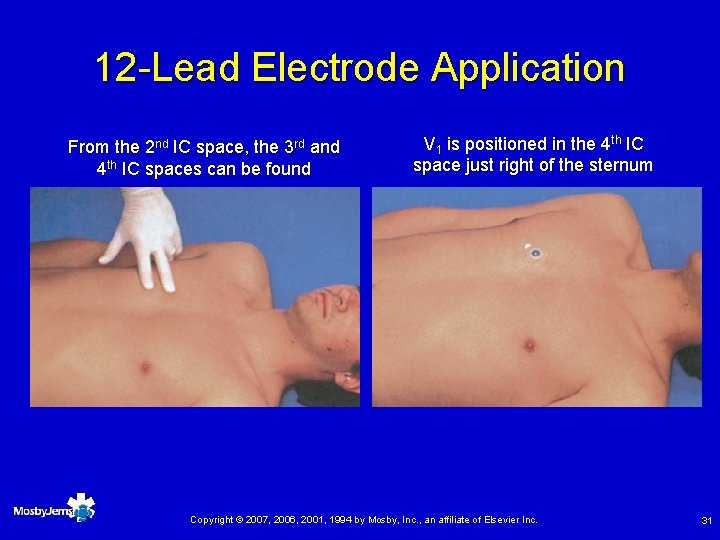
12 -Lead Electrode Application From the 2 nd IC space, the 3 rd and 4 th IC spaces can be found V 1 is positioned in the 4 th IC space just right of the sternum Copyright © 2007, 2006, 2001, 1994 by Mosby, Inc. , an affiliate of Elsevier Inc. 31
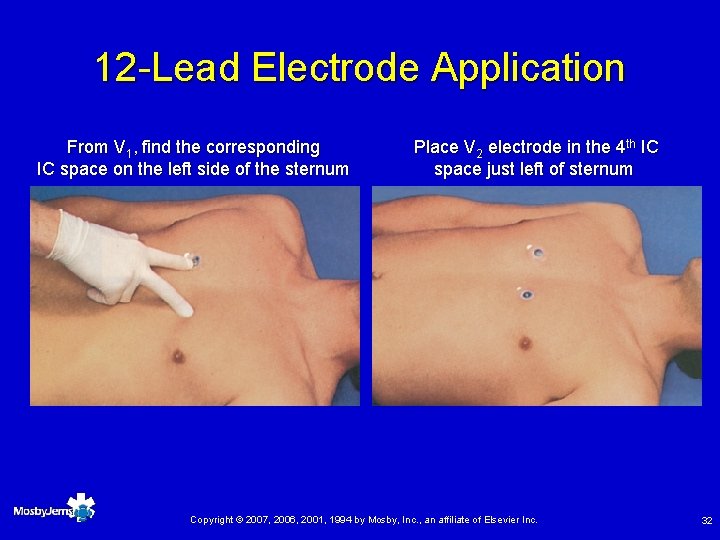
12 -Lead Electrode Application From V 1, find the corresponding IC space on the left side of the sternum Place V 2 electrode in the 4 th IC space just left of sternum Copyright © 2007, 2006, 2001, 1994 by Mosby, Inc. , an affiliate of Elsevier Inc. 32
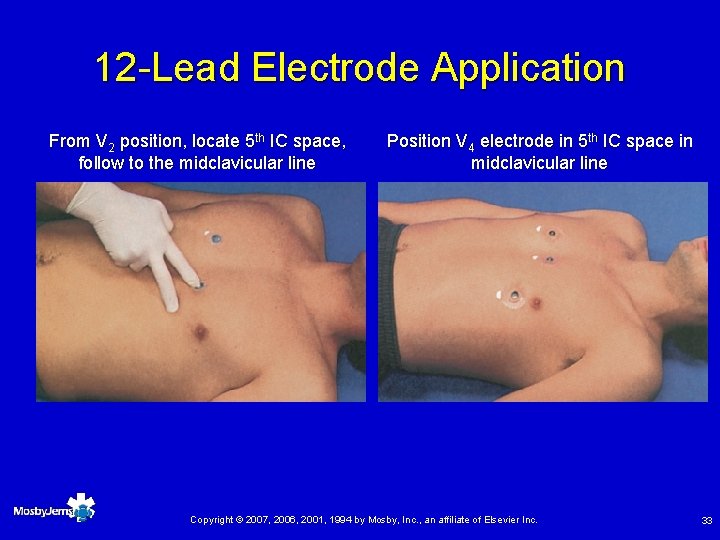
12 -Lead Electrode Application From V 2 position, locate 5 th IC space, follow to the midclavicular line Position V 4 electrode in 5 th IC space in midclavicular line Copyright © 2007, 2006, 2001, 1994 by Mosby, Inc. , an affiliate of Elsevier Inc. 33
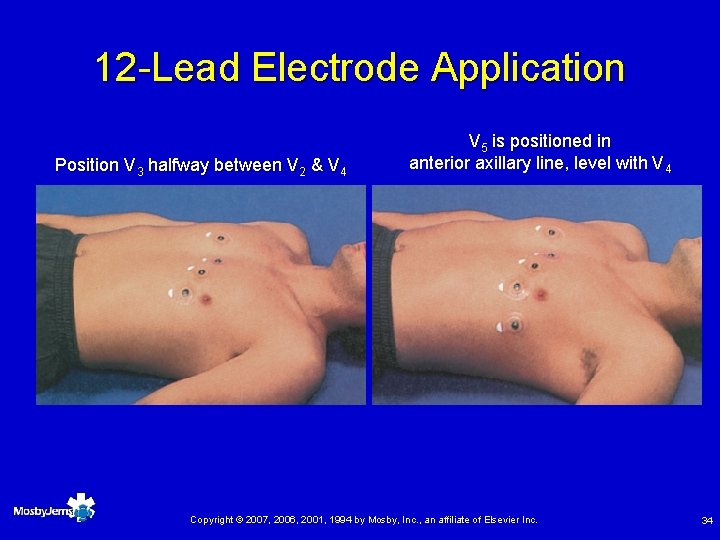
12 -Lead Electrode Application Position V 3 halfway between V 2 & V 4 V 5 is positioned in anterior axillary line, level with V 4 Copyright © 2007, 2006, 2001, 1994 by Mosby, Inc. , an affiliate of Elsevier Inc. 34
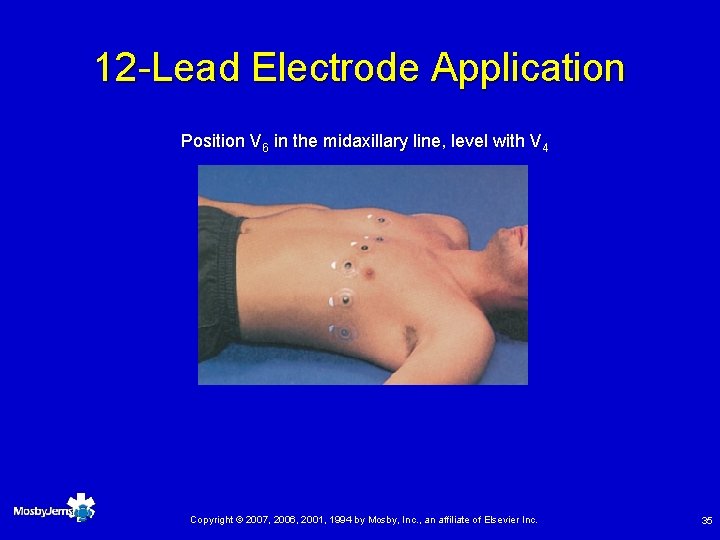
12 -Lead Electrode Application Position V 6 in the midaxillary line, level with V 4 Copyright © 2007, 2006, 2001, 1994 by Mosby, Inc. , an affiliate of Elsevier Inc. 35
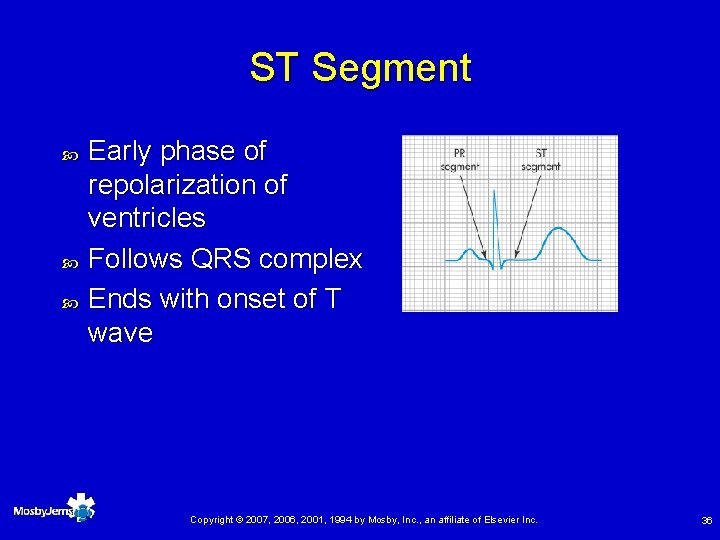
ST Segment Early phase of repolarization of ventricles Follows QRS complex Ends with onset of T wave Copyright © 2007, 2006, 2001, 1994 by Mosby, Inc. , an affiliate of Elsevier Inc. 36
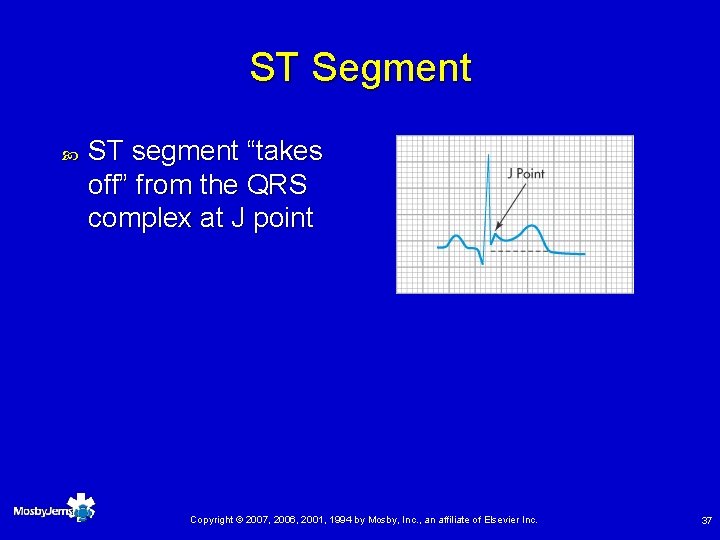
ST Segment ST segment “takes off” from the QRS complex at J point Copyright © 2007, 2006, 2001, 1994 by Mosby, Inc. , an affiliate of Elsevier Inc. 37
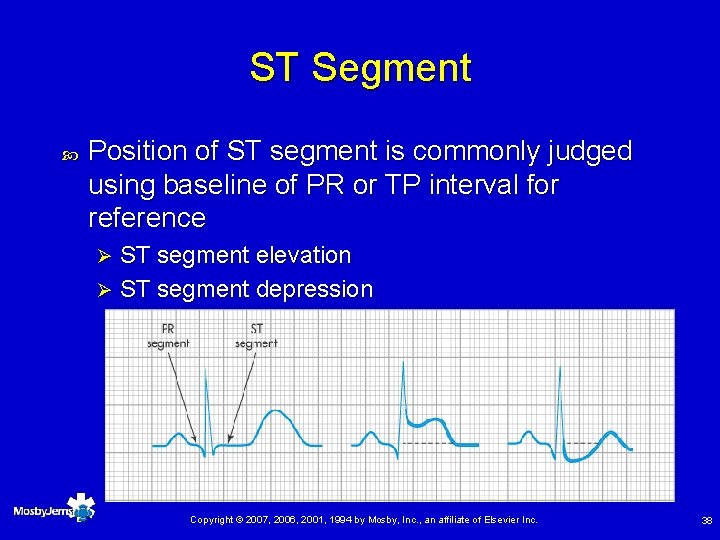
ST Segment Position of ST segment is commonly judged using baseline of PR or TP interval for reference ST segment elevation Ø ST segment depression Ø Copyright © 2007, 2006, 2001, 1994 by Mosby, Inc. , an affiliate of Elsevier Inc. 38
ST Segment Abnormal ST segments Infarction Ø Ischemia Ø Pericarditis Ø After digitalis administration Ø Other disease states Ø Copyright © 2007, 2006, 2001, 1994 by Mosby, Inc. , an affiliate of Elsevier Inc. 39
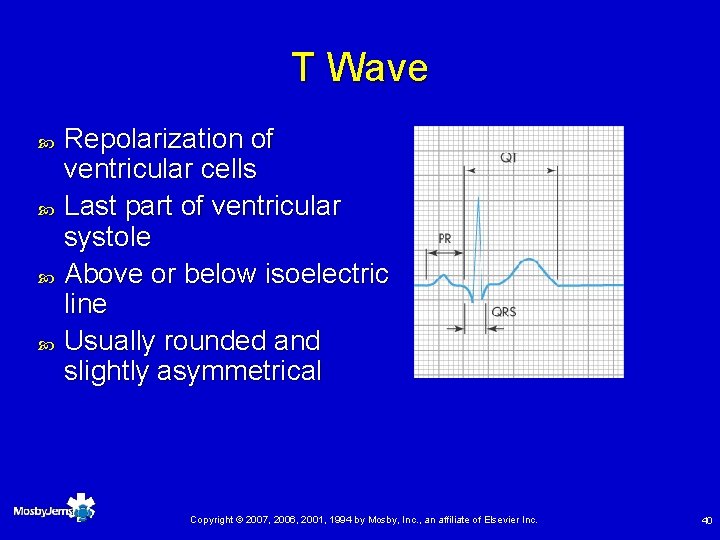
T Wave Repolarization of ventricular cells Last part of ventricular systole Above or below isoelectric line Usually rounded and slightly asymmetrical Copyright © 2007, 2006, 2001, 1994 by Mosby, Inc. , an affiliate of Elsevier Inc. 40
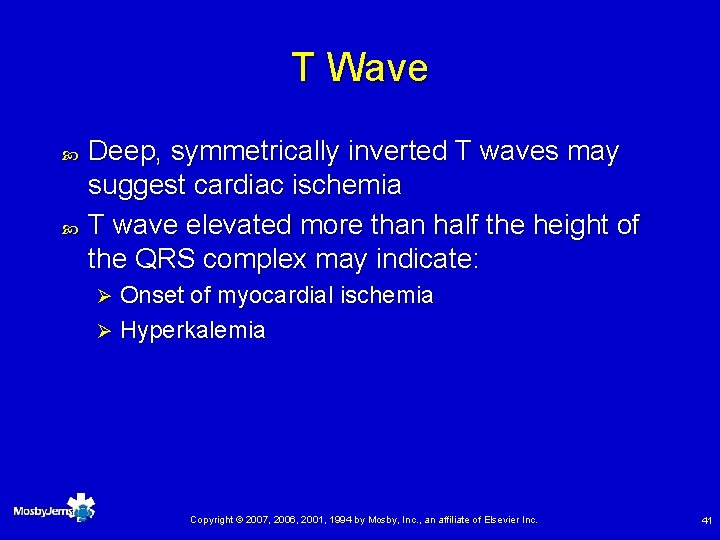
T Wave Deep, symmetrically inverted T waves may suggest cardiac ischemia T wave elevated more than half the height of the QRS complex may indicate: Onset of myocardial ischemia Ø Hyperkalemia Ø Copyright © 2007, 2006, 2001, 1994 by Mosby, Inc. , an affiliate of Elsevier Inc. 41
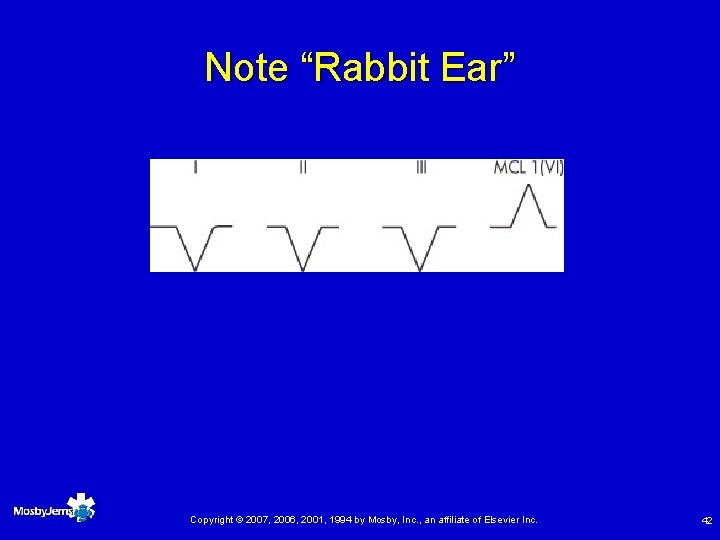
Note “Rabbit Ear” Copyright © 2007, 2006, 2001, 1994 by Mosby, Inc. , an affiliate of Elsevier Inc. 42
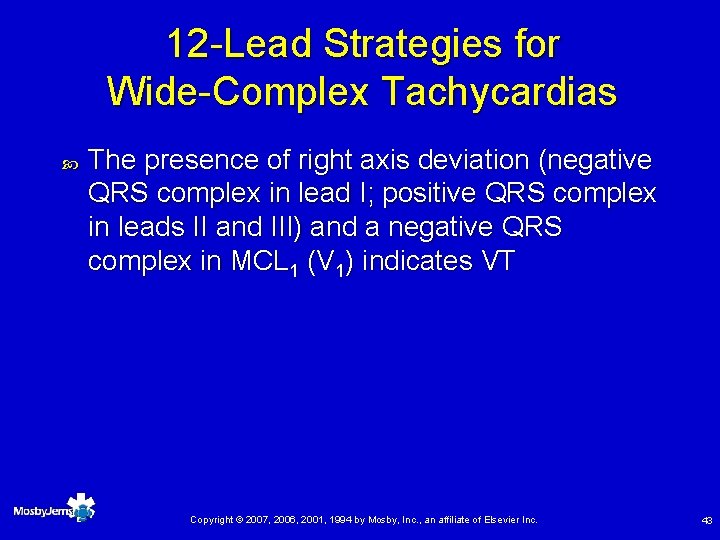
12 -Lead Strategies for Wide-Complex Tachycardias The presence of right axis deviation (negative QRS complex in lead I; positive QRS complex in leads II and III) and a negative QRS complex in MCL 1 (V 1) indicates VT Copyright © 2007, 2006, 2001, 1994 by Mosby, Inc. , an affiliate of Elsevier Inc. 43
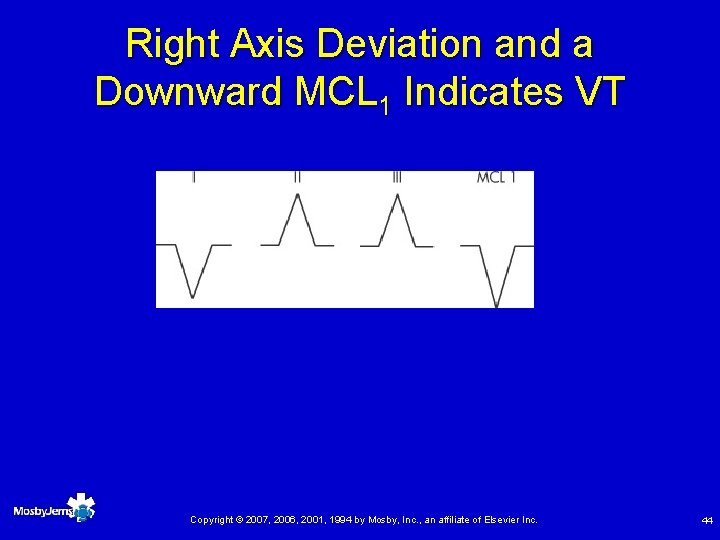
Right Axis Deviation and a Downward MCL 1 Indicates VT Copyright © 2007, 2006, 2001, 1994 by Mosby, Inc. , an affiliate of Elsevier Inc. 44
12 -Lead Strategies for Wide-Complex Tachycardias VT if: Ø All precordial leads (V leads) are either positive or negative • Precordial concordance Copyright © 2007, 2006, 2001, 1994 by Mosby, Inc. , an affiliate of Elsevier Inc. 45
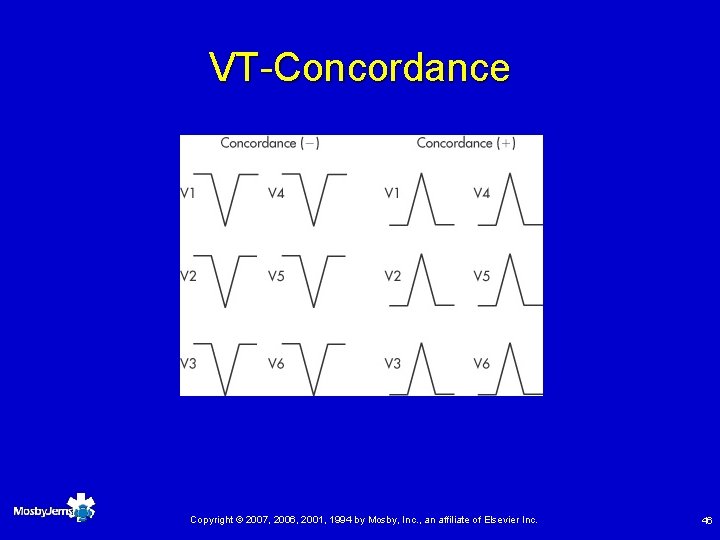
VT-Concordance Copyright © 2007, 2006, 2001, 1994 by Mosby, Inc. , an affiliate of Elsevier Inc. 46
12 -Lead Strategies for Wide-Complex Tachycardias RS interval >0. 10 sec in any V lead indicates VT Increased ventricular activation time Copyright © 2007, 2006, 2001, 1994 by Mosby, Inc. , an affiliate of Elsevier Inc. 47
Ventricular Conduction Disturbances Bundle branch blocks or hemiblocks Delay electrical transmission below bundle of His Copyright © 2007, 2006, 2001, 1994 by Mosby, Inc. , an affiliate of Elsevier Inc. 48
Bundle Branch Blocks and Hemiblocks Common causes of bundle branch block Ischemic heart disease Ø Acute heart failure Ø Acute myocardial infarction Ø Hyperkalemia Ø Trauma Ø Cardiomyopathy Ø Aortic stenosis Ø Infection Ø Copyright © 2007, 2006, 2001, 1994 by Mosby, Inc. , an affiliate of Elsevier Inc. 49
Bundle Branch Anatomy Bundle of His divides: Left and right bundle branches Ø Right bundle branch continues toward apex and spreads through right ventricle Ø Left bundle branch subdivides into anterior and posterior fascicles and spreads through left ventricle Ø Electrical impulse conduction through Purkinje fibers stimulates ventricular contraction Copyright © 2007, 2006, 2001, 1994 by Mosby, Inc. , an affiliate of Elsevier Inc. 50
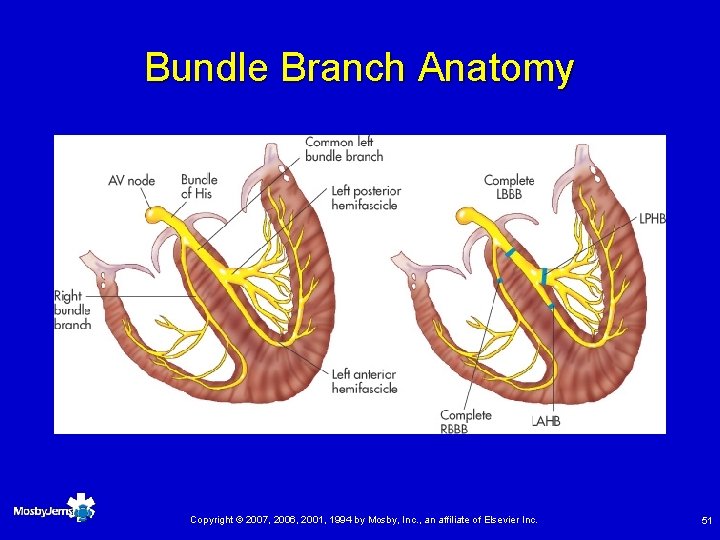
Bundle Branch Anatomy Copyright © 2007, 2006, 2001, 1994 by Mosby, Inc. , an affiliate of Elsevier Inc. 51
Bundle Branch Anatomy Normal conduction Left side of septum is stimulated first Ø Electrical impulse traverses septum to stimulate other side Ø Left and right ventricles are then simultaneously stimulated Ø Copyright © 2007, 2006, 2001, 1994 by Mosby, Inc. , an affiliate of Elsevier Inc. 52
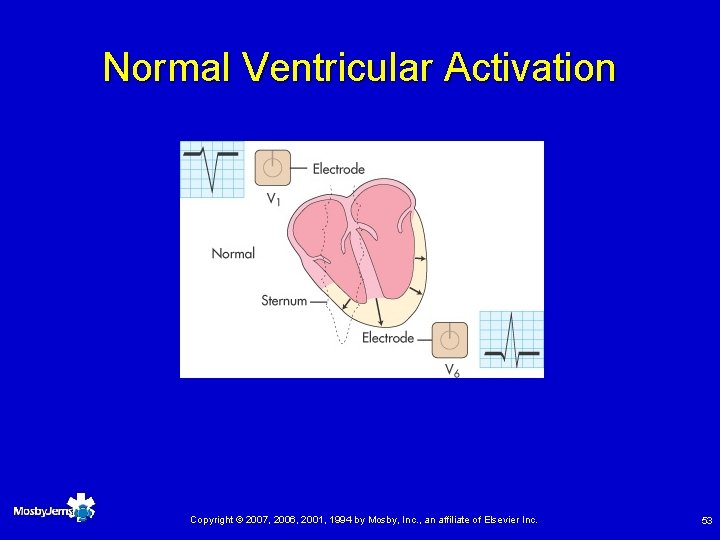
Normal Ventricular Activation Copyright © 2007, 2006, 2001, 1994 by Mosby, Inc. , an affiliate of Elsevier Inc. 53
Bundle Branch Block—ECG One ventricle depolarizes and contracts before the other Ventricular activation is not simultaneous, therefore QRS complex widens Ø Slurred or notched appearance • “Rabbit ears” QRS complex is >0. 12 sec Copyright © 2007, 2006, 2001, 1994 by Mosby, Inc. , an affiliate of Elsevier Inc. 54

Bundle Branch Block Criteria for bundle branch block QRS complex >0. 12 sec Ø QRS complexes produced by supraventricular activity Ø Copyright © 2007, 2006, 2001, 1994 by Mosby, Inc. , an affiliate of Elsevier Inc. 55
Bundle Branch Block Leads V 1 and V 6 MCL 1 and MCL 6 Ø Permit differentiation of right and left bundle branch blocks Ø Normal conduction V 1 (MCL 1) is predominantly negative Ø QRS complex is 0. 08 -0. 10 sec Ø Copyright © 2007, 2006, 2001, 1994 by Mosby, Inc. , an affiliate of Elsevier Inc. 56
Right Bundle Branch Block Left bundle branch performs normally Activates left side of heart before right ECG characteristics Initial negative deflection (S wave) Ø RSR-prime pattern Ø QRS (or in this case, RSR) duration >0. 12 sec Ø Copyright © 2007, 2006, 2001, 1994 by Mosby, Inc. , an affiliate of Elsevier Inc. 57
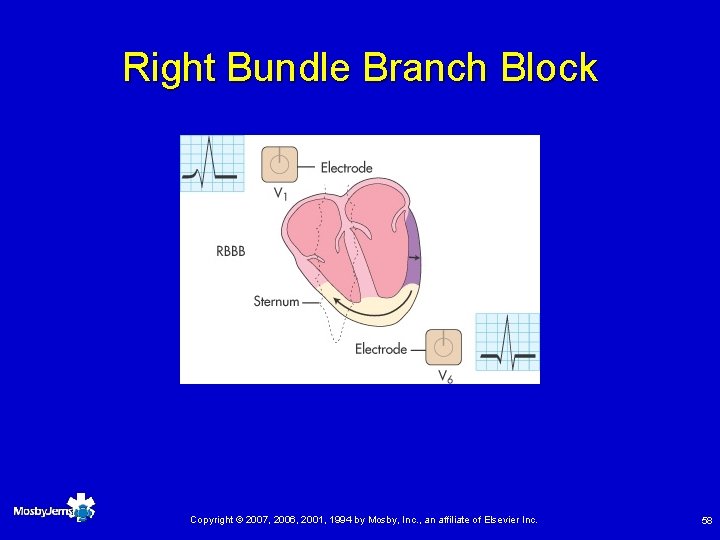
Right Bundle Branch Block Copyright © 2007, 2006, 2001, 1994 by Mosby, Inc. , an affiliate of Elsevier Inc. 58
Left Bundle Branch Block Fibers that fire interventricular septum are blocked: Alters normal septal activation Ø Sends it in opposite direction Ø ECG characteristics Initial Q wave in V 1 (MCL 1) Ø R wave in V 1 (MCL 1) Ø Deep, wide S wave (QS pattern) Ø QRS duration >0. 12 sec Ø Copyright © 2007, 2006, 2001, 1994 by Mosby, Inc. , an affiliate of Elsevier Inc. 59
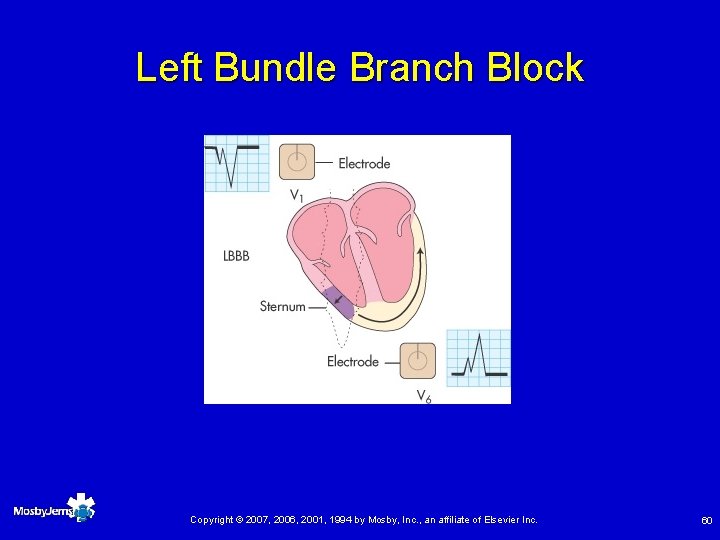
Left Bundle Branch Block Copyright © 2007, 2006, 2001, 1994 by Mosby, Inc. , an affiliate of Elsevier Inc. 60

Left vs. Right BBB Find J point Draw line back into QRS complex Fill in triangle created Note direction triangle points Copyright © 2007, 2006, 2001, 1994 by Mosby, Inc. , an affiliate of Elsevier Inc. 61
Anterior Hemiblock More common than posterior hemiblock Anterior fascicle of left bundle branch is a longer and thinner structure Blood supply primarily from left anterior descending (LAD) coronary artery Anterior hemiblock characterized by left axis deviation in patient with supraventricular rhythm Copyright © 2007, 2006, 2001, 1994 by Mosby, Inc. , an affiliate of Elsevier Inc. 62
Anterior Hemiblock Other ECG findings in anterior hemiblock: Normal QRS complex (<0. 12 sec) or a right bundle branch block Ø Small Q wave followed by tall R wave in lead I Ø Small R wave followed by deep S wave in lead III Ø High risk to develop complete heart block Copyright © 2007, 2006, 2001, 1994 by Mosby, Inc. , an affiliate of Elsevier Inc. 63
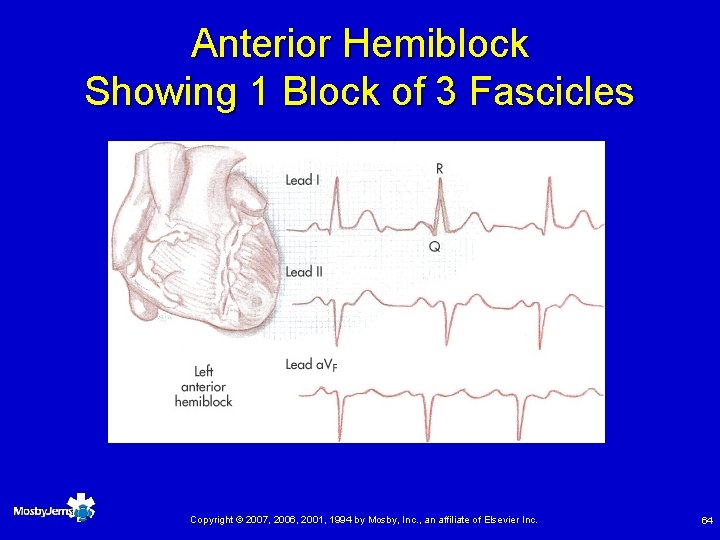
Anterior Hemiblock Showing 1 Block of 3 Fascicles Copyright © 2007, 2006, 2001, 1994 by Mosby, Inc. , an affiliate of Elsevier Inc. 64
Posterior Hemiblock Right axis deviation with normal QRS complex or right bundle branch block Other ECG findings Small R wave followed by deep S wave in lead I Ø Small Q wave followed by tall R wave in lead III Ø Copyright © 2007, 2006, 2001, 1994 by Mosby, Inc. , an affiliate of Elsevier Inc. 65
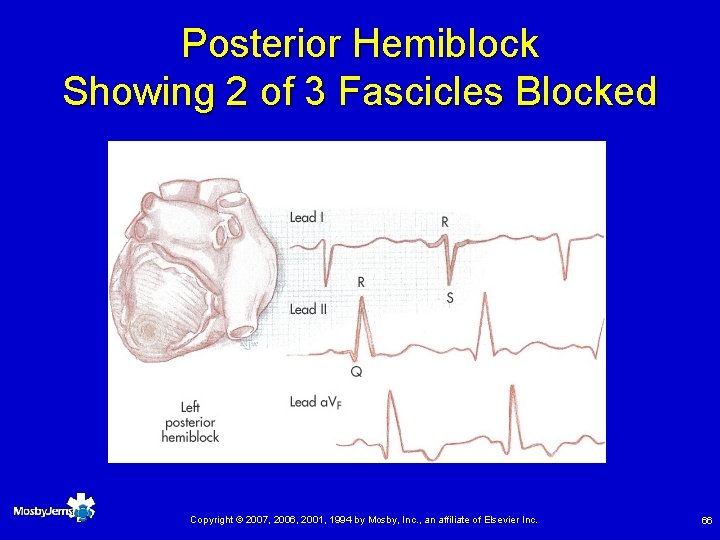
Posterior Hemiblock Showing 2 of 3 Fascicles Blocked Copyright © 2007, 2006, 2001, 1994 by Mosby, Inc. , an affiliate of Elsevier Inc. 66
Bifascicular Block 2 of 3 pathways for ventricular conduction blocked Right bundle branch block with anterior or posterior hemiblock Ø Left bundle branch block Ø Compromises myocardial contractility and cardiac output May develop complete heart block suddenly Copyright © 2007, 2006, 2001, 1994 by Mosby, Inc. , an affiliate of Elsevier Inc. 67
Multilead Determination of Axis and Hemiblocks Identifying axis can be useful in determining the presence of hemiblocks Best evaluated by looking at the QRS complexes in leads I, II, and III Copyright © 2007, 2006, 2001, 1994 by Mosby, Inc. , an affiliate of Elsevier Inc. 68
Multilead Determination of Axis and Hemiblocks Axis is: Normal if QRS deflection is positive in bipolar leads Ø Physiological left (normal in some patients) when QRS deflection is: • Positive in leads I and II • Negative (inverted) in lead III Ø Pathological left when QRS deflection is: • Positive in lead I • Negative in leads II and III (indicating an anterior hemiblock) Ø Copyright © 2007, 2006, 2001, 1994 by Mosby, Inc. , an affiliate of Elsevier Inc. 69
Multilead Determination of Axis and Hemiblocks Right axis when QRS deflection is: Negative in lead I, negative or positive in lead II Ø Positive in lead III (pathological in any adult) Ø Indicative of posterior hemiblock Ø Extreme right (“No man’s land”) when QRS deflection is negative in all three leads Ø Rhythm is ventricular in origin Copyright © 2007, 2006, 2001, 1994 by Mosby, Inc. , an affiliate of Elsevier Inc. 70
Acute Coronary Syndromes Acute myocardial infarction (AMI) Unstable angina (UA) Treatment goals Reduce myocardial necrosis Ø Prevent major adverse cardiac events Ø Treat acute complications of ACS Ø Copyright © 2007, 2006, 2001, 1994 by Mosby, Inc. , an affiliate of Elsevier Inc. 71
Atherosclerosis Progressive narrowing of lumen of medium and large arteries Ø Aorta and its branches, cerebral arteries, coronary arteries Development of thick, hard, atherosclerotic plaques called atheromas or atheromatous lesions Ø Commonly found in areas of turbulent blood flow Copyright © 2007, 2006, 2001, 1994 by Mosby, Inc. , an affiliate of Elsevier Inc. 72
Atherosclerosis—Risk Factors Age Earlier in men than women Family history Diabetes Smoking Hypertension Hypercholesterolemia Copyright © 2007, 2006, 2001, 1994 by Mosby, Inc. , an affiliate of Elsevier Inc. 73
Atherosclerosis—Effects Disrupts intimal surface, causing loss of vessel elasticity and increase in thrombogenesis Atheroma reduces diameter of vessel lumen Ø Decreases blood supply to tissues Ø Copyright © 2007, 2006, 2001, 1994 by Mosby, Inc. , an affiliate of Elsevier Inc. 74
Angina Pectoris Symptom of myocardial ischemia “Choking” pain in the chest Imbalance between myocardial oxygen supply and demand Accumulation of lactic acid and carbon dioxide in ischemic tissues of myocardium Ø Metabolites irritate nerve endings and produce pain Copyright © 2007, 2006, 2001, 1994 by Mosby, Inc. , an affiliate of Elsevier Inc. 75
Angina Pectoris Causes Atherosclerotic disease of the coronary arteries Ø Temporary occlusion due to coronary artery spasm with or without atherosclerosis • Prinzmetal's angina Ø Copyright © 2007, 2006, 2001, 1994 by Mosby, Inc. , an affiliate of Elsevier Inc. 76
Angina Pectoris Pain described as pressure, squeezing, heaviness, or tightness in chest 30% feel pain only in chest Ø Others describe as radiating to shoulders, arms, neck, and jaw and through to back Ø Associated signs and symptoms Anxiety Ø Shortness of breath Ø Nausea or vomiting Ø Diaphoresis Ø Copyright © 2007, 2006, 2001, 1994 by Mosby, Inc. , an affiliate of Elsevier Inc. 77
Stable Angina Usually caused by physical exertion or emotional stress Pain lasts 1 -5 min Ø May last as long as 15 min Relieved by rest, nitroglycerin, or oxygen “Attacks” are usually similar in nature Always relieved by same therapy Copyright © 2007, 2006, 2001, 1994 by Mosby, Inc. , an affiliate of Elsevier Inc. 78
Unstable Angina Preinfarction angina Anginal pattern that has changed in its ease of onset, frequency, intensity, duration, or quality Includes “new onset” anginal chest pain May occur during exercise or at rest Pain lasts >10 min Less promptly relieved than stable angina Copyright © 2007, 2006, 2001, 1994 by Mosby, Inc. , an affiliate of Elsevier Inc. 79
Unstable Angina—Management Place patient at rest Administer oxygen Administer aspirin (per protocol) IV therapy Pharmacological therapy Ø Ø Nitroglycerin Morphine Monitor ECG Transport as soon as possible Copyright © 2007, 2006, 2001, 1994 by Mosby, Inc. , an affiliate of Elsevier Inc. 80
Myocardial Infarction Sudden and total occlusion or near-occlusion of blood flowing through affected coronary artery Ischemia, injury, and necrosis of myocardium distal to occlusion Often associated with atherosclerotic heart disease (ASHD) Precipitating events Copyright © 2007, 2006, 2001, 1994 by Mosby, Inc. , an affiliate of Elsevier Inc. 81
Types and Locations of Infarcts Infarction distal to occluded artery Size of infarct determined by: Metabolic needs of tissue supplied by occluded vessel Ø Collateral circulation Ø Time until flow is reestablished Ø Copyright © 2007, 2006, 2001, 1994 by Mosby, Inc. , an affiliate of Elsevier Inc. 82
Types and Locations of Infarcts Emergency care Increasing oxygen supply Ø Decreasing metabolic needs Ø Providing collateral circulation Ø Reestablishing perfusion to ischemic myocardium quickly Ø Copyright © 2007, 2006, 2001, 1994 by Mosby, Inc. , an affiliate of Elsevier Inc. 83
Types and Locations of Infarcts Most AMIs involve ventricle or interventricular septum, which is supplied by either of two major coronary arteries Ø Some patients sustain damage to right ventricle Copyright © 2007, 2006, 2001, 1994 by Mosby, Inc. , an affiliate of Elsevier Inc. 84
Types and Locations of Infarcts Anterior, lateral, or septal wall infarction Ø Usually left coronary artery occlusion Inferior wall infarction Ø Usually right coronary artery occlusion Copyright © 2007, 2006, 2001, 1994 by Mosby, Inc. , an affiliate of Elsevier Inc. 85
Myocardial Infarction Three ischemic syndromes Based on rupture of an unstable plaque in an epicardial artery Unstable angina Ø Non-ST-elevation myocardial infarction Ø Copyright © 2007, 2006, 2001, 1994 by Mosby, Inc. , an affiliate of Elsevier Inc. 86
Infarction Unstable angina Thrombus has not completely obstructed coronary flow Ø Intermittent ischemic episode Ø May lead to complete occlusion and AMI Ø Non-ST-elevation MI ST-segment depression Ø T-wave abnormalities Ø Copyright © 2007, 2006, 2001, 1994 by Mosby, Inc. , an affiliate of Elsevier Inc. 87
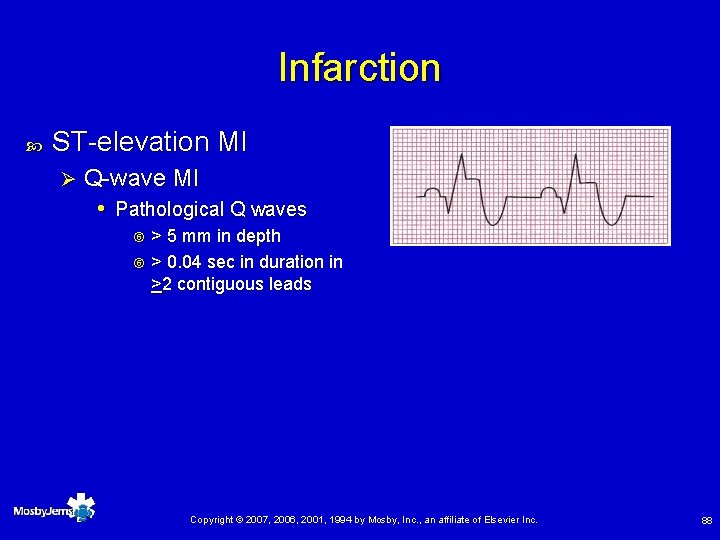
Infarction ST-elevation MI Ø Q-wave MI • Pathological Q waves > 5 mm in depth > 0. 04 sec in duration in >2 contiguous leads Copyright © 2007, 2006, 2001, 1994 by Mosby, Inc. , an affiliate of Elsevier Inc. 88
Death of Myocardium After blood flow to myocardium stops, cells switch to anaerobic metabolism Ø Produces ischemic pain (angina) Cells begin to swell and depolarize If collateral flow and reperfusion are inadequate, much of muscle dies distal to occlusion Copyright © 2007, 2006, 2001, 1994 by Mosby, Inc. , an affiliate of Elsevier Inc. 89
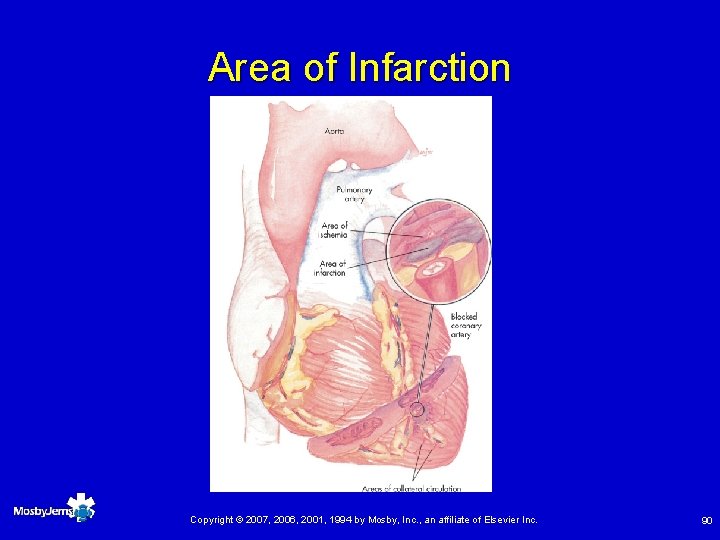
Area of Infarction Copyright © 2007, 2006, 2001, 1994 by Mosby, Inc. , an affiliate of Elsevier Inc. 90
Myocardial Infarction—Deaths Lethal dysrhythmias • VT • VF • Cardiac standstill Pump failure • Cardiogenic shock • CHF Myocardial tissue rupture • Ventricle, septum, or papillary muscle Copyright © 2007, 2006, 2001, 1994 by Mosby, Inc. , an affiliate of Elsevier Inc. 91

MI—Signs and Symptoms Pain is similar to angina May radiate to arms, neck, jaw, or back Dyspnea Anxiety Agitation Sense of impending doom Nausea and vomiting Diaphoresis Cyanosis Palpitations Copyright © 2007, 2006, 2001, 1994 by Mosby, Inc. , an affiliate of Elsevier Inc. 92

MI—Signs and Symptoms Chest pain often constant Not altered by nitroglycerin or medications, rest, changes in body position, or breathing patterns Onset of pain at rest in >50% of MI patients Ø Most have experienced warning anginal pain (preinfarction angina) hours or days before Ø Copyright © 2007, 2006, 2001, 1994 by Mosby, Inc. , an affiliate of Elsevier Inc. 93
Myocardial Infarction—ECG Findings Heart muscle unable to contract effectively Remains in depolarized state Ø Current flow between pathologically depolarized and normally repolarized areas can produce: • Abnormal ST segment elevation • Ischemic ST segment depression • Normal or non-diagnostic ECG changes Copyright © 2007, 2006, 2001, 1994 by Mosby, Inc. , an affiliate of Elsevier Inc. 94
Myocardial Infarction—ECG Findings ST-Segment Elevation MI (STEMI) ST segment elevation >1 mm in 2 adjacent leads Ø new LBBB Ø High-Risk UA/non-ST-Elevation MI (NSTEMI) ST segment depression >0. 5 mm lasting 20 min. Ø T-wave inversion with pain Ø Normal or nondiagnostic ECG changes Ø Inconclusive changes Copyright © 2007, 2006, 2001, 1994 by Mosby, Inc. , an affiliate of Elsevier Inc. 95
Myocardial Infarction ECG Imposters Left bundle branch block Some ventricular rhythms Left ventricular hypertrophy Pericarditis Ventricular aneurysm Early repolarization Copyright © 2007, 2006, 2001, 1994 by Mosby, Inc. , an affiliate of Elsevier Inc. 96
Myocardial Infarction—Management Oxygen Aspirin Nitroglycerin Morphine 12 -lead ECG Fibrinolytic screening Transport to appropriate facility Copyright © 2007, 2006, 2001, 1994 by Mosby, Inc. , an affiliate of Elsevier Inc. 97
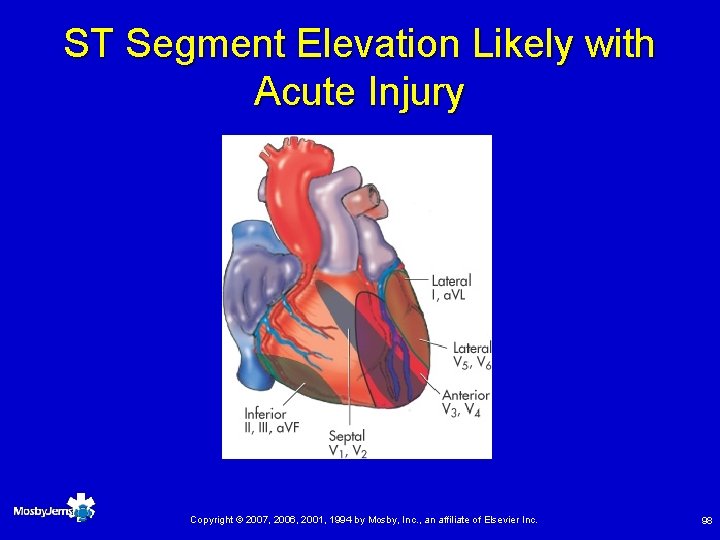
ST Segment Elevation Likely with Acute Injury Copyright © 2007, 2006, 2001, 1994 by Mosby, Inc. , an affiliate of Elsevier Inc. 98
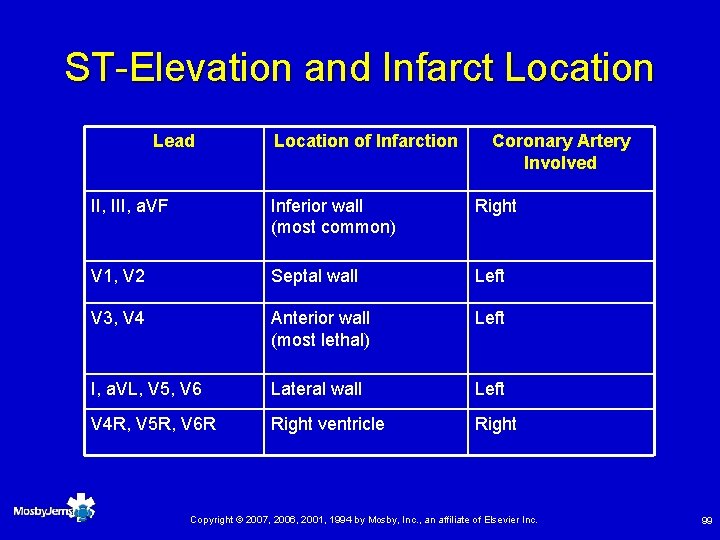
ST-Elevation and Infarct Location Lead Location of Infarction Coronary Artery Involved II, III, a. VF Inferior wall (most common) Right V 1, V 2 Septal wall Left V 3, V 4 Anterior wall (most lethal) Left I, a. VL, V 5, V 6 Lateral wall Left V 4 R, V 5 R, V 6 R Right ventricle Right Copyright © 2007, 2006, 2001, 1994 by Mosby, Inc. , an affiliate of Elsevier Inc. 99
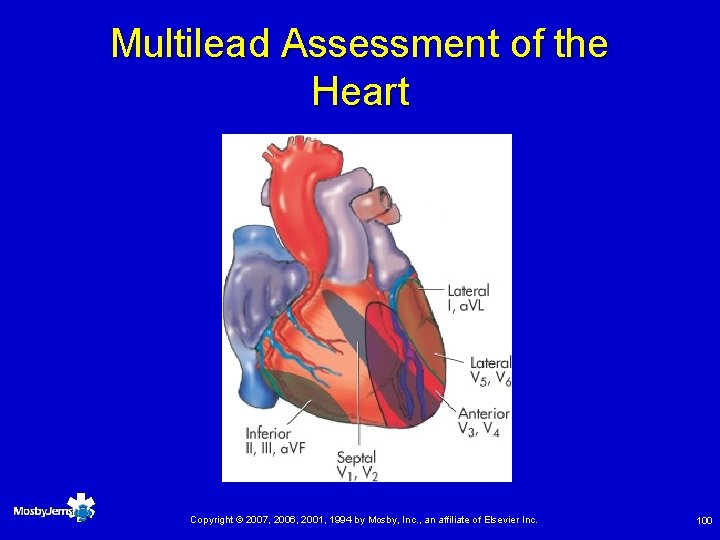
Multilead Assessment of the Heart Copyright © 2007, 2006, 2001, 1994 by Mosby, Inc. , an affiliate of Elsevier Inc. 100
Left Ventricular Failure (LVF) and Pulmonary Edema Left ventricle fails to function as an effective forward pump Causes back-pressure of blood into pulmonary circulation Copyright © 2007, 2006, 2001, 1994 by Mosby, Inc. , an affiliate of Elsevier Inc. 101
LVF and Pulmonary Edema Caused by heart disease, including: Ischemic Ø Valvular Ø Hypertensive heart disease Ø Untreated LVF leads to pulmonary edema Copyright © 2007, 2006, 2001, 1994 by Mosby, Inc. , an affiliate of Elsevier Inc. 102
LVF—Signs and Symptoms Respiratory distress Apprehension, agitation, confusion Cyanosis (if severe) Diaphoresis Adventitious lung sounds JVD Abnormal vital signs Copyright © 2007, 2006, 2001, 1994 by Mosby, Inc. , an affiliate of Elsevier Inc. 103
Pulmonary Edema—Management Oxygen, IV, monitor 12 -lead ECG Nitroglycerin (SBP >100) Furosemide Morphine CPAP Reversible causes Dobutamine or dopamine for shock Copyright © 2007, 2006, 2001, 1994 by Mosby, Inc. , an affiliate of Elsevier Inc. 104
Right Ventricular Failure (RVF) Right ventricle fails as effective forward pump Back-pressure of blood into systemic venous circulation Copyright © 2007, 2006, 2001, 1994 by Mosby, Inc. , an affiliate of Elsevier Inc. 105
RVF Causes Chronic hypertension (LVF precedes RVF) Ø COPD Ø Pulmonary embolism Ø Valvular heart disease Ø Right ventricular infarction Ø RVF usually results from LVF Copyright © 2007, 2006, 2001, 1994 by Mosby, Inc. , an affiliate of Elsevier Inc. 106
RVF Signs and symptoms Tachycardia Ø Venous congestion • Engorged liver, spleen, or both • Venous distention • Peripheral edema Ø Fluid accumulation in serous cavities Ø Management Copyright © 2007, 2006, 2001, 1994 by Mosby, Inc. , an affiliate of Elsevier Inc. 107
Cardiogenic Shock Most extreme form of pump failure Left ventricular function is so compromised heart cannot meet metabolic needs of body Extensive myocardial infarction 40% of left ventricle Ø Diffuse ischemia Ø Copyright © 2007, 2006, 2001, 1994 by Mosby, Inc. , an affiliate of Elsevier Inc. 108
Cardiac Tamponade Impaired diastolic filling of heart Increased fluid in pericardial space Volume of pericardial fluid encroaches on capacity of atria and ventricles to fill adequately Ventricular filling is mechanically limited, and stroke volume is decreased Copyright © 2007, 2006, 2001, 1994 by Mosby, Inc. , an affiliate of Elsevier Inc. 109
Cardiac Tamponade Acute onset Ø Trauma Gradual onset Neoplasm Ø Infection Ø Renal disease Ø Hypothyroidism Ø Management Fluid Ø Pericardiocentesis Ø Presentation Chest pain Ø Tachycardia Ø Ectopy Ø JVD Ø Decreased SBP Ø Pulsus paradoxus Ø Muffled heart sounds Ø ECG changes Ø Copyright © 2007, 2006, 2001, 1994 by Mosby, Inc. , an affiliate of Elsevier Inc. 110
Thoracic and Abdominal Aortic Aneurysms Aneurysm Ø Dilation of a vessel Causes Atherosclerotic disease (most common) Ø Infectious disease (primarily syphilis) Ø Traumatic injury Ø Certain genetic disorders (e. g. , Marfan's syndrome) Ø Copyright © 2007, 2006, 2001, 1994 by Mosby, Inc. , an affiliate of Elsevier Inc. 111
Aortic Aneurysms—Signs and Symptoms Hypotension Syncope Abdominal or back pain Ø Tearing or ripping Low back or flank pain Ø Peritoneal irritation Urge to defecate Pulsatile, tender mass Distal pulses present or absent GI bleeding Radiates to thigh, groin, testicle Copyright © 2007, 2006, 2001, 1994 by Mosby, Inc. , an affiliate of Elsevier Inc. 112
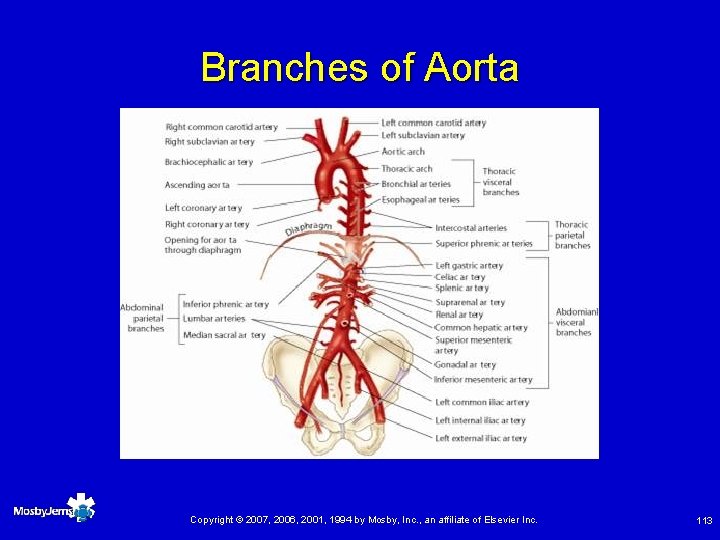
Branches of Aorta Copyright © 2007, 2006, 2001, 1994 by Mosby, Inc. , an affiliate of Elsevier Inc. 113
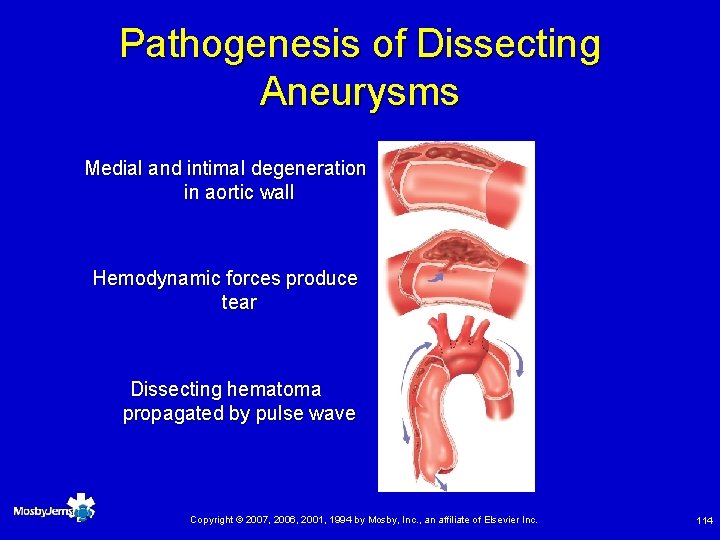
Pathogenesis of Dissecting Aneurysms Medial and intimal degeneration in aortic wall Hemodynamic forces produce tear Dissecting hematoma propagated by pulse wave Copyright © 2007, 2006, 2001, 1994 by Mosby, Inc. , an affiliate of Elsevier Inc. 114
Dissecting Aneurysms—Management Gentle handling Oxygen Monitor IV fluids Ø Bolus if profound shock Copyright © 2007, 2006, 2001, 1994 by Mosby, Inc. , an affiliate of Elsevier Inc. 115
Acute Arterial Occlusion Blockage of arterial flow caused by: Trauma Ø Embolus Ø Thrombosis Ø Severity of episode depends on: Site of occlusion Ø Collateral circulation Ø Copyright © 2007, 2006, 2001, 1994 by Mosby, Inc. , an affiliate of Elsevier Inc. 116
Acute Arterial Occlusion Signs and symptoms Ø Pain in extremity • May be severe and sudden in onset or absent because of paresthesia Pallor Ø Cool skin distal to occlusion Ø Change in sensory and motor function Ø Diminished or absent pulse distal to injury Ø Bruit over affected vessel Ø Slow capillary filling Ø Sometimes shock Ø Copyright © 2007, 2006, 2001, 1994 by Mosby, Inc. , an affiliate of Elsevier Inc. 117
Arterial Occlusion—Management Extremity occlusion is painful and limb threatening if blood flow is not reestablished within 4 -8 hrs Immobilize limb and transport Patients with mesenteric occlusion Manage for shock: • Oxygen • IV fluids Ø Analgesics for pain control Ø Copyright © 2007, 2006, 2001, 1994 by Mosby, Inc. , an affiliate of Elsevier Inc. 118
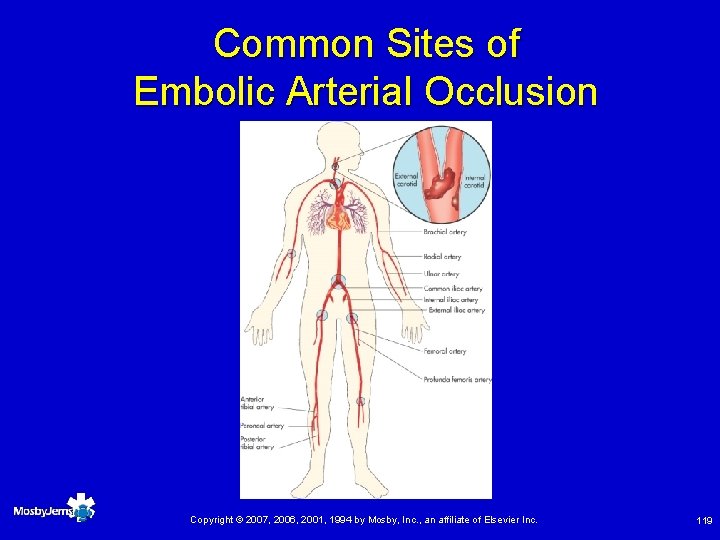
Common Sites of Embolic Arterial Occlusion Copyright © 2007, 2006, 2001, 1994 by Mosby, Inc. , an affiliate of Elsevier Inc. 119
Venous Thrombosis Predisposing factors Ø Ø Ø Ø Ø History of trauma Sepsis Stasis or inactivity Recent immobilization Pregnancy Birth control pills Malignancy Coagulopathies Smoking Varicose veins Copyright © 2007, 2006, 2001, 1994 by Mosby, Inc. , an affiliate of Elsevier Inc. 120
Acute Deep Vein Thrombosis (DVT) Occlusion of deep veins is serious, common problem May involve any portion of deep venous system Ø More common in lower extremities Copyright © 2007, 2006, 2001, 1994 by Mosby, Inc. , an affiliate of Elsevier Inc. 121
Acute DVT—Risk Factors Lower extremity trauma Recent surgery Advanced age Recent MI Inactivity Previous thrombosis Oral contraceptives Cancer Obesity CHF Copyright © 2007, 2006, 2001, 1994 by Mosby, Inc. , an affiliate of Elsevier Inc. 122
Acute DVT—Management Risk of pulmonary embolus Hospitalization Bed rest Anticoagulants Copyright © 2007, 2006, 2001, 1994 by Mosby, Inc. , an affiliate of Elsevier Inc. 123
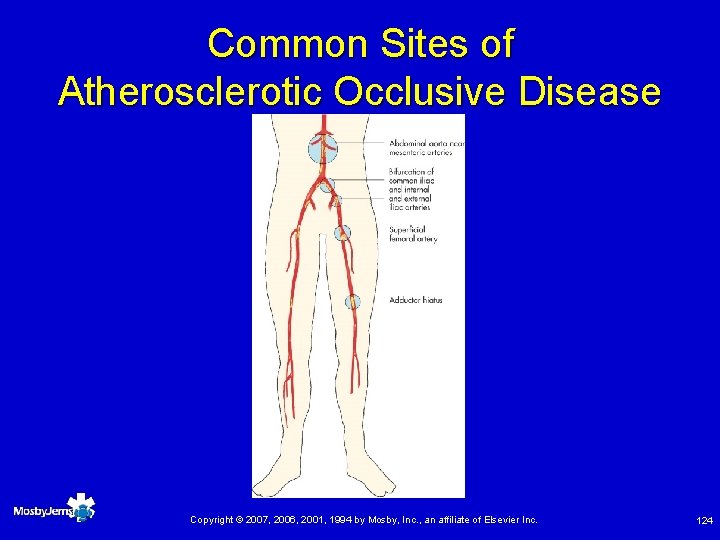
Common Sites of Atherosclerotic Occlusive Disease Copyright © 2007, 2006, 2001, 1994 by Mosby, Inc. , an affiliate of Elsevier Inc. 124
Hypertension Resting BP: Consistently >140/90 mm Hg Several categories of hypertension based on level of blood pressure, symptoms, and urgency of need for intervention Copyright © 2007, 2006, 2001, 1994 by Mosby, Inc. , an affiliate of Elsevier Inc. 125
Chronic Hypertension Conditions associated with chronic, uncontrolled hypertension Cerebral hemorrhage and stroke Ø Myocardial infarction Ø Renal failure (secondary to vascular changes in the kidney) Ø Thoracic and/or abdominal aortic aneurysm Ø Copyright © 2007, 2006, 2001, 1994 by Mosby, Inc. , an affiliate of Elsevier Inc. 126
Hypertensive Emergencies Blood pressure increase leads to significant, irreversible end-organ damage within hours if not treated Organs most at risk are brain, heart, and kidneys Copyright © 2007, 2006, 2001, 1994 by Mosby, Inc. , an affiliate of Elsevier Inc. 127
Hypertensive Emergencies Myocardial ischemia with hypertension Aortic dissection with hypertension Pulmonary edema with hypertension Hypertensive intracranial hemorrhage Toxemia Hypertensive encephalopathy Copyright © 2007, 2006, 2001, 1994 by Mosby, Inc. , an affiliate of Elsevier Inc. 128
Hypertensive Emergencies—Signs and Symptoms Paroxysmal nocturnal dyspnea Shortness of breath Altered mental status Vertigo Headache Epistaxis Tinnitus Changes in visual acuity Nausea and vomiting Seizures ECG changes Copyright © 2007, 2006, 2001, 1994 by Mosby, Inc. , an affiliate of Elsevier Inc. 129

Hypertensive Encephalopathy Severe hypertension produces hypertensive encephalopathy and cerebral hypoperfusion Loss of integrity of blood-brain barrier Fluid exudation into brain tissue Copyright © 2007, 2006, 2001, 1994 by Mosby, Inc. , an affiliate of Elsevier Inc. 130
Hypertensive Encephalopathy Progresses from: Ø Severe headache, nausea, vomiting, aphasia, hemiparesis, and transient blindness Later Ø Seizures, stupor, coma, and death Copyright © 2007, 2006, 2001, 1994 by Mosby, Inc. , an affiliate of Elsevier Inc. 131
Hypertensive Emergencies Supportive care Oxygen IV ECG monitoring Rapid transport Drugs under medical supervision Copyright © 2007, 2006, 2001, 1994 by Mosby, Inc. , an affiliate of Elsevier Inc. 132
Techniques for Managing Cardiac Emergencies Basic life support Mechanical CPR devices Monitor-defibrillators Implantable cardioverter-defibrillators (ICDs) Transcutaneous cardiac pacing (TCP) Advanced cardiac life support (ACLS) system Copyright © 2007, 2006, 2001, 1994 by Mosby, Inc. , an affiliate of Elsevier Inc. 133
- Slides: 133