
Corona Discharge Ignition for Advanced Stationary Natural Gas

- Slides: 35
Corona Discharge Ignition for Advanced Stationary Natural Gas Engines ASME Internal Combustion Engine Division Fall Technical Conference, Long Beach, CA October 25, 2004 Supported by DOE-UREP Principal Investigator: Prof. Paul D. Ronney Co-Principal Investigator: Prof. Martin Gundersen Research Associates: Nathan Theiss, Dr. Jian-Bang Liu Graduate students: Fei Wang, Jun Zhao Undergraduate students: Brad Tallon, Matthew Beck Jennifer Colgrove, Merritt Johnson, Gary Norris ASME Paper # ICEF 2004 -891
Motivation • Multi-point ignition has the potential to increase burning rates in internal combustion engines • (Simplest approach) Leaner mixtures (lower NOx) • (More difficult) Higher compression ratios + water injection (higher efficiency with same NOx) • (Most difficult) Redesign intake port and combustion chamber for lower turbulence since the same burn rate is possible with lower turbulence (reduced heat loss to walls, higher efficiency) • Lasers, multi-point sparks challenging • Lasers: energy efficiency, windows, fiber optics… • Multi-point sparks: multiple intrusive electrodes • How to obtain multi-point, energy efficient ignition?
Transient plasma (“pulsed corona”) discharges • Not to be confused with “plasma torch” • Initial phase of spark discharge (< 100 ns) - highly conductive (arc) channel not yet formed • Characteristics • Multiple streamers of electrons - possible multiple ignition sites • High energy (10 s of e. V) electrons compared to sparks (~1 e. V) • Electrons not at thermal equilibrium with ions/neutrals • Low anode & cathode drops, little radiation & shock formation more efficient use of energy deposited into gas • Enabling technology: USC-built discharge generators (Prof. Martin Gundersen)
Corona vs. arc discharge Corona phase (0 - 100 ns) Arc phase (> 500 ns)
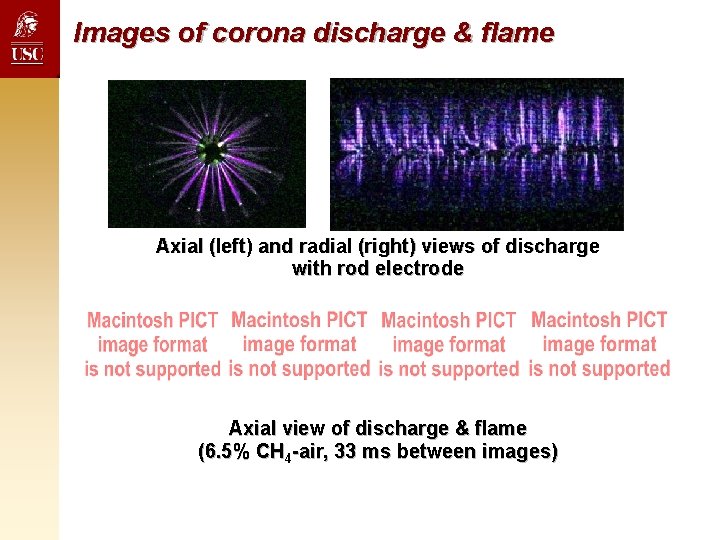
Images of corona discharge & flame Axial (left) and radial (right) views of discharge with rod electrode Axial view of discharge & flame (6. 5% CH 4 -air, 33 ms between images)
Characteristics of corona discharges Corona only Corona + arc • If arc forms, current increases some but voltage drops more, thus higher consumption of capacitor energy with little increase in energy deposited in gas (still have corona, but followed by (almost useless) arc)
Corona discharges are energy-efficient • Discharge efficiency d ≈ 10 x higher for corona than for conventional sparks
Program objectives • Characterize advantages of pulsed corona discharges for NG ignition in static combustion chambers • Integrate pulsed corona discharge ignition system into stationary natural gas engines • 1998 -2002 Ford Ranger, 2. 5 L SOHC 4 -cylinder engine, 2 plugs per cylinder (1 conventional plug, 1 corona ignition port) • Large-bore stationary natural gas engine • Determine if the ≈ 3 x shorter burn times found with pulsed corona discharges apply to NG engines also • If so, exploit the shorter burn times • Assess the possibility for NOx reduction using additional corona discharges during the exhaust stroke
Progress to date • Installed new engine in laboratory with two spark plug ports per cylinder (2000 Ford Ranger 2. 5 L I-4) and converted to NG • Updated lab engine data acquisition & control system hardware and software (National Instruments / Lab. View) • Interfaced emissions analyzer with Lab. View system • Implemented student-designed in-cylinder pressure monitoring system on engine • Built static test chamber that simulates engine geometry for electrode testing • Constructed turbulent test chamber and conducted bench tests to characterize effects of turbulence on corona ignition & combustion • Studied and characterized minimum ignition energies of corona discharges • Developed electrode for engine combustion chamber using machinable ceramics • Developed trigger system for firing corona generator on engine • Performed on-engine testing with pulsed corona discharge firing on one cylinder over a range of air/fuel ratios, engine loads and ignition timing
Laboratory test apparatus (constant volume) • 2. 5” (63. 5 mm) diameter chamber, 6” (152 mm) long • Energy release (stoich. CH 4 -air, 1 atm) ≈ 1650 J energy release ≈ 60, 000 x minimum ignition energy • Energy input for ignition is trivial fraction of heat release!
Definitions • Delay time: 0 - 10% of peak pressure (can be compensated for by adjusting “spark advance”) • Rise time: 10% - 90% of peak pressure (can’t be fixed with spark advance!)
Electrode configurations
Effect of geometry on delay time • Spark delay time ≈ 2 x larger than 1 -pin corona (≈ same geometry) • Consistent with computations by Dixon-Lewis, Sloane suggesting point radical sources improve ignition delay ≈ 2 x compared to thermal sources • More streamer locations (more pins, rod) yield lower delay time (≈ 3. 5 x lower for rod than spark) • Benefit of corona on delay time both chemical (≈ 1. 5 x) & geometrical (≈ 2 x)
Effect of geometry on rise time • Rise time of spark larger ≈ same as 1 -pin corona (≈ same flame propagation geometry) • More streamer locations (more pins, rod) yield lower rise time (≈ 3 - 4 x lower for rod than spark), but multi-pin almost as good with much less energy
Energy & geometry effects (lean mixture) • What is optimal electrode configuration to minimize delay/rise time for a given energy? • Delay time: 2 -ring, 4 -ring & plain rod similar (all are much better than spark)
Energy & geometry effects (lean mixture) • Rise time: 2 -ring or 4 -ring best • Note “step” behavior for multi-point ignition at low energies not all sites ignite • (Delay time doesn’t show “step” behavior)
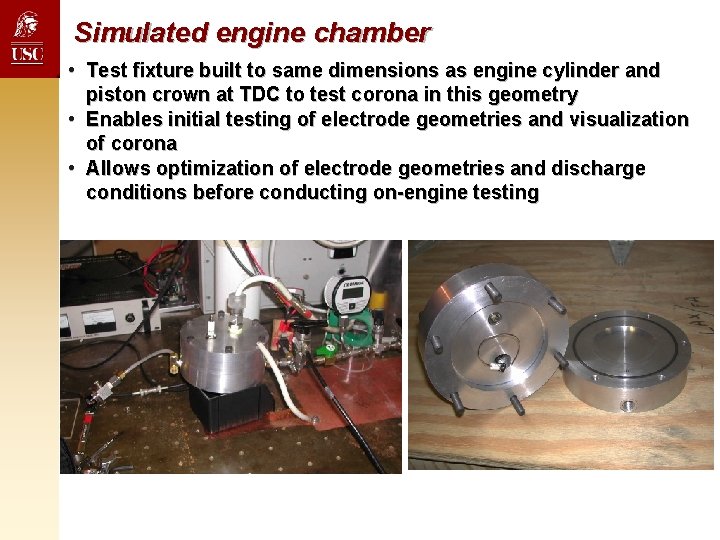
Simulated engine chamber • Test fixture built to same dimensions as engine cylinder and piston crown at TDC to test corona in this geometry • Enables initial testing of electrode geometries and visualization of corona • Allows optimization of electrode geometries and discharge conditions before conducting on-engine testing
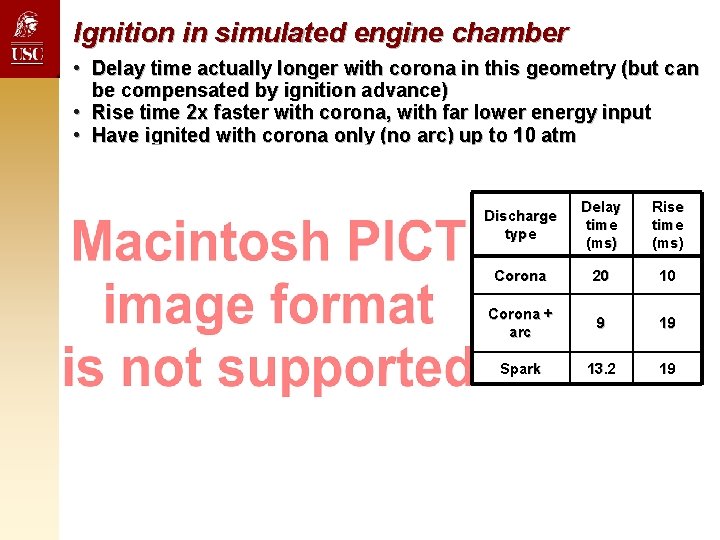
Ignition in simulated engine chamber • Delay time actually longer with corona in this geometry (but can be compensated by ignition advance) • Rise time 2 x faster with corona, with far lower energy input • Have ignited with corona only (no arc) up to 10 atm Discharge type Delay time (ms) Rise time (ms) Corona 20 10 Corona + arc 9 19 Spark 13. 2 19
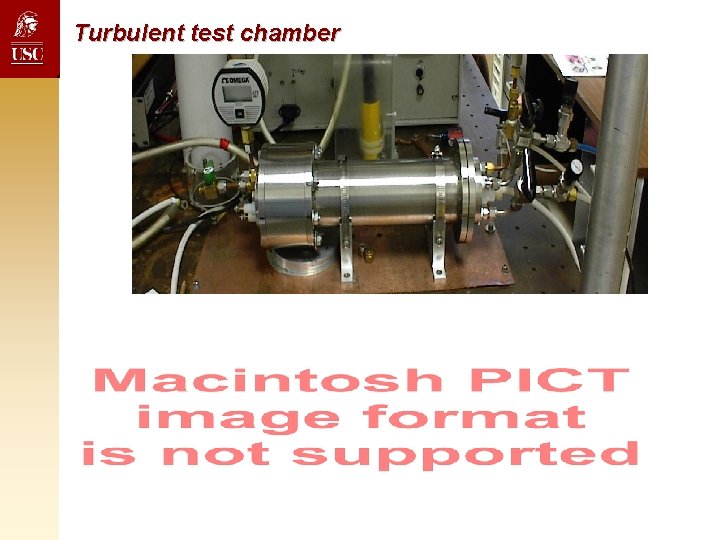
Turbulent test chamber
Turbulence effects • Simple turbulence generator (CPU cooling fan + grid) integrated into coaxial combustion chamber, rod electrode • Mean flow ≈ 11 m/s + turbulence intensity ≈ 1 m/s, u’/SL ≈ 3 (stoichiometric) • Benefit of corona ignition ≈ same in turbulent flames - shorter rise & delay times, higher peak P
Turbulence effects • Similar results for lean mixture but benefit of turbulence more dramatic - higher u’/SL (≈ 8)
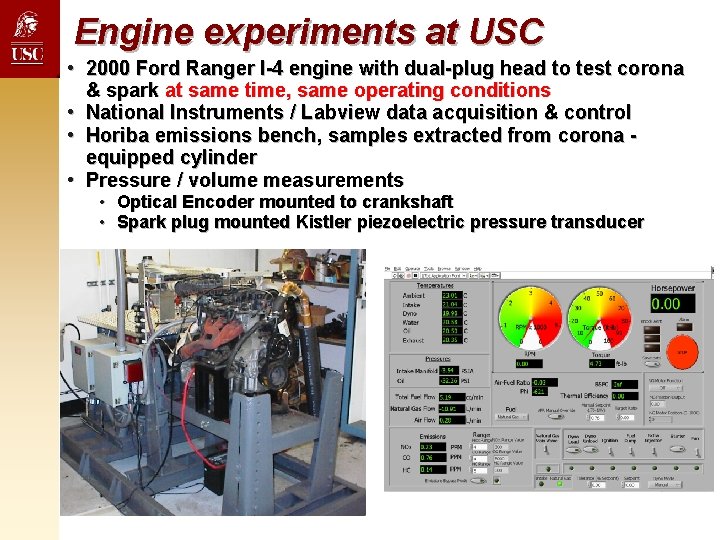
Engine experiments at USC • 2000 Ford Ranger I-4 engine with dual-plug head to test corona & spark at same time, same operating conditions • National Instruments / Labview data acquisition & control • Horiba emissions bench, samples extracted from corona equipped cylinder • Pressure / volume measurements • Optical Encoder mounted to crankshaft • Spark plug mounted Kistler piezoelectric pressure transducer
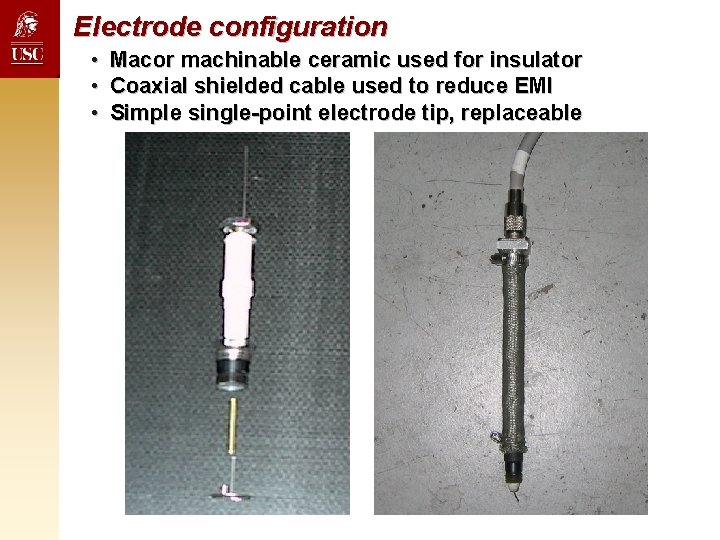
Electrode configuration • • • Macor machinable ceramic used for insulator Coaxial shielded cable used to reduce EMI Simple single-point electrode tip, replaceable
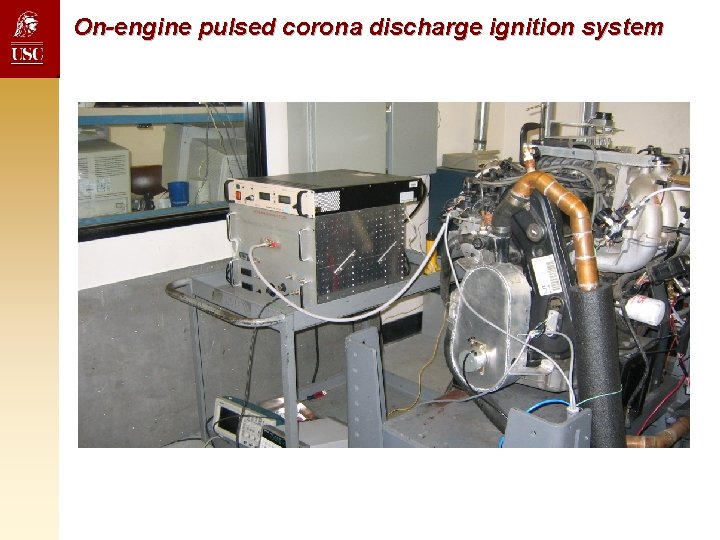
On-engine pulsed corona discharge ignition system • Pulsed corona discharges generated using “pseudospark” switch + Blumlein transmission line, triggered from camshaft • ≈ 500 m. J/pulse (equivalent “wall plug” energy requirement of ≈ 50 m. J spark) • Corona electrode and spark plug with pressure transducer in #1 cylinder • Switch wired for quick change between spark and corona ignition under identical operating conditions • Stock timing for spark ignition, variable timing for corona • 3 modes tested • Corona only • Single conventional plug • Two conventional plugs (results very similar to single plug)
On-engine pulsed corona discharge ignition system
On-engine results • Corona ignition shows increase in peak pressure under all conditions tested
On-engine results • Corona ignition shows increase in IMEP under all conditions tested
IMEP at various loads • Corona showed an average increase in IMEP of 16% over a range of engine loads, A/F ratios, ignition timings • Slight decrease in COV with corona • Stronger ceramic is needed for electrode to test at higher loads - need collaboration with plug manufacturer
IMEP at various air / fuel ratios
Burn rates • Corona ignition shows substantially faster burn rates at same conditions compared to 2 -plug conventional ignition 2900 RPM, = 0. 7, Pintake = 5. 9 psia
Emissions data - NOx • Improved NOx performance vs. indicated efficiency tradeoff compared to spark ignition by using leaner mixtures with sufficiently rapid burning
Emissions data - hydrocarbons • Hydrocarbons emissions similar, corona vs. spark
Emissions data - CO • CO emissions similar, corona vs. spark
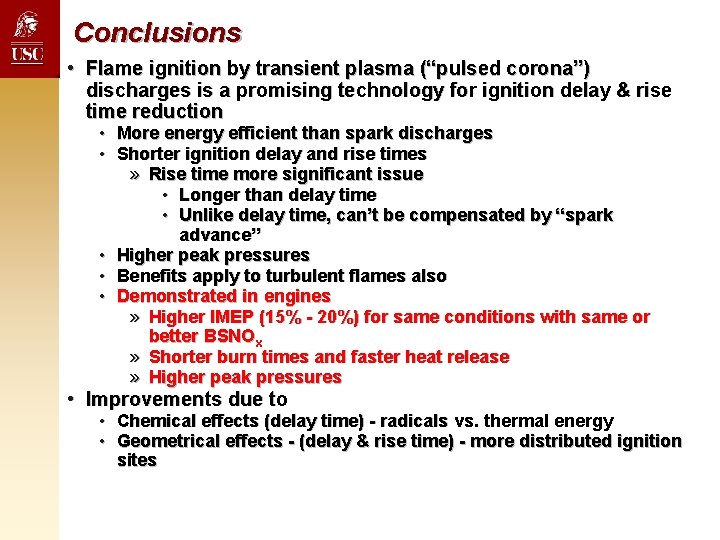
Conclusions • Flame ignition by transient plasma (“pulsed corona”) discharges is a promising technology for ignition delay & rise time reduction • More energy efficient than spark discharges • Shorter ignition delay and rise times » Rise time more significant issue • Longer than delay time • Unlike delay time, can’t be compensated by “spark advance” • Higher peak pressures • Benefits apply to turbulent flames also • Demonstrated in engines » Higher IMEP (15% - 20%) for same conditions with same or better BSNOx » Shorter burn times and faster heat release » Higher peak pressures • Improvements due to • Chemical effects (delay time) - radicals vs. thermal energy • Geometrical effects - (delay & rise time) - more distributed ignition sites
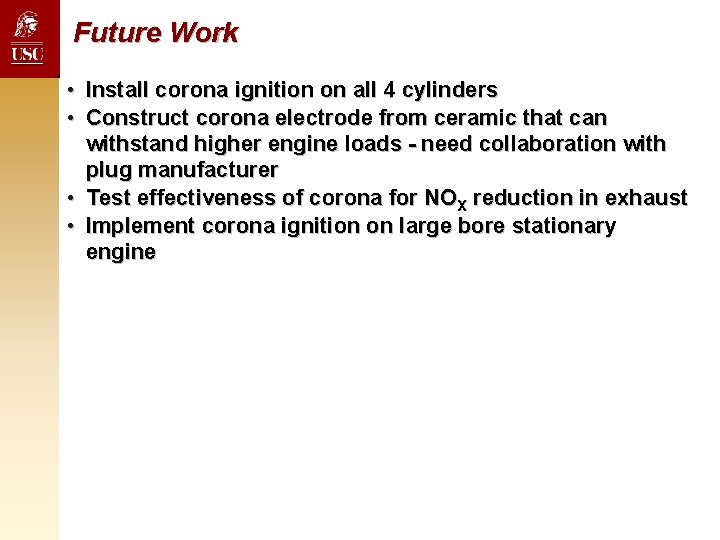
Future Work • Install corona ignition on all 4 cylinders • Construct corona electrode from ceramic that can withstand higher engine loads - need collaboration with plug manufacturer • Test effectiveness of corona for NOX reduction in exhaust • Implement corona ignition on large bore stationary engine