
Cornerstones of Managerial Accounting 3 e MOWEN HANSEN
- Slides: 96
Cornerstones of Managerial Accounting 3 e MOWEN / HANSEN / HEITGER COPYRIGHT © 2009 South-Western/Cengage Learning 1
Chapter Seven Activity-Based Costing and Management
Learning Objectives 1. Explain why functional-based costing approaches may produce distorted costs. 2. Explain how an activity-based costing system works for product costing. 3. Describe activity-based customer and supplier costing. 4. Explain how activity-based management can be used for cost reduction. 3
OBJECTIVE 1 Explain why functional -based costing approaches may produce distorted costs.
Functional-based Costing Systems • Functional-based systems – Based on volume measures, such as • Direct labor hours • Machine hours – Two types • Plantwide rates • Departmental rates • Often produce average costs that severely over- or understate individual product costs. 5
Functional-based Costing System Limitations Two major factors impair their ability to assign overhead costs accurately: 1. Proportion of non-unit-related overhead costs to total overhead charge is large 2. Degree of product diversity is great 6
Unit and Non-Unit Activities Unit-level-activities --- Activities that are performed each time a unit is produced. Non-unit-level-activities --- From the viewpoint of the subsequent process, transferredin costs are a type of raw material cost. 7
Non-Unit-Related Overhead Costs What is needed for accurate cost assignment of non-unit-level activities? Non-unit-level activity drivers Factors that measure the consumption of non-unit-level activities by products and other cost objects 8
Product Diversity Products consume overhead activities in systematically different proportions. Consumption Ratio --- Proportion of each activity consumed by a product. 9
Cornerstone 7 -1 HOW TO Calculate Consumption Ratios 10
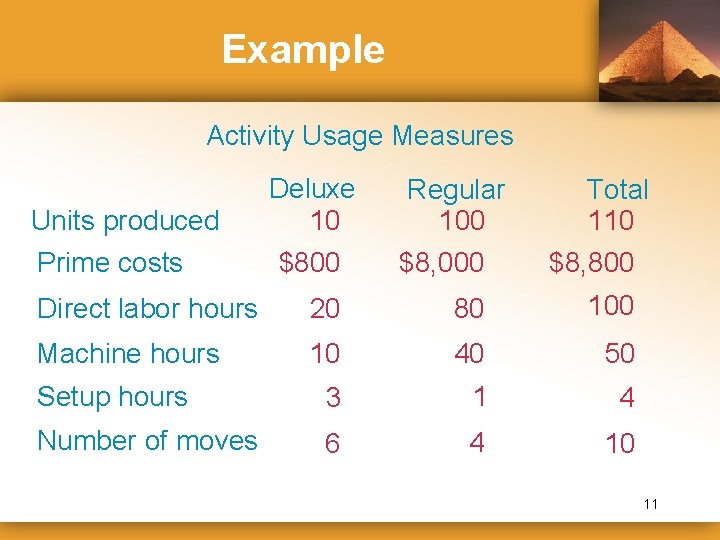
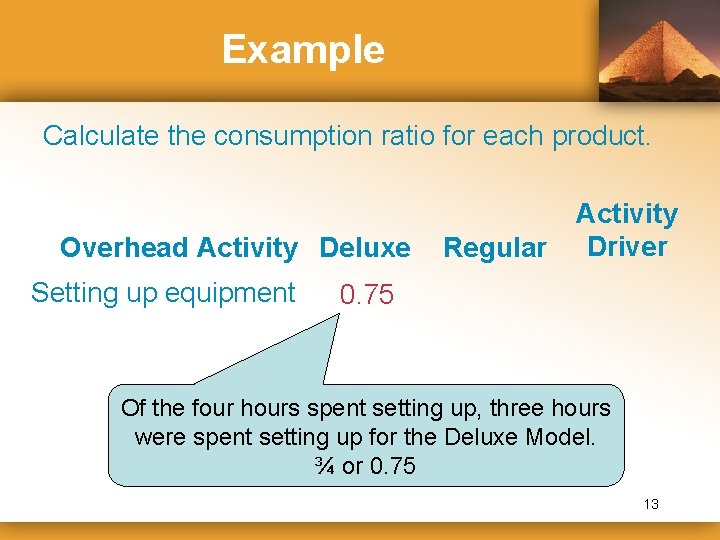
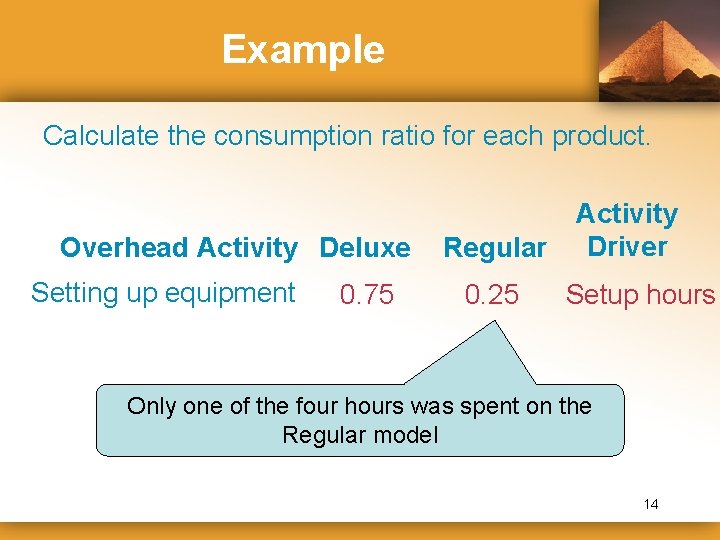
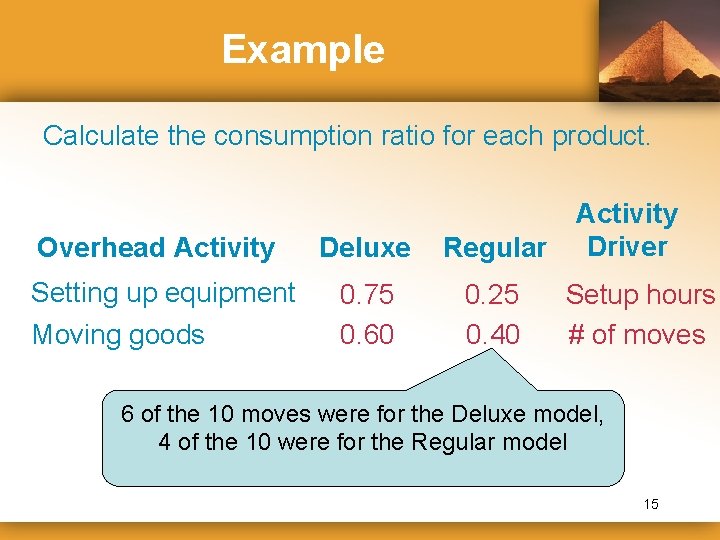
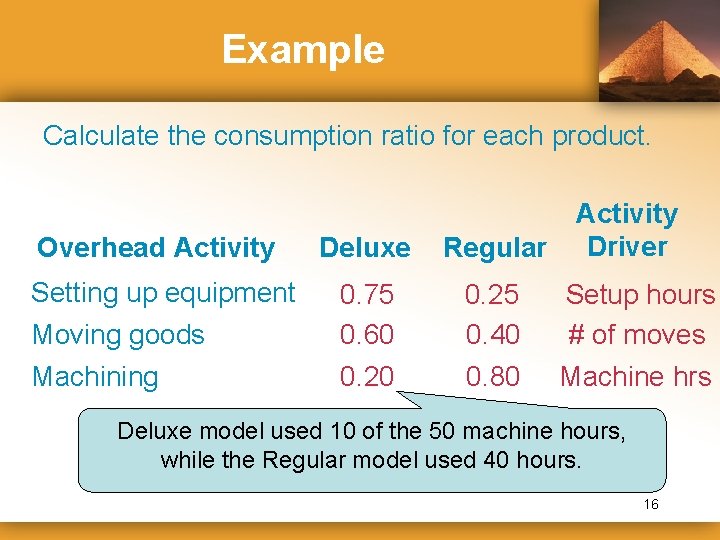
Example Activity Usage Measures Units produced Prime costs Deluxe 10 $800 Regular 100 $8, 000 Total 110 $8, 800 Direct labor hours 20 80 100 Machine hours 10 40 50 Setup hours 3 1 4 Number of moves 6 4 10 11
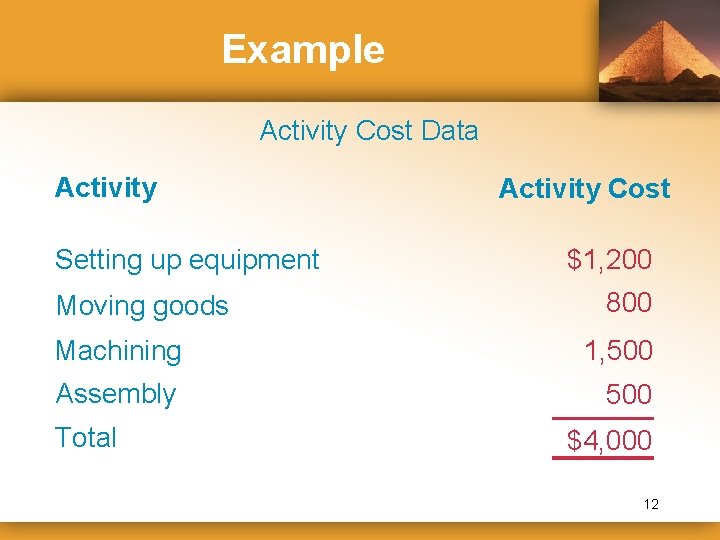
Example Activity Cost Data Activity Setting up equipment Moving goods Activity Cost $1, 200 800 Machining 1, 500 Assembly 500 Total $4, 000 12
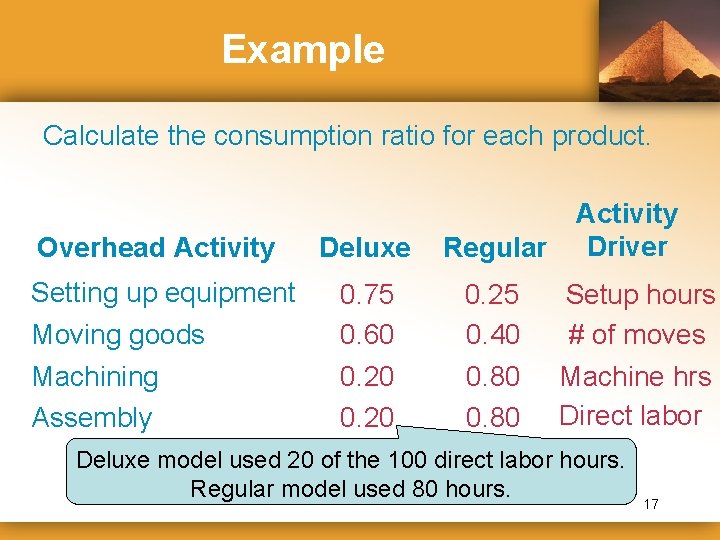
Example Calculate the consumption ratio for each product. Overhead Activity Deluxe Setting up equipment Regular Activity Driver 0. 75 Of the four hours spent setting up, three hours were spent setting up for the Deluxe Model. ¾ or 0. 75 13
Example Calculate the consumption ratio for each product. Overhead Activity Deluxe Setting up equipment 0. 75 Regular 0. 25 Activity Driver Setup hours Only one of the four hours was spent on the Regular model 14
Example Calculate the consumption ratio for each product. Overhead Activity Deluxe Regular Setting up equipment Moving goods 0. 75 0. 60 0. 25 0. 40 Activity Driver Setup hours # of moves 6 of the 10 moves were for the Deluxe model, 4 of the 10 were for the Regular model 15
Example Calculate the consumption ratio for each product. Overhead Activity Deluxe Regular Setting up equipment Moving goods Machining 0. 75 0. 60 0. 25 0. 40 0. 80 Activity Driver Setup hours # of moves Machine hrs Deluxe model used 10 of the 50 machine hours, while the Regular model used 40 hours. 16
Example Calculate the consumption ratio for each product. Overhead Activity Deluxe Regular Setting up equipment Moving goods Machining Assembly 0. 75 0. 60 0. 20 0. 25 0. 40 0. 80 Activity Driver Setup hours # of moves Machine hrs Direct labor Deluxe model used 20 of the 100 direct labor hours. Regular model used 80 hours. 17
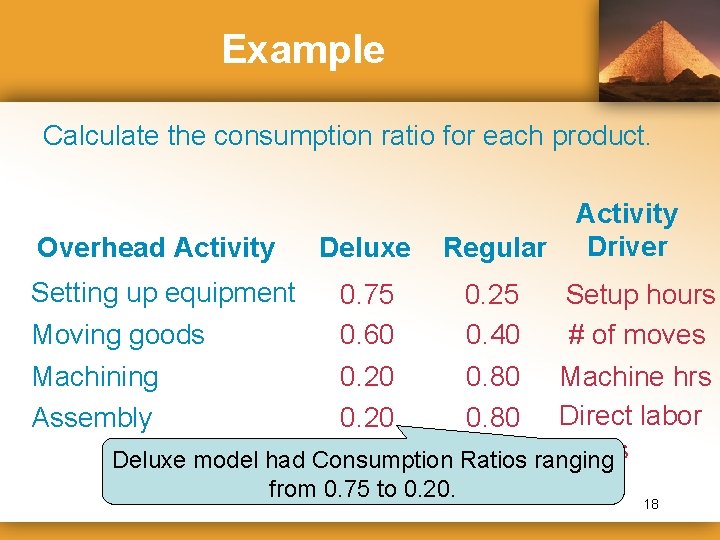
Example Calculate the consumption ratio for each product. Overhead Activity Deluxe Regular Setting up equipment Moving goods Machining Assembly 0. 75 0. 60 0. 20 0. 25 0. 40 0. 80 Activity Driver Setup hours # of moves Machine hrs Direct labor hours Deluxe model had Consumption Ratios ranging from 0. 75 to 0. 20. 18
Cornerstone 7 -2 HOW TO Calculate Activity Ratios 19
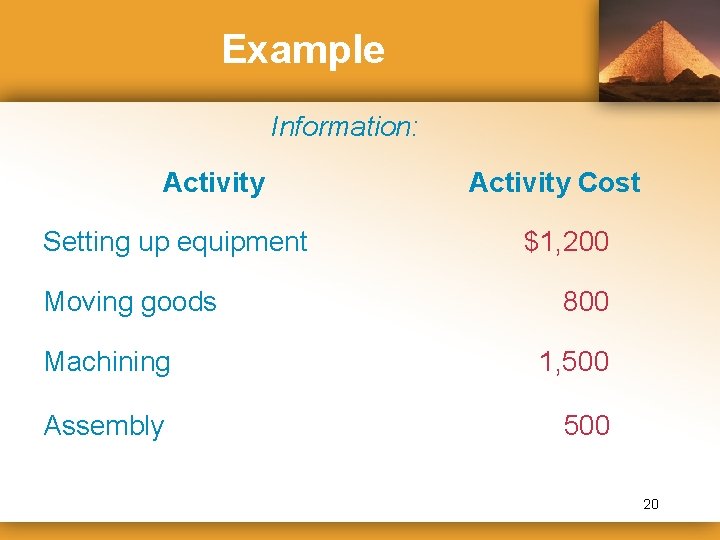
Example Information: Activity Setting up equipment Moving goods Activity Cost $1, 200 800 Machining 1, 500 Assembly 500 20
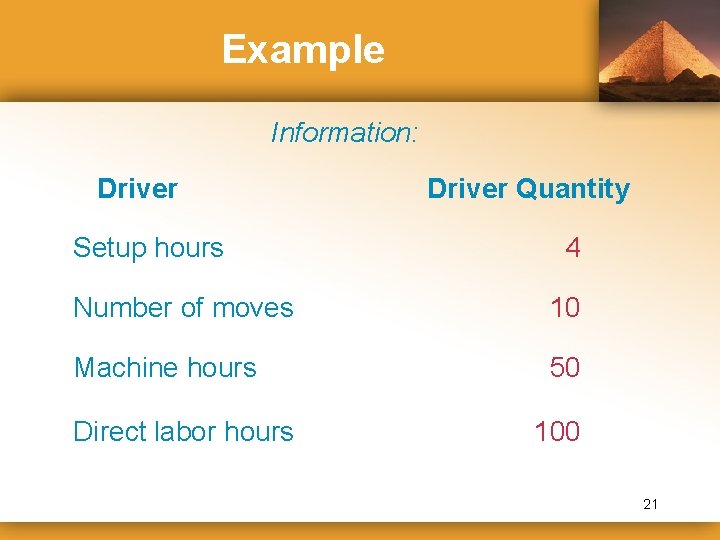
Example Information: Driver Setup hours Driver Quantity 4 Number of moves 10 Machine hours 50 Direct labor hours 100 21
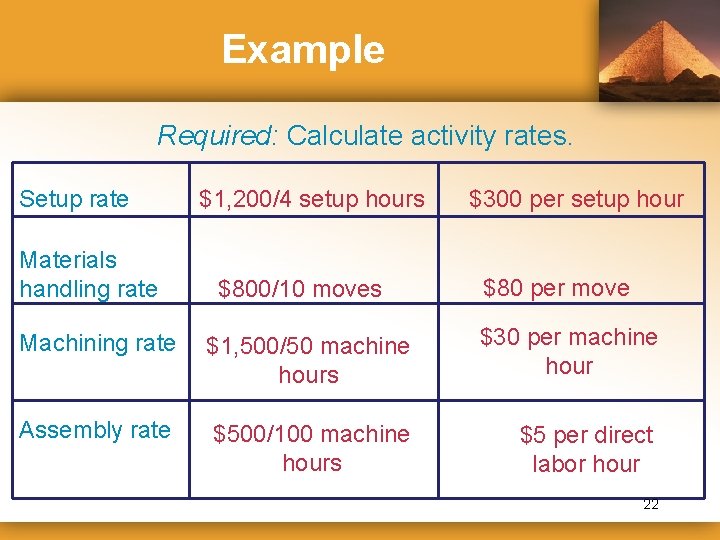
Example Required: Calculate activity rates. Setup rate Materials handling rate $1, 200/4 setup hours $800/10 moves $300 per setup hour $80 per move Machining rate $1, 500/50 machine hours $30 per machine hour Assembly rate $500/100 machine hours $5 per direct labor hour 22
Cornerstone 7 -3 HOW TO Calculate Activity-Based Unit Costs 23
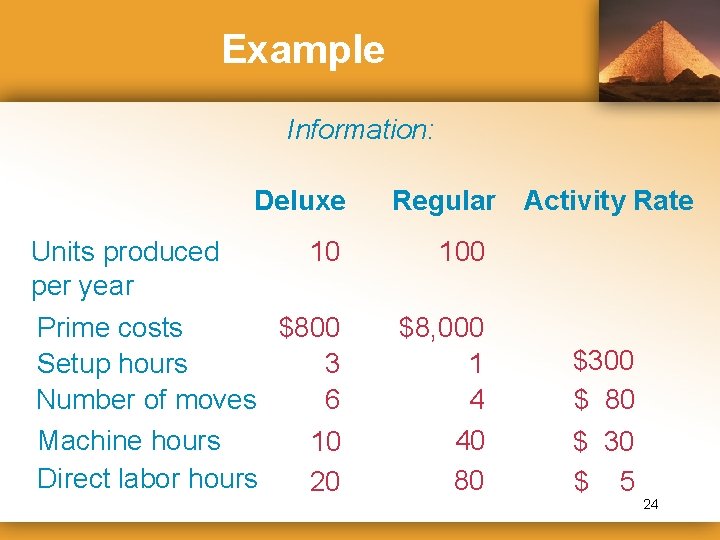
Example Information: Deluxe Units produced per year Regular 10 100 Prime costs $800 3 Setup hours Number of moves 6 Machine hours 10 Direct labor hours 20 $8, 000 1 4 40 80 Activity Rate $300 $ 80 $ 30 $ 5 24
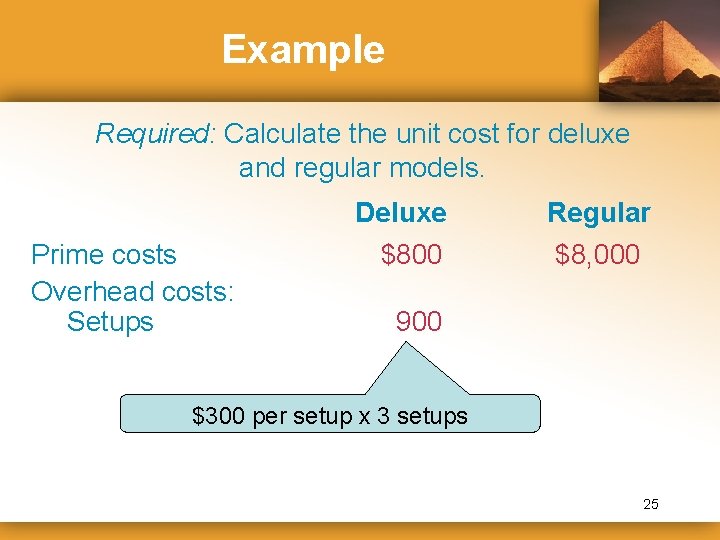
Example Required: Calculate the unit cost for deluxe and regular models. Deluxe Prime costs Overhead costs: Setups $800 Regular $8, 000 900 $300 per setup x 3 setups 25
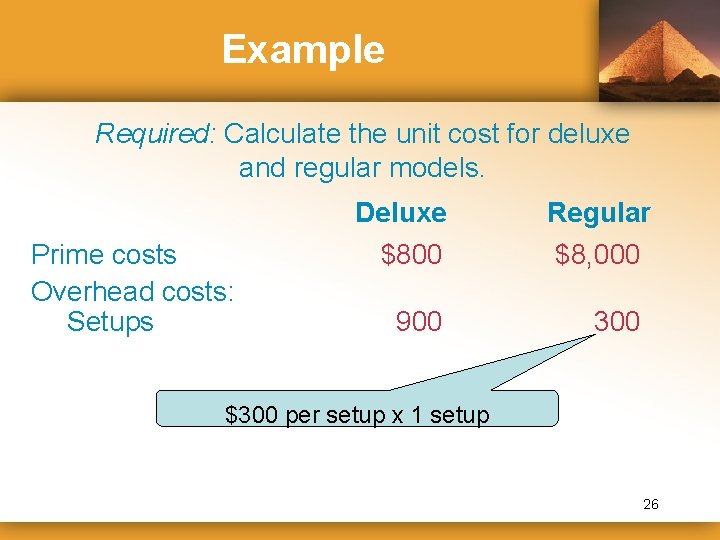
Example Required: Calculate the unit cost for deluxe and regular models. Deluxe Prime costs Overhead costs: Setups Regular $800 $8, 000 900 300 $300 per setup x 1 setup 26
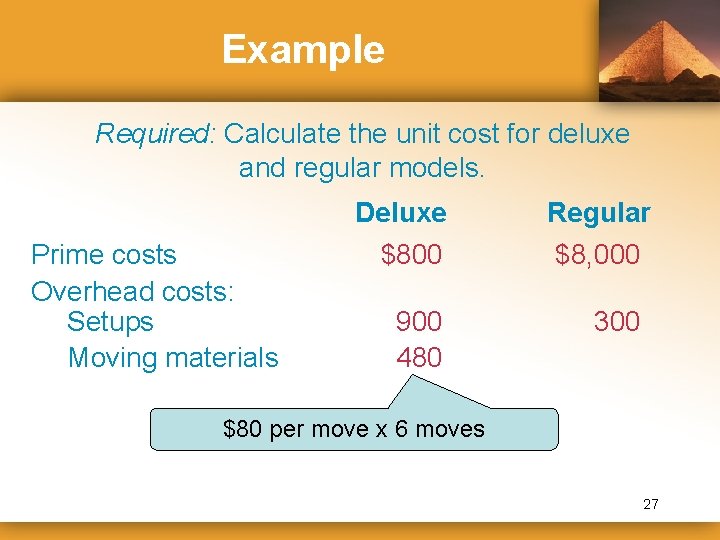
Example Required: Calculate the unit cost for deluxe and regular models. Deluxe Prime costs Overhead costs: Setups Moving materials Regular $800 $8, 000 900 480 300 $80 per move x 6 moves 27
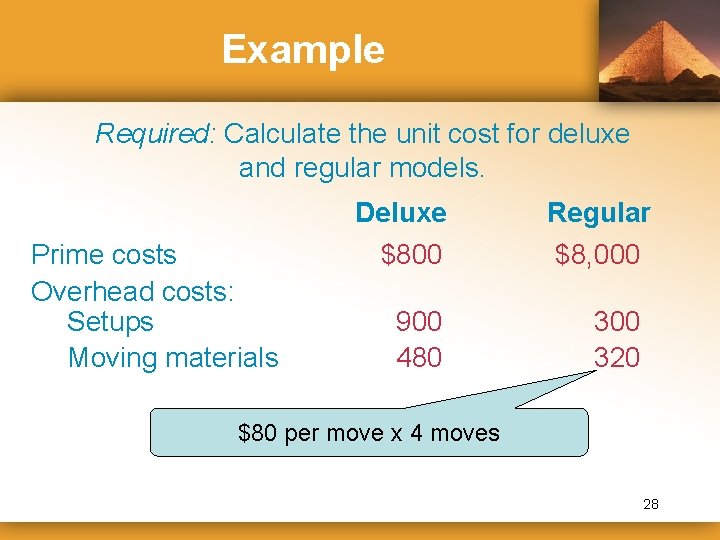
Example Required: Calculate the unit cost for deluxe and regular models. Deluxe Prime costs Overhead costs: Setups Moving materials Regular $800 $8, 000 900 480 300 320 $80 per move x 4 moves 28
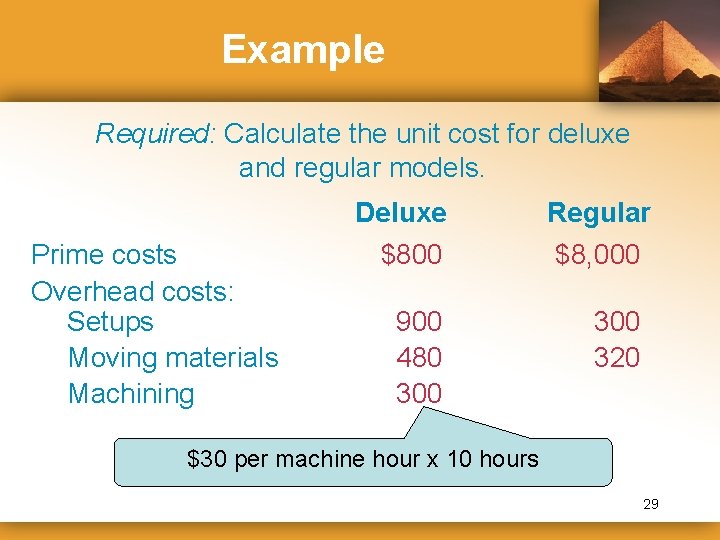
Example Required: Calculate the unit cost for deluxe and regular models. Deluxe Prime costs Overhead costs: Setups Moving materials Machining Regular $800 $8, 000 900 480 300 320 $30 per machine hour x 10 hours 29
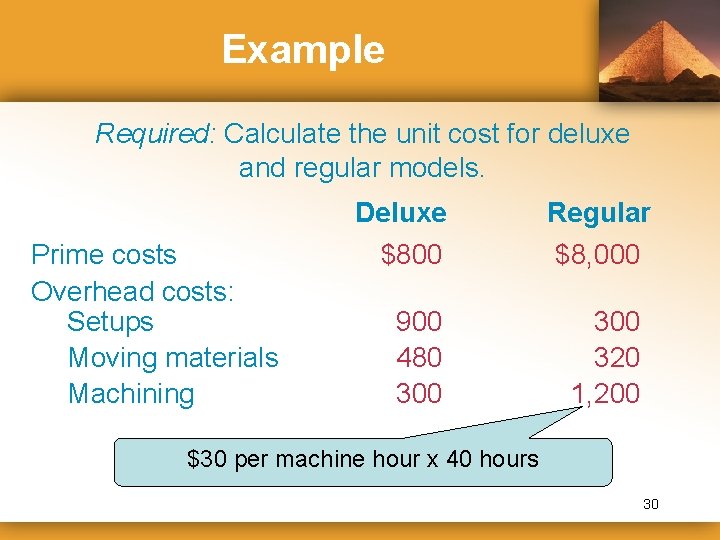
Example Required: Calculate the unit cost for deluxe and regular models. Deluxe Prime costs Overhead costs: Setups Moving materials Machining Regular $800 $8, 000 900 480 300 320 1, 200 $30 per machine hour x 40 hours 30
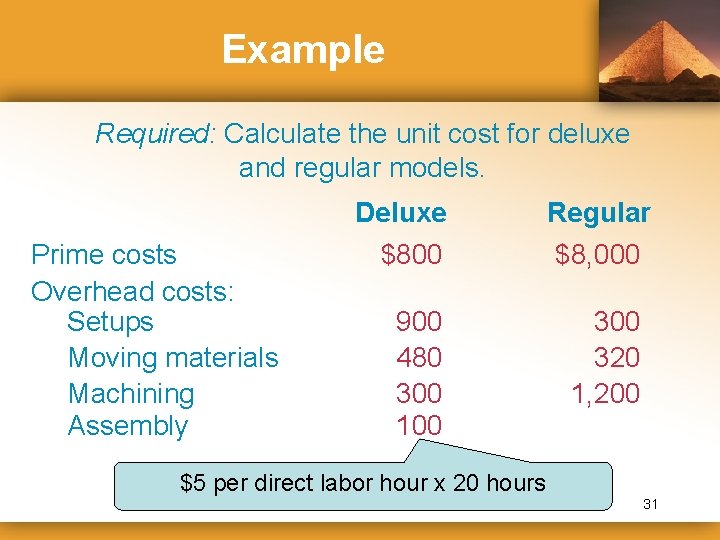
Example Required: Calculate the unit cost for deluxe and regular models. Deluxe Prime costs Overhead costs: Setups Moving materials Machining Assembly Regular $800 $8, 000 900 480 300 100 320 1, 200 $5 per direct labor hour x 20 hours 31
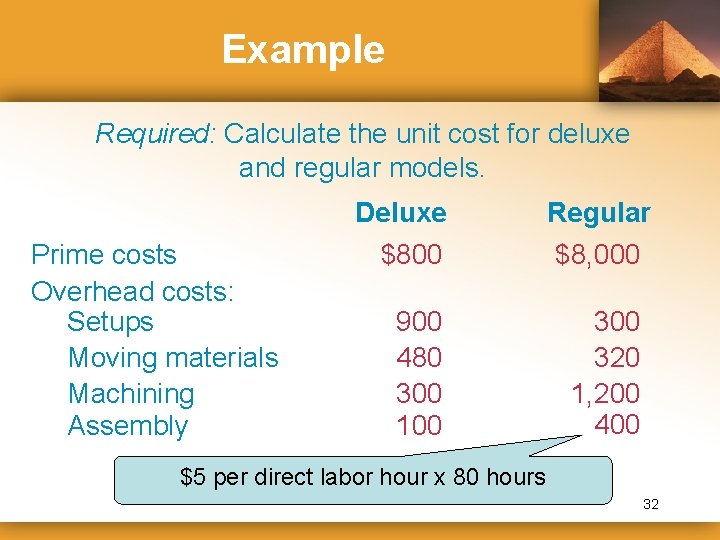
Example Required: Calculate the unit cost for deluxe and regular models. Deluxe Prime costs Overhead costs: Setups Moving materials Machining Assembly Regular $800 $8, 000 900 480 300 100 320 1, 200 400 $5 per direct labor hour x 80 hours 32
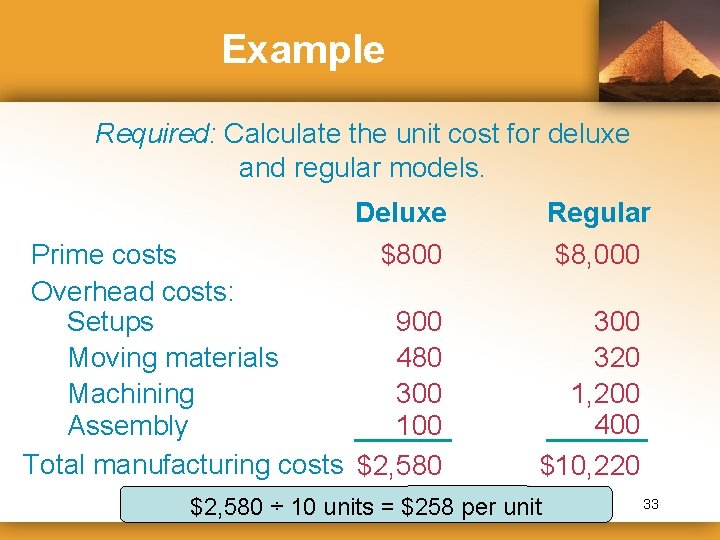
Example Required: Calculate the unit cost for deluxe and regular models. Deluxe Prime costs $800 Overhead costs: 900 Setups 480 Moving materials Machining 300 Assembly 100 Total manufacturing costs $2, 580 Regular $8, 000 320 1, 200 400 $10, 220 $2, 580 ÷ 10 units = $258 per unit 33
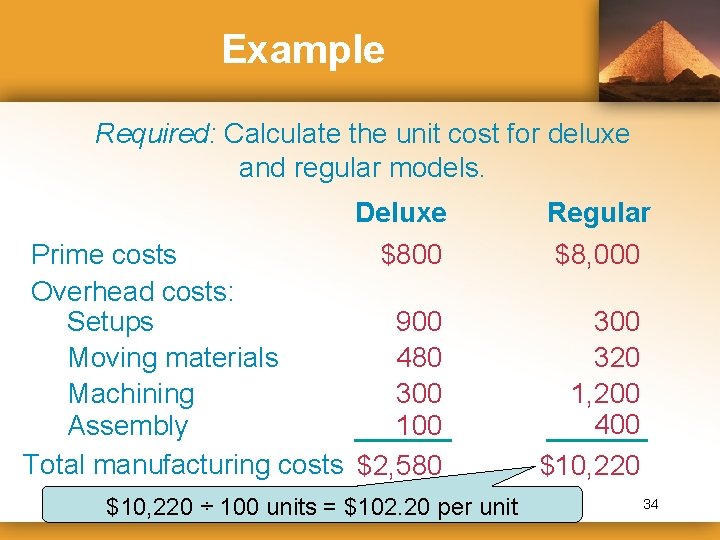
Example Required: Calculate the unit cost for deluxe and regular models. Deluxe Prime costs $800 Overhead costs: 900 Setups 480 Moving materials Machining 300 Assembly 100 Total manufacturing costs $2, 580 $10, 220 ÷ 100 units = $102. 20 per unit Regular $8, 000 320 1, 200 400 $10, 220 34
OBJECTIVE 2 Explain how an activitybased costing system works for product costing.
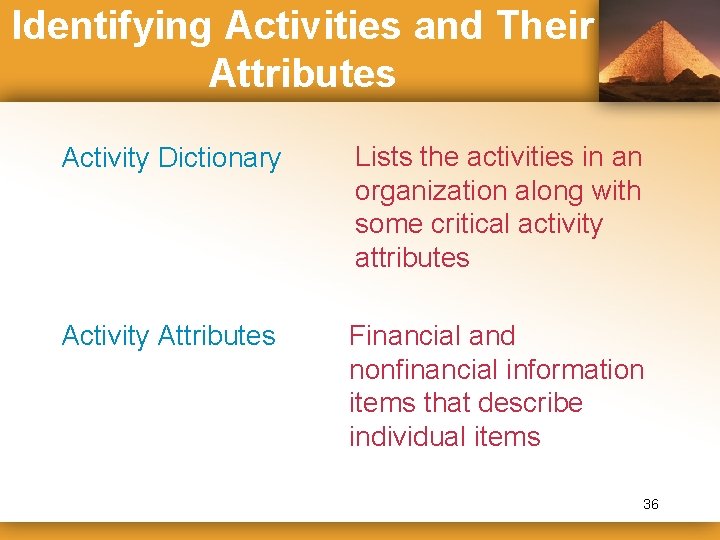
Identifying Activities and Their Attributes Activity Dictionary Lists the activities in an organization along with some critical activity attributes Activity Attributes Financial and nonfinancial information items that describe individual items 36
Key Questions to Identify Activities 1. How many employees are in your department? 2. What do they do? 3. Do customers outside your department use any equipment? 4. What resources are used by each activity? 5. What are the outputs of each activity? 6. Who or what uses the activity output? 7. How much time do workers spend on each activity? Time on each activity by equipment? 37
Assigning Costs to Activities • Must determine how much it costs to perform each activity – Requires identification of the resources being consumed • Labor, materials, energy, and capital – Cost of resources is found in the general ledger – Resources must be assigned using driver tracing • Work distribution matrix – Used to assign labor resources 38
Resource Drivers Factors that measure the consumption of resources by activity. 39
Cornerstone 7 -4 HOW TO Assign Resource Costs Using Direct Tracing and Resource Drivers 40
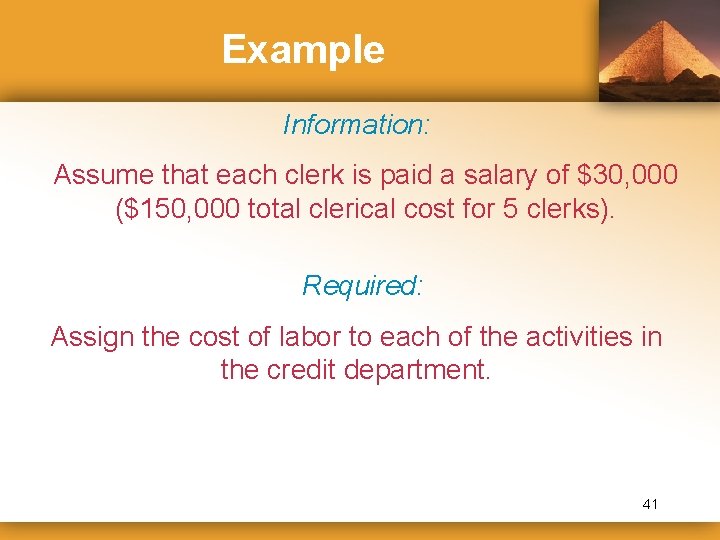
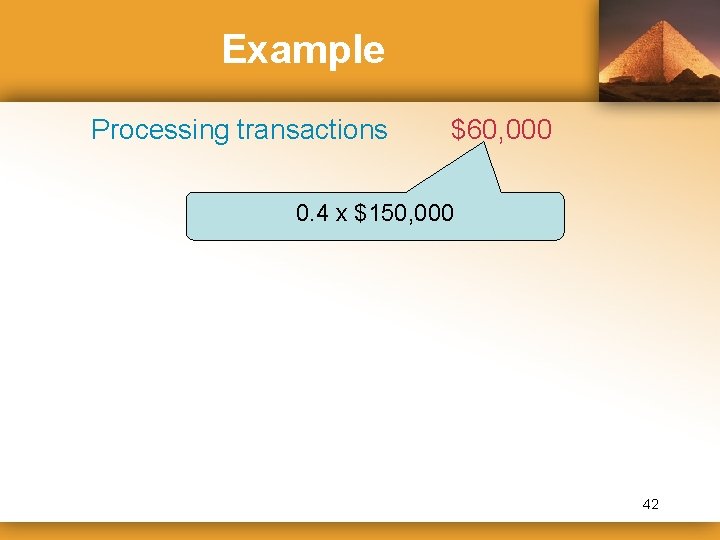
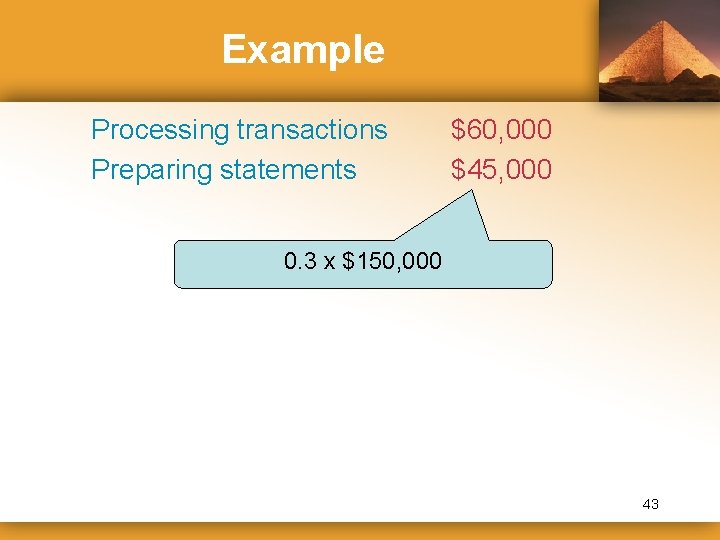
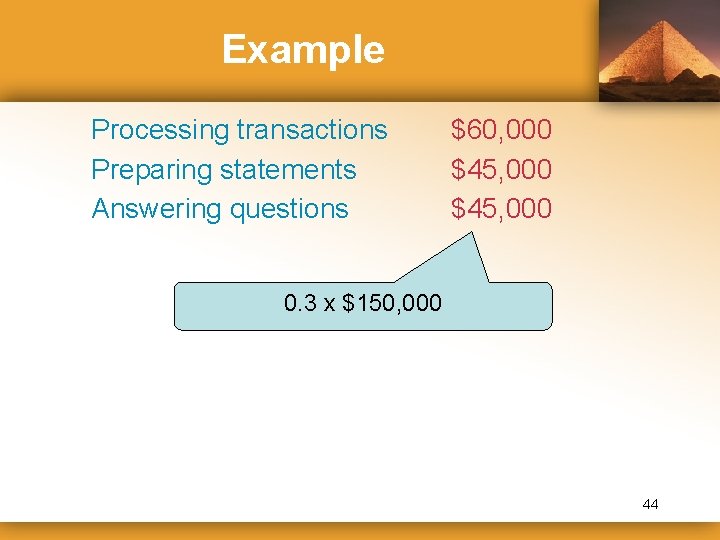
Example Information: Assume that each clerk is paid a salary of $30, 000 ($150, 000 total clerical cost for 5 clerks). Required: Assign the cost of labor to each of the activities in the credit department. 41
Example Processing transactions $60, 000 0. 4 x $150, 000 42
Example Processing transactions Preparing statements $60, 000 $45, 000 0. 3 x $150, 000 43
Example Processing transactions Preparing statements Answering questions $60, 000 $45, 000 0. 3 x $150, 000 44
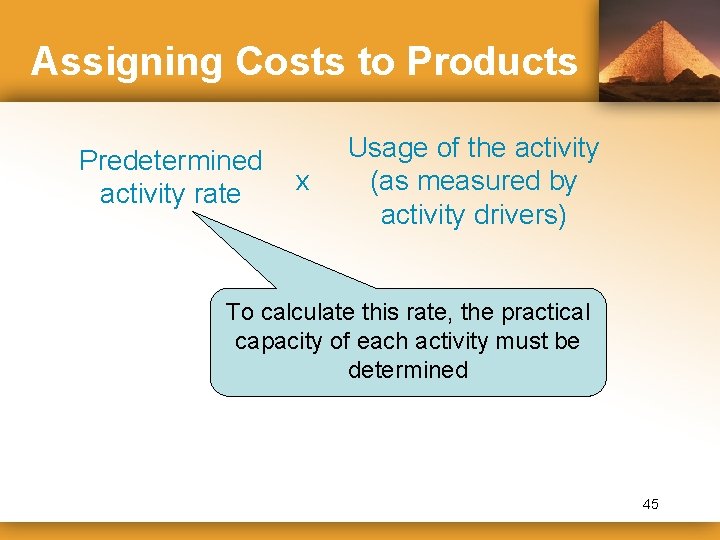
Assigning Costs to Products Predetermined activity rate x Usage of the activity (as measured by activity drivers) To calculate this rate, the practical capacity of each activity must be determined 45
OBJECTIVE 3 Describe activitybased customer and supplier costing.
Activity-Based Customer Costing • Customers are cost objects of fundamental interest. • Customer management can produce significant gains in profit. • Customers can consume customer-driven activities in different proportions. • Assigning the costs of customer service to customers is much the same as assigning manufacturing costs to products. 47
Cornerstone 7 -5 HOW TO Calculate Activity-Based Customer Costs 48
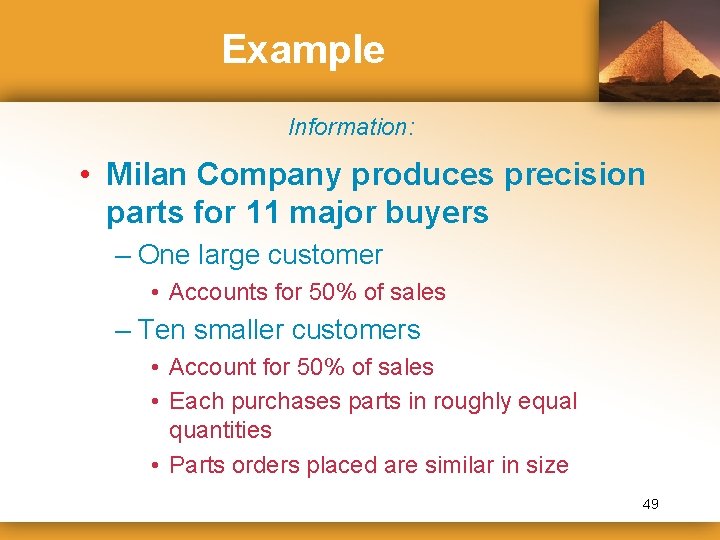
Example Information: • Milan Company produces precision parts for 11 major buyers – One large customer • Accounts for 50% of sales – Ten smaller customers • Account for 50% of sales • Each purchases parts in roughly equal quantities • Parts orders placed are similar in size 49
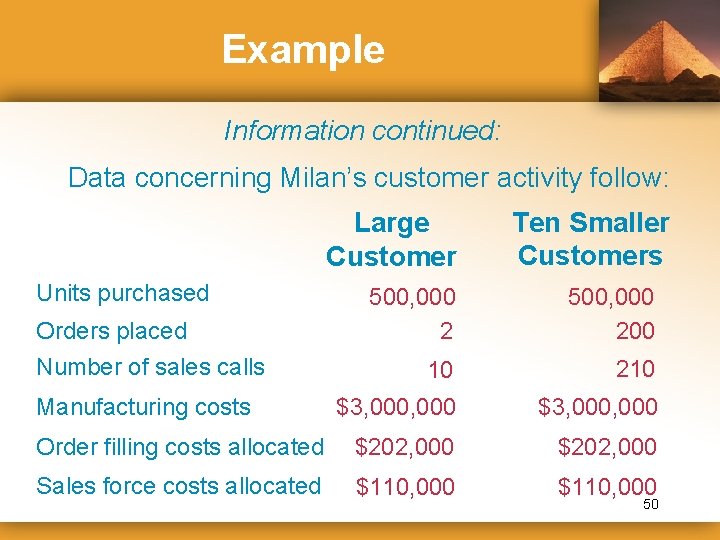
Example Information continued: Data concerning Milan’s customer activity follow: Large Customer Units purchased Ten Smaller Customers 500, 000 200 10 210 $3, 000, 000 Order filling costs allocated $202, 000 Sales force costs allocated $110, 000 Orders placed Number of sales calls Manufacturing costs 50
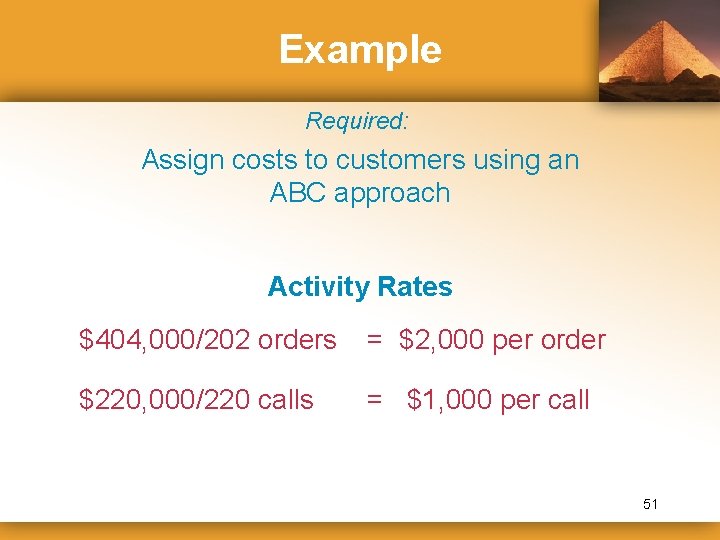
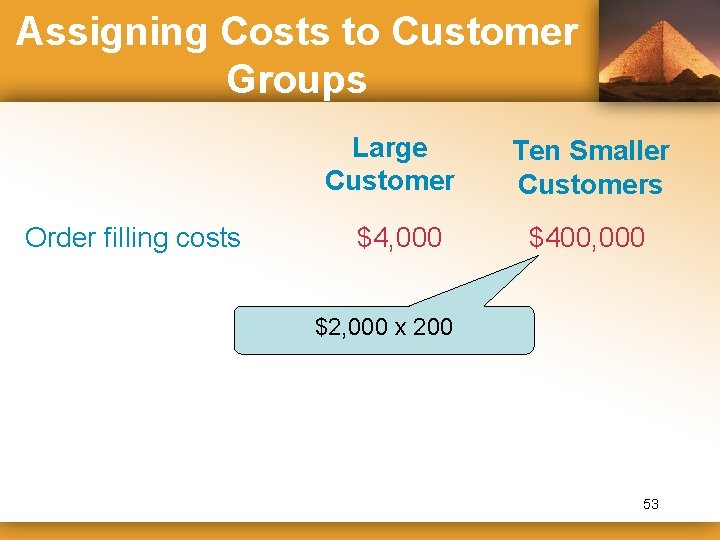
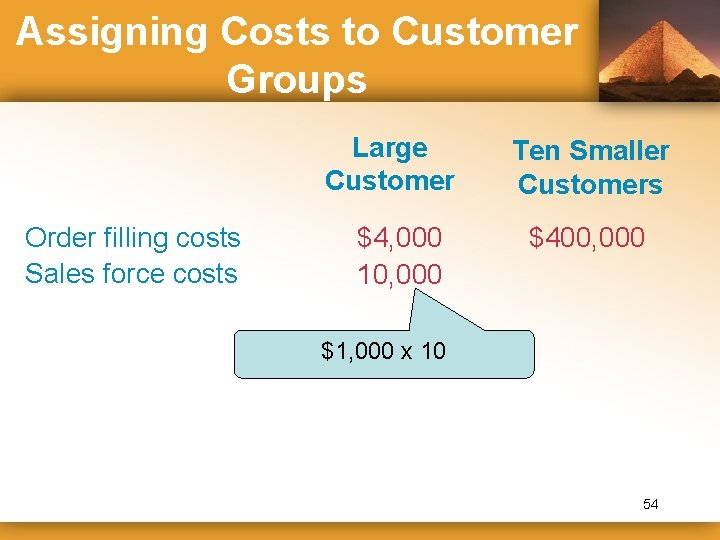
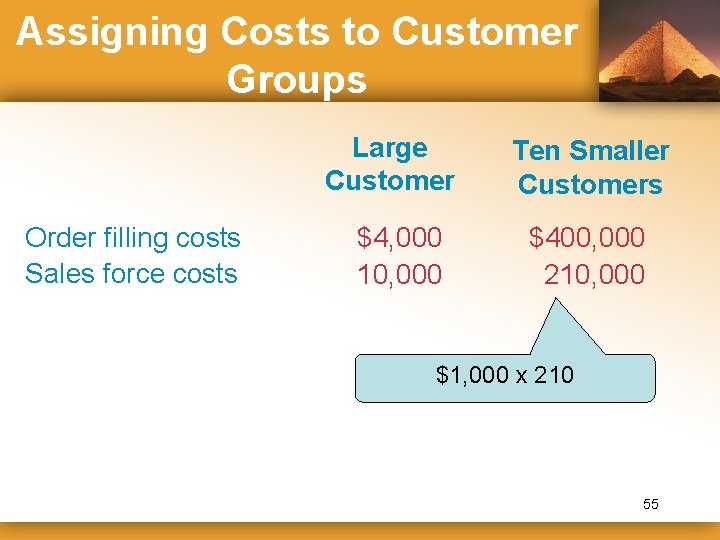
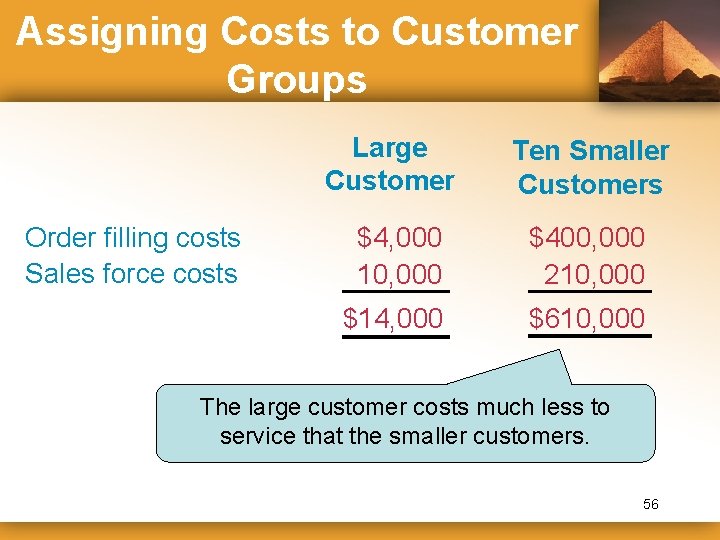
Example Required: Assign costs to customers using an ABC approach Activity Rates $404, 000/202 orders = $2, 000 per order $220, 000/220 calls = $1, 000 per call 51
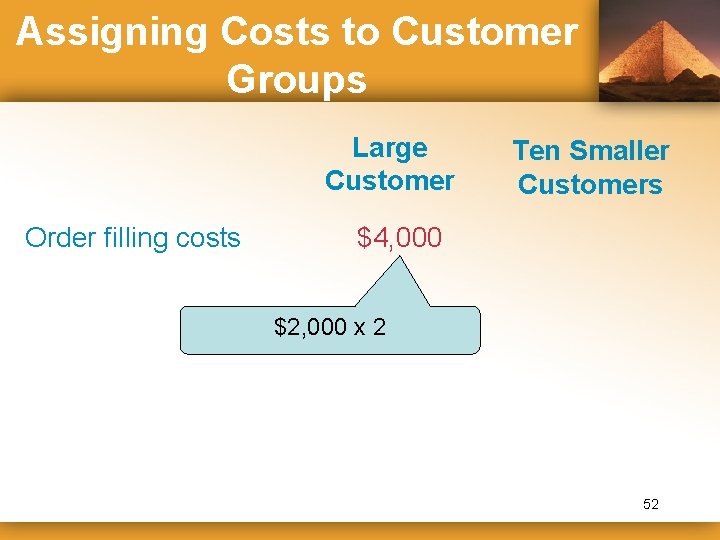
Assigning Costs to Customer Groups Large Customer Order filling costs Ten Smaller Customers $4, 000 $2, 000 x 2 52
Assigning Costs to Customer Groups Large Customer Order filling costs $4, 000 Ten Smaller Customers $400, 000 $2, 000 x 200 53
Assigning Costs to Customer Groups Large Customer Order filling costs Sales force costs $4, 000 10, 000 Ten Smaller Customers $400, 000 $1, 000 x 10 54
Assigning Costs to Customer Groups Large Customer Order filling costs Sales force costs $4, 000 10, 000 Ten Smaller Customers $400, 000 210, 000 $1, 000 x 210 55
Assigning Costs to Customer Groups Large Customer Order filling costs Sales force costs Ten Smaller Customers $4, 000 10, 000 $400, 000 210, 000 $14, 000 $610, 000 The large customer costs much less to service that the smaller customers. 56
Supplier Costing Methodology • Cost of a supplier is much more than the purchase price of the components or materials acquired • Assigning the cost to suppliers is similar to cost assignments we have seen for products and customers 57
Cornerstone 7 -6 HOW TO Calculate Activity-Based Supplier Costs 58
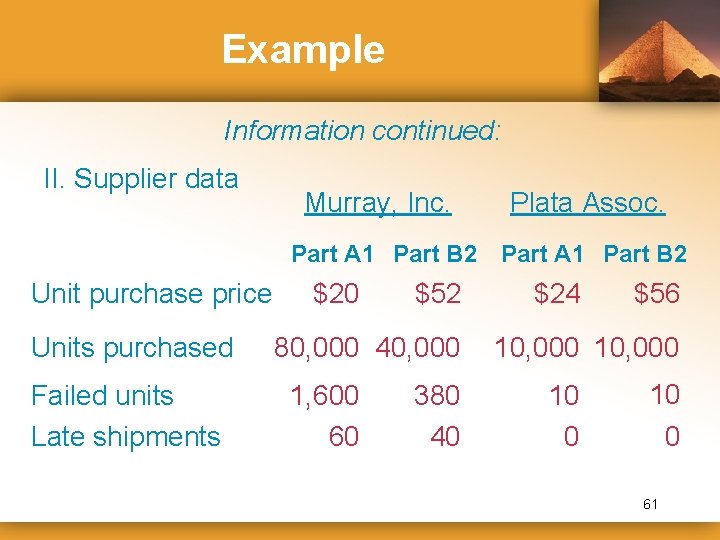
Example Information: • Purchasing manager uses two suppliers as sources of Part A 1 and Part B 2 – Murray Inc. – Plata Associates • Consider two activities – Repairing products • Because of part failure (bought from supplier) – Expediting products • Because supplier is late 59
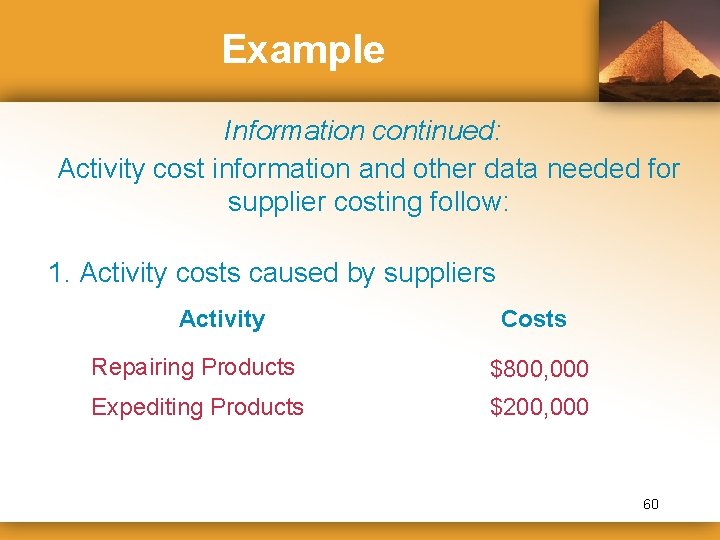
Example Information continued: Activity cost information and other data needed for supplier costing follow: 1. Activity costs caused by suppliers Activity Costs Repairing Products $800, 000 Expediting Products $200, 000 60
Example Information continued: II. Supplier data Unit purchase price Units purchased Failed units Late shipments Murray, Inc. Plata Assoc. Part A 1 Part B 2 $20 $52 80, 000 40, 000 1, 600 60 380 40 $24 $56 10, 000 10 0 61
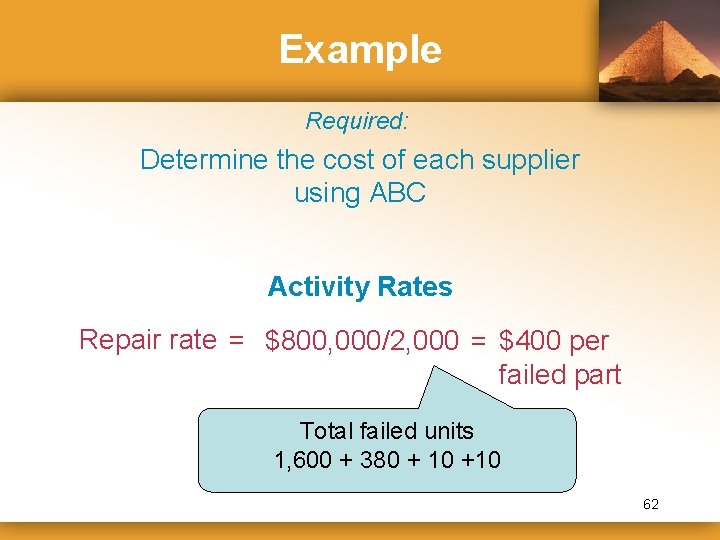
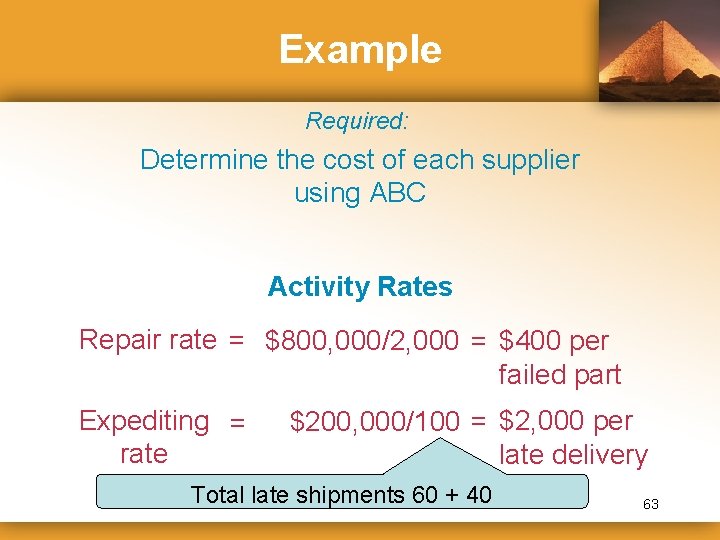
Example Required: Determine the cost of each supplier using ABC Activity Rates Repair rate = $800, 000/2, 000 = $400 per failed part Total failed units 1, 600 + 380 + 10 +10 62
Example Required: Determine the cost of each supplier using ABC Activity Rates Repair rate = $800, 000/2, 000 = $400 per failed part Expediting = rate $200, 000/100 = $2, 000 per late delivery Total late shipments 60 + 40 63
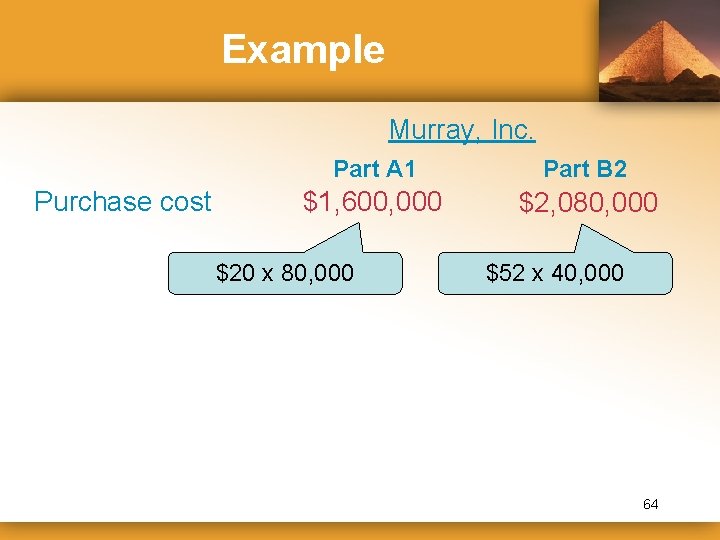
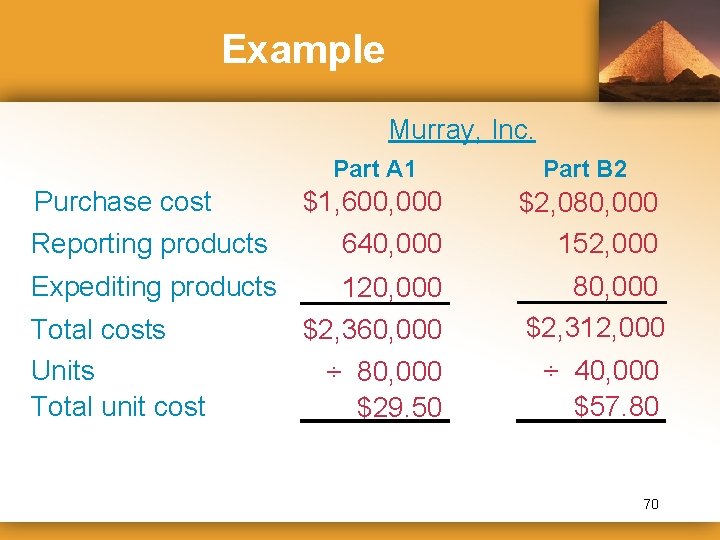
Example Murray, Inc. Purchase cost Part A 1 Part B 2 $1, 600, 000 $2, 080, 000 $20 x 80, 000 $52 x 40, 000 64
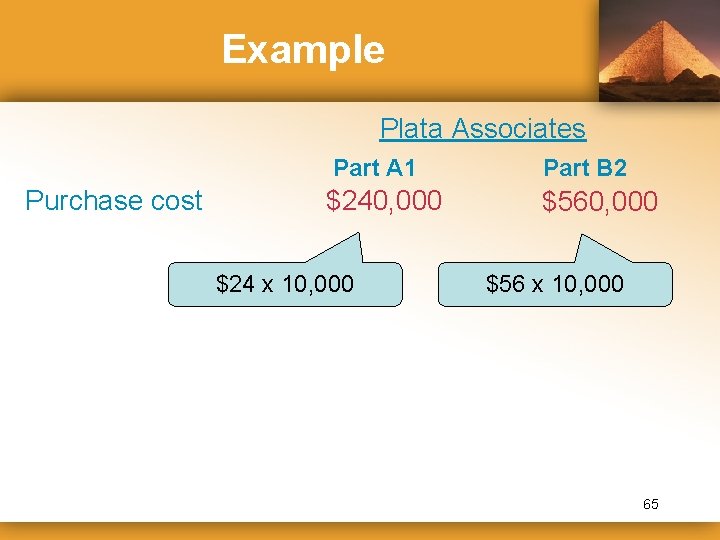
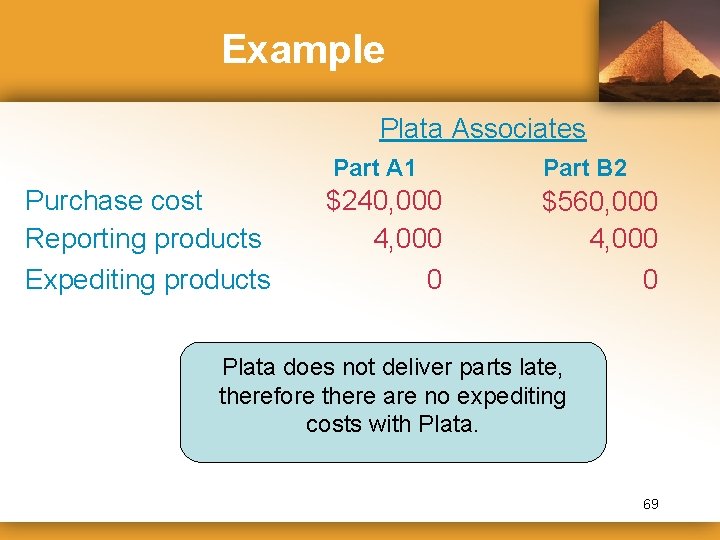
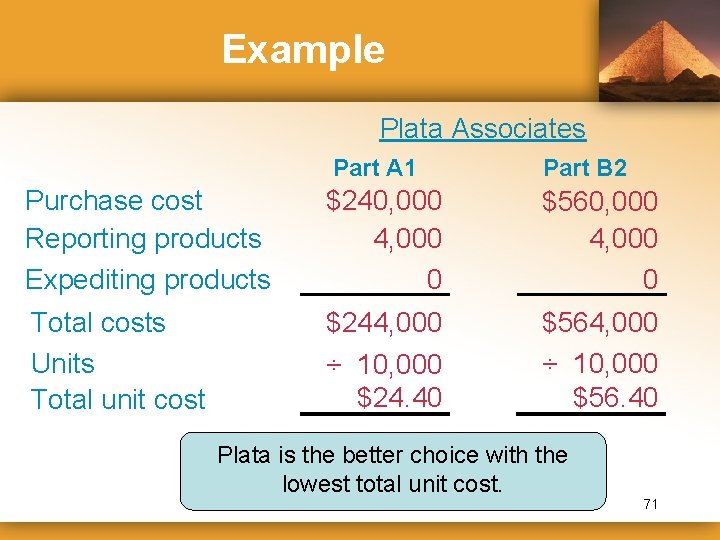
Example Plata Associates Purchase cost Part A 1 Part B 2 $240, 000 $560, 000 $24 x 10, 000 $56 x 10, 000 65
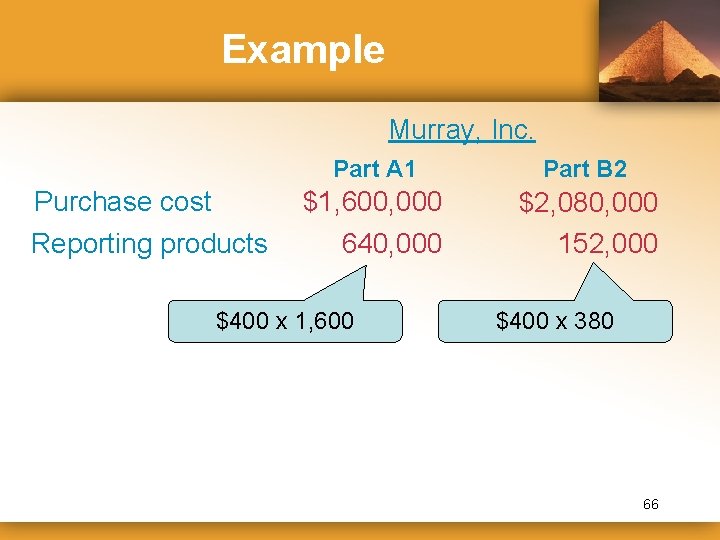
Example Murray, Inc. Purchase cost Reporting products Part A 1 Part B 2 $1, 600, 000 640, 000 $2, 080, 000 152, 000 $400 x 1, 600 $400 x 380 66
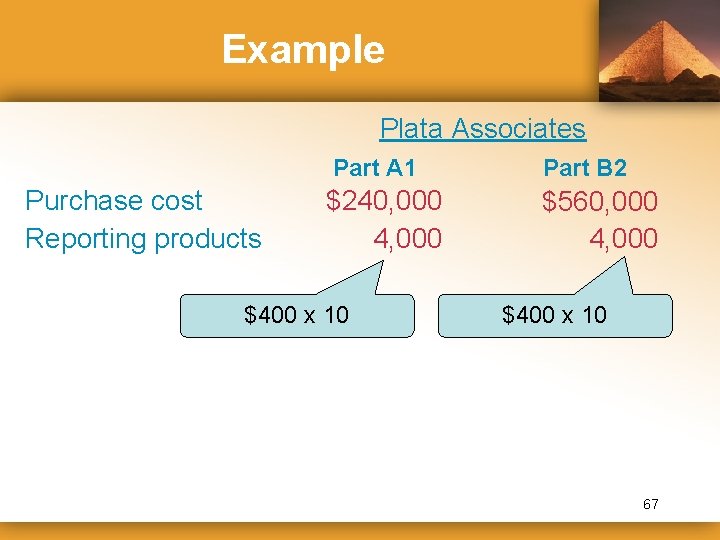
Example Plata Associates Purchase cost Reporting products Part A 1 Part B 2 $240, 000 4, 000 $560, 000 4, 000 $400 x 10 67
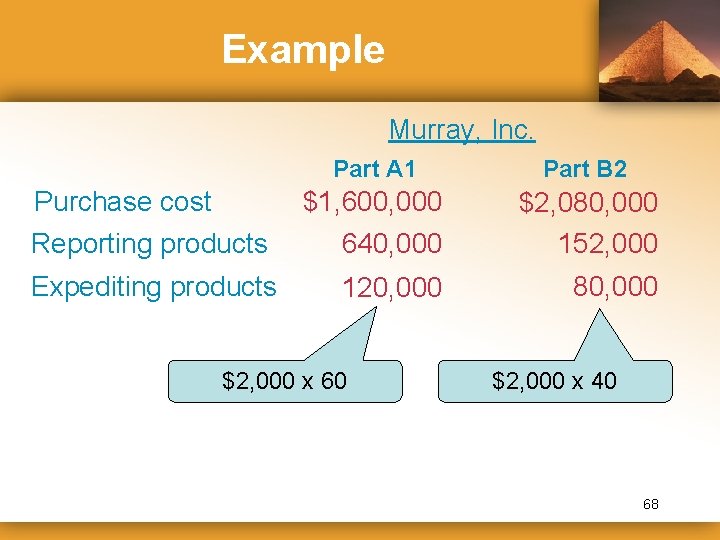
Example Murray, Inc. Purchase cost Reporting products Expediting products Part A 1 Part B 2 $1, 600, 000 640, 000 $2, 080, 000 152, 000 120, 000 80, 000 $2, 000 x 60 $2, 000 x 40 68
Example Plata Associates Purchase cost Reporting products Expediting products Part A 1 Part B 2 $240, 000 4, 000 0 $560, 000 4, 000 0 Plata does not deliver parts late, therefore there are no expediting costs with Plata. 69
Example Murray, Inc. Purchase cost Reporting products Expediting products Total costs Units Total unit cost Part A 1 Part B 2 $1, 600, 000 640, 000 $2, 080, 000 152, 000 120, 000 80, 000 $2, 312, 000 $2, 360, 000 ÷ 80, 000 $29. 50 ÷ 40, 000 $57. 80 70
Example Plata Associates Part A 1 Part B 2 Purchase cost Reporting products Expediting products $240, 000 4, 000 0 $560, 000 4, 000 0 Total costs Units Total unit cost $244, 000 ÷ 10, 000 $24. 40 $564, 000 ÷ 10, 000 $56. 40 Plata is the better choice with the lowest total unit cost. 71
OBJECTIVE 4 Explain how activitybased management can be used for cost reduction.
Process-Value Analysis • Focuses on cost reduction instead of cost assignment • Emphasizes the maximization of systemwide performance • Concerned with: – Driver analysis – Activity analysis – Performance measurement 73
Activity Inputs and Outputs Activity Inputs Resources consumed by the activity in producing its output Activity Outputs Result or product of an activity 74
Driver Analysis: The Search for Root Causes Activity Output Measure The number of time the activity is performed Driver Analysis The effort expended to identify those factors that are the root causes of activity costs 75
Activity Analysis • Process of identifying, describing, and evaluating the activities • It should produce four outcomes: – What activities are done – How many people perform the activities – The time and resources required to perform the activities – An assessment of the value of the activities to the organization 76
Value-Added Activities • Activities necessary to remain in business • Two types: – Value-added by mandate • Necessary to comply with legal mandate – Discretionary activities 77
Discretionary Value-Added Activities Three conditions must be met simultaneously for the activity to be classified as value added: 1. Produces a change of state 2. Change of state was not achievable by preceding conditions 3. Enables other activities to be performed 78
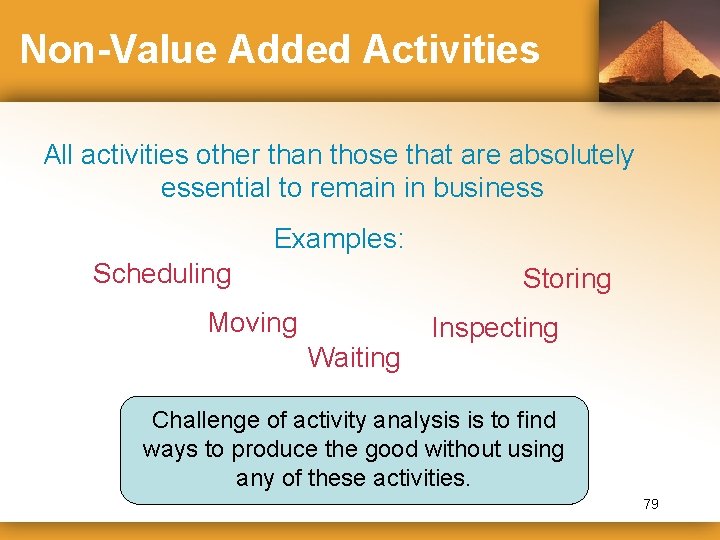
Non-Value Added Activities All activities other than those that are absolutely essential to remain in business Examples: Scheduling Storing Moving Waiting Inspecting Challenge of activity analysis is to find ways to produce the good without using any of these activities. 79
Cost Reduction Four Ways: 1. 2. 3. 4. Activity elimination Activity selection Activity reduction Activity sharing 80
Activity Elimination Once activities that fail to add value are identified, measures must be taken to rid the organization of these activities. 81
Activity Selection Involves choosing among different sets of activities that are caused by competing strategies. The lowest-cost design strategy should be chosen. 82
Activity Reduction Decreases the time and resources required by an activity. This approach focuses on improving efficiency. 83
Activity Sharing Increases the efficiency by using economies of scale. This lowers the per -unit cost of the cost driver and the amount of cost traceable to the products that consume the activity. 84
Cornerstone 7 -7 HOW TO Assess Non-Value Added Costs 85
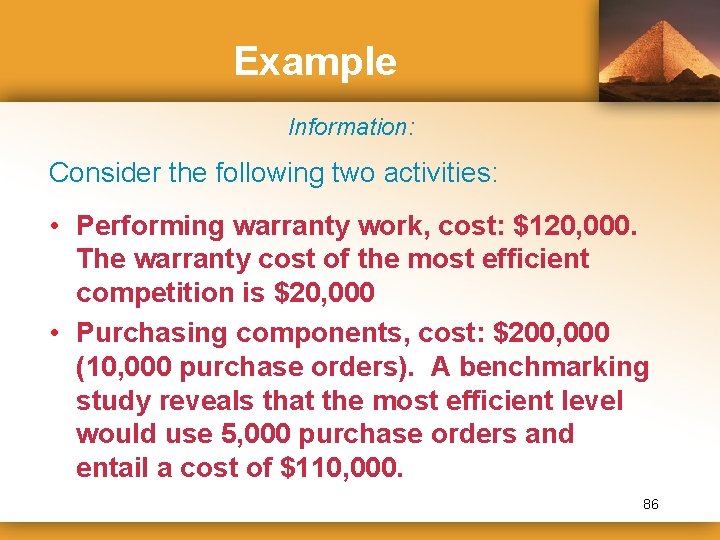
Example Information: Consider the following two activities: • Performing warranty work, cost: $120, 000. The warranty cost of the most efficient competition is $20, 000 • Purchasing components, cost: $200, 000 (10, 000 purchase orders). A benchmarking study reveals that the most efficient level would use 5, 000 purchase orders and entail a cost of $110, 000. 86
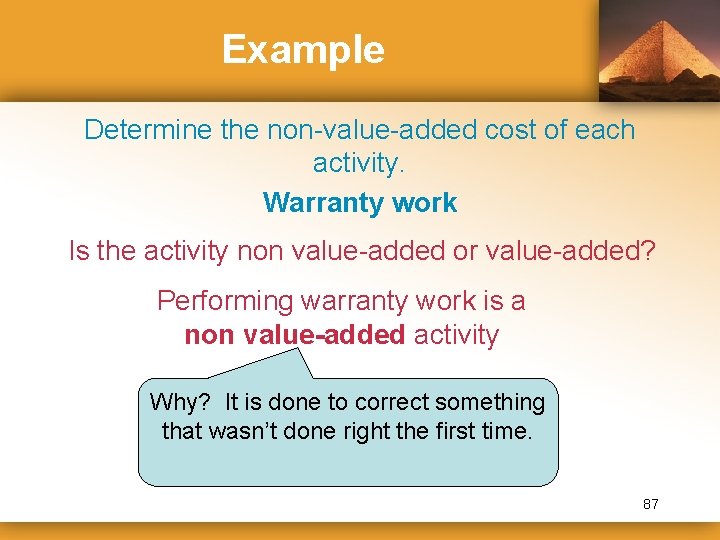
Example Determine the non-value-added cost of each activity. Warranty work Is the activity non value-added or value-added? Performing warranty work is a non value-added activity Why? It is done to correct something that wasn’t done right the first time. 87
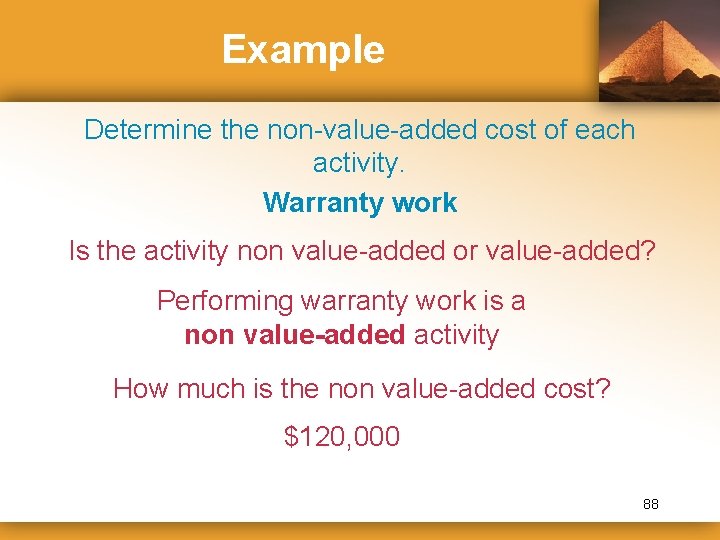
Example Determine the non-value-added cost of each activity. Warranty work Is the activity non value-added or value-added? Performing warranty work is a non value-added activity How much is the non value-added cost? $120, 000 88
Example Determine the non-value-added cost of each activity. Competitor Is the activity non value-added or value-added? Cost of the competitor is a non value-added activity Why? It has no bearing on the analysis. 89
Example Determine the non-value-added cost of each activity. Competitor Is the activity non value-added or value-added? Cost of the competitor is a non value-added activity How much is the non value-added cost? $200, 000 - $110, 000 = $90, 000 Because the activity is not performed efficiently 90
Example Determine the non-value-added cost of each activity. The cost of the competitor is non-valueadded and has no bearing on the analysis Purchasing components is necessary (value-added) but it is not performed efficiently Actual cost – benchmark study $200, 000 - $110, 000 $90, 000 in non-value added cost 91
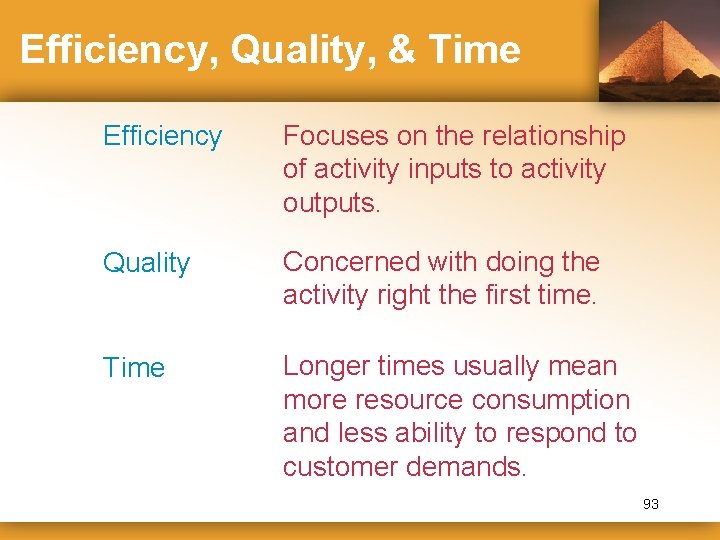
Activity Performance Measurement • Designed to assess how well an activity was performed and the results achieved. • Measures are both financial and nonfinancial • Centers on 3 dimensions: – Efficiency – Quality – Time 92
Efficiency, Quality, & Time Efficiency Focuses on the relationship of activity inputs to activity outputs. Quality Concerned with doing the activity right the first time. Time Longer times usually mean more resource consumption and less ability to respond to customer demands. 93
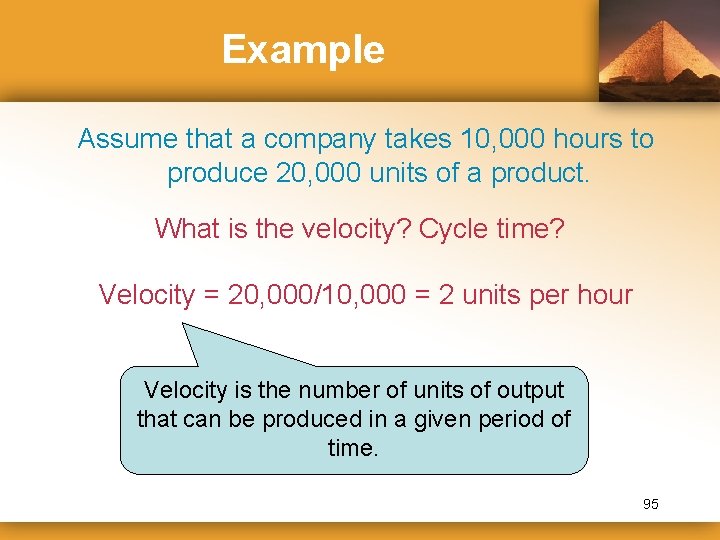
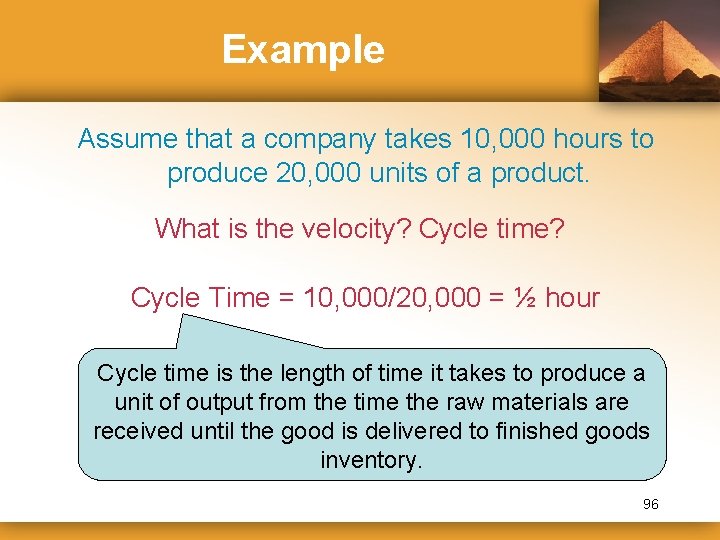
Cornerstone 7 -8 HOW TO Calculate Cycle Time and Velocity 94
Example Assume that a company takes 10, 000 hours to produce 20, 000 units of a product. What is the velocity? Cycle time? Velocity = 20, 000/10, 000 = 2 units per hour Velocity is the number of units of output that can be produced in a given period of time. 95
Example Assume that a company takes 10, 000 hours to produce 20, 000 units of a product. What is the velocity? Cycle time? Cycle Time = 10, 000/20, 000 = ½ hour Cycle time is the length of time it takes to produce a unit of output from the time the raw materials are received until the good is delivered to finished goods inventory. 96