
Core Theme 5 WEATHER CLIMATE AND ECOSYSTEMS Key
- Slides: 16
Core Theme 5: WEATHER, CLIMATE AND ECOSYSTEMS
Key Idea 5. 1: Climate change during the Quaternary period • 5. 1. 1 What is the evidence for climate change? • Lesson Objectives • You will understand: • What is climate change and nature of glacial and inter-glacial periods. • Know and explain the range of evidence for climate change to include, tree rings, historical accounts, temperature records, in particular ice cores and CO² levels.
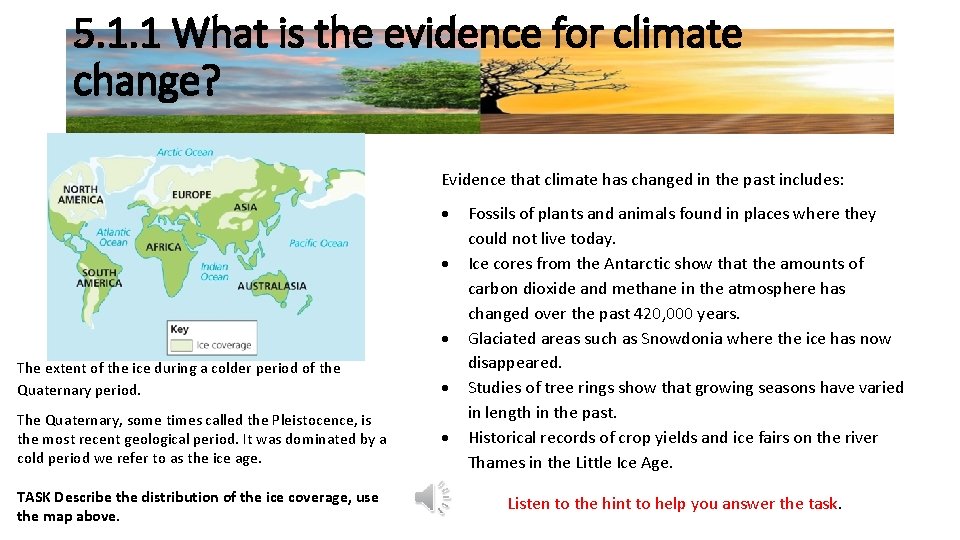
5. 1. 1 What is the evidence for climate change? Evidence that climate has changed in the past includes: The extent of the ice during a colder period of the Quaternary period. The Quaternary, some times called the Pleistocence, is the most recent geological period. It was dominated by a cold period we refer to as the ice age. TASK Describe the distribution of the ice coverage, use the map above. Fossils of plants and animals found in places where they could not live today. Ice cores from the Antarctic show that the amounts of carbon dioxide and methane in the atmosphere has changed over the past 420, 000 years. Glaciated areas such as Snowdonia where the ice has now disappeared. Studies of tree rings show that growing seasons have varied in length in the past. Historical records of crop yields and ice fairs on the river Thames in the Little Ice Age. Listen to the hint to help you answer the task.
5. 1. 1 What is the evidence for climate change? • Recent evidence includes: Increasing levels of CO 2 in atmosphere. Shifting seasons, changes in migration patterns for birds and insects. Glaciers and ice sheets melting and retreating. Measurements by the Met Office show increase of global temperatures by 0. 6 C in past 100 years. Increasing levels of CO 2 in atmosphere. Shifting seasons, changes in migration patterns for birds and insects. Glaciers and ice sheets melting and retreating. Measurements by the Met Office show increase of global temperatures by 0. 6 C in past 100 years.
5. 1. 1 What is the evidence for climate change? https: //www. bbc. co. uk/education/clips/zj 8 hfg 8 Watch the video and then answer the 2 questions below. TASK: 1. Explain how tree rings provide evidence for climate change 2. Explain how ice cores provide evidence for climate change.
• Exam practice: • Explain how one piece of evidence, other than rising temperatures, suggests that climate is changing. [4] • Debug the question. • Identify the command word and describe what the examiner expects you to do when you see this. • Identify the focus/geography words, this helps you know what content you have to use in your answer.
• Explain how one piece of evidence, other than rising temperatures, suggests that climate is changing. [4] • Explain is the command word, this means you have to demonstrate your understanding, AO 1. 2 • For explain you need to use connectives to develop your reason… • This means. . The result is…therefore… e. t. c. • One piece of evidence, rising temperatures and climate is changing are the focus/geography words. • You need to use evidence other than rising temperatures and only 1 other. • You must link how this evidence shows climate change.
• Possible answer below are 3 possible pieces of evidence identify the evidence and the following points qualify how the evidence shows climate change, • Choose one and using connectives write in your exercise books a model answer: • Ice cores [1], from the Antarctic [1], show that the amount of carbon dioxide (CO 2) in the atmosphere has increased [1], since the Industrial Revolution [1] • Shifting seasons [1], earlier arrival of spring [1], causes changes in migration patterns of birds [1], for example storks wintering in southern Europe instead of Africa [1] • Glaciers and ice sheets melting [1], the Pasterze Glacier in Austria [1], retreated 8 km in past 160 years [1], in 2008 a 400 km² piece of ice broke off the Antarctic ice sheet [1]
• Explain how one piece of evidence, other than rising temperatures, suggests that climate is changing. [4] • Model answer using glacial melting as evidence: • In general, glaciers around the world are retreating and ice sheets are melting as the climate slowly warms up. The evidence for this can be seen in some of the large Antarctic ice sheets either retreating or breaking off from the continent altogether. In 2008, a 400 km² piece of ice broke off the Antarctic ice sheet. Valley glaciers are also being measured to see how quickly they are retreating. The Mer de Glace in the French Alps is the largest glacier in France, 7 km long. It has been getting shorter and thinner since 1850. It is retreating by about 30 metres a year and is 500 metres shorter than it was in 1994. [4]
• Lesson Objectives • After this series of lessons, you will know and understand: • The processes that link flows and stores in the carbon cycle. • How the greenhouse effect operates. • How human activity affects the carbon cycle. • How volcanic activity as a natural cause of climate change can lead to global cooling.
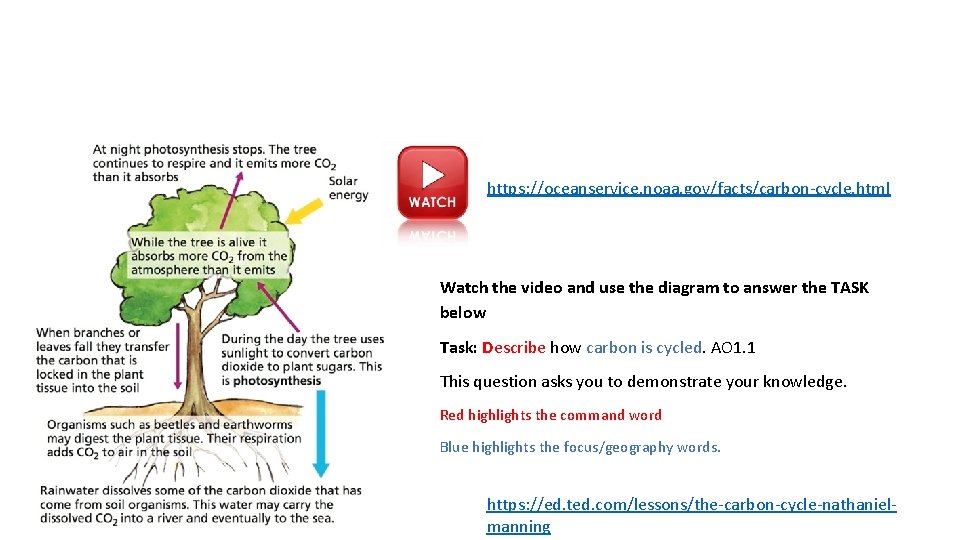
https: //oceanservice. noaa. gov/facts/carbon-cycle. html Watch the video and use the diagram to answer the TASK below Task: Describe how carbon is cycled. AO 1. 1 This question asks you to demonstrate your knowledge. Red highlights the command word Blue highlights the focus/geography words. https: //ed. ted. com/lessons/the-carbon-cycle-nathanielmanning
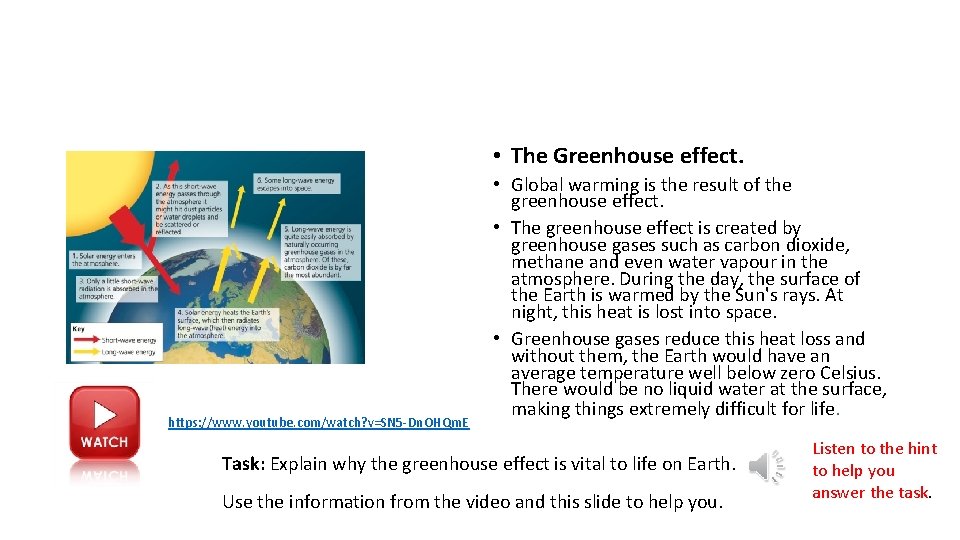
• The Greenhouse effect. https: //www. youtube. com/watch? v=SN 5 -Dn. OHQm. E • Global warming is the result of the greenhouse effect. • The greenhouse effect is created by greenhouse gases such as carbon dioxide, methane and even water vapour in the atmosphere. During the day, the surface of the Earth is warmed by the Sun's rays. At night, this heat is lost into space. • Greenhouse gases reduce this heat loss and without them, the Earth would have an average temperature well below zero Celsius. There would be no liquid water at the surface, making things extremely difficult for life. Task: Explain why the greenhouse effect is vital to life on Earth. Use the information from the video and this slide to help you. Listen to the hint to help you answer the task.
• Natural factors increasing global warming • There also natural factors which contribute to increased global warming: • Orbital changes - the Earth has natural warming and cooling periods caused by Milankovitch cycles or variations in the tilt and/or orbit of the Earth around the Sun (Wobble, roll and stretch theory). • Volcanic activity - during a volcanic eruption carbon dioxide is released into the atmosphere. • Solar output - there can be fluctuations in the amount of radiation from the sun. If there is high amount emitted there will be an increase in Earth's temperatures. • Human factors increasing global warming • Some human activities increase the greenhouse gases in the atmosphere: • Burning fossil fuels, eg coal, gas and oil - these release carbon dioxide into the atmosphere. • Deforestation - trees absorb carbon dioxide during photosynthesis. If they are cut down, there will be higher amounts of carbon dioxide in the atmosphere. • Dumping waste in landfill - when the waste decomposes it produces methane. • Agriculture - agricultural practices lead to the release of nitrogen oxides into the atmosphere. https: //www. bbc. co. uk/bitesize/guides/zx 234 j 6/revision/1
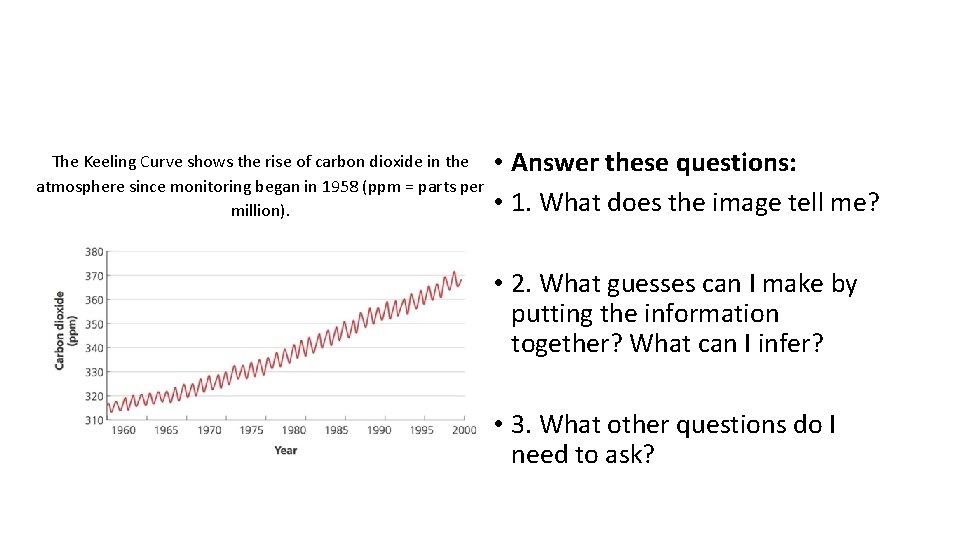
The Keeling Curve shows the rise of carbon dioxide in the atmosphere since monitoring began in 1958 (ppm = parts per million). • Answer these questions: • 1. What does the image tell me? • 2. What guesses can I make by putting the information together? What can I infer? • 3. What other questions do I need to ask?
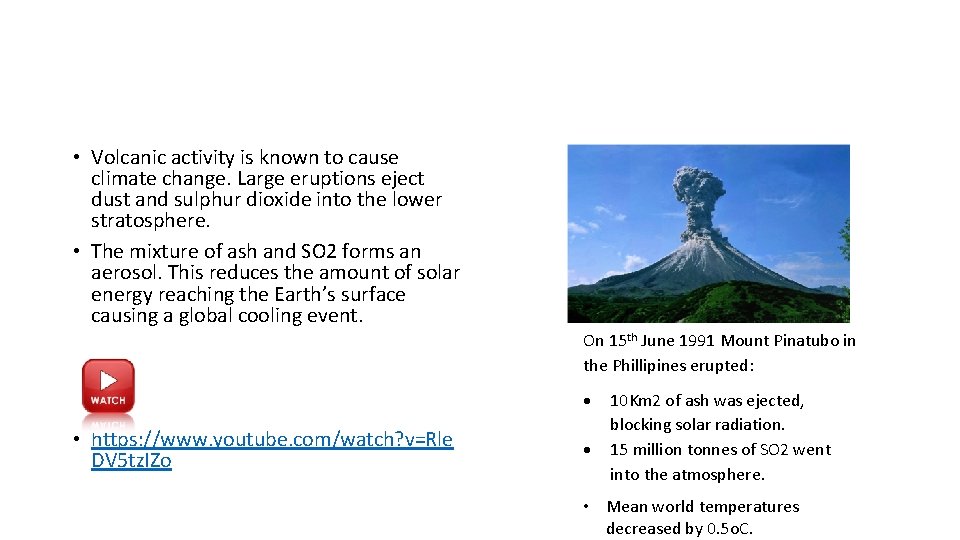
• Volcanic activity is known to cause climate change. Large eruptions eject dust and sulphur dioxide into the lower stratosphere. • The mixture of ash and SO 2 forms an aerosol. This reduces the amount of solar energy reaching the Earth’s surface causing a global cooling event. On 15 th June 1991 Mount Pinatubo in the Phillipines erupted: • https: //www. youtube. com/watch? v=Rle DV 5 tz. IZo 10 Km 2 of ash was ejected, blocking solar radiation. 15 million tonnes of SO 2 went into the atmosphere. • Mean world temperatures decreased by 0. 5 o. C.