
Core Strengthening Stabilization in Therapeutic Exercise What is
Core Strengthening & Stabilization in Therapeutic Exercise
What is the CORE? Lumbo-pelvic-hip complex Ø Location of center of gravity (Co. G) Ø Ø Efficient core allows for Ø Ø Maintenance of normal length-tension relationships Maintenance of normal force couples Maintenance of optimal arthrokinematics Optimal efficiency in entire kinetic chain during movement ü Acceleration, deceleration, dynamic stabilization Ø Proximal stability for movement of extremities
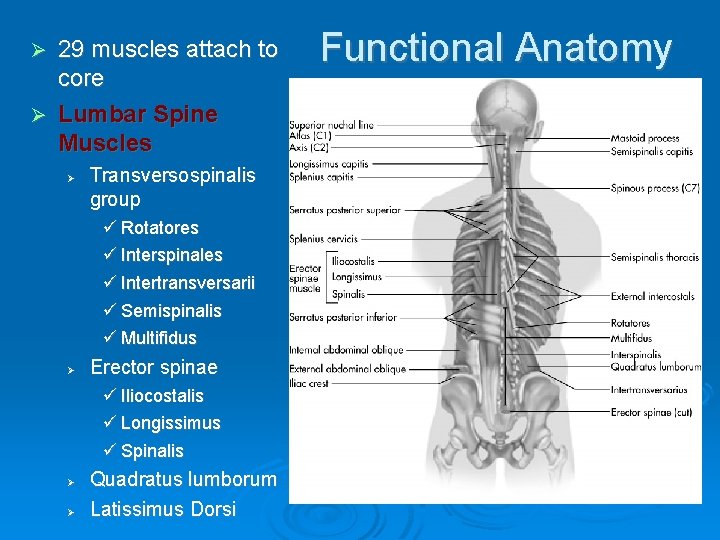
29 muscles attach to core Ø Lumbar Spine Muscles Ø Ø Transversospinalis group ü Rotatores ü Interspinales ü Intertransversarii ü Semispinalis ü Multifidus Ø Erector spinae ü Iliocostalis ü Longissimus ü Spinalis Ø Ø Quadratus lumborum Latissimus Dorsi Functional Anatomy
Ø Transversospinalis group Ø Ø Erector spinae Ø Ø Ø Provide intersegmental stabilization Eccentrically decelerate trunk flexion & rotation Quadratus Lumborum Ø Ø Ø Poor mechanical advantage relative to movement production Primarily Type I muscle fibers with high degree of muscle spindles ü Optimal for providing proprioceptive information to CNS Inter/intra-segmental stabilization Frontal plane stabilizer Works in conjunction with gluteus medius & tensor fascia latae Latissimus Dorsi Ø Bridge between upper extremity & core
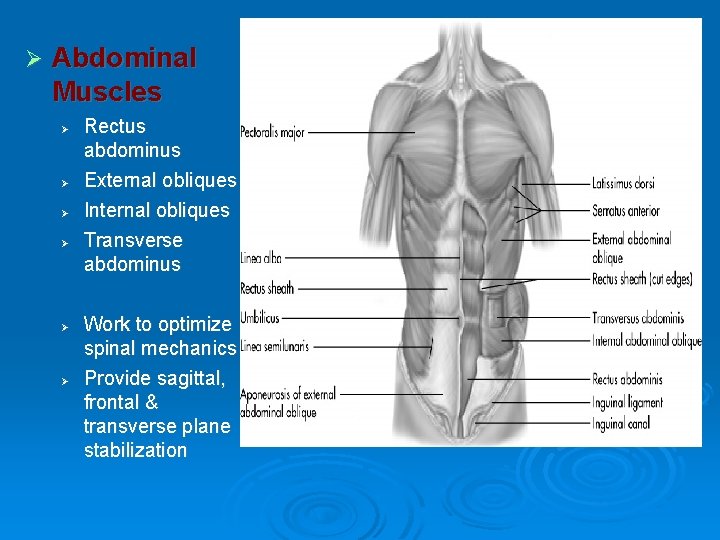
Ø Abdominal Muscles Ø Ø Ø Rectus abdominus External obliques Internal obliques Transverse abdominus Work to optimize spinal mechanics Provide sagittal, frontal & transverse plane stabilization
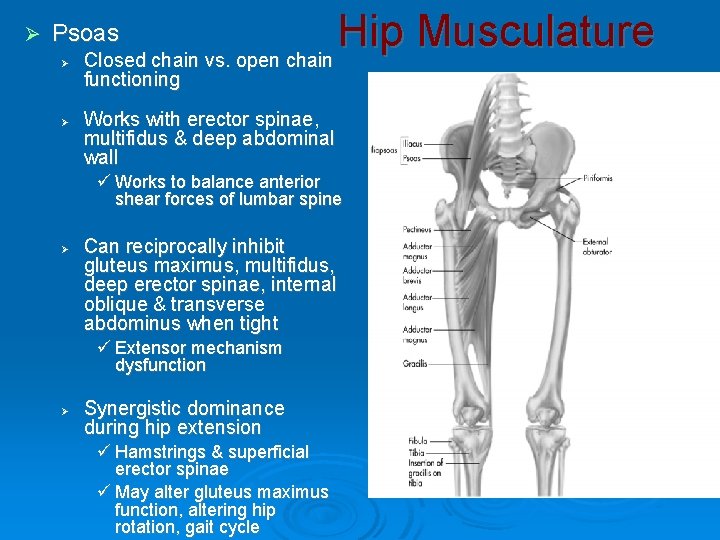
Ø Hip Musculature Closed chain vs. open chain Psoas Ø Ø functioning Works with erector spinae, multifidus & deep abdominal wall ü Works to balance anterior shear forces of lumbar spine Ø Can reciprocally inhibit gluteus maximus, multifidus, deep erector spinae, internal oblique & transverse abdominus when tight ü Extensor mechanism dysfunction Ø Synergistic dominance during hip extension ü Hamstrings & superficial erector spinae ü May alter gluteus maximus function, altering hip rotation, gait cycle
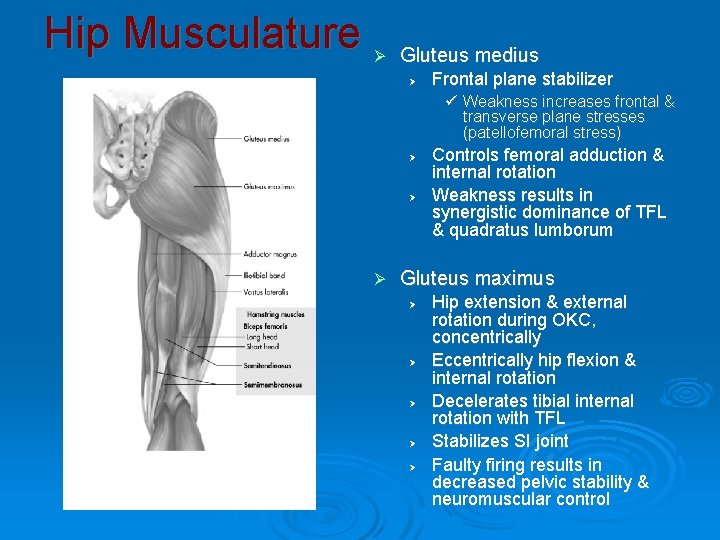
Hip Musculature Ø Gluteus medius Ø Frontal plane stabilizer ü Weakness increases frontal & transverse plane stresses (patellofemoral stress) Ø Ø Ø Controls femoral adduction & internal rotation Weakness results in synergistic dominance of TFL & quadratus lumborum Gluteus maximus Ø Ø Ø Hip extension & external rotation during OKC, concentrically Eccentrically hip flexion & internal rotation Decelerates tibial internal rotation with TFL Stabilizes SI joint Faulty firing results in decreased pelvic stability & neuromuscular control
Ø Hamstrings Ø Ø Concentrically flex the knee, extend the hip & rotate the tibia Eccentrically decelerate knee extension, hip flexion & tibial rotation Work synergistically with the ACL to stabilize tibial translation All muscles produce & control forces in multiple planes
The CORE Ø Functions & operates as an integrated unit Ø Ø In an efficient state, the CORE enables each of the structural components to operate optimally through: Ø Ø Ø Entire kinetic chain operates synergistically to produce force, reduce force & dynamically stabilize against abnormal force Distribution of weight Absorption of force Transfer of ground reaction forces Requires training for optimal functioning! Train entire kinetic chain on all levels in all planes
Ø Neuromuscular efficiency Ø Ø Ability of CNS to allow agonists, antagonists, synergists, stabilizers & neutralizers to work efficiently & interdependently Established by combination of postural alignment & stability strength Optimizes body’s ability to generate & adapt to forces Dynamic stabilization is critical for optimal neuromuscular efficiency Ø Rehab generally focuses on isolated single plane strength gains in single muscles Ø Functional activities are multi-planar requiring acceleration & stabilization Ø Inefficiency results in body’s inability to respond to demands Ø Can result in repetitive microtrauma, faulty biomechanics & injury Ø Compensatory actions result
Core Stabilization Concepts Ø A specific core strengthening program can: ü IMPROVE dynamic postural control ü Ensure appropriate muscular balance & joint arthrokinematics in the lumbo-pelvic-hip complex ü Allow for expression of dynamic functional performance throughout the entire kinetic chain ü Increase neuromuscular efficiency throughout the entire body Ø Spinal stabilization Ø Must effectively utilize strength, power, neuromuscular control & endurance of the “prime movers” Ø Weak core = decreased force production & efficiency Ø Ø Ø Protective mechanism for the spine Facilitates balanced muscular functioning of the entire kinetic chain Enhances neuromuscular control to provide a more efficient body positioning
Postural Considerations Ø Core functions to maintain postural alignment & dynamic postural equilibrium Ø Ø Optimal alignment = optimal functional training and rehabilitation Segmental deficit results in predictable dysfunction Ø Serial distortion patterns ü Structural integrity of body is compromised due to malalignment ü Abnormal forces are distributed above and below misaligned segment
Neuromuscular Considerations Enhance dynamic postural control with strong stable core Ø Kinetic chain imbalances = deficient neuromuscular control Ø l l Ø Impact of low back pain on neuromuscular control Joint/ligament injury neuromuscular deficits Arthrokinetic reflex l l Reflexes mediated by joint receptor activity Altered arthrokinetic reflex can result in arthrogenic muscle inhibition • Disrupted muscle function due to altered joint functioning
Assessment of the Core Muscle imbalances Ø Arthrokinematic deficits Ø Core Ø l l Ø Strength Endurance Neuromuscular control Power Overall function of lower extremity kinetic chain
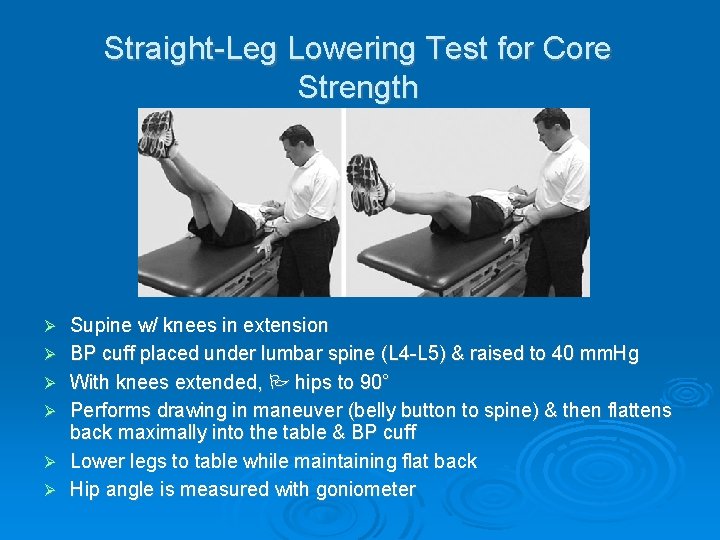
Straight-Leg Lowering Test for Core Strength Ø Ø Ø Supine w/ knees in extension BP cuff placed under lumbar spine (L 4 -L 5) & raised to 40 mm. Hg With knees extended, hips to 90° Performs drawing in maneuver (belly button to spine) & then flattens back maximally into the table & BP cuff Lower legs to table while maintaining flat back Hip angle is measured with goniometer
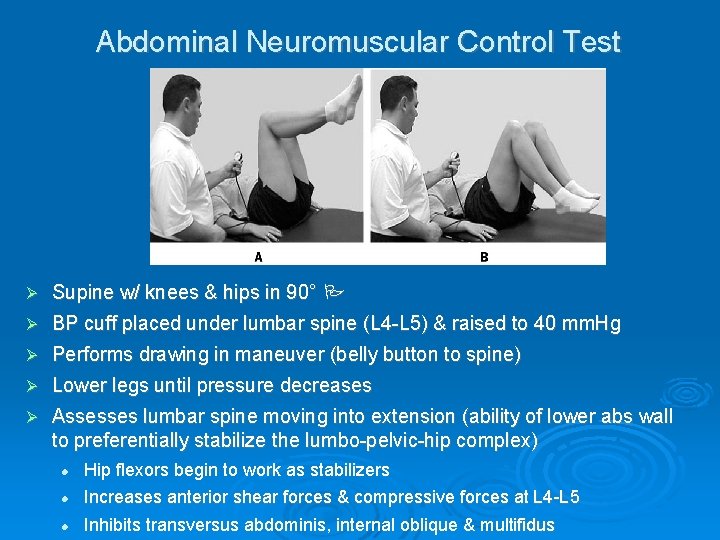
Abdominal Neuromuscular Control Test Ø Supine w/ knees & hips in 90° Ø BP cuff placed under lumbar spine (L 4 -L 5) & raised to 40 mm. Hg Ø Performs drawing in maneuver (belly button to spine) Ø Lower legs until pressure decreases Ø Assesses lumbar spine moving into extension (ability of lower abs wall to preferentially stabilize the lumbo-pelvic-hip complex) l Hip flexors begin to work as stabilizers Increases anterior shear forces & compressive forces at L 4 -L 5 l Inhibits transversus abdominis, internal oblique & multifidus l
Core Muscular Endurance & Power Ø Endurance Ø Erector spinae performance ü Prone with hands behind head & spine extended 30º ü Measure ability to sustain position with goniometer ü Utilize axilla and table for frame of reference ü Hold & maintain as long as they can Ø Power Ø Ø Backwards, overhead medicine ball jump & throw Assessment of total body power production
Ø Lower extremity functional profiles Ø Ø Ø Isokinetic tests Balance tests Jump tests Power tests Sports specific functional tests Kinetic chain assessment must assess all areas of potential deficiency
Guidelines for Core Stabilization Training Ø Perform comprehensive evaluation Ø Muscles imbalances, myokinematic deficits, arthrokinematic deficits, core strength/ neuromuscular control/power, overall kinetic chain function ØMuscle imbalances & arthrokinematic deficits must be corrected prior to initiating aggressive training Ø Program Requirements Ø Ø Ø Systematic Progressive Functional
Ø Emphasize muscle contraction spectrum • Concentric (force production) • Eccentric (force reduction) • Isometric (dynamic stabilization) Ø Begin program in most challenging environment that can be controlled l Ø Must be challenging with progression through function continuum Program Variation ü Plane of motion ü Range of motion ü Loading (physioball, med. ball, body blade, weight vest, tubing) ü Body position ü Amount of control & speed ü Feedback ü Duration and frequency (sets, reps, time under tension)
Specific Guidelines – Exercise Selection Ø Ø Ø Ø Proprioceptively rich program Safe Challenging Stress multiple planes Incorporate multi-sensory environment Activity specific Progressive functional continuum Ø Ø Ø Slow to fast Simple to complex Known to unknown Low force to high force Eyes open to eyes closed Static to dynamic
Ø Goal of program - develop optimal levels of functional strength & stabilization Ø Ø Ø Focus on neural adaptations instead of absolute strength gains Increase proprioceptive demands Quality not quantity üPoor technique and neuromuscular control results in poor motor patterns & stabilization Ø Focus on function
Questions to Ask Yourself Ø Is it dynamic? Ø Is it multiplanar? Ø Is it multidimensional? Ø Is it proprioceptively enriched? Ø Is it systematic? Ø Is it progressive? Ø Is it activity-specific? Ø Is it based on functional anatomy & science?
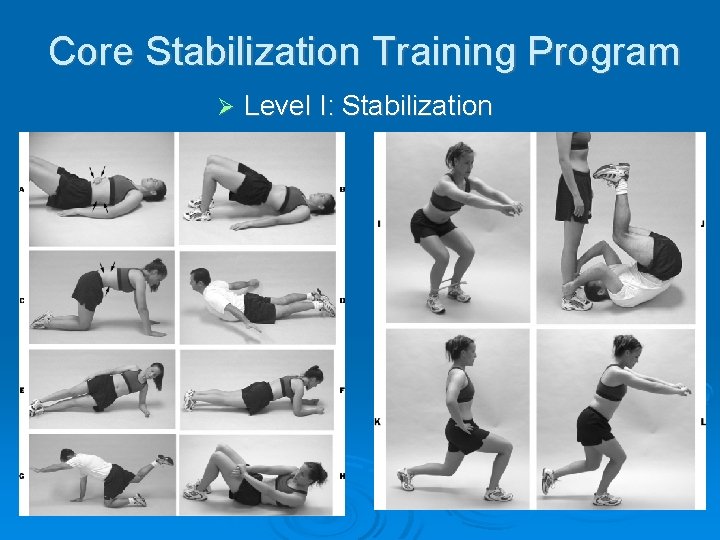
Core Stabilization Training Program Ø Level I: Stabilization
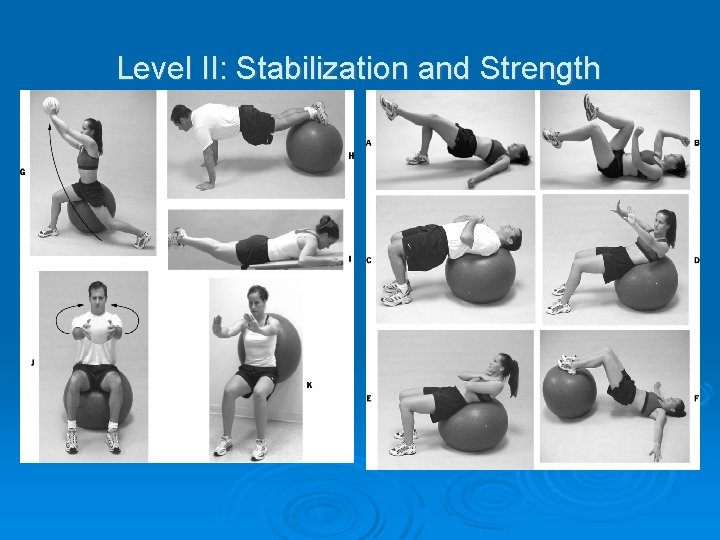
Level II: Stabilization and Strength
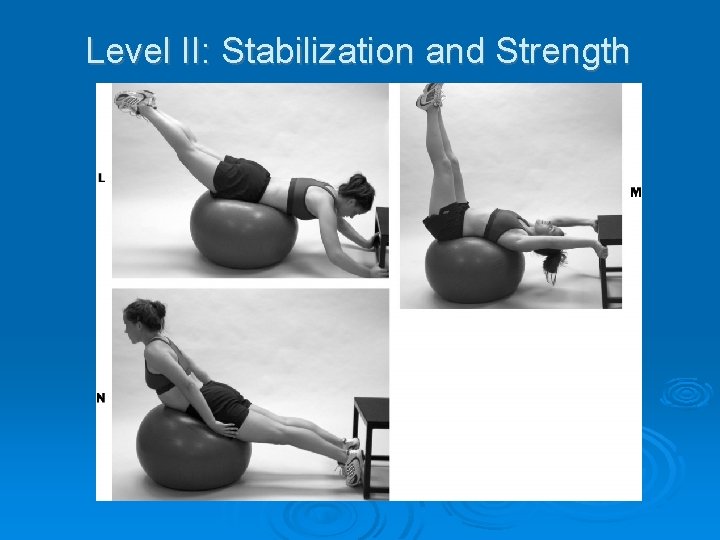
Level II: Stabilization and Strength
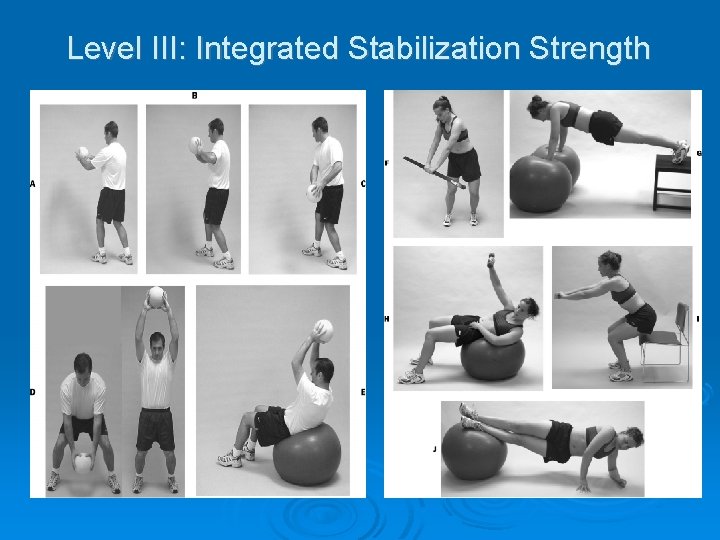
Level III: Integrated Stabilization Strength
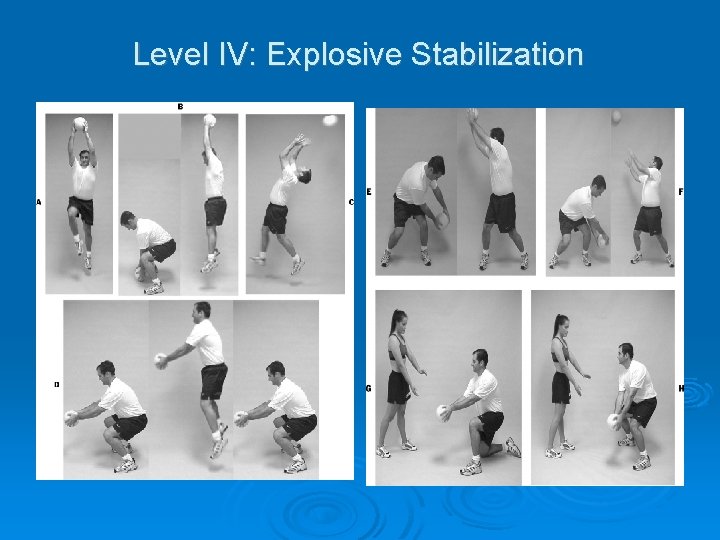
Level IV: Explosive Stabilization
References Ø Prentice, W. E. (2004). Rehabilitation Techniques for Sports Medicine & Athletic Training, 4 th ed. Ø Houglum, P. (2005). Therapeutic Exercise for Musculoskeletal Injuries, 2 nd ed. Ø Kisner, C. & Colby, L. A. (2002). Therapeutic Exercise: Foundations & Techniques, 4 th ed.
- Slides: 29