
Core Pure 2 Chapter 8 Modelling With Differential








- Slides: 22
Core. Pure 2 Chapter 8 : : Modelling With Differential Equations jfrost@tiffin. kingston. sch. uk www. drfrostmaths. com @Dr. Frost. Maths Last modified: 15 th August 2018
www. drfrostmaths. com Everything is completely free. Why not register? Register now to interactively practise questions on this topic, including past paper questions and extension questions (including MAT + UKMT). Teachers: you can create student accounts (or students can register themselves), to set work, monitor progress and even create worksheets. With questions by: Dashboard with points, trophies, notifications and student progress. Questions organised by topic, difficulty and past paper. Teaching videos with topic tests to check understanding.
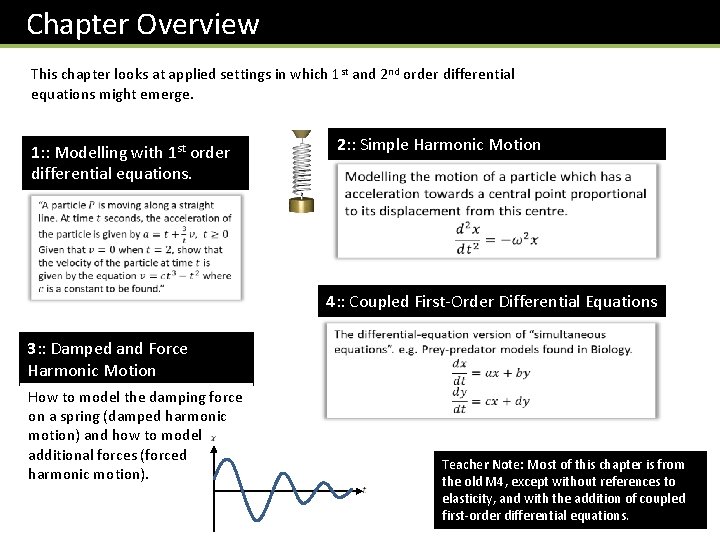
Chapter Overview This chapter looks at applied settings in which 1 st and 2 nd order differential equations might emerge. 2: : Simple Harmonic Motion 1: : Modelling with 1 st order differential equations. 4: : Coupled First-Order Differential Equations 3: : Damped and Force Harmonic Motion How to model the damping force on a spring (damped harmonic motion) and how to model additional forces (forced harmonic motion). Teacher Note: Most of this chapter is from the old M 4, except without references to elasticity, and with the addition of coupled first-order differential equations.
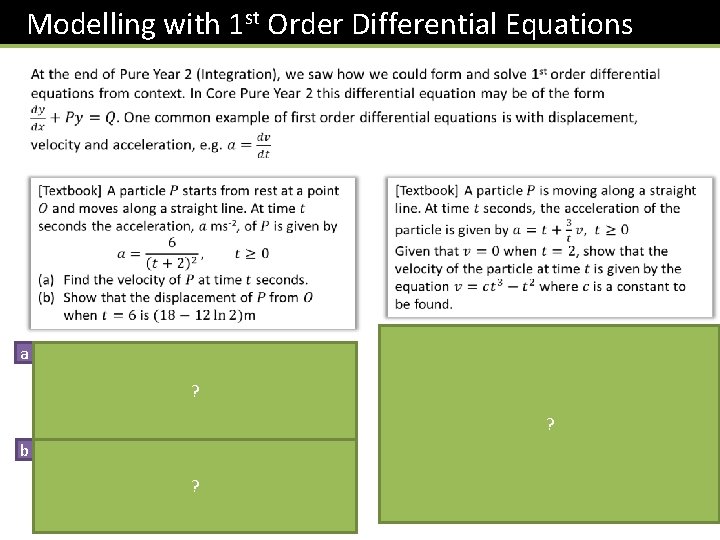
Modelling with 1 st Order Differential Equations a Form 1 st order ? differential equation ? b ?
Classic ‘Filling a Container’ Example b ? c a ? ?
Exercise 8 A Pearson Core Pure Year 2 Pages 174 -175
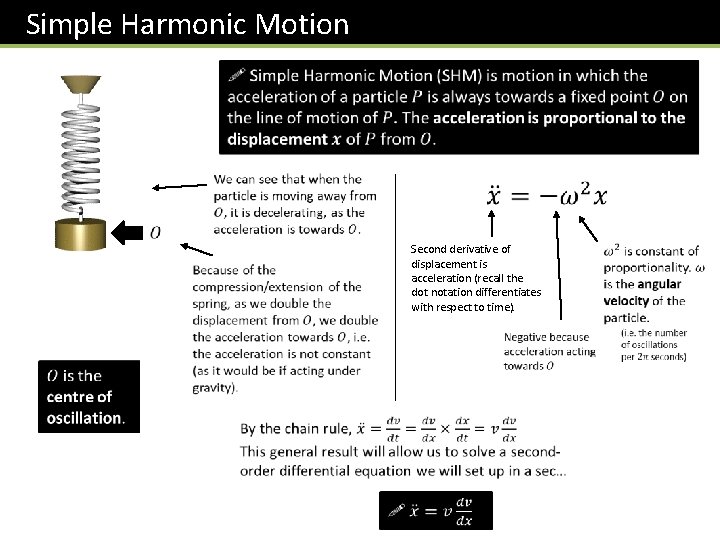
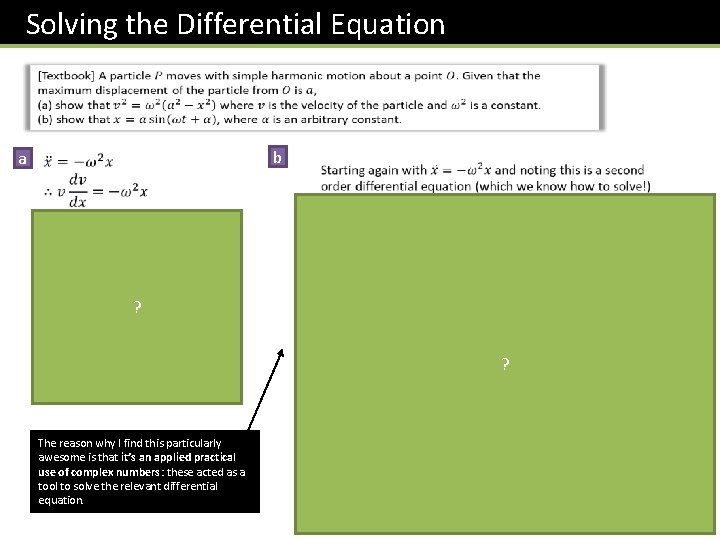
Simple Harmonic Motion Second derivative of displacement is acceleration (recall the dot notation differentiates with respect to time).
Solving the Differential Equation b a Using Pure Yr 2 trig techniques. ? Holy Smokes Batman! That means the displacement of the ? particle follows a sine way (as we may have suspected) The reason why I find this particularly awesome is that it’s an applied practical use of complex numbers: these acted as a tool to solve the relevant differential equation. The maximum displacement is known as the amplitude of the wave.
Examples a ? a b ? ? b ? c ?
Exercise 8 B Pearson Core Pure Year 2 Pages 178 -180
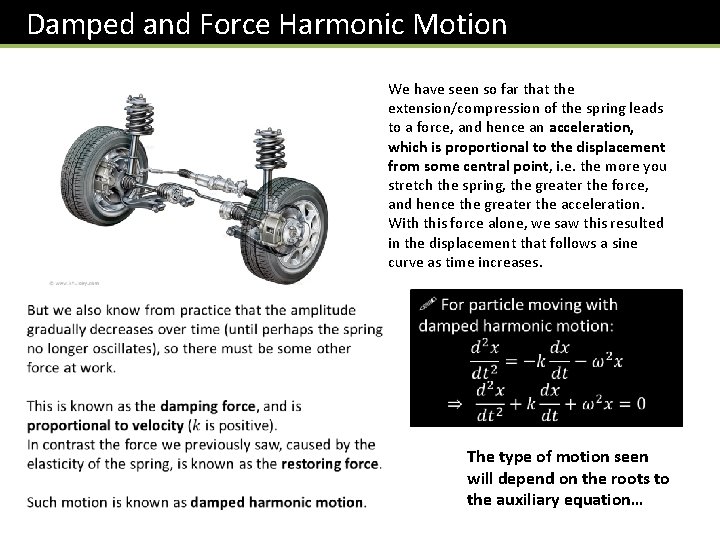
Damped and Force Harmonic Motion We have seen so far that the extension/compression of the spring leads to a force, and hence an acceleration, which is proportional to the displacement from some central point, i. e. the more you stretch the spring, the greater the force, and hence the greater the acceleration. With this force alone, we saw this resulted in the displacement that follows a sine curve as time increases. The type of motion seen will depend on the roots to the auxiliary equation…
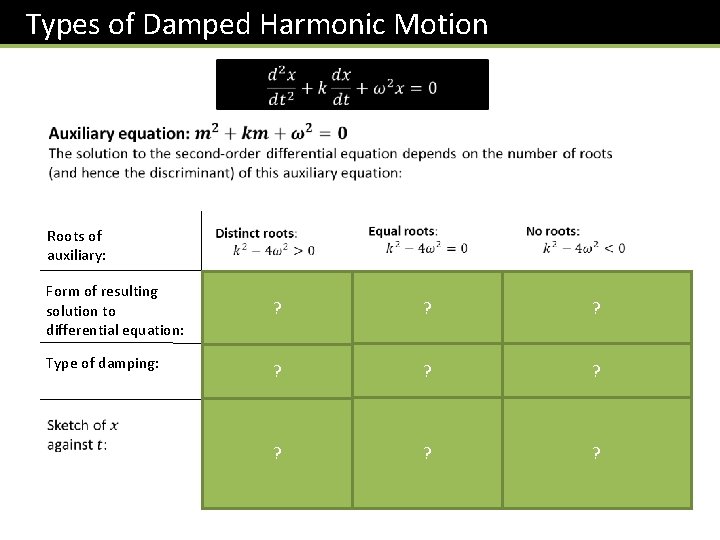
Types of Damped Harmonic Motion Roots of auxiliary: Form of resulting solution to differential equation: Type of damping: ? Light damping Critical damping Heavy damping ? (the limit for which there ? (no oscillations) are no oscillations) (oscillates) ? ? ?
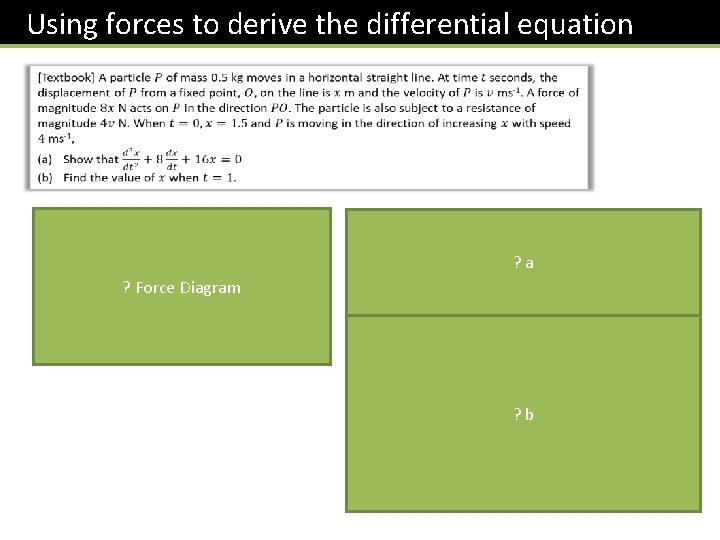
Using forces to derive the differential equation ? a ? Force Diagram Equal roots so example of critical damping. ? b
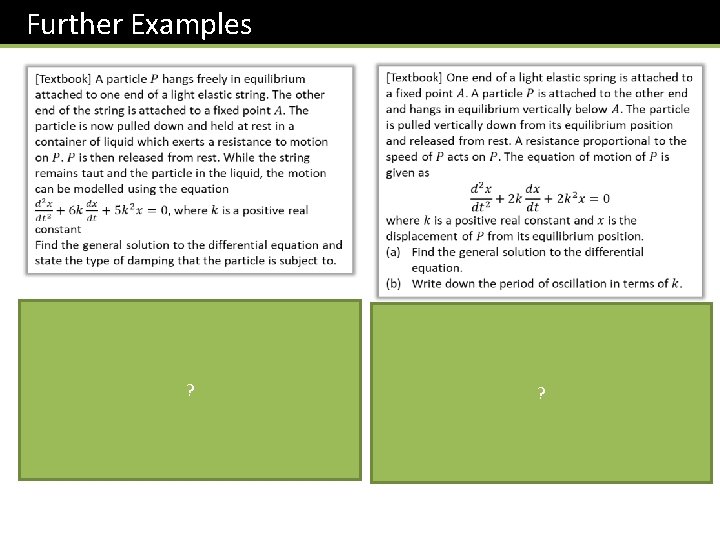
Further Examples ? ?
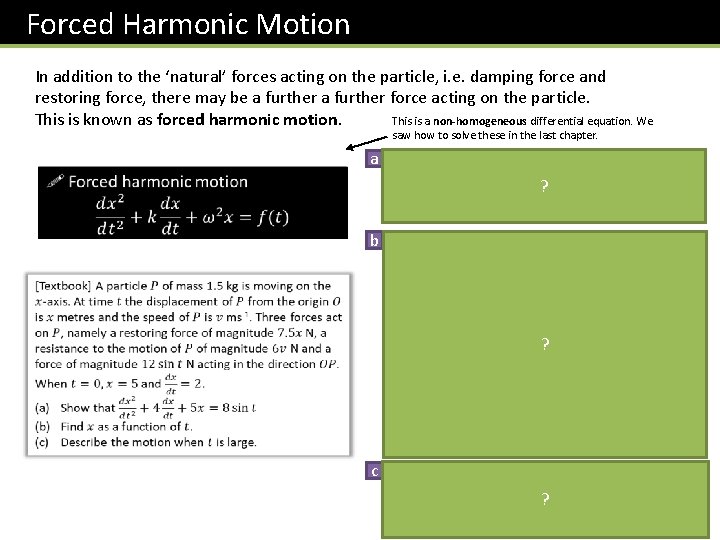
Forced Harmonic Motion In addition to the ‘natural’ forces acting on the particle, i. e. damping force and restoring force, there may be a further force acting on the particle. This is a non-homogeneous differential equation. We This is known as forced harmonic motion. saw how to solve these in the last chapter. a ? b ? c ?
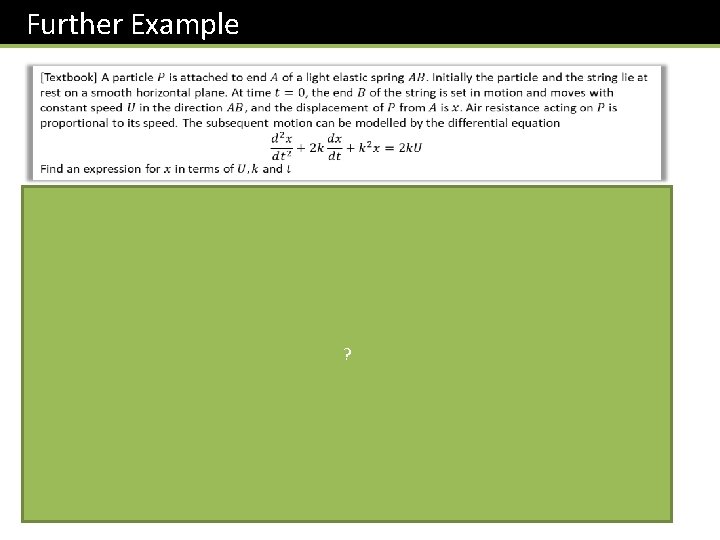
Further Example This is because the RHS is a constant. ?
Exercise 8 C Pearson Core Pure Year 2 Pages 184 -186
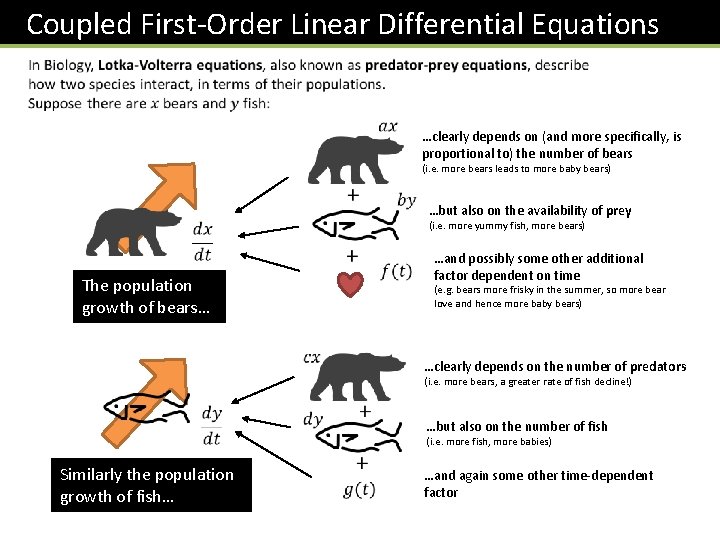
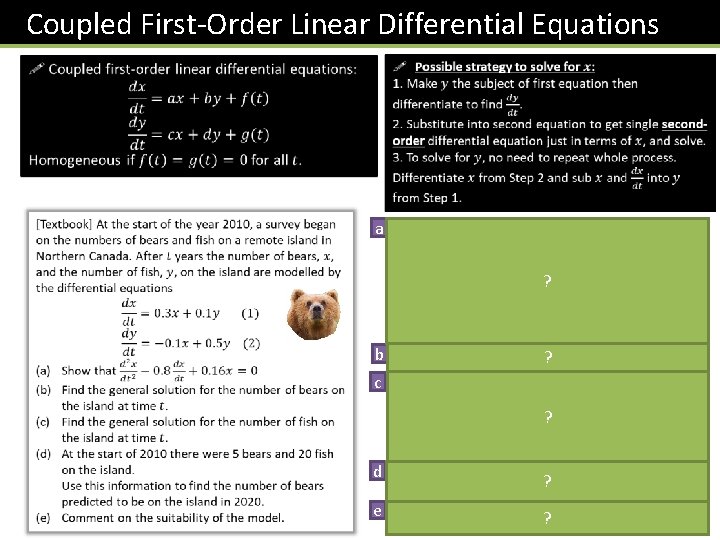
Coupled First-Order Linear Differential Equations …clearly depends on (and more specifically, is proportional to) the number of bears (i. e. more bears leads to more baby bears) …but also on the availability of prey (i. e. more yummy fish, more bears) The population growth of bears… …and possibly some other additional factor dependent on time (e. g. bears more frisky in the summer, so more bear love and hence more baby bears) …clearly depends on the number of predators (i. e. more bears, a greater rate of fish decline!) …but also on the number of fish (i. e. more fish, more babies) Similarly the population growth of fish… …and again some other time-dependent factor
Coupled First-Order Linear Differential Equations a ? b ? c ? d e ? ?
Test Your Understanding ?
Exercise 8 D Pearson Core Pure Year 2 Pages 188 -190
You have reached the end of maths. * * At A Level.