
Core Pure 1 Chapter 7 Linear Transformations jfrosttiffin





- Slides: 29
Core. Pure 1 Chapter 7 : : Linear Transformations jfrost@tiffin. kingston. sch. uk www. drfrostmaths. com @Dr. Frost. Maths Last modified: 14 th September 2018
www. drfrostmaths. com Everything is completely free. Why not register? Register now to interactively practise questions on this topic, including past paper questions and extension questions (including MAT + UKMT). Teachers: you can create student accounts (or students can register themselves), to set work, monitor progress and even create worksheets. With questions by: Dashboard with points, trophies, notifications and student progress. Questions organised by topic, difficulty and past paper. Teaching videos with topic tests to check understanding.
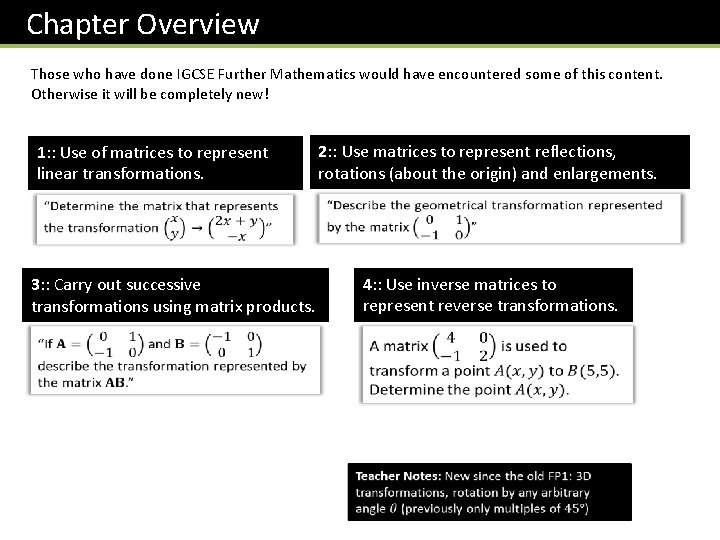
Chapter Overview Those who have done IGCSE Further Mathematics would have encountered some of this content. Otherwise it will be completely new! 1: : Use of matrices to represent linear transformations. 2: : Use matrices to represent reflections, rotations (about the origin) and enlargements. 3: : Carry out successive transformations using matrix products. 4: : Use inverse matrices to represent reverse transformations.
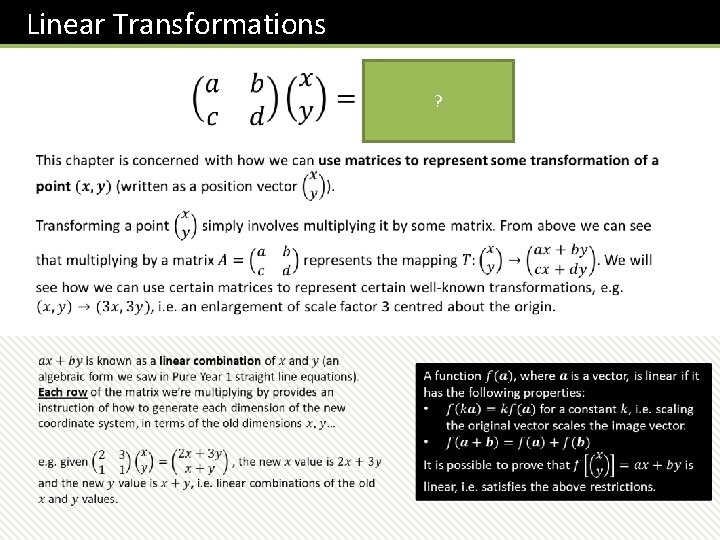
Linear Transformations ?
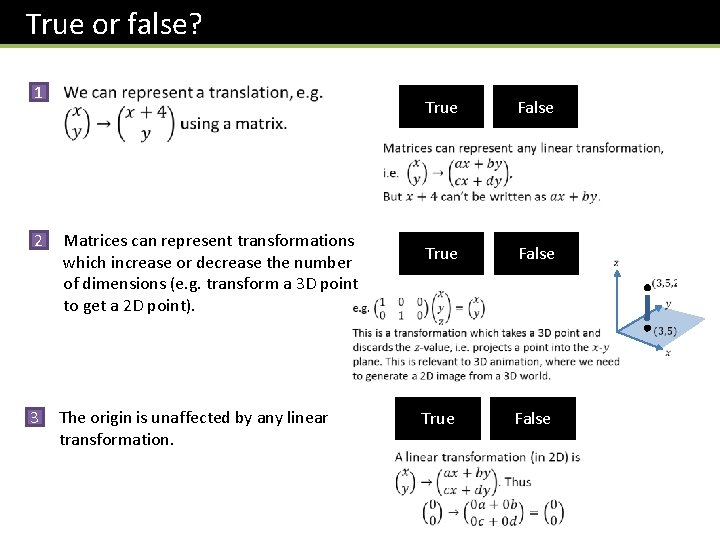
True or false? 1 True False 2 Matrices can represent transformations which increase or decrease the number of dimensions (e. g. transform a 3 D point to get a 2 D point). 3 The origin is unaffected by any linear transformation. True False
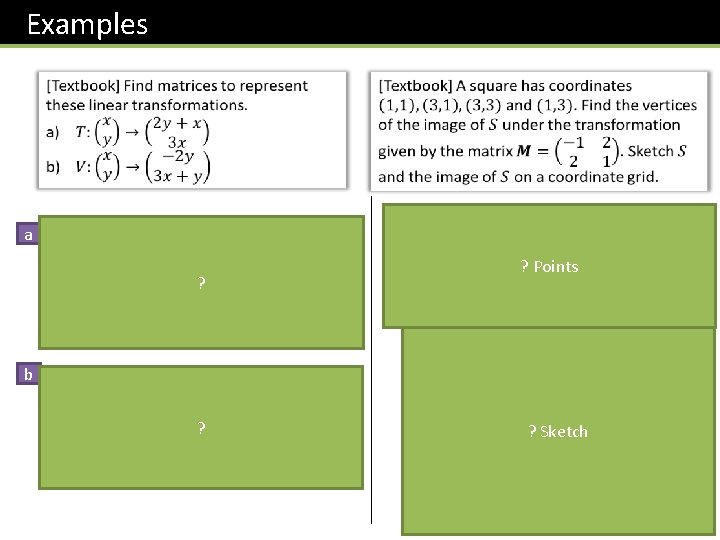
Examples a ? b ? Points ? ? Sketch As mentioned before, we write coordinates as position vectors to enable matrix multiplication. Fro Note: By transforming multiple points, it’s easier to see the effect that a transformation represented by a matrix has. We can see there’s a mixture of enlargement and rotation here.
Exercise 7 A Pearson Pure Mathematics Year 1/AS Pages 129 -130
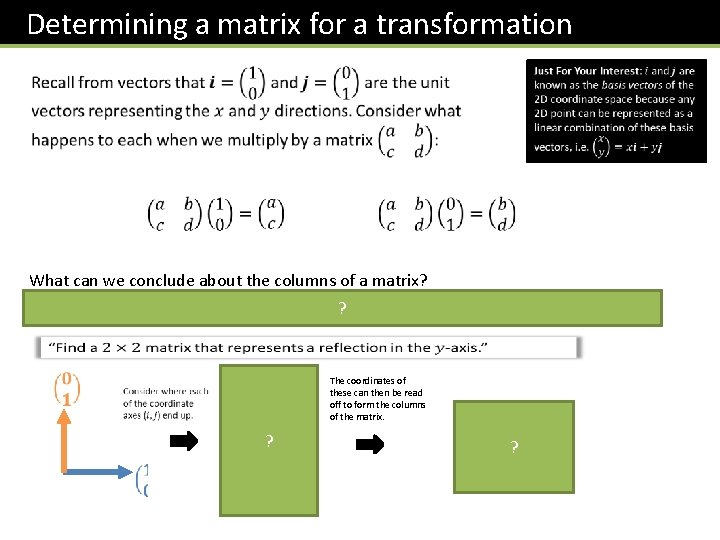
Determining a matrix for a transformation What can we conclude about the columns of a matrix? They tell us where each of the coordinate? axes end up under the transformation. ? The coordinates of these can then be read off to form the columns of the matrix. ?
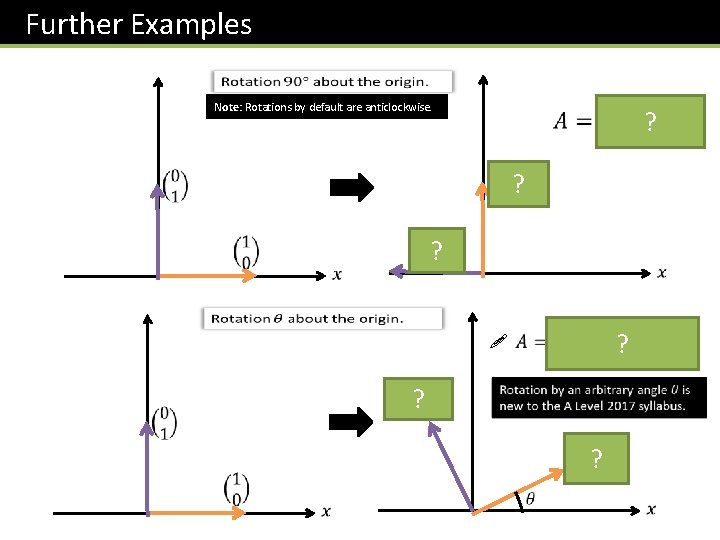
Further Examples Note: Rotations by default are anticlockwise. ? ? ! ? ? ? ?
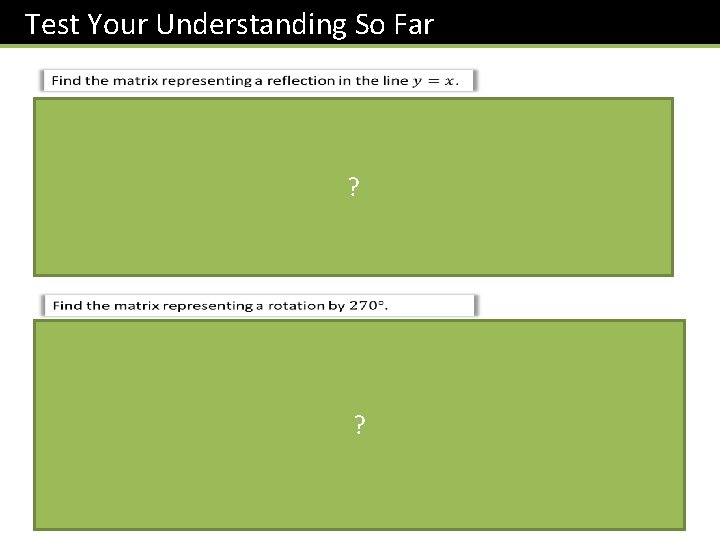
Test Your Understanding So Far ?
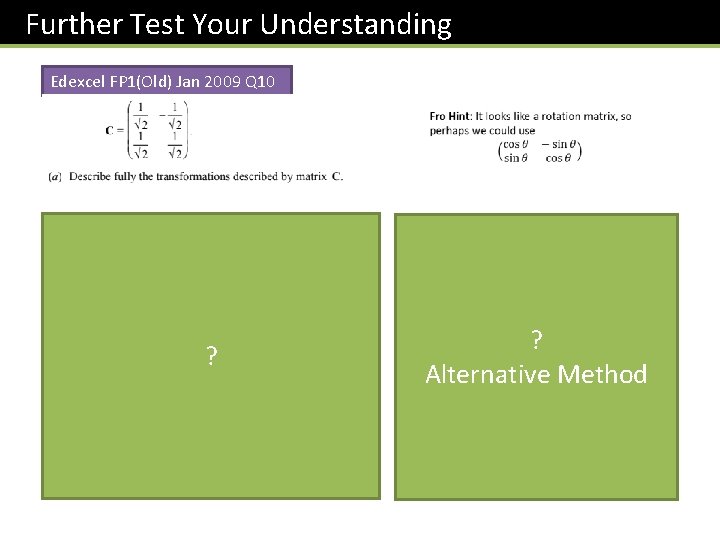
Further Test Your Understanding Edexcel FP 1(Old) Jan 2009 Q 10 ? Alternative method: Plot the two columns as vectors from the origin. ? Alternative Method
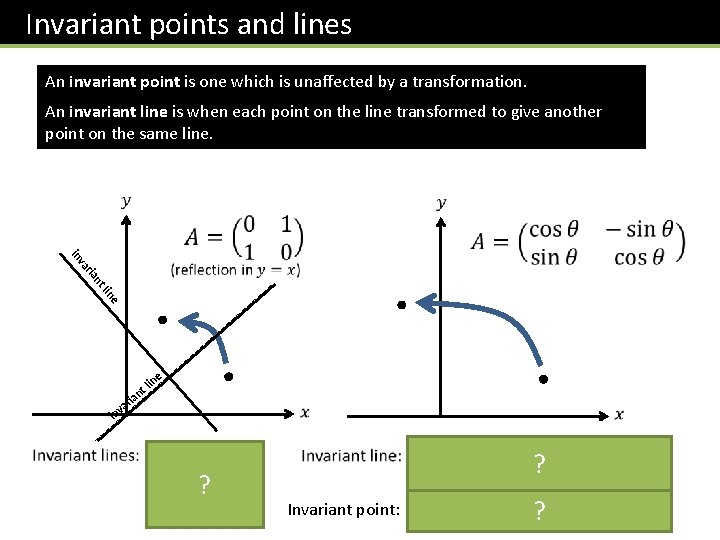
Invariant points and lines An invariant point is one which is unaffected by a transformation. An invariant line is when each point on the line transformed to give another point on the same line. nt ria va in e lin ria l nt va in in e ? Invariant point: (0, 0) ? ?
Exercise 7 B Pearson Pure Mathematics Year 1/AS Pages 134 -135
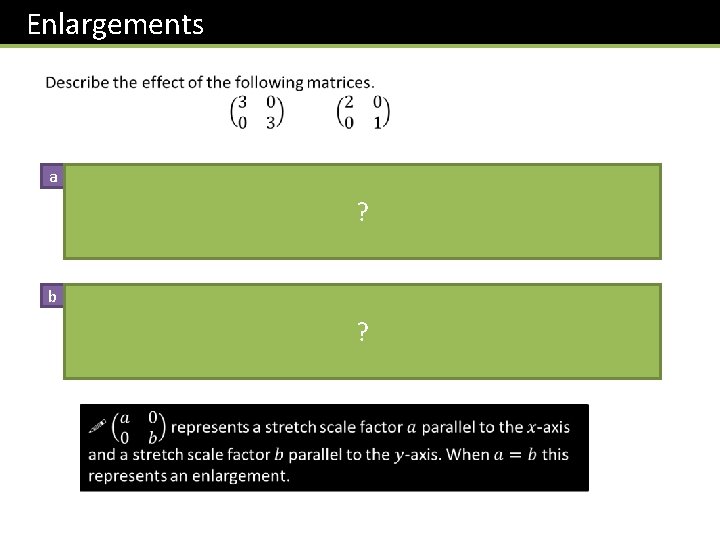
Enlargements a ? b ?
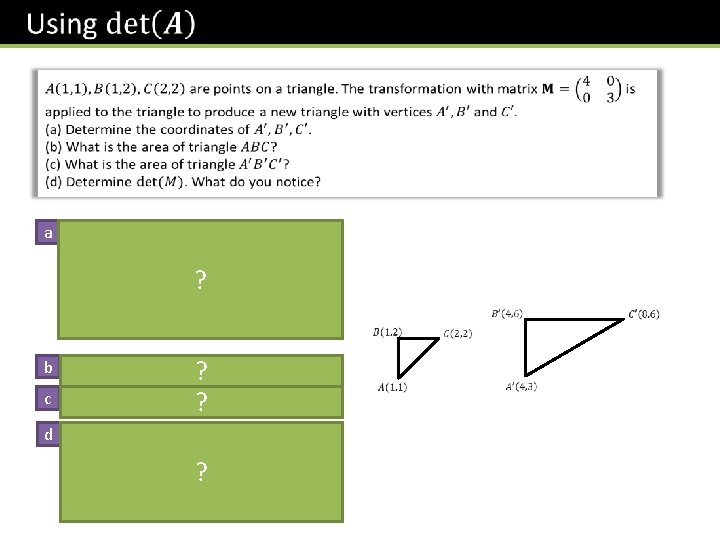
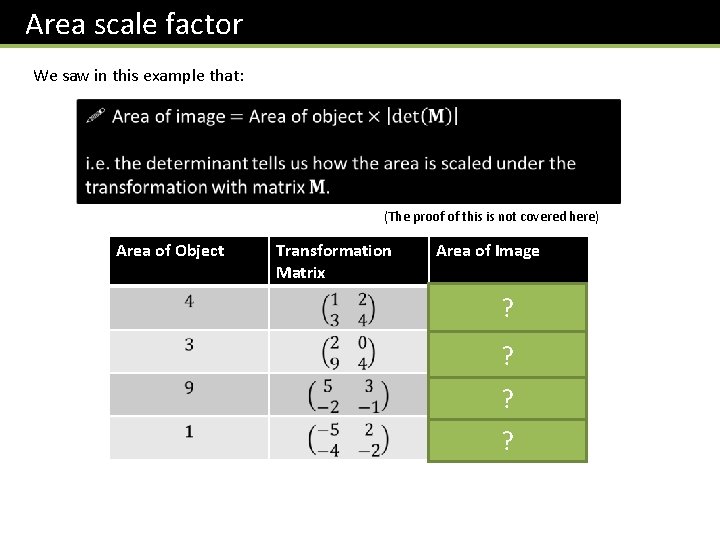
Area scale factor We saw in this example that: (The proof of this is not covered here) Area of Object Transformation Matrix Area of Image ? ?
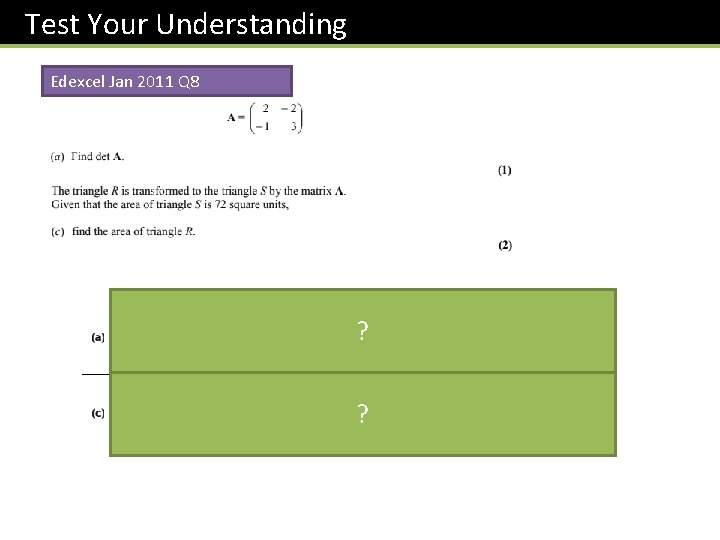
Test Your Understanding Edexcel Jan 2011 Q 8 ? ?
Exercise 7 C Pearson Pure Mathematics Year 1/AS Pages 138 -140
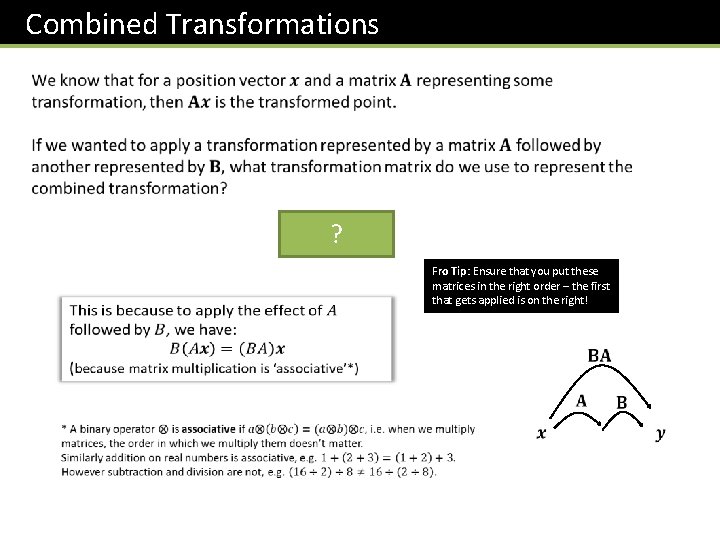
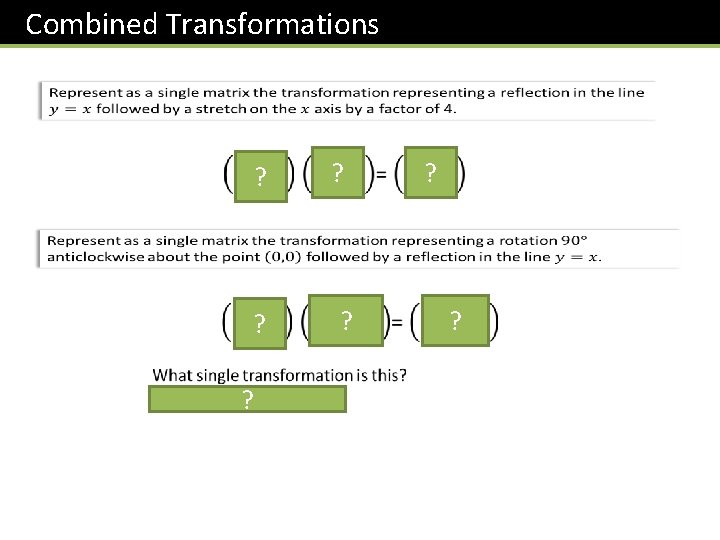
Combined Transformations ? Fro Tip: Ensure that you put these matrices in the right order – the first that gets applied is on the right!
Combined Transformations ? ?
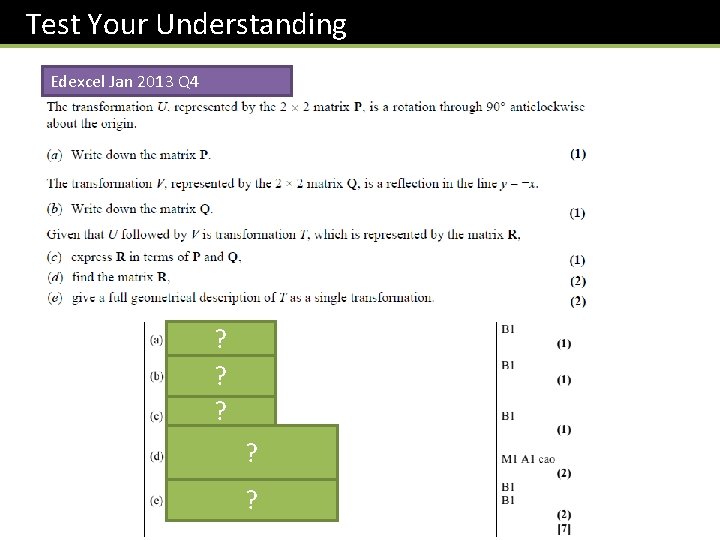
Test Your Understanding Edexcel Jan 2013 Q 4 ? ? ?
Exercise 7 D Pearson Pure Mathematics Year 1/AS Pages 141 -143
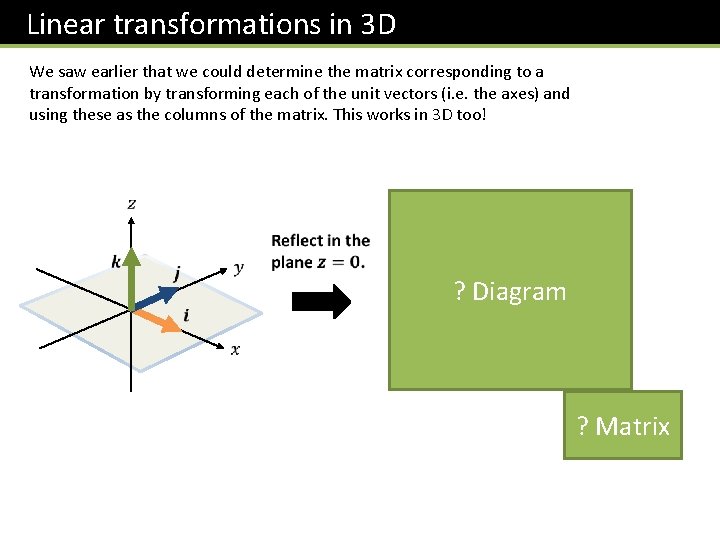
Linear transformations in 3 D We saw earlier that we could determine the matrix corresponding to a transformation by transforming each of the unit vectors (i. e. the axes) and using these as the columns of the matrix. This works in 3 D too! ? Diagram ? Matrix
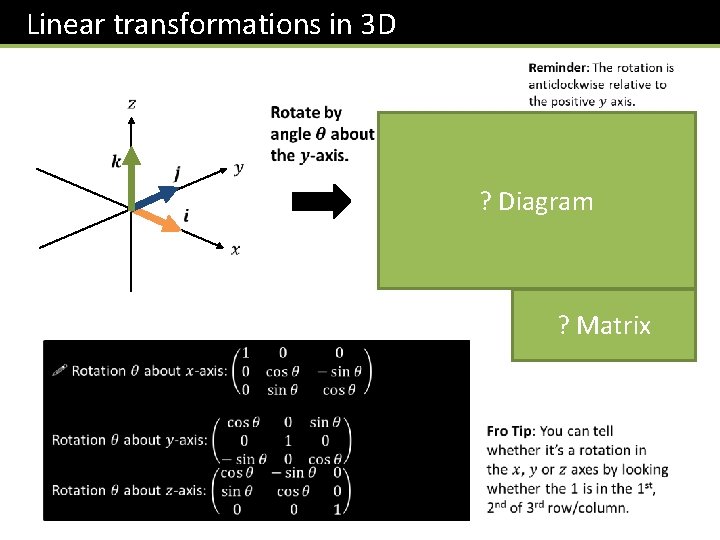
Linear transformations in 3 D ? Diagram ? Matrix
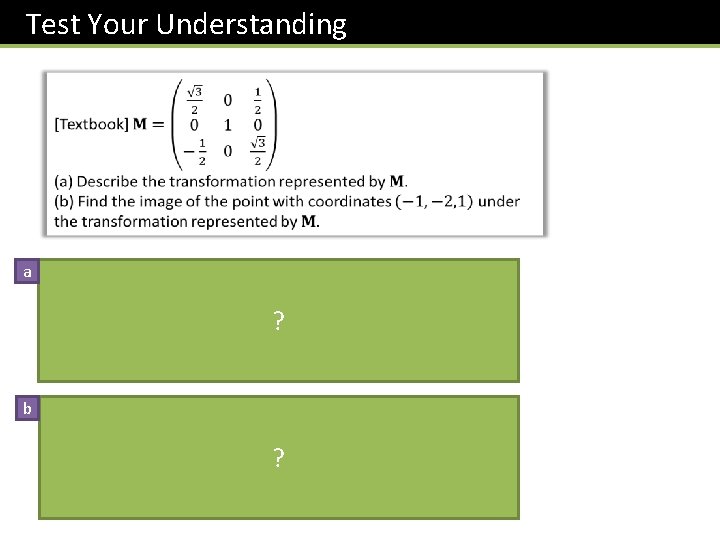
Test Your Understanding a ? b ?
Exercise 7 E Pearson Pure Mathematics Year 1/AS Pages 146 -147
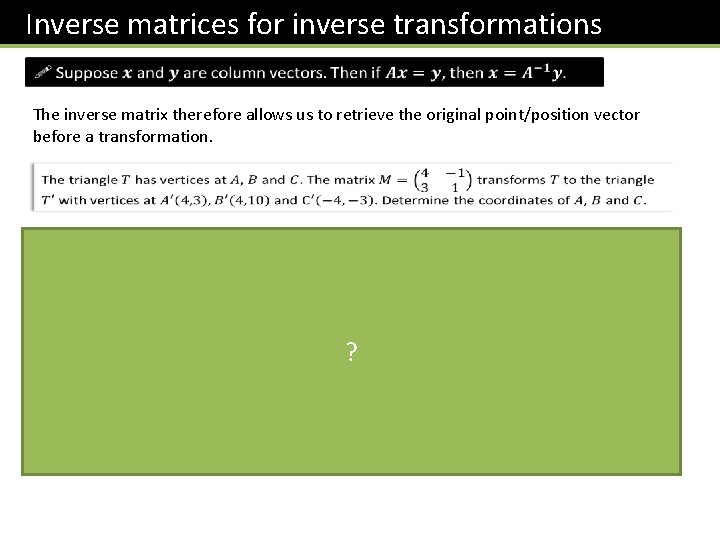
Inverse matrices for inverse transformations The inverse matrix therefore allows us to retrieve the original point/position vector before a transformation. ?
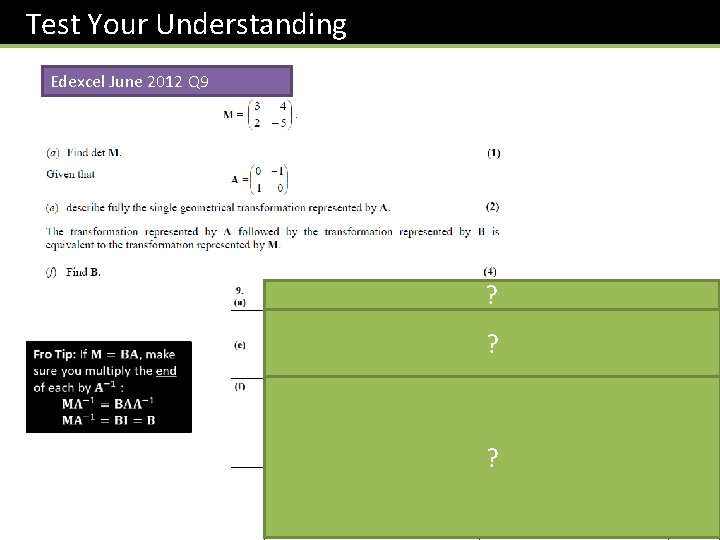
Test Your Understanding Edexcel June 2012 Q 9 ? ? ?
Exercise 7 F Pearson Pure Mathematics Year 1/AS Pages 148 -150