
Core Pure 1 Chapter 1 Complex Numbers jfrosttiffin
Core. Pure 1 Chapter 1 : : Complex Numbers jfrost@tiffin. kingston. sch. uk www. drfrostmaths. com @Dr. Frost. Maths Last modified: 6 th September 2019
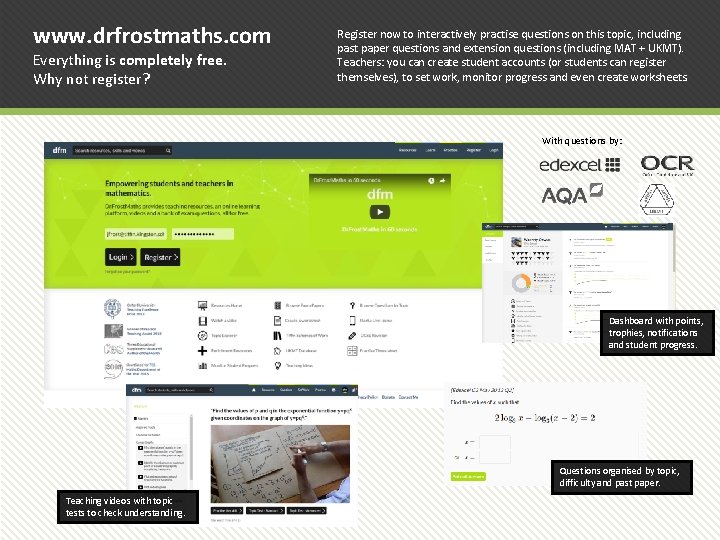
www. drfrostmaths. com Everything is completely free. Why not register? Register now to interactively practise questions on this topic, including past paper questions and extension questions (including MAT + UKMT). Teachers: you can create student accounts (or students can register themselves), to set work, monitor progress and even create worksheets. With questions by: Dashboard with points, trophies, notifications and student progress. Questions organised by topic, difficulty and past paper. Teaching videos with topic tests to check understanding.
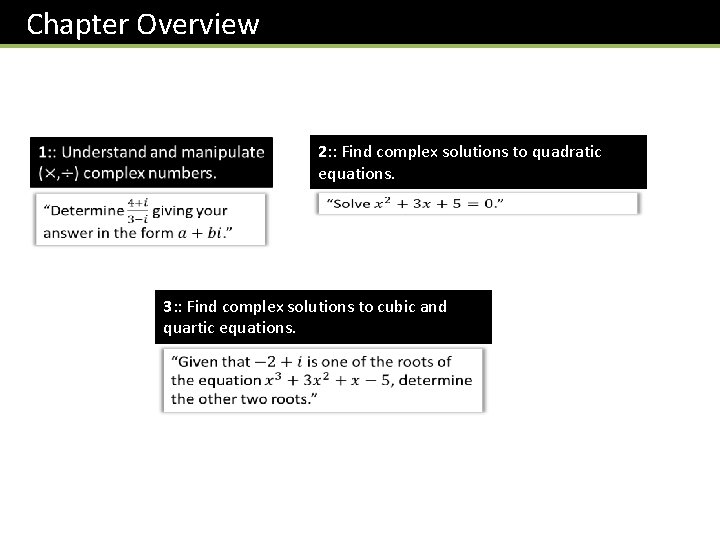
Chapter Overview 2: : Find complex solutions to quadratic equations. 3: : Find complex solutions to cubic and quartic equations.

Why complex numbers? Complex numbers were originally introduced by the Italian mathematician Cardano in the 1500 s for this very purpose, i. e. to represent the roots of polynomials which weren’t ‘real’.
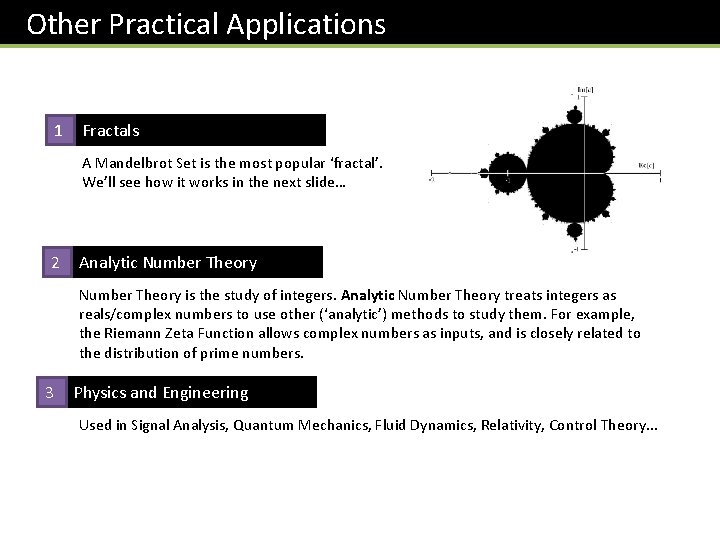
Other Practical Applications 1 Fractals A Mandelbrot Set is the most popular ‘fractal’. We’ll see how it works in the next slide… 2 Analytic Number Theory is the study of integers. Analytic Number Theory treats integers as reals/complex numbers to use other (‘analytic’) methods to study them. For example, the Riemann Zeta Function allows complex numbers as inputs, and is closely related to the distribution of prime numbers. 3 Physics and Engineering Used in Signal Analysis, Quantum Mechanics, Fluid Dynamics, Relativity, Control Theory. . .
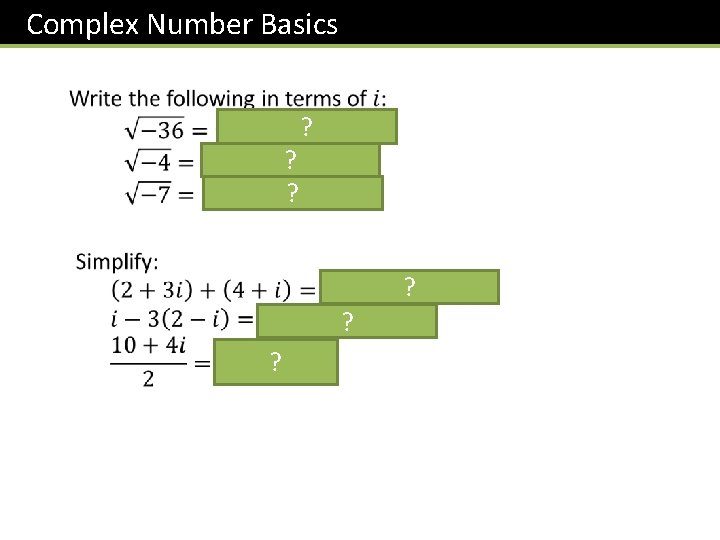
Complex Number Basics ? ? ? ? ? ?
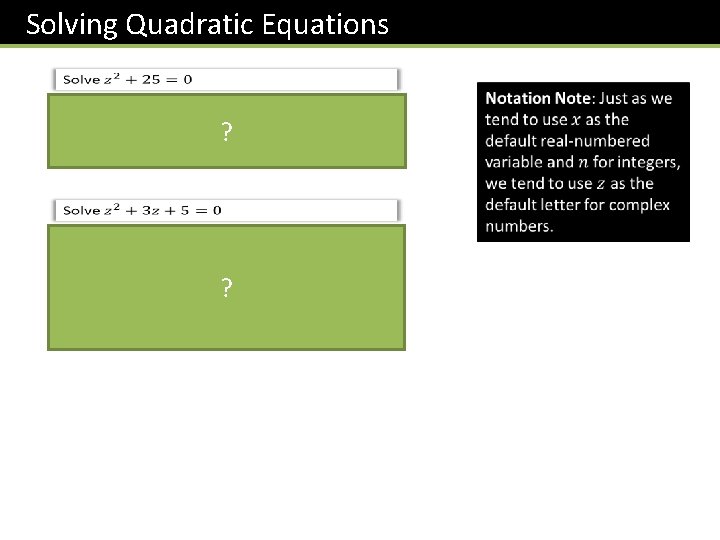
Solving Quadratic Equations ? ?
Exercises 1 A-1 B Pearson Core Pure Mathematics Book 1 Page 3, 4 -5
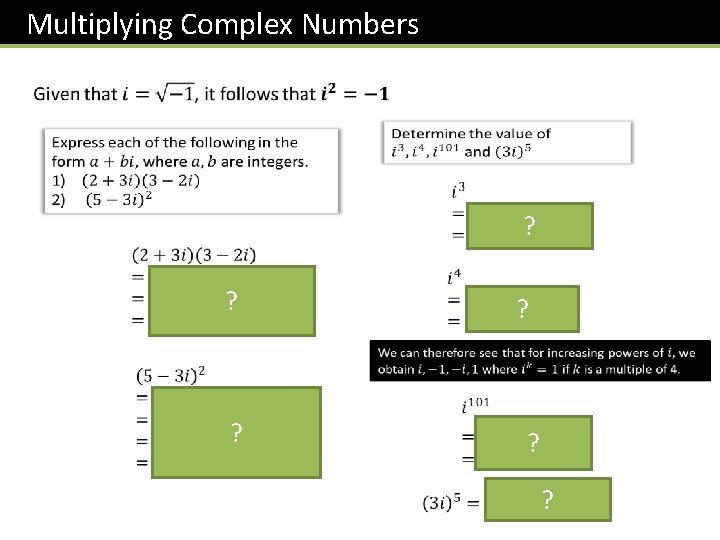
Multiplying Complex Numbers ? ?
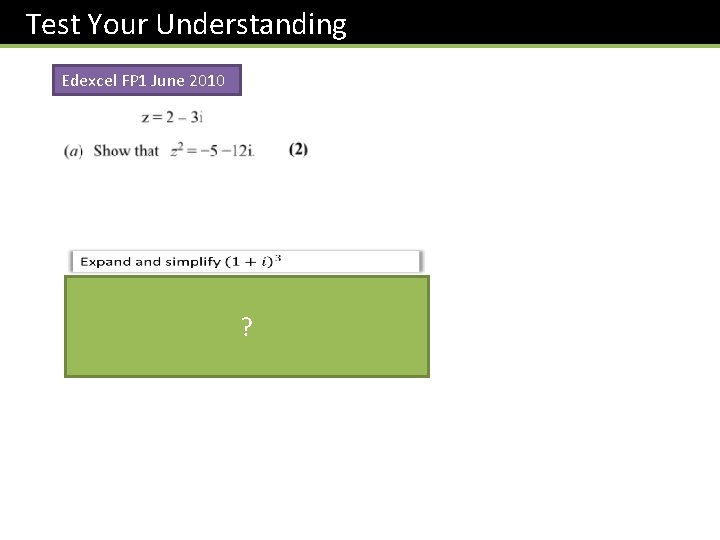
Test Your Understanding Edexcel FP 1 June 2010 ?
Exercise 1 C Pearson Core Pure Mathematics Book 1 Page 6
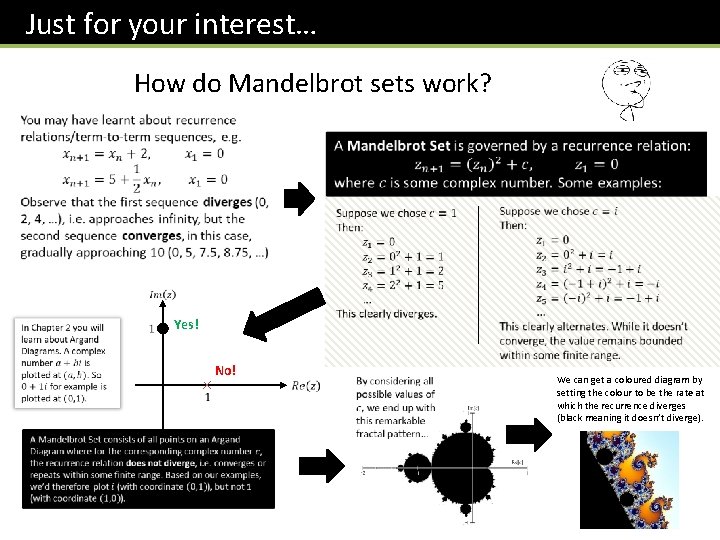
Just for your interest… How do Mandelbrot sets work? Yes! No! We can get a coloured diagram by setting the colour to be the rate at which the recurrence diverges (black meaning it doesn’t diverge).
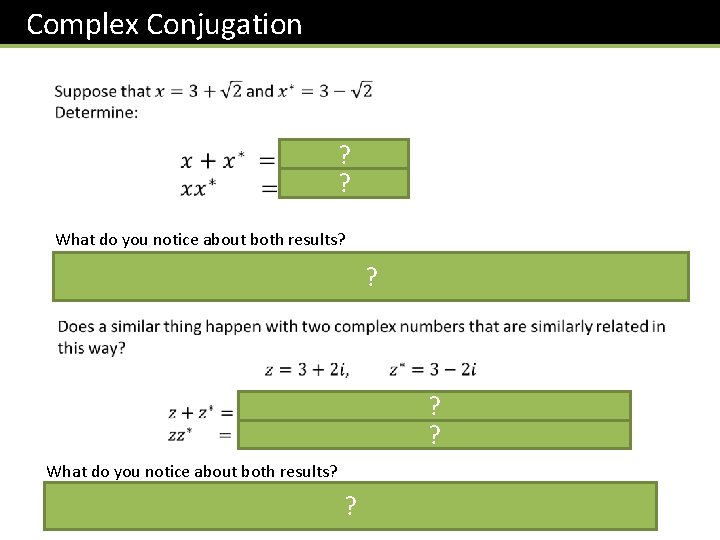
Complex Conjugation ? ? What do you notice about both results? They are both rational/surd-free! The second result in particular is useful, because ? a means to rationalise a denominator. we saw in Pure Year 1/GCSE that it gives us ? ? What do you notice about both results? They are both real! This similarly gives us a way to “real”-ise a denominator, and thus do division of complex numbers… ?

Complex Conjugation ? ? As with rationalise denominators of surds, we multiple numerator and denominator by the conjugate of the denominator.
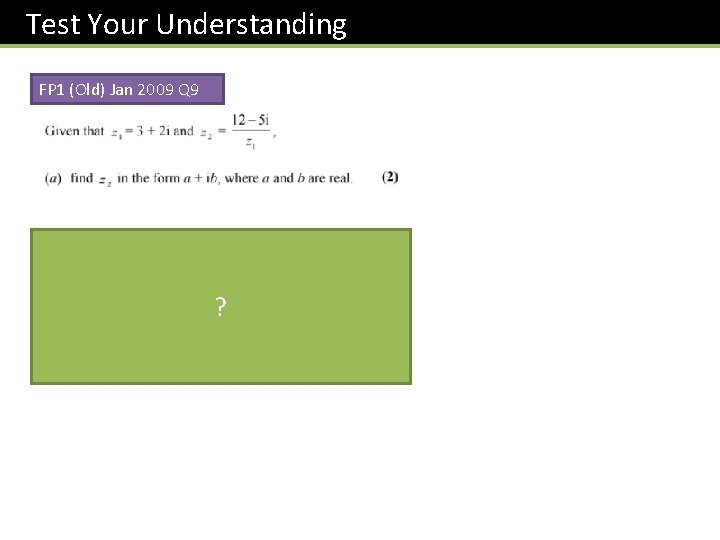
Test Your Understanding FP 1 (Old) Jan 2009 Q 9 ?
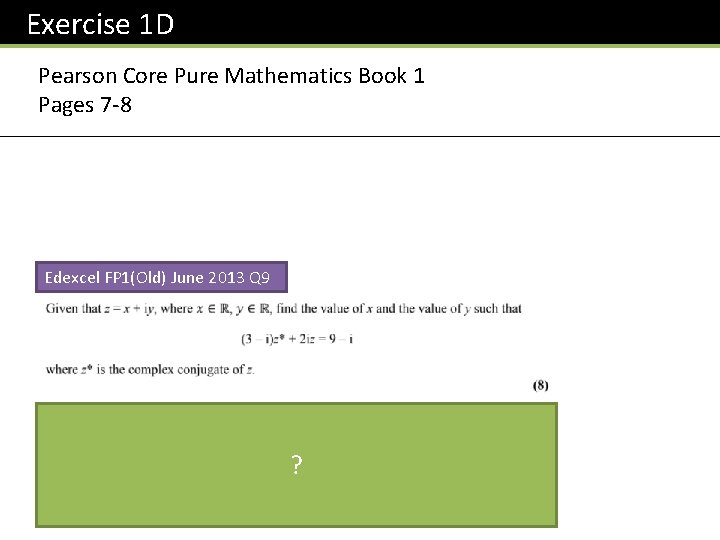
Exercise 1 D Pearson Core Pure Mathematics Book 1 Pages 7 -8 Edexcel FP 1(Old) June 2013 Q 9 ?
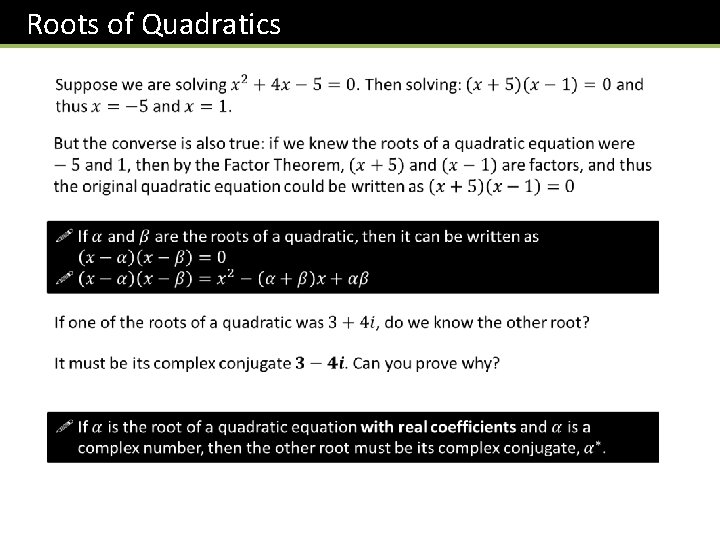
Roots of Quadratics
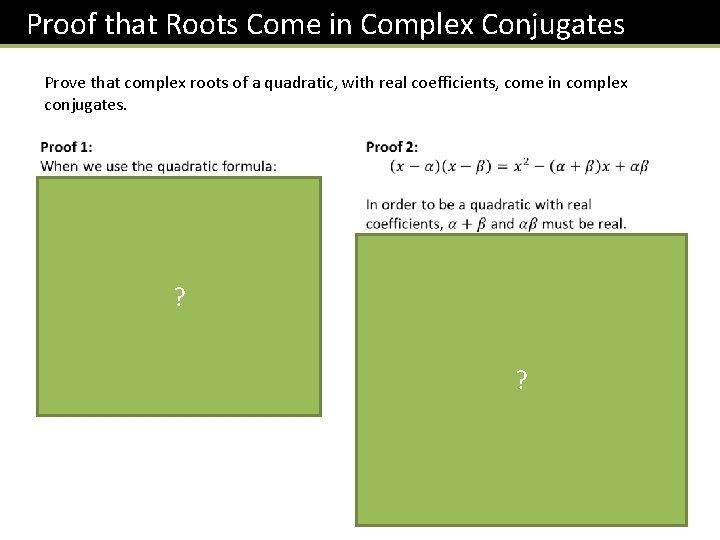
Proof that Roots Come in Complex Conjugates Prove that complex roots of a quadratic, with real coefficients, come in complex conjugates. ? ?
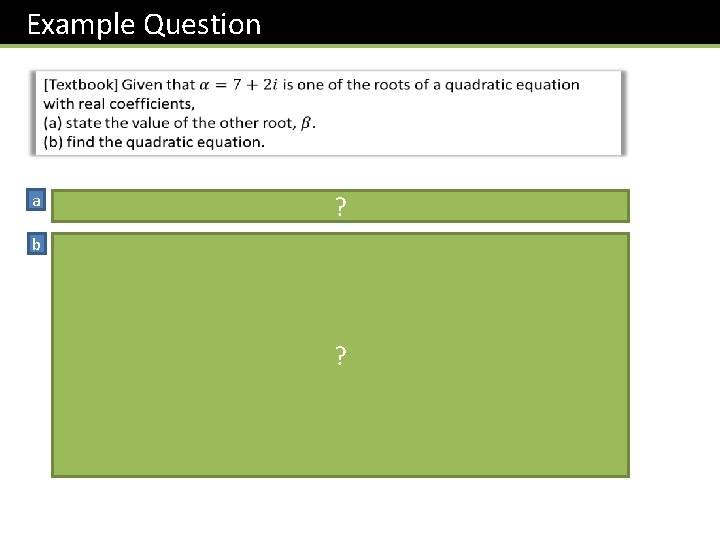
Example Question a ? b ?
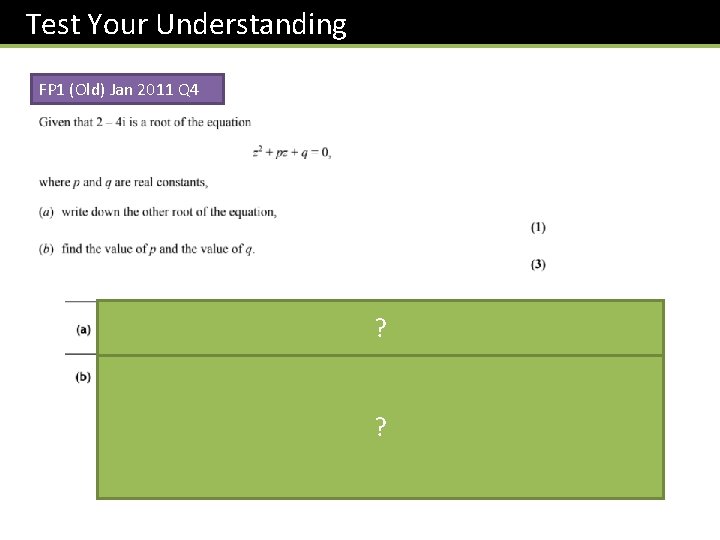
Test Your Understanding FP 1 (Old) Jan 2011 Q 4 ? ?
Exercise 1 E Pearson Core Pure Mathematics Book 1 Pages 9 -10
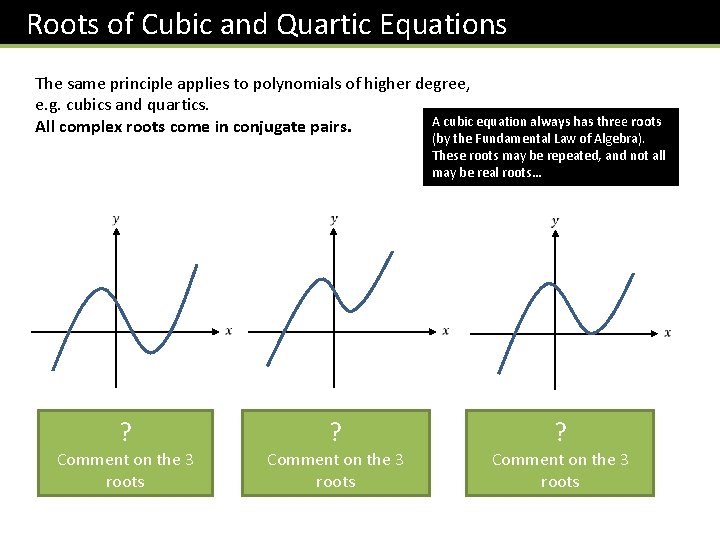
Roots of Cubic and Quartic Equations The same principle applies to polynomials of higher degree, e. g. cubics and quartics. A cubic equation always has three roots All complex roots come in conjugate pairs. (by the Fundamental Law of Algebra). These roots may be repeated, and not all may be real roots… ? 3 real roots. Comment on the 3 roots 1 real root. ? Comment on the 3 2 complex roots (which roots are conjugates) ? but two of 3 real roots, Comment on the 3 them the same value roots root). (i. e. repeated
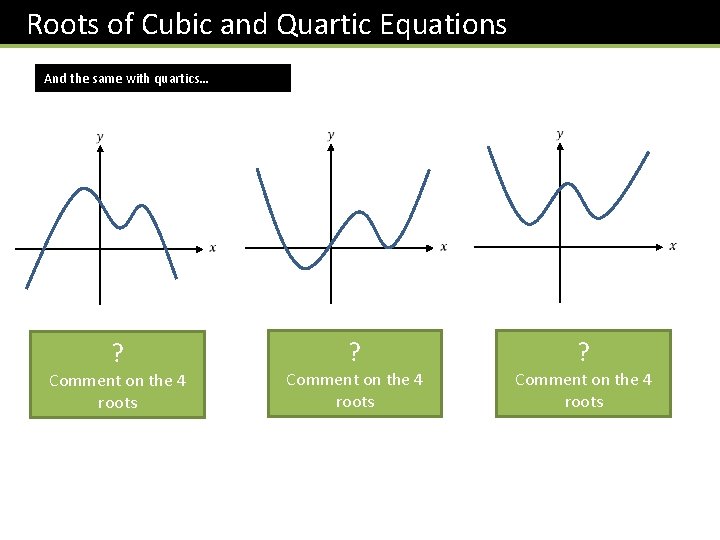
Roots of Cubic and Quartic Equations And the same with quartics… 2 real roots. ? 2 complexonroots Comment the 4 (a conjugate roots pair) 4 real roots. ? Two of them Comment onwith the 4 the same value. roots 0 real roots. ? 2 Comment pairs of complex on the 4 conjugate roots
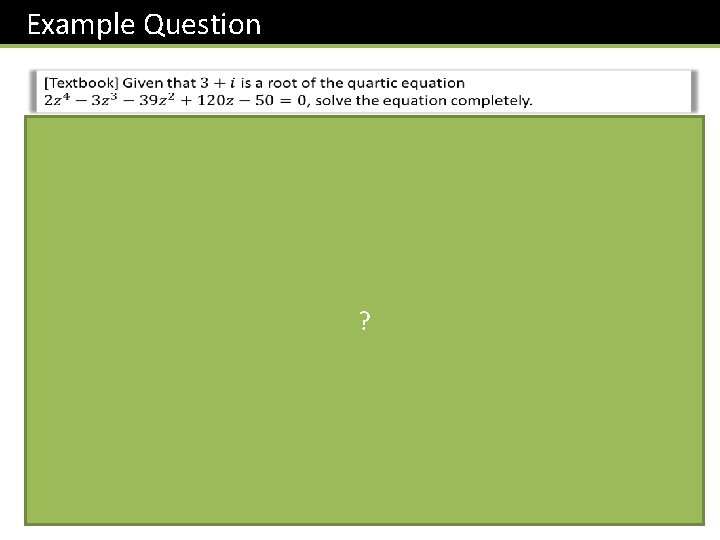
Example Question ? You could also use algebraic long division, but I’ve always favoured determining the second bracket by intuition as per the left.
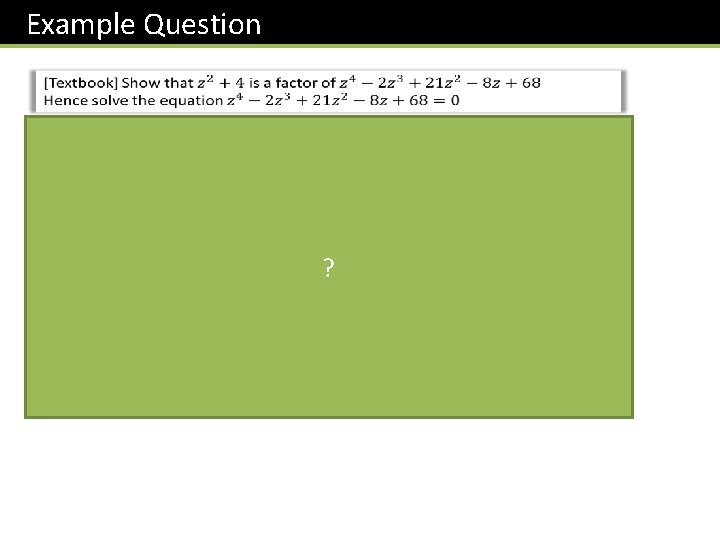
Example Question ?
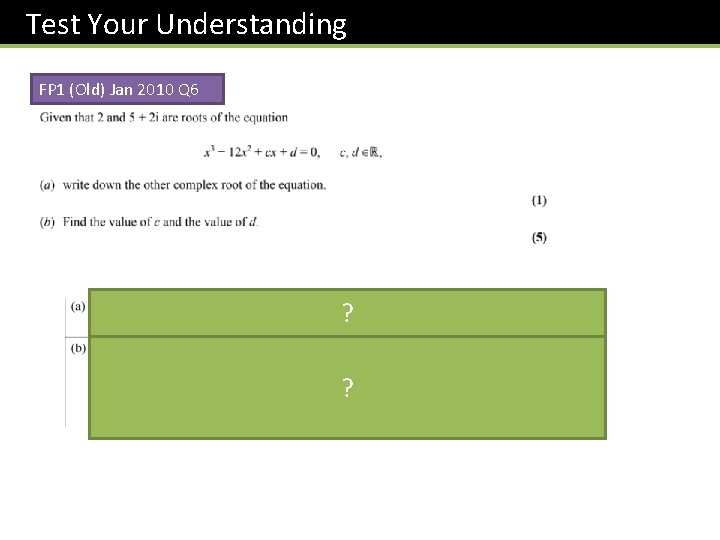
Test Your Understanding FP 1 (Old) Jan 2010 Q 6 ? ?
Exercise 1 F Pearson Core Pure Mathematics Book 1 Pages 13 -14
- Slides: 27