
Core Knowledge 1 9 Papers and Boards Name
Core Knowledge 1. 9 Papers and Boards Name: Group: Teacher:
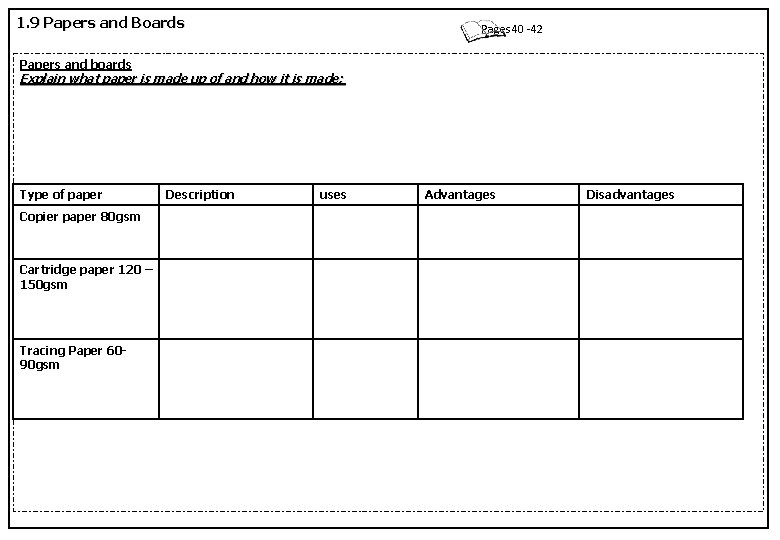
1. 9 Papers and Boards Pages 40 -42 Papers and boards Explain what paper is made up of and how it is made: Type of paper Copier paper 80 gsm Cartridge paper 120 – 150 gsm Tracing Paper 6090 gsm Description uses Advantages Disadvantages
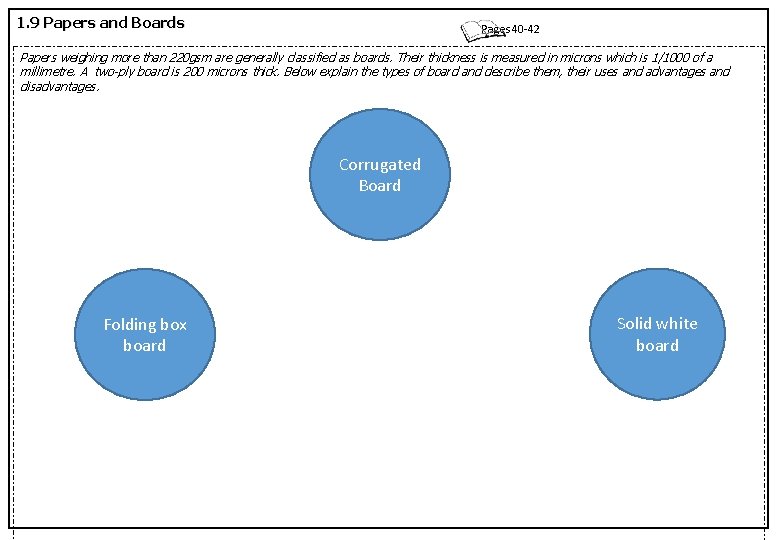
1. 9 Papers and Boards Pages 40 -42 Papers weighing more than 220 gsm are generally classified as boards. Their thickness is measured in microns which is 1/1000 of a millimetre. A two-ply board is 200 microns thick. Below explain the types of board and describe them, their uses and advantages and disadvantages. Corrugated Board Folding box board Solid white board
1. 9 Papers and Boards Pages 40 -42 List x 5 products that are packaged and explain in detail why you think that material has been chosen for the product. Explain the 3 properties below: Flexibility: Printability: Biodegradability:
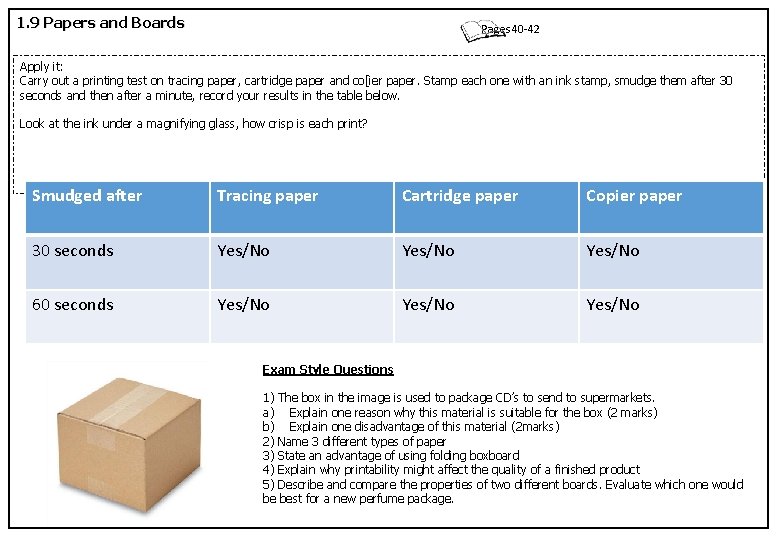
1. 9 Papers and Boards Pages 40 -42 Apply it: Carry out a printing test on tracing paper, cartridge paper and co[ier paper. Stamp each one with an ink stamp, smudge them after 30 seconds and then after a minute, record your results in the table below. Look at the ink under a magnifying glass, how crisp is each print? Smudged after Tracing paper Cartridge paper Copier paper 30 seconds Yes/No 60 seconds Yes/No Exam Style Questions 1) The box in the image is used to package CD’s to send to supermarkets. a) Explain one reason why this material is suitable for the box (2 marks) b) Explain one disadvantage of this material (2 marks) 2) Name 3 different types of paper 3) State an advantage of using folding boxboard 4) Explain why printability might affect the quality of a finished product 5) Describe and compare the properties of two different boards. Evaluate which one would be best for a new perfume package.
- Slides: 5