
Core Instruction in Tier 1 The Prevention That

- Slides: 43
Core Instruction in Tier 1 The Prevention That Avoids Intervention Dean Richards ORTIi
Where do these ideas come from?
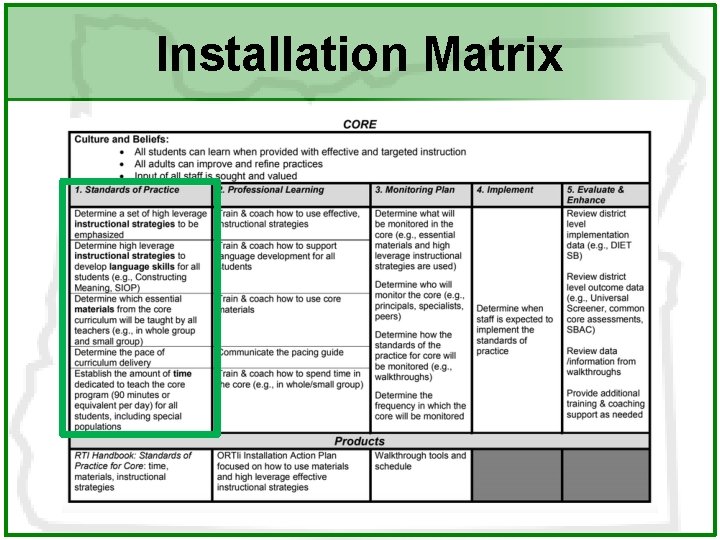
Installation Matrix
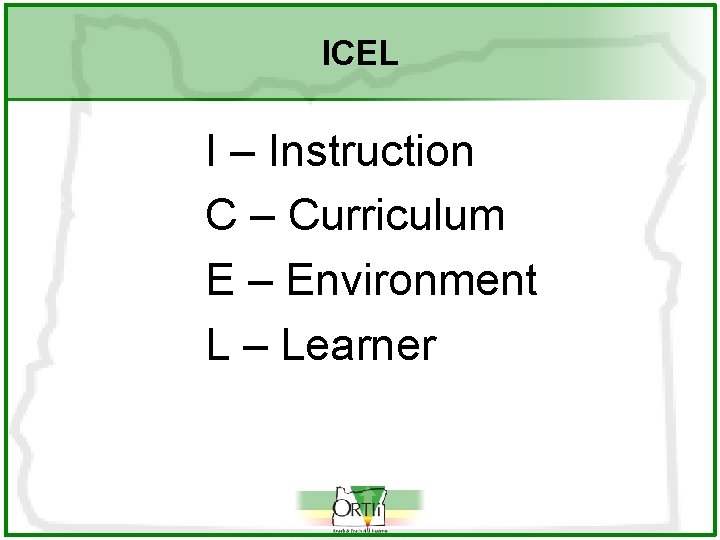
ICEL I – Instruction C – Curriculum E – Environment L – Learner
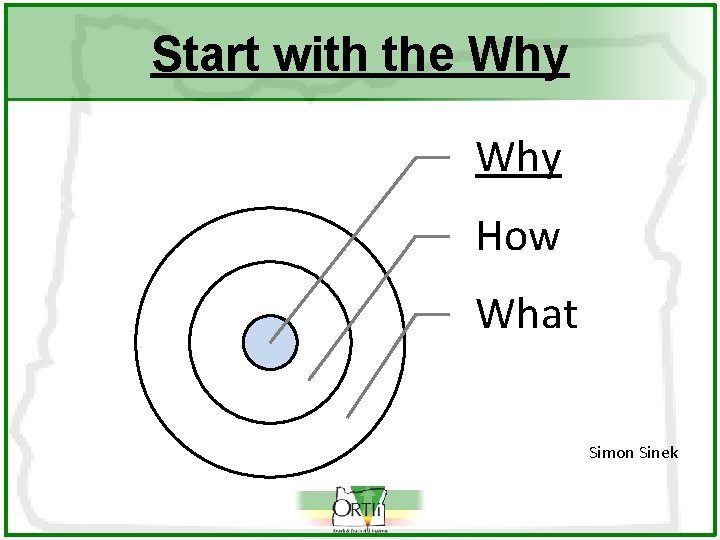
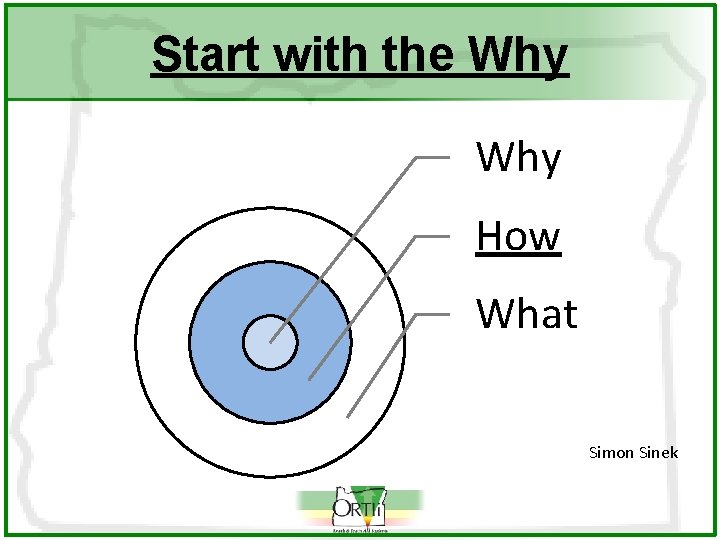
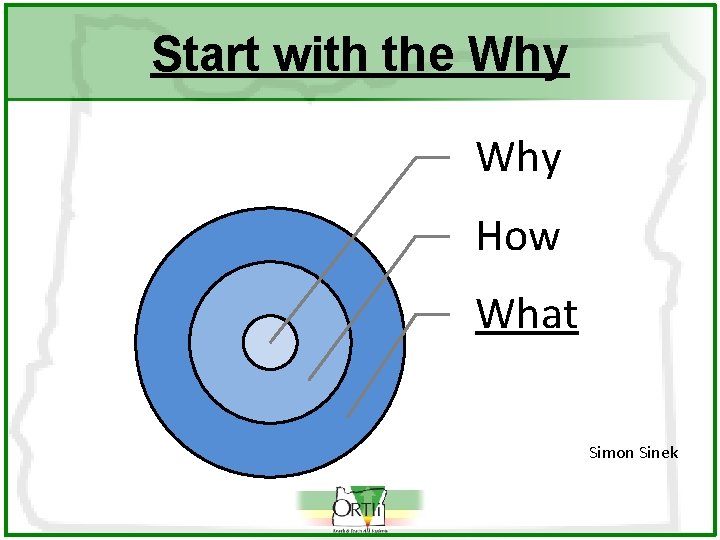
Start with the Why How What Simon Sinek
Why do we need a core? • A core Reading program provides a system of instruction for students as they move through grade levels.
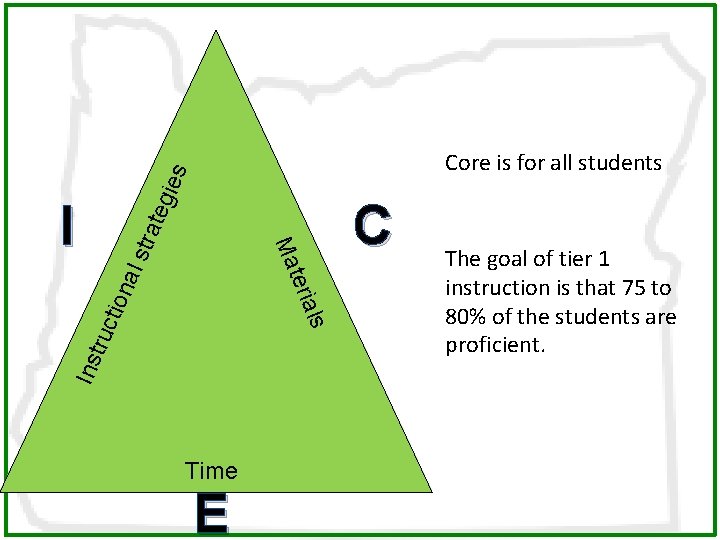
al s trat Ins truc als tion teri Ma I egi e s Core is for all students Time E C The goal of tier 1 instruction is that 75 to 80% of the students are proficient.
RTI begins with General Education! § Teachers don’t fail students, systems do. § RTI is a system for differentiation of instruction! § RTI is a system that is predicated on the general education teachers’ skill and knowledge of instruction, assessment, curriculum, and children.
Start with the Why How What Simon Sinek
How is instruction organized? • A core Reading curriculum has standards of practice across the district and grade levels that provide guidance and clarity as to the expectations for instruction.
Start with the Why How What Simon Sinek
Standards of Practice Instruction Routines
Explicit instruction is a systematic instructional approach that includes a set of delivery and design procedures derived from effective schools research. ~Ideas That Work
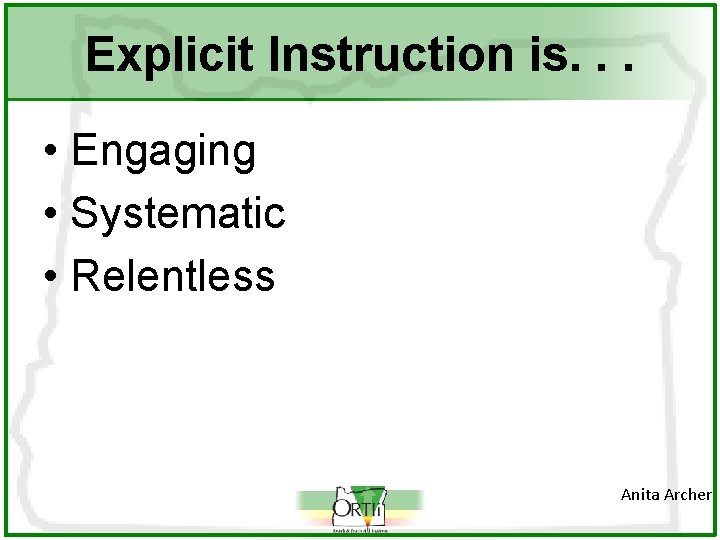
Explicit Instruction is. . . • Engaging • Systematic • Relentless Anita Archer
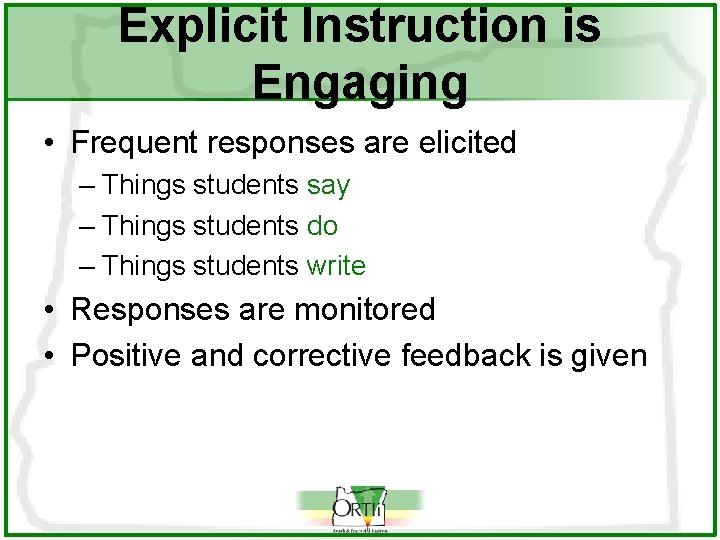
Explicit Instruction is Engaging • Frequent responses are elicited – Things students say – Things students do – Things students write • Responses are monitored • Positive and corrective feedback is given
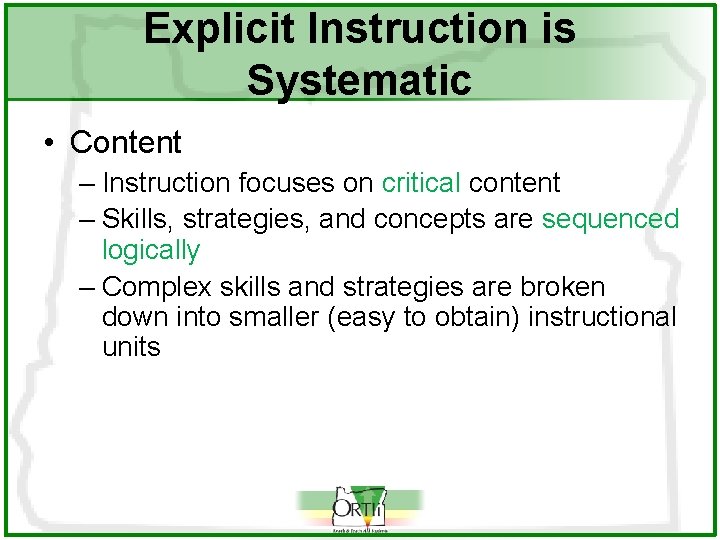
Explicit Instruction is Systematic • Content – Instruction focuses on critical content – Skills, strategies, and concepts are sequenced logically – Complex skills and strategies are broken down into smaller (easy to obtain) instructional units
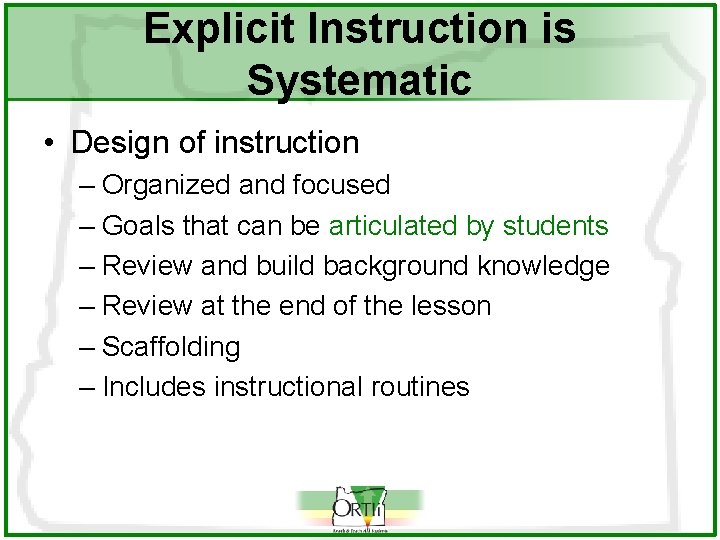
Explicit Instruction is Systematic • Design of instruction – Organized and focused – Goals that can be articulated by students – Review and build background knowledge – Review at the end of the lesson – Scaffolding – Includes instructional routines
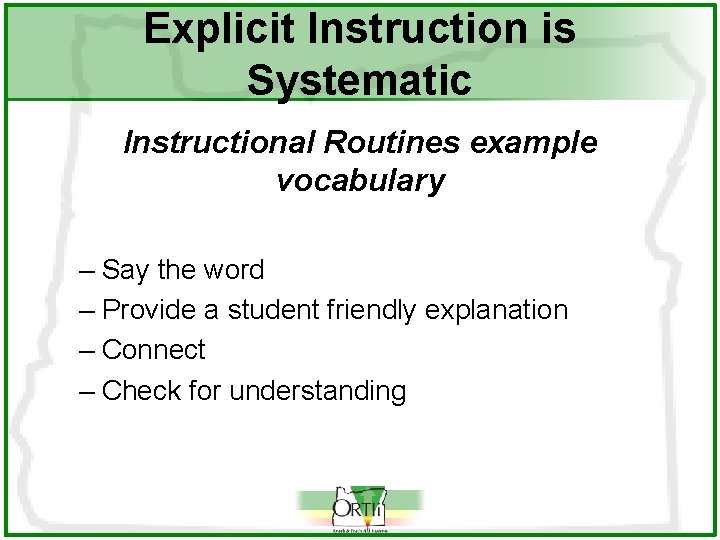
Explicit Instruction is Systematic Instructional Routines example vocabulary – Say the word – Provide a student friendly explanation – Connect – Check for understanding
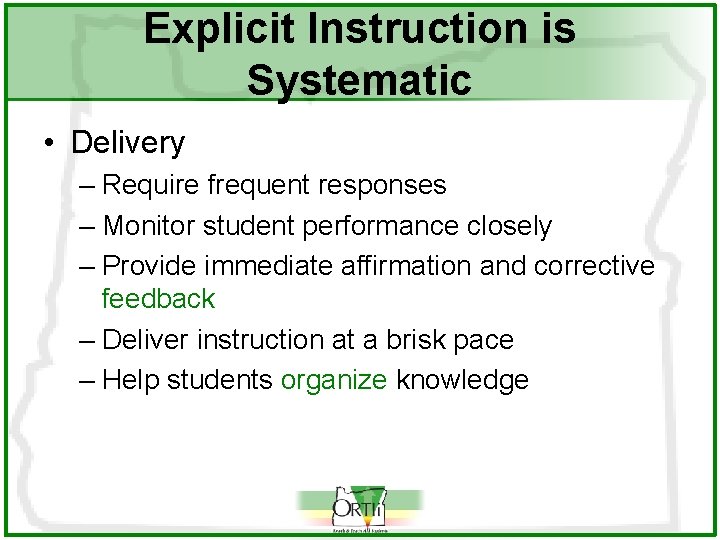
Explicit Instruction is Systematic • Delivery – Require frequent responses – Monitor student performance closely – Provide immediate affirmation and corrective feedback – Deliver instruction at a brisk pace – Help students organize knowledge
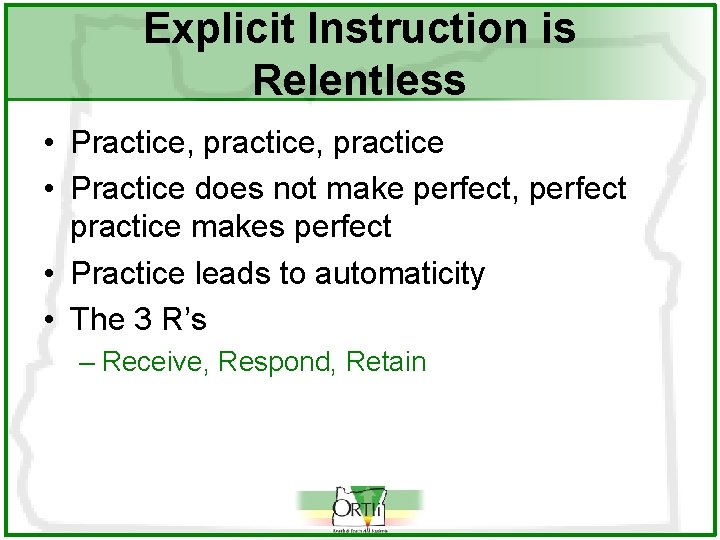
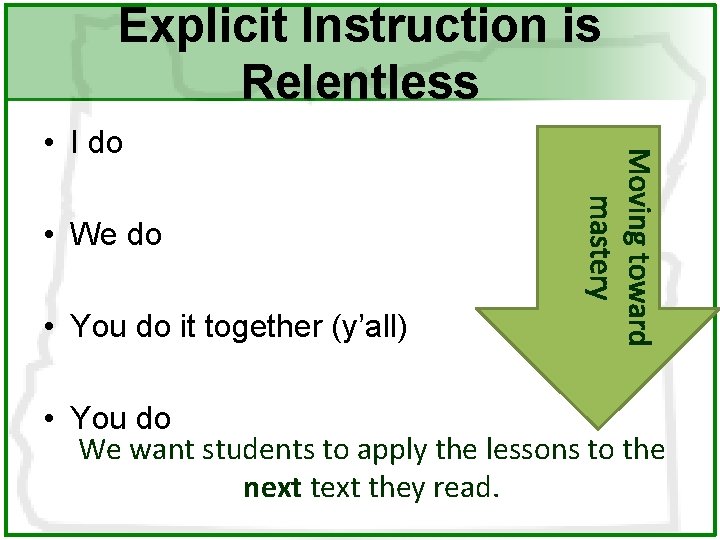
Explicit Instruction is Relentless • Practice, practice • Practice does not make perfect, perfect practice makes perfect • Practice leads to automaticity • The 3 R’s – Receive, Respond, Retain
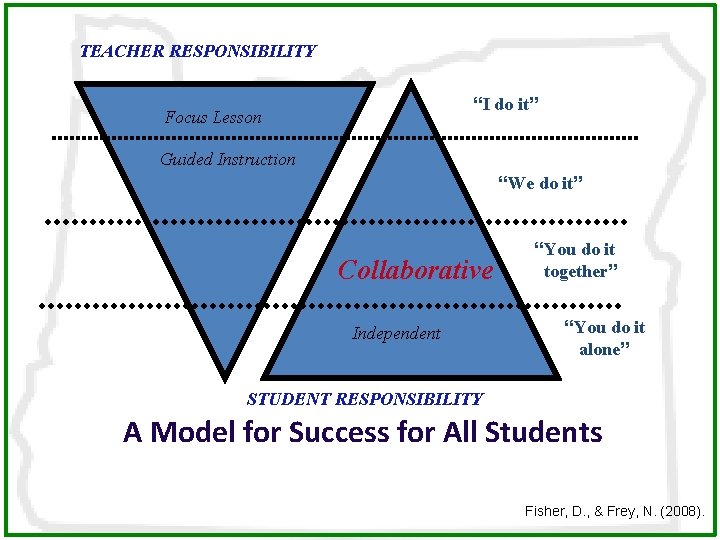
TEACHER RESPONSIBILITY “I do it” Focus Lesson Guided Instruction “We do it” Collaborative Independent “You do it together” “You do it alone” STUDENT RESPONSIBILITY A Model for Success for All Students Fisher, D. , & Frey, N. (2008).
Explicit Instruction is Relentless • We do • You do it together (y’all) Moving toward mastery • I do • You do We want students to apply the lessons to the next they read.
Differentiation during core • What instructional strategies are to be used? – When is direct instruction necessary? – When and how do you get more?
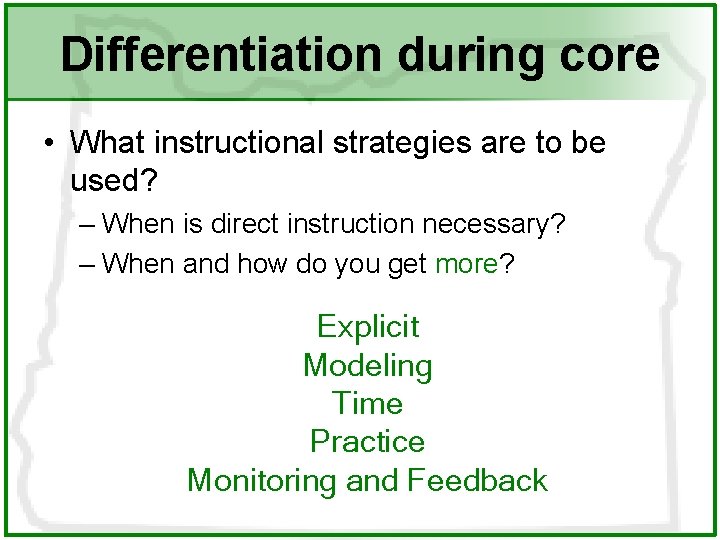
Differentiation during core • What instructional strategies are to be used? – When is direct instruction necessary? – When and how do you get more? Explicit Modeling Time Practice Monitoring and Feedback
Standards of Practice Curriculum Materials
Why? • Comprehensive program that incorporates all components of reading • Students have the opportunity to make connections • Students read text that supports vocabulary, phonics, and comprehension lessons • The whole school has a common language, common goal, and common tools
Materials • Check materials for cultural relevance – Representation of a variety of groups • Think about how the materials fit the culture and context of your students – Provide background knowledge as needed
What do the Materials Address 1. The Big 5 of Reading 2. The scope and sequence 3. Common Core State Standards
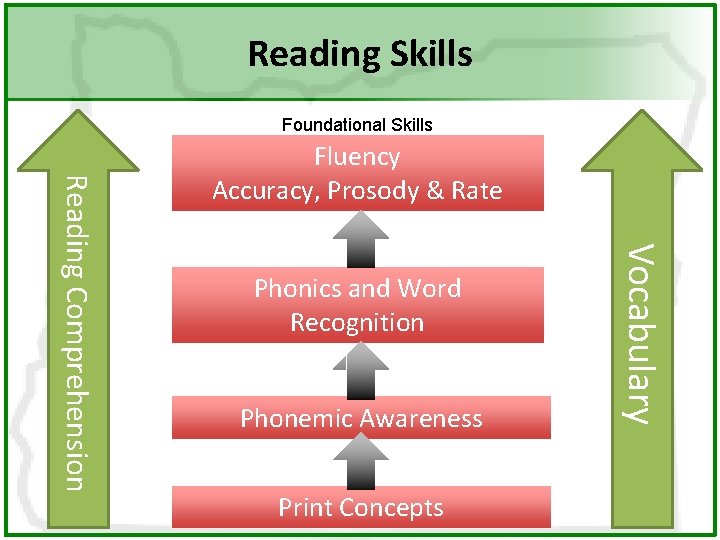
Reading Skills Foundational Skills Phonics and Word Recognition Phonemic Awareness Print Concepts Vocabulary Reading Comprehension Fluency Accuracy, Prosody & Rate
Scope and sequence • We want to be sure that we know what has and what will be taught. • Mastery of skills looks different at all levels • Repeated opportunities to learn • We don’t want to slow down and limit student knowledge
Differentiation during core Differentiation is changing the size of the meal, not the menu.
Differentiation during core • What specific materials are to be used? – Which ones meet the Big 5 of Reading? – Which ones meet the State and Common Core? Who gets feed what? - Whole Group - Small Group - Independent Practice
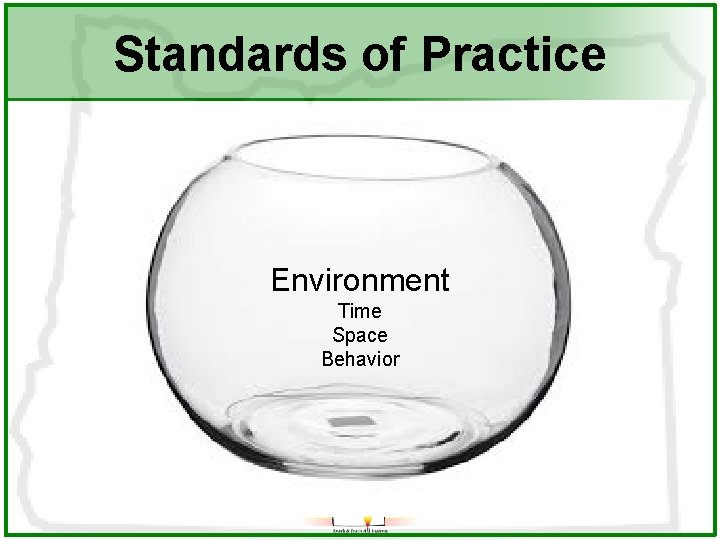
Standards of Practice Environment Time Space Behavior
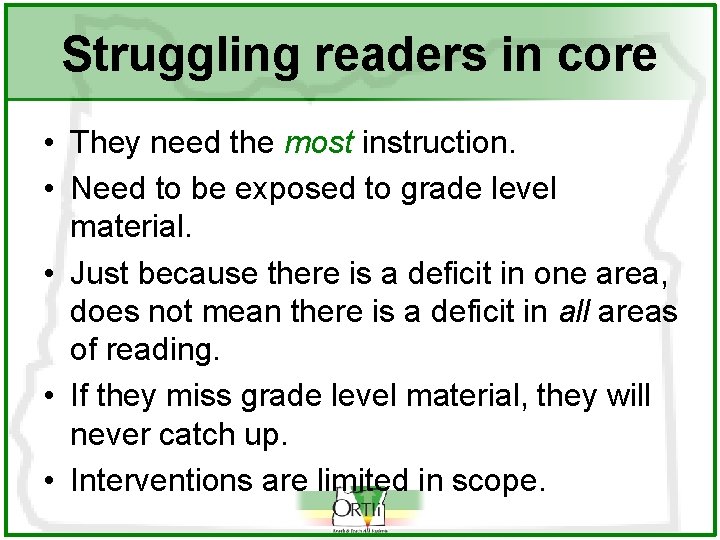
Struggling readers in core • They need the most instruction. • Need to be exposed to grade level material. • Just because there is a deficit in one area, does not mean there is a deficit in all areas of reading. • If they miss grade level material, they will never catch up. • Interventions are limited in scope.
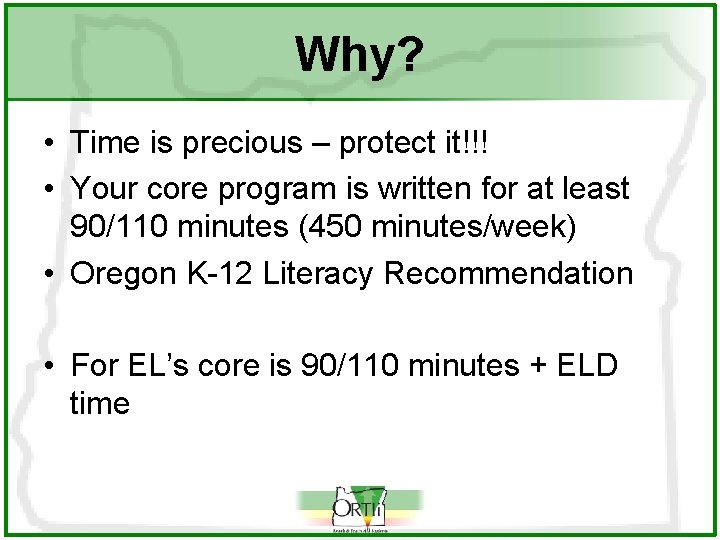
Why? • Time is precious – protect it!!! • Your core program is written for at least 90/110 minutes (450 minutes/week) • Oregon K-12 Literacy Recommendation • For EL’s core is 90/110 minutes + ELD time
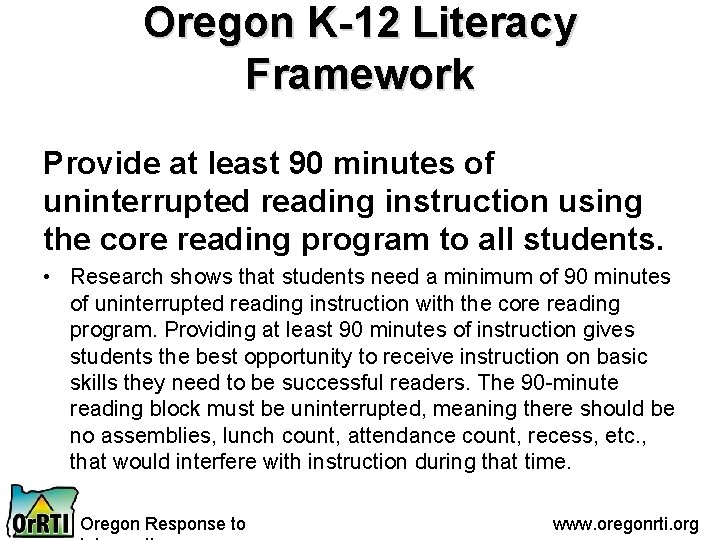
Oregon K-12 Literacy Framework Provide at least 90 minutes of uninterrupted reading instruction using the core reading program to all students. • Research shows that students need a minimum of 90 minutes of uninterrupted reading instruction with the core reading program. Providing at least 90 minutes of instruction gives students the best opportunity to receive instruction on basic skills they need to be successful readers. The 90 -minute reading block must be uninterrupted, meaning there should be no assemblies, lunch count, attendance count, recess, etc. , that would interfere with instruction during that time. Oregon Response to www. oregonrti. org
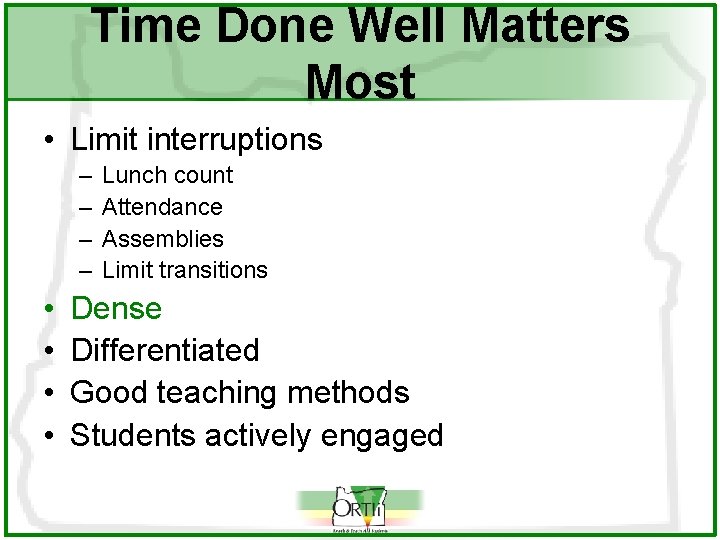
Time Done Well Matters Most • Limit interruptions – – • • Lunch count Attendance Assemblies Limit transitions Dense Differentiated Good teaching methods Students actively engaged
Core Reading Minutes • This does not include the instruction of writing – It may include the practice of writing • Writing in response to reading
Core Instructional Behavior Program • School rules & associated behavior expectations explicitly taught to ALL students (i. e. , safe, respectful, responsible behavior in the bathroom) • ALL students consistently & regularly acknowledged for demonstrating positive behavior expectations • ALL students immediately & reliably (meaning all staff) corrected when behavior expectations are not demonstrated. Positive behaviors immediately retaught.
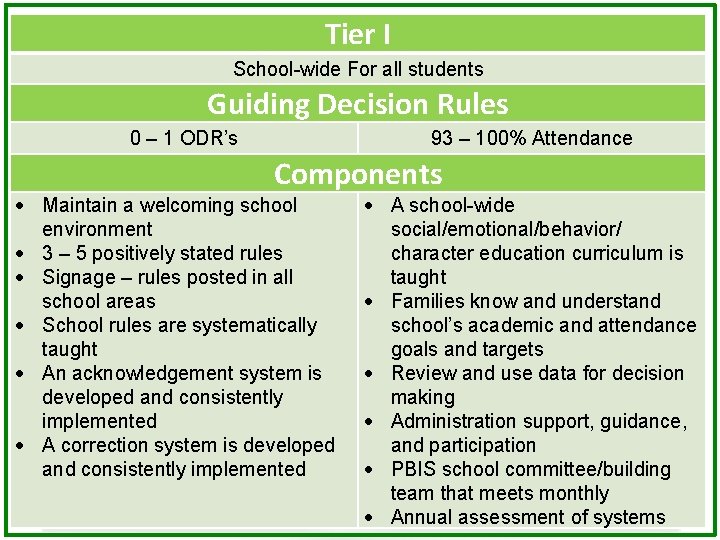
Tier I School-wide For all students Guiding Decision Rules 0 – 1 ODR’s 93 – 100% Attendance Components Maintain a welcoming school environment 3 – 5 positively stated rules Signage – rules posted in all school areas School rules are systematically taught An acknowledgement system is developed and consistently implemented A correction system is developed and consistently implemented A school-wide social/emotional/behavior/ character education curriculum is taught Families know and understand school’s academic and attendance goals and targets Review and use data for decision making Administration support, guidance, and participation PBIS school committee/building team that meets monthly Annual assessment of systems
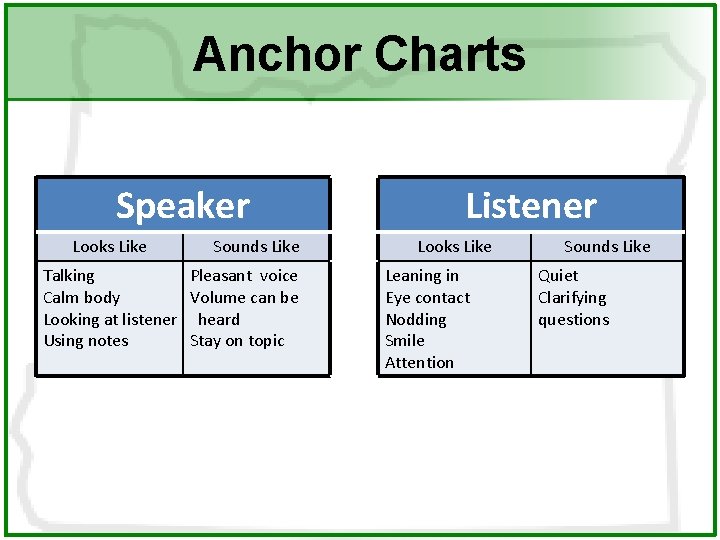
Anchor Charts Speaker Looks Like Sounds Like Talking Pleasant voice Calm body Volume can be Looking at listener heard Using notes Stay on topic Listener Looks Like Leaning in Eye contact Nodding Smile Attention Sounds Like Quiet Clarifying questions
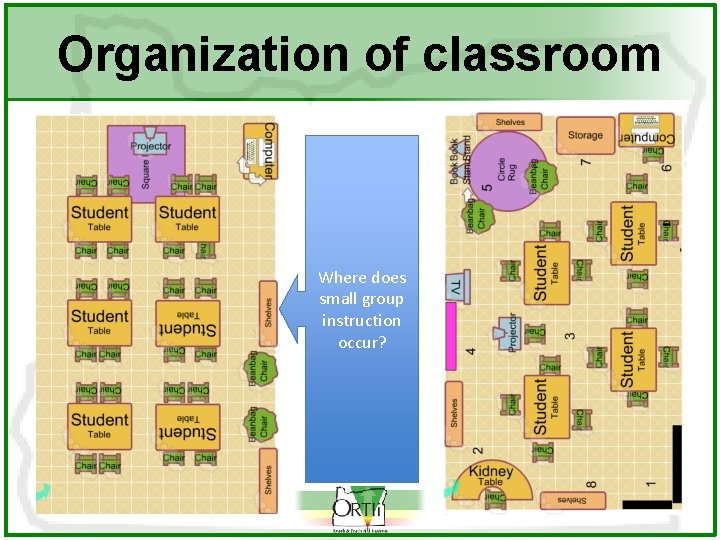
Organization of classroom Where does small group instruction occur?
Cumulative Review Effective core instruction is the most important thing you can do in RTI • Explicit instruction works for everyone • Materials align across years • Dedicate a minimum of 90 minutes to Reading