
CORE IDEAS IN BOWEN THEORY Michael E Kerr
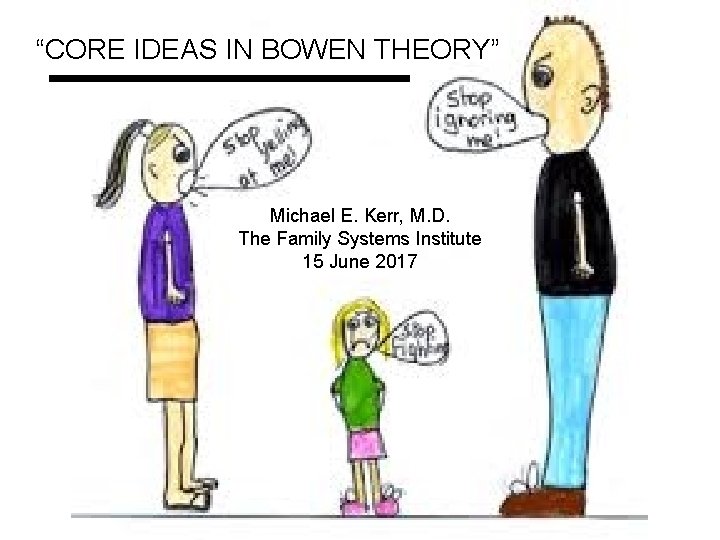
“CORE IDEAS IN BOWEN THEORY” Michael E. Kerr, M. D. The Family Systems Institute 15 June 2017
I. Systems thinking
The core of this presentation is the application of systems thinking to human behavior. With the exception of people who have tried to extend general system theory and cybernetics to human behavior, the Bowen family systems theory that is the basis of this short talk is the first application of systems thinking that came from the direct study of a living system, namely, the human family system.
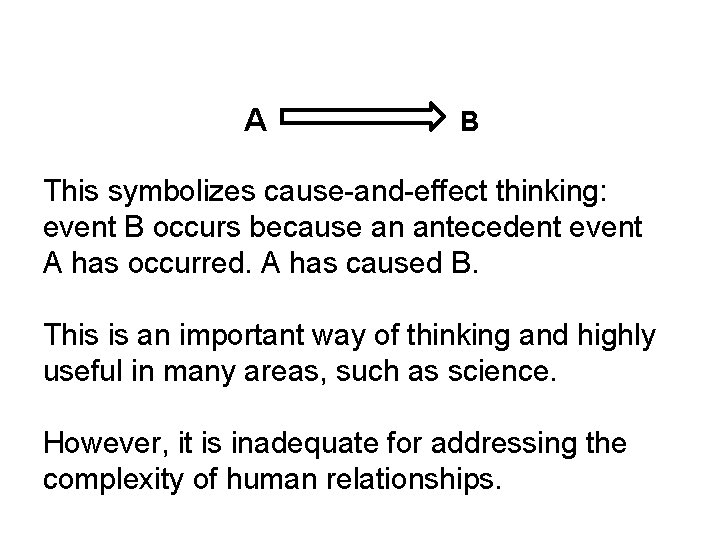
A B This symbolizes cause-and-effect thinking: event B occurs because an antecedent event A has occurred. A has caused B. This is an important way of thinking and highly useful in many areas, such as science. However, it is inadequate for addressing the complexity of human relationships.
Clinical example of cause-and-effect thinking: Jim, the husband, saying to his wife: “I feel depressed because you would rather work in your garden than be with me!” This statement is typically delivered accompanied by a sad looking face and slumping shoulders. His assertion implies that her actions cause him to be depressed.
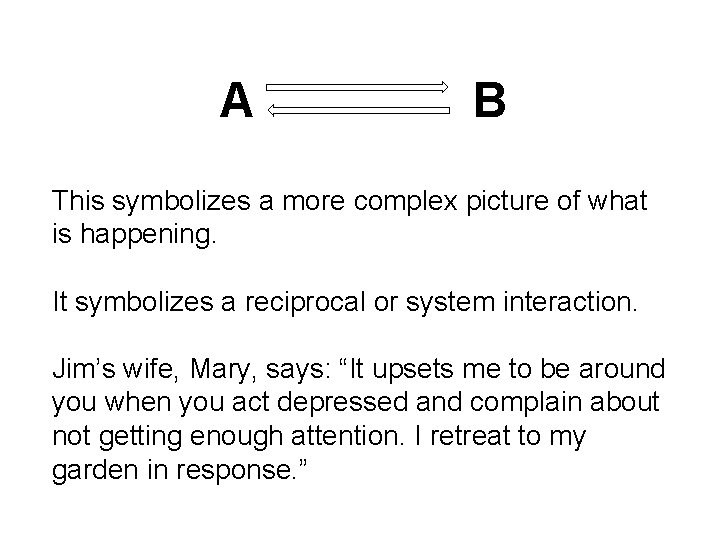
A B This symbolizes a more complex picture of what is happening. It symbolizes a reciprocal or system interaction. Jim’s wife, Mary, says: “It upsets me to be around you when you act depressed and complain about not getting enough attention. I retreat to my garden in response. ”
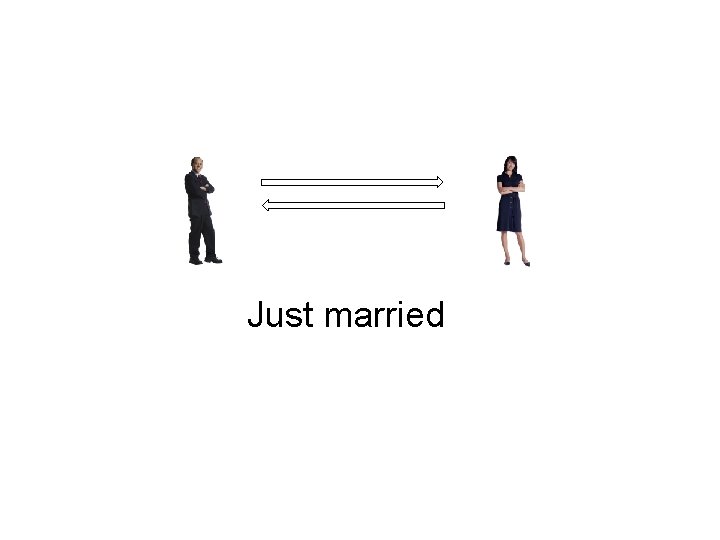
Just married
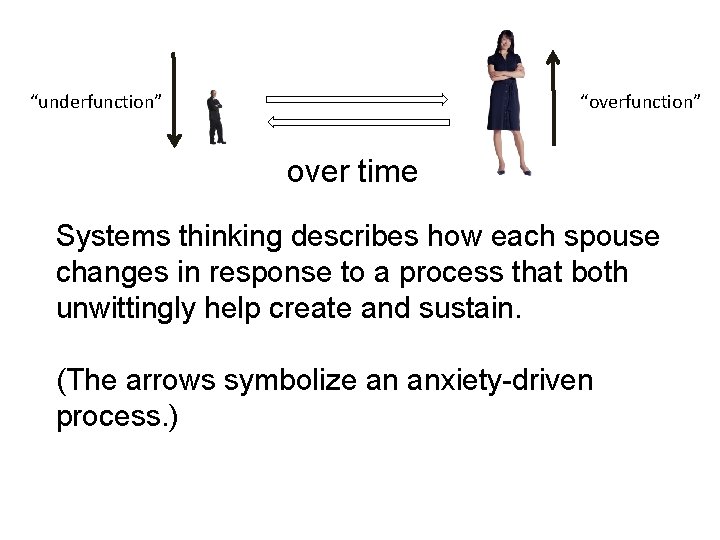
“underfunction” “overfunction” over time Systems thinking describes how each spouse changes in response to a process that both unwittingly help create and sustain. (The arrows symbolize an anxiety-driven process. )
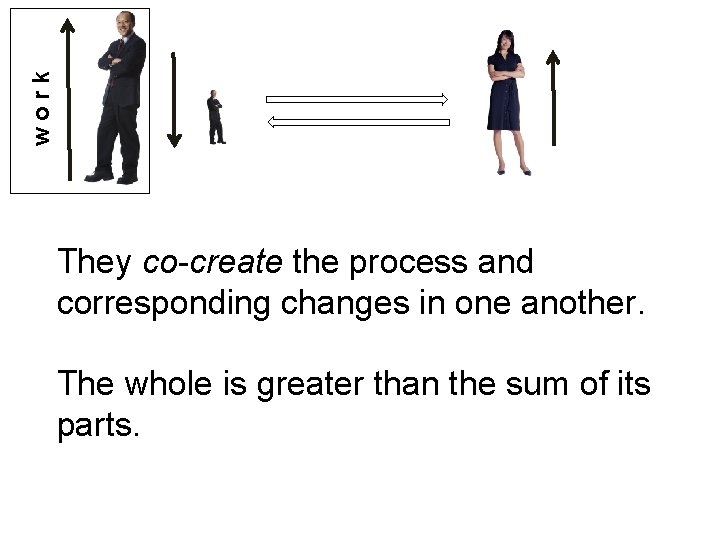
work They co-create the process and corresponding changes in one another. The whole is greater than the sum of its parts.
Systems thinking applies as much to parent-child relationships as it does to adult-adult relationships.
Each person’s emotions not only reflect their internal states, but also function to change each other’s internal states and associated actions. In human beings, the process is mediated primarily by auditory and visual stimuli.
It is nonsense to blame one another because they both help create changes in each other to which both react. Blaming the other amounts to blaming oneself.
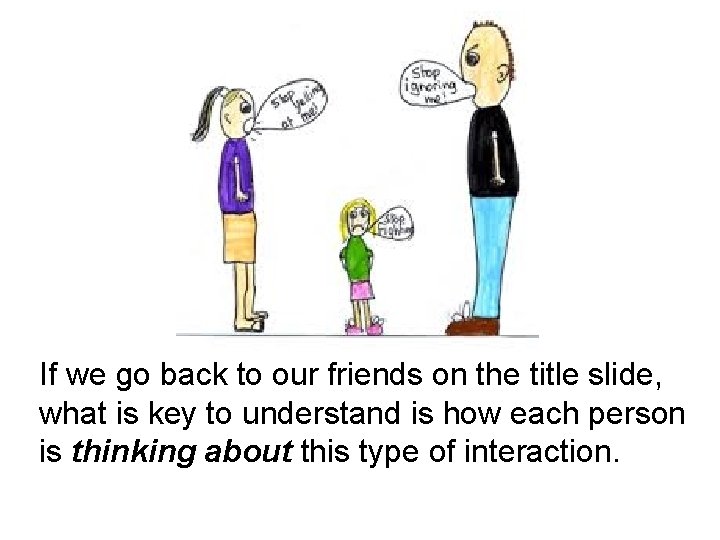
If we go back to our friends on the title slide, what is key to understand is how each person is thinking about this type of interaction.
If they are each thinking cause-and-effect, he blames his yelling on her ignoring him and she blames her ignoring him on his yelling. Neither wants to give in. If either partner can apply systems thinking, he or she can work to change self without feeling like they are giving in. Their daughter will obviously derive benefit from their more mature behavior.
A key assumption here is that a systems’ view of relationships is a better description of reality than a cause-and-effect view. The task is for people to gain more objectivity about an emotional process.
Progress results from developing a new way of thinking and translating that into a new way of being. It takes a leader to start the process rolling, but it does not always have to be the same person taking the lead.
My task as a family systems therapist is to stay objective about what people say and often act out in front of me, ask questions that reflect that objectivity and way of thinking, and thus help them educate themselves to an alternative way of understanding their relationship.
When a person can act on the new way of thinking, he or she is being more of a “self” in the relationship. This means he or she can be more reflective and consider a long-term view. He or she does less automatic reacting and acting to relieve the anxiety of the moment.
It may seem easy to make this shift in thinking, but it is not. Cause-and-effect thinking is a powerful default mode when situations carry some emotional valence. It is much easier to think systems about the cosmos than one’s own family.
“Reasoning has evolved not to help us find truth, but to help us engage in arguments, persuasion, and manipulation in the context of discussions with others. Confirmation bias is a built-in feature of the argumentative mind. ” Jonathan Haidt, Ph. D.
Jim feels that if Mary were more attentive, he would not feel depressed, which is true; Mary feels if he did not act so depressed, she would not feel overwhelmed and want to distance, which is also true. Both spouses are caught in a process similar to a Chinese finger trap. Each is equally reactive to the other spouse. It takes two to tango.
Most people pay lip service to this being true, but it is difficult to live it. The shift from causal thinking to observing emotional process and one’s part in it generates a state of equanimity that produces almost instant changes in interactive process and its consequent effects on the moods and behaviors of both people. People often compare it to a “breath of fresh air. ”
It is probably the right spot in this presentation to let a certain cat out of the bag. Many people are prone to disagree with this assumption in Bowen theory, but it has been implied by everything I have presented thus far:

People select marriage partners and friends who match their own level of emotional maturity— or what Bowen theory terms differentiation of self. Are there exceptions? Nowhere nearly as many as people claim. If you embrace this assumption, it is much easier to apply systems thinking to relationships.
Cause-and-effect thinking asks, “Why? ” “Why does the other treat me this way? Maybe he or she has abandonment issues, commitment issues, bonding, anger, or bipolar issues. Cause-and-effect thinking seeks the explanation for a person’s actions within that individual.
Systems thinking does not ask, “Why? ” It focuses on: How? What? When? Where?
Systems thinking describes functional facts about relationship interactions. In the Jim & Mary story, it is a functional fact that if the husband says things that blame Mary, she retreats in reaction; it is a functional fact that if she retreats, he makes more blaming comments.
Functional facts are easy to observe once the observer is thinking systems. Speculations about why Jim makes blaming remarks are of little value and unnecessary.
II. Social cues and chronic anxiety
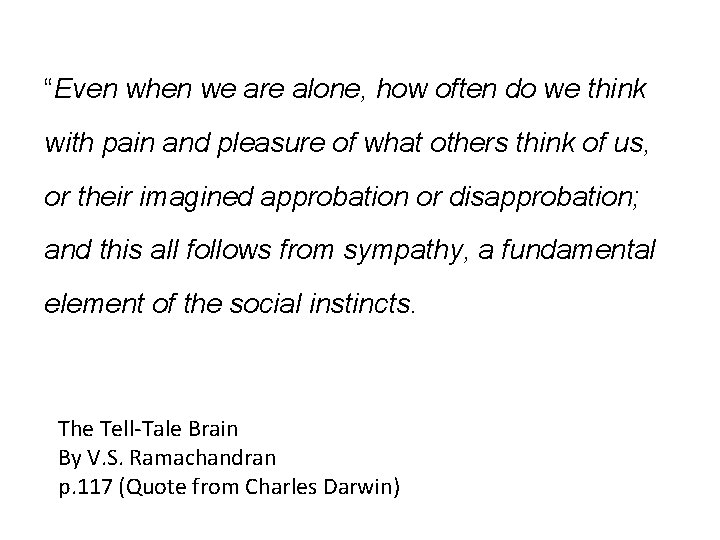
“Even when we are alone, how often do we think with pain and pleasure of what others think of us, or their imagined approbation or disapprobation; and this all follows from sympathy, a fundamental element of the social instincts. The Tell-Tale Brain By V. S. Ramachandran p. 117 (Quote from Charles Darwin)

Four Horsemen of the Apocalypse: Conquest War Famine Death
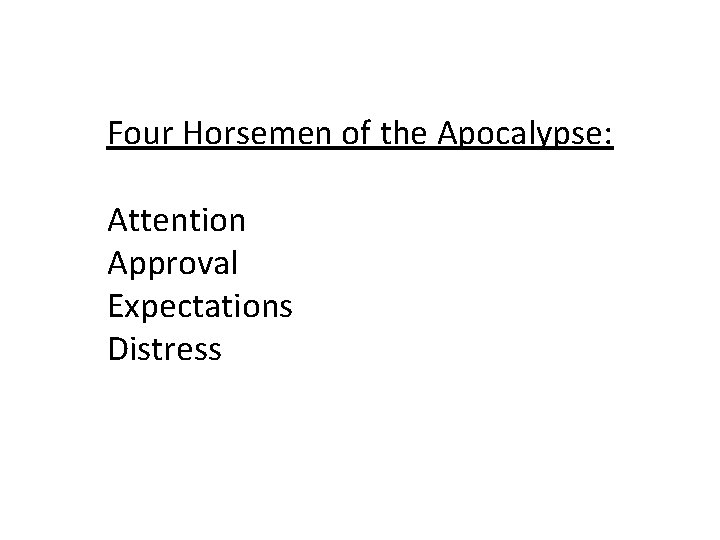
Four Horsemen of the Apocalypse: Attention Approval Expectations Distress
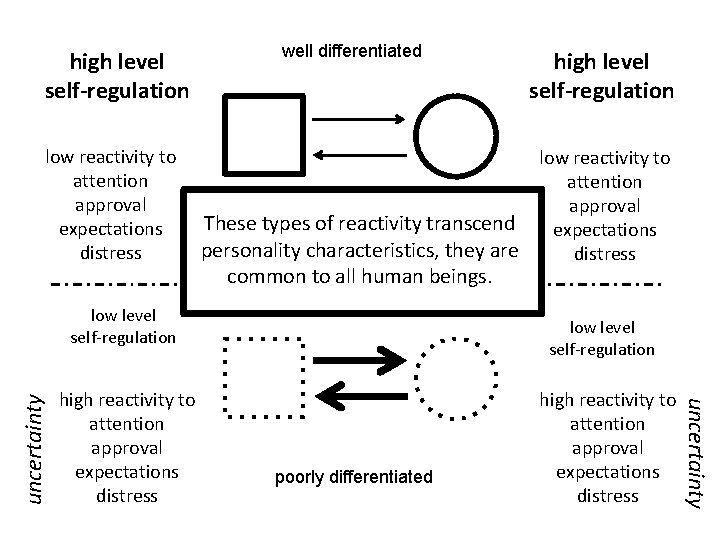
high level self-regulation low reactivity to attention approval expectations distress well differentiated These types of reactivity transcend personality characteristics, they are common to all human beings. high reactivity to attention approval expectations distress low level self-regulation poorly differentiated high reactivity to attention approval expectations distress uncertainty low level self-regulation high level self-regulation
III. Evolution and the Emotional System
Ø Living systems are fountains of energy and activity. Ø Bowen theory assumes that the driving forces of this energy and activity reside in the emotional system. Ø The emotional systems of Homo sapiens and of all other species have been shaped by their long phylogenetic histories.
Ø The emotional systems of all the species on the phylogenetic tree are not composed of identical biological systems and mediated by identical communication signals. Ø However, there are likely more common denominators among the seemingly disparate emotional systems of the myriad species on the planet than is generally thought.

Bowen theory uses the term ‘emotional’ more broadly than in common usage. Simpler unicellular creatures such as bacteria do not have a brain but they are capable of adaptive behavior.
The intracellular systems that support and motivate adaptive behavior are part of the bacterial emotional system. Bowen theory conceptualizes that an emotional system was part of living systems long before what people commonly consider as emotions became part of emotional systems.
The flow of emotional forces through a family system is an invisible process. You infer their presence by their impact on the emotional functioning of family members. Observing the impact of emotional forces or the “emotional field” on family members is emphatically mind-expanding.
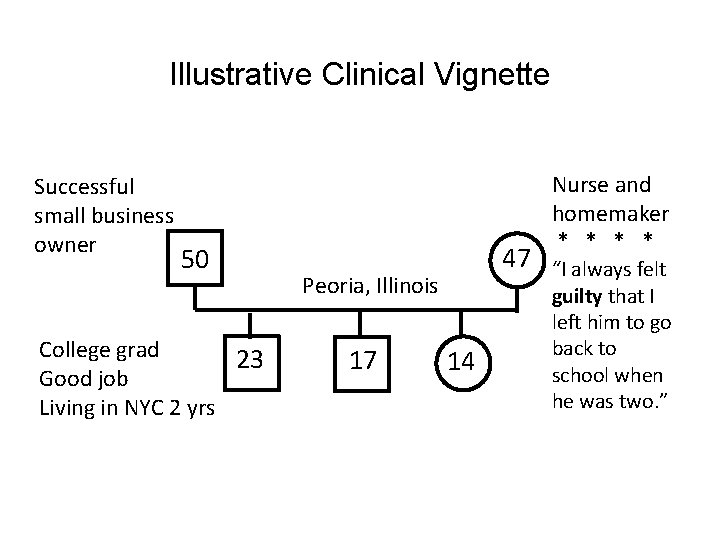
Illustrative Clinical Vignette Successful small business owner 50 College grad 23 Good job Living in NYC 2 yrs 47 Peoria, Illinois 17 14 Nurse and homemaker * * “I always felt guilty that I left him to go back to school when he was two. ”
The 23 -year-old oldest son complains that he does not like to visit his parents because they still treat him like a child. “It’s like I never left home, ” he laments. Dr. K. asks, “Do you act like a child? ” He replies vigorously, “Yes, and that is what I hate most about going home (to Peoria from NYC)!”
At this point, the young man thinks that his parents cause him to act like a child. He has not reflected on his highly sensitized emotional reactions to his parents’ facial expressions, tone of voice, and other nonverbal cues. It is not just what they say, but that is in the mix too. Furthermore, he has not thought much about what his parents react to in his own behavior and demeanor.
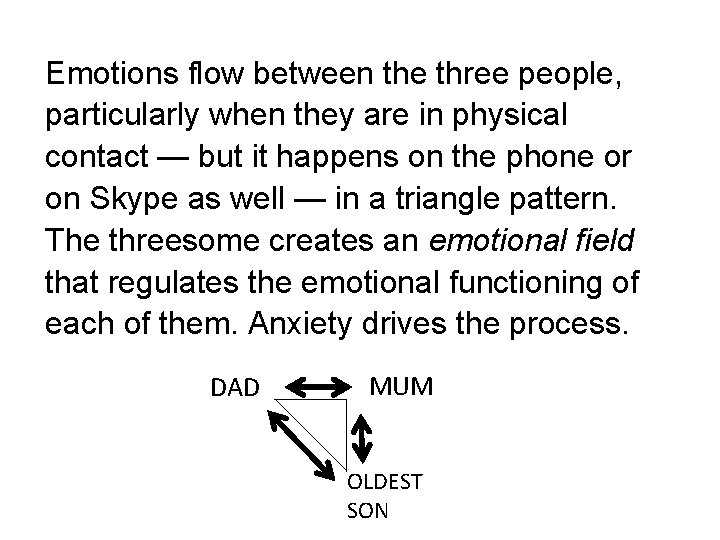
Emotions flow between the three people, particularly when they are in physical contact — but it happens on the phone or on Skype as well — in a triangle pattern. The threesome creates an emotional field that regulates the emotional functioning of each of them. Anxiety drives the process. DAD MUM OLDEST SON
The process is activated by the high level of emotional reactivity each person has to the other. No victims here. As described earlier, each person reacts to attention, approval, expectations, and distress. The level of reactivity in this parental triangle is an unresolved legacy from the years of the son growing up in the family. It is also a legacy of what the parents never resolved with their own parents. Emotionally-driven relationship interactions transmit down the generations of every family.
N. B. , a useful perspective for people to develop if they are trying to change such a process is that the past does not cause the problem in the present. The father, mother, and son repeatedly recreate the problem in the present. Correspondingly, changing the process that unfolds in the present is the high road for resolving issues with the past.
As in the earlier example of the depressed husband his distancing wife, it is impossible to discern when this particular chapter of an old process began. The son has planned an obligatory visit home and has been anxious about it for weeks. The mother has likely been excited about seeing a son she wishes she could see more of. The father worries about having another visit that does not meet expectations, particularly for his wife. All three people are primed in their emotional reactivity, whether aware of it or not.
A huge source of human chronic anxiety is anticipating situations for which you lack the confidence that you can deal with them to your satisfaction. Many of these situations have to do with relationships, inside and outside the family.
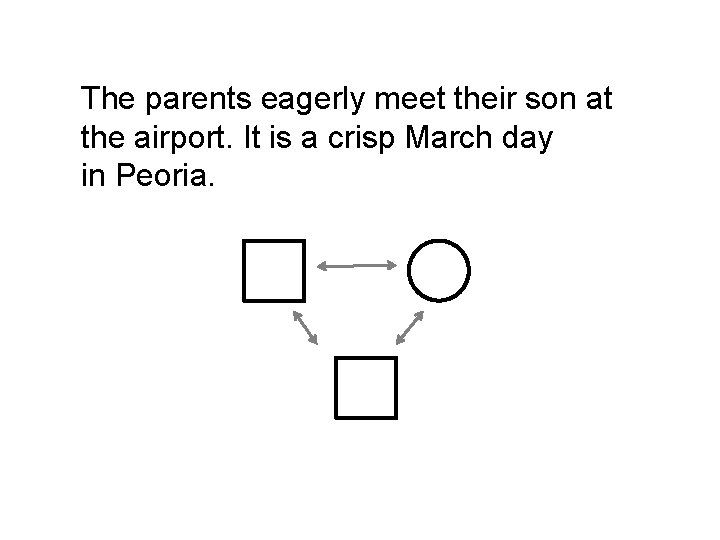
The parents eagerly meet their son at the airport. It is a crisp March day in Peoria.
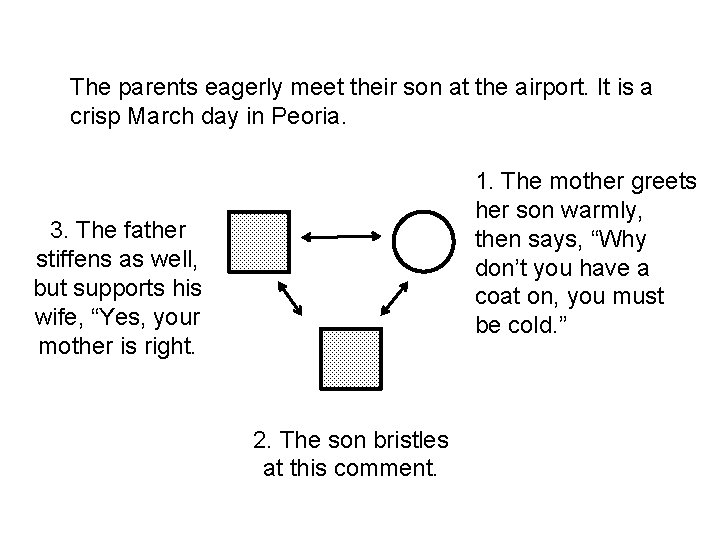
The parents eagerly meet their son at the airport. It is a crisp March day in Peoria. 1. The mother greets her son warmly, then says, “Why don’t you have a coat on, you must be cold. ” 3. The father stiffens as well, but supports his wife, “Yes, your mother is right. 2. The son bristles at this comment.
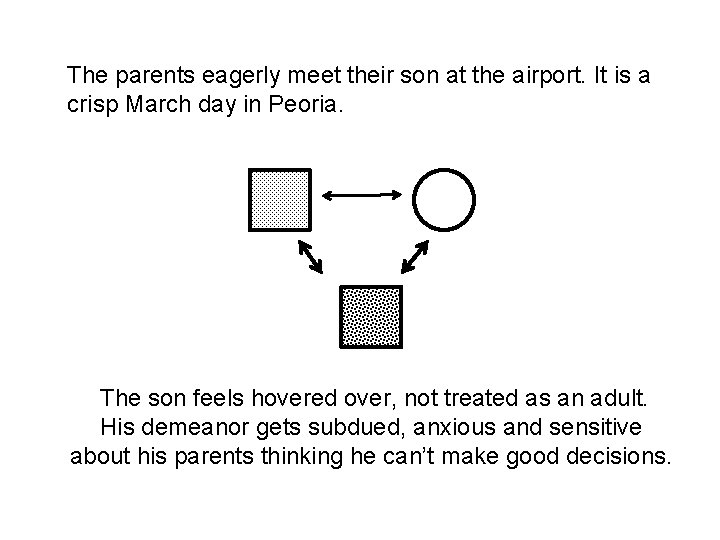
The parents eagerly meet their son at the airport. It is a crisp March day in Peoria. The son feels hovered over, not treated as an adult. His demeanor gets subdued, anxious and sensitive about his parents thinking he can’t make good decisions.
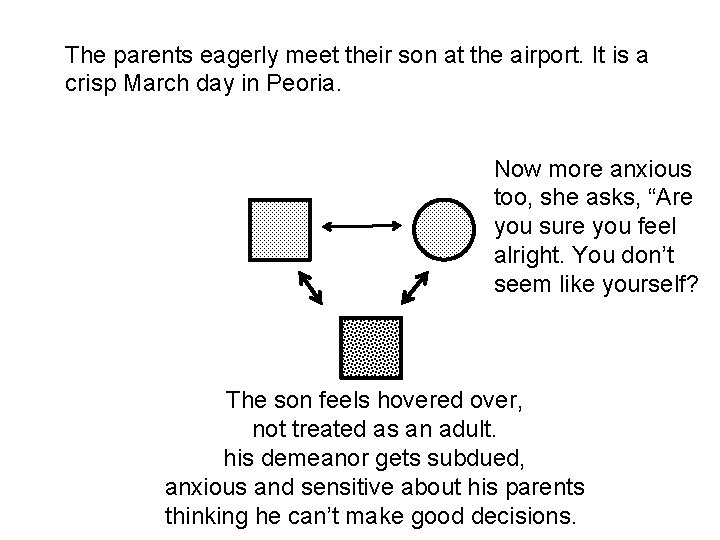
The parents eagerly meet their son at the airport. It is a crisp March day in Peoria. Now more anxious too, she asks, “Are you sure you feel alright. You don’t seem like yourself? The son feels hovered over, not treated as an adult. his demeanor gets subdued, anxious and sensitive about his parents thinking he can’t make good decisions.
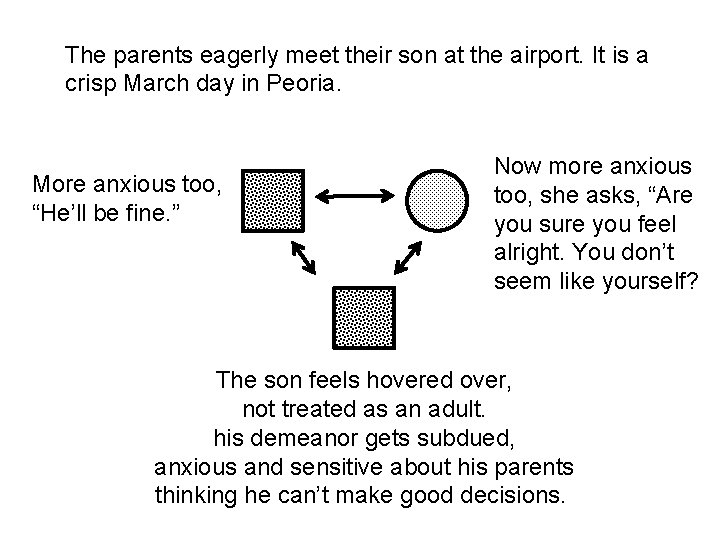
The parents eagerly meet their son at the airport. It is a crisp March day in Peoria. More anxious too, “He’ll be fine. ” Now more anxious too, she asks, “Are you sure you feel alright. You don’t seem like yourself? The son feels hovered over, not treated as an adult. his demeanor gets subdued, anxious and sensitive about his parents thinking he can’t make good decisions.
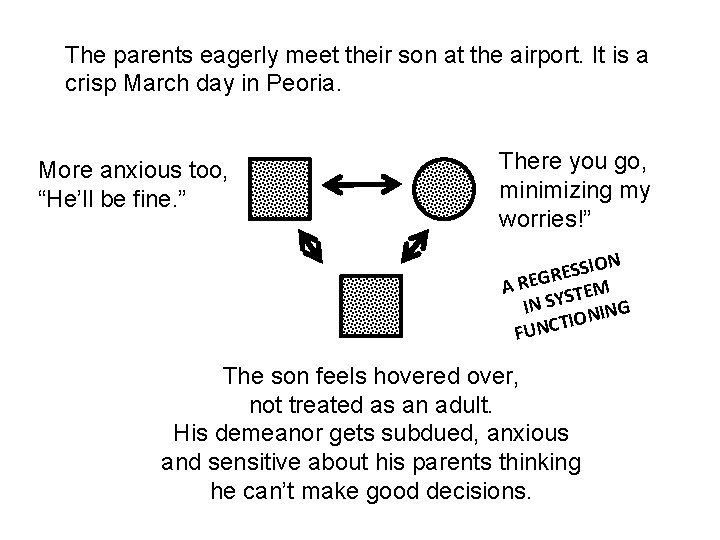
The parents eagerly meet their son at the airport. It is a crisp March day in Peoria. More anxious too, “He’ll be fine. ” There you go, minimizing my worries!” ON I S S E R A REG STEM IN SY NING TIO C N U F The son feels hovered over, not treated as an adult. His demeanor gets subdued, anxious and sensitive about his parents thinking he can’t make good decisions.
Commonly, the mother’s worry and hovering are viewed as the problem, both by the son and the father. The father walks on egg shells with the mother, knowing how easily upset she gets about signs she interprets as unhappiness in her kids. He tries to do what it takes to keep her happy. The son is often angry that his father mostly seems to take his mother’s side. The son has the same deep desire as his father to please his mother, to keep her happy. It’s easier that way.
The mother is not to blame. She is one of three equal participants in an automatic emotional system process. Each has difficulty maintaining a “self” in the triangle.
An important lesson from this vignette that applies to a lot of people is that the mother’s guilt about going back to school when their son was two years old fueled much of her overprotective-ness. She feared that he had been traumatized by her action. Her putting her son in daycare at an early age is not the problem. His core problem was his difficulty developing a “self” in the ongoing, anxiety -ridden relationship process with his parents.
IV. Triangle: the molecule of an emotional system
“A dysfunctional family is any family with more than one person in it. ” (Mary Karr) Grew up in Leechfield, TX
What is it about human nature that creates the core dilemma of human relationships?
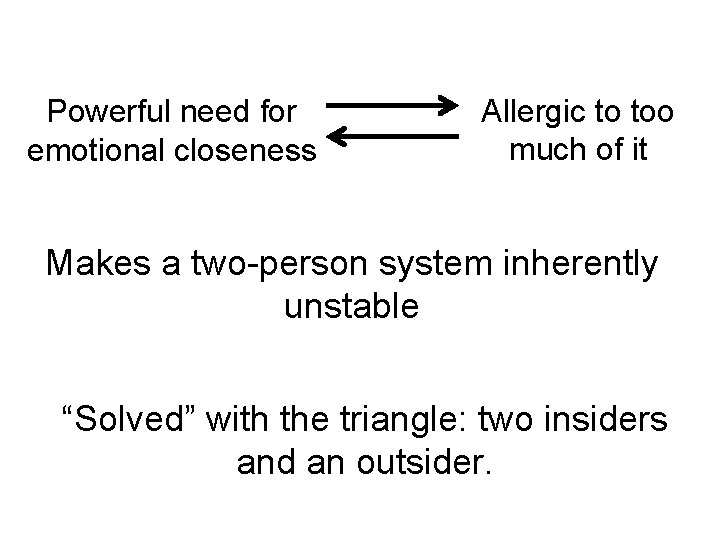
Powerful need for emotional closeness Allergic to too much of it Makes a two-person system inherently unstable “Solved” with the triangle: two insiders and an outsider.
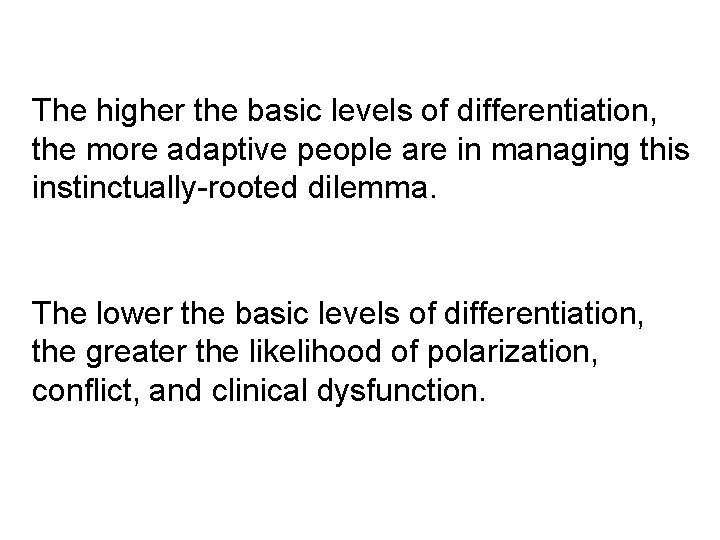
The higher the basic levels of differentiation, the more adaptive people are in managing this instinctually-rooted dilemma. The lower the basic levels of differentiation, the greater the likelihood of polarization, conflict, and clinical dysfunction.
V. Patterns of emotional functioning and symptom development
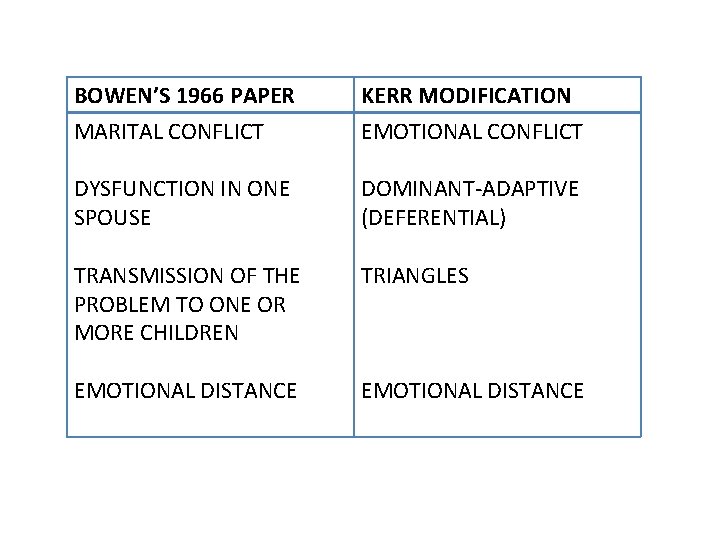
BOWEN’S 1966 PAPER MARITAL CONFLICT KERR MODIFICATION EMOTIONAL CONFLICT DYSFUNCTION IN ONE SPOUSE DOMINANT-ADAPTIVE (DEFERENTIAL) TRANSMISSION OF THE PROBLEM TO ONE OR MORE CHILDREN TRIANGLES EMOTIONAL DISTANCE
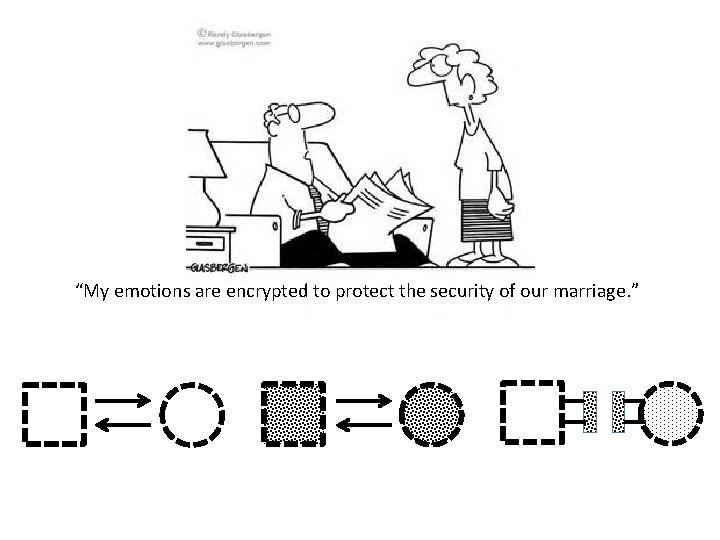
“My emotions are encrypted to protect the security of our marriage. ”
Approach/avoid are evolutionarily ancient behaviors
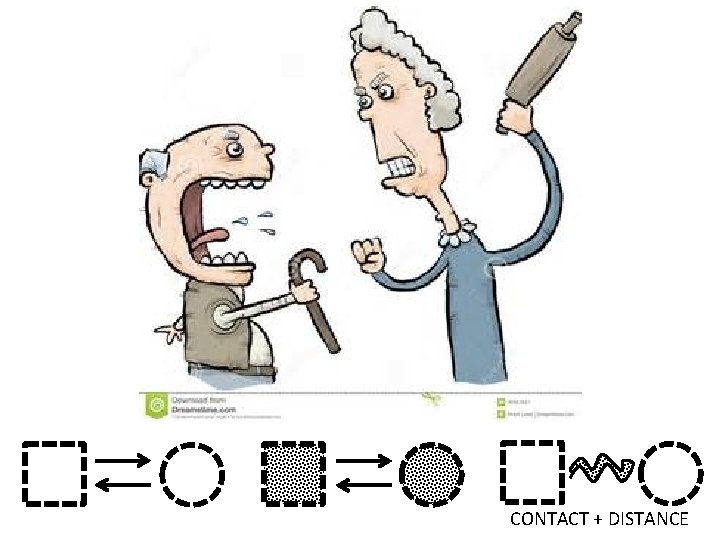
CONTACT + DISTANCE
Anchored in the Emotional System Plus subjective feeling states & Psychological factors
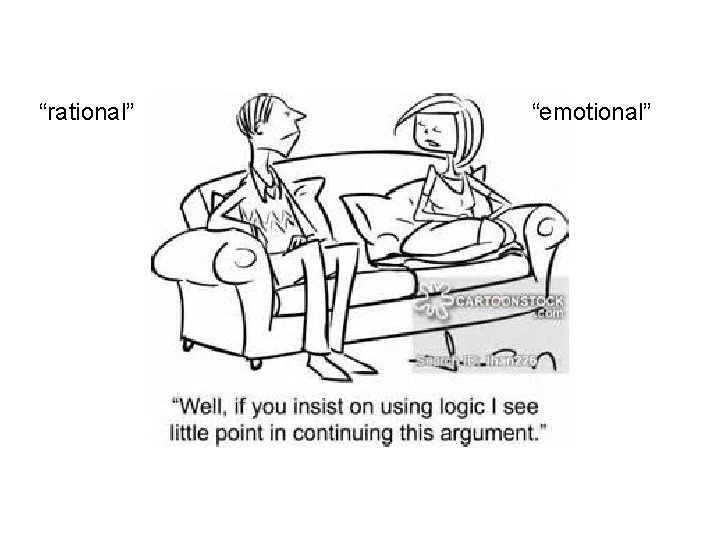
“rational” “emotional”
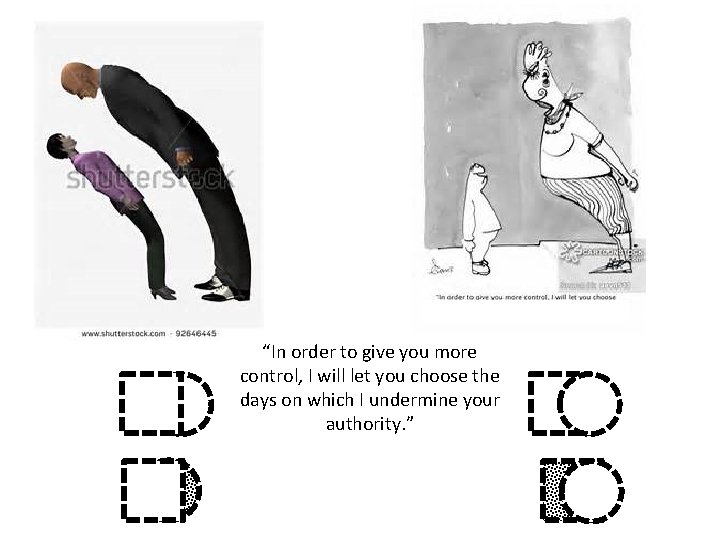
“In order to give you more control, I will let you choose the days on which I undermine your authority. ”
Anchored in the Emotional System Plus subjective feeling states & Psychological factors
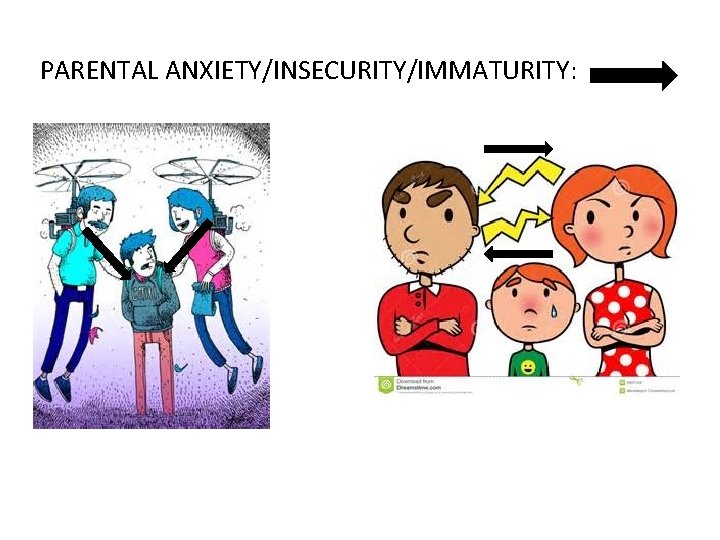
PARENTAL ANXIETY/INSECURITY/IMMATURITY:
Flo, Flint, and Dr. Goodall Baboon mother’s position in the social hierarchy affects degree of overprotectiveness. Yerkes research demonstrating that a gorilla mother’s rejection of an offspring symptomatic of her social isolation.
“Emotions, acting through the brain, can affect nervous system function, hormone levels, and immunological responses, thereby changing a person’s susceptibility to a host of organic ills. ” Sir William Osler (1849 -1919) “Father of Modern Medicine”
A mountain of research has confirmed this idea of a mind-body connection since Osler’s time. This is not to say that relationships and a person’s particular position in a relationship system cause illness. Disturbances in relationships and a person’s position in a system render that person more vulnerable to physical, mental, or social symptoms, but many other factors play important roles in whether or not someone develops an illness; e. g. , genetic predispositions, but genetic predispositions by themselves are usually not causal either.
- Slides: 74