
Core Curriculum Review HIV Jason M Leider M







- Slides: 83
Core Curriculum Review: HIV Jason M. Leider, M. D. , Ph. D. NBHN Associate Medical Director of HIV Services Associate Professor of Internal Medicine, AECOM
Occupational Bloodborne Exposures focus on HIV • HIV, HBV, HCV are the primary agents – Risk of infection: • HBV = 27 -47% • HCV = 1. 9% (range 0%-22%) • HIV = 0. 32% • HIV PEP: based on in vitro evidence, maternalfetal transmission studies, retrospective casecontrol studies of occup HIV infxn & recent clinical experience • PEP is based on type of exposure (hollow-bore needles), depth of penetration, type of host
HIV pathogenesis • High replication rate (even during asymptomatic early phase) • High mutation rate: abilty to generate mutiple quasi-species
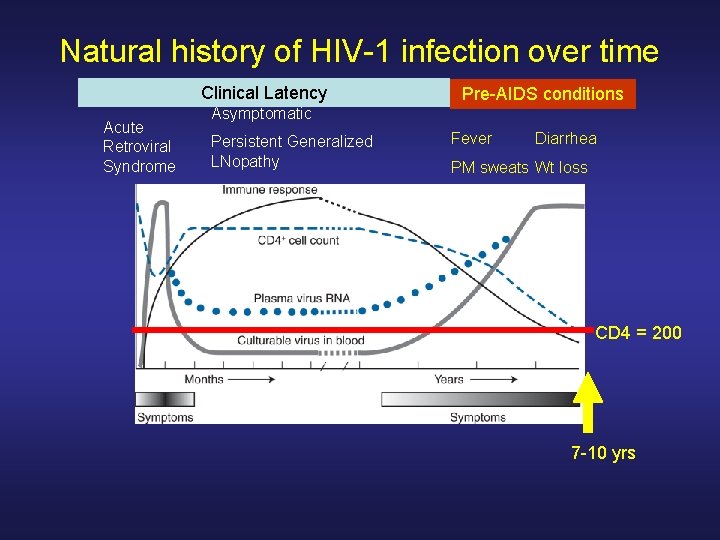
Natural history of HIV-1 infection over time Clinical Latency Acute Retroviral Syndrome Pre-AIDS conditions Asymptomatic Persistent Generalized LNopathy Fever Diarrhea PM sweats Wt loss CD 4 = 200 7 -10 yrs
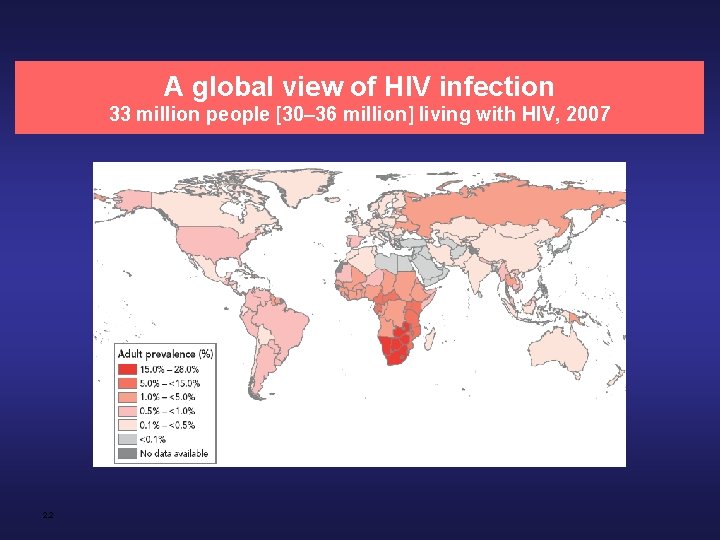
A global view of HIV infection 33 million people [30– 36 million] living with HIV, 2007 2. 2
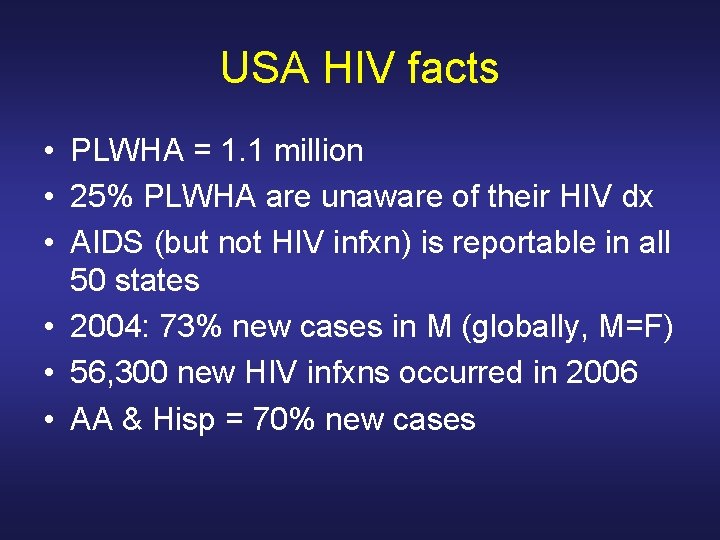
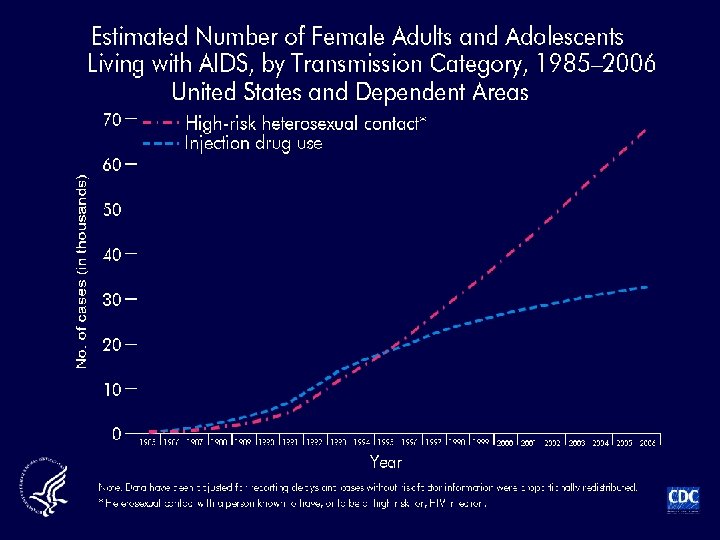
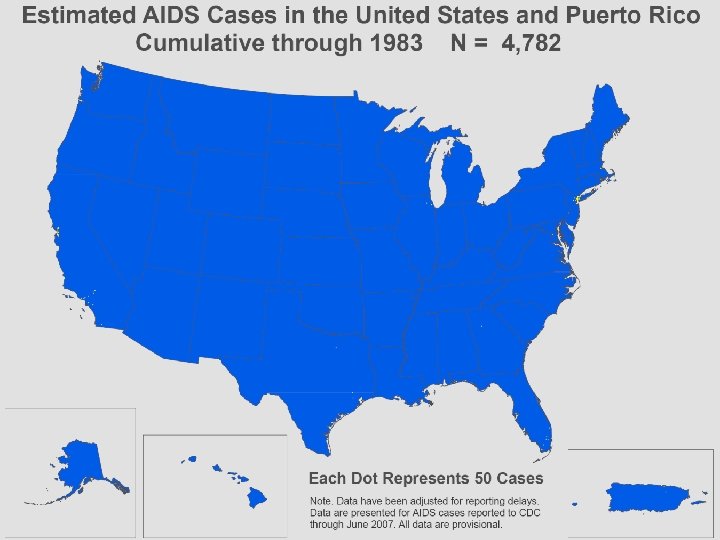
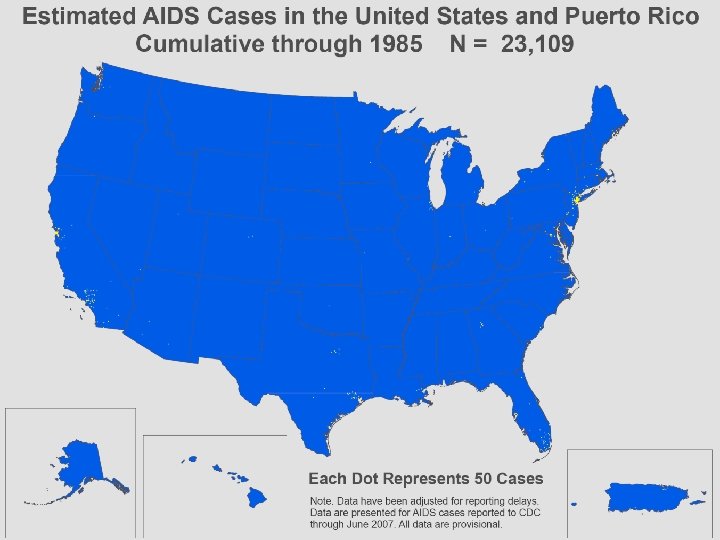
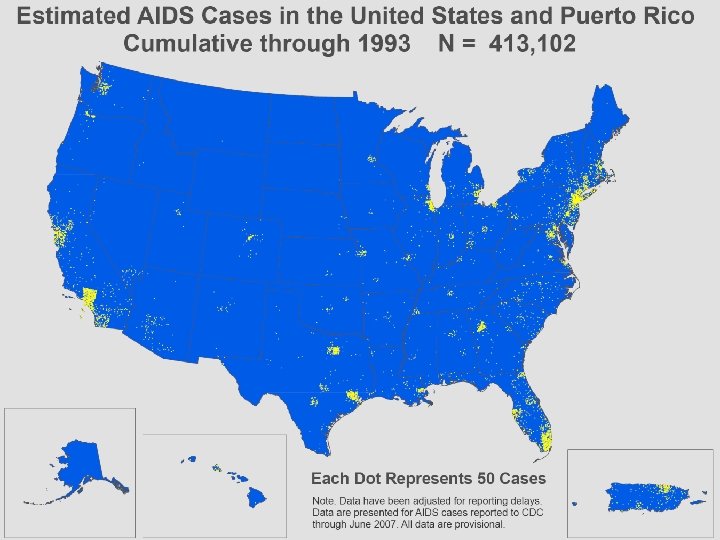
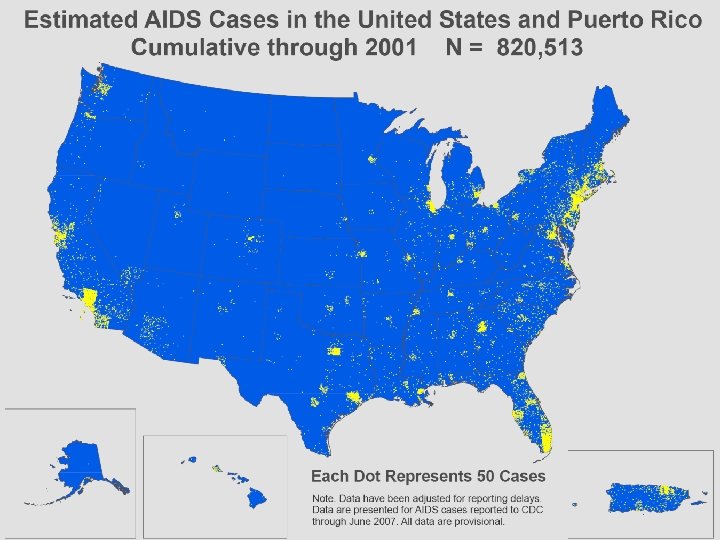
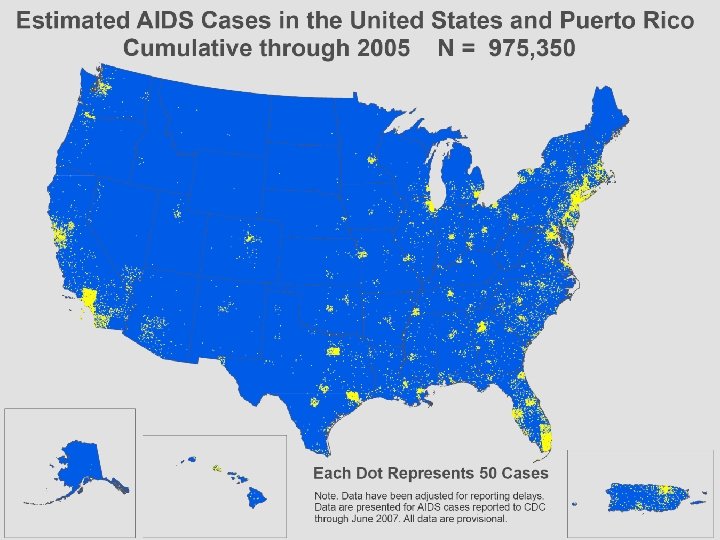
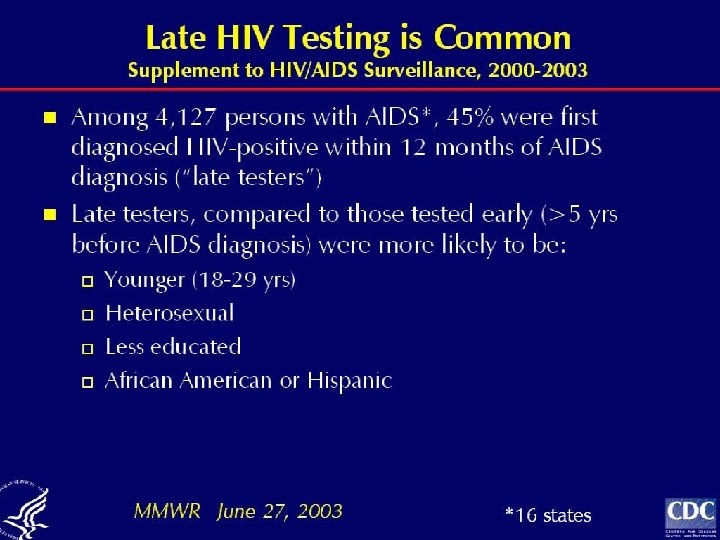
USA HIV facts • PLWHA = 1. 1 million • 25% PLWHA are unaware of their HIV dx • AIDS (but not HIV infxn) is reportable in all 50 states • 2004: 73% new cases in M (globally, M=F) • 56, 300 new HIV infxns occurred in 2006 • AA & Hisp = 70% new cases
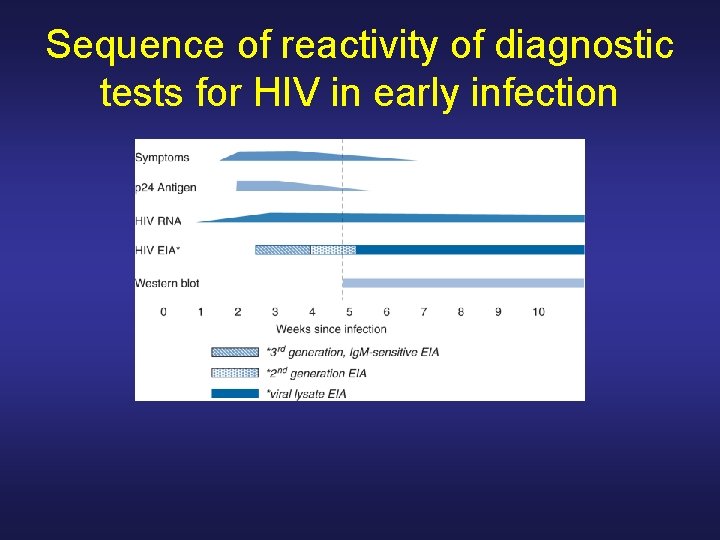
Sequence of reactivity of diagnostic tests for HIV in early infection
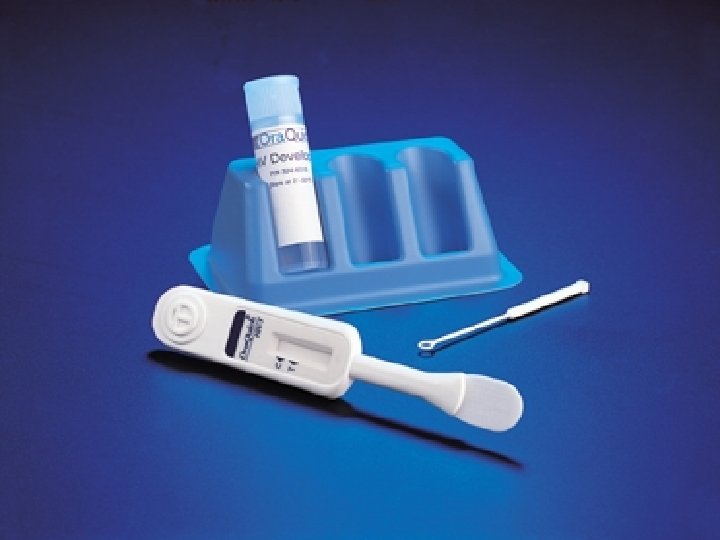
Rapid HIV tests • Results in < 20 min • Oral or blood tests • Sensitivity & specificity > 99% (similar to conventional HIV enzyme immunosorbent tests
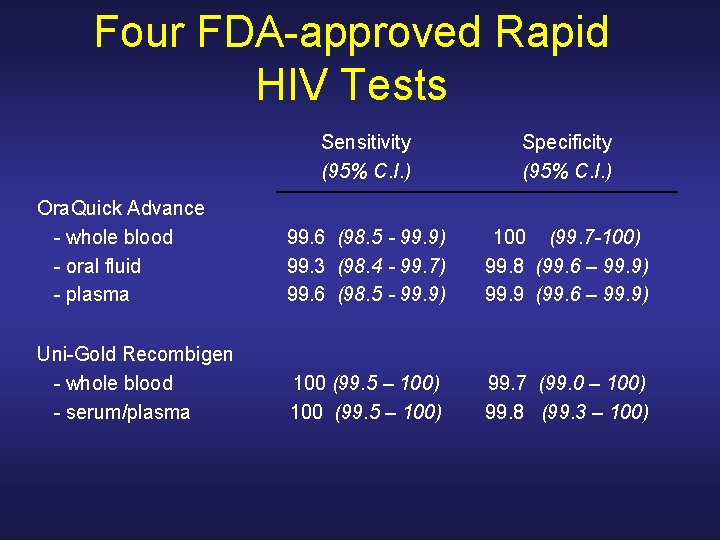
Four FDA-approved Rapid HIV Tests Sensitivity (95% C. I. ) Specificity (95% C. I. ) Ora. Quick Advance - whole blood - oral fluid - plasma 99. 6 (98. 5 - 99. 9) 99. 3 (98. 4 - 99. 7) 99. 6 (98. 5 - 99. 9) 100 (99. 7 -100) 99. 8 (99. 6 – 99. 9) 99. 9 (99. 6 – 99. 9) Uni-Gold Recombigen - whole blood - serum/plasma 100 (99. 5 – 100) 99. 7 (99. 0 – 100) 99. 8 (99. 3 – 100)
US Public Health Service algorithm for serologic diagnosis of HIV-1/HIV-2 infection.
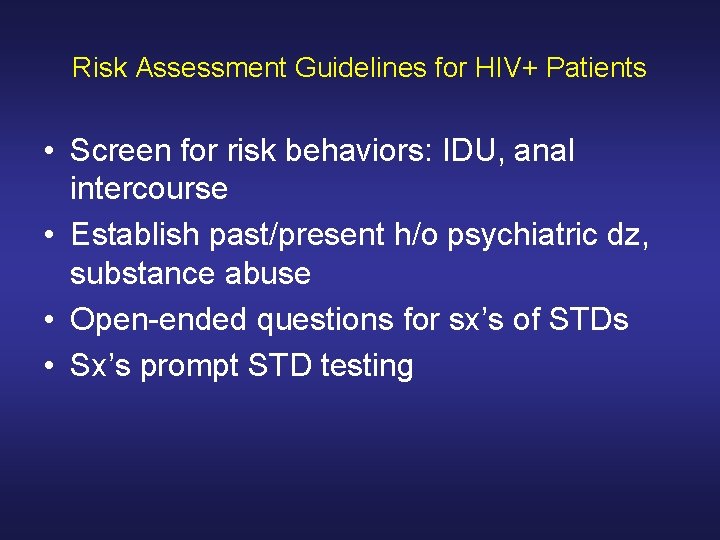
Risk Assessment Guidelines for HIV+ Patients • Screen for risk behaviors: IDU, anal intercourse • Establish past/present h/o psychiatric dz, substance abuse • Open-ended questions for sx’s of STDs • Sx’s prompt STD testing
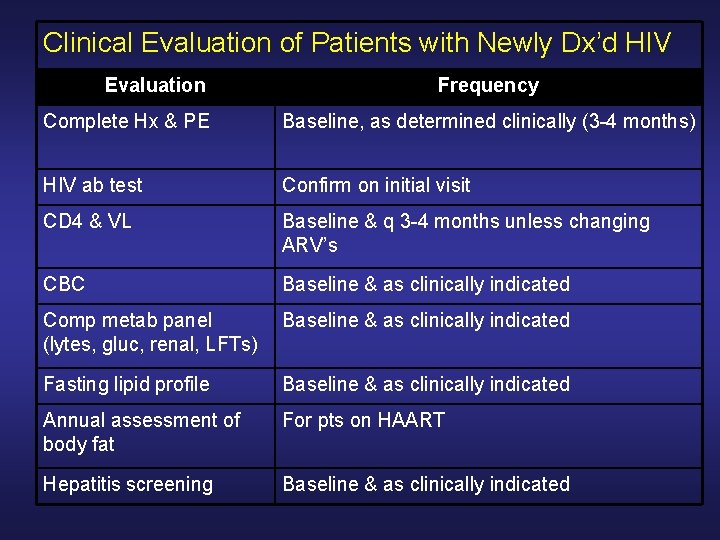
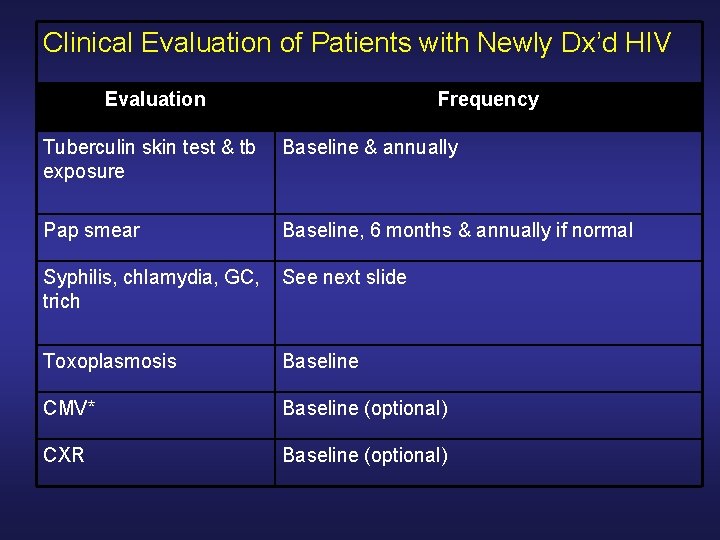
Clinical Evaluation of Patients with Newly Dx’d HIV Evaluation Frequency Complete Hx & PE Baseline, as determined clinically (3 -4 months) HIV ab test Confirm on initial visit CD 4 & VL Baseline & q 3 -4 months unless changing ARV’s CBC Baseline & as clinically indicated Comp metab panel (lytes, gluc, renal, LFTs) Baseline & as clinically indicated Fasting lipid profile Baseline & as clinically indicated Annual assessment of body fat For pts on HAART Hepatitis screening Baseline & as clinically indicated
Clinical Evaluation of Patients with Newly Dx’d HIV Evaluation Frequency Tuberculin skin test & tb Baseline & annually exposure Pap smear Baseline, 6 months & annually if normal Syphilis, chlamydia, GC, See next slide trich Toxoplasmosis Baseline CMV* Baseline (optional) CXR Baseline (optional)
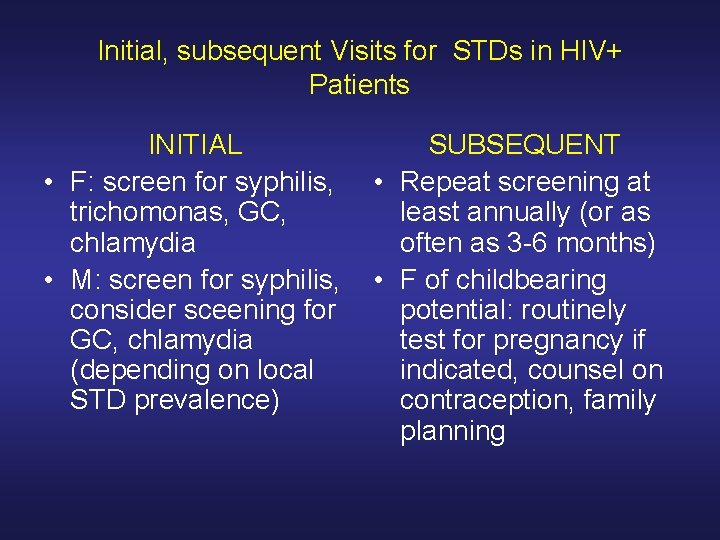
Initial, subsequent Visits for STDs in HIV+ Patients INITIAL SUBSEQUENT • F: screen for syphilis, • Repeat screening at trichomonas, GC, least annually (or as chlamydia often as 3 -6 months) • M: screen for syphilis, • F of childbearing consider sceening for potential: routinely GC, chlamydia test for pregnancy if (depending on local indicated, counsel on STD prevalence) contraception, family planning
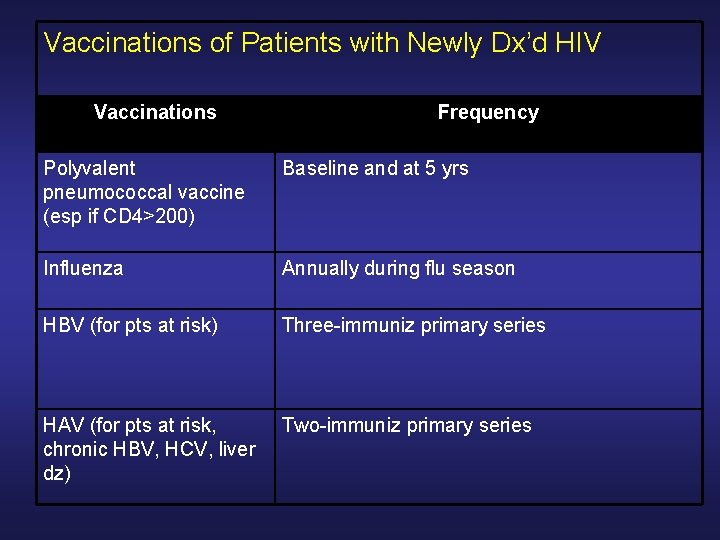
Vaccinations of Patients with Newly Dx’d HIV Vaccinations Frequency Polyvalent pneumococcal vaccine (esp if CD 4>200) Baseline and at 5 yrs Influenza Annually during flu season HBV (for pts at risk) Three-immuniz primary series HAV (for pts at risk, chronic HBV, HCV, liver dz) Two-immuniz primary series
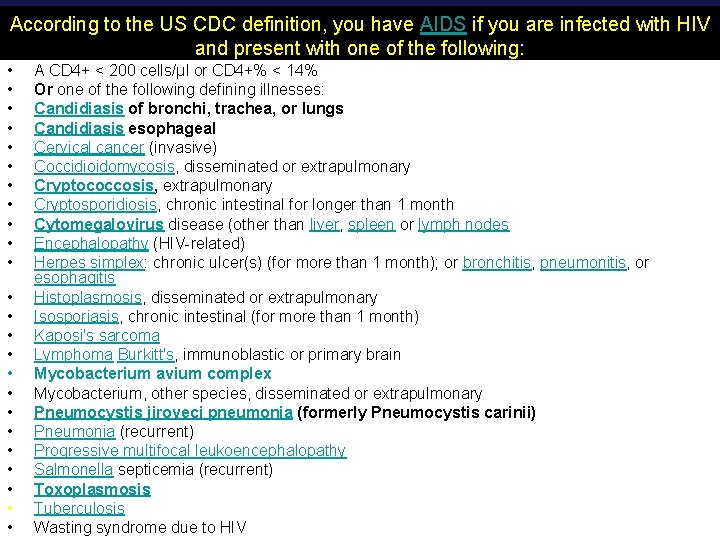
According to the US CDC definition, you have AIDS if you are infected with HIV and present with one of the following: • • • • • • A CD 4+ < 200 cells/µl or CD 4+% < 14% Or one of the following defining illnesses: Candidiasis of bronchi, trachea, or lungs Candidiasis esophageal Cervical cancer (invasive) Coccidioidomycosis, disseminated or extrapulmonary Cryptococcosis, extrapulmonary Cryptosporidiosis, chronic intestinal for longer than 1 month Cytomegalovirus disease (other than liver, spleen or lymph nodes Encephalopathy (HIV-related) Herpes simplex: chronic ulcer(s) (for more than 1 month); or bronchitis, pneumonitis, or esophagitis Histoplasmosis, disseminated or extrapulmonary Isosporiasis, chronic intestinal (for more than 1 month) Kaposi's sarcoma Lymphoma Burkitt's, immunoblastic or primary brain Mycobacterium avium complex Mycobacterium, other species, disseminated or extrapulmonary Pneumocystis jiroveci pneumonia (formerly Pneumocystis carinii) Pneumonia (recurrent) Progressive multifocal leukoencephalopathy Salmonella septicemia (recurrent) Toxoplasmosis of the brain Tuberculosis Wasting syndrome due to HIV
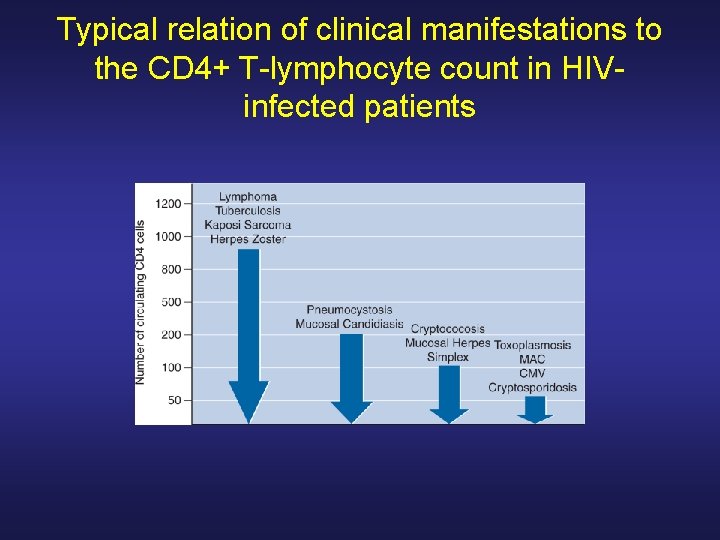
Typical relation of clinical manifestations to the CD 4+ T-lymphocyte count in HIVinfected patients
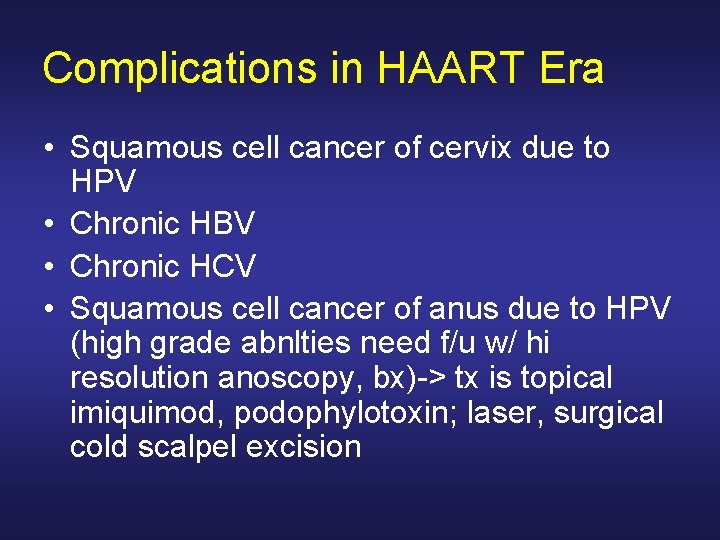
Complications in HAART Era • Squamous cell cancer of cervix due to HPV • Chronic HBV • Chronic HCV • Squamous cell cancer of anus due to HPV (high grade abnlties need f/u w/ hi resolution anoscopy, bx)-> tx is topical imiquimod, podophylotoxin; laser, surgical cold scalpel excision
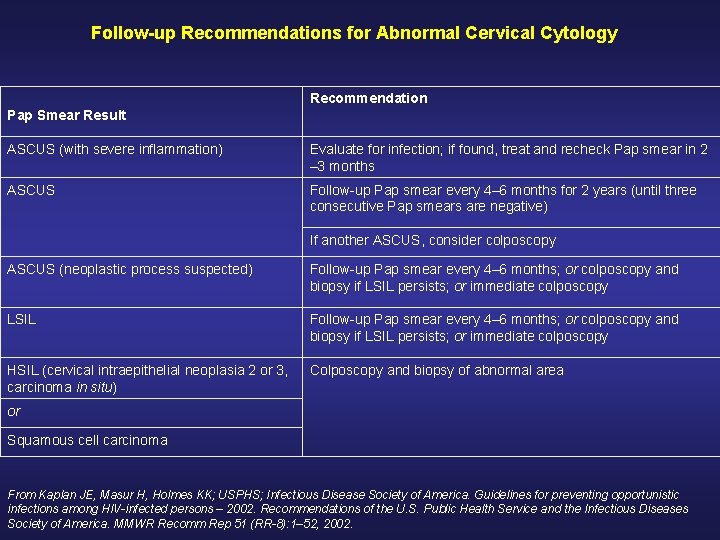
Follow-up Recommendations for Abnormal Cervical Cytology Recommendation Pap Smear Result ASCUS (with severe inflammation) Evaluate for infection; if found, treat and recheck Pap smear in 2 – 3 months ASCUS Follow-up Pap smear every 4– 6 months for 2 years (until three consecutive Pap smears are negative) If another ASCUS, consider colposcopy ASCUS (neoplastic process suspected) Follow-up Pap smear every 4– 6 months; or colposcopy and biopsy if LSIL persists; or immediate colposcopy LSIL Follow-up Pap smear every 4– 6 months; or colposcopy and biopsy if LSIL persists; or immediate colposcopy HSIL (cervical intraepithelial neoplasia 2 or 3, carcinoma in situ) Colposcopy and biopsy of abnormal area or Squamous cell carcinoma From Kaplan JE, Masur H, Holmes KK; USPHS; Infectious Disease Society of America. Guidelines for preventing opportunistic infections among HIV-infected persons – 2002. Recommendations of the U. S. Public Health Service and the Infectious Diseases Society of America. MMWR Recomm Rep 51 (RR-8): 1– 52, 2002.
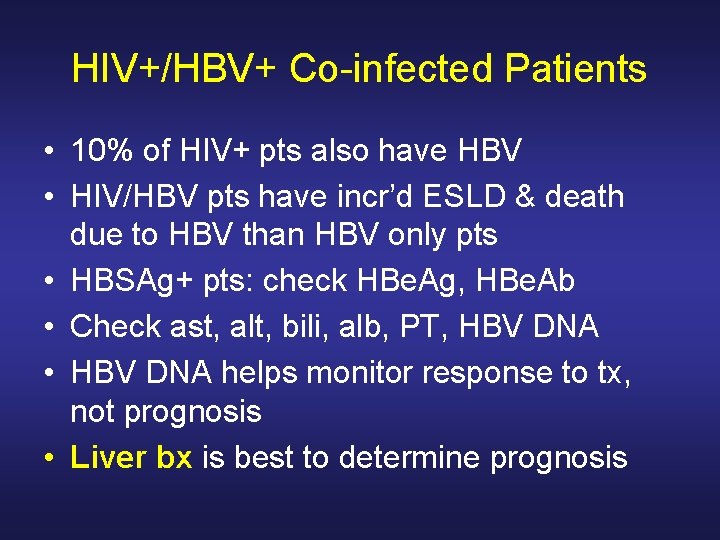
HIV+/HBV+ Co-infected Patients • 10% of HIV+ pts also have HBV • HIV/HBV pts have incr’d ESLD & death due to HBV than HBV only pts • HBSAg+ pts: check HBe. Ag, HBe. Ab • Check ast, alt, bili, alb, PT, HBV DNA • HBV DNA helps monitor response to tx, not prognosis • Liver bx is best to determine prognosis
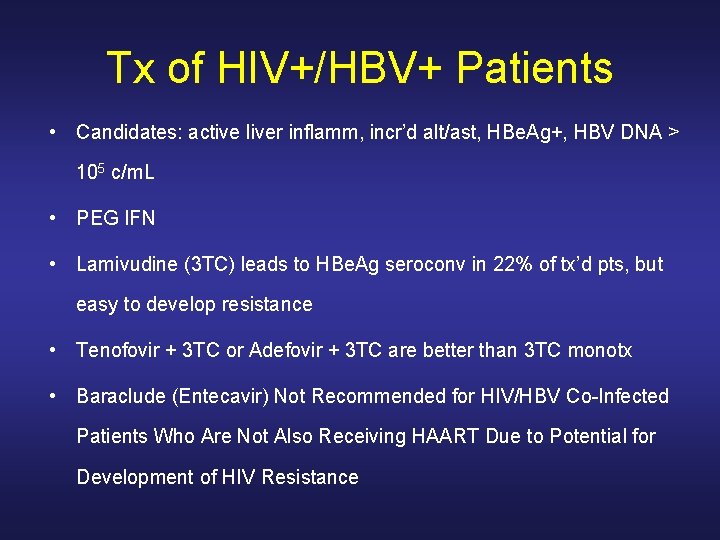
Tx of HIV+/HBV+ Patients • Candidates: active liver inflamm, incr’d alt/ast, HBe. Ag+, HBV DNA > 105 c/m. L • PEG IFN • Lamivudine (3 TC) leads to HBe. Ag seroconv in 22% of tx’d pts, but easy to develop resistance • Tenofovir + 3 TC or Adefovir + 3 TC are better than 3 TC monotx • Baraclude (Entecavir) Not Recommended for HIV/HBV Co-Infected Patients Who Are Not Also Receiving HAART Due to Potential for Development of HIV Resistance
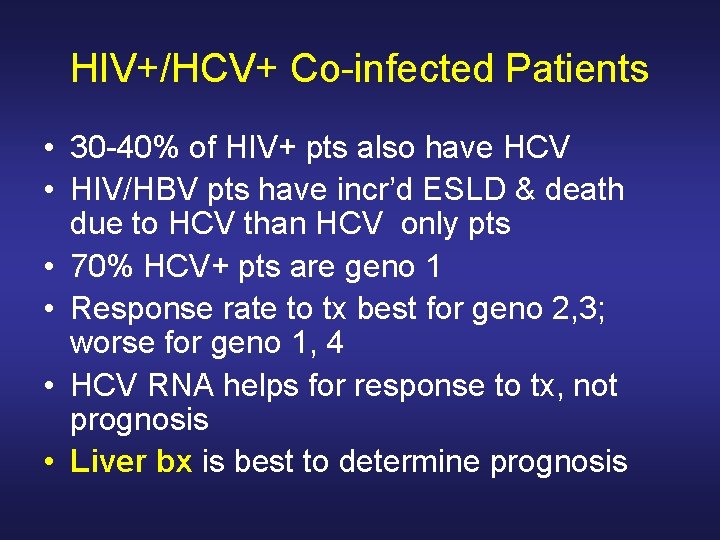
HIV+/HCV+ Co-infected Patients • 30 -40% of HIV+ pts also have HCV • HIV/HBV pts have incr’d ESLD & death due to HCV than HCV only pts • 70% HCV+ pts are geno 1 • Response rate to tx best for geno 2, 3; worse for geno 1, 4 • HCV RNA helps for response to tx, not prognosis • Liver bx is best to determine prognosis
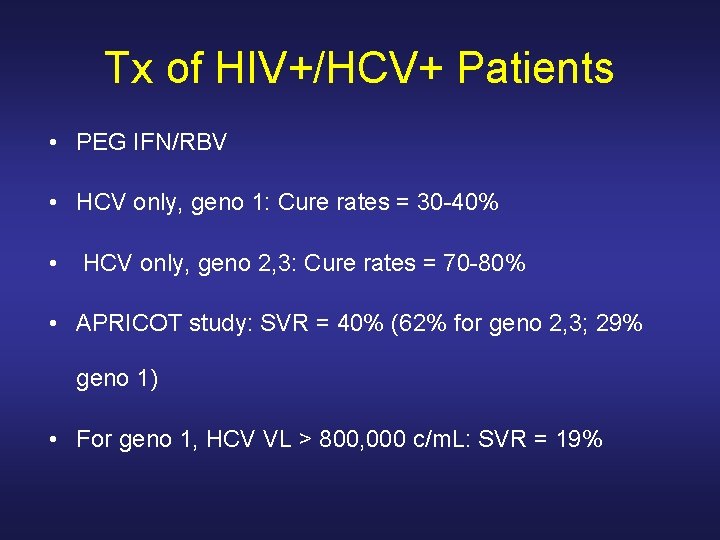
Tx of HIV+/HCV+ Patients • PEG IFN/RBV • HCV only, geno 1: Cure rates = 30 -40% • HCV only, geno 2, 3: Cure rates = 70 -80% • APRICOT study: SVR = 40% (62% for geno 2, 3; 29% geno 1) • For geno 1, HCV VL > 800, 000 c/m. L: SVR = 19%
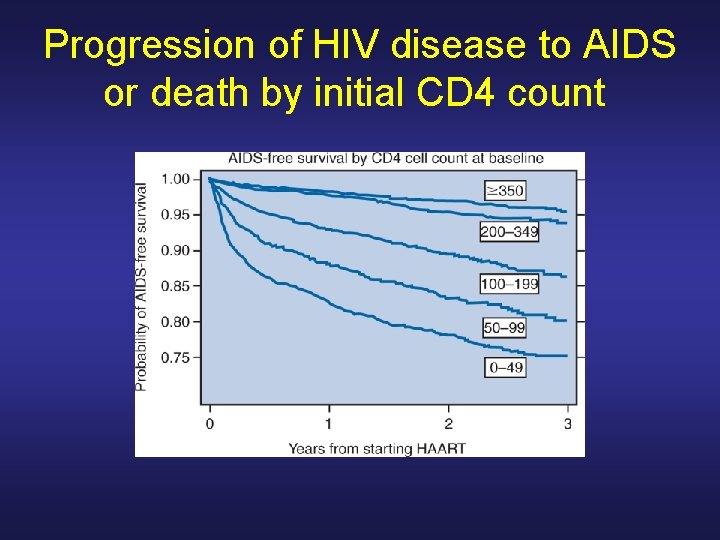
Progression of HIV disease to AIDS or death by initial CD 4 count
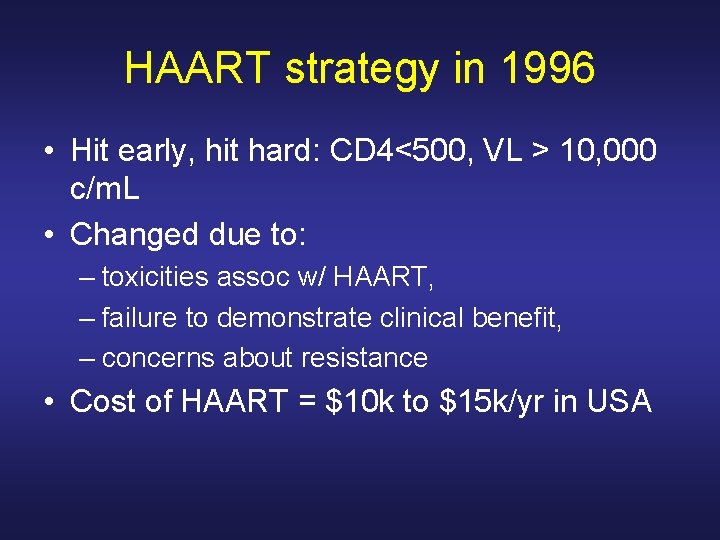
HAART strategy in 1996 • Hit early, hit hard: CD 4<500, VL > 10, 000 c/m. L • Changed due to: – toxicities assoc w/ HAART, – failure to demonstrate clinical benefit, – concerns about resistance • Cost of HAART = $10 k to $15 k/yr in USA
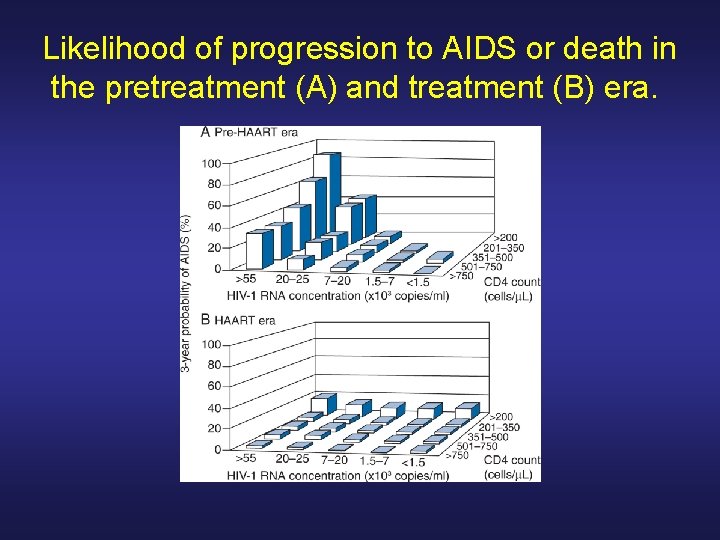
Likelihood of progression to AIDS or death in the pretreatment (A) and treatment (B) era.
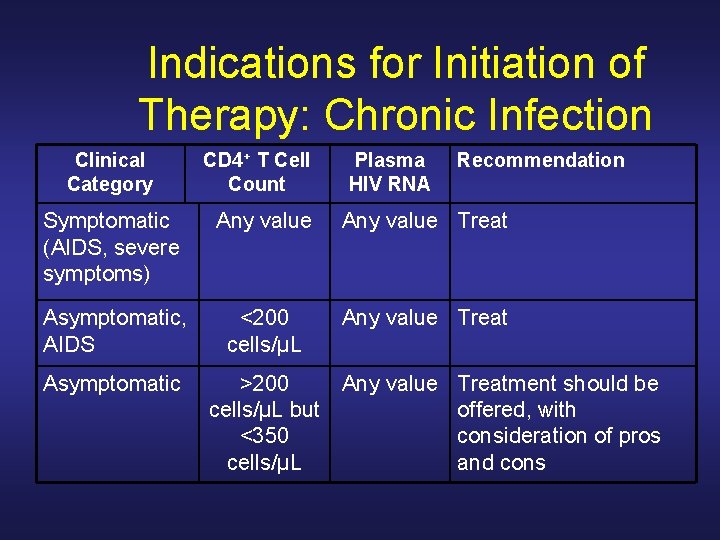
Indications for Initiation of Therapy: Chronic Infection Clinical Category CD 4+ T Cell Count Plasma HIV RNA Recommendation Symptomatic (AIDS, severe symptoms) Any value Treat Asymptomatic, AIDS <200 cells/µL Any value Treat Asymptomatic >200 Any value Treatment should be cells/µL but offered, with <350 consideration of pros cells/µL and cons
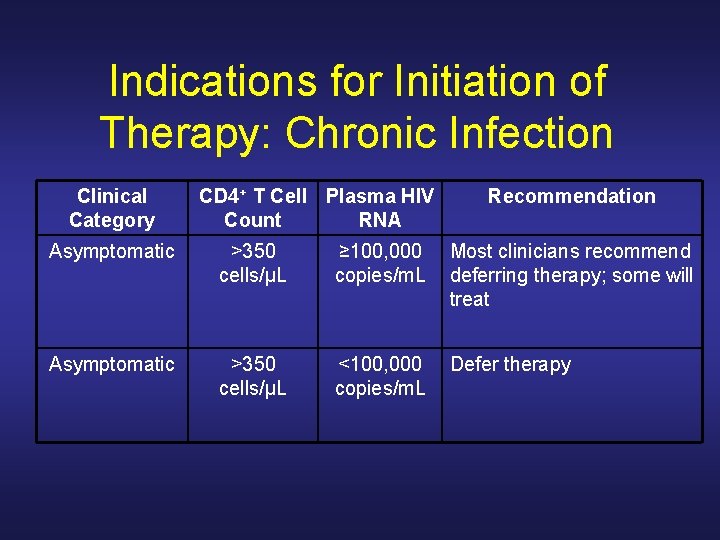
Indications for Initiation of Therapy: Chronic Infection Clinical Category CD 4+ T Cell Plasma HIV Count RNA Recommendation Asymptomatic >350 cells/µL ≥ 100, 000 Most clinicians recommend copies/m. L deferring therapy; some will treat Asymptomatic >350 cells/µL <100, 000 Defer therapy copies/m. L
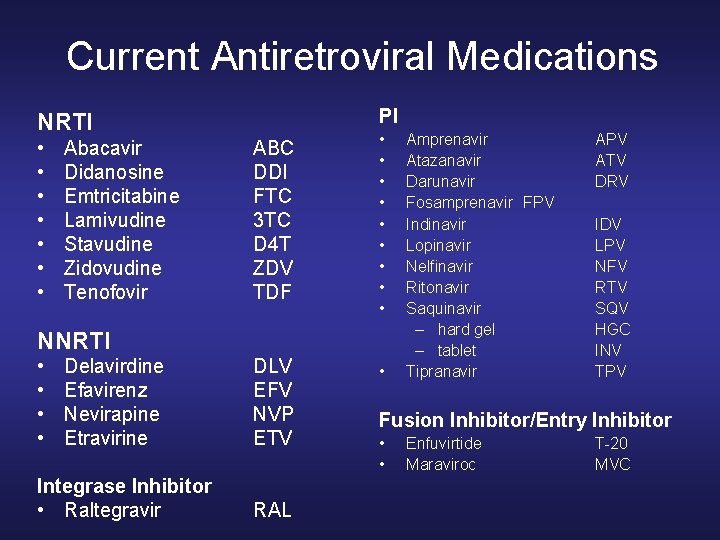
Current Antiretroviral Medications PI NRTI • • Abacavir Didanosine Emtricitabine Lamivudine Stavudine Zidovudine Tenofovir ABC DDI FTC 3 TC D 4 T ZDV TDF • • • DLV EFV NVP ETV • NNRTI • • Delavirdine Efavirenz Nevirapine Etravirine Integrase Inhibitor • Raltegravir RAL Amprenavir Atazanavir Darunavir Fosamprenavir FPV Indinavir Lopinavir Nelfinavir Ritonavir Saquinavir – hard gel – tablet Tipranavir APV ATV DRV IDV LPV NFV RTV SQV HGC INV TPV Fusion Inhibitor/Entry Inhibitor • • Enfuvirtide Maraviroc T-20 MVC
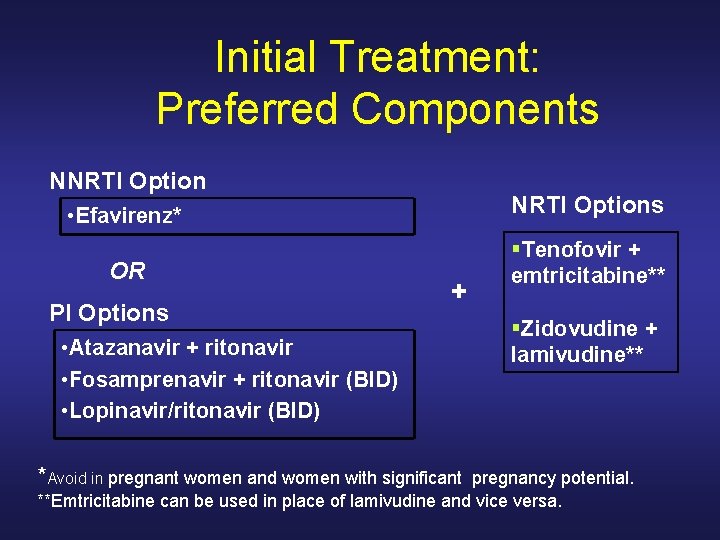
Initial Treatment: Preferred Components NNRTI Option • Efavirenz* NRTI Options OR §Tenofovir + emtricitabine** PI Options • Atazanavir + ritonavir • Fosamprenavir + ritonavir (BID) • Lopinavir/ritonavir (BID) + §Zidovudine + lamivudine** *Avoid in pregnant women and women with significant pregnancy potential. **Emtricitabine can be used in place of lamivudine and vice versa.
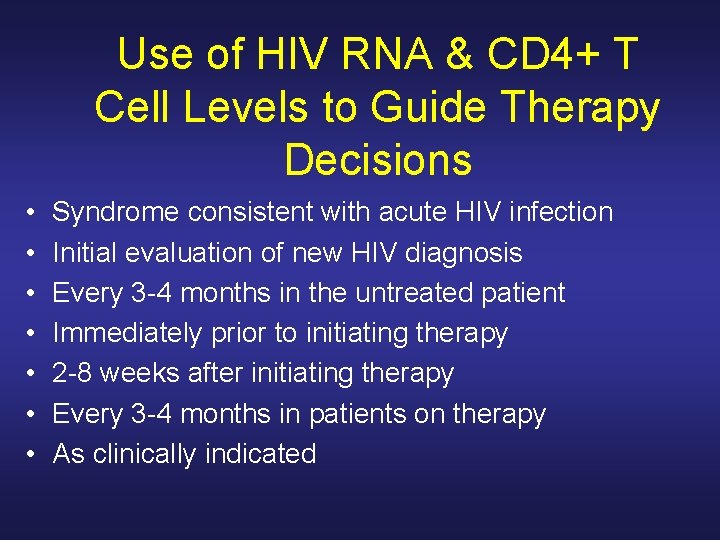
Use of HIV RNA & CD 4+ T Cell Levels to Guide Therapy Decisions • • Syndrome consistent with acute HIV infection Initial evaluation of new HIV diagnosis Every 3 -4 months in the untreated patient Immediately prior to initiating therapy 2 -8 weeks after initiating therapy Every 3 -4 months in patients on therapy As clinically indicated
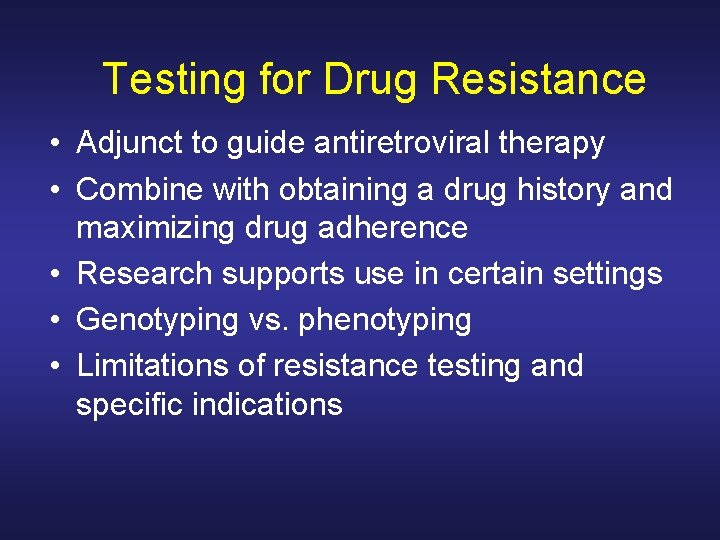
Testing for Drug Resistance • Adjunct to guide antiretroviral therapy • Combine with obtaining a drug history and maximizing drug adherence • Research supports use in certain settings • Genotyping vs. phenotyping • Limitations of resistance testing and specific indications
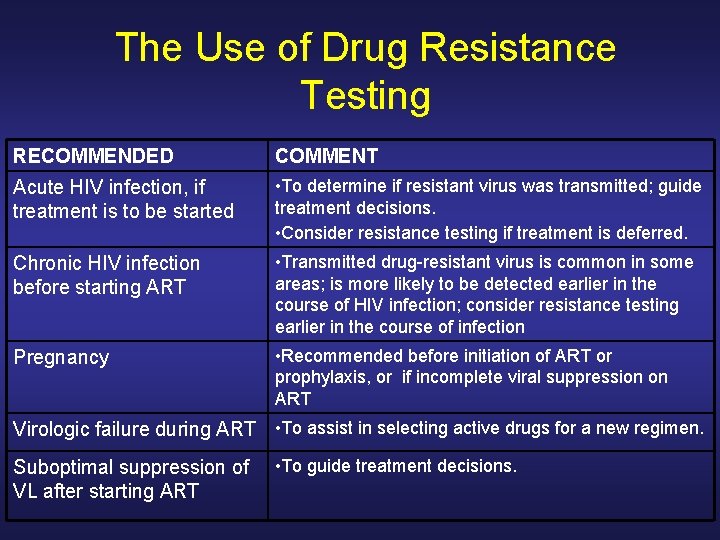
The Use of Drug Resistance Testing RECOMMENDED COMMENT Acute HIV infection, if treatment is to be started • To determine if resistant virus was transmitted; guide treatment decisions. • Consider resistance testing if treatment is deferred. Chronic HIV infection before starting ART • Transmitted drug-resistant virus is common in some areas; is more likely to be detected earlier in the course of HIV infection; consider resistance testing earlier in the course of infection Pregnancy • Recommended before initiation of ART or prophylaxis, or if incomplete viral suppression on ART Virologic failure during ART • To assist in selecting active drugs for a new regimen. Suboptimal suppression of VL after starting ART • To guide treatment decisions.
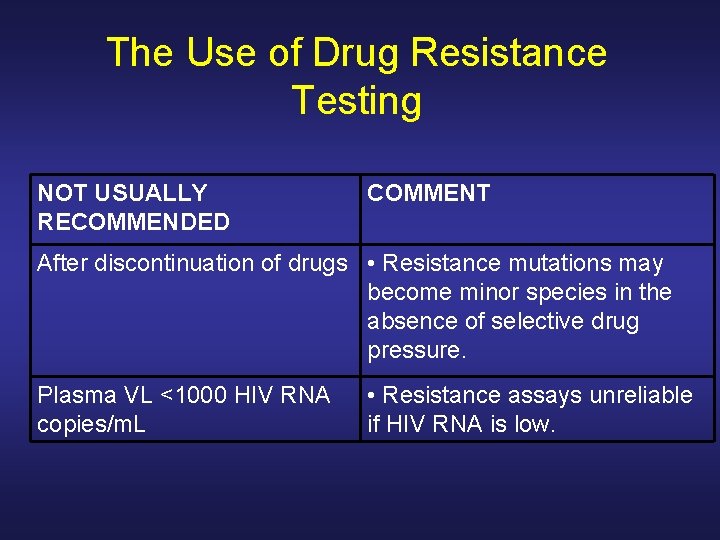
The Use of Drug Resistance Testing NOT USUALLY RECOMMENDED COMMENT After discontinuation of drugs • Resistance mutations may become minor species in the absence of selective drug pressure. Plasma VL <1000 HIV RNA copies/m. L • Resistance assays unreliable if HIV RNA is low.
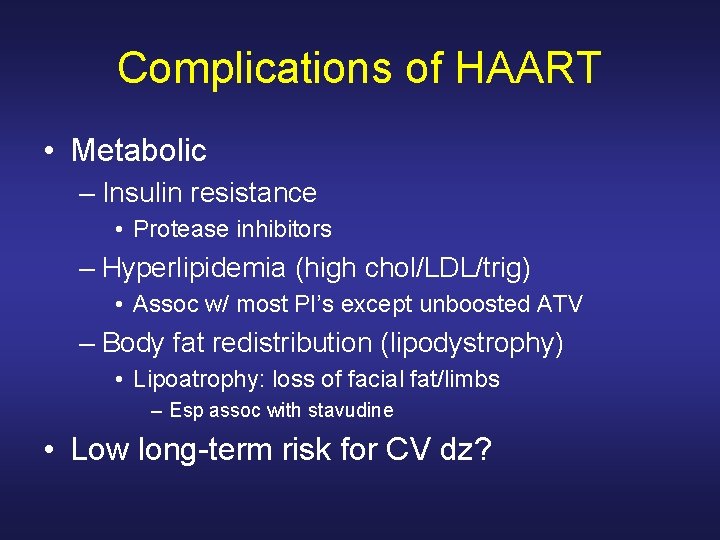
Complications of HAART • Metabolic – Insulin resistance • Protease inhibitors – Hyperlipidemia (high chol/LDL/trig) • Assoc w/ most PI’s except unboosted ATV – Body fat redistribution (lipodystrophy) • Lipoatrophy: loss of facial fat/limbs – Esp assoc with stavudine • Low long-term risk for CV dz?
Prognosis with HAART tx • HAART can: – Suppress viral replication – Permit adquate immune system recovery • Lasting concerns: – long-term adherence – SE mgmt (esp CV events) • HAART is not a cure (cannot eliminate long-lived T-cell population)
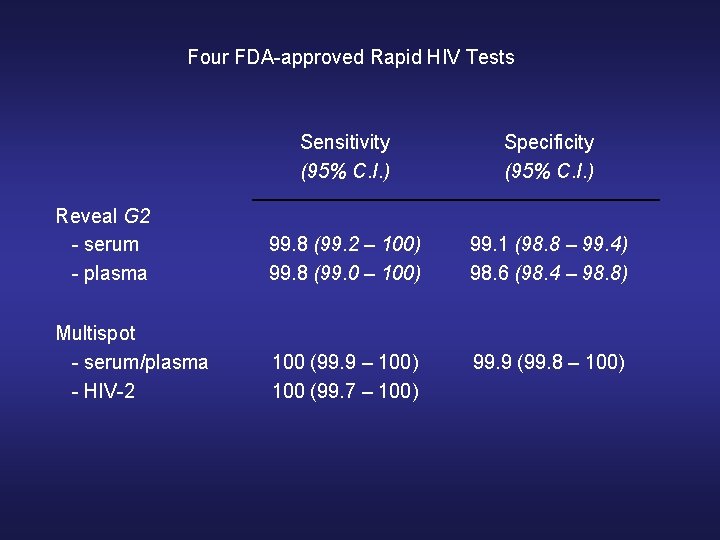
Four FDA-approved Rapid HIV Tests Sensitivity (95% C. I. ) Specificity (95% C. I. ) Reveal G 2 - serum - plasma 99. 8 (99. 2 – 100) 99. 8 (99. 0 – 100) 99. 1 (98. 8 – 99. 4) 98. 6 (98. 4 – 98. 8) Multispot - serum/plasma - HIV-2 100 (99. 9 – 100) 100 (99. 7 – 100) 99. 9 (99. 8 – 100)
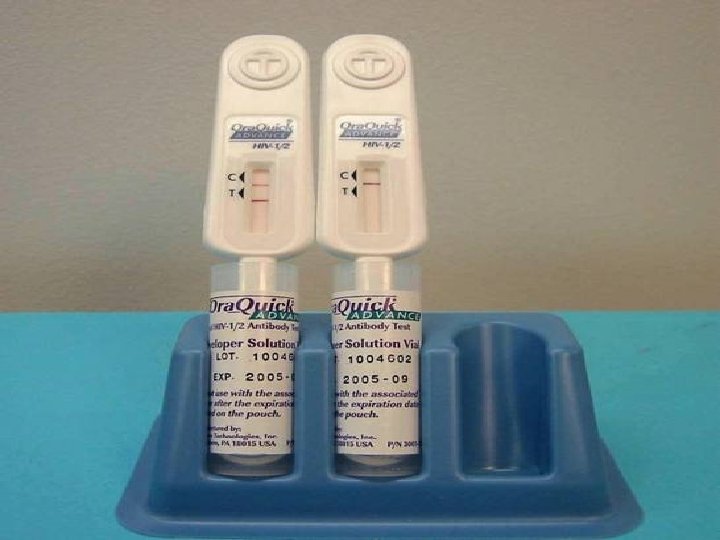
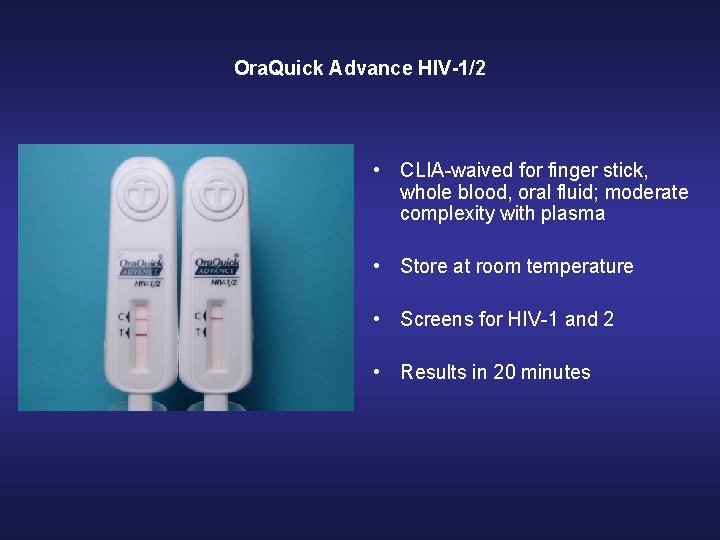
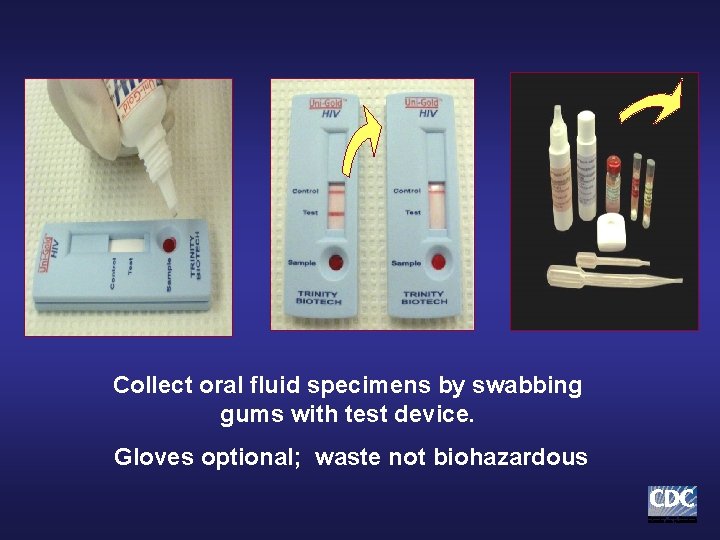
Ora. Quick Advance HIV-1/2 • CLIA-waived for finger stick, whole blood, oral fluid; moderate complexity with plasma • Store at room temperature • Screens for HIV-1 and 2 • Results in 20 minutes
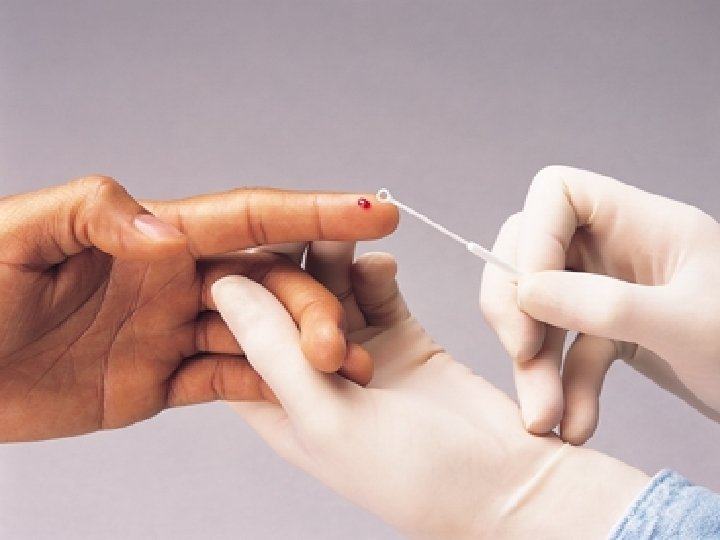
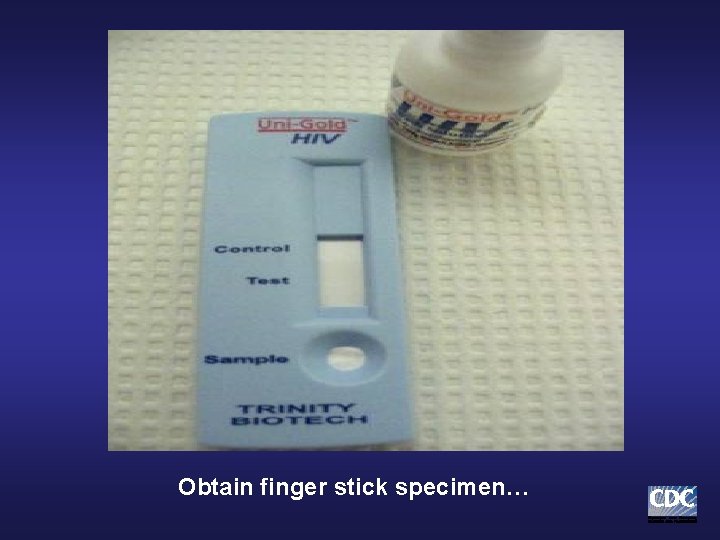
Obtain finger stick specimen…
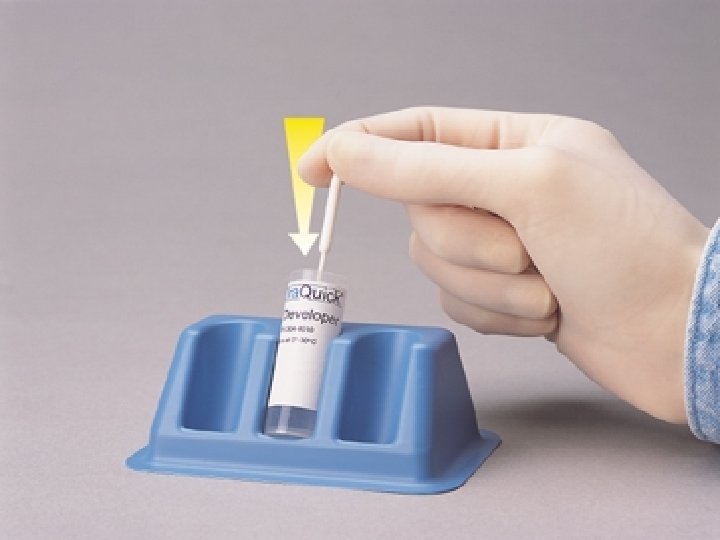
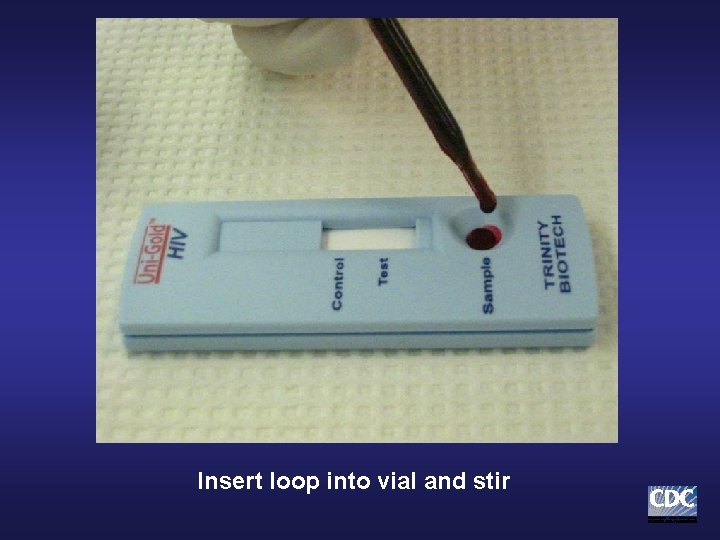
Insert loop into vial and stir
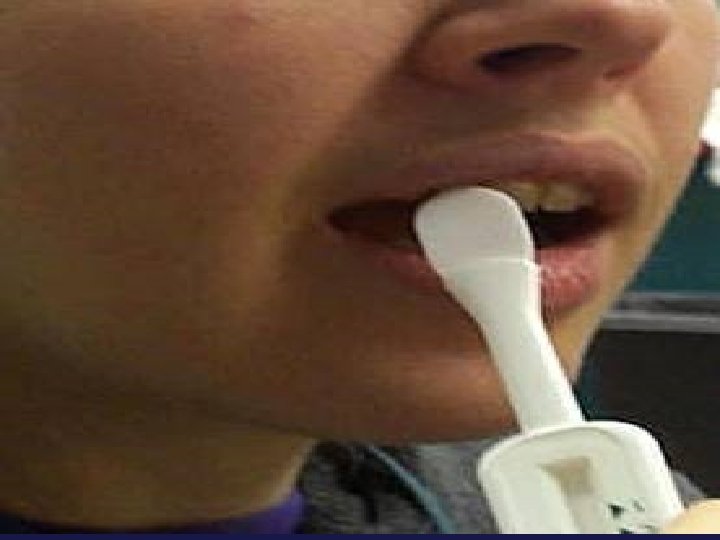
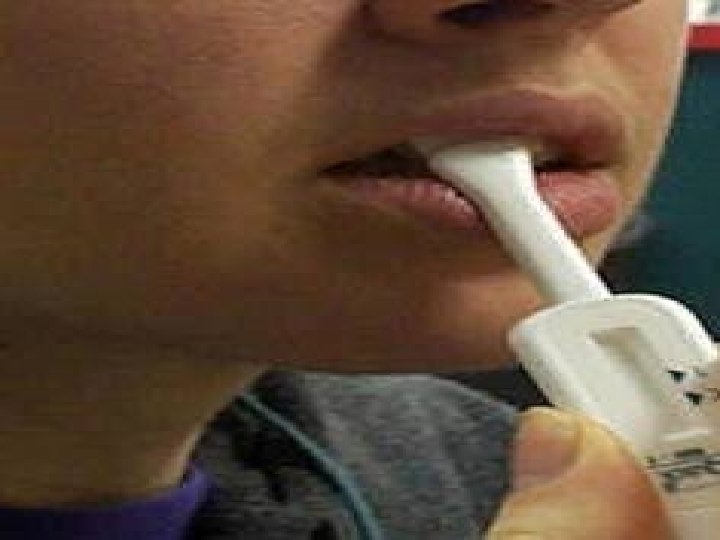
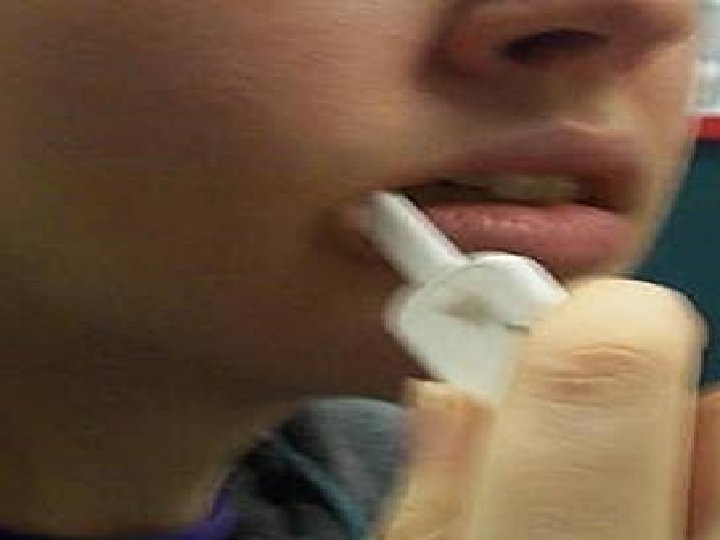
Collect oral fluid specimens by swabbing gums with test device. Gloves optional; waste not biohazardous
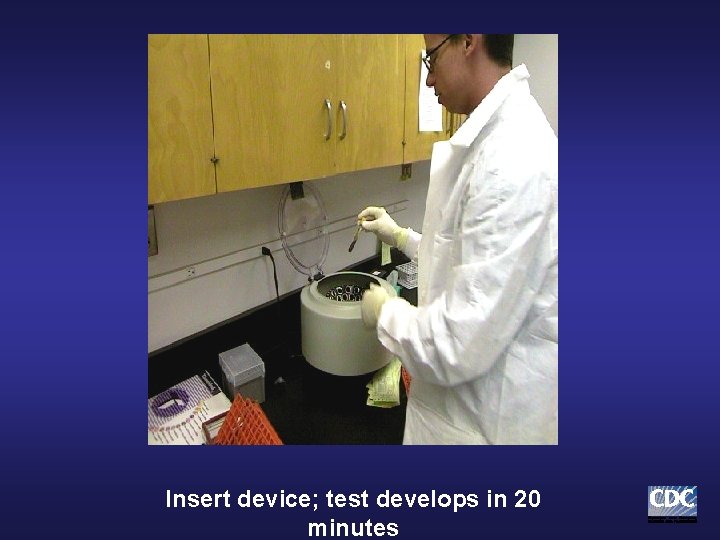
Insert device; test develops in 20 minutes
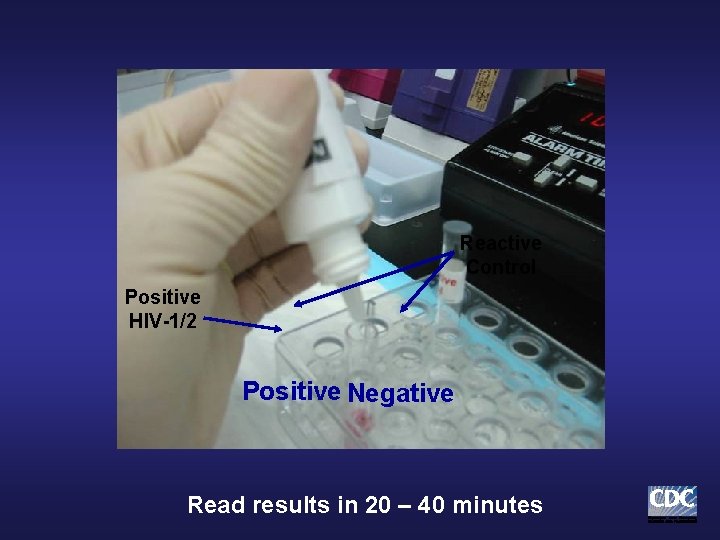
Reactive Control Positive HIV-1/2 Positive Negative Read results in 20 – 40 minutes
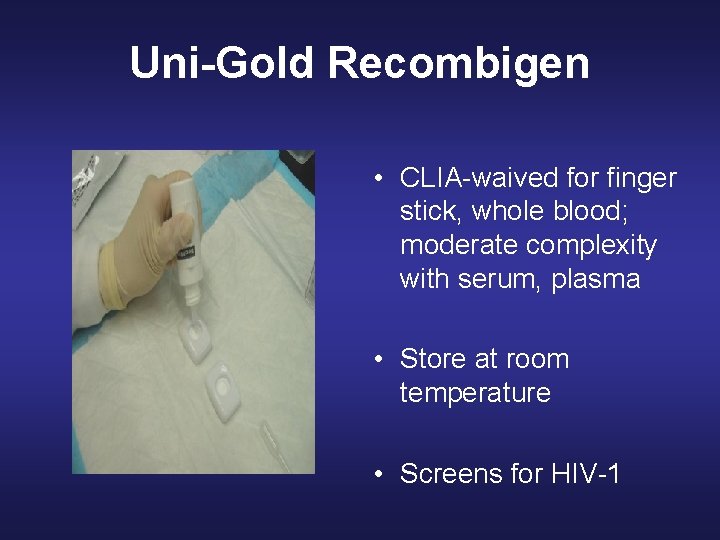
Uni-Gold Recombigen • CLIA-waived for finger stick, whole blood; moderate complexity with serum, plasma • Store at room temperature • Screens for HIV-1
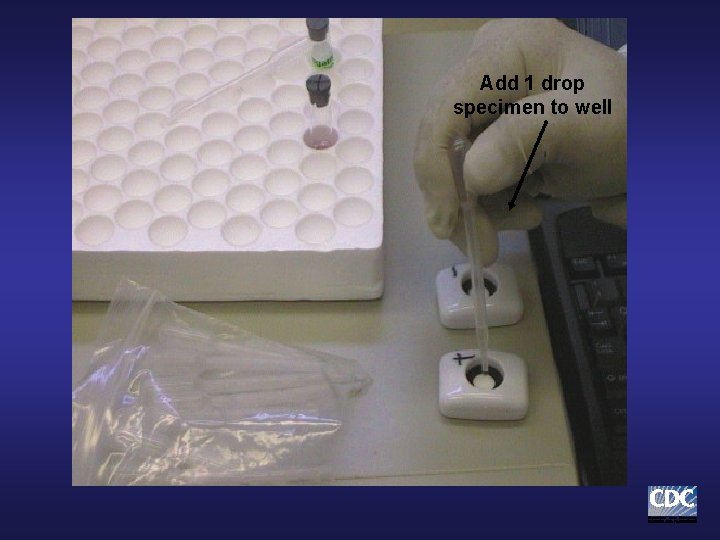
Add 1 drop specimen to well
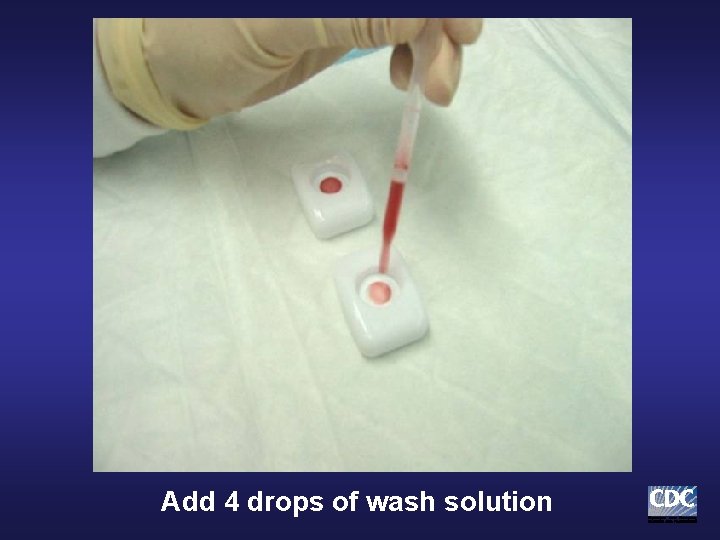
Add 4 drops of wash solution
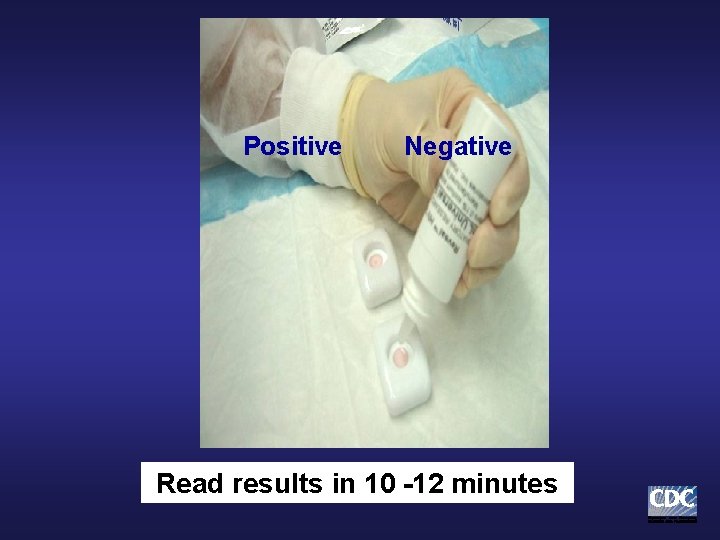
Positive Negative Read results in 10 -12 minutes
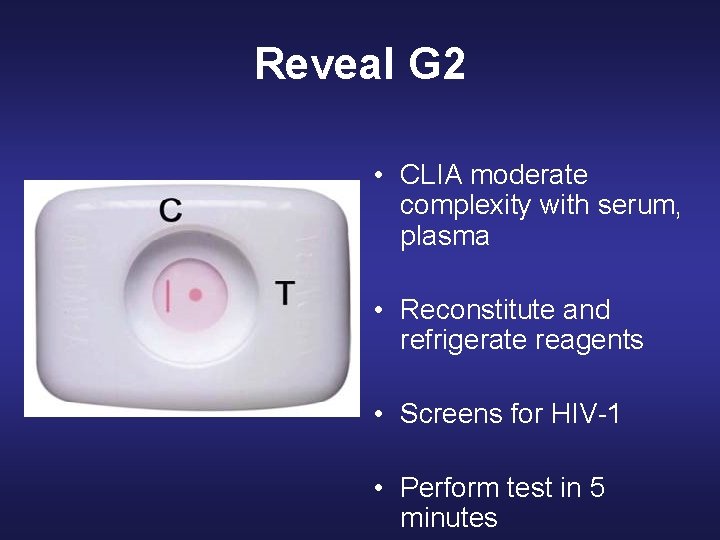
Reveal G 2 • CLIA moderate complexity with serum, plasma • Reconstitute and refrigerate reagents • Screens for HIV-1 • Perform test in 5 minutes
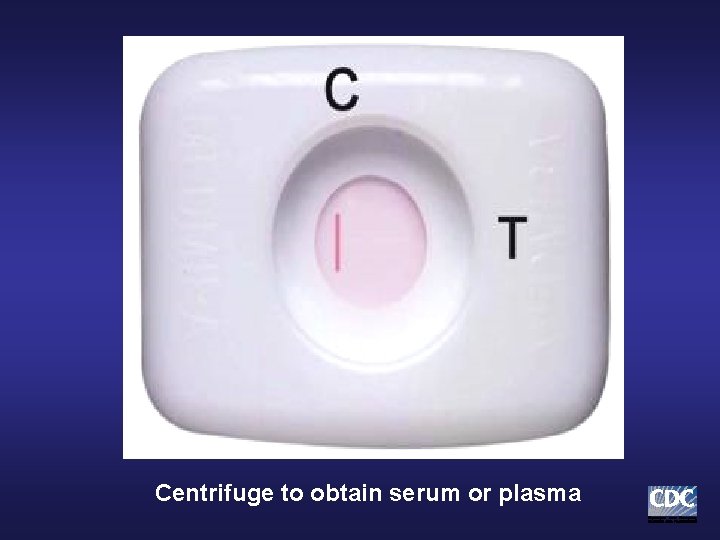
Centrifuge to obtain serum or plasma
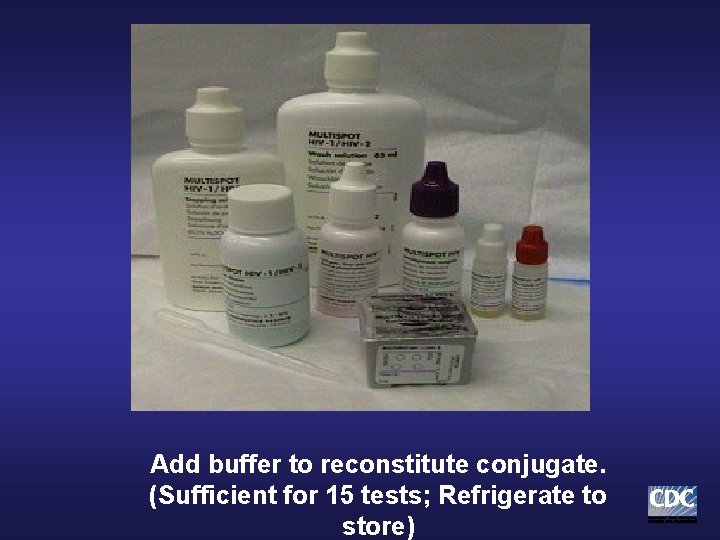
Add buffer to reconstitute conjugate. (Sufficient for 15 tests; Refrigerate to store)
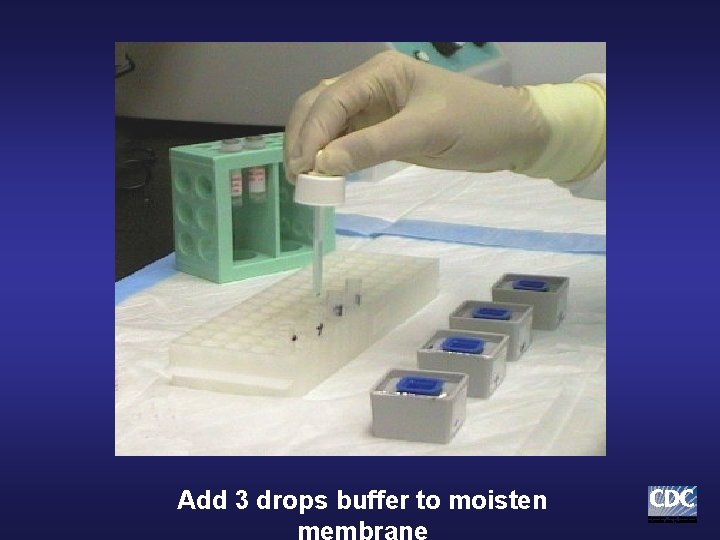
Add 3 drops buffer to moisten
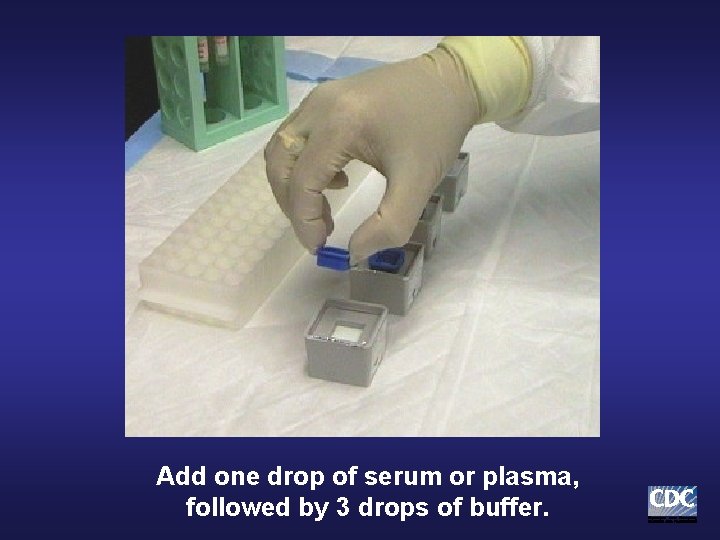
Add one drop of serum or plasma, followed by 3 drops of buffer.
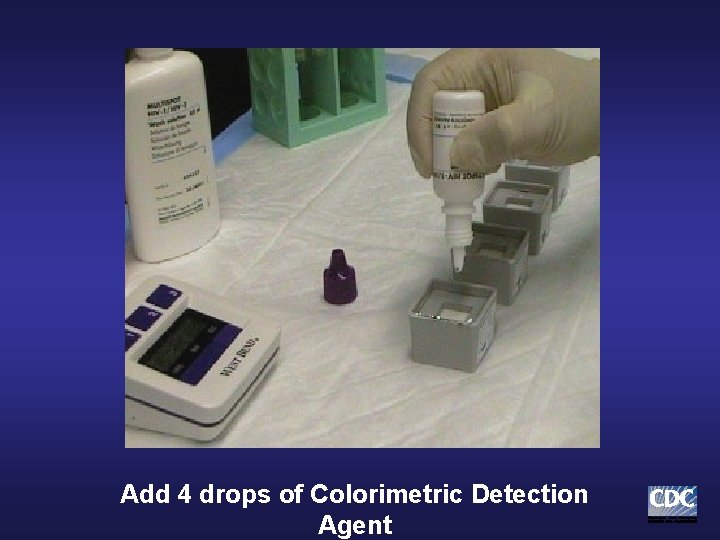
Add 4 drops of Colorimetric Detection Agent
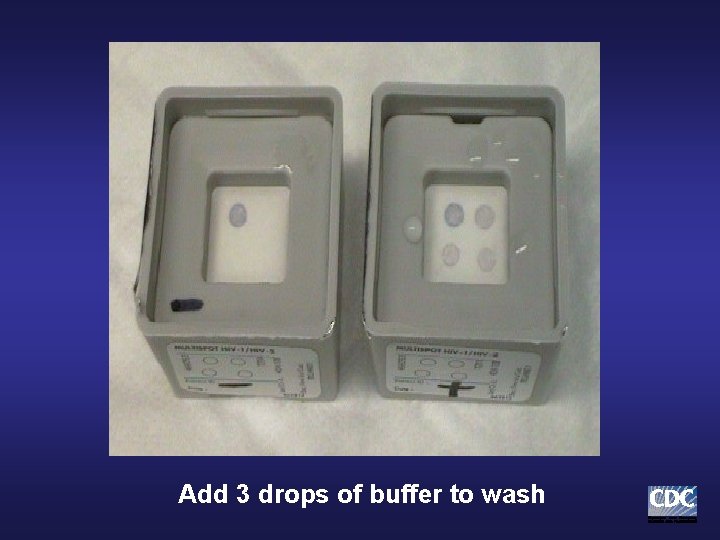
Add 3 drops of buffer to wash
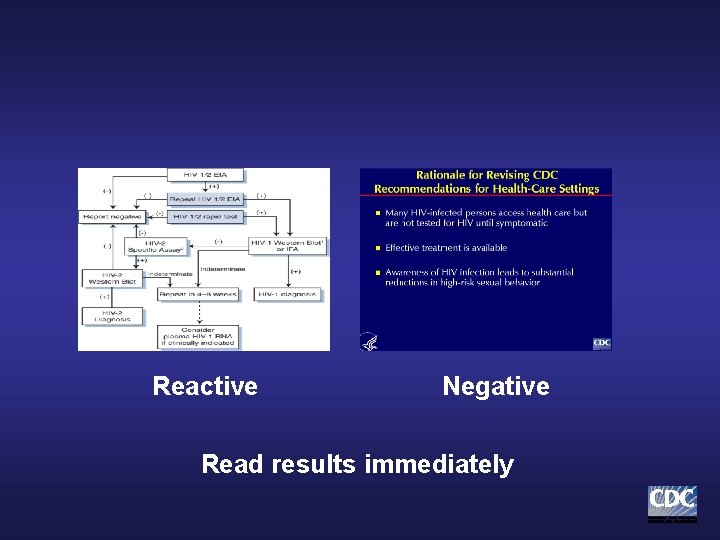
Reactive Negative Read results immediately
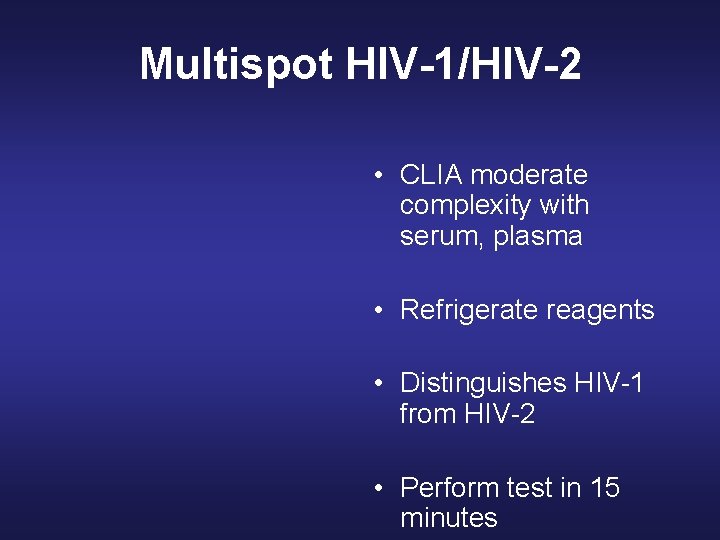
Multispot HIV-1/HIV-2 • CLIA moderate complexity with serum, plasma • Refrigerate reagents • Distinguishes HIV-1 from HIV-2 • Perform test in 15 minutes
Dilution of plasma or serum
Remove and discard pre-filter
Several timed reagent & wash steps
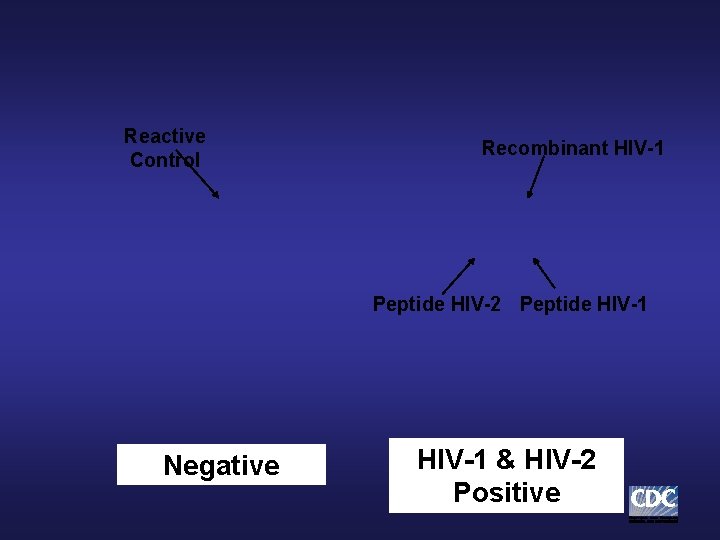
Reactive Control Recombinant HIV-1 Peptide HIV-2 Peptide HIV-1 Negative HIV-1 & HIV-2 Positive