
Core Course 10 Practical Attitude Scale Construction General

- Slides: 17
Core Course 10 : Practical (Attitude Scale Construction)
General Guidelines for Likert scale construction : Ø Domain selection: • Defining the object of attitude and selecting domains and items. • Define the object of attitude according to some standard book. • Read earlier literature about it to select domains. • Take expert help for selecting domains. No. of experts for Likert’s scale: For Classroom- 10 For Examination- 2 -3
Topics for Likert Scale construction on Environment: i. Violence in Jail. ii. Weather and Altruism. iii. The design of built environment in relation (Crime, privacy, crowding and territoriality) with human life. iv. The effect of noise and lighting on interpersonal relationships. v. Spatial arrangement in offices and schools. vi. Social aspects of managing natural resources. vii. Role of climate change.
Ø Item writing and item selection: • Collect items from available newspapers, literature, films, books, experts etc. • Amass relatively large number of items/statements. • Check each item according to Edwards criteria, and modify pr rewrite them so that at least 30 for Likert scale are retained. • Ensure that there are items of different strength, that is not all are extreme/neutral. Do this by considering the likelihood of endorsement by general population. Do this from common sense and acquaintance from culture. In case of Likert : For Classroom- 40 -50 statements; As many domains as possible; Number of items to be retained after editing with Edwards criteria : 30 items. For Examination- 15 -20 statements; As many domains as possible.
LIKERT SCALE CONSTRUCTION • It was observed by Likert (1932) that a much simpler arrangement of statements and responses provide a solid technique for measurement of attitude. • A number of items may be collected or prepared to represent favourable and unfavourable poles, with a gross idea as to how they will relate to the score on the scale as a whole. Steps of Likert scale construction : § Collection of a large number of statements or propositions either referring directly to or considered as likely to relate to the object of attitude. ü For this purpose possible items should be selected from all available sources –newspapers, magazines, books, films, student’s own knowledge, expert knowledge and informal help. ü These should be then put in the form of items as per rule. Both positively and negatively worded statements should be prepared.
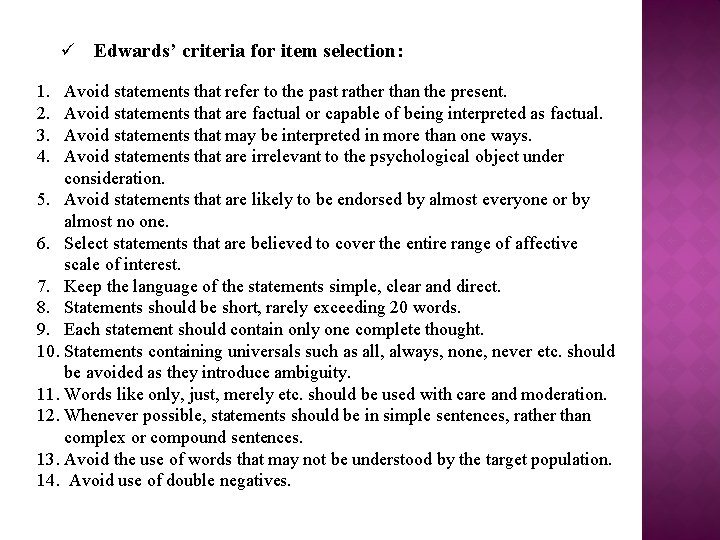
ü Edwards’ criteria for item selection: 1. 2. 3. 4. Avoid statements that refer to the past rather than the present. Avoid statements that are factual or capable of being interpreted as factual. Avoid statements that may be interpreted in more than one ways. Avoid statements that are irrelevant to the psychological object under consideration. 5. Avoid statements that are likely to be endorsed by almost everyone or by almost no one. 6. Select statements that are believed to cover the entire range of affective scale of interest. 7. Keep the language of the statements simple, clear and direct. 8. Statements should be short, rarely exceeding 20 words. 9. Each statement should contain only one complete thought. 10. Statements containing universals such as all, always, none, never etc. should be avoided as they introduce ambiguity. 11. Words like only, just, merely etc. should be used with care and moderation. 12. Whenever possible, statements should be in simple sentences, rather than complex or compound sentences. 13. Avoid the use of words that may not be understood by the target population. 14. Avoid use of double negatives.
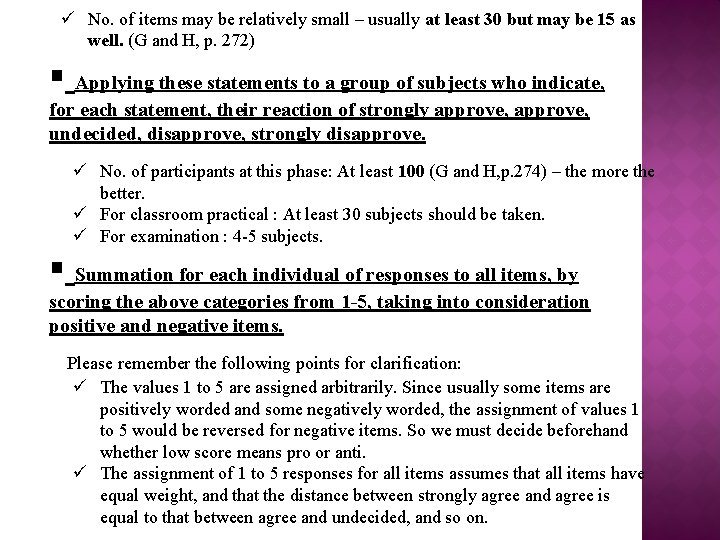
ü No. of items may be relatively small – usually at least 30 but may be 15 as well. (G and H, p. 272) § Applying these statements to a group of subjects who indicate, for each statement, their reaction of strongly approve, undecided, disapprove, strongly disapprove. ü No. of participants at this phase: At least 100 (G and H, p. 274) – the more the better. ü For classroom practical : At least 30 subjects should be taken. ü For examination : 4 -5 subjects. § Summation for each individual of responses to all items, by scoring the above categories from 1 -5, taking into consideration positive and negative items. Please remember the following points for clarification: ü The values 1 to 5 are assigned arbitrarily. Since usually some items are positively worded and some negatively worded, the assignment of values 1 to 5 would be reversed for negative items. So we must decide beforehand whether low score means pro or anti. ü The assignment of 1 to 5 responses for all items assumes that all items have equal weight, and that the distance between strongly agree and agree is equal to that between agree and undecided, and so on.
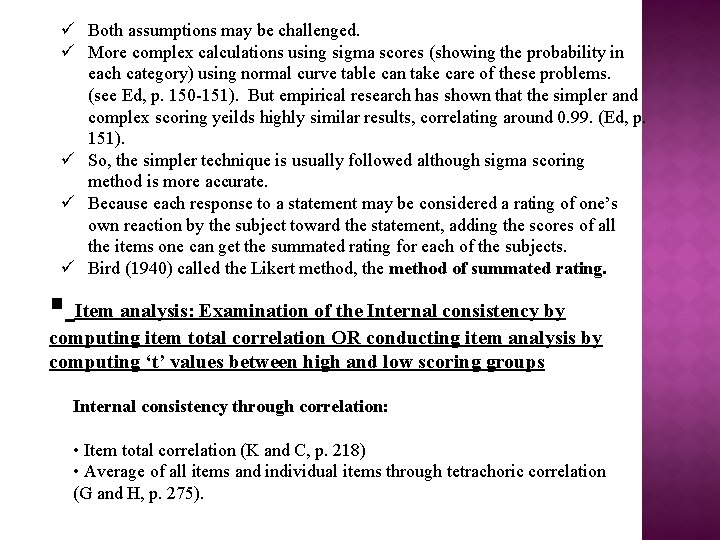
ü Both assumptions may be challenged. ü More complex calculations using sigma scores (showing the probability in each category) using normal curve table can take care of these problems. (see Ed, p. 150 -151). But empirical research has shown that the simpler and complex scoring yeilds highly similar results, correlating around 0. 99. (Ed, p. 151). ü So, the simpler technique is usually followed although sigma scoring method is more accurate. ü Because each response to a statement may be considered a rating of one’s own reaction by the subject toward the statement, adding the scores of all the items one can get the summated rating for each of the subjects. ü Bird (1940) called the Likert method, the method of summated rating. § Item analysis: Examination of the Internal consistency by computing item total correlation OR conducting item analysis by computing ‘t’ values between high and low scoring groups Internal consistency through correlation: • Item total correlation (K and C, p. 218) • Average of all items and individual items through tetrachoric correlation (G and H, p. 275).
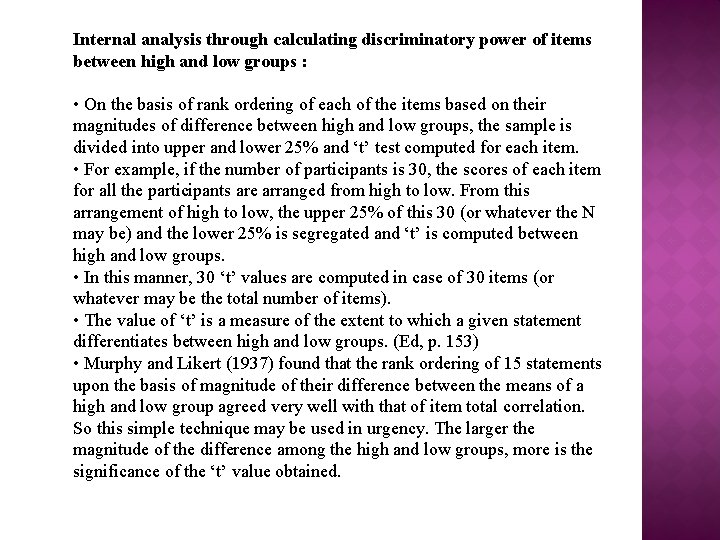
Internal analysis through calculating discriminatory power of items between high and low groups : • On the basis of rank ordering of each of the items based on their magnitudes of difference between high and low groups, the sample is divided into upper and lower 25% and ‘t’ test computed for each item. • For example, if the number of participants is 30, the scores of each item for all the participants are arranged from high to low. From this arrangement of high to low, the upper 25% of this 30 (or whatever the N may be) and the lower 25% is segregated and ‘t’ is computed between high and low groups. • In this manner, 30 ‘t’ values are computed in case of 30 items (or whatever may be the total number of items). • The value of ‘t’ is a measure of the extent to which a given statement differentiates between high and low groups. (Ed, p. 153) • Murphy and Likert (1937) found that the rank ordering of 15 statements upon the basis of magnitude of their difference between the means of a high and low group agreed very well with that of item total correlation. So this simple technique may be used in urgency. The larger the magnitude of the difference among the high and low groups, more is the significance of the ‘t’ value obtained.
§ Selecting items for the final scale The following considerations may be made for final selection of items (G and H, p. 275) • Those items that correlate best with the total OR discriminate best between high and low groups. • The final scale should contain items ranging equally toward favourable and unfavourable. • The final scale should contain wide range of each type of ‘strong’ and ‘weak’ statements. § Interpretation of a Likert scale scores • One difficulty with Likert scale scores is that we do not exactly know the summated rating score corresponding to the zero or neutral point on a favourable-unfavourable continuum. Also if one gives all ‘ 3’ responses, his score would be equal to one who gives equal number of favourable or unfavourable responses. Thus locating the absolute position of the subject is difficult in Likert scale. Norms are required to interpret the scores.
• For example, if the scale consists of 30 items and participant A endorses all 30 items as ‘undecided’, so his total score will be 3 x 30 = 90 (‘ 3’ is the scale score of ‘undecided’ and 30 is the number of items). In case of participant B, who gives equal number of favourable or unfavourable responses, will be scoring as follows: If in the scale out of 30 items, 15 are favourable and the other 15 are unfavourable items, participant B endorses all the favoirable items as “strongly agree”, having a scale score of 5 – hence his total score for favourable items will be 5 x 15 = 75. Now for 15 unfavourable items, he endorses all of them as “strongly disagree”, having a scale score of 1 – hence his total score for unfavourable items will be 1 x 15 = 15. Ultimately for participant B, his total summated score for all the 30 items will be 75 + 15 = 90. Hence this reflects that Participants A and B score the same although the pattern of responses are different. Thus locating the absolute position of the subject is difficult in Likert scale. • The ‘Undecided’ category is not clear. Total score always do not indicate change of attitude. Hence, if we use the scale scores of the individual item to see how attitude changes, we are in a safer domain. Therefore in this case it is better to interpret item-wise. • The limitations of using the Likert’s scale in classroom practicals should be clearly mentioned.
§ Reliability and Validity (For Viva Voce) • May be done by any standard procedure. • Reliability is usually done with Chronbach’s alpha, test retest and internal consistency. • Criterion validity can be evaluated. Order in which LNB is to be written : • General Problem : On Attitude • Specific Problem: As in syllabus. (On Environment) • Basic Concept: Definition of attitude, components of Attitude (Affective, Cognitive, Conative), Factors affecting attitude formation, Attitude change in brief, Measurement of attitude (Direct and indirect methods with elaboration of direct method), Likert method elaboration
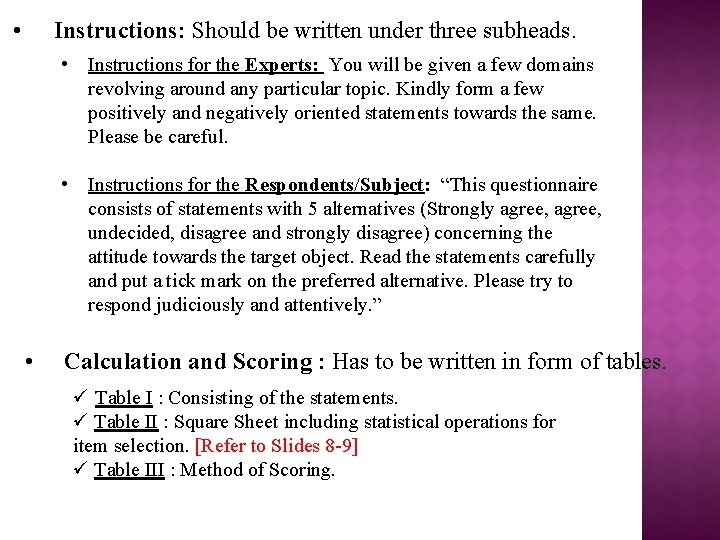
• Preliminaries: a) For Construction: Experts (N=10) Respondents (N=4 to 5) b) For Administration: Subject (N=1) • Materials Required: Pen, pencil and other stationaries. • Step of Work: - Write in future tense, pointwise, dividing into two phases, PHASE-I (Scale Construction) and PHASE-II (Scale administration). [Refer to slides 5 to 11] • Procedure: - Write in past tense, paragraph wise, dividing in the following manner: v Phase I: Construction of scale. 1. Collection of items 2. Editing of items 3. Preparation of workable form of the scale v Phase II: Administration of scale.
• Instructions: Should be written under three subheads. • Instructions for the Experts: You will be given a few domains revolving around any particular topic. Kindly form a few positively and negatively oriented statements towards the same. Please be careful. • Instructions for the Respondents/Subject: “This questionnaire consists of statements with 5 alternatives (Strongly agree, undecided, disagree and strongly disagree) concerning the attitude towards the target object. Read the statements carefully and put a tick mark on the preferred alternative. Please try to respond judiciously and attentively. ” • Calculation and Scoring : Has to be written in form of tables. ü Table I : Consisting of the statements. ü Table II : Square Sheet including statistical operations for item selection. [Refer to Slides 8 -9] ü Table III : Method of Scoring.
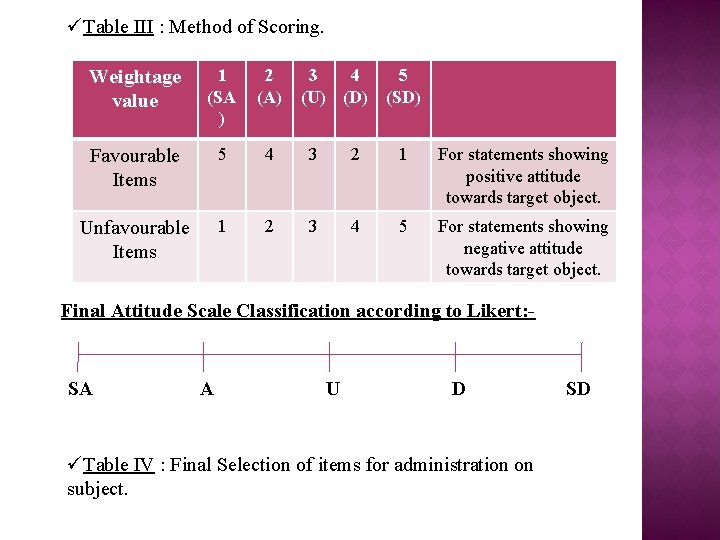
üTable III : Method of Scoring. Weightage value 1 (SA ) 2 (A) 3 4 (U) (D) 5 (SD) Favourable Items 5 4 3 2 1 For statements showing positive attitude towards target object. Unfavourable Items 1 2 3 4 5 For statements showing negative attitude towards target object. Final Attitude Scale Classification according to Likert: - SA A U D üTable IV : Final Selection of items for administration on subject. SD
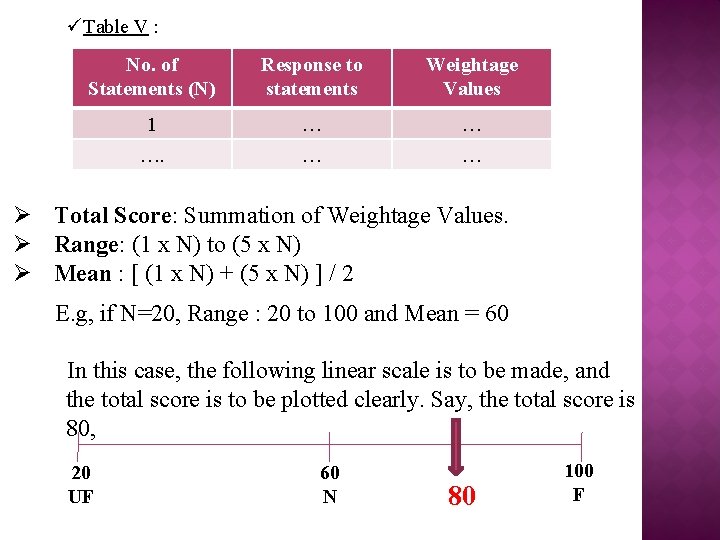
üTable V : No. of Statements (N) Response to statements Weightage Values 1 … … … Ø Total Score: Summation of Weightage Values. Ø Range: (1 x N) to (5 x N) Ø Mean : [ (1 x N) + (5 x N) ] / 2 E. g, if N=20, Range : 20 to 100 and Mean = 60 In this case, the following linear scale is to be made, and the total score is to be plotted clearly. Say, the total score is 80, 20 UF 60 N 80 100 F
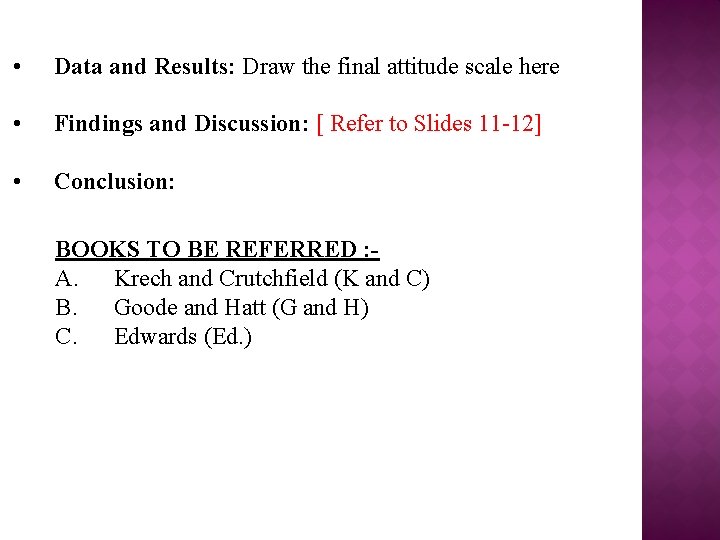
• Data and Results: Draw the final attitude scale here • Findings and Discussion: [ Refer to Slides 11 -12] • Conclusion: BOOKS TO BE REFERRED : A. Krech and Crutchfield (K and C) B. Goode and Hatt (G and H) C. Edwards (Ed. )