
Core Competencies for Creating Interprofessional Educational Exercises IPE

- Slides: 16
Core Competencies for Creating Interprofessional Educational Exercises
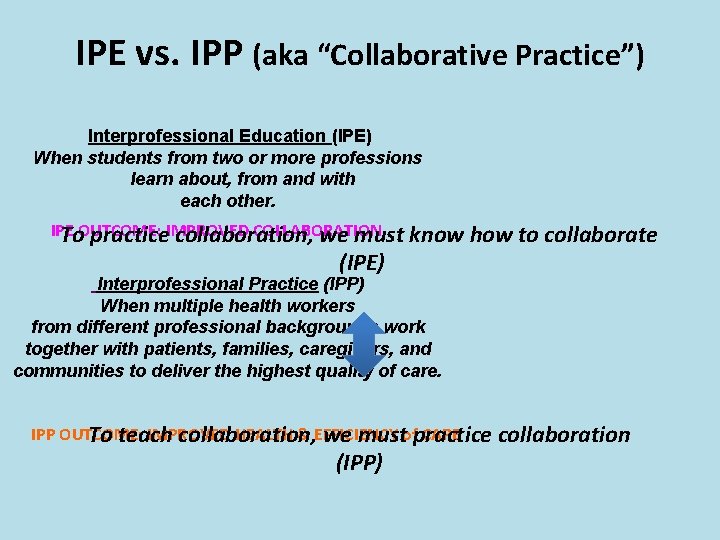
IPE vs. IPP (aka “Collaborative Practice”) Interprofessional Education (IPE) When students from two or more professions learn about, from and with each other. IPE COLLABORATION To. OUTCOME: practice. IMPROVED collaboration, we must (IPE) know how to collaborate Interprofessional Practice (IPP) When multiple health workers from different professional backgrounds work together with patients, families, caregivers, and communities to deliver the highest quality of care. IPP OUTCOME: IMPROVED HEALTH & EFFICIENCY CARE To teach collaboration, we mustofpractice (IPP) collaboration
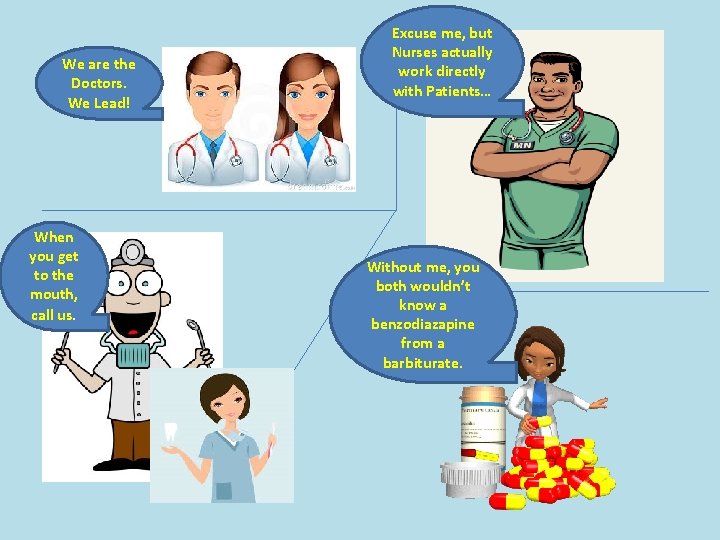
We are the Doctors. We Lead! When you get to the mouth, call us. Excuse me, but Nurses actually work directly with Patients… Without me, you both wouldn’t know a benzodiazapine from a barbiturate.
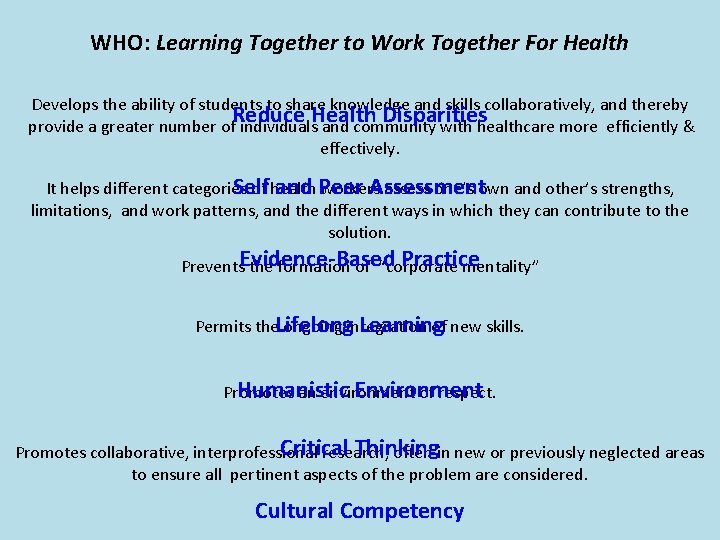
WHO: Learning Together to Work Together For Health Develops the ability of students to share knowledge and skills collaboratively, and thereby Reduce Health Disparities provide a greater number of individuals and community with healthcare more efficiently & effectively. Self and Peer Assessment It helps different categories of health workers assess one’s own and other’s strengths, limitations, and work patterns, and the different ways in which they can contribute to the solution. Practice Prevents. Evidence-Based the formation of “corporate mentality” Learning Permits the. Lifelong ongoing integration of new skills. Humanistic Environment Promotes an environment of respect. Critical Thinking Promotes collaborative, interprofessional research, often in new or previously neglected areas to ensure all pertinent aspects of the problem are considered. Cultural Competency
The goal of this interprofessional learning is to prepare all health professions students for deliberatively working together with the common goal of building a safer and better patientcentered and community/population oriented U. S. health care system. Fixing teeth Improving Health
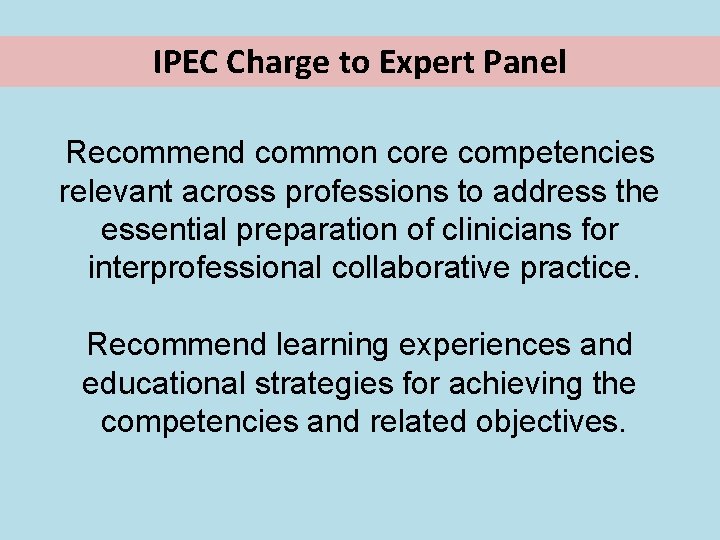
IPEC Charge to Expert Panel Recommend common core competencies relevant across professions to address the essential preparation of clinicians for interprofessional collaborative practice. Recommend learning experiences and educational strategies for achieving the competencies and related objectives.
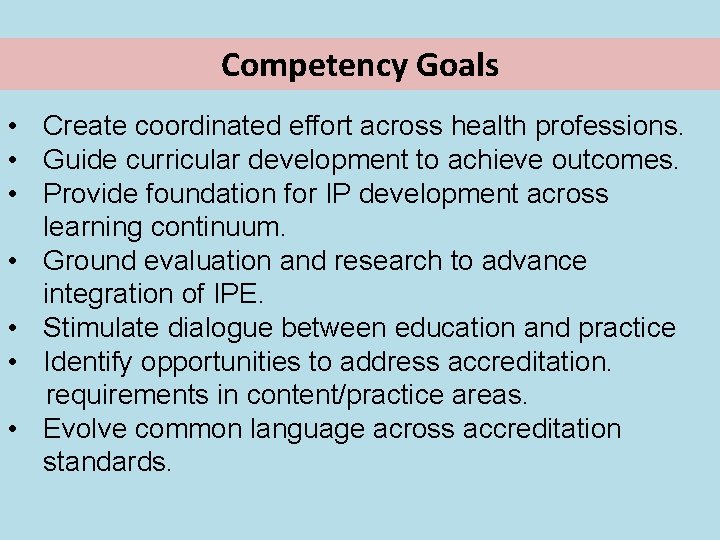
Competency Goals • Create coordinated effort across health professions. • Guide curricular development to achieve outcomes. • Provide foundation for IP development across learning continuum. • Ground evaluation and research to advance integration of IPE. • Stimulate dialogue between education and practice • Identify opportunities to address accreditation. requirements in content/practice areas. • Evolve common language across accreditation standards.
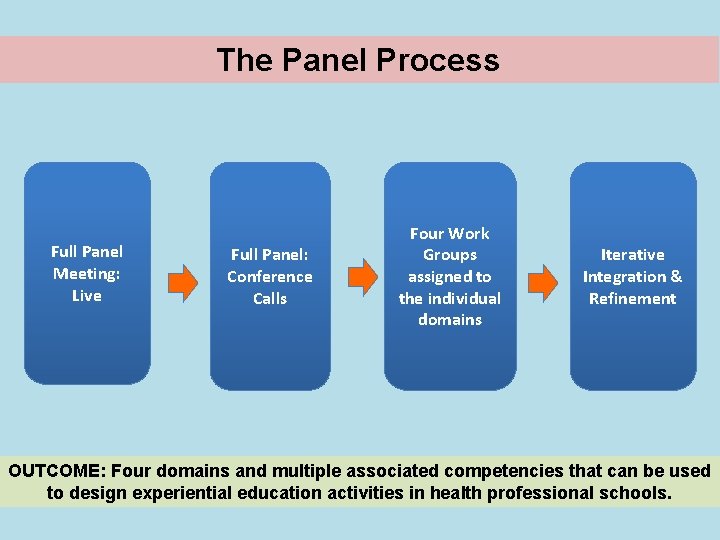
The Panel Process Full Panel Meeting: Live Full Panel: Conference Calls Four Work Groups assigned to the individual domains Iterative Integration & Refinement OUTCOME: Four domains and multiple associated competencies that can be used to design experiential education activities in health professional schools.
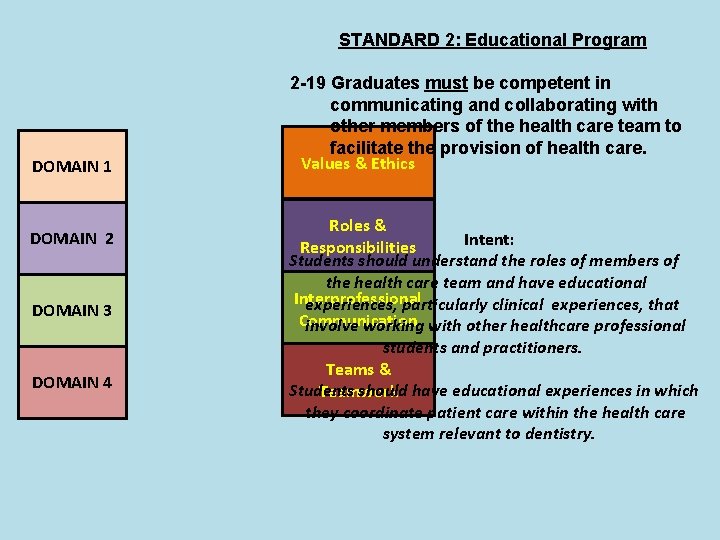
STANDARD 2: Educational Program DOMAIN 1 DOMAIN 2 DOMAIN 3 DOMAIN 4 2 -19 Graduates must be competent in communicating and collaborating with other members of the health care team to facilitate the provision of health care. Values & Ethics Roles & Intent: Responsibilities Students should understand the roles of members of the health care team and have educational Interprofessional experiences, particularly clinical experiences, that Communication involve working with other healthcare professional students and practitioners. Teams & Students should have educational experiences in which Teamwork they coordinate patient care within the health care system relevant to dentistry.
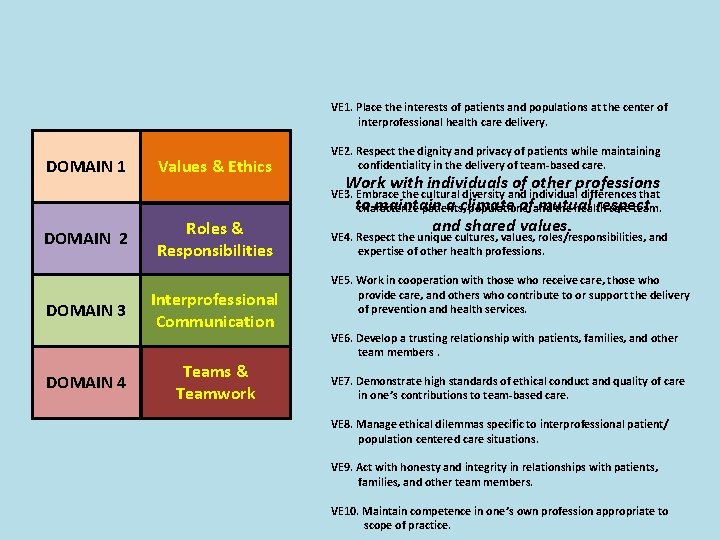
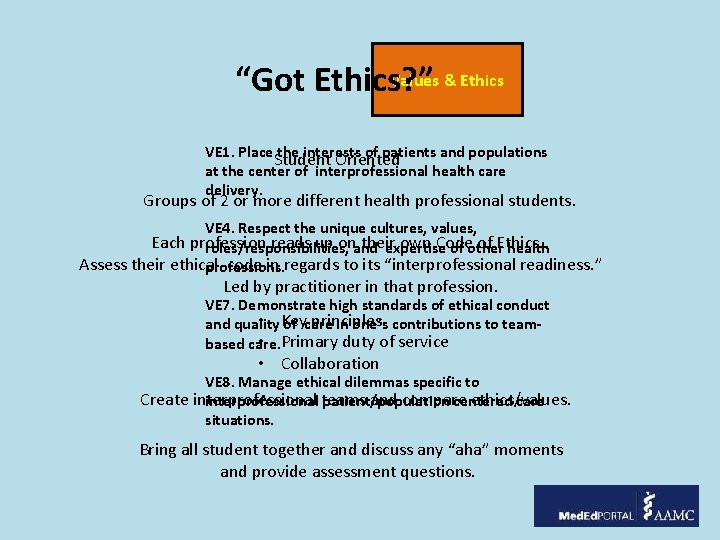
VE 1. Place the interests of patients and populations at the center of interprofessional health care delivery. DOMAIN 1 Values & Ethics VE 2. Respect the dignity and privacy of patients while maintaining confidentiality in the delivery of team-based care. Work with individuals of other professions VE 3. Embrace the cultural diversity and individual differences that to maintain a climate ofand mutual respect characterize patients, populations, the health care team. DOMAIN 2 DOMAIN 3 DOMAIN 4 Roles & Responsibilities Interprofessional Communication Teams & Teamwork and shared values. VE 4. Respect the unique cultures, values, roles/responsibilities, and expertise of other health professions. VE 5. Work in cooperation with those who receive care, those who provide care, and others who contribute to or support the delivery of prevention and health services. VE 6. Develop a trusting relationship with patients, families, and other team members. VE 7. Demonstrate high standards of ethical conduct and quality of care in one’s contributions to team-based care. VE 8. Manage ethical dilemmas specific to interprofessional patient/ population centered care situations. VE 9. Act with honesty and integrity in relationships with patients, families, and other team members. VE 10. Maintain competence in one’s own profession appropriate to scope of practice.
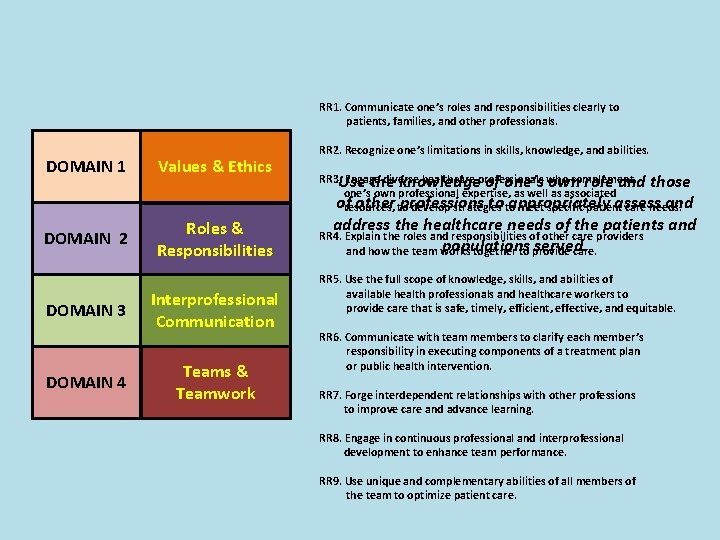
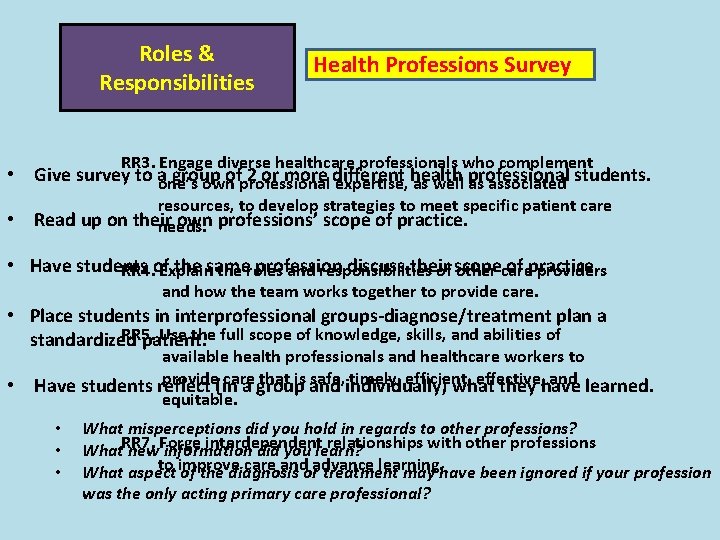
RR 1. Communicate one’s roles and responsibilities clearly to patients, families, and other professionals. DOMAIN 1 Values & Ethics DOMAIN 2 Roles & Responsibilities DOMAIN 3 DOMAIN 4 Interprofessional Communication Teams & Teamwork RR 2. Recognize one’s limitations in skills, knowledge, and abilities. RR 3. Use Engage diverse healthcare professionals complement the knowledge of one’s who own role and those one’s own professional expertise, as well as associated ofresources, other toprofessions to toappropriately assess and develop strategies meet specific patient care needs. address the healthcare needs of the patients and RR 4. Explain the roles and responsibilities of other care providers populations served. and how the team works together to provide care. RR 5. Use the full scope of knowledge, skills, and abilities of available health professionals and healthcare workers to provide care that is safe, timely, efficient, effective, and equitable. RR 6. Communicate with team members to clarify each member’s responsibility in executing components of a treatment plan or public health intervention. RR 7. Forge interdependent relationships with other professions to improve care and advance learning. RR 8. Engage in continuous professional and interprofessional development to enhance team performance. RR 9. Use unique and complementary abilities of all members of the team to optimize patient care.
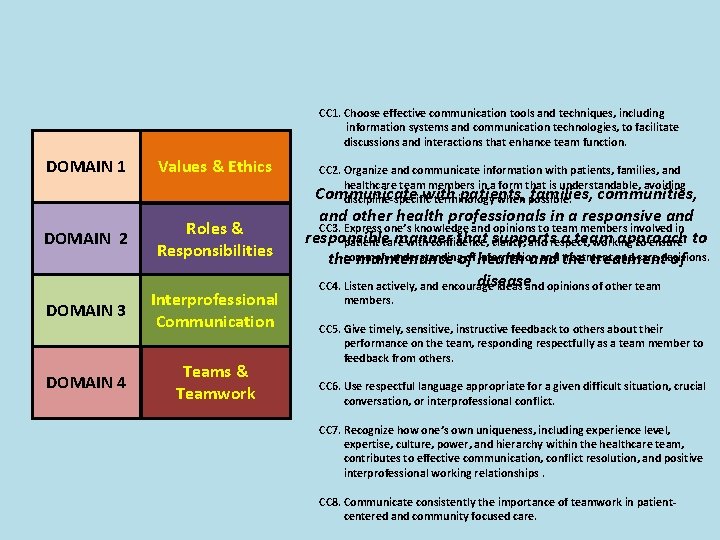
CC 1. Choose effective communication tools and techniques, including information systems and communication technologies, to facilitate discussions and interactions that enhance team function. DOMAIN 1 Values & Ethics DOMAIN 2 Roles & Responsibilities DOMAIN 3 Interprofessional Communication DOMAIN 4 Teams & Teamwork CC 2. Organize and communicate information with patients, families, and healthcare team members in a form that is understandable, avoiding Communicate with patients, families, communities, discipline-specific terminology when possible. and other health professionals in a responsive and CC 3. Express one’s knowledge and opinions to team members involved in responsible manner that clarity, supports a team approach patient care with confidence, and respect, working to ensure to understandingof of health information and the treatment and care decisions. thecommon maintenance and treatment of disease. CC 4. Listen actively, and encourage ideas and opinions of other team members. CC 5. Give timely, sensitive, instructive feedback to others about their performance on the team, responding respectfully as a team member to feedback from others. CC 6. Use respectful language appropriate for a given difficult situation, crucial conversation, or interprofessional conflict. CC 7. Recognize how one’s own uniqueness, including experience level, expertise, culture, power, and hierarchy within the healthcare team, contributes to effective communication, conflict resolution, and positive interprofessional working relationships. CC 8. Communicate consistently the importance of teamwork in patientcentered and community focused care.
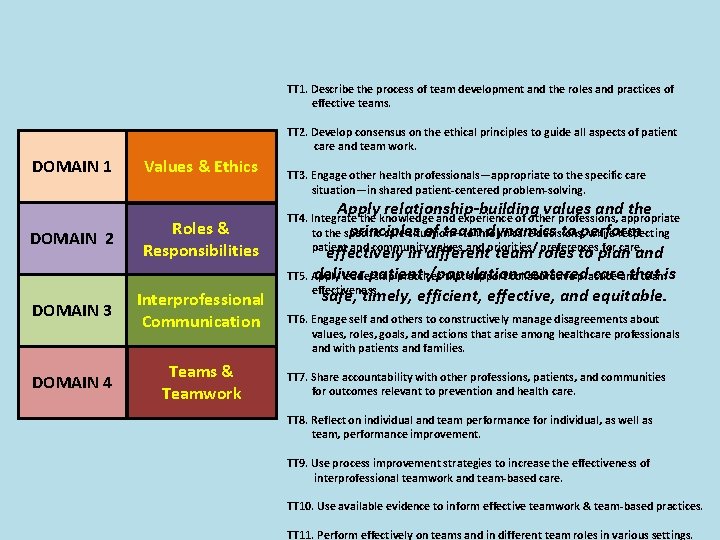
TT 1. Describe the process of team development and the roles and practices of effective teams. TT 2. Develop consensus on the ethical principles to guide all aspects of patient care and team work. DOMAIN 1 Values & Ethics DOMAIN 2 Roles & Responsibilities DOMAIN 3 Interprofessional Communication DOMAIN 4 Teams & Teamwork TT 3. Engage other health professionals—appropriate to the specific care situation—in shared patient-centered problem-solving. Apply relationship-building values and the TT 4. Integrate the knowledge and experience of other professions, appropriate principles of teaminform dynamics to perform to the specific care situation—to care decisions, while respecting patient and community values and priorities/ preferences for care. effectively in different team roles to plan and deliver patient-/population-centered careand that TT 5. Apply leadership practices that support collaborative practice teamis effectiveness. safe, timely, efficient, effective, and equitable. TT 6. Engage self and others to constructively manage disagreements about values, roles, goals, and actions that arise among healthcare professionals and with patients and families. TT 7. Share accountability with other professions, patients, and communities for outcomes relevant to prevention and health care. TT 8. Reflect on individual and team performance for individual, as well as team, performance improvement. TT 9. Use process improvement strategies to increase the effectiveness of interprofessional teamwork and team-based care. TT 10. Use available evidence to inform effective teamwork & team-based practices. TT 11. Perform effectively on teams and in different team roles in various settings.
Roles & Responsibilities • • Health Professions Survey RR 3. Engage diverse healthcare professionals who complement Give survey to aone’s group ofprofessional 2 or more different own expertise, health as well professional as associated students. resources, to develop strategies to meet specific patient care Read up on their own professions’ scope of practice. needs. • Have students the same profession discuss their of practice. RR 4. of Explain the roles and responsibilities of scope other care providers and how the team works together to provide care. • Place students in interprofessional groups-diagnose/treatment plan a RR 5. Use the full scope of knowledge, skills, and abilities of standardized patient. • available health professionals and healthcare workers to provide(in care that is and safe, individually) timely, efficient, effective, and learned. Have students reflect a group what they have equitable. • • • What misperceptions did you hold in regards to other professions? interdependent relationships with other professions What. RR 7. new. Forge information did you learn? to improve care andoradvance learning. What aspect of the diagnosis treatment may have been ignored if your profession was the only acting primary care professional?
Values & Ethics “Got Ethics? ” VE 1. Place the interests of patients and populations Student Oriented at the center of interprofessional health care delivery. Groups of 2 or more different health professional students. VE 4. Respect the unique cultures, values, Each profession reads up onand their own Code of Ethics. roles/responsibilities, expertise of other health Assess their ethical code in regards to its “interprofessional readiness. ” professions. Led by practitioner in that profession. VE 7. Demonstrate high standards of ethical conduct • Key principles and quality of care in one’s contributions to team • Primary duty of service based care. • Collaboration VE 8. Manage ethical dilemmas specific to Create interprofessional and compare ethics/values. interprofessional teams patient/population centered care situations. Bring all student together and discuss any “aha” moments and provide assessment questions.
“Got Ethics? ” The Faculty Friendly Version Let’s Play Doctor!