
Core Commitments for Children in Humanitarian Action Updated
- Slides: 21
Core Commitments for Children in Humanitarian Action Updated Third Version UNICEF
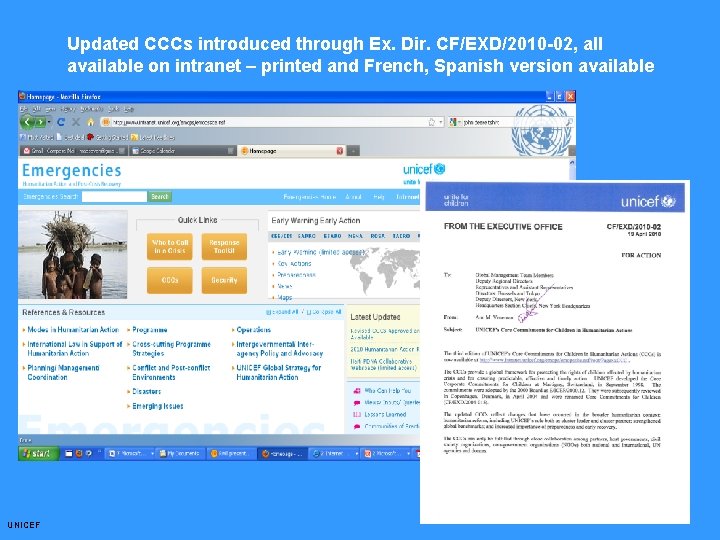
Updated CCCs introduced through Ex. Dir. CF/EXD/2010 -02, all available on intranet – printed and French, Spanish version available UNICEF 2
What are the CCCs? ®UNICEF’s core humanitarian policy to uphold the rights of children affected by humanitarian crisis ®Promote predictable, effective and timely collective humanitarian action ®A framework based on norms and standards, around which UNICEF seeks to engage with partners UNICEF
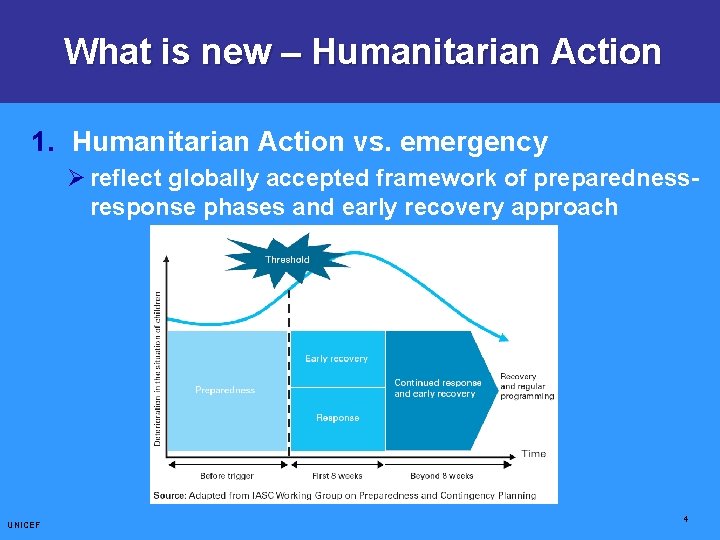
What new – Humanitarian Action CCCs: is Core Commitments for Children 1. Humanitarian Action vs. emergency Ø reflect globally accepted framework of preparednessresponse phases and early recovery approach UNICEF 4
Preparedness is part of every Programme and Operational Commitment ® The first Programme Commitment is to sort out coordination ® Monitoring done by EWEA; ® Preparedness activities need to go into AWPs UNICEF 5
What is new – Humanitarian Reform 2. Humanitarian reform has changed the way we work as humanitarian agencies: Ø Cluster approach Ø Financing Ø Humanitarian leadership Ø Partnerships UNICEF 6
What is new – Results orientation 3. Results-oriented, with clear Strategic Results, Commitments and Benchmarks for each sector Ø Strategic results articulate goals aligned to global standards to which UNICEF contributes. Ø Commitments and Benchmarks are defined as results based on recent evidence and best practices. Ø Fulfillment depends on many factors, including availability of partners and resources, both human and financial UNICEF 7
What is UNICEF committing to? ® Ensure the situation of children and women is monitored ® Respond in defined programme sectors where resources and partners allow ® Advocate with governments and other partners to ensure that the benchmarks are achieved ® Ensure minimum preparedness in defined programme sectors and within UNICEF 8
What is UNICEF’s role? ® UNICEF’s role varies depending on context and who has comparative advantage. May include: Ø promoting CCCs through advocacy, Ø leadership, Ø cluster roles (lead and/or member), Ø Role of UNICEF within humanitarian country teams, etc. UNICEF 9
What are UNICEF’s cluster commitments? ® Ensure effective leadership and interagency coordination ® Always on preparedness (clarify UNICEF and partners cluster responsibility) ® Articulated under 1 st commitment for Nutrition, Health, WASH, Child Protection and Education ® UNICEF’s role in country often mirrors global role, but varies according to capacity and context UNICEF 10
When are the CCCs used? ® In all countries on: Ø Preparedness Ø Situation monitoring of women and children ® In both rapid onset, slow onset and protracted humanitarian situations UNICEF 11
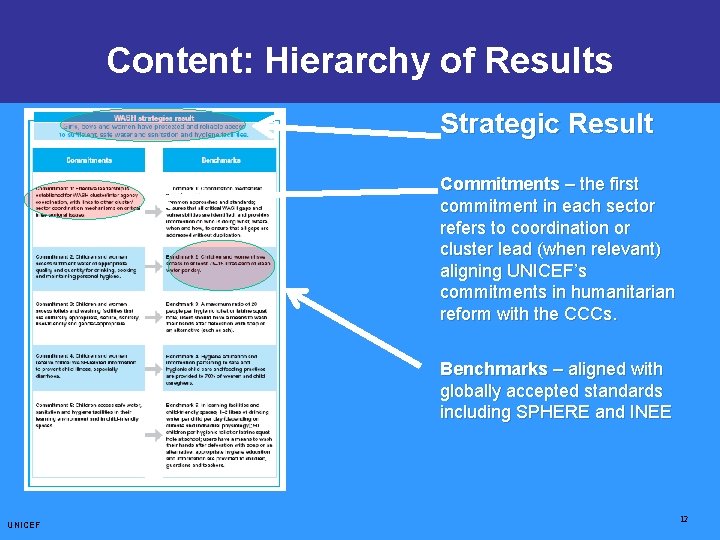
Content: Hierarchy offor Results CCCs: Core Commitments Children Strategic Result Commitments – the first commitment in each sector refers to coordination or cluster lead (when relevant) aligning UNICEF’s commitments in humanitarian reform with the CCCs. Benchmarks – aligned with globally accepted standards including SPHERE and INEE UNICEF 12
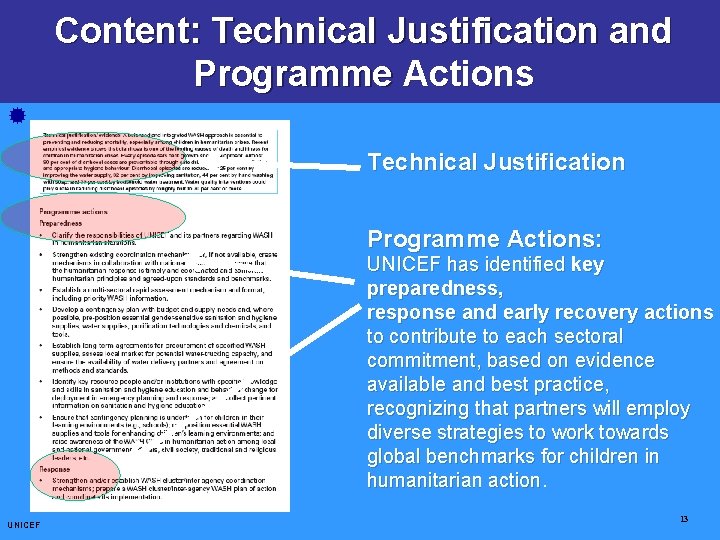
Content: Technical Justification and CCCs: Core Commitments for Children Programme Actions ® Technical Justification Programme Actions: UNICEF has identified key preparedness, response and early recovery actions to contribute to each sectoral commitment, based on evidence available and best practice, recognizing that partners will employ diverse strategies to work towards global benchmarks for children in humanitarian action UNICEF 13
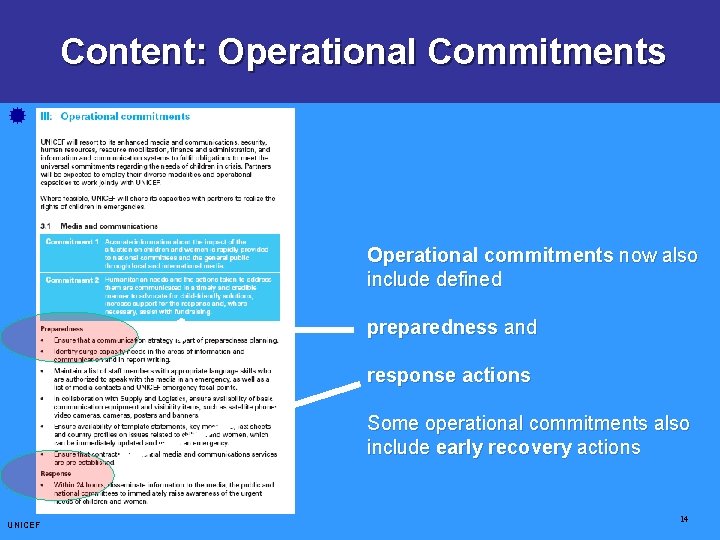
Content: Operational Commitments CCCs: Core Commitments for Children ® Operational commitments now also include defined preparedness and response actions Some operational commitments also include early recovery actions UNICEF 14
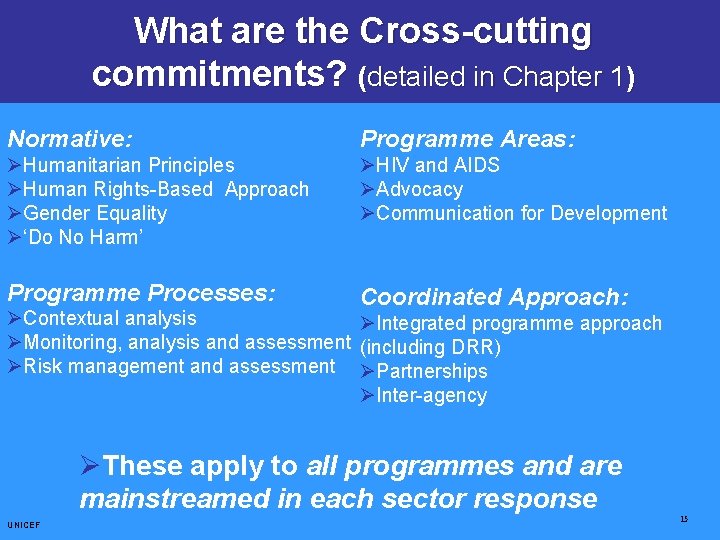
What are the Cross-cutting commitments? (detailed in Chapter 1) Normative: Programme Areas: ØHumanitarian Principles ØHuman Rights-Based Approach ØGender Equality Ø‘Do No Harm’ ØHIV and AIDS ØAdvocacy ØCommunication for Development Programme Processes: Coordinated Approach: ØContextual analysis ØIntegrated programme approach ØMonitoring, analysis and assessment (including DRR) ØRisk management and assessment ØPartnerships ØInter-agency ØThese apply to all programmes and are mainstreamed in each sector response UNICEF 15
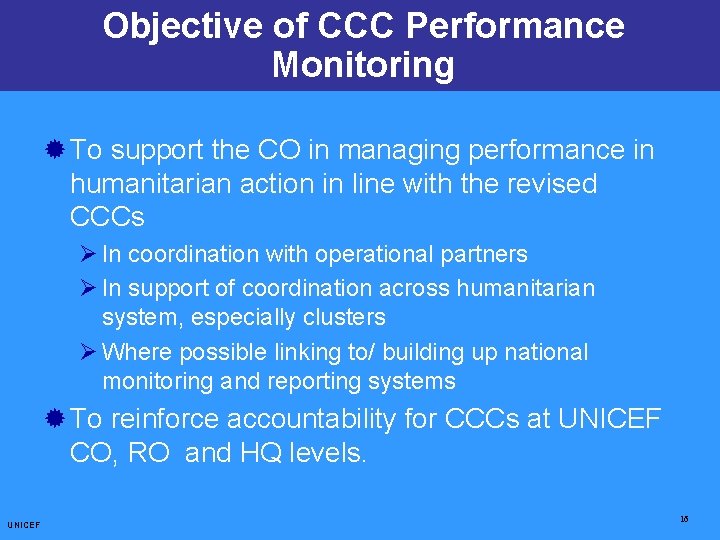
Objective of CCC Performance Monitoring ® To support the CO in managing performance in humanitarian action in line with the revised CCCs Ø In coordination with operational partners Ø In support of coordination across humanitarian system, especially clusters Ø Where possible linking to/ building up national monitoring and reporting systems ® To reinforce accountability for CCCs at UNICEF CO, RO and HQ levels. UNICEF 16
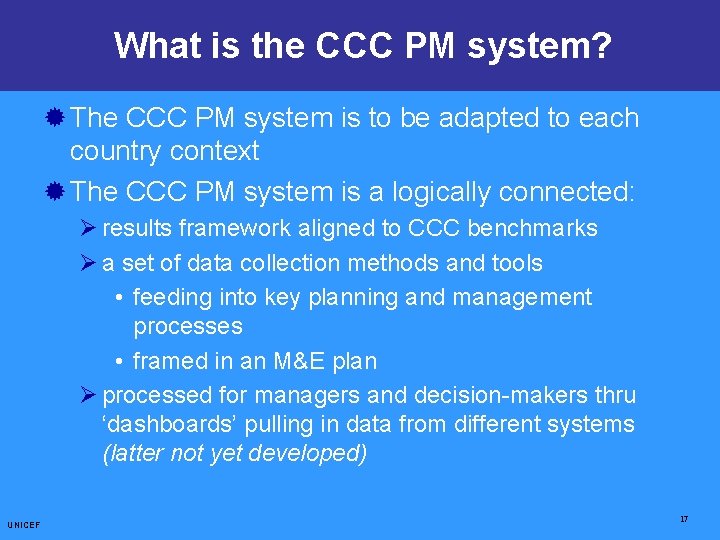
What is the CCC PM system? ® The CCC PM system is to be adapted to each country context ® The CCC PM system is a logically connected: Ø results framework aligned to CCC benchmarks Ø a set of data collection methods and tools • feeding into key planning and management processes • framed in an M&E plan Ø processed for managers and decision-makers thru ‘dashboards’ pulling in data from different systems (latter not yet developed) UNICEF 17
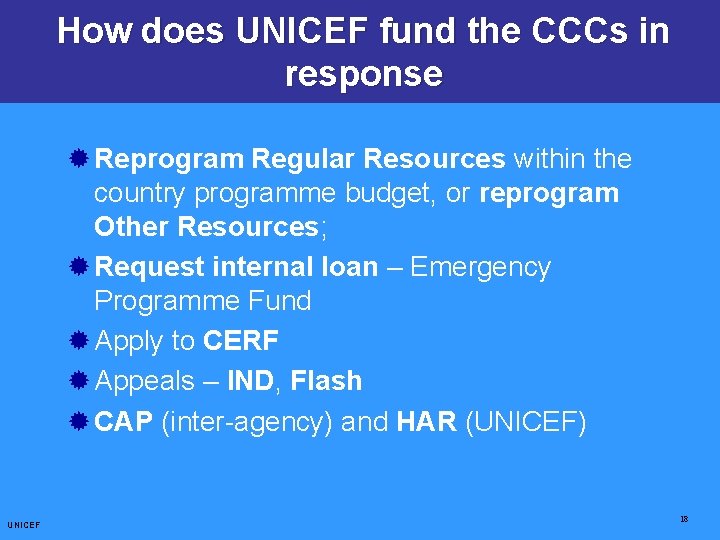
How does UNICEF fund the CCCs in response ® Reprogram Regular Resources within the country programme budget, or reprogram Other Resources; ® Request internal loan – Emergency Programme Fund ® Apply to CERF ® Appeals – IND, Flash ® CAP (inter-agency) and HAR (UNICEF) UNICEF 18
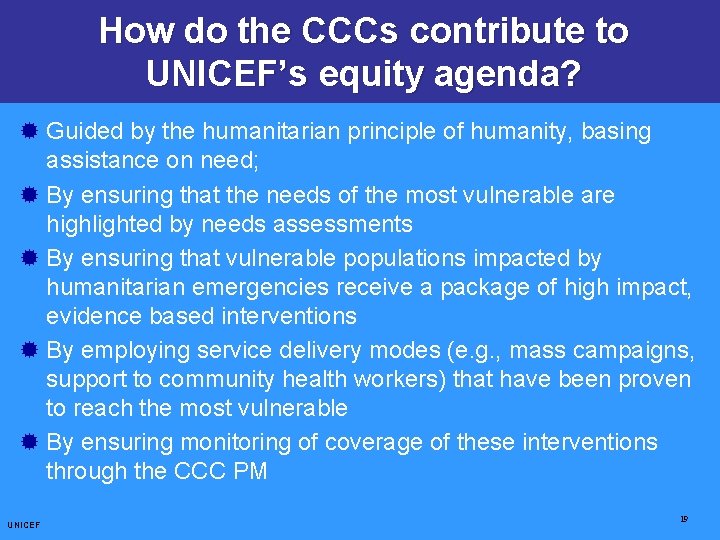
How do the CCCs contribute to UNICEF’s equity agenda? ® Guided by the humanitarian principle of humanity, basing assistance on need; ® By ensuring that the needs of the most vulnerable are highlighted by needs assessments ® By ensuring that vulnerable populations impacted by humanitarian emergencies receive a package of high impact, evidence based interventions ® By employing service delivery modes (e. g. , mass campaigns, support to community health workers) that have been proven to reach the most vulnerable ® By ensuring monitoring of coverage of these interventions through the CCC PM UNICEF 19
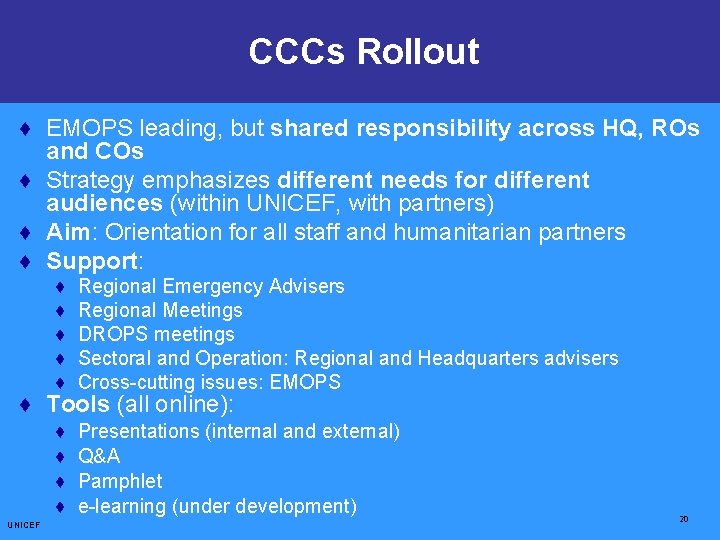
Rolloutfor Children CCCs: Core CCCs Commitments ♦ EMOPS leading, but shared responsibility across HQ, ROs and COs ♦ Strategy emphasizes different needs for different audiences (within UNICEF, with partners) ♦ Aim: Orientation for all staff and humanitarian partners ♦ Support: ♦ ♦ ♦ Regional Emergency Advisers Regional Meetings DROPS meetings Sectoral and Operation: Regional and Headquarters advisers Cross-cutting issues: EMOPS ♦ ♦ Presentations (internal and external) Q&A Pamphlet e-learning (under development) ♦ Tools (all online): UNICEF 20
Your feedback is welcome, especially suggestions for the roll-out Thank You UNICEF