
Core brightness in presence of spacecharge Jorge GinerNavarro
Core brightness in presence of space-charge Jorge Giner-Navarro Pietro Musumeci Workshop on Methods in Collective and Nonlinear Effects in Bright Charged Particle Beams University of Chicago – October 28 th, 2017
Outline • Motivation – Brightness, emittance and photocathodes • Simulations GPT in space-charge scenarios – Core brightness computation – Simulations and analysis • Experimental techniques – Pepper-pot – TEM grids – Slit + deflector system • Summary J. Giner-Navarro. Workshop: Methods in Collective and Nonlinear Effects in Bright Charged Particle Beams. Oct 28 th, 2017 2
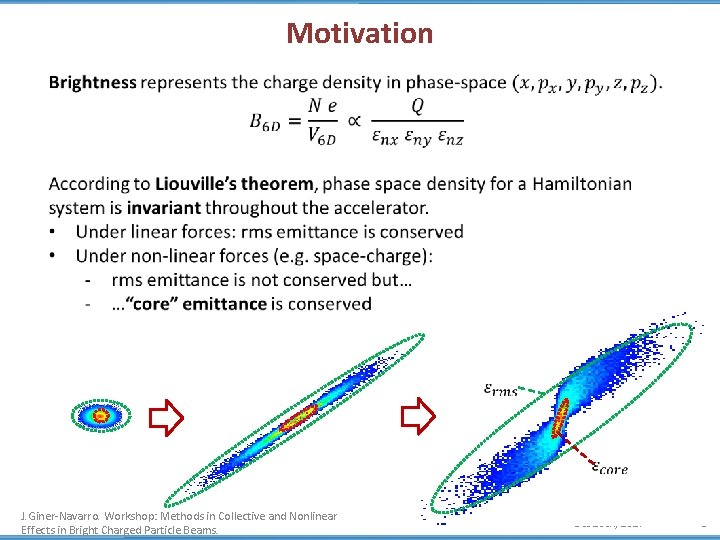
Motivation J. Giner-Navarro. Workshop: Methods in Collective and Nonlinear Effects in Bright Charged Particle Beams. Oct 28 th, 2017 3
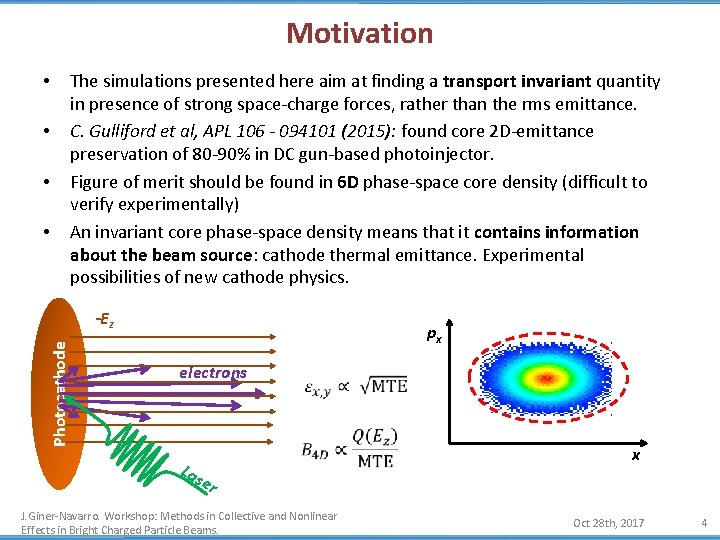
Motivation • • The simulations presented here aim at finding a transport invariant quantity in presence of strong space-charge forces, rather than the rms emittance. C. Gulliford et al, APL 106 - 094101 (2015): found core 2 D-emittance preservation of 80 -90% in DC gun-based photoinjector. Figure of merit should be found in 6 D phase-space core density (difficult to verify experimentally) An invariant core phase-space density means that it contains information about the beam source: cathode thermal emittance. Experimental possibilities of new cathode physics. Photocathode -Ez px electrons Las x er J. Giner-Navarro. Workshop: Methods in Collective and Nonlinear Effects in Bright Charged Particle Beams. Oct 28 th, 2017 4
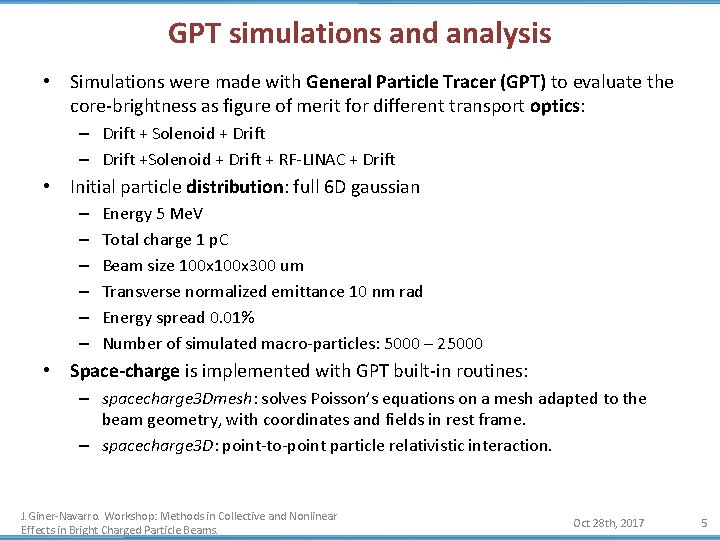
GPT simulations and analysis • Simulations were made with General Particle Tracer (GPT) to evaluate the core-brightness as figure of merit for different transport optics: – Drift + Solenoid + Drift – Drift +Solenoid + Drift + RF-LINAC + Drift • Initial particle distribution: full 6 D gaussian – – – Energy 5 Me. V Total charge 1 p. C Beam size 100 x 300 um Transverse normalized emittance 10 nm rad Energy spread 0. 01% Number of simulated macro-particles: 5000 – 25000 • Space-charge is implemented with GPT built-in routines: – spacecharge 3 Dmesh: solves Poisson’s equations on a mesh adapted to the beam geometry, with coordinates and fields in rest frame. – spacecharge 3 D: point-to-point particle relativistic interaction. J. Giner-Navarro. Workshop: Methods in Collective and Nonlinear Effects in Bright Charged Particle Beams. Oct 28 th, 2017 5
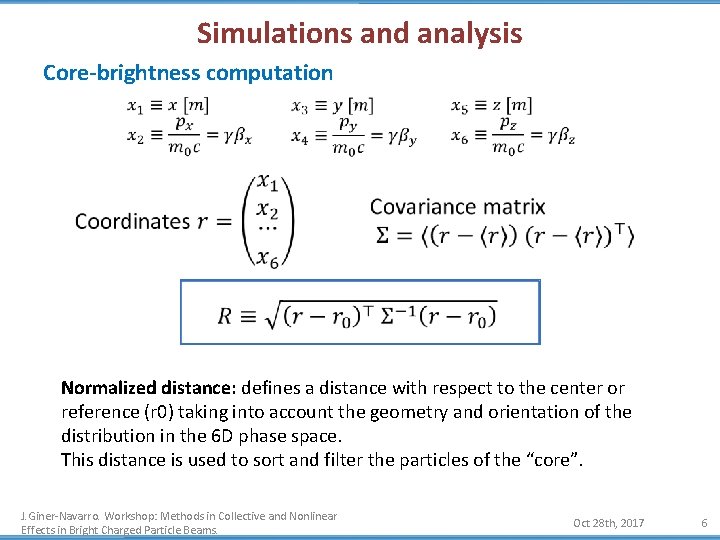
Simulations and analysis Core-brightness computation Normalized distance: defines a distance with respect to the center or reference (r 0) taking into account the geometry and orientation of the distribution in the 6 D phase space. This distance is used to sort and filter the particles of the “core”. J. Giner-Navarro. Workshop: Methods in Collective and Nonlinear Effects in Bright Charged Particle Beams. Oct 28 th, 2017 6
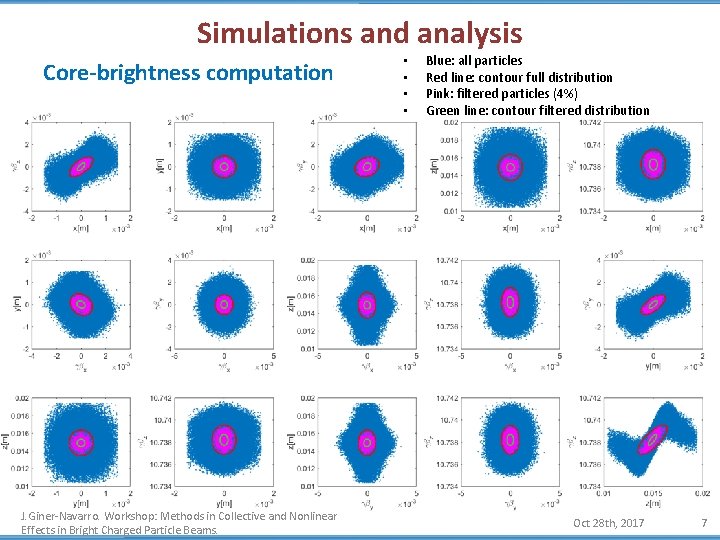
Simulations and analysis Core-brightness computation J. Giner-Navarro. Workshop: Methods in Collective and Nonlinear Effects in Bright Charged Particle Beams. • • Blue: all particles Red line: contour full distribution Pink: filtered particles (4%) Green line: contour filtered distribution Oct 28 th, 2017 7
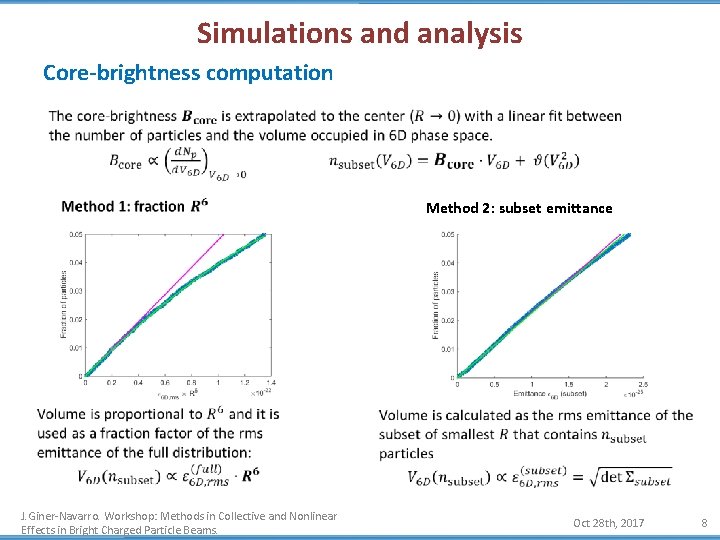
Simulations and analysis Core-brightness computation J. Giner-Navarro. Workshop: Methods in Collective and Nonlinear Effects in Bright Charged Particle Beams. Method 2: subset emittance Oct 28 th, 2017 8
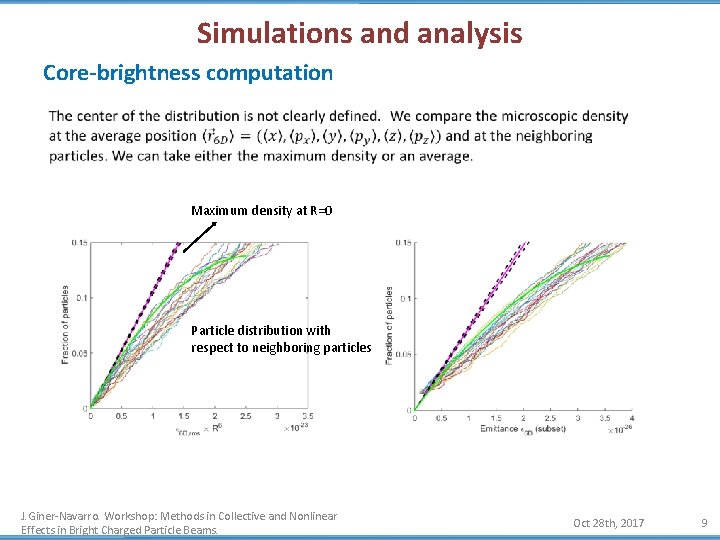
Simulations and analysis Core-brightness computation Maximum density at R=0 Particle distribution with respect to neighboring particles J. Giner-Navarro. Workshop: Methods in Collective and Nonlinear Effects in Bright Charged Particle Beams. Oct 28 th, 2017 9
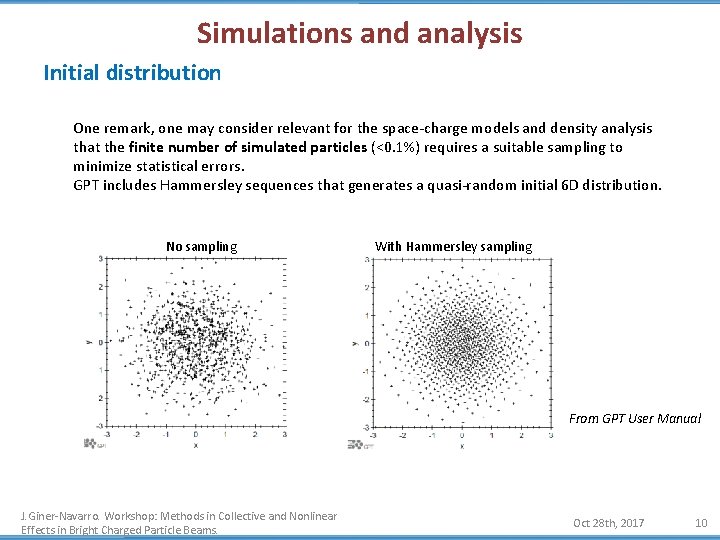
Simulations and analysis Initial distribution One remark, one may consider relevant for the space-charge models and density analysis that the finite number of simulated particles (<0. 1%) requires a suitable sampling to minimize statistical errors. GPT includes Hammersley sequences that generates a quasi-random initial 6 D distribution. No sampling With Hammersley sampling From GPT User Manual J. Giner-Navarro. Workshop: Methods in Collective and Nonlinear Effects in Bright Charged Particle Beams. Oct 28 th, 2017 10
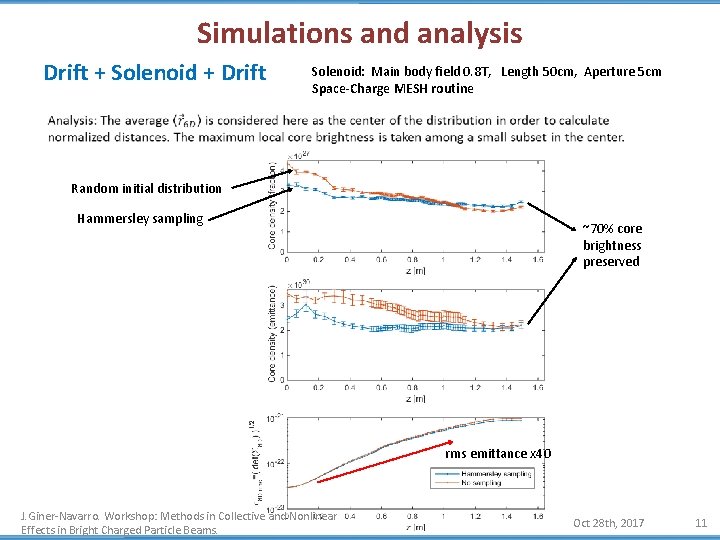
Simulations and analysis Drift + Solenoid + Drift Solenoid: Main body field 0. 8 T, Length 50 cm, Aperture 5 cm Space-Charge MESH routine Random initial distribution Hammersley sampling ~70% core brightness preserved rms emittance x 40 J. Giner-Navarro. Workshop: Methods in Collective and Nonlinear Effects in Bright Charged Particle Beams. Oct 28 th, 2017 11
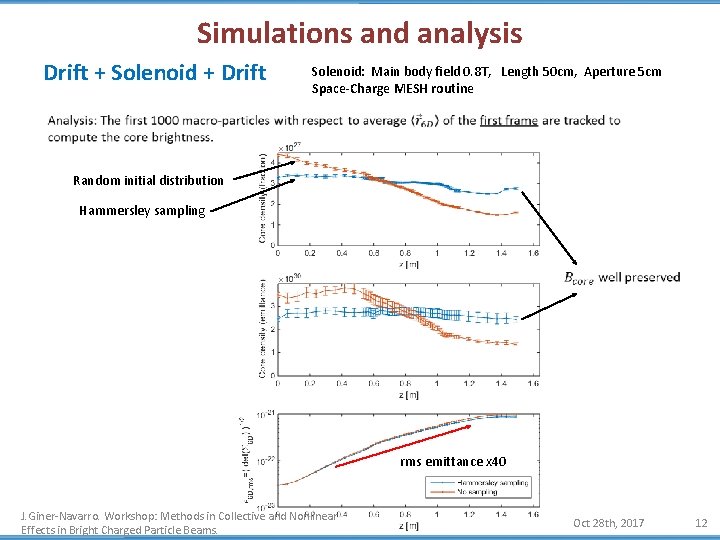
Simulations and analysis Drift + Solenoid + Drift Solenoid: Main body field 0. 8 T, Length 50 cm, Aperture 5 cm Space-Charge MESH routine Random initial distribution Hammersley sampling rms emittance x 40 J. Giner-Navarro. Workshop: Methods in Collective and Nonlinear Effects in Bright Charged Particle Beams. Oct 28 th, 2017 12
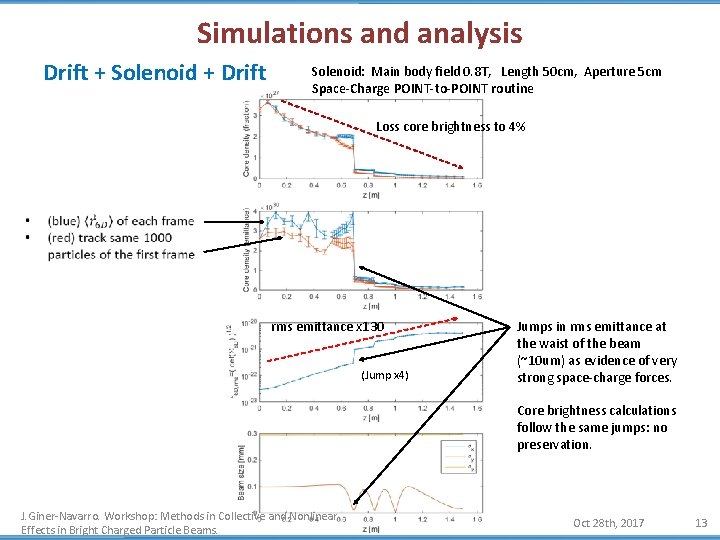
Simulations and analysis Drift + Solenoid + Drift Solenoid: Main body field 0. 8 T, Length 50 cm, Aperture 5 cm Space-Charge POINT-to-POINT routine Loss core brightness to 4% rms emittance x 130 (Jump x 4) Jumps in rms emittance at the waist of the beam (~10 um) as evidence of very strong space-charge forces. Core brightness calculations follow the same jumps: no preservation. J. Giner-Navarro. Workshop: Methods in Collective and Nonlinear Effects in Bright Charged Particle Beams. Oct 28 th, 2017 13
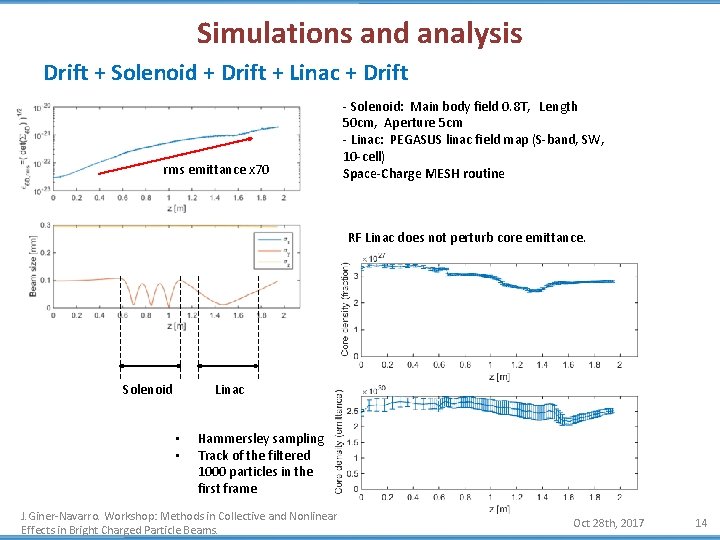
Simulations and analysis Drift + Solenoid + Drift + Linac + Drift rms emittance x 70 - Solenoid: Main body field 0. 8 T, Length 50 cm, Aperture 5 cm - Linac: PEGASUS linac field map (S-band, SW, 10 -cell) Space-Charge MESH routine RF Linac does not perturb core emittance. Solenoid Linac • • Hammersley sampling Track of the filtered 1000 particles in the first frame J. Giner-Navarro. Workshop: Methods in Collective and Nonlinear Effects in Bright Charged Particle Beams. Oct 28 th, 2017 14
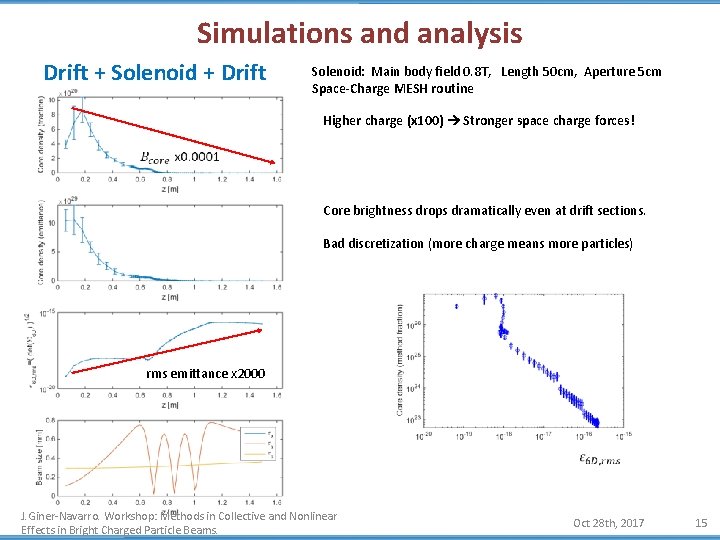
Simulations and analysis Drift + Solenoid + Drift Solenoid: Main body field 0. 8 T, Length 50 cm, Aperture 5 cm Space-Charge MESH routine Higher charge (x 100) Stronger space charge forces! Core brightness drops dramatically even at drift sections. Bad discretization (more charge means more particles) rms emittance x 2000 J. Giner-Navarro. Workshop: Methods in Collective and Nonlinear Effects in Bright Charged Particle Beams. Oct 28 th, 2017 15
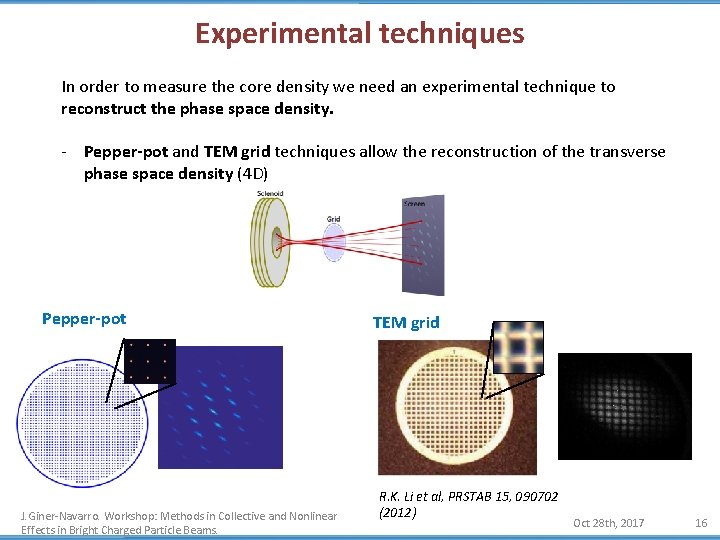
Experimental techniques In order to measure the core density we need an experimental technique to Simulation reconstruct the phase space density. - Pepper-pot and TEM grid techniques allow the reconstruction of the transverse phase space density (4 D) Pepper-pot J. Giner-Navarro. Workshop: Methods in Collective and Nonlinear Effects in Bright Charged Particle Beams. TEM grid R. K. Li et al, PRSTAB 15, 090702 (2012) Oct 28 th, 2017 16
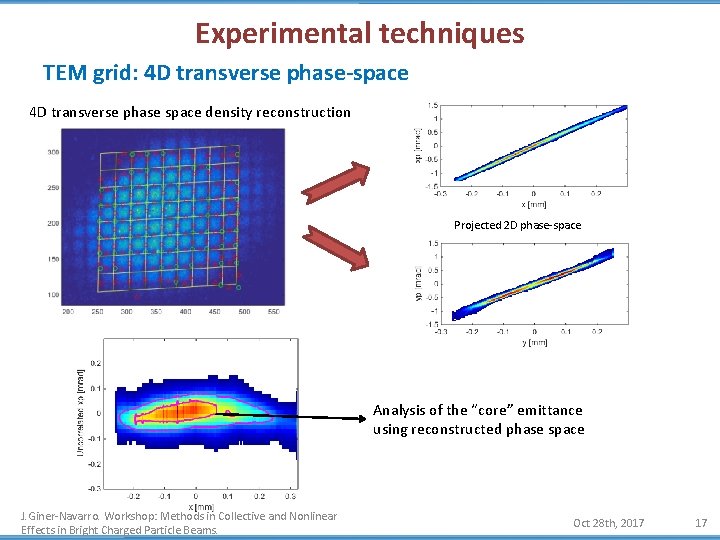
Experimental techniques TEM grid: 4 D transverse phase-space 4 D transverse phase space density reconstruction Projected 2 D phase-space Analysis of the “core” emittance using reconstructed phase space J. Giner-Navarro. Workshop: Methods in Collective and Nonlinear Effects in Bright Charged Particle Beams. Oct 28 th, 2017 17
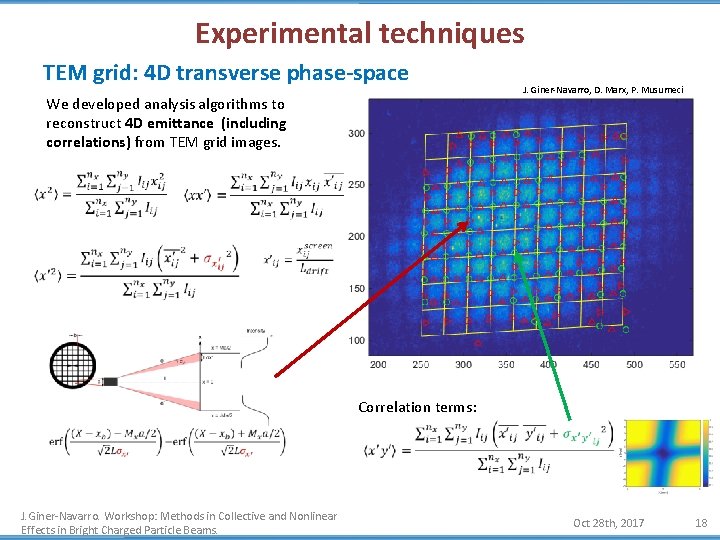
Experimental techniques TEM grid: 4 D transverse phase-space We developed analysis algorithms to Simulation reconstruct 4 D emittance (including correlations) from TEM grid images. J. Giner-Navarro, D. Marx, P. Musumeci Correlation terms: J. Giner-Navarro. Workshop: Methods in Collective and Nonlinear Effects in Bright Charged Particle Beams. Oct 28 th, 2017 18
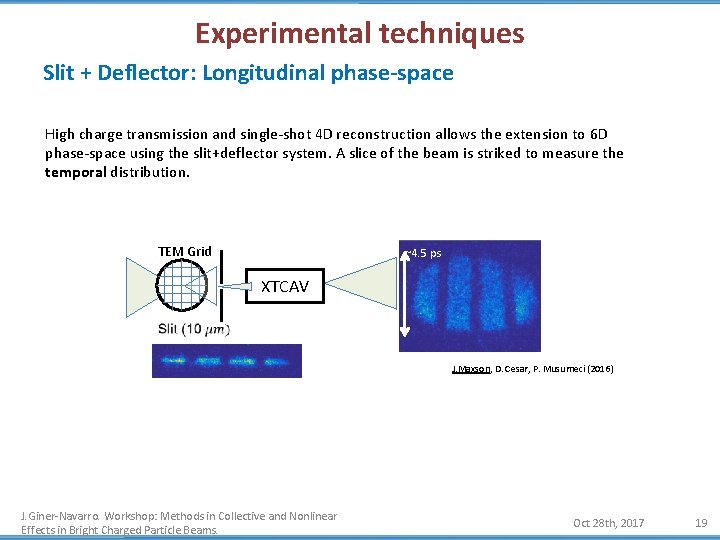
Experimental techniques Slit + Deflector: Longitudinal phase-space Simulation High charge transmission and single-shot 4 D reconstruction allows the extension to 6 D phase-space using the slit+deflector system. A slice of the beam is striked to measure the temporal distribution. TEM Grid ~4. 5 ps XTCAV J. Maxson, D. Cesar, P. Musumeci (2016) J. Giner-Navarro. Workshop: Methods in Collective and Nonlinear Effects in Bright Charged Particle Beams. Oct 28 th, 2017 19
Summary • Numerical simulations have been performed using GPT to analyse the evolution of the “core” 6 D-brightness in beam transport systems in presence of non-linear space-charge forces. • Mesh routines of space-charge forces show fair agreement of core brightness preservation, rather than point-to-point interaction routines which demand larger number of particles and computation time. • Ultimate goal is the use of this invariant for the characterization of new photocathodes from the analysis of the produced beam properties in the diagnostics section. • The use of TEM grids combined with a slit-deflector system is presented to be a good candidate for phase space density reconstruction and analysis of the core 6 D brightness. J. Giner-Navarro. Workshop: Methods in Collective and Nonlinear Effects in Bright Charged Particle Beams. Oct 28 th, 2017 20
Thank you for your attention! J. Giner-Navarro. Workshop: Methods in Collective and Nonlinear Effects in Bright Charged Particle Beams. Oct 28 th, 2017 21
BACK UP Slides: J. Giner-Navarro. Workshop: Methods in Collective and Nonlinear Effects in Bright Charged Particle Beams. Oct 28 th, 2017 22
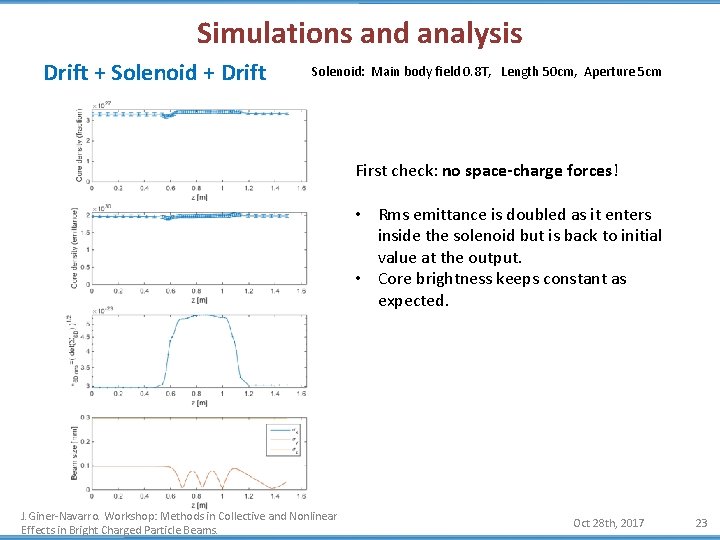
Simulations and analysis Drift + Solenoid + Drift Solenoid: Main body field 0. 8 T, Length 50 cm, Aperture 5 cm First check: no space-charge forces! • Rms emittance is doubled as it enters inside the solenoid but is back to initial value at the output. • Core brightness keeps constant as expected. J. Giner-Navarro. Workshop: Methods in Collective and Nonlinear Effects in Bright Charged Particle Beams. Oct 28 th, 2017 23
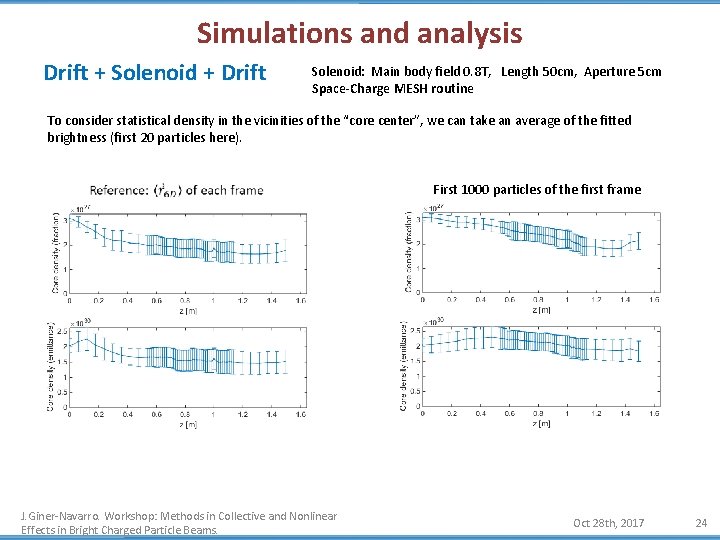
Simulations and analysis Drift + Solenoid + Drift Solenoid: Main body field 0. 8 T, Length 50 cm, Aperture 5 cm Space-Charge MESH routine To consider statistical density in the vicinities of the “core center”, we can take an average of the fitted brightness (first 20 particles here). J. Giner-Navarro. Workshop: Methods in Collective and Nonlinear Effects in Bright Charged Particle Beams. First 1000 particles of the first frame Oct 28 th, 2017 24
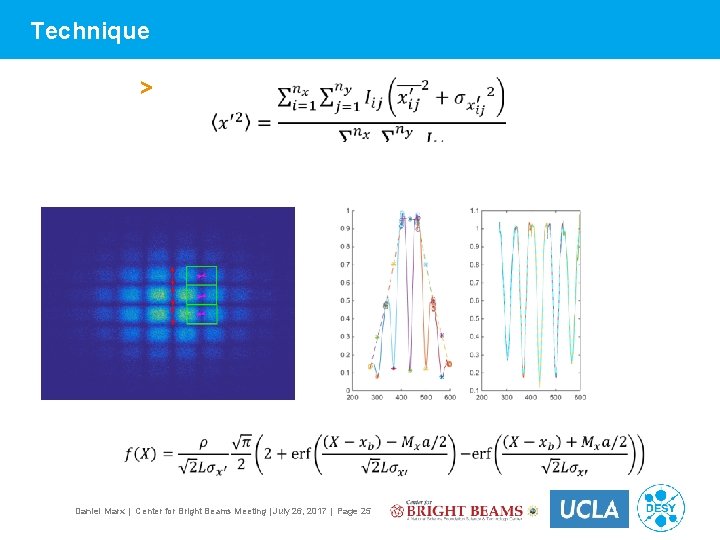
Technique > Daniel Marx | Center for Bright Beams Meeting | July 26, 2017 | Page 25
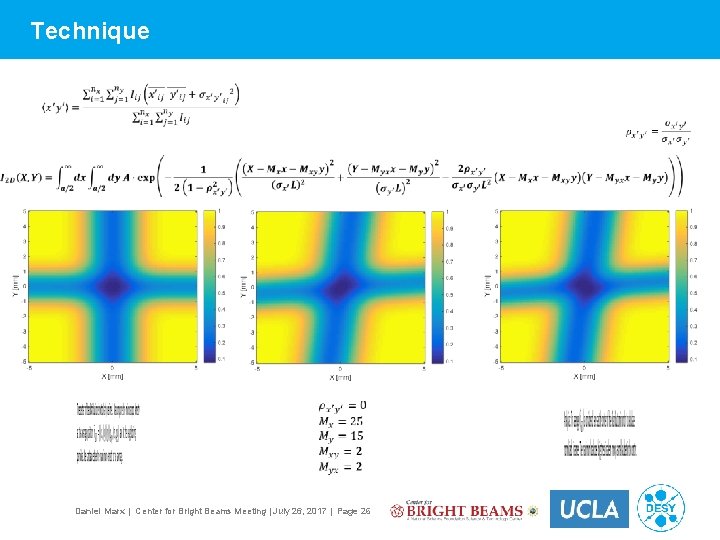
Technique Daniel Marx | Center for Bright Beams Meeting | July 26, 2017 | Page 26
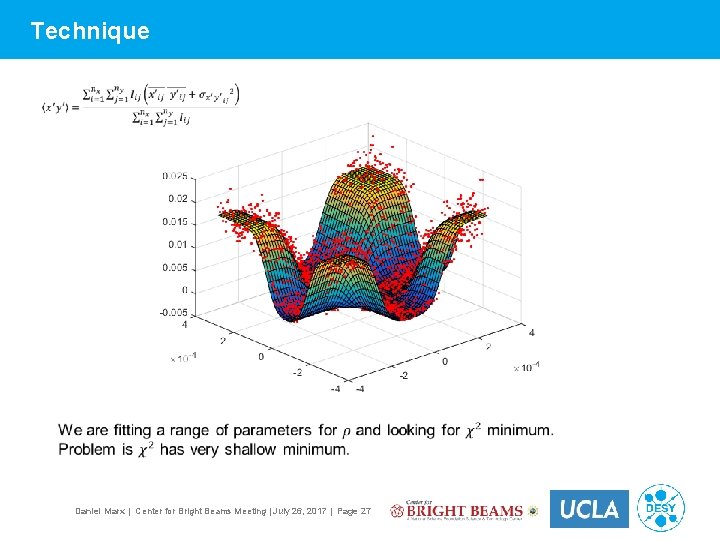
Technique Daniel Marx | Center for Bright Beams Meeting | July 26, 2017 | Page 27
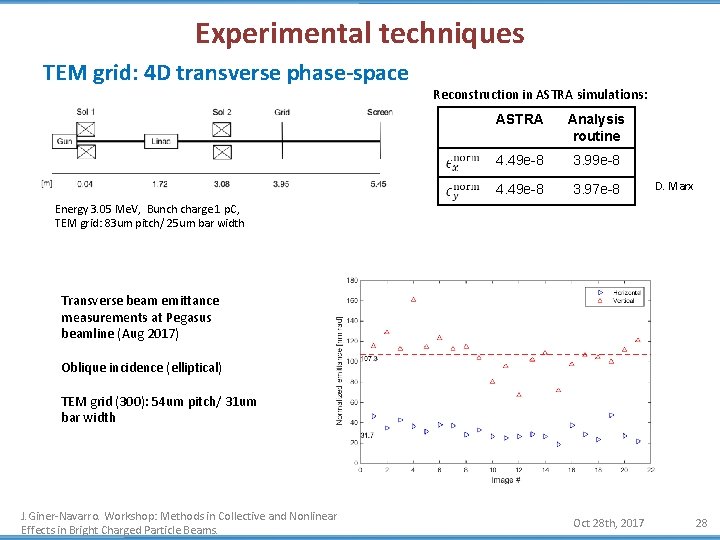
Experimental techniques TEM grid: 4 D transverse phase-space Simulation Reconstruction in ASTRA simulations: ASTRA Analysis routine 4. 49 e-8 3. 99 e-8 4. 49 e-8 3. 97 e-8 D. Marx Energy 3. 05 Me. V, Bunch charge 1 p. C, TEM grid: 83 um pitch/ 25 um bar width Transverse beam emittance measurements at Pegasus beamline (Aug 2017) Oblique incidence (elliptical) TEM grid (300): 54 um pitch/ 31 um bar width J. Giner-Navarro. Workshop: Methods in Collective and Nonlinear Effects in Bright Charged Particle Beams. Oct 28 th, 2017 28
- Slides: 28