
CORE ACADEMIC GROWTH MODEL RESULTS INTERPRETATION Last updated
- Slides: 14
CORE ACADEMIC GROWTH MODEL: RESULTS INTERPRETATION Last updated 9. 13. 16
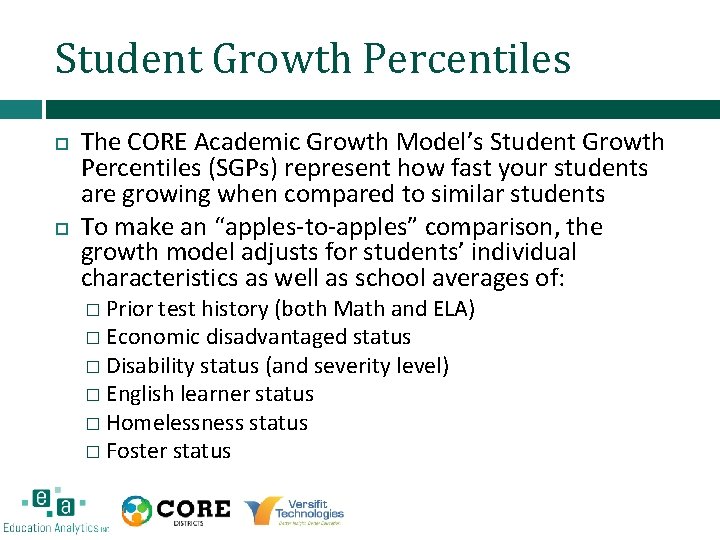
Student Growth Percentiles The CORE Academic Growth Model’s Student Growth Percentiles (SGPs) represent how fast your students are growing when compared to similar students To make an “apples-to-apples” comparison, the growth model adjusts for students’ individual characteristics as well as school averages of: � Prior test history (both Math and ELA) � Economic disadvantaged status � Disability status (and severity level) � English learner status � Homelessness status � Foster status
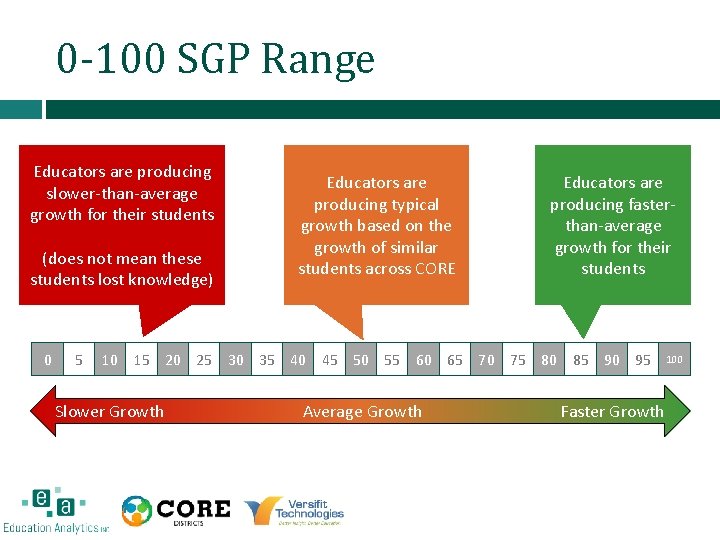
0 -100 SGP Range Educators are producing slower-than-average growth for their students (does not mean these students lost knowledge) 0 5 Educators are producing typical growth based on the growth of similar students across CORE Educators are producing fasterthan-average growth for their students 10 15 20 25 30 35 40 45 50 55 60 65 70 75 80 85 90 95 Slower Growth Average Growth Faster Growth 100
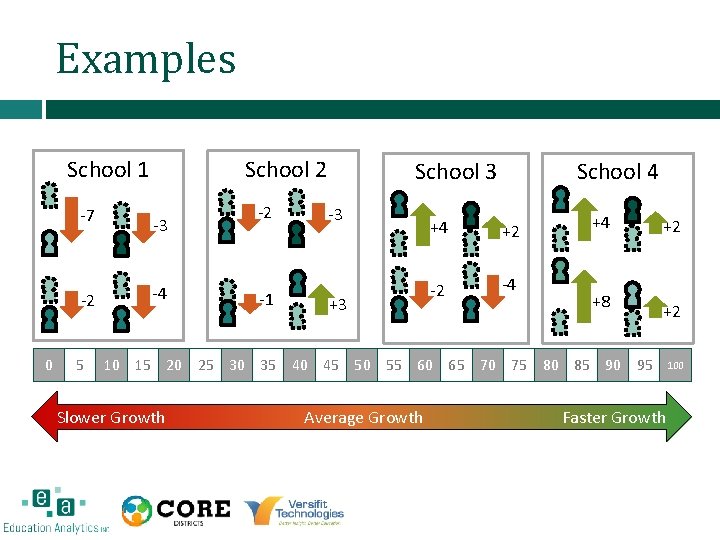
Examples School 1 -7 -2 0 5 School 2 -3 -4 -2 -1 School 3 -3 +3 School 4 +4 +2 -2 -4 +4 +8 +2 +2 10 15 20 25 30 35 40 45 50 55 60 65 70 75 80 85 90 95 Slower Growth Average Growth Faster Growth 100
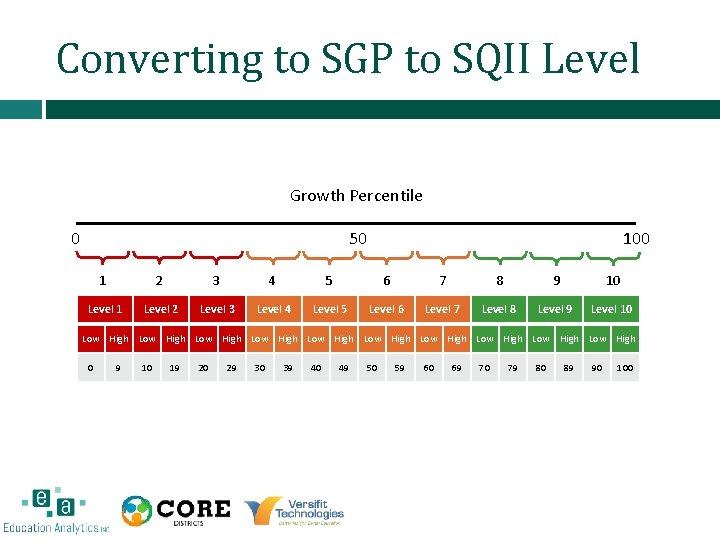
Converting to SGP to SQII Level Growth Percentile 0 100 50 1 2 3 4 5 6 7 8 9 10 Level 1 Level 2 Level 3 Level 4 Level 5 Level 6 Level 7 Level 8 Level 9 Level 10 Low High Low High Low High 0 9 10 19 20 29 30 39 40 49 50 59 60 69 70 79 80 89 90 100
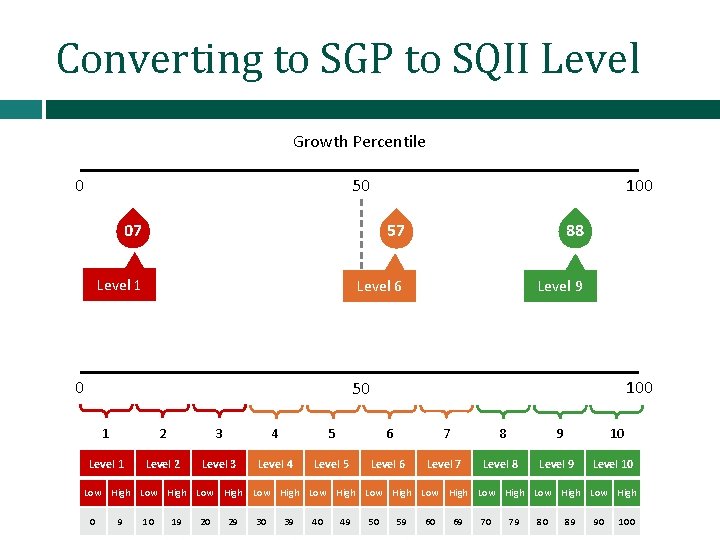
Converting to SGP to SQII Level Growth Percentile 0 100 50 07 57 88 Level 1 Level 6 Level 9 0 100 50 1 2 3 4 5 6 7 8 9 10 Level 1 Level 2 Level 3 Level 4 Level 5 Level 6 Level 7 Level 8 Level 9 Level 10 Low High Low High Low High 0 9 10 19 20 29 30 39 40 49 50 59 60 69 70 79 80 89 90 100
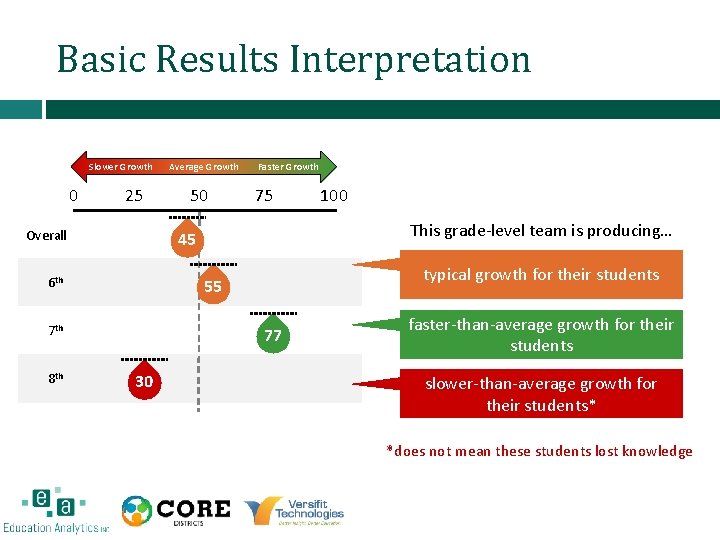
Basic Results Interpretation Slower Growth 0 25 Overall 50 Faster Growth 75 typical growth for their students 55 7 th 77 30 100 This grade-level team is producing… 45 6 th 8 th Average Growth faster-than-average growth for their students slower-than-average growth for their students* *does not mean these students lost knowledge
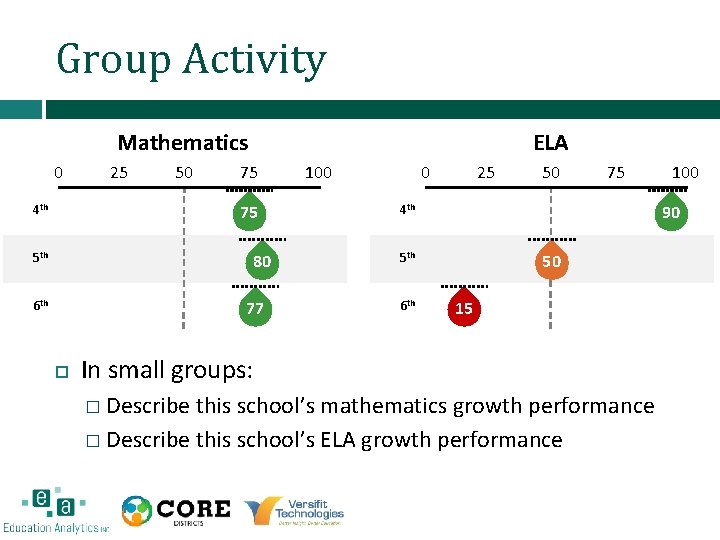
Group Activity ELA Mathematics 0 25 50 4 th 75 75 5 th 80 6 th 77 100 0 25 50 75 4 th 90 5 th 6 th 50 15 In small groups: � Describe 100 this school’s mathematics growth performance � Describe this school’s ELA growth performance
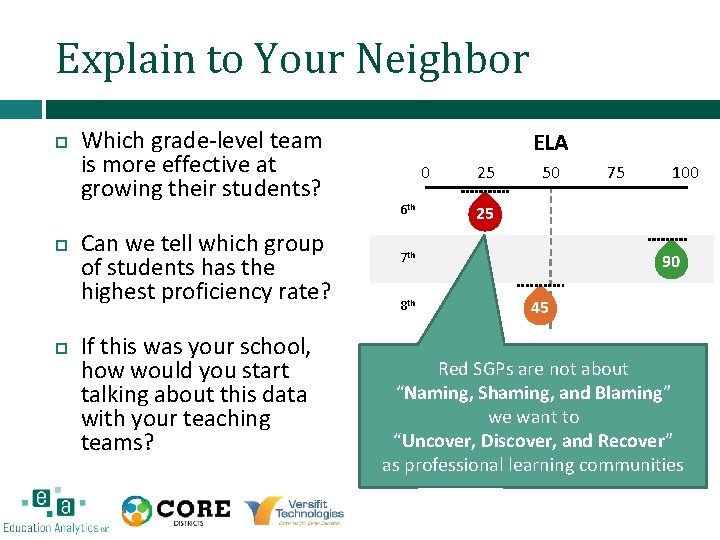
Explain to Your Neighbor Which grade-level team is more effective at growing their students? Can we tell which group of students has the highest proficiency rate? If this was your school, how would you start talking about this data with your teaching teams? ELA 0 6 th 25 50 100 25 7 th 8 th 75 90 45 Red SGPs are not about “Naming, Shaming, and Blaming” we want to “Uncover, Discover, and Recover” as professional learning communities
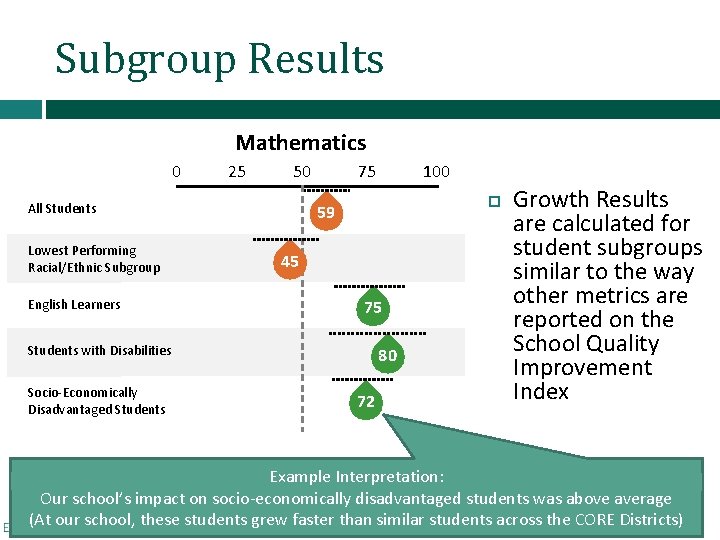
Subgroup Results Mathematics 0 25 50 All Students Lowest Performing Racial/Ethnic Subgroup English Learners 75 59 45 75 Students with Disabilities Socio-Economically Disadvantaged Students 100 80 72 Growth Results are calculated for student subgroups similar to the way other metrics are reported on the School Quality Improvement Index Example Interpretation: Our school’s impact on socio-economically disadvantaged students was above average (At our school, these students grew faster than similar students across the CORE Districts)
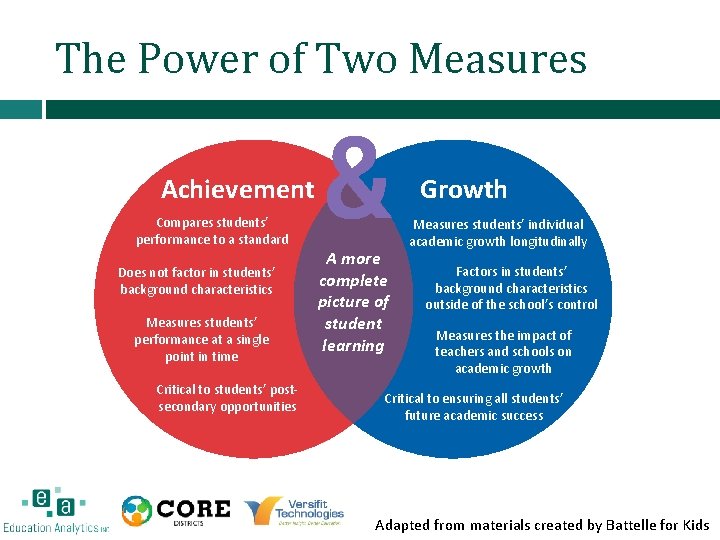
The Power of Two Measures Achievement Compares students’ performance to a standard Does not factor in students’ background characteristics Measures students’ performance at a single point in time Critical to students’ postsecondary opportunities & A more complete picture of student learning Growth Measures students’ individual academic growth longitudinally Factors in students’ background characteristics outside of the school’s control Measures the impact of teachers and schools on academic growth Critical to ensuring all students’ future academic success Adapted from materials created by Battelle for Kids
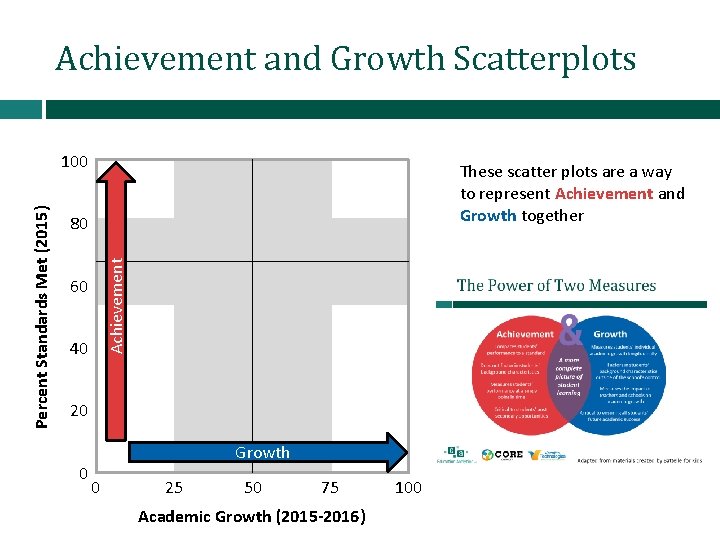
Achievement and Growth Scatterplots These scatter plots are a way to represent Achievement and Growth together 80 Achievement Percent Standards Met (2015) 100 60 40 20 0 Growth 0 25 50 75 Academic Growth (2015 -2016) 100
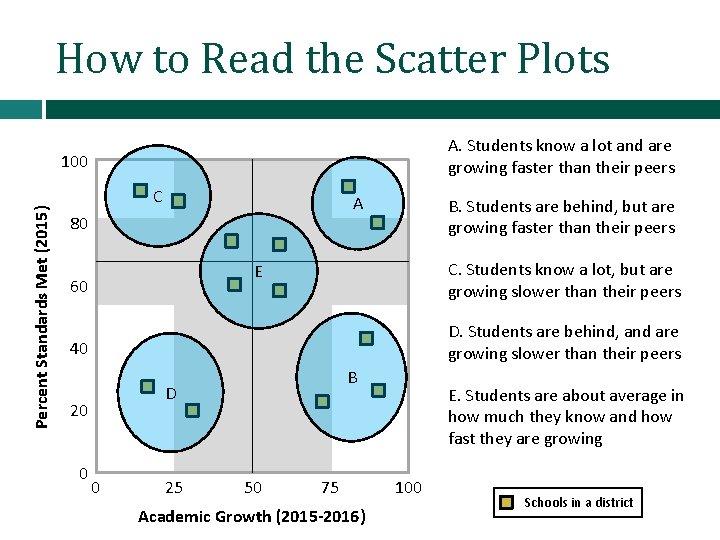
How to Read the Scatter Plots A. Students know a lot and are growing faster than their peers Percent Standards Met (2015) 100 C A 80 B. Students are behind, but are growing faster than their peers C. Students know a lot, but are growing slower than their peers E 60 D. Students are behind, and are growing slower than their peers 40 D 20 0 B 0 25 50 75 Academic Growth (2015 -2016) E. Students are about average in how much they know and how fast they are growing 100 Schools in a district
Your Results Review What are the strengths at your school? Are we outstanding in any areas? � Where are we “on track” with the CORE districts’ schools? � Where can we improve as a school? � Not about “naming, blaming, shaming” – we want to “uncover, discover, recover” Conversation starters How would you start talking about this data at your school? � What other data would you want to see? � Interpretation questions � What questions might your colleagues have about these reports?