
CORC for Schools in Mind Breakfast Briefing Tuesday
CORC for Schools in Mind Breakfast Briefing Tuesday 8 th March 2016 Emma Morgan
CORC for Schools 1. Overview of CORC for Schools 2. Introduction to the measures that are proving popular and practice at scoring one 3. Benefits and challenges arising from the pilot: consulting on attainment measures 4. CORC for Schools membership models and training offer
1. Overview of CORC for Schools
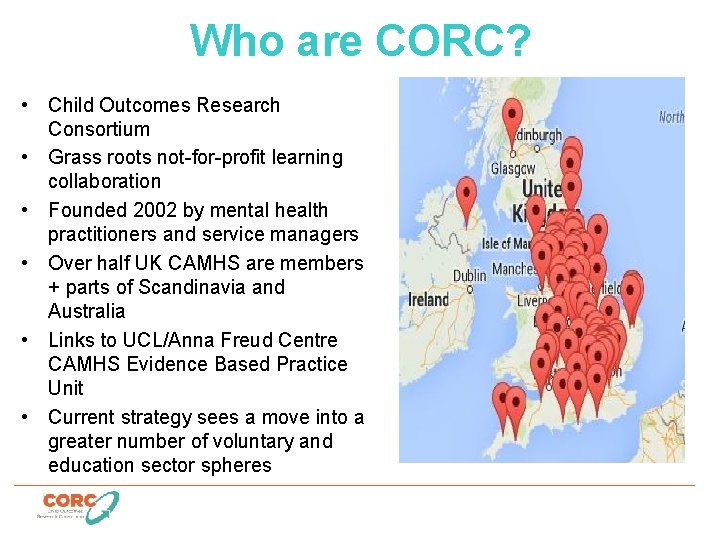
Who are CORC? • Child Outcomes Research Consortium • Grass roots not-for-profit learning collaboration • Founded 2002 by mental health practitioners and service managers • Over half UK CAMHS are members + parts of Scandinavia and Australia • Links to UCL/Anna Freud Centre CAMHS Evidence Based Practice Unit • Current strategy sees a move into a greater number of voluntary and education sector spheres
CORC’s Mission To support all those seeking to provide services that promote child wellbeing to make meaningful use of outcome data to develop highest quality services • As part of person centred care • To improve direct work • To inform the improvement and design of services
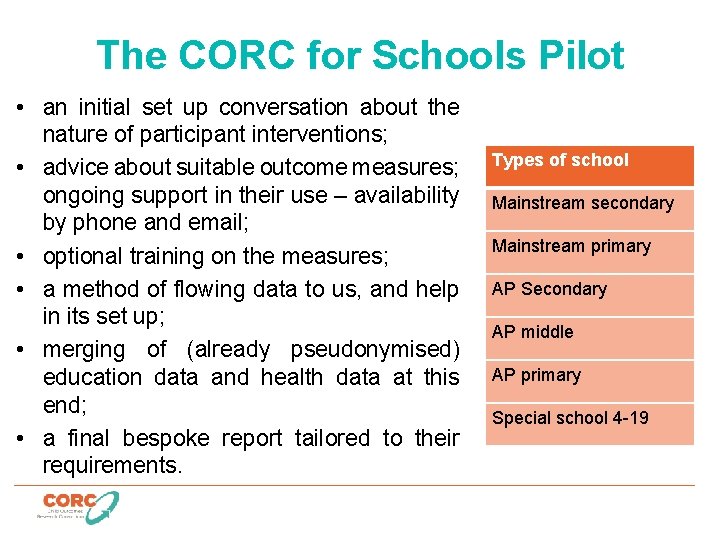
The CORC for Schools Pilot • an initial set up conversation about the nature of participant interventions; • advice about suitable outcome measures; ongoing support in their use – availability by phone and email; • optional training on the measures; • a method of flowing data to us, and help in its set up; • merging of (already pseudonymised) education data and health data at this end; • a final bespoke report tailored to their requirements. Types of school Mainstream secondary Mainstream primary AP Secondary AP middle AP primary Special school 4 -19
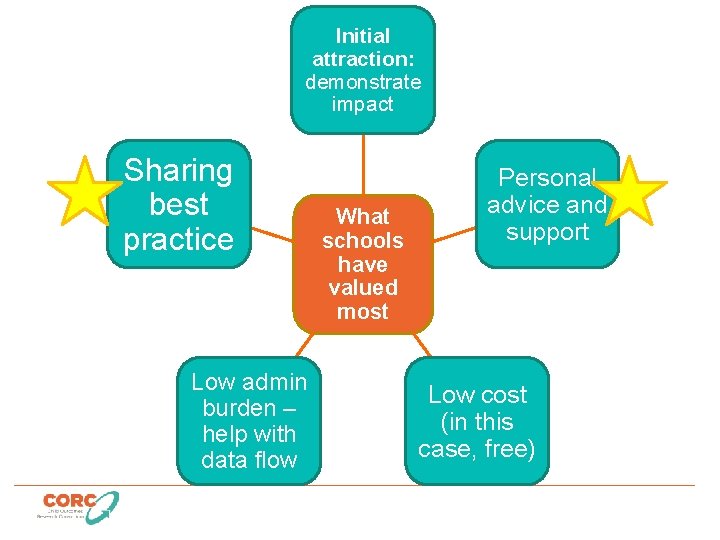
Initial attraction: demonstrate impact Sharing best practice Low admin burden – help with data flow What schools have valued most Personal advice and support Low cost (in this case, free)
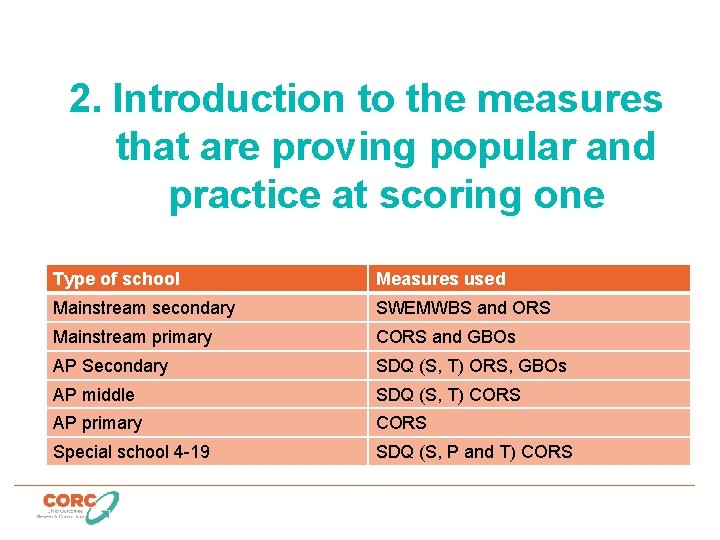
2. Introduction to the measures that are proving popular and practice at scoring one Type of school Measures used Mainstream secondary SWEMWBS and ORS Mainstream primary CORS and GBOs AP Secondary SDQ (S, T) ORS, GBOs AP middle SDQ (S, T) CORS AP primary CORS Special school 4 -19 SDQ (S, P and T) CORS
Opportunities in the use of questionnaire based measures in schools • Questionnaire based measures are useful in that they capture subjective feelings and behaviours. • They can measure elements that are hard to capture through observation alone. • By using in schools, as opposed to in clinics, you’re measuring their natural environment. • They can actively make people think about how they feel – often key to changing behaviours. CLINICAL USEFULNESS • They can be used for service evaluation and improvement. SERVICE EVALUATION
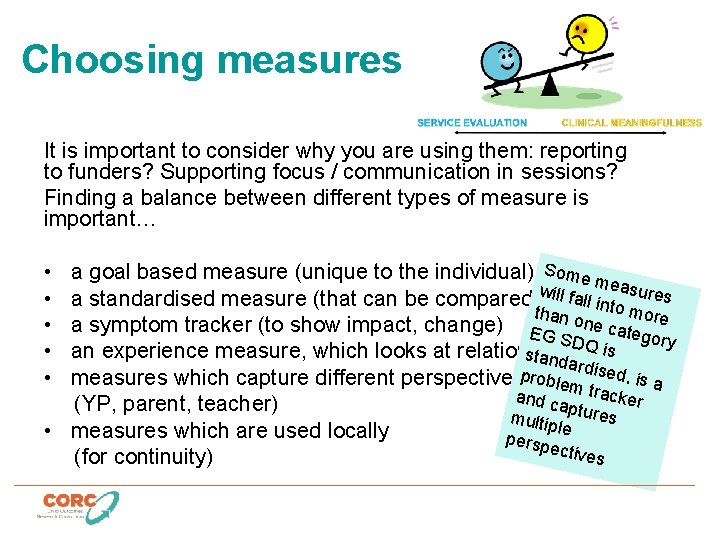
Choosing measures It is important to consider why you are using them: reporting to funders? Supporting focus / communication in sessions? Finding a balance between different types of measure is important… • a goal based measure (unique to the individual) Some me a • a standardised measure (that can be compared)will fall into smures th o • a symptom tracker (to show impact, change) EGan one categ re ory SDQ i s • an experience measure, which looks at relationship stand ardise • measures which capture different perspectives problem d, is a trac and c (YP, parent, teacher) aptur ker es multip l e • measures which are used locally persp ective (for continuity) s
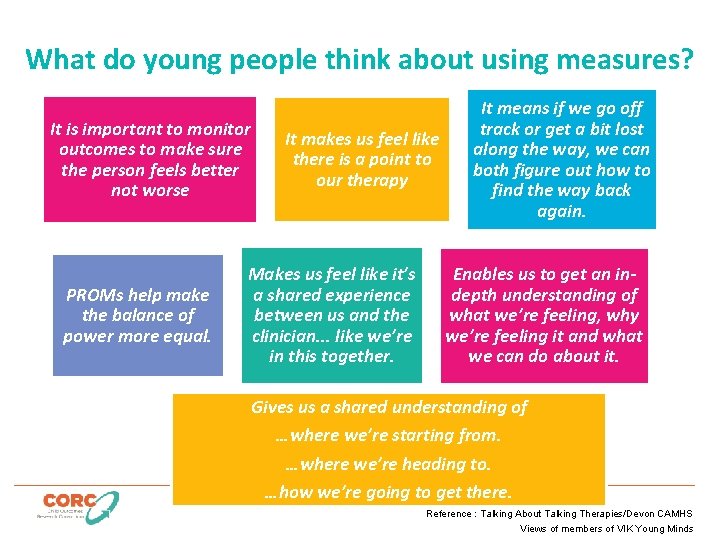
What do young people think about using measures? It is important to monitor outcomes to make sure the person feels better not worse PROMs help make the balance of power more equal. It makes us feel like there is a point to our therapy Makes us feel like it’s a shared experience between us and the clinician. . . like we’re in this together. It means if we go off track or get a bit lost along the way, we can both figure out how to find the way back again. Enables us to get an indepth understanding of what we’re feeling, why we’re feeling it and what we can do about it. Gives us a shared understanding of …where we’re starting from. …where we’re heading to. …how we’re going to get there. Reference : Talking About Talking Therapies/Devon CAMHS Views of members of VIK Young Minds
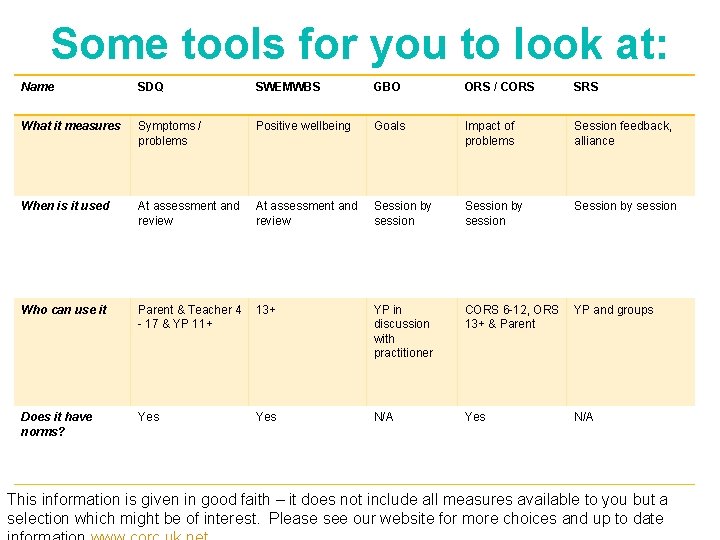
Some tools for you to look at: Name SDQ SWEMWBS GBO ORS / CORS SRS What it measures Symptoms / problems Positive wellbeing Goals Impact of problems Session feedback, alliance When is it used At assessment and review Session by session Who can use it Parent & Teacher 4 - 17 & YP 11+ 13+ YP in discussion with practitioner CORS 6 -12, ORS YP and groups 13+ & Parent Does it have norms? Yes N/A This information is given in good faith – it does not include all measures available to you but a selection which might be of interest. Please see our website for more choices and up to date
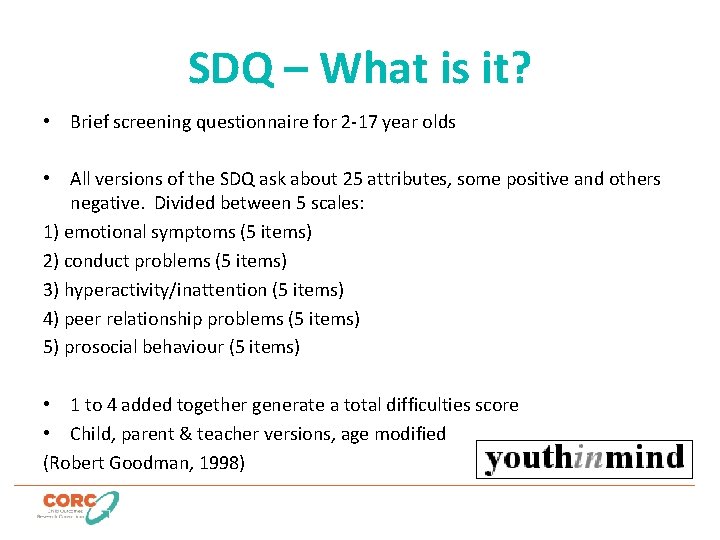
SDQ – What is it? • Brief screening questionnaire for 2 -17 year olds • All versions of the SDQ ask about 25 attributes, some positive and others negative. Divided between 5 scales: 1) emotional symptoms (5 items) 2) conduct problems (5 items) 3) hyperactivity/inattention (5 items) 4) peer relationship problems (5 items) 5) prosocial behaviour (5 items) • 1 to 4 added together generate a total difficulties score • Child, parent & teacher versions, age modified (Robert Goodman, 1998)
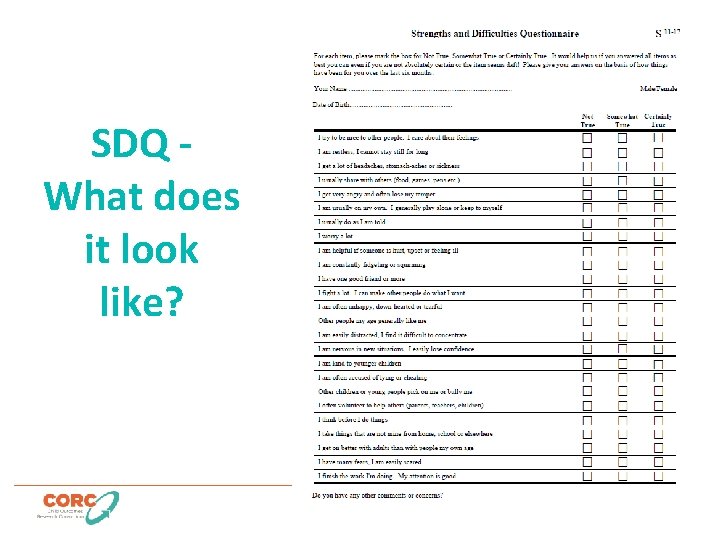
SDQ What does it look like?
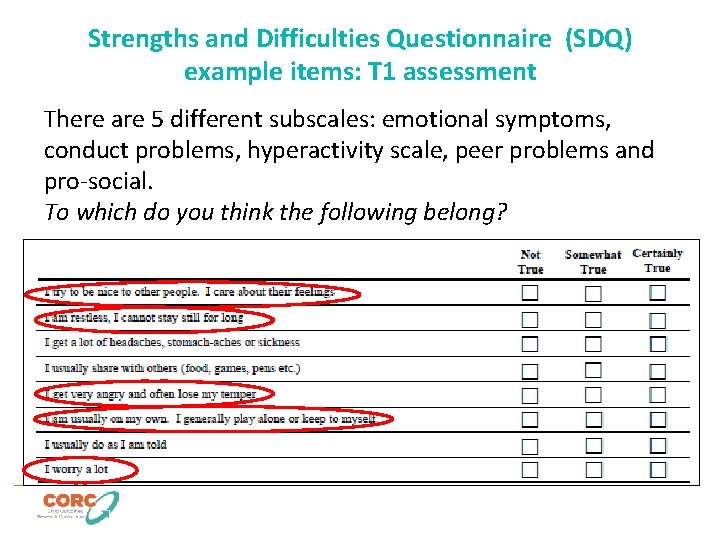
Strengths and Difficulties Questionnaire (SDQ) example items: T 1 assessment There are 5 different subscales: emotional symptoms, conduct problems, hyperactivity scale, peer problems and pro-social. To which do you think the following belong? Robert Goodman
Scoring the SDQ Each item on the questionnaire fits into one of 5 categories, and each item can be given 0, 1 or 2. The ‘total’ difficulties score is calculated from adding four of the categories (excluding prosocial behaviour) together, giving a score out of 40. You may also find that some of the categories present more strongly than others.
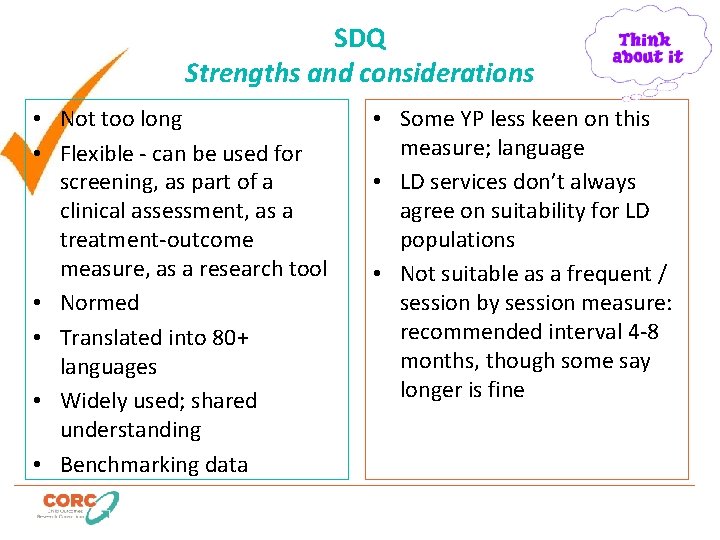
SDQ Strengths and considerations • Not too long • Flexible - can be used for screening, as part of a clinical assessment, as a treatment-outcome measure, as a research tool • Normed • Translated into 80+ languages • Widely used; shared understanding • Benchmarking data • Some YP less keen on this measure; language • LD services don’t always agree on suitability for LD populations • Not suitable as a frequent / session by session measure: recommended interval 4 -8 months, though some say longer is fine
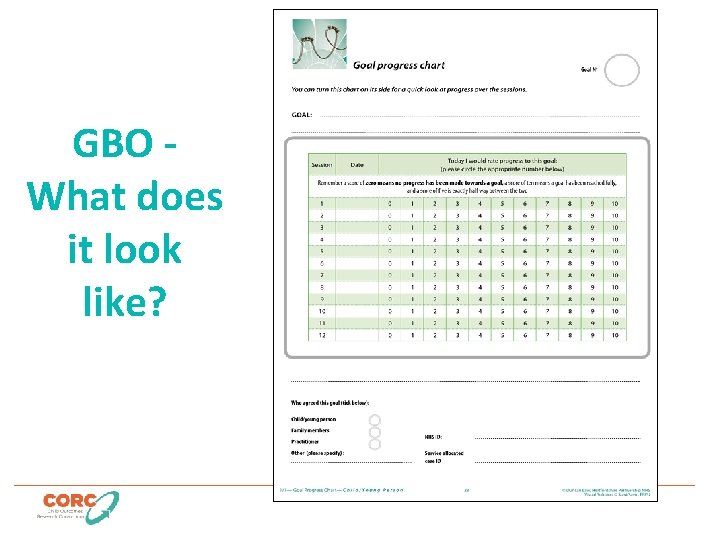
GBO What does it look like?
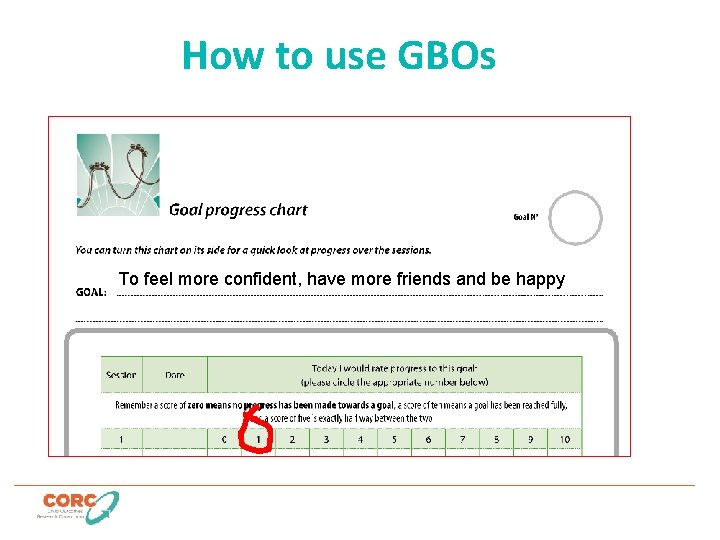
How to use GBOs To feel more confident, have more friends and be happy
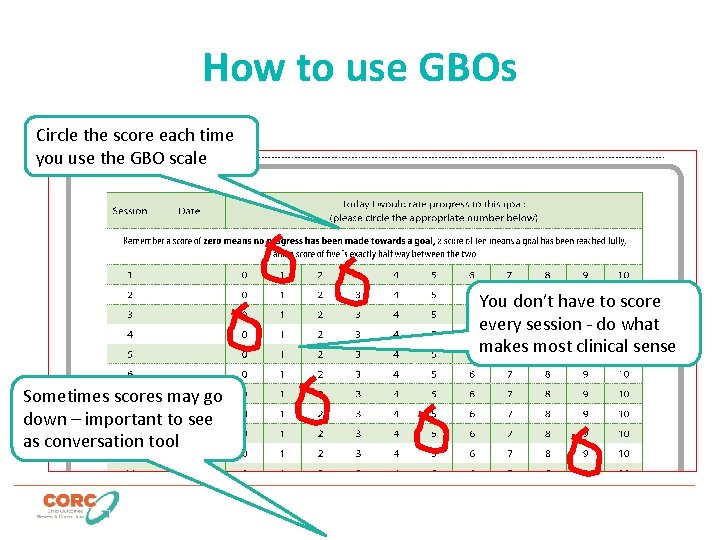
How to use GBOs Circle the score each time you use the GBO scale You don’t have to score every session - do what makes most clinical sense Sometimes scores may go down – important to see as conversation tool
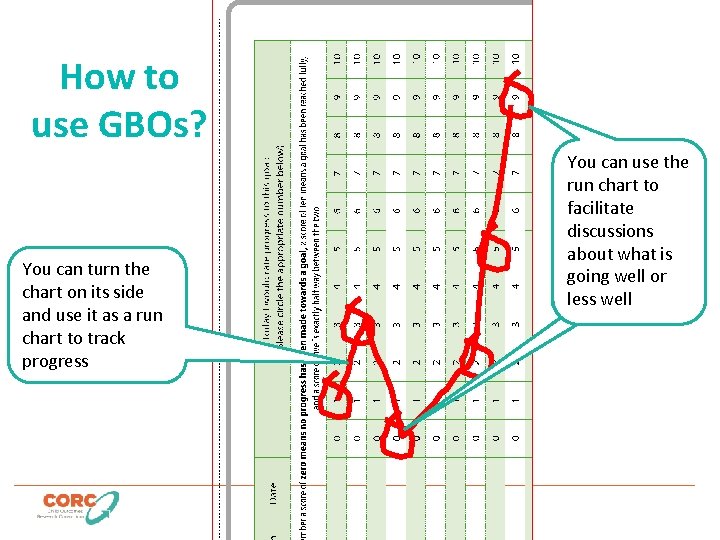
How to use GBOs? You can turn the chart on its side and use it as a run chart to track progress You can use the run chart to facilitate discussions about what is going well or less well
GBOs Strengths and Considerations • Can be a good starting point • Can provide structure • Can help set collaborative targets for therapy • Allow progress to be tracked in a way that is meaningful to young people, recognising progress and building self-confidence. • Applicable to a broad spectrum of interventions • Complement other measures • Can support a strong working alliance • It is important to set the right goals - achievable • Goals can make young people feel under pressure, particularly those anxious about succeeding • Need to be aware of what makes a good goal. • Need to explore young people’s thoughts about using goals so worries are made explicit and can direct decisions about choice and use of goals in therapy • Not normed Views from interviews with service users at Young People’s Participation project in East Hertfordshire Specialist CAMHS
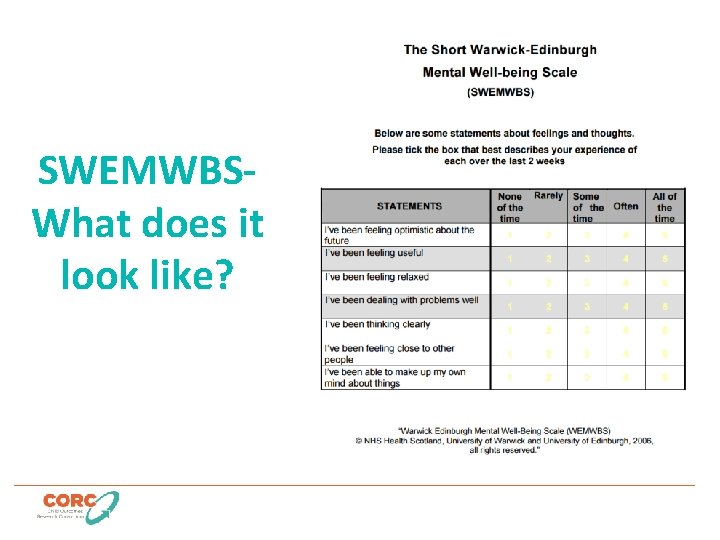
SWEMWBSWhat does it look like?
(S)WEMWBS Strengths and considerations • The WEMWBS is a scale that measures mental wellbeing (as opposed to mental illness or disorder) • It is suitable for use in the general population. • Its strengths are that it is positively worded, represents positive attributes of wellbeing and covers both feeling and functioning. • The WEMWBS is a scale that measures mental wellbeing (as opposed to mental illness or disorder) • It may not suit a specific targeted intervention. • The positive wording may lead to being less keen to disclose negatives
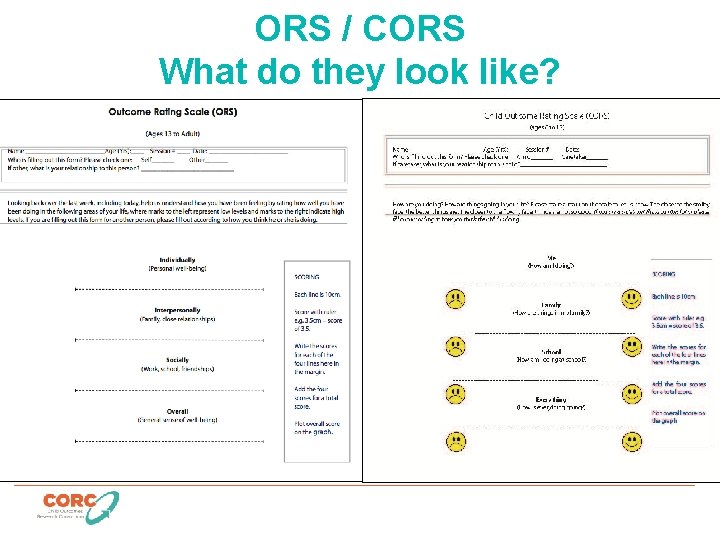
ORS / CORS What do they look like?
ORS / CORS Strengths and considerations • Simple to complete • Separates different areas of a child’s life: self, family, school, overall. • Can be used session by session • Available (US) norms • Can support a conversation / dialogue about feelings • Simplicity makes data less specific, and gives less depth. • Might be better for internal comparison than direct comparison with others – change is relative.
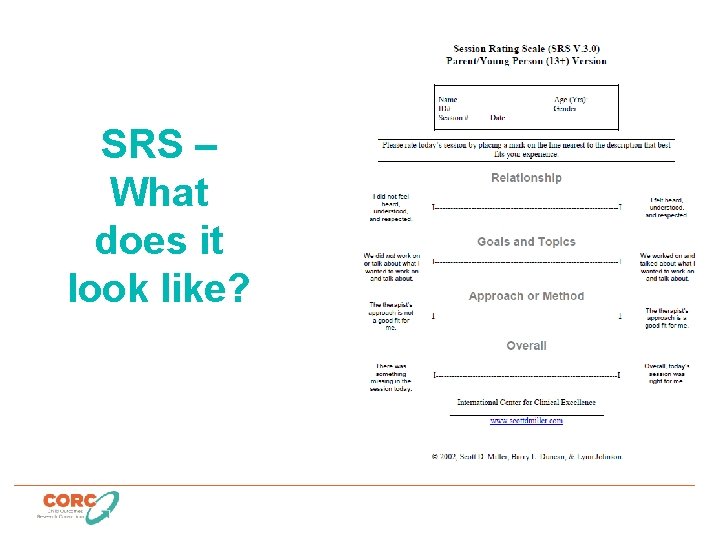
SRS – What does it look like?
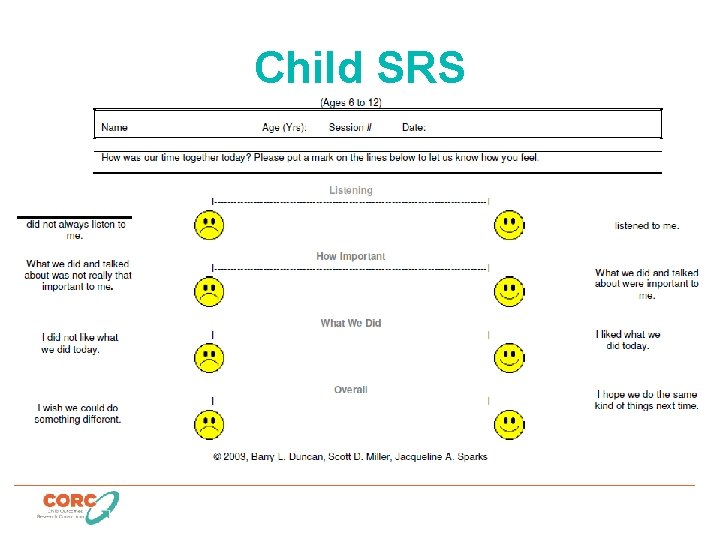
Child SRS
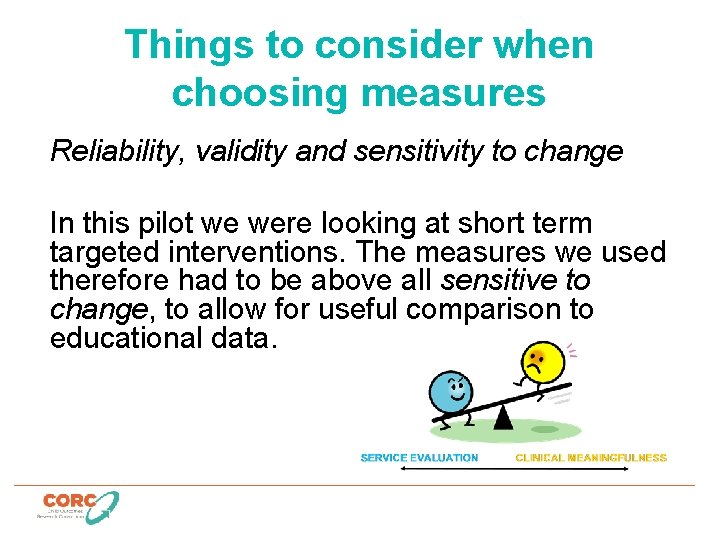
Things to consider when choosing measures Reliability, validity and sensitivity to change In this pilot we were looking at short term targeted interventions. The measures we used therefore had to be above all sensitive to change, to allow for useful comparison to educational data.
3. Benefits and challenges arising from the pilot
Towards a common attainment measure Since the use of National Curriculum levels has been discontinued, schools are using a range of methods for recording attainment and tracking progress. Four possible solutions identified: 1. Bespoke analysis 2. Small number of options 3. Devise common measure a. b. c. devise a four point scale for Educational Level akin to the Current View descriptors, and in consultation with school contacts, that schools would fill in, based on whatever they collect. Information would be provided on where students sit within their year e. g. bottom 20% Information would be provided on percentage distance from target 4. Do not include attainment
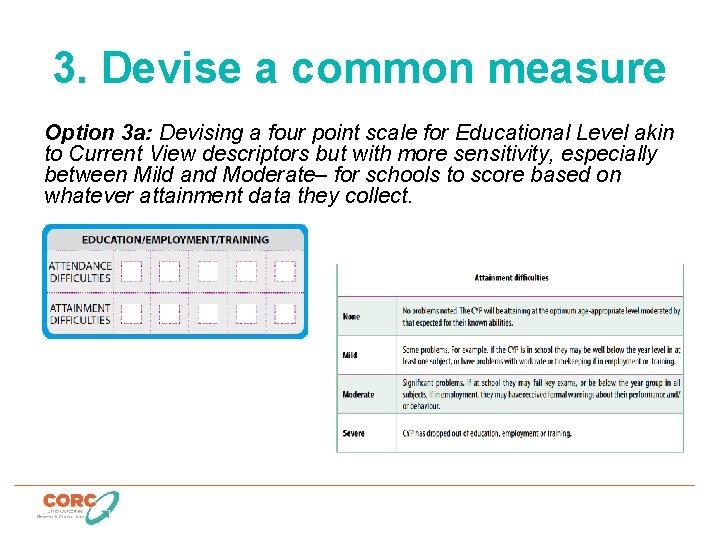
3. Devise a common measure Option 3 a: Devising a four point scale for Educational Level akin to Current View descriptors but with more sensitivity, especially between Mild and Moderate– for schools to score based on whatever attainment data they collect.
4. CORC for Schools membership models
Relevant learning from CORC for Schools Pilot Implications of learning for membership models • • No dedicated budget Admin capacity Limited IT facilities Report might not be cost efficient
Single School Membership The Offer: School Membership Access to telephone and email support and advice about choosing, working with, and understanding data from measures Access to regional and national shared learning events and an opt in enewsletter with updates, shared learning and latest research Access to membership level day rates if they want face to face support, e. g. training on using measures, capturing or analysing data Access to easy-to-use tools that help schools to do their own simple analysis
Single School Membership Interpreting measures data Access to easy-to-use tools that help schools to do their own simple analysis – e. g. an excel spreadsheet into which T 1 and T 2 data can be entered that generates a graph and contains some guiding text on considerations/ questions to ask yourself about the data – e. g. access to an annual or 6 monthly generic ‘rest of CORC’ benchmark for change in scores against relevant measures e. g. average points change for a goal between T 1 and T 2 Cost per annum: £ 300 for a school of <900 pupils, £ 450 for 900<
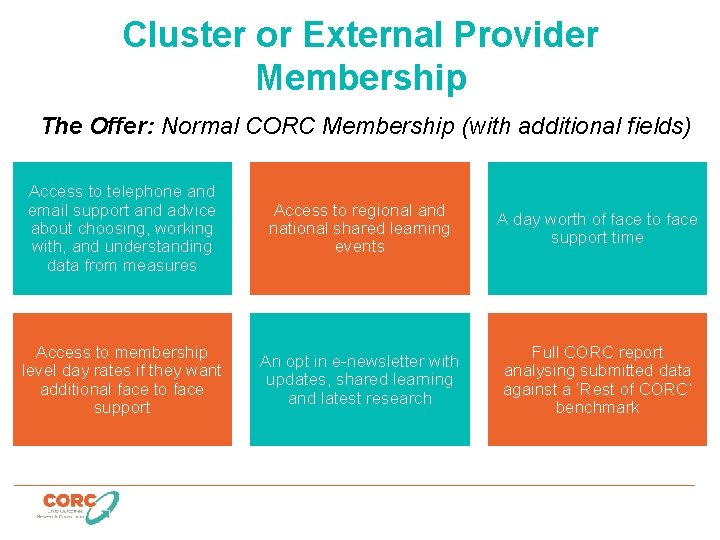
Cluster or External Provider Membership The Offer: Normal CORC Membership (with additional fields) Access to telephone and email support and advice about choosing, working with, and understanding data from measures Access to regional and national shared learning events A day worth of face to face support time Access to membership level day rates if they want additional face to face support An opt in e-newsletter with updates, shared learning and latest research Full CORC report analysing submitted data against a ‘Rest of CORC’ benchmark
Cluster or External Provider Membership Interpreting measures data Unlike the pilot, education and measures data would be flowed together through an AFC owned platform. In order to pick up on aspects of reporting that are important to schools we would make the following additions to the current CORC data specification – Additional field: Attendance (% score measured in a standard way as currently) – Additional field: Attainment (see options below) – Ensure people complete fields stating ‘setting’; ‘professionals present’ – this will enable people to see which data are from school based interventions / delivered by different types of professionals Cost per annum: £ 1, 500 (voluntary) or £ 3, 000 (statutory)
Non-member training offer • Outcomes measures training available independent of membership • Up to 10 people £ 500 (£ 350 for members) plus expenses • Larger groups negotiable • Offer on first year of membership if previously bought training
If you have any questions, please contact: • Emma Morgan – CORC for Schools Project Manager – emma. morgan@annafreud. org • CORC Office – corc@annafreud. org – 0207 443 2225
- Slides: 41