
Coral Reef Ecosystems of Guam BI 201 Natural
Coral Reef Ecosystems of Guam BI 201 Natural History of Guam Class Presentation 36
General Characteristics n Coral reefs are accumulations of calcium carbonate generated by certain organisms cementing their skeletons together, especially corals and coralline algae • Organisms extract Ca. CO 3 from seawater and deposit new limestone, increasing the size of the reef • Other benthic organisms living on the limestone substrate contribute to the accumulation of carbonate as they die, leaving their Ca. CO 3 skeletal remains
• Coral reefs are so massive that they are also considered geological structures • In the nautical sense, a reef is shoal water, a sand bar, or a navigational hazard
n Coral reefs are scattered over 190, 000 km 2 of Earth’s surface • The total area inhabited by coral reefs has expanded and contracted with global climate and sea level changes n For example, in the Devonian (ca. 400– 350 Mybp), coral reefs covered 540, 000 km 2 • The distribution of corals is pantropical
n Environmental requirements for coral reef development • Three environmental factors control the distribution and development of coral reefs 1) Salinity 2) Temperature 3) Water transparency

• Salinity is a measure of the amount of dissolved solids in seawater n Coral reef development requires a salinity of 34– 36 ‰ • Therefore, corals do not grow well in mouths of rivers where salinity <30 ‰
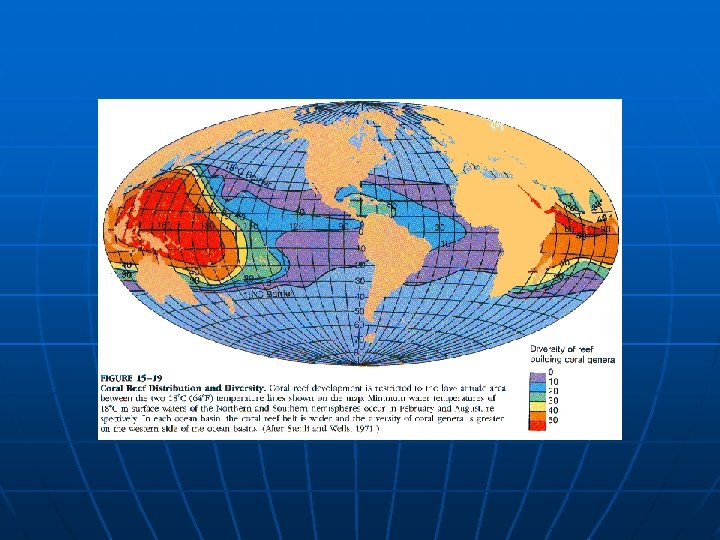
• Temperature n The optimum temperature range for coral reefs is 25– 28° C • Therefore, coral reefs are restricted to shallow, warm waters of the tropics n Because of the distribution of warmth on Earth, the optimum geographic range of coral reefs is from about 20° N to 20° S latitude • However, the distribution of coral reefs can reach to 30° latitude where warm-water currents flow to that latitude, e. g. , southern Japan or southern Australian Great Barrier Reef
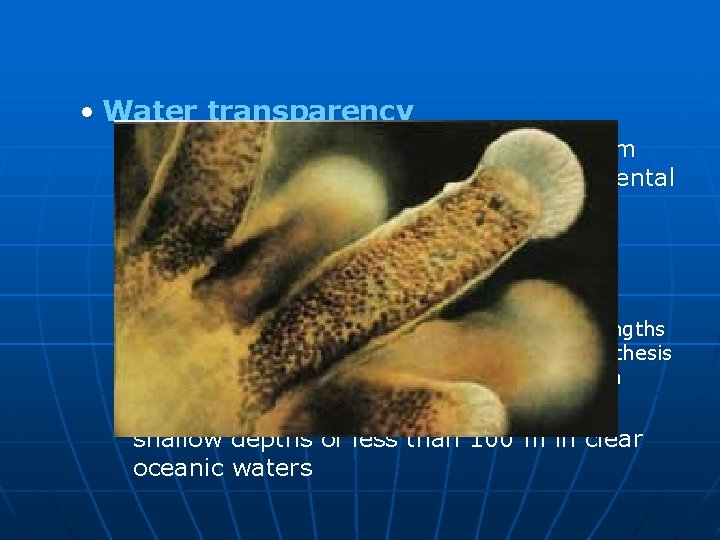
• Water transparency Coral reefs require clear water away from intense sedimentation from large continental rivers n Coral reefs also require brightly lighted waters to sustain symbiotic algae called zooxanthellae living in their tissues n • Because water differentially absorbs wavelengths of light energy, light that supports photosynthesis does not penetrate beyond a depth of 100 m n Therefore, coral reefs are restricted to shallow depths of less than 100 m in clear oceanic waters
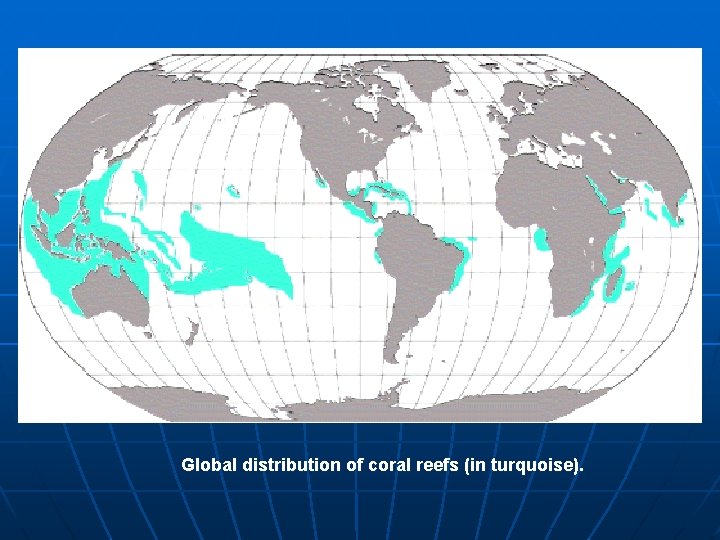
Global distribution of coral reefs (in turquoise).
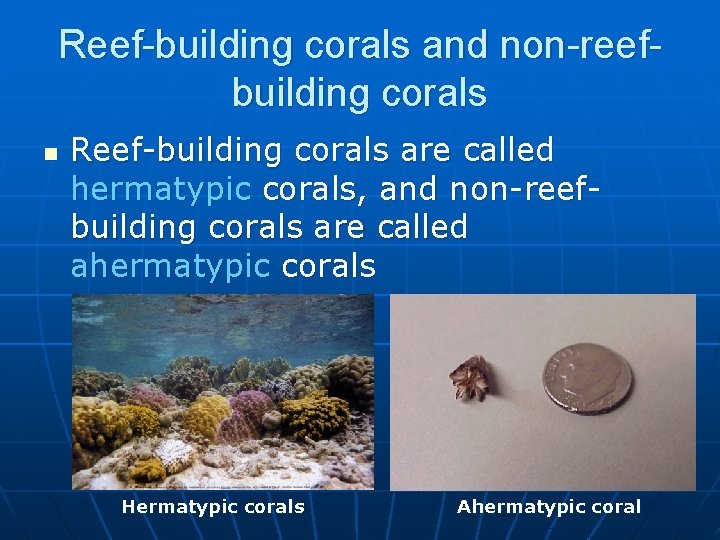
Reef-building corals and non-reefbuilding corals n Reef-building corals are called hermatypic corals, and non-reefbuilding corals are called ahermatypic corals Hermatypic corals Ahermatypic coral
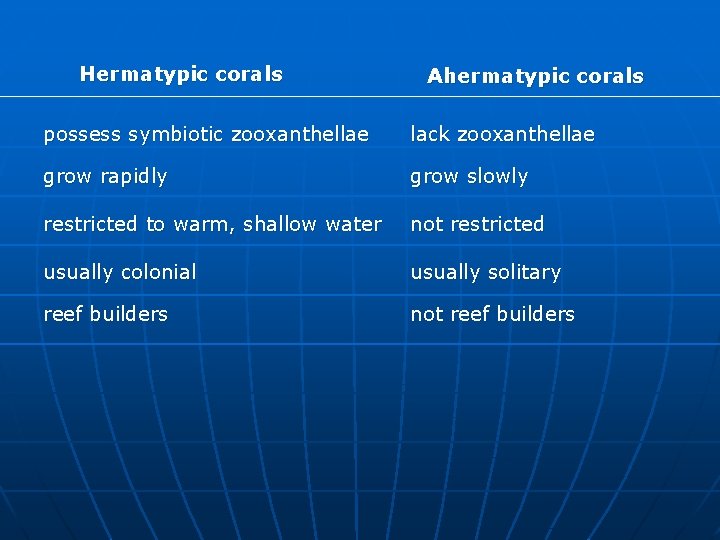
Hermatypic corals Ahermatypic corals possess symbiotic zooxanthellae lack zooxanthellae grow rapidly grow slowly restricted to warm, shallow water not restricted usually colonial usually solitary reef builders not reef builders
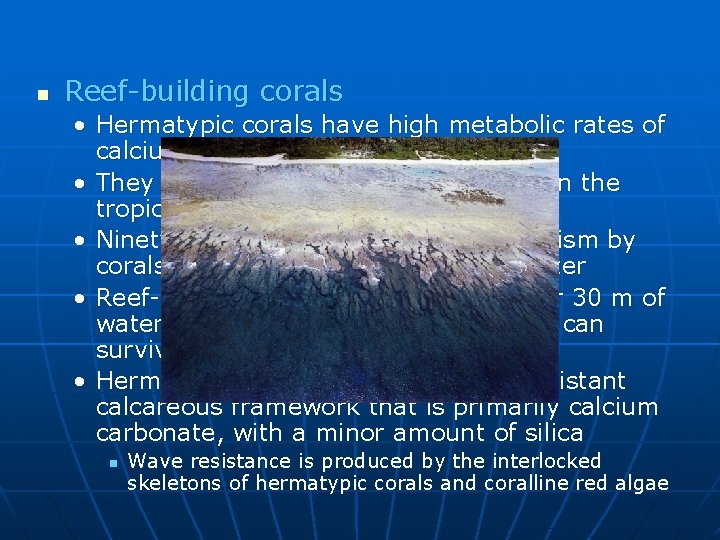
n Reef-building corals • Hermatypic corals have high metabolic rates of calcium carbonate production • They live in warm marine waters within the tropical zone of high solar illumination • Ninety percent of the calcium metabolism by corals occurs in the upper 20 m of water • Reef-building is restricted to the upper 30 m of water, even though hermatypic corals can survive to depths of 200 m • Hermatypic corals produce a wave-resistant calcareous framework that is primarily calcium carbonate, with a minor amount of silica n Wave resistance is produced by the interlocked skeletons of hermatypic corals and coralline red algae
Coral reef development n The idea of evolution of coral reefs through a series of developmental stages was first proposed by Charles Darwin after he returned from the voyage of HMS Beagle • Darwin was the first to recognize the connections between fringing reefs, barrier reefs, and atolls
n Fringing reefs • Fringing reefs are formed by coral larvae settling on the sides of a volcanic island • Fringing that are adjacent to land essentially are underwater extensions of the land • Examples of well-developed fringing reefs can be found on Guam and Kosrae
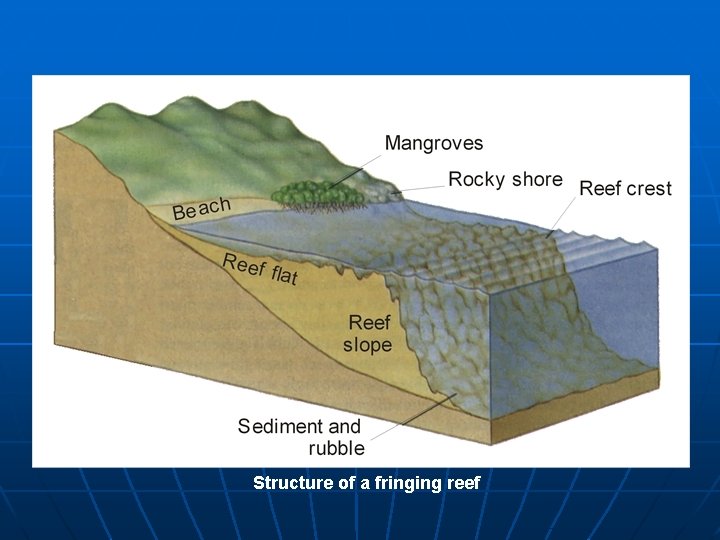
Structure of a fringing reef
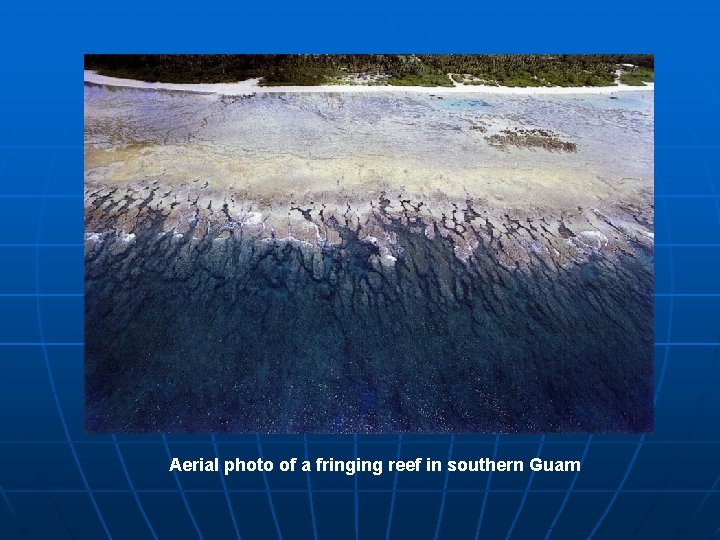
Aerial photo of a fringing reef in southern Guam
n Barrier reefs • Over geological time, the volcano becomes inactive, the lithosphere cools, and the island begins to subside • If subsidence is not fast, coral growth keeps pace with subsidence, and reefs grow vertically • Reef growth produces barrier reefs, which are reefs that are separated from the shore by a deep lagoon
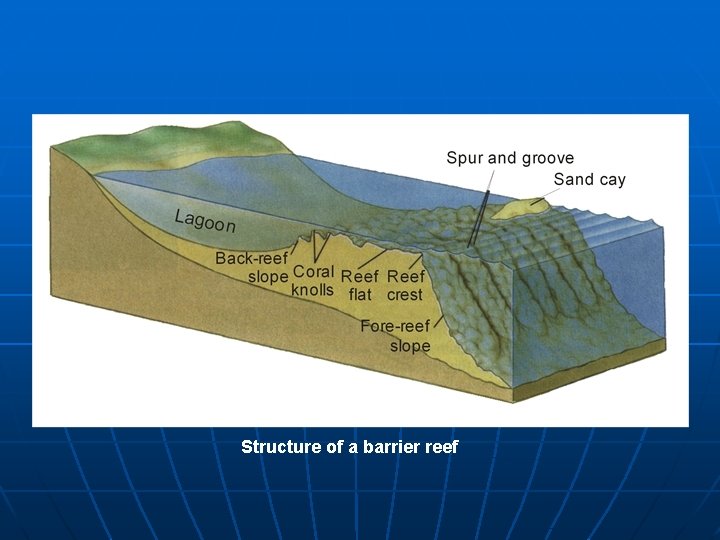
Structure of a barrier reef
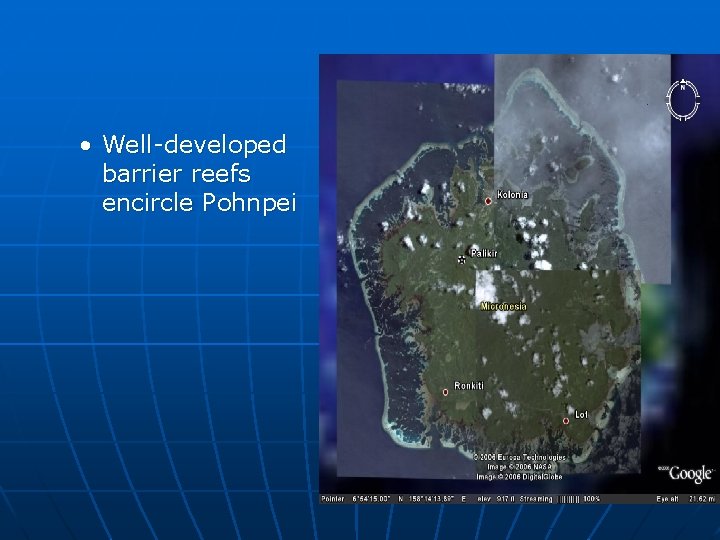
• Well-developed barrier reefs encircle Pohnpei
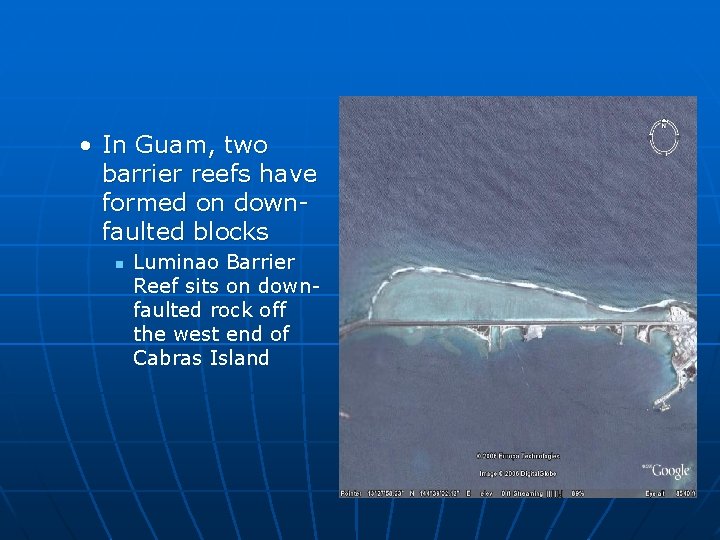
• In Guam, two barrier reefs have formed on downfaulted blocks n Luminao Barrier Reef sits on downfaulted rock off the west end of Cabras Island
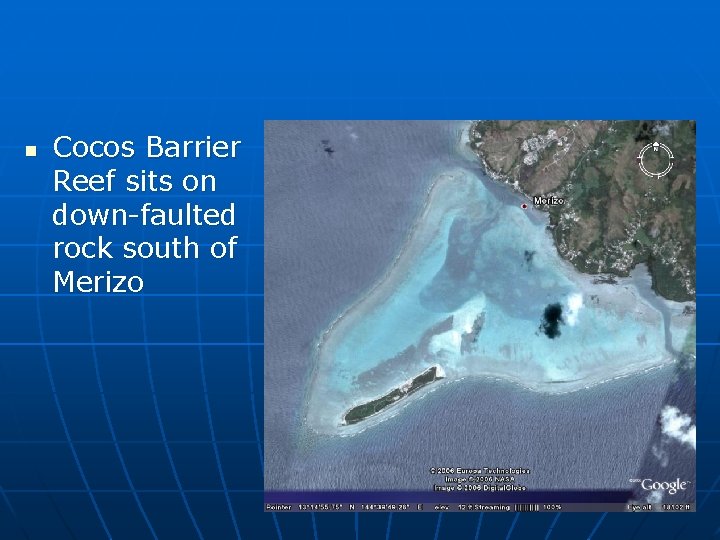
n Cocos Barrier Reef sits on down-faulted rock south of Merizo
n Atolls • Over geological time, volcanic islands continue to subside until the island is submerged • Where reef growth keeps pace with subsidence, the barrier reef becomes an atoll surrounding a deep central lagoon • Many atolls are found in Micronesia, including the largest (Kwajalein) and the smallest (Ant)
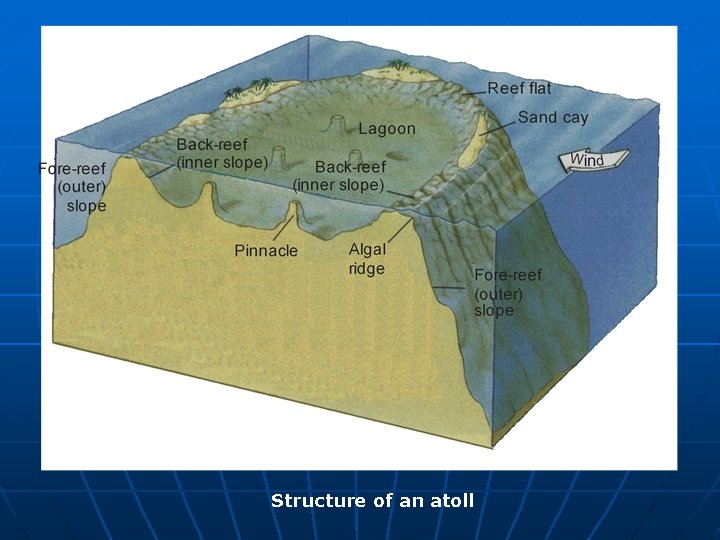
Structure of an atoll

n Guyots • Continued subsidence will “drown” an atoll when the rate of subsidence exceeds the rate of coral growth • When the atoll subsides deeper than the 30 m depth where reef formation can occur, the drowned atoll is called a guyot
• Darwin’s hypothesis on coral reef evolution was supported when geologists drilled cores through the reef at Enewetak in 1957 and found the basement volcanic rock at a depth of 3, 936 ft n The estimated age of volcanic rocks was 51– 59 Mybp (Eocene) • Darwin’s model is supported by data from mid-plate island chains throughout the Pacific, e. g. , Hawaii; Mururoa, French Polynesia
• Therefore, Darwin’s hypothesis anticipated the idea of plate tectonics • However, Darwin’s hypothesis does not always apply to reefs associated with continental shelf islands (e. g. , Caribbean islands) or forearc islands (e. g. , Mariana Islands) in marginal seas
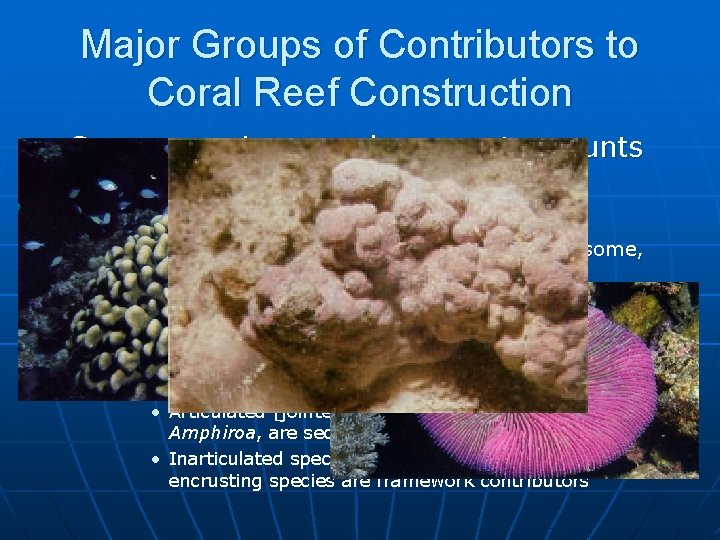
Major Groups of Contributors to Coral Reef Construction n Some organisms produce great amounts of carbonate to reef construction • hermatypic corals n Most corals are framework contributors, but some, i. e, Fungia, are sedimentary contributors • coralline red algae n Some species of algae have a calcium carbonate skeleton that provides some protection from being eaten by herbivores • Articulated [jointed, segmented] species, e. g. , Amphiroa, are sedimentary contributors • Inarticulated species, e. g, . Lithophyllum, and encrusting species are framework contributors
• calcareous green algae n n All are sedimentary contributors e. g. , Halimeda, Neomeris, Udotea • foraminiferans n n Solitary species, e. g. , Baculogypsina, Marginopora, are sedimentary contributors Colonial species, e. g. , Gypsina, Homotrema, are framework contributors • molluscs n n Most are sedimentary contributors, e. g. , gastropods Some large bivalves, e. g. , Spondylus sp. , are framework contributors
Erosional Forces on Coral Reefs n In addition to contributors to construction of coral reefs, there also factors that erode coral reefs a) Physical factors n n The primary physical destruction of coral reefs is caused by storm waves Chemical dissolution of reef limestone also contributes to the erosion of reefs
b)Biological factors 1)abrasion • Some species grind out a place to live on bare reef limestone n e. g. , home scar of intertidal limpets, Patelloida chamorrorum n e. g. , galleries of alpheid snapping shrimp 2)boring • Some species bore into reef limestone and even living coral colonies n e. g. , worms, mussels, sponges, gastropods • Boring weakens the reef and may cause areas to collapse
3) chemical • Some species use acidic body fluids to dissolve or etch reef limestone 4) eating • Some species bite off chunks coral and digest the living tissues n e. g. , parrotfishes, some filefishes
n All erosional forces produce carbonate sediments • Sediments are also important in development of reefs • Sediments are incorporated into the reef structure when cemented together by encrusting corals or algae • The ratio of framework : sediment on coral reefs is about 1: 10
Biodiversity n n Coral reef ecosystems are perhaps the most species-rich systems in the marine environment This high species diversity produces complex species interactions • For example, food chains in coral reef ecosystems are usually longer than those of other marine ecosystems
n High diversity also results in extreme competition for space • This competition is probably the reason for the high frequency of symbiotic associations in coral reef ecosystems
• Symbiosis is the close and usually obligatory association of two different organisms of different species living together, not necessarily to their mutual benefit Obligatory means that one or both organisms cannot survive without the symbiosis n Facultative symbiosis occurs when either or both organism can survive without the symbiosis, but both usually do better when in symbiosis n
n Types of symbiosis • Commensalism n Commensal is a symbiotic association that is clearly to the advantage of one organism while not causing any disadvantage to the other organism n Members of this type of association are commensal and host • Mutualism n Mutualism is a symbiotic association in which two species live together to their mutual benefit n Members are called symbionts • Parasitism n Parasitism is a symbiotic association in which one member receives advantage to the detriment of the other n Members are parasite and host
n n Coral reef flora and fauna of Guam are incompletely known The most comprehensive report on marine diversity of Guam and the Marianas can be viewed at the following link http: //www. uog. edu/up/micronesica/ abstracts_35 -36/vols_35 -36. htm
n n Many as-yet unidentified and several undescribed species are not included in this volume The most diverse taxa are: • • reef-building corals = 254 spp. macroalgae = 200 spp. fishes = 880 spp. molluscs = ca. 1400 spp. n n gastropods = 1200 spp. bivalves = 200 spp. • echinoderms = 112 spp.
- Slides: 40