
Copyright What is it For Elementary Students Terms


- Slides: 17
Copyright – What is it? For Elementary Students
Terms (key ideas) �There are some key terms that are important to help us understand copyright: � 1. Copyright (of course!) � 2. Intellectual Property � 3. Trade-Marks � 4. Patent � 5. Royalty � 6. Plagiarism � 7. Public Domain
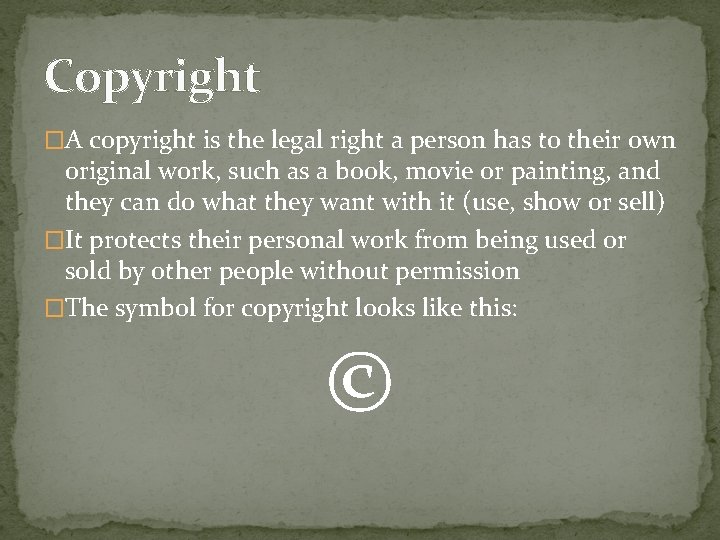
Copyright �A copyright is the legal right a person has to their own original work, such as a book, movie or painting, and they can do what they want with it (use, show or sell) �It protects their personal work from being used or sold by other people without permission �The symbol for copyright looks like this: ©
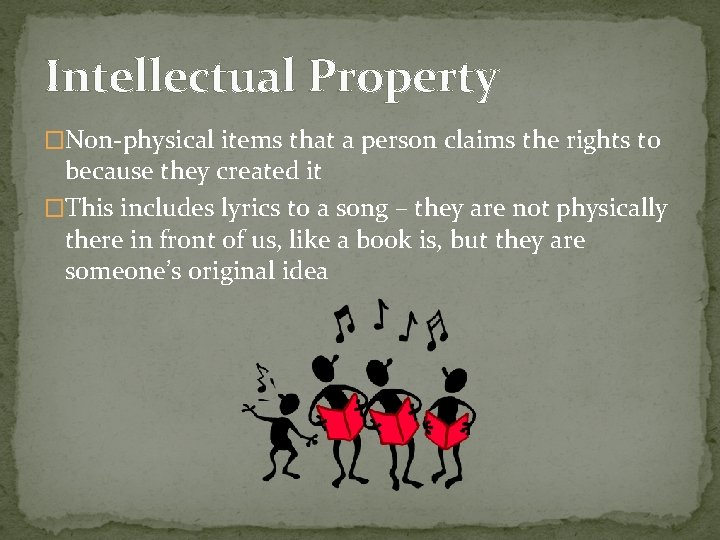
Intellectual Property �Non-physical items that a person claims the rights to because they created it �This includes lyrics to a song – they are not physically there in front of us, like a book is, but they are someone’s original idea
Trade-Marks �Trade-marks are used to tell the difference between different products from different companies �These include slogans, names, designs, or specific colours on packaging �An example is the Mc. Donald’s “arches” or their slogan, “I’m Lovin’ It” �Can you think of any other examples of trade-marks?
Patent �This is a type of copyright given by the government to someone to protect their invention from being copied or sold by others �It also lets that person sell their invention �An invention is something new or unique, such as a special type of equipment
Royalty �These are payments made to the owner of the copyright in order to use their product that is protected under a copyright �For example, musicians are paid royalties in order for places, such as radio stations, to play their music
Plagiarism �Pretending that someone else’s work is your own or not citing them properly (we will learn about citation later in this presentation!) �Plagiarism includes using direction quotations or summaries of their ideas without saying where you got those ideas from
Public Domain �In Canada, a copyright only lasts the life of the author plus 50 years � This means that once an author dies, the copyright on their product lasts another 50 years after they are gone �After that time has passed, the product is now public domain and there is no copyright – it can be used freely without having to ask permission �For example, the popular Christmas song “Up on the House Top” is public domain because the author passed away in 1867, and it is now well past 50 years from then!
Question: How do you let people know where you got your information, pictures or ideas? Answer: CITATION!
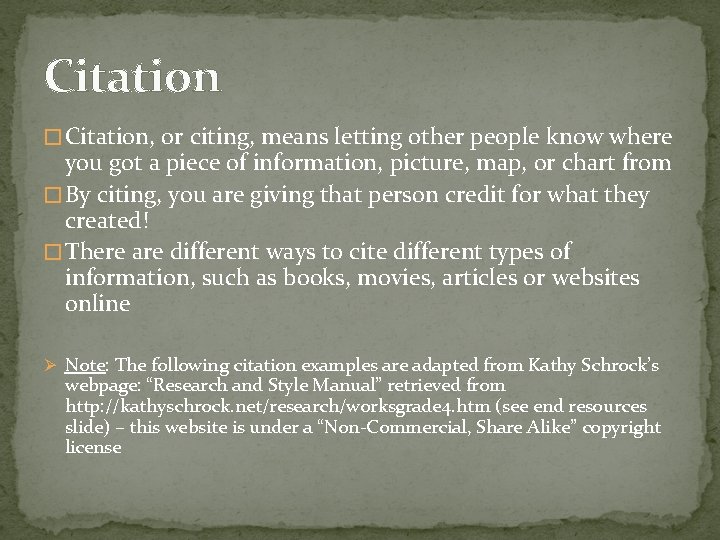
Citation � Citation, or citing, means letting other people know where you got a piece of information, picture, map, or chart from � By citing, you are giving that person credit for what they created! � There are different ways to cite different types of information, such as books, movies, articles or websites online Ø Note: The following citation examples are adapted from Kathy Schrock’s webpage: “Research and Style Manual” retrieved from http: //kathyschrock. net/research/worksgrade 4. htm (see end resources slide) – this website is under a “Non-Commercial, Share Alike” copyright license
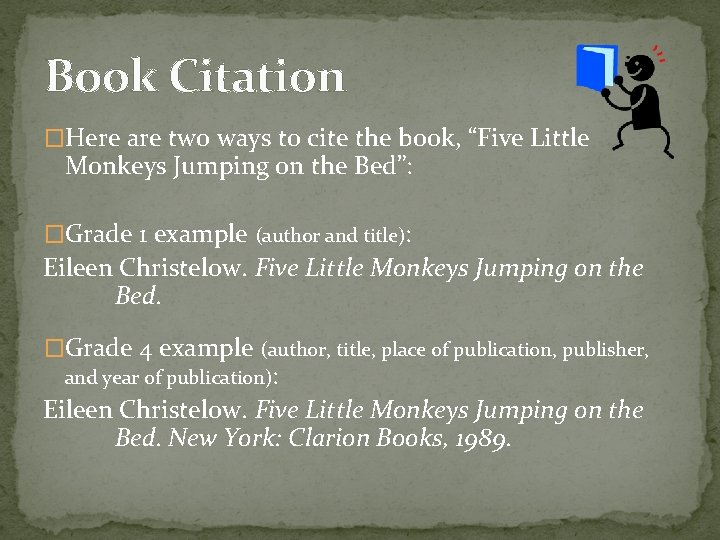
Book Citation �Here are two ways to cite the book, “Five Little Monkeys Jumping on the Bed”: �Grade 1 example (author and title): Eileen Christelow. Five Little Monkeys Jumping on the Bed. �Grade 4 example (author, title, place of publication, publisher, and year of publication): Eileen Christelow. Five Little Monkeys Jumping on the Bed. New York: Clarion Books, 1989.
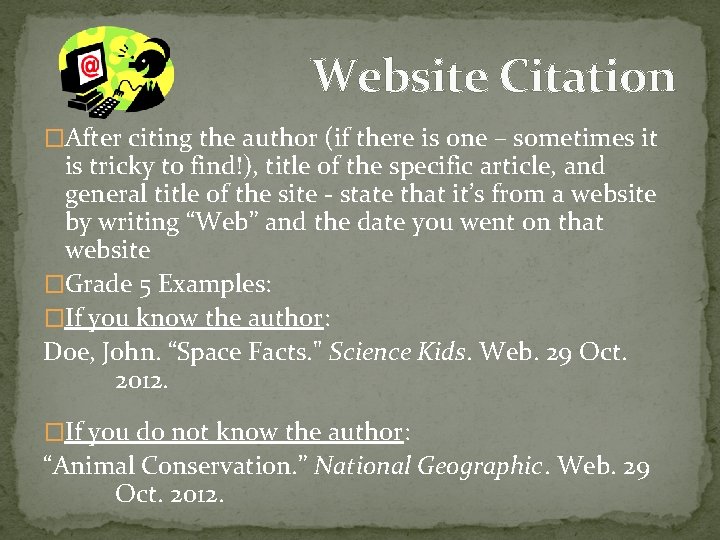
Website Citation �After citing the author (if there is one – sometimes it is tricky to find!), title of the specific article, and general title of the site - state that it’s from a website by writing “Web” and the date you went on that website �Grade 5 Examples: �If you know the author: Doe, John. “Space Facts. " Science Kids. Web. 29 Oct. 2012. �If you do not know the author: “Animal Conservation. ” National Geographic. Web. 29 Oct. 2012.
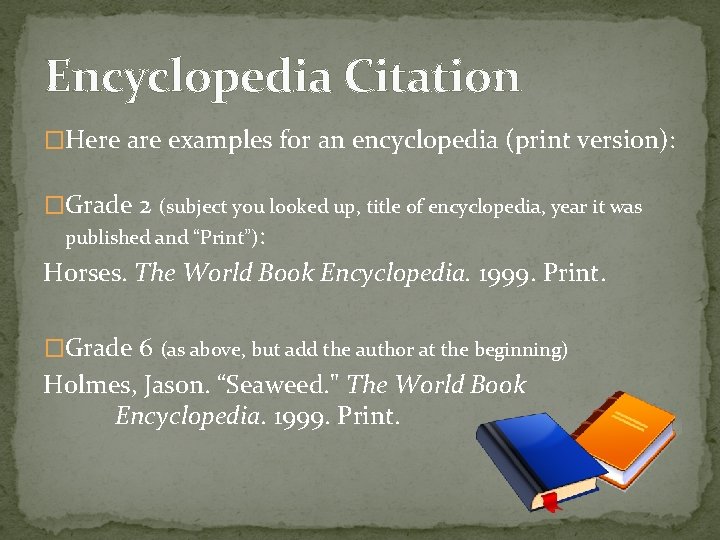
Encyclopedia Citation �Here are examples for an encyclopedia (print version): �Grade 2 (subject you looked up, title of encyclopedia, year it was published and “Print”): Horses. The World Book Encyclopedia. 1999. Print. �Grade 6 (as above, but add the author at the beginning) Holmes, Jason. “Seaweed. " The World Book Encyclopedia. 1999. Print.
Article in Periodical /Journal �Grade 6 example (author, title of article, title of periodical, date, page used, and “Print”): Daily, Heather. “Trains and Planes. ” Real Kids Magazine 5 Feb. 2000: 34. Print.
The End! I hope this presentation helped you to learn a little more about copyright and how to cite where you get your information from! Good Luck and Keep Learning!
Resources for this Presentation Industry Canada. (2012). Canadian Intellectual Property Office: Patents. Retrieved from http: //www. cipo. ic. gc. ca/eic/site/ cipointernet-internetopic. nsf/eng/h_wr 00001. html Makarenko, J. (2009). Copyright law in Canada: An introduction to the Canadian copyright act. Retrieved from http: //www. mapleleafweb. com/features/copyright-lawcanada-introduction-canadian-copyright-act#introduction Schrock, K. (2011). Research and Style Manual. Retrieved from http: //kathyschrock. net/research/worksgrade 4. htm Wikipedia. (2012). Royalties. Retrieved from http: //en. wikipedia. org/wiki/Royalties *All pictures taken from Microsoft Clip Art via Power. Point