
Copyright Statement This work is the intellectual property
- Slides: 31
Copyright Statement This work is the intellectual property of the authors. Permission is granted for this material to be shared for non-commercial, educational purposes, provided that this copyright statement appears on the reproduced materials and notice is given that the copying is by permission of the authors. To disseminate otherwise or to republish requires written permission from the authors. EDUCAUSE Southeast Regional 2005 Copyright 2005, Danny Adams, Jim Mazoué, Darlene Williams
What is the Best Model for Producing a Technology Transformed Faculty? Danny Adams, Norfolk State University Jim Mazoué, James Madison University Darlene Williams, Northwestern State University
Trends in Current Issues, Y 2 K 2005 Faculty Development, Support, & Training n Potential to Become More Significant # 6 n Need to Resolve for the Institution’s Strategic Success # 7 (Maltz L. , De. Blois P. B. , & the EDUCAUSE Current Issues Committee, 2005) EDUCAUSE Southeast Regional 2005 Copyright 2005, Danny Adams, Jim Mazoué, Darlene Williams
Faculty Development n How to conduct faculty development programs: n n Procedural & operational details What is the rationale for faculty development programs? Improve the quality of teaching & learning n Assist research n EDUCAUSE Southeast Regional 2005 Copyright 2005, Danny Adams, Jim Mazoué, Darlene Williams
Educational Technologies n n n n n Paper & pen Printed text The chair Chalkboard Overhead projectors TV & video Computers Learning Management Systems Collaboration Tools & Rich Media Software Agents EDUCAUSE Southeast Regional 2005 Copyright 2005, Danny Adams, Jim Mazoué, Darlene Williams
Assumptions Using technology for teaching & learning is generally good. n Specialized preparation is needed for faculty to use technology effectively in their teaching and research. n Faculty development in the use of technology should focus on improving teaching, learning, and research. n EDUCAUSE Southeast Regional 2005 Copyright 2005, Danny Adams, Jim Mazoué, Darlene Williams
Faculty Development What is Faculty Development and why is it needed? Resources n Skills n Competencies n Innovation n Research n Collaboration n EDUCAUSE Southeast Regional 2005 Copyright 2005, Danny Adams, Jim Mazoué, Darlene Williams
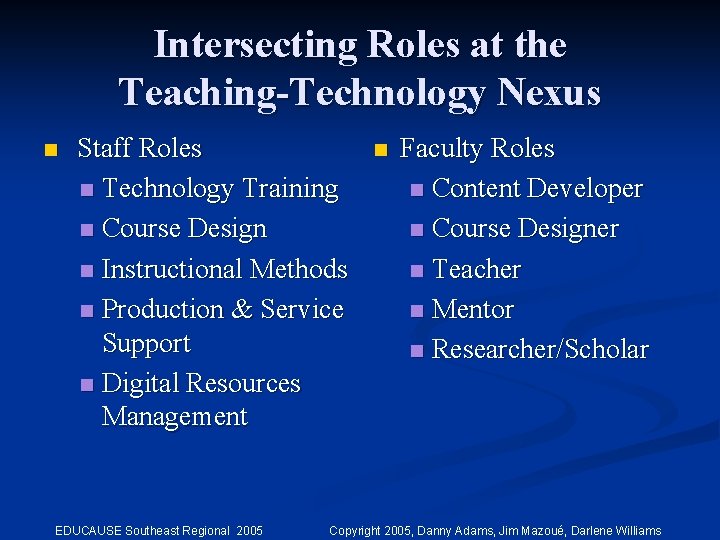
Intersecting Roles at the Teaching-Technology Nexus n Staff Roles n Technology Training n Course Design n Instructional Methods n Production & Service Support n Digital Resources Management EDUCAUSE Southeast Regional 2005 n Faculty Roles n Content Developer n Course Designer n Teacher n Mentor n Researcher/Scholar Copyright 2005, Danny Adams, Jim Mazoué, Darlene Williams
Faculty Development Models Content Developer n Course Designer n Facilitator (Uo. P) n Tech Savvy Teacher n Nuts & Bolts User n Instructional Technology Innovator n Mentor n Scholar n EDUCAUSE Southeast Regional 2005 Copyright 2005, Danny Adams, Jim Mazoué, Darlene Williams
Questions What is a faculty development model, and why is it needed? n What is the goal of faculty development? n Are some faculty development models preferable to others? n Are some models counter-productive? n What are the characteristics of successful faculty development initiatives? n EDUCAUSE Southeast Regional 2005 Copyright 2005, Danny Adams, Jim Mazoué, Darlene Williams
Questions How much technology do faculty need to know? What skills are important? n Can, or should, technology & teaching skills be unbundled? n What role should faculty have in creating the learning environment in which they teach? n EDUCAUSE Southeast Regional 2005 Copyright 2005, Danny Adams, Jim Mazoué, Darlene Williams
One Perspective Faculty Development at Northwestern State University
In the Beginning… Limited staff resources n Staff included “ 1” person n Limited technology resources n One size fits all approach n Limited support n Faculty responsible for content development n EDUCAUSE Southeast Regional 2005 Copyright 2005, Danny Adams, Jim Mazoué, Darlene Williams
Guidelines for Professional Development n n n Institutional commitment Provide a purpose Provide a variety of opportunities n n n n Large and small groups Individualized Multiple delivery methods Structure faculty development with qualified staff Identify a measurable outcome and deliverable Provide ongoing support Provide recognition or reward for faculty EDUCAUSE Southeast Regional 2005 Copyright 2005, Danny Adams, Jim Mazoué, Darlene Williams
Faculty Development Voluntary n Multiple applications offered at various levels n Overview of technology applications n Limited but ongoing support provided n Multiple delivery methods n face to face n online n compressed video n Recognition, praise n EDUCAUSE Southeast Regional 2005 Copyright 2005, Danny Adams, Jim Mazoué, Darlene Williams
Faculty Development Voluntary but requires commitment n Three levels n In depth coverage of technology applications n Opportunities to demonstrate proficiency n Continuous support for faculty to include mentors n Deliverables required for each level n Rewards, recognition, praise n EDUCAUSE Southeast Regional 2005 Copyright 2005, Danny Adams, Jim Mazoué, Darlene Williams
Lessons Learned n n n Faculty development is fruitless without adequate faculty support Funding must be provided to maintain a “qualified” staff Faculty needs must be met n Time n Resources Use “Peer groups” and mentors when possible n Departmental n Interdisciplinary Realize that course development, revision, and maintenance is time consuming – and ongoing EDUCAUSE Southeast Regional 2005 Copyright 2005, Danny Adams, Jim Mazoué, Darlene Williams
“Pod” Perspective Faculty Development at Norfolk State University
Growing faculty development in a small pot Faculty as practitioner-scholars because the n n pot has. . . limited resources self-generated irrigation system that sustains utilization of limited resources n i. e. , provides incentives for faculty to function as practitioner-scholars “Reap what you sow” EDUCAUSE Southeast Regional 2005 Copyright 2005, Danny Adams, Jim Mazoué, Darlene Williams
Impact of faculty development. . . (institution and individual gain) Resources n Skills n Competencies n Innovation n Research n Collaboration n EDUCAUSE Southeast Regional 2005 Copyright 2005, Danny Adams, Jim Mazoué, Darlene Williams
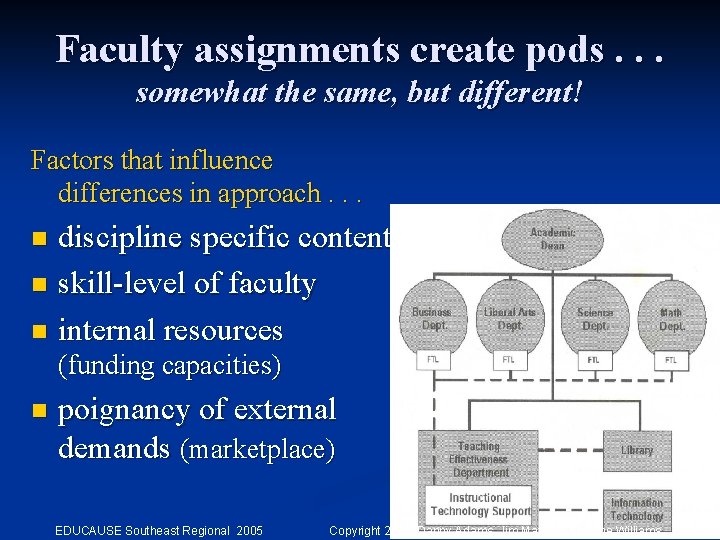
Faculty assignments create pods. . . somewhat the same, but different! Factors that influence differences in approach. . . discipline specific content n skill-level of faculty n internal resources n (funding capacities) n poignancy of external demands (marketplace) EDUCAUSE Southeast Regional 2005 Copyright 2005, Danny Adams, Jim Mazoué, Darlene Williams
Environmental conditions. . . differ across academic units n n n n n Funding Enrollments Curriculum changes /new and old programs Personnel changes Technology expectations (faculty and students) Departmental strengths Faculty evaluation process Faculty incentives Time constraints EDUCAUSE Southeast Regional 2005 Copyright 2005, Danny Adams, Jim Mazoué, Darlene Williams
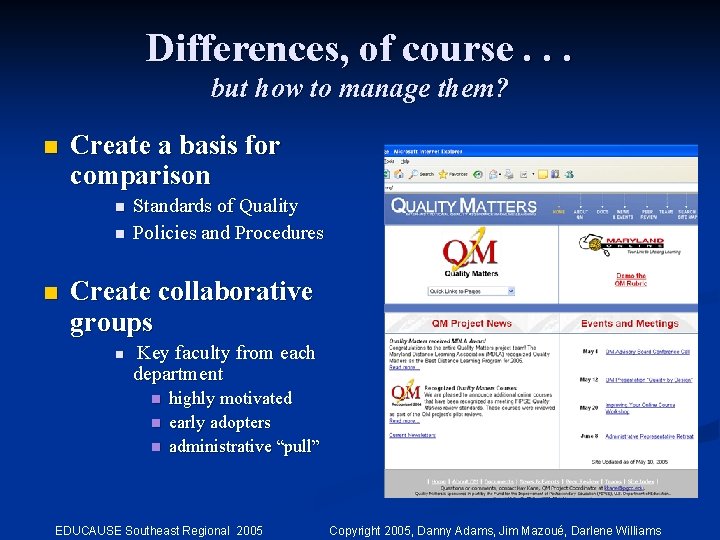
Differences, of course. . . but how to manage them? n Create a basis for comparison n Standards of Quality Policies and Procedures Create collaborative groups n Key faculty from each department n n n highly motivated early adopters administrative “pull” EDUCAUSE Southeast Regional 2005 Copyright 2005, Danny Adams, Jim Mazoué, Darlene Williams
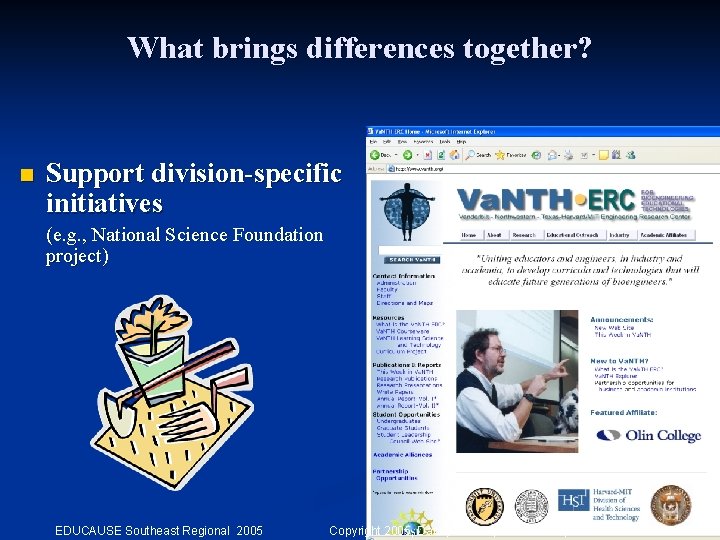
What brings differences together? n Support division-specific initiatives (e. g. , National Science Foundation project) EDUCAUSE Southeast Regional 2005 Copyright 2005, Danny Adams, Jim Mazoué, Darlene Williams
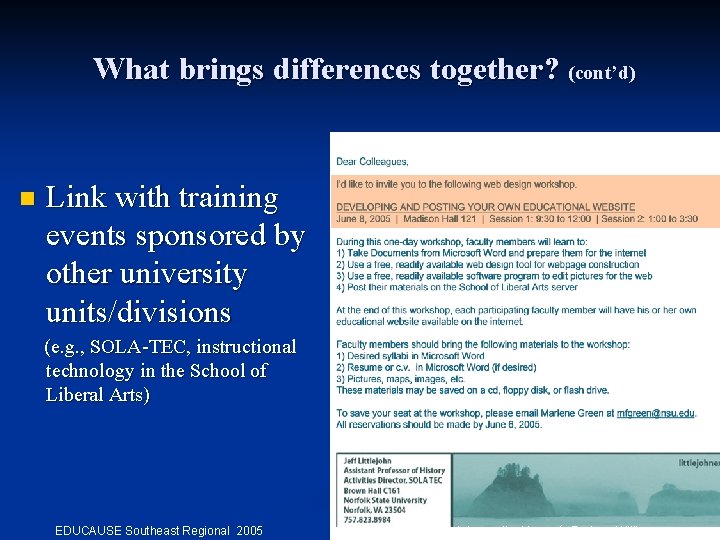
What brings differences together? (cont’d) n Link with training events sponsored by other university units/divisions (e. g. , SOLA-TEC, instructional technology in the School of Liberal Arts) EDUCAUSE Southeast Regional 2005 Copyright 2005, Danny Adams, Jim Mazoué, Darlene Williams
How different is different? n Are multiple activities sponsored by the same funding sources (e. g. , Title III)? n If so, make the case for: n collaborative efforts n resource efficient n larger buy-in n more comprehensive scope n better able to deliver variable, yet unified training (multi-pronged) EDUCAUSE Southeast Regional 2005 Copyright 2005, Danny Adams, Jim Mazoué, Darlene Williams
Execution: Who and How? e. Learning Team and Company (e. TC. ) Translation:
Execution: Who and How? (cont’d) e. TC. e. Learning Team and Company The core planning group (20 targeted participants) n e-Quality Team n quality assessment of online courses (begin with web-courses, initially 6 participants) n TA/Resource Team n select Teaching Assistants and monitor resource utilization (4 participants) EDUCAUSE Southeast Regional 2005 Copyright 2005, Danny Adams, Jim Mazoué, Darlene Williams
Execution: Who and How? (cont’d) e. TC. n e-Instruction Team n Assist in developing process and course design prototype for online instruction (inclusive of ADA compliance elements) EDUCAUSE Southeast Regional 2005 Copyright 2005, Danny Adams, Jim Mazoué, Darlene Williams
Practitioner and -Scholar Model: “Yeas and Nays” Formation of numerous liaisons essential n Fewer resources n Limited number of projects at any one time n Long-term projects usually means longer-term for completion n Short-term projects usually mean replication in order to have effect system-wide n EDUCAUSE Southeast Regional 2005 Copyright 2005, Danny Adams, Jim Mazoué, Darlene Williams
Thank you! Danny Adams Director of e. Learning Norfolk State University LBB Library, Ste. 323 823 -8066 elearning@nsu. edu EDUCAUSE Southeast Regional 2005 Copyright 2005, Danny Adams, Jim Mazoué, Darlene Williams