
Copyright Notice Do not remove this notice COMMONWEALTH












- Slides: 34
Copyright Notice Do not remove this notice. COMMONWEALTH OF AUSTRALIA Copyright Regulations 1969 WARNING This material has been produced and communicated to you by or on behalf of the University of South Australia pursuant to Part VB of the Copyright Act 1968 (the Act). The material in this communication may be subject to copyright under the Act. Any further reproduction or communication of this material by you may be the subject of copyright protection under the Act. Do not remove this notice.
Understanding Travel and Tourism (TOUR 1001) TOPIC 2 Continuities in the history of travel Dr Gayathri(Gee) Wijesinghe
Topic Objectives • explain why it is important to study the history of travel and tourism • explain the reasons why travel for pleasure developed in the ancient world • determine the links between motives for travel in the ancient world and at the present time • compare the travel experiences of people in ancient times with the travel experiences of contemporary tourists • explain the meaning of ‘pilgrimage’ • distinguish between a religious pilgrimage and a secular pilgrimage • explain the similarities between pilgrimage and tourism • explain and apply Turner’s analysis of pilgrimage • explain why and how some pilgrimage sites are contested • identify the continuity between past and present pilgrimages • describe the impact of modernisation on traditional pilgrimages 3
Required Readings • Study Note Topic 2 • Required Readings Part 2 – Chapters 2 & 3 • Text book Chapter 3 (read up to page 55 stop before EARLY MODERN TOURISM (1500 – 1950) 4
Sample exam questions 1. Explain how the agricultural revolution in the ancient world made possible the ‘push’ factors that enabled people to travel at that time. What kinds of developments in transport technology made it possible for people in the ancient world to travel? 2. Discuss the ways in which the ancient Olympic Games differed from the modern Olympic Games. 3. Why is the Tai Shan Mountain in China an important pilgrimage site? Explain how pilgrimages to Tai Shan have been modernised in recent times. 4. Apply Turner’s analysis of pilgrimage to the visits of Elvis Presley fans in Graceland. Why is this visit regarded as a secular pilgrimage? 5
Why study history? One way to understand so avoid the contradictions of tourism is to prepare ourselves with a knowledge of the history of travel. If. . . tourism has its own culture and history with its own continuities, we may learn about ourselves as travellers by understanding the habits we have inherited from the past (Wood 1992, p. 15). ‘[r]ecognition of these timeless impulses and characteristics is valuable to the tourism manager, as they are factors that must be taken into consideration in any contemporary or future situation involving tourism’ (Weaver & Lawton 2014, p. 50). 6
Why study history? • There are similarities between pre-modern tourism and contemporary tourism. • History helps those who study it to understand why changes occur and why things are the way they are. • Arguably history develops wisdom. It is important that we learn the lessons of history. • The study of history enables us to see patterns in history. • Travellers in relatively recently established societies like to visit societies which have older histories than their own 'the new world pays its respects to the old' (Turner & Ash, 1976, p. 29) e. g. Australians visiting Egypt to see pyramids.
WHAT IS THE ANCIENT WORLD? • • In ancient times people tended not to travel, except to seek food and to avoid danger. Ancient world approximately 3000 BCE until the fall of the Roman Empire Travel for purposes of trade along rivers led to the development of boat transport. see Videos: https: //www. youtube. com/watch? v=Vr. Kp. KBdlrag 3: 31 minutes • Major river valley regions of the ancient world: • The Tigris-Euphrates valley (modern Iraq) • The Nile valley in Egypt • Chinese river valleys • The Indus valley in what is now Pakistan • Mesopotamian Civilization - The Tigris-Euphrates valley (modern Iraq) https: //www. youtube. com/watch? v=mzat. Is. Uv. GQs 6: 44 minutes
AGRICULTURAL REVOLUTION IN THE ANCIENT WORLD • The move from nomadism to settled living is known as the agricultural revolution. The agricultural revolution occurred when people learned how to grow crops and to stay in one place to look after those crops. • The effects of the agricultural revolution (see https: //www. youtube. com/watch? v=6 QKIts 2_y. J 0) 5: 05 minutes • It resulted in: • • Growing a surplus. Making wealth from selling a surplus. Discretionary income (spare income) to spend on pleasure travel. Discretionary time – leisure - available for travel. • Transport technology of the ancient world helped people to travel. • Wheels, wagons and boats • Roman roads
‘PUSH’ FACTORS for travel and tourism • Factors influencing people to travel are ‘push’ factors. • ‘Push’ factors are ‘economic, social, demographic, technological and political forces that stimulate a demand for tourism activity by ‘pushing’ consumers away from their usual place of residence’ (Weaver and Lawton 2014, p. 76) • In the ancient world the following ‘push’ factors made travel for pleasure possible: • Discretionary income • Discretionary time • Availability of transport (the transport revolution • Richer people (the elites) had these ‘push’ factors. • The people who became wealthier than others as a result of the agricultural revolution had the time and the wealth to travel.
Themes in the history of travel and tourism: TRAVEL FOR TRADE The history of tourism is part of the history of human movement from one geographical location to another. Therefore it has links with the following kinds of travel. Commerce/trade • People in the ancient world also travelled for trade, to invade the territories of other people and to establish colonies. • Business travel and war continue to cause people to travel around the world. • Travel for trade was made possible by the invention of the earliest forms of transport technology: canoes, rafts, sea-going ships and wagons and carts drawn by oxen, donkeys and horses. Ancient Trade route using “The Silk Road” https: //www. youtube. com/watch? v=56 Izy. Mf. LJFA (14: 34 minutes) https: //www. youtube. com/watch? v=8 UUWX 2 Dpd. P 0 (4: 10 minutes) The inland routes of the Silk Road were dotted with caravanserais, large guest houses or hostels designed to welcome travelling merchants and their caravans as they made their way along these trade routes ( see https: //en. unesco. org/silkroad/content/caravanserais-cross-roads-commerce-and-culture-along-silk-roads)
MOTIVATIONAL FACTORS for travel Motivation for travel refers to people’s desires, wants and needs that they hope to satisfy by travelling. People in the ancient world travelled for the following reasons: • To escape various natural and human created conditions: • Escape from crowded cities (e. g. Rome), escape the heat to cooler climates (e. g. Roman villas, holiday houses in the hills, on the Bay of Naples) • Spas for health • To satisfy their curiosity about parts of the world they had not so far seen • E. g. travellers were interested in satisfying their curiosity about the Egyptian pyramids. In the contemporary world the pyramids still fascinate tourists. • To satisfy their social need to be with other people • Parties, Sailing • To pray for divine intervention • e. g. religious festivals in honour of their gods, • e. g. consult the oracle of Delphi (https: //www. youtube. com/watch? v=To. Veo. Uzh. R 0 Q)
MOTIVATIONAL FACTORS for travel • to satisfy their need to experience beauty in landscapes and in works of art • e. g. to meet with poets • to satisfy their need for more knowledge • e. g In India people went in search of ‘gurus’ to teach them various subjects ranging from medicine to metaphysical subjects such as meditation and yoga • to enjoy entertainments • e. g. performance of plays • to escape the routine of their daily lives and to engage in ritual inversion (Graburn 1983, p. 21). which meant doing the opposite to what they did in their daily lives • e. g. attending festivals, Sports events
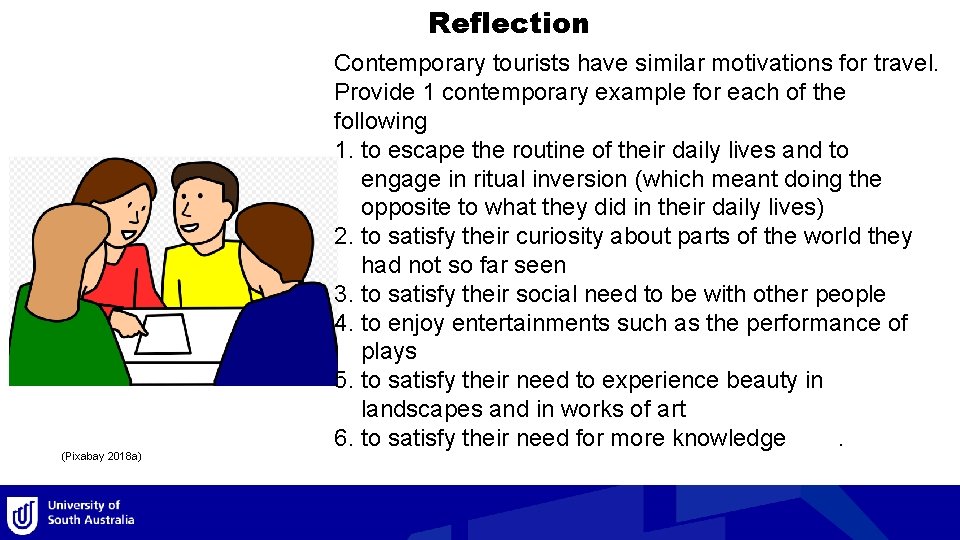
Reflection (Pixabay 2018 a) Contemporary tourists have similar motivations for travel. Provide 1 contemporary example for each of the following 1. to escape the routine of their daily lives and to engage in ritual inversion (which meant doing the opposite to what they did in their daily lives) 2. to satisfy their curiosity about parts of the world they had not so far seen 3. to satisfy their social need to be with other people 4. to enjoy entertainments such as the performance of plays 5. to satisfy their need to experience beauty in landscapes and in works of art 6. to satisfy their need for more knowledge.
Themes in the history of travel and tourism: SPORT EVENTS Example: The Olympic games • In ancient times, Greece was divided into many city-states that went to war with one another from time to time. • At times the Greeks came together to engage in games and artistic competitions. • While the games were on, no wars were allowed (truce). These were the earliest Olympic Games. • The Games were held in honour of god Zeus. • While the games were held in peace, the practice of athletics was seen as a preparation for war. • Since the re-birth of the Olympic Games in 1896, games have continued to serve political purposes and promote tourism. Watch 5 – 7 minutes of this video: http: //access. library. unisa. edu. au/login? url=https: //edutv. informit. com. au/watchscreen. php? video. ID=152100
Olympic Games: ancient versus contemporary • The ancient Greeks participated in the Olympic Games both as athletes and spectators but there were differences between the ancient and modern Games. • The modern Olympics are an international event whereas only Greeks participated in the ancient Olympic Games • The modern Olympics are associated with world harmony although the modern Olympics have been used for political purposes and as a sign of international conflicts. • At the Munich Olympics in 1972, the Games were used to draw attention to the struggle between the Israelis and the Palestinians when Israeli athletes were taken hostage by masked Palestinian gunmen and were murdered (Schaffer & Sidonie 2000, p. 15). • For example, in 1956 at the Melbourne Olympics, the Hungarian and Soviet Russian water-polo contestants continued their political struggle in the event following the Hungarian uprising against the Soviet Union and the Russian invasion of Hungary. • In ancient Greece, however, sport was regarded as a way to train for war. Although in ancient Greece wars stopped briefly to let the athletes and spectators get to and from the Games safely, the wars were not stopped permanently. See following videos: • https: //www. youtube. com/watch? v=HJRFFc. GGPPo • https: //www. youtube. com/watch? v=w. Zl. KFw 7 a 9 Ko
Themes in the history of travel and tourism: Pilgrimage • Travel for religious or spiritual purposes • One of the oldest forms of human movement • A physical journey to a holy site • A quest • Spiritual quest • More benefits – cure from an illness • Associated with sacred places
Pilgrimage Structure: Turner’s analysis of pilgrimage https: //www. youtube. com/watch? v=6 TLK 5 -Pxynk (6: 16 minutes) Stages 1. Separation stage – separated from usual environment • From structure to anti-structure – implications for code of conduct 2. Liminal stage - move into a world free from the structures and constraints of everyday lives. • Anti-structure • Communitas – sense of belonging - sharing experience with others • Rituals 3. Re-integration stage • Return to usual environment – higher status
Applications of Turner’s analysis: Religious pilgrimage: the Hajj Mecca in Saudi Arabia 1. Separation from everyday lives • Symbols such as shaving of the head, ritual bathing, wearing a white robe. 2. Liminal stage • Performance of rituals e. g. circuits of the Kaaba (principal shrine at Mecca), stopping each time to kiss the Black Stone (associated with the Patriarch Abraham) • pilgrims throw stones at pillars representing the devil and temptation. 3. Re-integration stage • Return home – higher level of status https: //www. youtube. com/watch? v=j. M 81 wroj_MQ
Application of Turner’s analysis Secular pilgrimage: Elvis Presley Graceland Secular pilgrimage is a non-religious kind of pilgrimage. Examples visits to Disneyland, Graceland Honouring the musician Elvis Presley – secular pilgrimage Graceland as pilgrimage site 1. Separation stage • Fans separated from their everyday life 2. Liminal stage 3. Re-integration stage • Communitas – shared respect and love for Elvis • Rituals – e. g. meditating in the Meditation Garden • Mugs and key-rings like medieval relics • the status of having made the pilgrimage Video Elvis Presley's Graceland • https: //www. youtube. com/watch? v=82 bj. Qn-Cp. XQ • https: //www. youtube. com/watch? v=Qcv. HNm. J 1 Dz 0 Read topic 3 required Readings Part 2
Themes in the history of travel and tourism: PILGRIMAGES: Tai Shan mountain in China To the Chinese, mountains have traditionally been sacred places. According to Carr-Gomm (2008, p. 214), the Chinese visit mountains for ‘essential spiritual sustenance’. He points out that, in Chinese, the word pilgrimage means ‘paying one’s respect to a mountain’ (Carr-Gomm 2008, p. 214). Traditionally, hermits who were supposed to have discovered the secret of longevity lived in the mountains (Carr-Gomm 2008, p. 214). Mount Taishan is the most famous sacred mountain of China, with exceptional historic, cultural, aesthetic and scientific value. ‘The route is lined with shrines, temples and carved stones that record the poems and tributes of previous pilgrims’ (Carr-Gomm 2008, p. 216). At the peak - the Temple of the Jade Emperor and the Temple of the Princess of the Azure Clouds, which ‘has become the foremost place of pilgrimage for Chinese women’ (Carr-Gomm 2008, p. 216). Tai Shan is also now a World Heritage site (see See http: //whc. unesco. org/en/list/437/) https: //youtu. be/CNc. P 3 kwm 94 U (2: 48 minutes)
Commercialisation of pilgrimage • Mt. Tai Shan example • The climbing of Mt. Tai Shan has been commercialised. • Over-development, crowded • Cable car to the top, destroy environment • Hotels and restaurants on top • Modern advertising and sinage – see sunrise
Faith based tourism • Religious Tourism https: //www. youtube. com/watch? v=_Mz 7 Nmj. C 9 IA
Pilgrimage and healing • During the Middle Ages (approximately 1100 -1500) people suffered from many illnesses because of poor diet, poor hygiene and a lack of scientific medical knowledge. • Making pilgrimages to famous churches and to shrines associated with the memory of holy people was a popular way to seek healing. • Statues of Mary, the Mother of Christ • Touching objects which saints had touched • Lourdes in France, where a young peasant girl in the 19 th century had visions of the Mother of Christ, has water to which healing has been attributed. • Sufi Muslim shrine in Pakistan where people believe the spirit of Hazrat Abdullah Shah Ashabi, who came very close to God because of the good life he lived, will help them with their physical and mental health and to escape stress. (see https: //www. huffingtonpost. com/2014/03/12/spiritual-healingpilgrimages_n_4944030. html)
Contested pilgrimage sites Jerusalem https: //www. youtube. com/watch? v=3 inh. Qff. Pl. AI • Jerusalem is a sacred site to the three Abrahamic faiths – Christianity, Islam and Judaism. • To the Jews it was the site of their Temple. • To Christians it is the city where Christ ‘taught, died and was resurrected and where the first Christians congregated’ (Emmett 1997, p. 19). • To the Muslims it is the place where the Prophet Mohammed ‘made his mystical nocturnal journey into heaven’ (p. 19). • It is also a place associated with beliefs that the three religions share. ‘Christians and Muslims share a common belief and respect for all the Hebrew prophets, and Muslims revere Jesus as a great prophet’ (p. 19).
Contested pilgrimage sites • Contested sites is ‘sacred locations where there is a contest over access and usage by any number of groups or individuals who have an interest in being able to freely enter and move around the site’ (Digance 2003, p. 144). Examples Uluru in Central Australia • http: //www. abc. net. au/btn/story/s 4759791. htm • Uluru has spiritual significance for the Anangu indigenous people. Non-indigenous Australians and other tourists wish to show their physical power by climbing Uluru but the indigenous owners discourage this practice (Digance 2003, p. 151). Uluru climbing is banned from 2019.
Suggested Videos • Academy, K 2017, Ancient Mesopotamia | Early Civilizations | World History | Khan Academy, viewed 4 March 2018, <https: //www. youtube. com/watch? v=9 GQdh 2 e. GP-Y>. • National Geographic 2009, The Mystery of the Delphi Oracle viewed 6 March 2018, <https: //www. youtube. com/watch? v=To. Veo. Uzh. R 0 Q>. • nofearoffalling 2008, Ancient and Modern Olympics, viewed 4 March 2018, <https: //www. youtube. com/watch? v=w. Zl. KFw 7 a 9 Ko>. • Schwieters, J 2012, Ancient Olympics Vs. Modern Day Olympics, viewed 4 March 2018, <https: //www. youtube. com/watch? v=HJRFFc. GGPPo>. • Sully. Social. Studies 2013 a, River Valleys, viewed 4 March 2018, <https: //www. youtube. com/watch? v=Vr. Kp. KBdlrag>. • Sully. Social. Studies 2013 b, Mesopotamian Civilization, viewed 4 March 2018, <https: //www. youtube. com/watch? v=mzat. Is. Uv. GQs>. • The History Channel 2011, The Ancient Greek Olympics: Death Or Glory Edu TV, viewed 4 March 2018, <http: //access. library. unisa. edu. au/login? url=https: //edutv. informit. com. au/watchscreen. php? video. ID=152100>. 27
Bibliography Alderman, DH 2002, ‘Writing on the Graceland wall: on the importance of authorship in pilgrimage landscapes’, Tourism recreation research, vol. 27, no. 2, pp. 27 -33. Boniface, BG & Cooper, CP 1994, The geography of travel and tourism, Butterworth Heinemann, Oxford. Carr-Gomm, P 2008, Sacred places, Quercus, London. Casson, L 1994, Travel in the ancient world, Johns Hopkins University Press, Baltimore and London. Climb Mt Fuji with Fuji Mountain Guides, http: //www. fujimountainguides. com, accessed 12/8/2011. Cohen, E 1974, ‘Who is a tourist? A conceptual clarification’, The Sociological Review, vol. 22, no. 4, pp. 527 -555. Cohen, E 1974, ‘Who is a tourist? A conceptual clarification’, The Sociological Review (new series), vol. 22, no. 4, pp. 527 -555. Cohen, E 1979, ‘A phenomenology of tourist experiences’, Sociology, vol. 13, no. 2, pp. 180 -201. Collins-Kreiner, N 2010, ‘Researching pilgrimage: continuity and transformations’, Annals of Tourism Research, vol. 37, no. 2, pp. 440 -456. Crowther, N 1999, ‘Sports, nationalism and peace in Ancient Greece’, Peace Review, vol. 11, no. 4, pp. 585 -589. Cusack, CM & Digance, J 2009, ‘The Melbourne Cup: Australian identity and secular pilgrimage’, Sport in Society, vol. 12, no. 7, pp. 876 -889. Digance, J 2003, ‘Pilgrimage at contested sites’, Annals of Digance, J 2006, ‘Religious and secular pilgrimage’ in eds DJ Timothy & DH Olsen Tourism, religion and spiritual journeys, Routledge, London & New York, pp. 36 -48. 28
Bibliography Dubisch, J 1988, ‘Golden oranges and silver ships: an interpretive approach to a Greek holy shrine’, Journal of Modern Greek Studies, vol. 6, no. 1, pp. 117 -134. Eade, J 1992, ‘Pilgrimage and tourism at Lourdes, France’, Annals of Tourism Research, vol. 19, pp. 18 -32. Emmett, CF 1997, ‘The status quo for Jerusalem’, Journal of Palestine Studies, vol. 26, no. 2, pp. 16 -28. Galbraith, M 2000, ‘On the road to Szestochowa: rhetoric and experience on a Polish pilgrimage’, Anthropological Quarterly, vol. 73, no. 2, pp. 61 -73. Gesler, W 1996, ‘Lourdes: healing in a place of pilgrimage’, Health & Place, vol. 2, no. 2, pp. 95 -105. Graburn, NHH 1983 ‘The anthropology of tourism’, Annals of Tourism Research, vol. 10, no. 1, pp. 9 -33. Graburn, NHH 1989 ‘Tourism: the sacred journey’ in ed V Smith, Hosts and guests: the anthropology of tourism, 2 nd edn, University of Pennsylvania Press, Philadelphia, pp. 21 -36. Graburn, NHH 1989, ‘Tourism: the sacred journey’, in ed. VL Smith, Hosts and guests: anthropology of tourism, 2 nd edition, , University of Pennsylvania Press, Philadelphia, pp. 21 -36. Gupta, V 1989, ‘Sustainable tourism: learning from Indian religious traditions’, Journal of Contemporary Hospitality Management, vol. 11, nos. 2 -3, pp. 91 -95. Guttmann, A, Kestner, H & Eisen, G 2000, ‘’Jewish athletes and the “Nazi Olympics”’, in ed. K Schaffer & S Smith, The Games at the millennium: power, politics and the Games, Rutgers University Press, New Brunswick and London, pp. 51 -62. Hall, CM 1998, Introduction to tourism: development, dimensions and issues, 3 rd edn, Addison Wesley Longman Australia, South Melbourne. 29
Bibliography Hall, CM 1998, Introduction to tourism: development, dimensions and issues, 3 rd edn, Addison Wesley Longman Australia, South Melbourne. Harrison, CK 2000, ‘Racing with race at the Olympics: from Negro to Black to African-American athlete’, in ed. K Schaffer & S Smith, The Games at the millennium: power, politics and the Games, Rutgers University Press, New Brunswick and London, pp. 63 -71. Herodotus, 1996, The histories, vol. 2, trans G Rawlinson, Ware, Wordsworth Editions Limited, Hertfordshire. Horne, D 1984, The Great Museum: the representation of history, Pluto Press, Sydney. Horne, D 1992, The intelligent tourist, Margaret Gee, Mc. Mahon’s Point, New South Wales. Ivakhiv, A 2010, ‘Nature and self in New Age pilgrimage’, Culture and Religion: an Interdisciplinary Journal, vol. 4, no. 1, pp. 93 -118. Jackson, R 1990, ‘Waters and spas in the classical world’, Medical History, Supplement No. 10, pp. 1 -13. James, S 2007, ‘Constructing the climb: visitor decision-making at Uluru’, Geographical Research, vol. 45, no. 4, pp. 398 -407. Lennon, J and Foley, M 2000, Dark tourism: the attraction of death and disaster. Meijer, F 2004, The Gladiators: history’s most deadly sport, Souvenir Press, London. Mill, RC 1990, Tourism: the international business, Prentice Hall, Englewood Cliffs, New Jersey. Murray, M, Graham, B 1997, ‘Exploring the dialectics of route-based tourism: the Camino de Santiago’, Tourism Management, vol. 18, no. 8, pp. 513 -524. 30
Bibliography O’Reilly, CC 2006, ‘From drifter to gap year tourist: mainstreaming backpacker travel’, Annals of Tourism Research, vol. 33, no. 4, pp. 998 -1017. Pirani, FM, Papadopoulos, I, Foster, J &Leavey, G 2008, ‘“I will accept whatever is meant for us. I wait for that – day and night”: the search for healing at a Muslim shrine in Pakistan’, Mental Health, Religion & Culture, vol. 11, no. 4, pp. , 375 -386. Rigby, M 2001, ‘Graceland: a sacred place in a secular world? ’ in eds, C Cusack & P Oldmeadows, The end of religions? Religion in an age of globalisation, Sydney Studies in Religion 4, University of Sydney, pp. 155168. Rinehart, RE 1996, ‘ “Fists flew and blood flowed”: symbolic resistance and international response in Hungarian water –polo at the Melbourne Olympics, 1956’, Journal of Sport History, vol. 23, no. 2, pp. 120 -139. Rinschede, G 1992, ‘Forms of religious tourism’, Annals of Tourism Research, vol. 19, no. 1, pp. 51 -67. Rinschehe, G 1992, ‘Forms of religious tourism’, Annals of Tourism Research, vol. 19, no. 1, pp. 51 -67. Rojek, C 1993, Ways of escape: modern transformations in leisure and travel, The Macmillan Press, Basingstoke, Hampshire. Rowse, AL 1971, The use of history, Penguin Books, Harmondsworth. Ryan, C 1997, ‘The chase of a dream, the end of a play’, in ed C Ryan, The tourist experience: A new introduction, Cassell, London, pp. 1 -24. Sacred Sites of Japan and Mt Fuji – no other details available. 31
Bibliography Sallnow, MJ 1981, ‘Communitas reconsidered: the sociology of Andean pilgrimage’, Man, vol. 16, no. 2, pp. 163182. Scates, B 2006, Return to Gallipoli: walking the battlefields of the Great War, Cambridge University Press, Cambridge. Schaffer, K & Sidonie, S 2000, ‘Introduction’ in eds. K Schaffer & S Sidonie, The Olympics at the millennium: power, politics and the Games, Rutgers University Press, New Brunswick and London, pp. 1 -16. Singh, S 2004, ‘Religion, heritage and travel: case references from the Indian Himalayas’, Current Issues in Tourism, vol. 7, no. 1, pp. 44 -65. Sofield THB, Li FMS 1998, ‘Tourism development and cultural policies in China’, Annals of Tourism Research, vol. 25, no. 2, pp. 362 -392. Sumption, J 2002, Pilgrimage: an image of medieval religion, Paperback edition, Faber and Faber. London. Tourism Research, vol. 30, no. 1, pp. 143 -159. The History Channel 2011, The Ancient Greek Olympics: Death Or Glory Edu TV, viewed 4 March 2018, <http: //access. library. unisa. edu. au/login? url=https: //edutv. informit. com. au/watch-screen. php? video. ID=152100>. Trumble, T 2011, Unholy pilgrims: how one man thought walking 800 kilometres across Spain would sort out his life, Penguin, Camberwell, Victoria. Turner L, Ash J 1976, The golden hordes: international tourism and the pleasure periphery, St Martin’s Press, New York. Turner, V, Turner E 1978, Image and pilgrimage in Christian culture, Columbia University Press, New York. 32
Bibliography Urry, J 1990, The tourist gaze, SAGE Publications, London. Wall, K 2009, ‘“Across distances and differences”: Aboriginal pilgrimage at Lac Ste. Anne’, Leisure/Loisir, vol. 33, no. 1, pp. 291 -315. Weaver, D, Lawton, L 2006, Tourism Management, 3 rd edn, John Wiley and Sons, Milton, Queensland. Weaver, D, Lawton, L 2010, Tourism Management, 4 th edn, John Wiley and Sons, Milton, Queensland. Weaver, D, Lawton, L 2014, Tourism management, John Wiley and Sons, Milton, Queensland. Weaver, D, Lawton, L 2015, Tourism Management, 5 th edn Wolf, ER 1958, ‘The Virgin of Guadalupe: a Mexican national symbol’, The Journal of American Folklore, vol. 71, no. 279, pp. 34 -39. Wood, C 1992, Framework for travellers, Australians Studying Abroad, Melbourne. Zimbardo, 1985, Psychology and life, 12 th edition, Harper Collins, New York 33
Q&A