
Copyright Issues LIS 2000 Hot Topic Presentation October
Copyright Issues LIS 2000 “Hot Topic” Presentation October 19 th, 2006 Andrea Welsh, Gail Stebbins, Rania Sullivan
© Copyright Definition • The exclusive right to reproduce, publish or sell an original literary, artistic or musical work. Copyright allows the author to exclude others from exploiting their work. • Currently copyright lasts for the life of the author plus 70 years. • For works of corporate authorship the copyright term is the life of the author plus 95 years.
Copyright Requirements • Copyright pertains to original works fixed in a tangible form. • Original Work– copyright does not protect the ideas or facts in a work. It only protects the original way the author organized or arranged those facts. Copyright does not protect ideas, procedures, systems, or methods of operation. • Fixation – A work is “created” when it is fixed in any tangible medium of expression from which it can be reproduced i. e. the pages of a book, a canvas or a computer hard drive.
Infringement • To infringe on a copyright is to violate the exclusive rights of the copyright owner without authorization. • It is not an infringement to make “fair use” of a copyrighted work.
Exclusive Rights of the Copyholder • Some of the exclusive rights of copyright are: o reproducing the copyrighted work o distributing copies of the copyrighted work to the public o creating a “derivative work” based upon the copyrighted work
Anti-Piracy Legislation • Harsher penalties for infringing upon copyright • Pushed for primarily by the MPAA and the RIAA • Family Entertainment and Copyright Act of 2005 o Unauthorized recording of movies in public theater is unlawful o Allows preservation and research of audiovisual during the last 20 years of copyright term
Further Information and Issues • http: //www. ala. org/ala/washoff/WOis sues/copyrightb/antipiracylegislation/ antipiracy. htm • Existing laws vs. proposed laws • Entertainment Industry
DMCA (The Digital Millennium Copyright Act) • Criminalizes bypassing anti-piracy devices built into software • Passed unanimously by Senate, signed into law in 1998 by President Clinton • Opposed by librarians, scientists and academics • Supported by software and entertainment industries
DRM: Digital Rights Management • Access control technology devices • Restrictions • Proponents o Creators have power to limit access to their digital work • Opponents o Private rights infringement o Restricts some fair use activities
Broadcast Flag • Mandate that would allow copyright holders to embed a “flag” programs • All digital television tuners would have to build in content protection software • Possible restrictions o Skipping commercials o Recording quality lessened o Saving to storage device • ALA vs. FCC
Library Issues • TEACH Act • Would limit use of news and public affair programs • Exceptions • Communications Act of 2006 o Digital Content Protection Act
Limitations and Exemptions • Limits liability of service providers provided they remove anything that constitutes copyright infringement from users’ websites • Nonprofit libraries, archives, and educational institutions are not liable in certain circumstances

Issues • Prevents publisher profiting from the sale of copyrighted work • Protects more broadly than copyright law • Lawrence Lessig: “Makes criminal what copyright law would forgive. ”
Discussion • What it could mean for public libraries • Preservation
Fair Use and Electronic Reserves • What constitutes fair use of electronic reserves systems? • Licensing e-reserve systems
The Four Factor Test • Character of use o Nonprofit or educational vs. commerical • Nature of work o Published fact vs. unpublished speculation • Amount used o Small amount vs. substantial amount • Use on market/value of work o Fair use vs. taking away marketability - does it avoid paying royalties?
Fair Use Legislation • DMCRA o Digital Management Consumers Rights Act of 2005 § Would allow bypassing security measures if not used for copyright infringement § Copying technology is allowable if it can be used for non-infringing purposes § Would allow further exemptions for scientific research § Prominent labeling to ensure consumer knowledge
Fair Use Legislation • Public Domain Enhancement Act o H. R. 2408 § Would allow abandoned copyrighted works to become public domain after 50 years • Orphan Works Act o Arose from concern that works with unidentified authors may not be used for fear of infringement o If previously unknown author should reappear, liability of accused infringer may be limited if user made a “good faith” effort to find owner of work
Fair Use Legislation • BALANCE Act o Reintroduced in March 2003 o Would allow user to make copies of the digital media purchased, and to sell or lend these copies
Database Protection Legislation • Databases are generally protected under copyright law • “Sui generis” right o Prevents the reuse of information in a new database • Proponents
The Database and Collections of Information Misappropriation Act • Makes illegal the use of a large portion of information from a database for commercial availability • Competition within market • Library liability • Does allow nonprofit institutions to make databases available for educational purposes
The Consumer Access to Information Act of 2004 • Defines misappropriation of database in a concise way • Prohibits individual right to sue • Federal Trade Commission enforcement
International Copyright • No law that will protect copyright throughout the world • Most countries offer protection through conventions o Berne Convention § Works created by citizen of member country or works first published in member country are protected o Universal Copyright Convention § If there is a copyright notice, any national law is satisfied
Related Websites • General o http: //www. ala. org/ala/washoff/WOissues/copyr ightb/copyrightagenda/cpylegagenda. htm o http: //www. copyright. gov/ o http: //fairuse. stanford. edu/Copyright_and_Fair_ Use_Overview/chapter 7/index. html • Anti-Piracy o http: //www. ala. org/ala/washoff/WOissues/copyr ightb/antipiracylegislation/antipiracy. htm
Websites (Continued) • Broad. Cast Flag o http: //www. eff. org/IP/broadcastflag/ o http: //en. wikipedia. org/wiki/Broadcast_flag • Copyright Term Extension Act o http: //en. wikipedia. org/wiki/Copyright_Term_Ex tension_Act • Database Protection o http: //www. ala. org/ala/washoff/WOissues/copyr ightb/dbprotection/databaseprotection. htm#sum
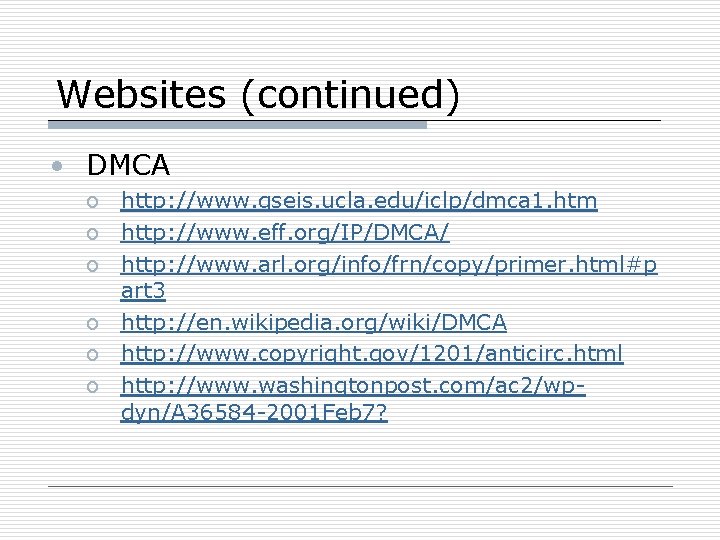
Websites (continued) • DMCA o http: //www. gseis. ucla. edu/iclp/dmca 1. htm o http: //www. eff. org/IP/DMCA/ o http: //www. arl. org/info/frn/copy/primer. html#p art 3 o http: //en. wikipedia. org/wiki/DMCA o http: //www. copyright. gov/1201/anticirc. html o http: //www. washingtonpost. com/ac 2/wpdyn/A 36584 -2001 Feb 7?
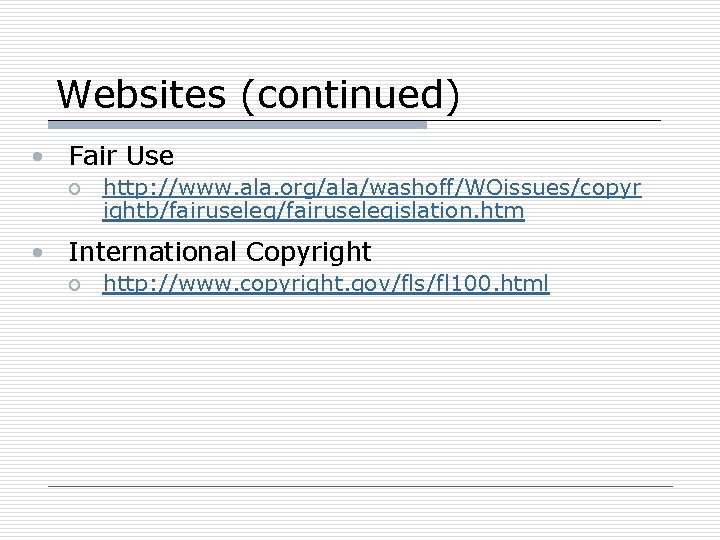
Websites (continued) • Fair Use o http: //www. ala. org/ala/washoff/WOissues/copyr ightb/fairuselegislation. htm • International Copyright o http: //www. copyright. gov/fls/fl 100. html
Annotated Bibliography
Bibliography page 1 Electronic Frontier Foundation: Defending Freedom in the Digital World http: //www. eff. org/ (accessed October 17, 2006). This is a website of a non-profit organization which is working to “protect your digital rights”. The website home page has a tab for each of the following: News, Press Releases and Cases. They have an extensive archive of news and cases relating to Digital media. The press releases are those issued by EFF about the organization’s activities, or in response to current events. The website covers a variety of topics including “Intellectual Property” and “Blogger’s Rights” If one has strong feelings about this topic, this is an excellent site since it allows the user to get involved.
Bibliography page 2 Hoffman, Gretchen Mc. Cord. Copyright in Cyberspace 2: Questions and Answers for Librarians. New York: Neal-Schuman Publishers, Inc. , 2005. This is a recent book written by a librarian who is also a lawyer. The book is arranged so it could be read straight through, or used as a handbook. It is divided into four sections; Copyright fundamentals in cyberspace, Applying copyright in cyberspace, Specific library applications and Sourcebox. Part IV, Source box, contains good reference tools including excerpts from the Copyright Act of 1976, ALA Model policy concerning College and University Photocopying for Classroom, Research and Library Reserve Use and the Code of Ethics of the American Library Association. The Specific library application section has a chapter on Writing a copyright policy. Each chapter is set up in a question and answer format. Although this book discusses many legal issues, it is easy to understand.
Bibliography page 3 Lessig, Lawrence Free Culture: The Nature and Future of Creativity. New York, The Penguin Press, 2005. The author founded the Stanford Center for Internet and Technology. He teaches at the Stanford Law School and is known internationally as a leader in the emerging field of “cyberlaw”. Cyberlaw combines constitutional law with Intellectual Property Law. He once clerked for Judge Richard Posner of the U. S. Seventh Circuit Court of Appeals. This book includes sections on Piracy and Property. Lessig discusses many lawsuits including Eldred v. Ashcroft in which he took part. He reviews his answers to the court and explains to the reader where the argument for Eldred went wrong. The hardback edition of this book was published with the name Free Culture: How Big Media Uses Technology and the Law to Lock Down Culture and Control Creativity which was published in 2004, also by Penguin Press.
Bibliography page 4 Littman, Jessica. Digital Copyright. New York, Promethius Books, 2001. Jessica Littman is a Professor of Law at Wayne State University in Detroit Michigan. She teaches classes in copyright law, internet law and trademarks and unfair competition. She has co-authored other books about copyright issues however these works seem to be geared towards other members of the law profession. She is also the author of Revising Copyright Law for the Information Age which is mentioned in the “Infringement in the Courtroom” section of this presentation. Russell, Carrie, ed. Complete Copyright: An Everyday Guide for Librarians. Chicago: American Library Association, 2004. Using a cast of imaginary librarians and characters, this book covers eight topics of the copyright issue. The topics include some basics about copyrights, the DMCA, fair use, and the TEACH Act.
Bibliography page 5 Stanford University Libraries Copyright and Fair Use Act http: //fairuse. stanford. edu/Copyright_and_Fair_Use_Overview /chapter 7/index. html (Accessed October 14, 2006) This site has a tab “For Librarians” which is useful, however the information about legislation is not as helpful. The web page for Librarians has an outline of policy guides put together by various library associations. It also contains links to some actual University policies, however some of these links need to be updated. The Legislation area of the website contains links to actual Hearing Documents but does not summarize their meaning for the website user.
Bibliography page 6 Stim, Richard Getting Permission: How to Clear Copyrighted Materials Online and Off. Berkeley, CA: Nolo. com, 2004 (2 nd Edition). This book discusses the process for obtaining permission to use materials under copyright. It is written as a guide to researchers and educators. The book contains the actual forms (tear-out version) needed to obtain permission, and it also comes with a CD-ROM of the forms. This would be useful for reference librarians, especially those working in an academic setting. Users of the library may look to the librarian for the answers to copyright questions, as well as for sources about the topic they are researching.
Bibliography page 7 United States Copyright Office Copyright http: //www. copyright. gov/ (accessed October 16, 2006) This is the main page of the website for the United States Copyright Office. From here the user can access web pages about the copyright law, legislation and mandatory deposit requirements. Some other useful pages on this site are http: //www. copyright. gov/legislation/ and http: //www. copyright. gov/newsnet/. This site also allows the user to search prior copyright records. The main page has a link to a page explaining how to transfer ownership of a copyright. There is also a separate link for each of these kinds of works; Literary works, Visual Arts, Performing Arts, Sound Recordings, Serials/Periodicals as well as a link for information written in Spanish.
Bibliography page 8 Vaidhyanathan, Siva. Copyrights and Copywrongs: The Rise of Intellectual Property and how it Threatens Creativity. New York: New York University Press, 2001. This book contains a history of Literary Copyright, and it also discusses “The Digital Moment” as well as some of the challenges the copyright laws have received from the music industry. The author does in-depth research of his topics and is able to keep the reader interested. This resource seems to be cited often by other authors.
Bibliography page 9 Wherry, Timothy Lee. Librarians Guide to Intellectual Property in the Digital Age: Copyrights, Patents and Trademarks. Chicago: American Library Association, 2002 (electronic resource). This book is available online or in hard copy. It is yet another guide for Librarians and Researchers to use. This book also contains chapters about patents, so it would be very helpful for Librarians working in Academic Science or Engineering Libraries. Some corporate Librarians would also find this book useful. In the introduction the author gives some examples of how new technologies are often forced into the already existing categories of items. For example, cars were first called “horseless carriages” and rockets that leave the earth’s orbit are called space “ships”. The last chapter of the book is a list of twelve questions and answers pertaining to intellectual property. The author does an excellent job of explaining the difference between phrases which are available for copyright and which would be protected under a trademark. He also discusses the timing of when each is applied for and granted.
Copyright in the Courtroom
Copyright vs. Plagiarism • • Plagiarism is an ethical violation, Copyright Infringement is a legal violation. o If I try to pass off one of Shakespeare’s plays as my own, that's plagiarism, as the work is in the public domain. o If I copy one of August Wilson's copyright-protected plays onto a CD-ROM collection that I'm selling, that's copyright infringement. o If I try to pass off one of his copyright-protected plays as my own, even if it’s not for monetary gain, that's still copyright infringement. If I try to pass off something from Wikipedia (that I have not cited or attributed to them) as my own, that's an ethical violation and possibly a legal violation as well. Be sure that when using Creative Commons content, that you follow all guidelines, and check to be sure that the way you are using the content/work is according to the uses specified by the creative commons license holder.
Eldred v. Ashcroft, 1998 • The Case: A challenge to Sonny Bono’s Copyright Term Extension Act (CTEA), which adds 20 years to existing and future copyrights. • The Decision: The Supreme Court felt that if this extension wasn’t appropriate, why weren’t extensions in 1976 and earlier challenged? • Factoid: The Jungle book was created by Disney (who lobbied FOR CTEA) only 7 years after the copyright expired. Graphic image copied form Lawerence Lessig’s blog: http: //www. lessig. org/
CTEA Commentary • Vaidhyanathan: “the trend has been to make copyright more restrictive and tip the balance towards the holders of copyright… copyright is best at promoting science and art when it is less restrictive. ” • Let’s say I publish a book when I’m 45 years old…and I live to age 75. My book will have copyright protection for 100 years. Most books fade from memory after 10 or 20 years. But, for the next 100 years my book will be unavailable to the public. If anyone wants to publish my book they’ll need to have written permission from the copyright owner. • Searches for the copyright owner are often difficult and expensive, as there is no central repository that tracks who the copyright owner is and how they may be contacted.
The Betamax Decision • Sony Corp. of America v. Universal City Studios, Inc. • The ruling in favor of Sony hinged on the possibility that the technology in question had significant non-infringing uses. These uses include copying a TV show to be viewed at another time. The Court decided that this is not copyright infringement, it is “fair use. ” • “I say to you that the VCR is to the American film producer and the American public as the Boston strangler is to the woman home alone. ” – Jack Valenti, former chairman of the MPAA (for 38 years), 1982 Congressional Hearing on Home Recording of Copyrighted works. • The decision predated the internet and file-sharing websites. Most files shared on peer-to-peer (P 2 P) networks are copies of copyrighted works (videos, music). This case is often cited in decisions involving P 2 P websites.
MGM v. Grokster, et. al. • In 2005 MGM Studios + 28 others sued filesharing companies Grokster and Streamcast (makers of Morpheus). • In a unanimous opinion, the Supreme Court held that companies that distributed software, and promoted that software to infringe copyrights, were liable for the resulting acts of infringement, also known as contributory Infringement. • Originally the Ninth Circuit ruled for Grokster and Streamcast citing the Betamax decision. Although the Supreme Court set aside the Ninth Circuit’s ruling, it did not overturn the Betamax decision.
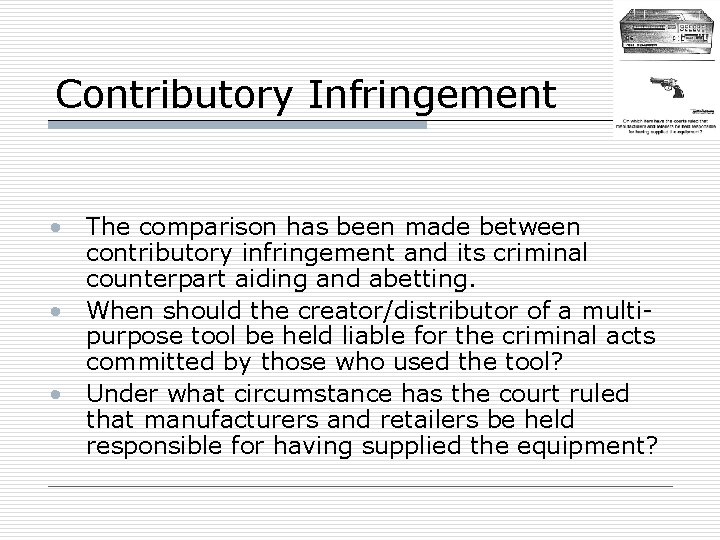
Contributory Infringement • The comparison has been made between contributory infringement and its criminal counterpart aiding and abetting. • When should the creator/distributor of a multipurpose tool be held liable for the criminal acts committed by those who used the tool? • Under what circumstance has the court ruled that manufacturers and retailers be held responsible for having supplied the equipment?
Implications of copyright infringement cases brought against P 2 Ps From Lawrence Lessig’s Blog • Using secondary copyright infringement to undermine P 2 Ps (peer to peers file-sharing systems) can potentially undermine the whole Internet. The internet is a “free” environment, and it thrives because it is open to all applications and innovators. Because there is little control over technological innovation, the Internet has developed in unpredictable ways. • Lessig states that “the Internet network is neutral”, meaning that it’s open to any type of application. Because the Internet is designed in this way: 1. it allows for as yet unimagined technologies to be implemented. 2. innovators can create without asking anyone’s permission. • Lessig calls this an “innovation commons, " a resource that others are free to build on.
File-Sharing Systems Fight Back • You. Tube’s STRATEGY You. Tube is relying on the Digital Millennium Copyright Act, which does not require them to screen videos in advance, but they must remove the videos when a copyright holder informs them of a violation. And, You. Tube recently signed a deal with Warner Music Group to distribute the music company’s videos on its web site. • LIME WIRE’S STRATEGY Lime Wire was hit with a lawsuit (in August 2006) by Warner Bros. Records, Virgin Records, Sony BMG Music etc. They filed a countersuit, which states that these record labels launched their own digital-distribution Web sites and they allege that the labels joined forces to be the sole recipients of any financial benefit.
New York Times v. Tasini • • In 2001 The National Writers Union sued NY Times, Newsday, Time, University Microfilms, and Lexis/Nexis for copyright infringement. The Case: Initially the freelance articles were licensed to be published in print form, but they were later published in electronic databases without consent of the writers. The Decision: The Supreme Court ruled for the freelance writers. As a result of the decision, the National Writers Union won a compensation pool of $18 million, which has not yet been distributed. Result: The NY Times and other news agencies have reworded contracts to include that freelance works may be published in other formats without consent.
Frankel v. Lyons Partnership • Last month the EFF (Electronic Frontier Foundation) asked a federal court to protect the free speech rights (online free speech) of a website publisher (Dr. Stuart Frankel )who has suffered years of baseless legal threats over his parody of the Barney and Friends television show. • Dr. Stuart Frankel’s website is at: http: //www. dustyfeet. com/evil/enemy. html
Copyright Wrongs, By Randy Cohen (The Ethicist) NYTimes Oct. 8, 2006 • Q: Is it piracy if you take your laptop into a library and download CD’s or copy movies from its DVD collection? I travel the country continuously and frequent libraries. Never have I seen a sign that prohibits copying the material on their shelves. Adam Wasserman, L. A. • A: I, too, frequent libraries, and never have I seen a sign that prohibits shooting a patron who jabbers into his cellphone in the reference section. . . While libraries exist to lend just the sort of material you describe, duplicating an entire copyrighted work is forbidden. Siva Vaidhyanathan, an expert on intellectual-property issues… explains that copying an excerpt for educational, research, artistic or journalistic purposes is generally legal, “but copying an entire book or film would usually lie beyond any fair use of copyrighted material. ” That is, downloading a few moments of “Tear the Roof off the Sucker (Give Up the Funk)” for nonprofit scholarly purposes is fine; duplicating all of “Mothership Connection, ” the Parliament album on which that splendid song is found, is not. In judging such conduct, both motive and size count. This guideline strives to balance the right of a creator to be paid for his work (and thus encourage his creativity) and the interest of the larger society in the dissemination of ideas. The fundamental goal of copyright is not to secure profits but to inspire thought — “to promote the progress of science and useful arts, ” as Article I, Section 8 of the Constitution puts it.
Fogerty v. Fantasy, Inc. , (1994) • Saul Zaentz, owner of Fantasy Records and the rights to CCR’s songs, sued John Fogerty for copyright infringement, and self-plagiarism. Zaentz charged that Fogerty’s 1985 solo hit "The Old Man Down the Road" sounded too similar to the CCR hit, "Run Through the Jungle. “ • Fogerty won the case, but it cost him 400 k in lawyer’s fees.
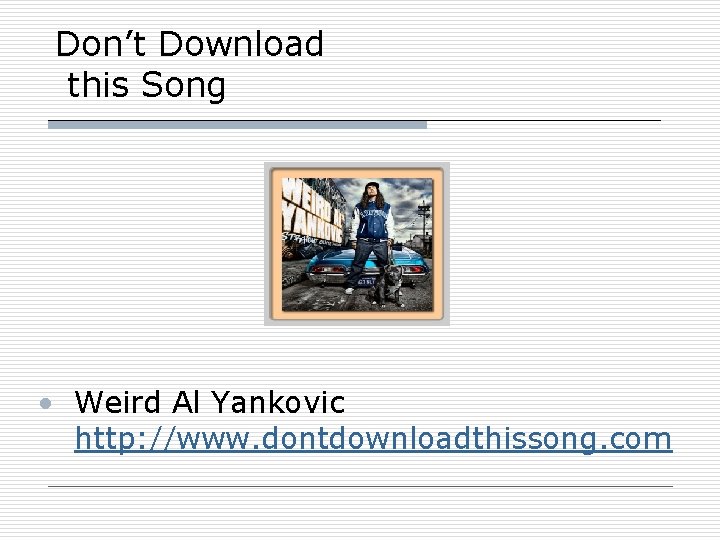
Don’t Download this Song • Weird Al Yankovic http: //www. dontdownloadthissong. com
The ideas and concepts presented were influenced by these sources: • Wikipedia • Berkman Center for Internet and Society at Harvard Law School • Wordspy. com • Oyez. org – US Supreme Court Multimedia • The Elecrtonic Frontier Foundation • IPCentral blog (IP=Intellectual Property) • ARL website • Copyright Jungle by Siva Vaidhyanathan • Copyrights and Copywrongs by Siva Vaidhyanathan • Lawrence Lessig’s blog • Jewsrock. org • Answers. com • Revising Copyright Law for the Information Age by Jessica Littman • The New York Times • Red Herring I did not obtain permission for use of the non-clip aret images, but I believe that this is considered fair use ---- as I am using the images for the purpose of teaching. (crossing fingers here…)
- Slides: 52