
Copyright Guide for Students The information in this
- Slides: 29
Copyright Guide for Students • The information in this guide is based on fact sheets (Students and copyright and Creative Commons) from the Smartcopying website • Source: National Copyright Unit on behalf of the Copyright Advisory Groups (Schools and TAFEs). , Information sheets Schools. , retrieved from http: //www. smartcopying. edu. au/infomationsheets/schools
Contents • • • What is copyright? Why is copyright important? Who owns the copyright in work? How long does copyright protection last? When can you use other people’s work? 1. Copyright protection expired 2. NEALS 3. Fair Dealing 4. Obtain permission 5. Creative Commons Licences Where to find Creative Commons material How to attribute material Smartcopying Tips
What is copyright? Copyright is a bunch of rights in certain creative works (literary works, artistic works, musical works, computer programs, sound recordings, films and broadcasts) which can be used to stop others from copying the work without permission. The rights are granted exclusively to the copyright owner to • reproduce (copy, scan, print), • communicate (email, put on Internet) • perform or show the work to the public.
Why is copyright important? It gives creators the ability to earn a living from their works and to control how their works are used or copied. They can decide who uses their work, how it can be used and if they will charge a fee to other people who want to use it.
What does copyright protect? Copyright does not protect ideas, concepts, styles or techniques. For example, copyright will not protect an idea for a film or book, but it will protect the script. The types of works copyright does protect include: • Artistic Works - paintings, photographs, maps, graphics, cartoons, charts, diagrams and illustrations • Literary Works - novels, textbooks, poems, song lyrics, newspaper articles, computer software, computer games • Musical Works - melodies, song music, advertising jingles, film scores • Dramatic works - plays, screenplays and choreography • Films and Moving Images - Feature films, short films, documentaries, television programs, interactive games, television advertisements, music videos and vodcasts • Sound Recordings - MP 3 files, CDs, DVDs, vinyl and tape recordings, podcasts. • Broadcasts - Pay and Free to air television and radio It is important to note that online text, images, broadcasts, videos and music on websites, wikis, blogs and social networking sites are all protected by copyright.
When does copyright apply? In Australia, copyright protection is automatic. A work will be protected as soon as it is written down or recorded in some way. Copyright and plagiarism Plagiarism occurs where a student uses someone else’s ideas or words in their work and pretends they are their own. If the student has used a lot of someone else’s words without that person’s permission, copyright infringement may also occur.
Who owns the copyright in work? The person who creates a work will normally own its’ copyright. In general: • the creator of a visual art work will own the copyright in the artwork • the author of a poem will own copyright in the poem • the production company of a film will own copyright in the film • the composer of a song will own copyright in the music of a song • the record company will own the copyright in a sound recording of music • the broadcaster will own the copyright in the radio or television broadcast
How long does copyright protection last? 1. Artistic, literary, musical and dramatic works are protected until 70 years after the creator’s death. 2. Films, sound recordings and broadcasts are protected for 70 years from the end of the year in which the work was released. After this, works are said to be in the PUBLIC DOMAIN and anyone can copy the work without having first to obtain permission from the copyright owner.
When can you use other people’s work?
Number One: Copyright protection expired When copyright protection has run out (i. e. 70 year rule) and the work is now public domain. Number Two: NEALS (National Educational Access Licence for Schools) Where content is marked with the NEALS logo, all government, catholic and independent schools may copy and communicate the content for educational purposes in schools free of charge, provided acknowledgement is made of the source on each printed page.
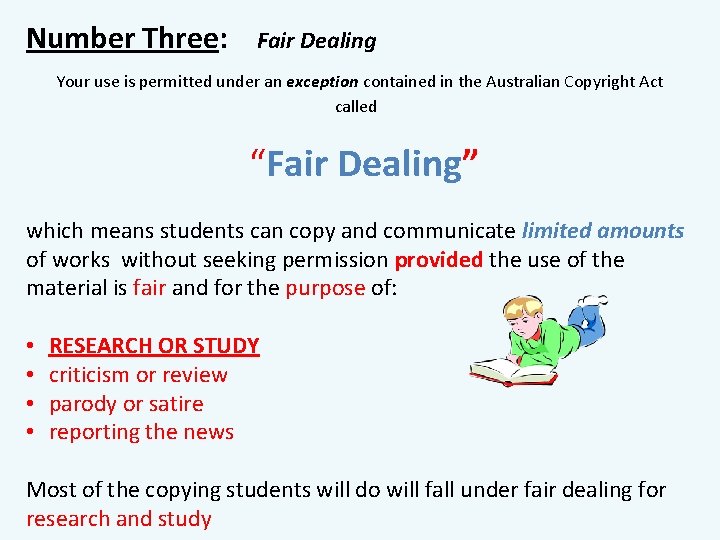
Number Three: Fair Dealing Your use is permitted under an exception contained in the Australian Copyright Act called “Fair Dealing” which means students can copy and communicate limited amounts of works without seeking permission provided the use of the material is fair and for the purpose of: • • RESEARCH OR STUDY criticism or review parody or satire reporting the news Most of the copying students will do will fall under fair dealing for research and study
How much is “fair” to COPY? The Copyright Act states that students are permitted to copy a reasonable portion for RESEARCH OR STUDY, defined as: Books and texts (including ebooks): 10% or one chapter Journals (including ejournals): one article (or two if on the same topic) Web/online material: 10% of words on website, blog, wiki etc (if no permission given in ‘conditions of use’ on the site, for example) Artistic/graphic/short works: one painting, cartoon, photograph, illustration, poem, graph, diagram, table, short quotation etc - the whole work may be copied but the source MUST be acknowledged Radio and TV broadcasts: can copy all or part Podcasts: if made available online by a radio /TV network can copy all or part
Audio visual material i. e. CD’s, DVD’s a “reasonable portion” only that amount necessary for the purpose is allowed e. g. excerpts to use in an assignment The whole item can only be copied for research and study if it is not available commercially You tube: Under Section 28 of the copyright act teachers and students can stream You. Tube videos (from You. Tube website or embedded link) to a class where it is: • in the course of education and not for profit; and • the people in the audience or class are giving or receiving instruction. • Downloading a You. Tube video is making a copy which is not allowed unless it is CC or permission is given under terms and conditions
General rule: Students should only copy what is necessary for the fair dealing purpose to ensure that their use is ‘fair’. Overall, when relying on fair dealing, students must: • Use extracts and not whole works. In rare cases, a whole work can be copied provided it is necessary for the fair dealing purpose. • Always attribute the author/creator and publisher where the source is known.
Number Four: Obtain permission You will need to seek permission from the copyright owner if you wish to use the work in a way which is not permitted by fair dealing. Asking via email is usually the fastest and easiest method Sometimes the copyright owner will ask for payment in exchange for giving permission.
Number Five Creative commons Copyright owner has said that it can be used for free or has licensed the material under a Creative Commons licence attached to the work (see website) • All Creative Commons licences allow the material to be used free for educational purposes. • CC is a good alternative to relying on the fair dealing exceptions because fair dealing makes it difficult for a student to: • Copy an entire work or large portions of a work • Modify and remix a work.
Under Creative Commons: Students can: • copy an entire work without limitation • distribute, communicate, display or perform and format shift the work • modify and remix the material where allowed
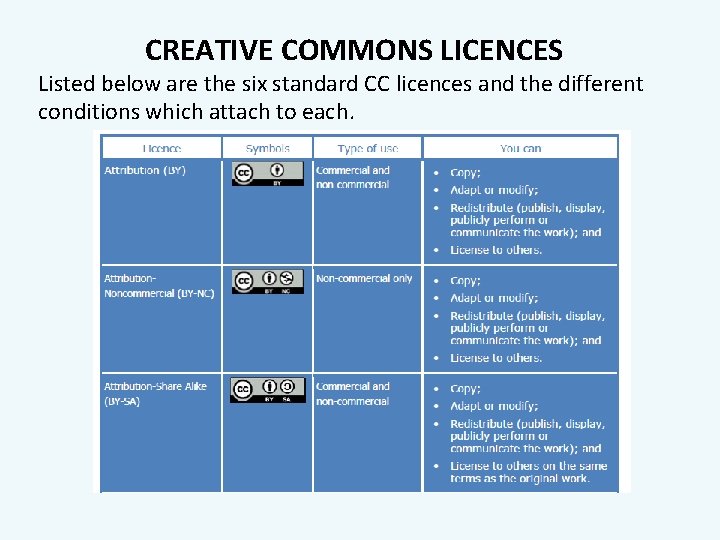
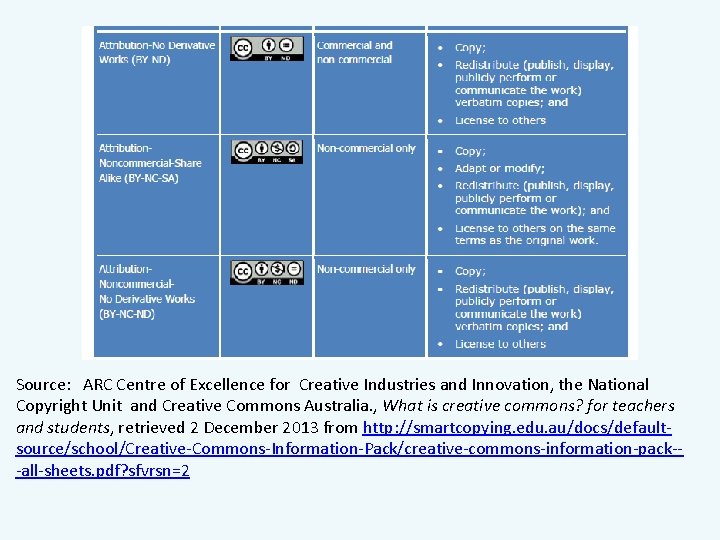
CREATIVE COMMONS LICENCES Listed below are the six standard CC licences and the different conditions which attach to each.
Source: ARC Centre of Excellence for Creative Industries and Innovation, the National Copyright Unit and Creative Commons Australia. , What is creative commons? for teachers and students, retrieved 2 December 2013 from http: //smartcopying. edu. au/docs/defaultsource/school/Creative-Commons-Information-Pack/creative-commons-information-pack--all-sheets. pdf? sfvrsn=2
Where to find Creative Commons material
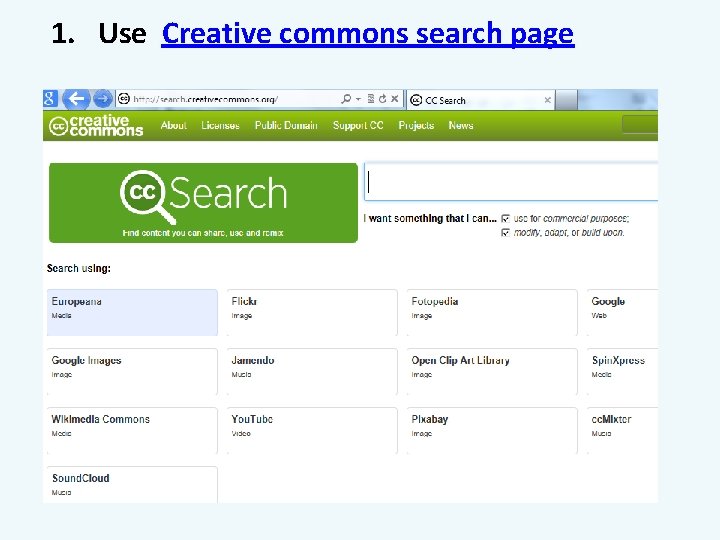
1. Use Creative commons search page
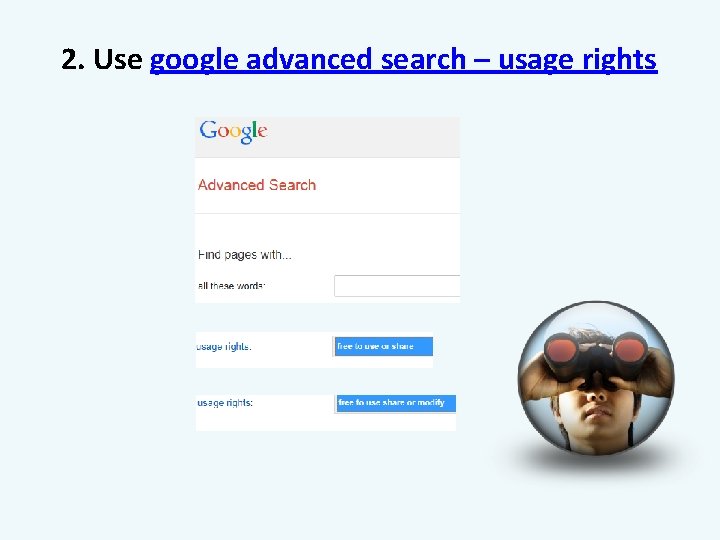
2. Use google advanced search – usage rights
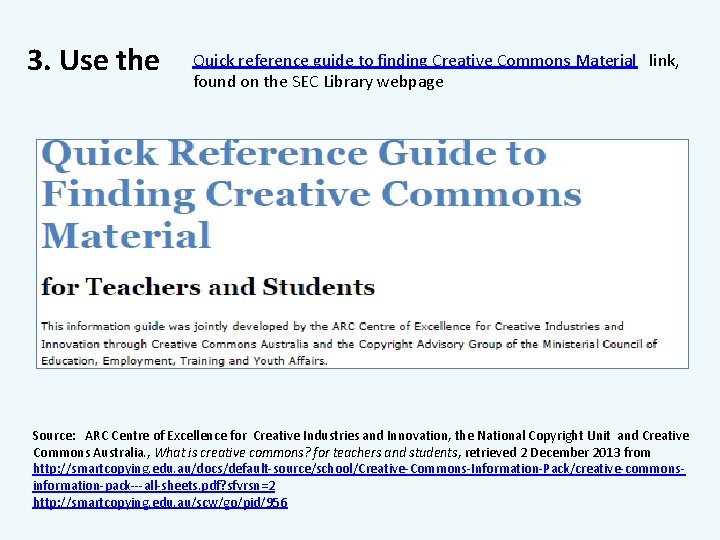
3. Use the Quick reference guide to finding Creative Commons Material link, found on the SEC Library webpage Source: ARC Centre of Excellence for Creative Industries and Innovation, the National Copyright Unit and Creative Commons Australia. , What is creative commons? for teachers and students, retrieved 2 December 2013 from http: //smartcopying. edu. au/docs/default-source/school/Creative-Commons-Information-Pack/creative-commonsinformation-pack---all-sheets. pdf? sfvrsn=2 http: //smartcopying. edu. au/scw/go/pid/956
How to attribute material
Attributing Material All material copied and/or communicated in your work should be labelled with the details of: • • the copyright owner/ author/creator the title/name of the work, where the material was copied from (link) when it was copied.
Attributing Creative Commons Material Provide: the creator; the title of the work; the URL where the work is hosted; the type of licence it is available under and provide a link to the licence • keep intact any copyright notice associated with the work. • • eg. Peter Alexander, ‘Sounion Temple’, http: //www. flickr. com/photos/40681760@N 07/3961143351/, 5 August 2009 Available under a Creative Commons 2. 0 Attribution licence: http: //creativecommons. org/licenses/by/2. 0/deed. en
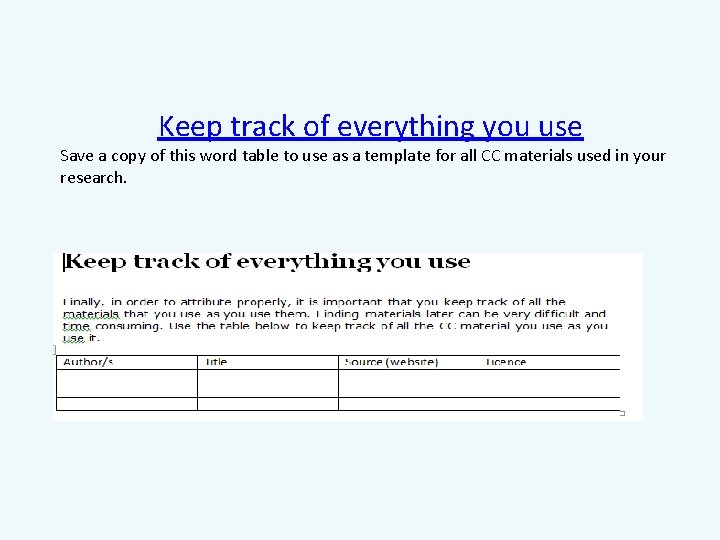
Keep track of everything you use Save a copy of this word table to use as a template for all CC materials used in your research.
Smartcopying Tips 1. You are free to bookmark, add to favourites, share links etc as these are not copyright activities. 2. Link to material Linking is not a copyright activity. This is because you are not actually ‘copying’ or ‘communicating’ any material, you are just providing a path to its location on another website. Providing links to material on external websites will not infringe copyright and you do not need to seek permission from the website owner to include a link to their website. 3. Use embedded links Embedding is another type of linking, except you don’t have to leave your website (e. g. blog or wiki) or intranet to access the content. It is commonly used for displaying online films, e. g. You. Tube films, on websites. Embedding involves copying the HTML code of the film, which is often displayed in a box near the film, and pasting it onto your website. The result of this is, rather than displaying the link, a small screen of the film will be shown on your website. The primary advantage to embedding material is that you do not need to copy the material in order to make it available on your website. Some websites, such as You. Tube, provide the link for embedding films. This makes embedding an easy and practical alternative to copying.
Compiled by Margaret Murney, Teacher Librarian, Brother Field’s Education and Resource Centre, St Edmund’s College, Canberra, ACT