
Copyright Dangers and the Importance of Fair Use
![Draft of House version of Digital Millenium Bill u u u “[This bill] contains](https://slidetodoc.com/presentation_image/1af7dcadc3f747590776081dd68b5cc2/image-58.jpg "Draft of House version of Digital Millenium Bill u u u “[This bill] contains")
- Slides: 60
Copyright Dangers and the Importance of Fair Use Electronic Publishing, 10/29/00 Howard Besser Associate Professor UCLA School of Education & Information http: //www. gseis. ucla. edu/~howard/ Besser--Borgman class 10/30/00 10/29/00, 1
Copyright Dangers and the Importance of Fair Useu u u History of Copyright Erosion of Public Domain The Digital Dilemma – unbundling/unraveling – stakeholders u My far-out ideas as provocation Besser--Borgman class 10/30/00 10/29/00, 2
Constitution, Article 1, Section 8 u The Congress shall have power. . . to provide for the. . . general welfare of the United States To promote the progress of science and useful arts, by securing for limited times to authors and inventors the exclusive right to their respective writings and discoveries; Underlining added Besser--Borgman class 10/30/00 10/29/00, 3
Copyright Background/Origins u u Copyright is a delicate balance btwn users and creators, but is supposed to be clearly oriented towards the public good. Copyright is NOT an unlimited Economic Right Copyright is really a temporary monopoly right granted to creators in order to fulfill the societal need to increase creativity The Copyright monopoly is temporary, then works become freely available for all purposes Besser--Borgman class 10/30/00 10/29/00, 4
Delicate balance u u Fair Use is a powerful tool for both education and social commentary First Sale is important for social aims Besser--Borgman class 10/30/00 10/29/00, 5
What has copyright become u u (1/2) Who actually holds Copyright? Licensing is replacing copyright in the digital age Besser--Borgman class 10/30/00 10/29/00, 6
What has copyright become u u (2/2) The larger trend -- moving long-standing common-law or constitutional rights into the arena of person-to-person business transactions, where these rights no longer apply licensing eliminating fair use – privacy – international arena – increasing time before work enters public domain Besser--Borgman class 10/30/00 10/29/00, 7
Disturbing Legislation u u u Duration Lengthening Fair Use Disappearing but first we need to understand the public domain Besser--Borgman class 10/30/00 10/29/00, 8
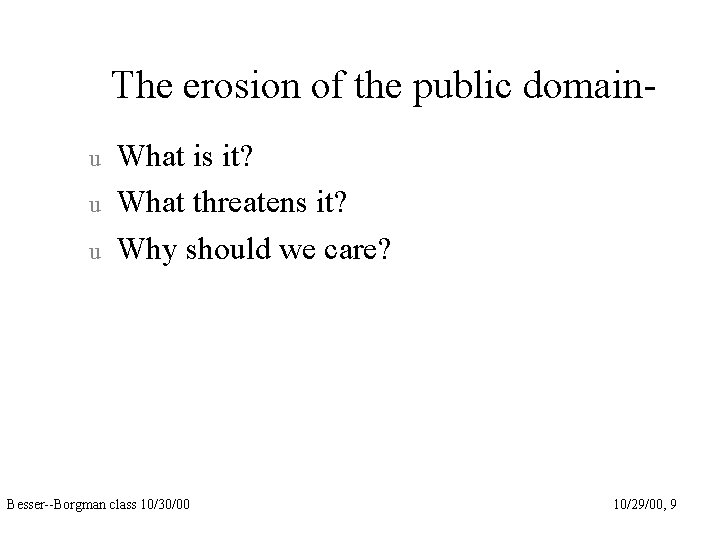
The erosion of the public domainu u u What is it? What threatens it? Why should we care? Besser--Borgman class 10/30/00 10/29/00, 9
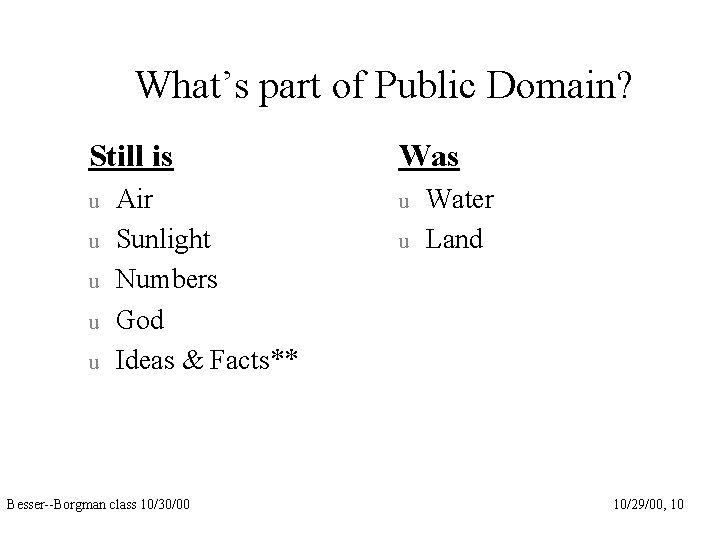
What’s part of Public Domain? Still is u u u Air Sunlight Numbers God Ideas & Facts** Besser--Borgman class 10/30/00 Was u u Water Land 10/29/00, 10
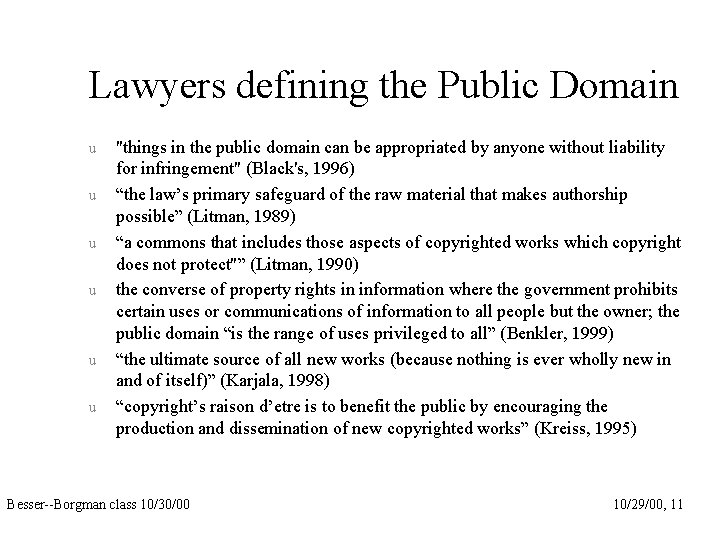
Lawyers defining the Public Domain u u u "things in the public domain can be appropriated by anyone without liability for infringement" (Black's, 1996) “the law’s primary safeguard of the raw material that makes authorship possible” (Litman, 1989) “a commons that includes those aspects of copyrighted works which copyright does not protect"” (Litman, 1990) the converse of property rights in information where the government prohibits certain uses or communications of information to all people but the owner; the public domain “is the range of uses privileged to all” (Benkler, 1999) “the ultimate source of all new works (because nothing is ever wholly new in and of itself)” (Karjala, 1998) “copyright’s raison d’etre is to benefit the public by encouraging the production and dissemination of new copyrighted works” (Kreiss, 1995) Besser--Borgman class 10/30/00 10/29/00, 11
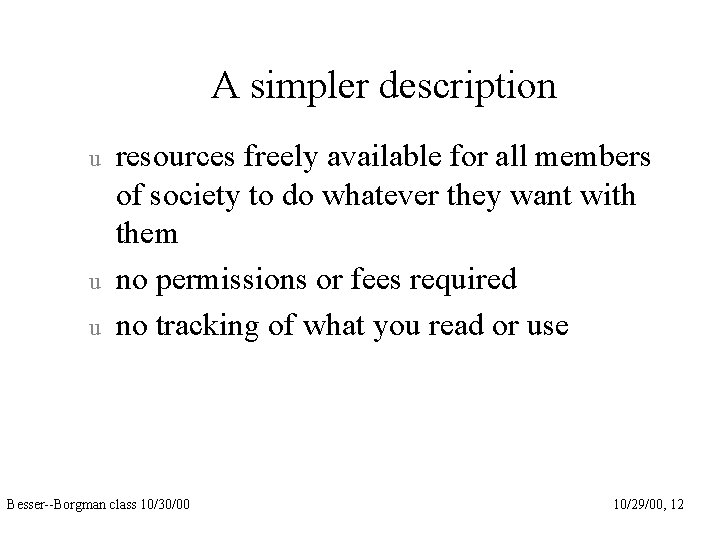
A simpler description u u u resources freely available for all members of society to do whatever they want with them no permissions or fees required no tracking of what you read or use Besser--Borgman class 10/30/00 10/29/00, 12
Importance of Public Domain u u Common Heritage (philosophical) New Knowledge incorporates Old (progress) Derivative Works rely upon pre-existing Works (creativity) Social Commentary (free speech) Besser--Borgman class 10/30/00 10/29/00, 13
What threatens it? u u u Term extension Returning out-of-copyright works back to copyright Mickey Mouse Licensing Other forms of Contract Laws Besser--Borgman class 10/30/00 10/29/00, 14
Time before works enter public domain Besser--Borgman class 10/30/00 10/29/00, 15
Lengthier Copyright Means Besser--Borgman class 10/30/00 10/29/00, 16
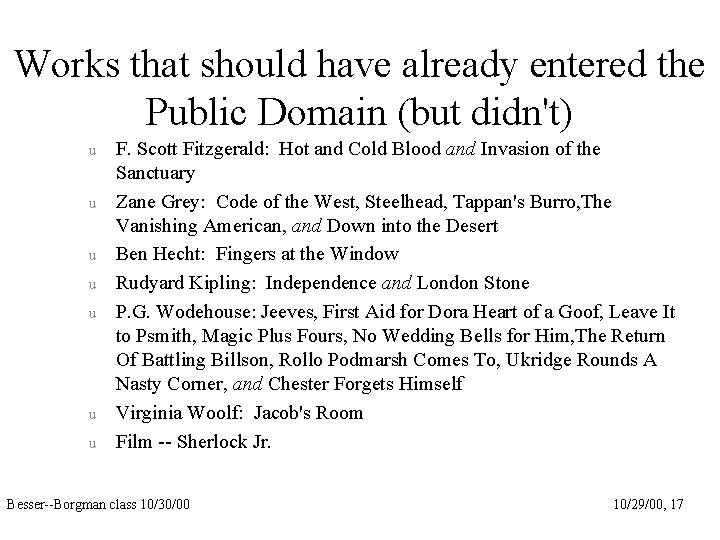
Works that should have already entered the Public Domain (but didn't) u u u u F. Scott Fitzgerald: Hot and Cold Blood and Invasion of the Sanctuary Zane Grey: Code of the West, Steelhead, Tappan's Burro, The Vanishing American, and Down into the Desert Ben Hecht: Fingers at the Window Rudyard Kipling: Independence and London Stone P. G. Wodehouse: Jeeves, First Aid for Dora Heart of a Goof, Leave It to Psmith, Magic Plus Fours, No Wedding Bells for Him, The Return Of Battling Billson, Rollo Podmarsh Comes To, Ukridge Rounds A Nasty Corner, and Chester Forgets Himself Virginia Woolf: Jacob's Room Film -- Sherlock Jr. Besser--Borgman class 10/30/00 10/29/00, 17
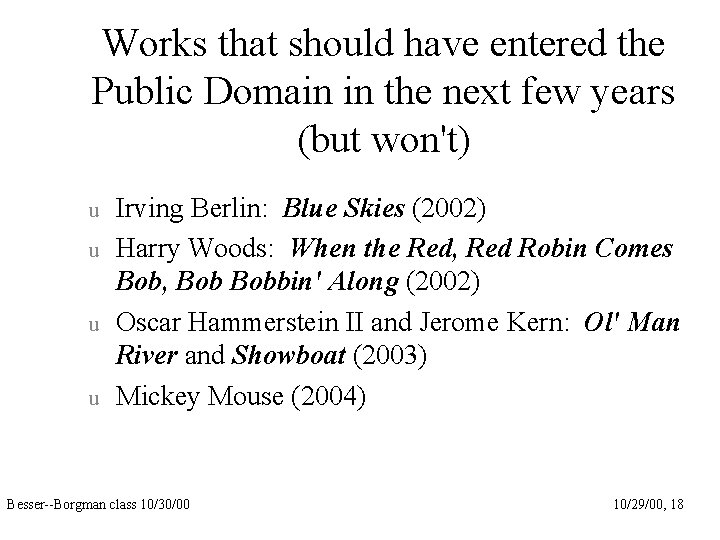
Works that should have entered the Public Domain in the next few years (but won't) u u Irving Berlin: Blue Skies (2002) Harry Woods: When the Red, Red Robin Comes Bob, Bobbin' Along (2002) Oscar Hammerstein II and Jerome Kern: Ol' Man River and Showboat (2003) Mickey Mouse (2004) Besser--Borgman class 10/30/00 10/29/00, 18
The Digital Dilemma: Intellectual Property in the Information Age Computer Science and Telecommunications Board National Research Council National Academy of Science
A Study of the National Research Council/CSTB u u The National Research Council & CSTB Nature of a Study – common ground btwn stakeholders, not necessarily what is best for NAS or research u Origins of This Study – unbundling of previously-grouped packages (publishers/distributors, works as units, …) – changing interpretations of concepts such as first sale and fair use u u Scope of This Study focused on US Besser--Borgman class 10/30/00 Computer Science and Telecommunications Board 10/29/00, 20
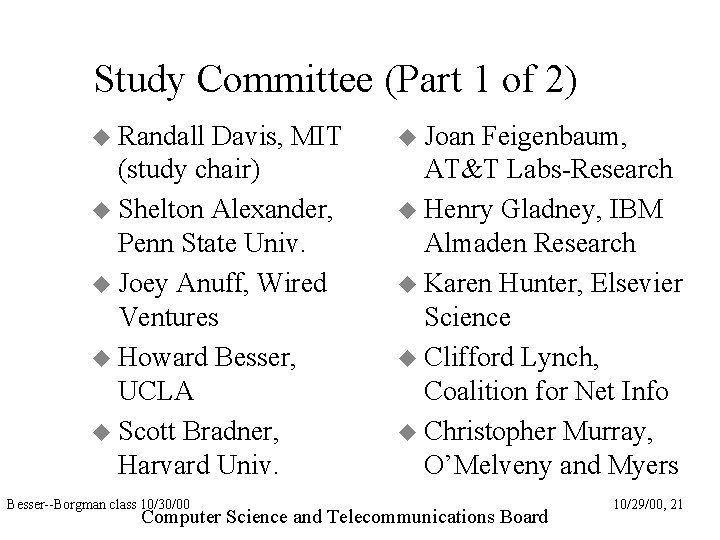
Study Committee (Part 1 of 2) Randall Davis, MIT (study chair) Shelton Alexander, Penn State Univ. Joey Anuff, Wired Ventures Howard Besser, UCLA Scott Bradner, Harvard Univ. Besser--Borgman class 10/30/00 Joan Feigenbaum, AT&T Labs-Research Henry Gladney, IBM Almaden Research Karen Hunter, Elsevier Science Clifford Lynch, Coalition for Net Info Christopher Murray, O’Melveny and Myers Computer Science and Telecommunications Board 10/29/00, 21
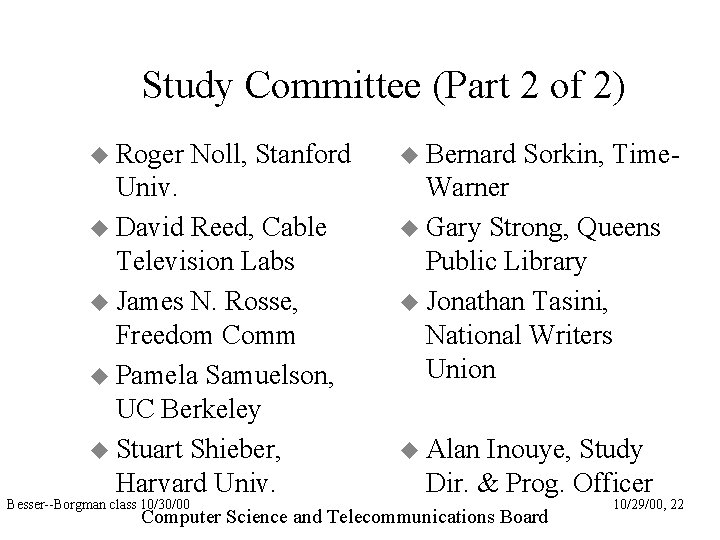
Study Committee (Part 2 of 2) Roger Noll, Stanford Univ. David Reed, Cable Television Labs James N. Rosse, Freedom Comm Pamela Samuelson, UC Berkeley Stuart Shieber, Harvard Univ. Besser--Borgman class 10/30/00 Bernard Sorkin, Time- Warner Gary Strong, Queens Public Library Jonathan Tasini, National Writers Union Alan Inouye, Study Dir. & Prog. Officer Computer Science and Telecommunications Board 10/29/00, 22
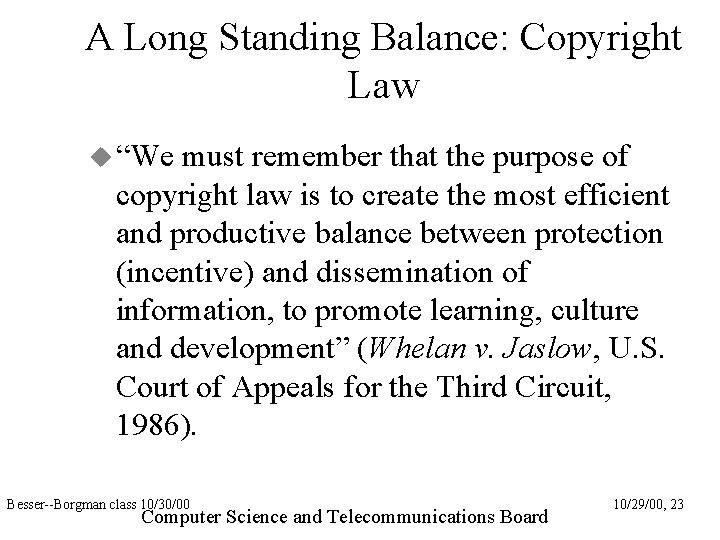
A Long Standing Balance: Copyright Law “We must remember that the purpose of copyright law is to create the most efficient and productive balance between protection (incentive) and dissemination of information, to promote learning, culture and development” (Whelan v. Jaslow, U. S. Court of Appeals for the Third Circuit, 1986). Besser--Borgman class 10/30/00 Computer Science and Telecommunications Board 10/29/00, 23
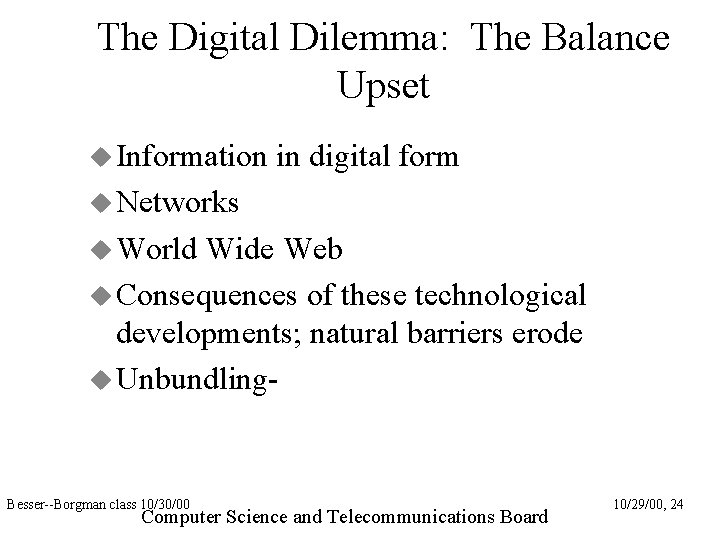
The Digital Dilemma: The Balance Upset Information in digital form Networks World Wide Web Consequences of these technological developments; natural barriers erode Unbundling- Besser--Borgman class 10/30/00 Computer Science and Telecommunications Board 10/29/00, 24
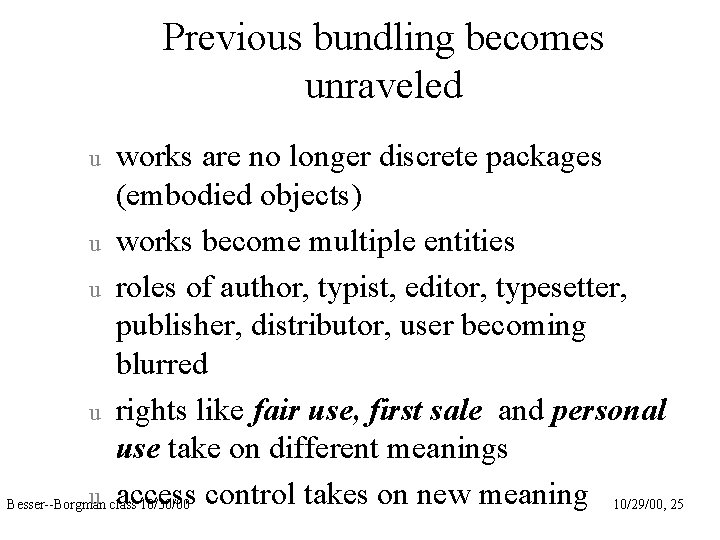
Previous bundling becomes unraveled works are no longer discrete packages (embodied objects) u works become multiple entities u roles of author, typist, editor, typesetter, publisher, distributor, user becoming blurred u rights like fair use, first sale and personal use take on different meanings u class access Besser--Borgman 10/30/00 control takes on new meaning 10/29/00, 25 u
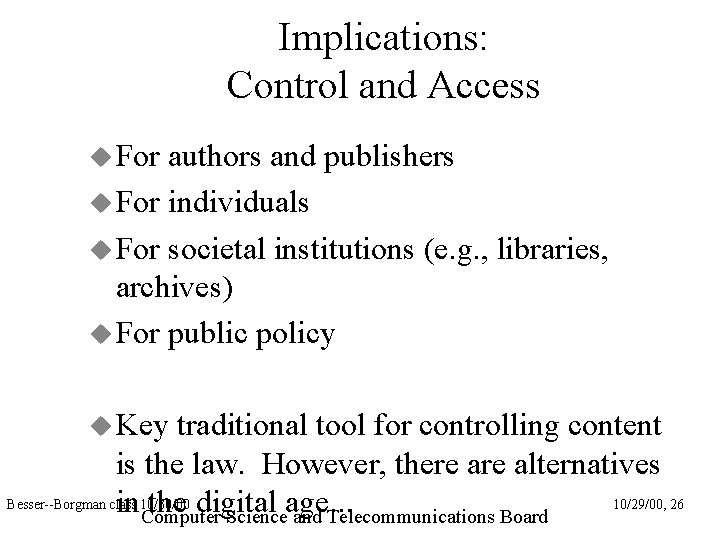
Implications: Control and Access For authors and publishers For individuals For societal institutions (e. g. , libraries, archives) For public policy Key traditional tool for controlling content is the law. However, there alternatives Besser--Borgman class 10/29/00, 26 in 10/30/00 the digital age. . . Computer Science and Telecommunications Board
Digital IP Issues are Complicated u u Not solely legal Not solely technical Social, economic & public policy aspects If you think there are simple answers, you haven’t been listening Besser--Borgman class 10/30/00 Computer Science and Telecommunications Board 10/29/00, 27
Digital IP Issues Have Advocates With Vigorously Different Perspectives Consensus often not possible “I can live with that” Process blunts sharp edges Besser--Borgman class 10/30/00 Computer Science and Telecommunications Board 10/29/00, 28
No Need to Overhaul IP Laws, But: Areas to watch Areas to research Areas to “clarify” the law Besser--Borgman class 10/30/00 Computer Science and Telecommunications Board 10/29/00, 29
Selected Highlights from the Study u u u u Go slow on Legislation Provision needs to be made for traditional entities to preserve works in digital form Legislation criminalizing circumvention of protection mechanisms is far to broad and harsh Not all classes of works need the same treatment Technological protection methods may prove useful but have their limits. New Business Models show great promise for solving the problems. We need reliable research on the economic impact of copying- Besser--Borgman class 10/30/00 10/29/00, 30
Characteristics of the Techniques for Technical Protection u u u Technology provides means, not ends No technique will provide perfect protection Technical protection does more than protecting the rights of copyright owners Besser--Borgman class 10/30/00 Computer Science and Telecommunications Board 10/29/00, 31
Characteristics of the Techniques for Technical Protection u u There are different degrees of technical protection: curb-high deterrence vs. security against commercial pirates Technical protection almost invariably causes some inconvenience to users Historically, amount of inconvenience correlated with degree of protection Techniques that are useful in special-purpose devices are quite different from those intended for general-purpose computers Besser--Borgman class 10/30/00 Computer Science and Telecommunications Board 10/29/00, 32
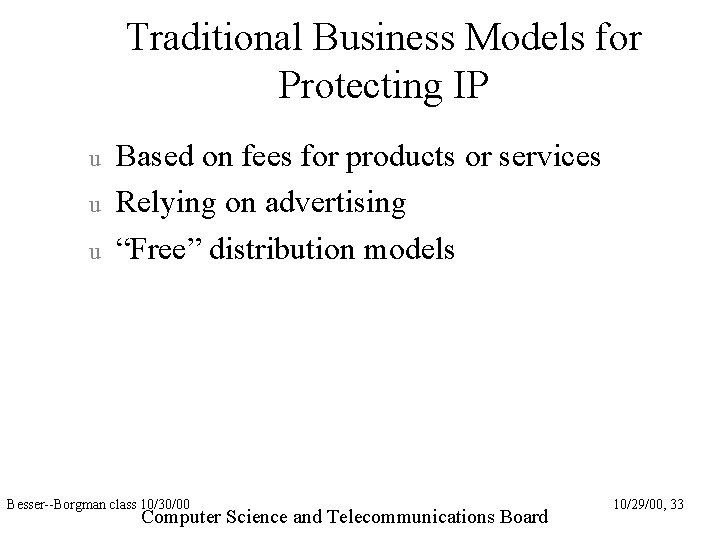
Traditional Business Models for Protecting IP u u u Based on fees for products or services Relying on advertising “Free” distribution models Besser--Borgman class 10/30/00 Computer Science and Telecommunications Board 10/29/00, 33
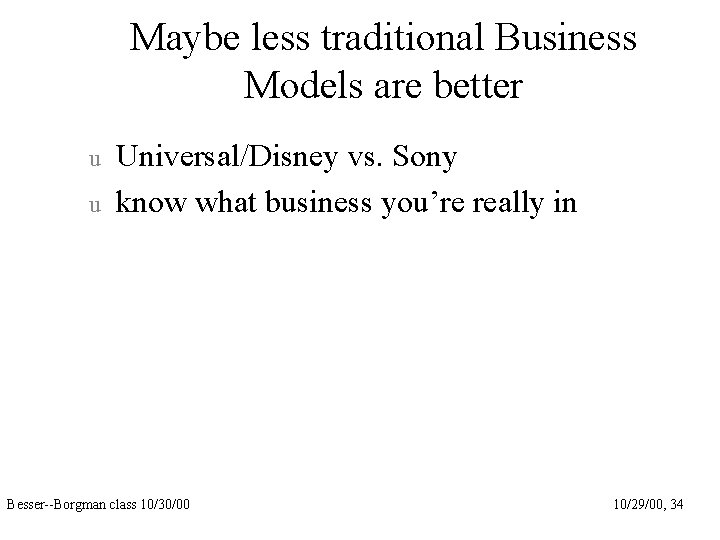
Maybe less traditional Business Models are better u u Universal/Disney vs. Sony know what business you’re really in Besser--Borgman class 10/30/00 10/29/00, 34
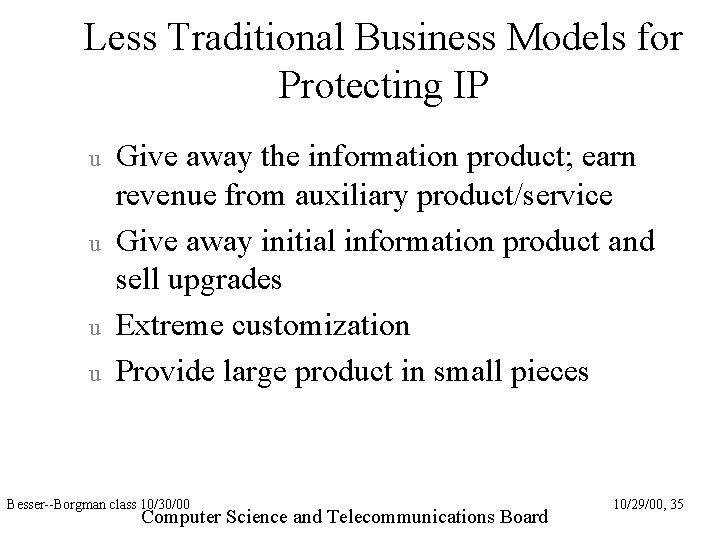
Less Traditional Business Models for Protecting IP u u Give away the information product; earn revenue from auxiliary product/service Give away initial information product and sell upgrades Extreme customization Provide large product in small pieces Besser--Borgman class 10/30/00 Computer Science and Telecommunications Board 10/29/00, 35
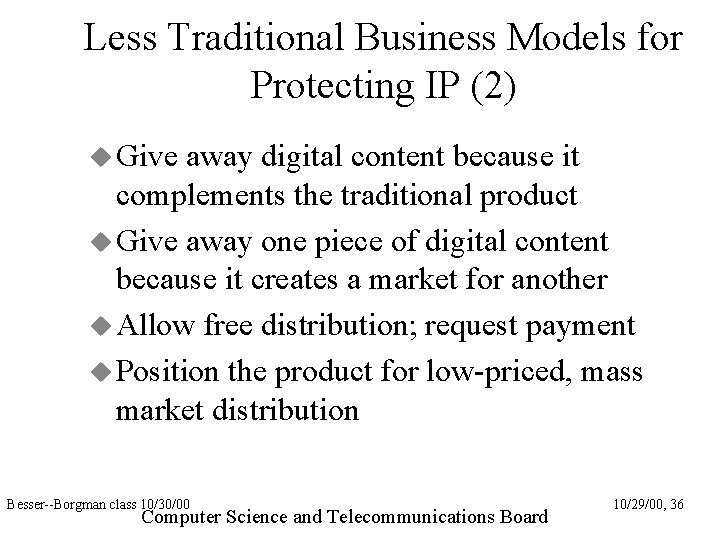
Less Traditional Business Models for Protecting IP (2) Give away digital content because it complements the traditional product Give away one piece of digital content because it creates a market for another Allow free distribution; request payment Position the product for low-priced, mass market distribution Besser--Borgman class 10/30/00 Computer Science and Telecommunications Board 10/29/00, 36
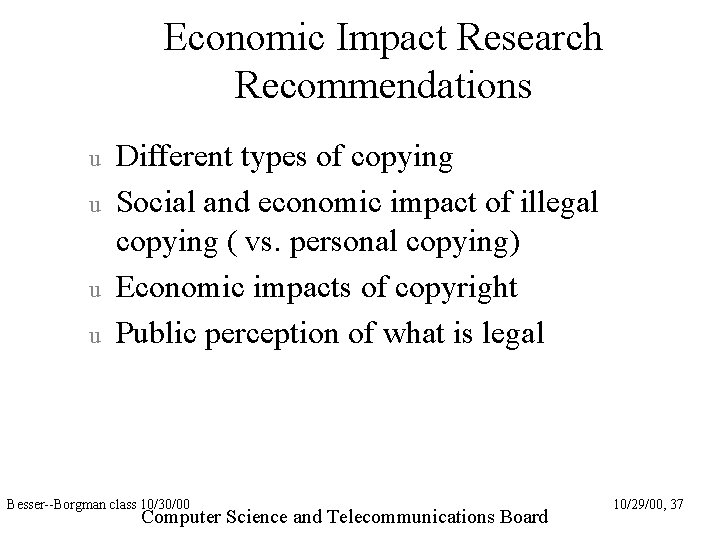
Economic Impact Research Recommendations u u Different types of copying Social and economic impact of illegal copying ( vs. personal copying) Economic impacts of copyright Public perception of what is legal Besser--Borgman class 10/30/00 Computer Science and Telecommunications Board 10/29/00, 37
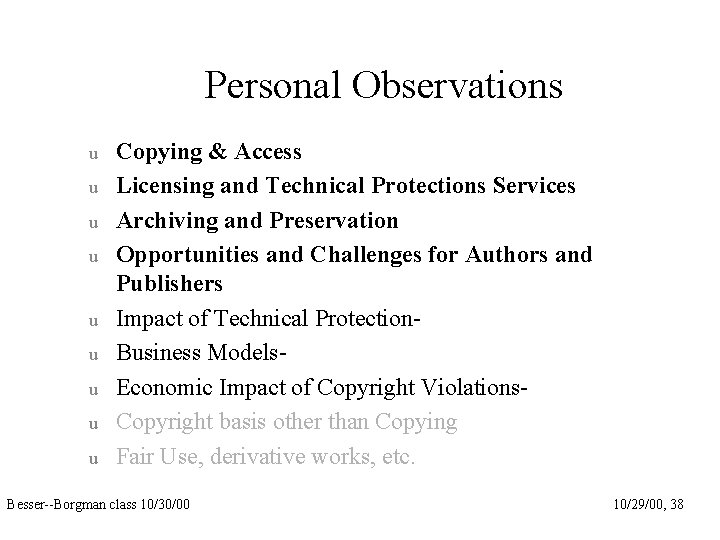
Personal Observations u u u u u Copying & Access Licensing and Technical Protections Services Archiving and Preservation Opportunities and Challenges for Authors and Publishers Impact of Technical Protection. Business Models. Economic Impact of Copyright Violations. Copyright basis other than Copying Fair Use, derivative works, etc. Besser--Borgman class 10/30/00 10/29/00, 38
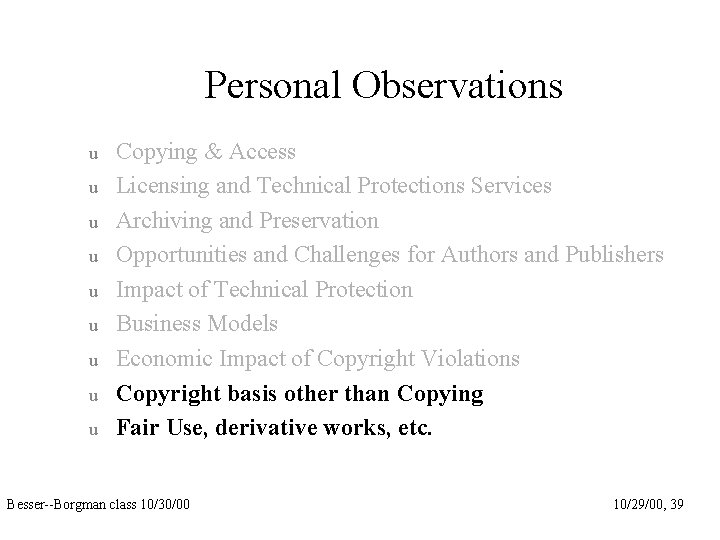
Personal Observations u u u u u Copying & Access Licensing and Technical Protections Services Archiving and Preservation Opportunities and Challenges for Authors and Publishers Impact of Technical Protection Business Models Economic Impact of Copyright Violations Copyright basis other than Copying Fair Use, derivative works, etc. Besser--Borgman class 10/30/00 10/29/00, 39
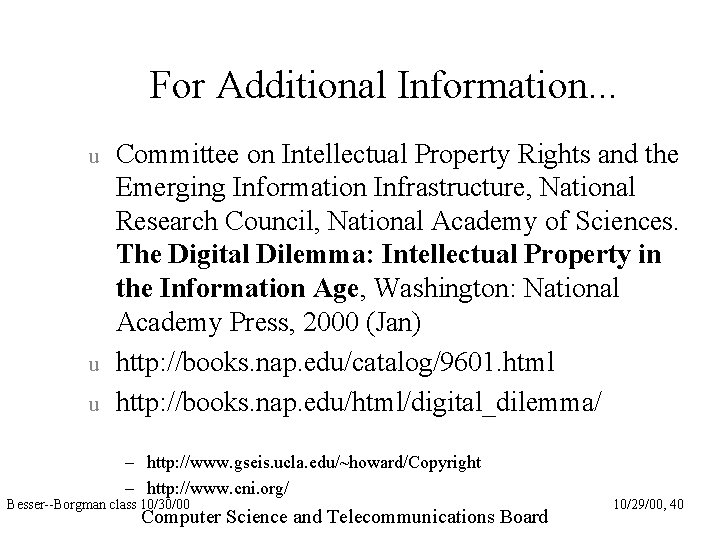
For Additional Information. . . u u u Committee on Intellectual Property Rights and the Emerging Information Infrastructure, National Research Council, National Academy of Sciences. The Digital Dilemma: Intellectual Property in the Information Age, Washington: National Academy Press, 2000 (Jan) http: //books. nap. edu/catalog/9601. html http: //books. nap. edu/html/digital_dilemma/ – http: //www. gseis. ucla. edu/~howard/Copyright – http: //www. cni. org/ Besser--Borgman class 10/30/00 Computer Science and Telecommunications Board 10/29/00, 40
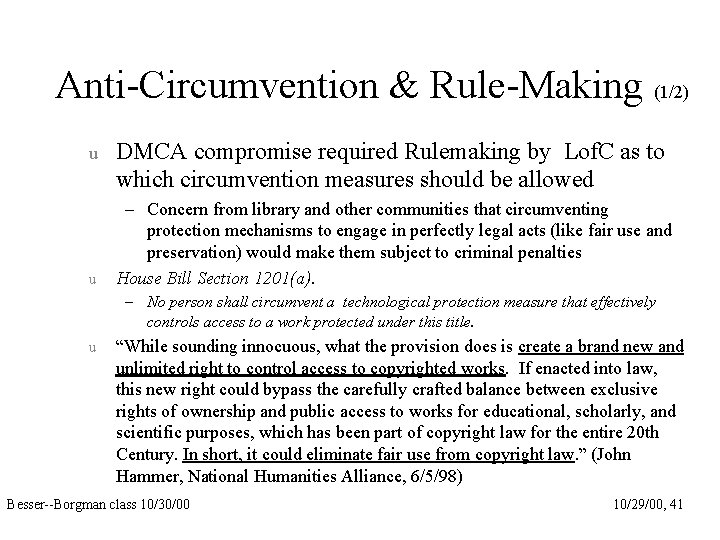
Anti-Circumvention & Rule-Making (1/2) u u DMCA compromise required Rulemaking by Lof. C as to which circumvention measures should be allowed – Concern from library and other communities that circumventing protection mechanisms to engage in perfectly legal acts (like fair use and preservation) would make them subject to criminal penalties House Bill Section 1201(a). – No person shall circumvent a technological protection measure that effectively controls access to a work protected under this title. u “While sounding innocuous, what the provision does is create a brand new and unlimited right to control access to copyrighted works. If enacted into law, this new right could bypass the carefully crafted balance between exclusive rights of ownership and public access to works for educational, scholarly, and scientific purposes, which has been part of copyright law for the entire 20 th Century. In short, it could eliminate fair use from copyright law. ” (John Hammer, National Humanities Alliance, 6/5/98) Besser--Borgman class 10/30/00 10/29/00, 41
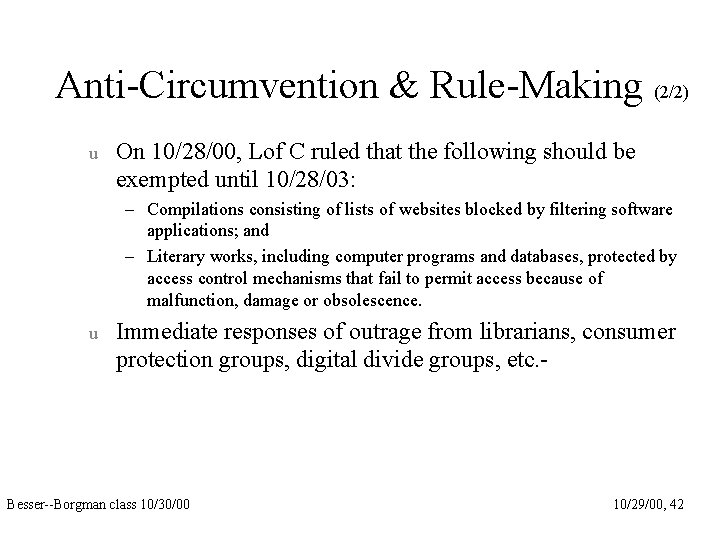
Anti-Circumvention & Rule-Making (2/2) u On 10/28/00, Lof C ruled that the following should be exempted until 10/28/03: – Compilations consisting of lists of websites blocked by filtering software applications; and – Literary works, including computer programs and databases, protected by access control mechanisms that fail to permit access because of malfunction, damage or obsolescence. u Immediate responses of outrage from librarians, consumer protection groups, digital divide groups, etc. - Besser--Borgman class 10/30/00 10/29/00, 42
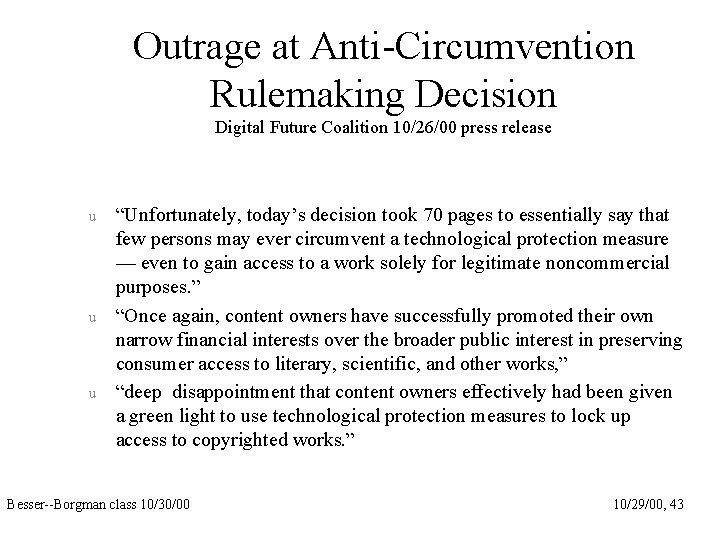
Outrage at Anti-Circumvention Rulemaking Decision Digital Future Coalition 10/26/00 press release u u u “Unfortunately, today’s decision took 70 pages to essentially say that few persons may ever circumvent a technological protection measure — even to gain access to a work solely for legitimate noncommercial purposes. ” “Once again, content owners have successfully promoted their own narrow financial interests over the broader public interest in preserving consumer access to literary, scientific, and other works, ” “deep disappointment that content owners effectively had been given a green light to use technological protection measures to lock up access to copyrighted works. ” Besser--Borgman class 10/30/00 10/29/00, 43
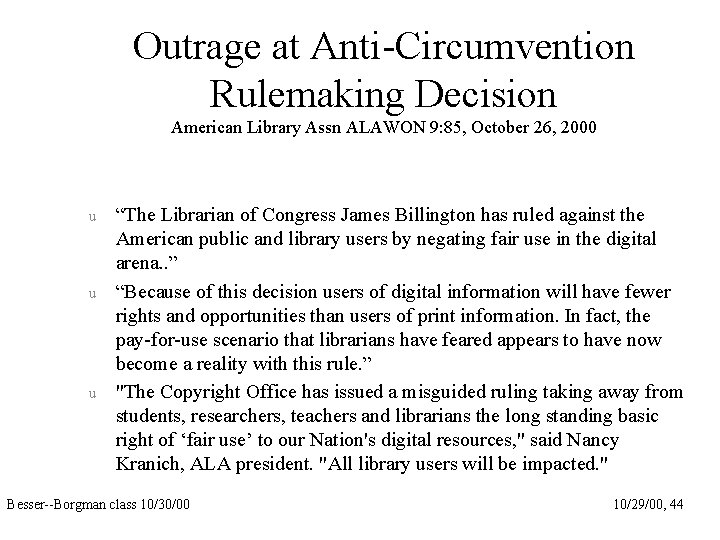
Outrage at Anti-Circumvention Rulemaking Decision American Library Assn ALAWON 9: 85, October 26, 2000 u u u “The Librarian of Congress James Billington has ruled against the American public and library users by negating fair use in the digital arena. . ” “Because of this decision users of digital information will have fewer rights and opportunities than users of print information. In fact, the pay-for-use scenario that librarians have feared appears to have now become a reality with this rule. ” "The Copyright Office has issued a misguided ruling taking away from students, researchers, teachers and librarians the long standing basic right of ‘fair use’ to our Nation's digital resources, " said Nancy Kranich, ALA president. "All library users will be impacted. " Besser--Borgman class 10/30/00 10/29/00, 44
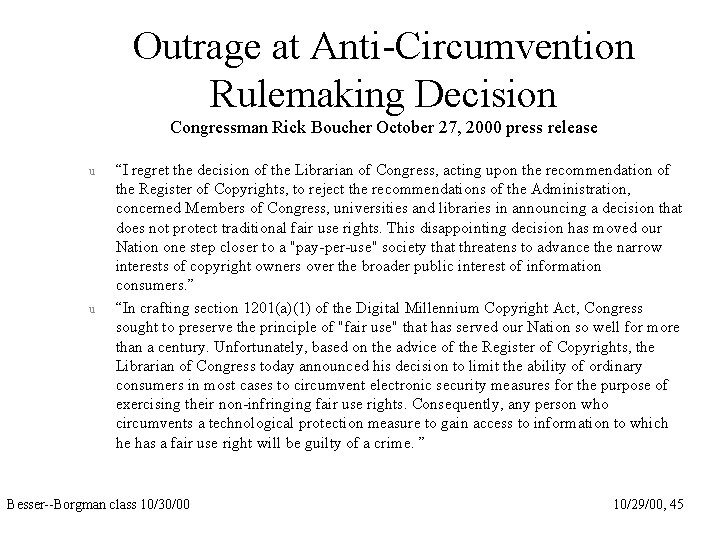
Outrage at Anti-Circumvention Rulemaking Decision Congressman Rick Boucher October 27, 2000 press release u u “I regret the decision of the Librarian of Congress, acting upon the recommendation of the Register of Copyrights, to reject the recommendations of the Administration, concerned Members of Congress, universities and libraries in announcing a decision that does not protect traditional fair use rights. This disappointing decision has moved our Nation one step closer to a "pay-per-use" society that threatens to advance the narrow interests of copyright owners over the broader public interest of information consumers. ” “In crafting section 1201(a)(1) of the Digital Millennium Copyright Act, Congress sought to preserve the principle of "fair use" that has served our Nation so well for more than a century. Unfortunately, based on the advice of the Register of Copyrights, the Librarian of Congress today announced his decision to limit the ability of ordinary consumers in most cases to circumvent electronic security measures for the purpose of exercising their non-infringing fair use rights. Consequently, any person who circumvents a technological protection measure to gain access to information to which he has a fair use right will be guilty of a crime. ” Besser--Borgman class 10/30/00 10/29/00, 45
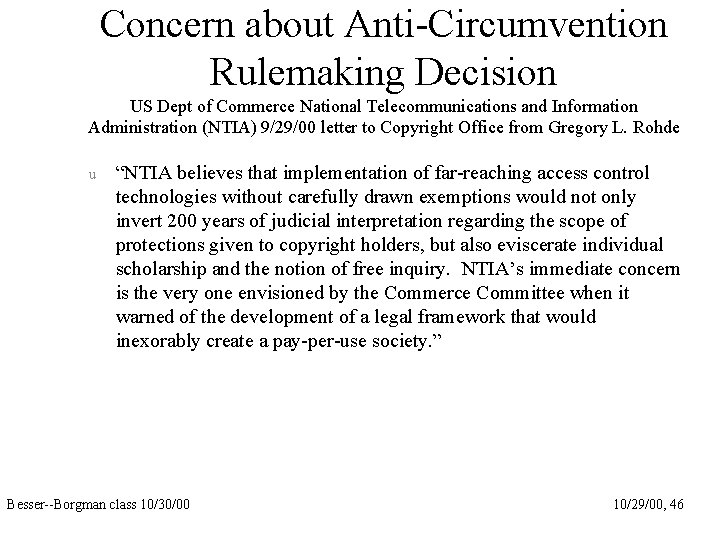
Concern about Anti-Circumvention Rulemaking Decision US Dept of Commerce National Telecommunications and Information Administration (NTIA) 9/29/00 letter to Copyright Office from Gregory L. Rohde u “NTIA believes that implementation of far-reaching access control technologies without carefully drawn exemptions would not only invert 200 years of judicial interpretation regarding the scope of protections given to copyright holders, but also eviscerate individual scholarship and the notion of free inquiry. NTIA’s immediate concern is the very one envisioned by the Commerce Committee when it warned of the development of a legal framework that would inexorably create a pay-per-use society. ” Besser--Borgman class 10/30/00 10/29/00, 46
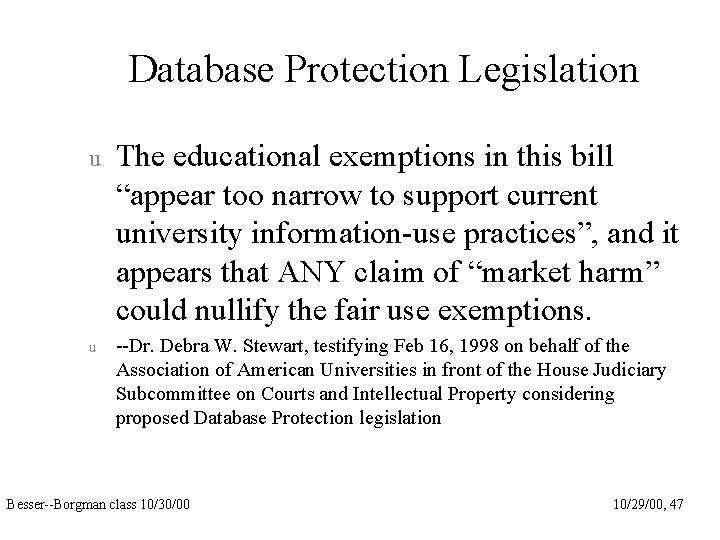
Database Protection Legislation u The educational exemptions in this bill “appear too narrow to support current university information-use practices”, and it appears that ANY claim of “market harm” could nullify the fair use exemptions. u --Dr. Debra W. Stewart, testifying Feb 16, 1998 on behalf of the Association of American Universities in front of the House Judiciary Subcommittee on Courts and Intellectual Property considering proposed Database Protection legislation Besser--Borgman class 10/30/00 10/29/00, 47
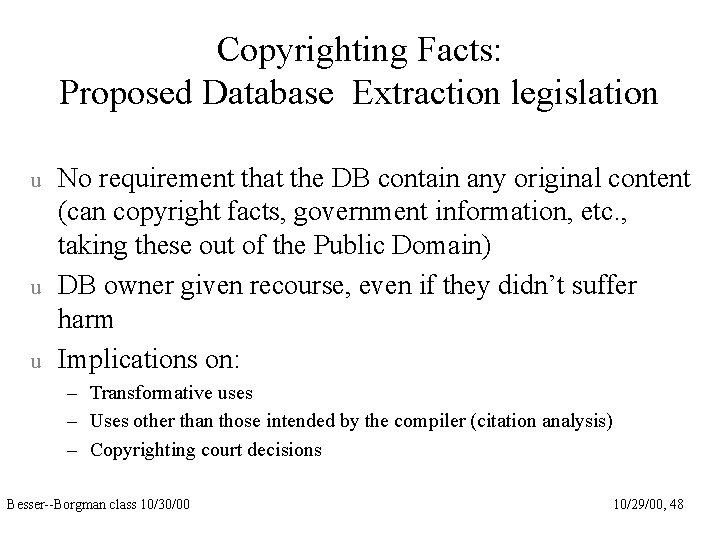
Copyrighting Facts: Proposed Database Extraction legislation u u u No requirement that the DB contain any original content (can copyright facts, government information, etc. , taking these out of the Public Domain) DB owner given recourse, even if they didn’t suffer harm Implications on: – Transformative uses – Uses other than those intended by the compiler (citation analysis) – Copyrighting court decisions Besser--Borgman class 10/30/00 10/29/00, 48
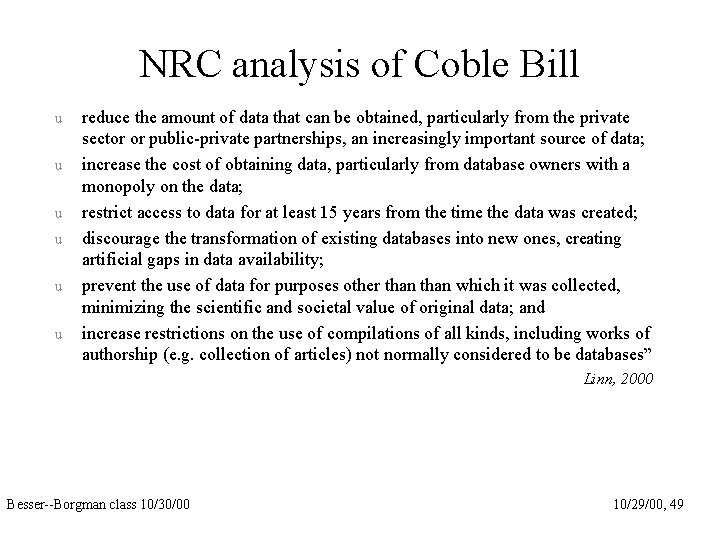
NRC analysis of Coble Bill u u u reduce the amount of data that can be obtained, particularly from the private sector or public-private partnerships, an increasingly important source of data; increase the cost of obtaining data, particularly from database owners with a monopoly on the data; restrict access to data for at least 15 years from the time the data was created; discourage the transformation of existing databases into new ones, creating artificial gaps in data availability; prevent the use of data for purposes other than which it was collected, minimizing the scientific and societal value of original data; and increase restrictions on the use of compilations of all kinds, including works of authorship (e. g. collection of articles) not normally considered to be databases” Linn, 2000 Besser--Borgman class 10/30/00 10/29/00, 49
Further commodification of information, diminishment of exploration and experimentation- Besser--Borgman class 10/30/00 10/29/00, 50
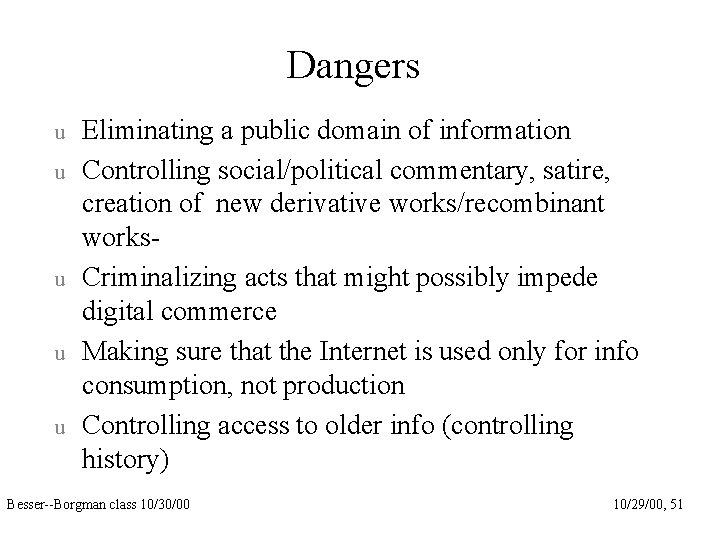
Dangers u u u Eliminating a public domain of information Controlling social/political commentary, satire, creation of new derivative works/recombinant works. Criminalizing acts that might possibly impede digital commerce Making sure that the Internet is used only for info consumption, not production Controlling access to older info (controlling history) Besser--Borgman class 10/30/00 10/29/00, 51
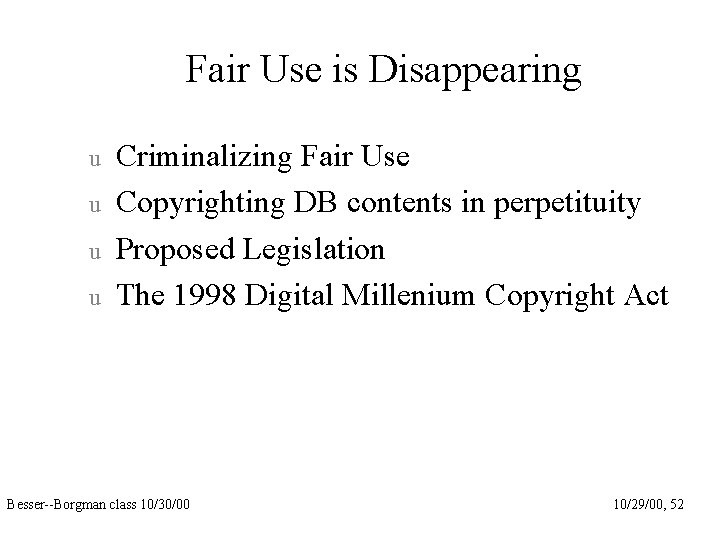
Fair Use is Disappearing u u Criminalizing Fair Use Copyrighting DB contents in perpetituity Proposed Legislation The 1998 Digital Millenium Copyright Act Besser--Borgman class 10/30/00 10/29/00, 52
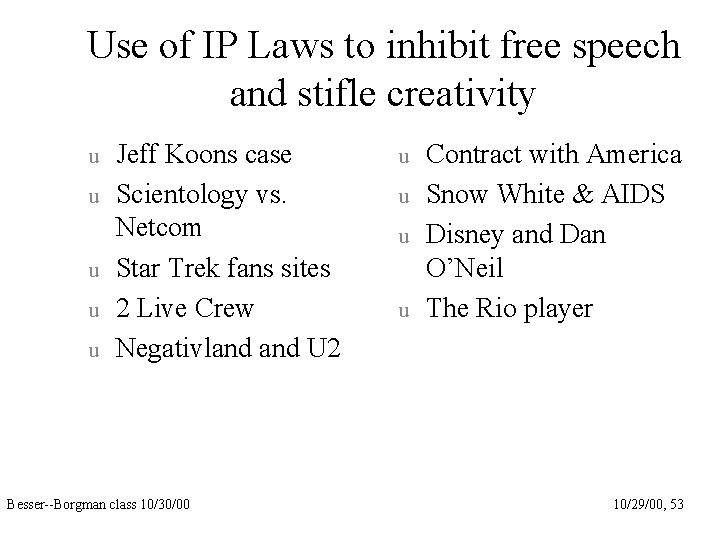
Use of IP Laws to inhibit free speech and stifle creativity u u u Jeff Koons case Scientology vs. Netcom Star Trek fans sites 2 Live Crew Negativland U 2 Besser--Borgman class 10/30/00 u u Contract with America Snow White & AIDS Disney and Dan O’Neil The Rio player 10/29/00, 53
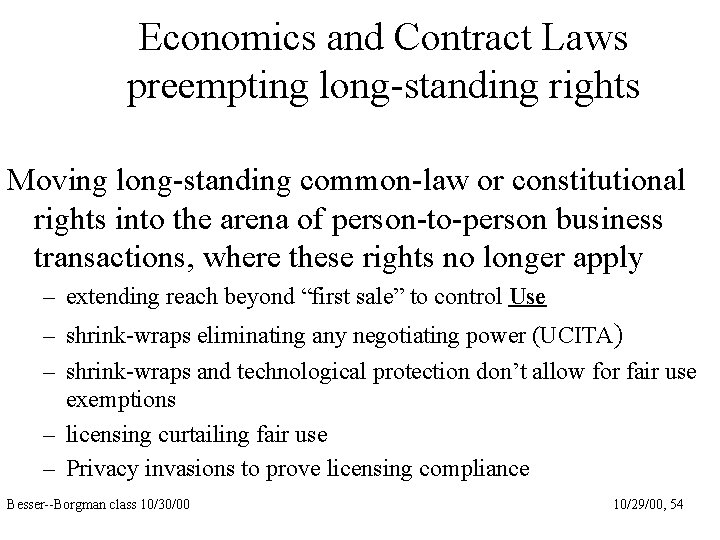
Economics and Contract Laws preempting long-standing rights Moving long-standing common-law or constitutional rights into the arena of person-to-person business transactions, where these rights no longer apply – extending reach beyond “first sale” to control Use – shrink-wraps eliminating any negotiating power (UCITA) – shrink-wraps and technological protection don’t allow for fair use exemptions – licensing curtailing fair use – Privacy invasions to prove licensing compliance Besser--Borgman class 10/30/00 10/29/00, 54
Further commodification of information u u Dismantlement of the public sphere in general Attempts to turn everything into a commodity (even things that don’t really behave like commodities) Besser--Borgman class 10/30/00 10/29/00, 55
Why does any of this matter? u u u Derivative works Postmodernism Diminishment of exploration and experimentation Public discourse Democratic values (anyone can be a creator) Besser--Borgman class 10/30/00 10/29/00, 56
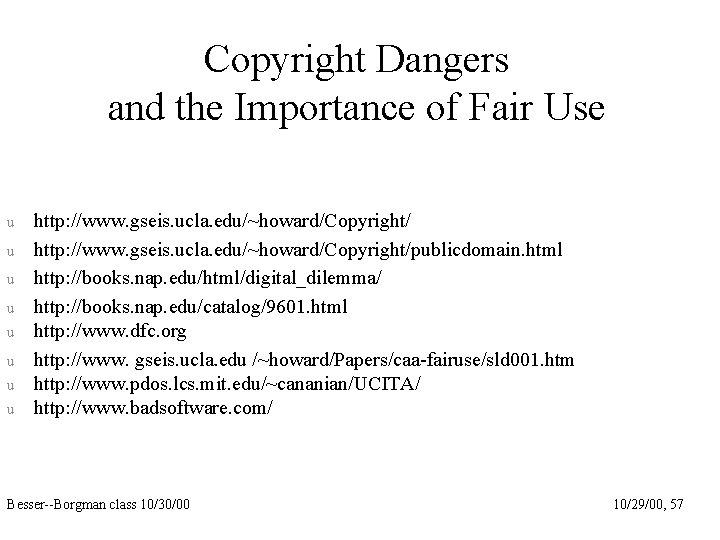
Copyright Dangers and the Importance of Fair Use u u u u http: //www. gseis. ucla. edu/~howard/Copyright/publicdomain. html http: //books. nap. edu/html/digital_dilemma/ http: //books. nap. edu/catalog/9601. html http: //www. dfc. org http: //www. gseis. ucla. edu /~howard/Papers/caa-fairuse/sld 001. htm http: //www. pdos. lcs. mit. edu/~cananian/UCITA/ http: //www. badsoftware. com/ Besser--Borgman class 10/30/00 10/29/00, 57
Draft of House version of Digital Millenium Bill u u u “[This bill] contains a provision that would effect the most dramatic change in copyright law in over one hundred years. Buried in the Digital Millennium Copyright Act, a measure designed to implement new international copyright treaties which bring the rest of the world up with current U. S. law, reads: Section 1201(a). No person shall circumvent a technological protection measure that effectively controls access to a work protected under this title. While sounding innocuous, what the provision does is create a brand new and unlimited right to control access to copyrighted works. If enacted into law, this new right could bypass the carefully crafted balance between exclusive rights of ownership and public access to works for educational, scholarly, and scientific purposes, which has been part of copyright law for the entire 20 th Century. In short, it could eliminate fair use from copyright law. ” -John Hammer, National Humanities Alliance, 6/5/98 Besser--Borgman class 10/30/00 10/29/00, 58
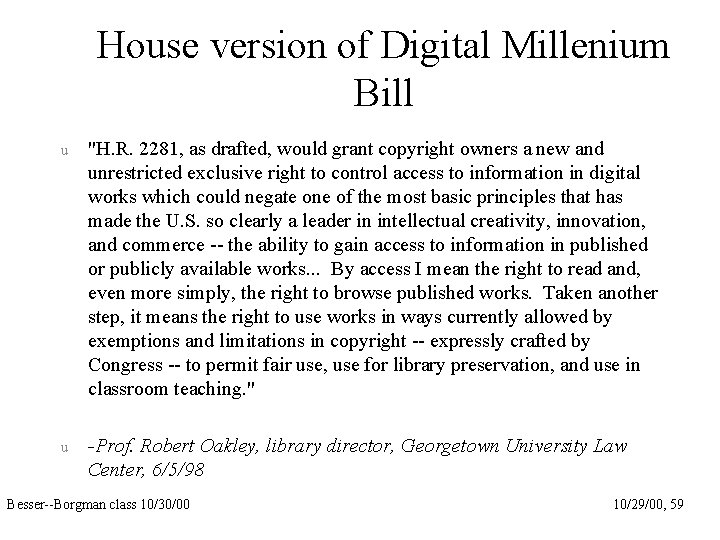
House version of Digital Millenium Bill u "H. R. 2281, as drafted, would grant copyright owners a new and unrestricted exclusive right to control access to information in digital works which could negate one of the most basic principles that has made the U. S. so clearly a leader in intellectual creativity, innovation, and commerce -- the ability to gain access to information in published or publicly available works. . . By access I mean the right to read and, even more simply, the right to browse published works. Taken another step, it means the right to use works in ways currently allowed by exemptions and limitations in copyright -- expressly crafted by Congress -- to permit fair use, use for library preservation, and use in classroom teaching. " u -Prof. Robert Oakley, library director, Georgetown University Law Center, 6/5/98 Besser--Borgman class 10/30/00 10/29/00, 59
Besser--Borgman class 10/30/00 10/29/00, 60