
Copyright Aware What You Need to Know Copyright

- Slides: 46
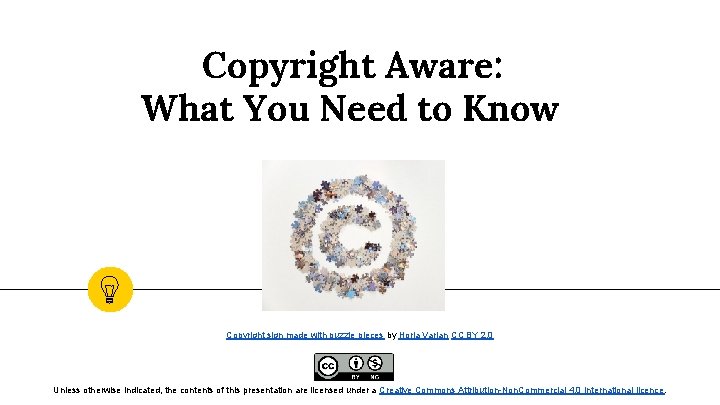
Copyright Aware: What You Need to Know Copyright sign made with puzzle pieces by Horia Varlan CC BY 2. 0 Unless otherwise indicated, the contents of this presentation are licensed under a Creative Commons Attribution-Non. Commercial 4. 0 International licence.
Your instructors Mélanie Brunet Obianuju Mollel 2
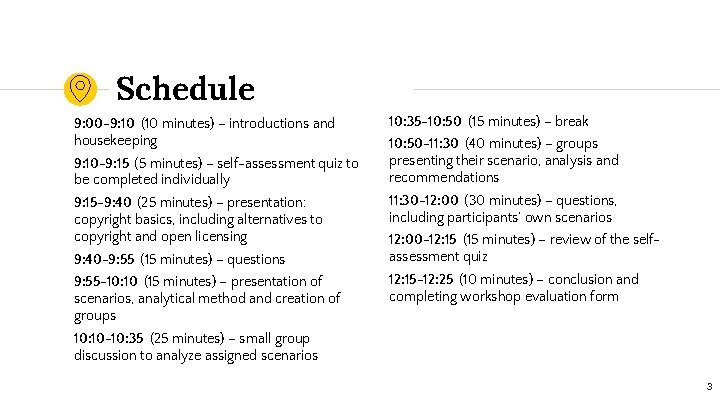
Schedule 9: 00 -9: 10 (10 minutes) – introductions and housekeeping 9: 10 -9: 15 (5 minutes) – self-assessment quiz to be completed individually 9: 15 -9: 40 (25 minutes) – presentation: copyright basics, including alternatives to copyright and open licensing 9: 40 -9: 55 (15 minutes) – questions 9: 55 -10: 10 (15 minutes) – presentation of scenarios, analytical method and creation of groups 10: 35 -10: 50 (15 minutes) – break 10: 50 -11: 30 (40 minutes) – groups presenting their scenario, analysis and recommendations 11: 30 -12: 00 (30 minutes) – questions, including participants’ own scenarios 12: 00 -12: 15 (15 minutes) – review of the selfassessment quiz 12: 15 -12: 25 (10 minutes) – conclusion and completing workshop evaluation form 10: 10 -10: 35 (25 minutes) – small group discussion to analyze assigned scenarios 3
The information provided in this session does not constitute legal advice. 4
Presentation Overview ◉ ◉ ◉ Copyright defined Copyright ownership Exceptions and limits of copyright Open licensing (e. g. Creative Commons) Licence agreements & terms of use 5
1 What is Copyright? 6
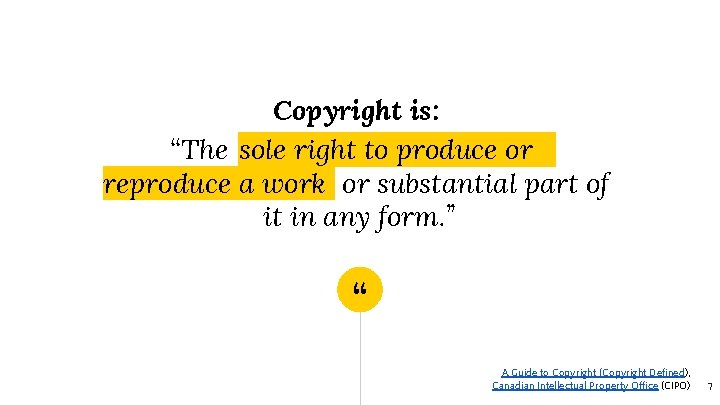
Copyright is: “The sole right to produce or reproduce a work or substantial part of it in any form. ” “ A Guide to Copyright (Copyright Defined), Canadian Intellectual Property Office (CIPO) 7
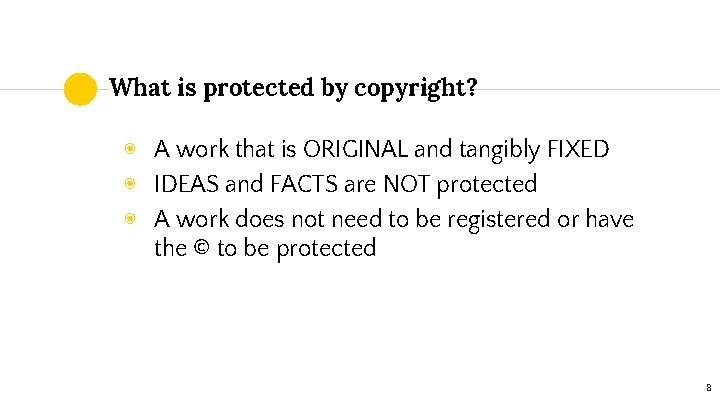
What is protected by copyright? ◉ A work that is ORIGINAL and tangibly FIXED ◉ IDEAS and FACTS are NOT protected ◉ A work does not need to be registered or have the © to be protected 8
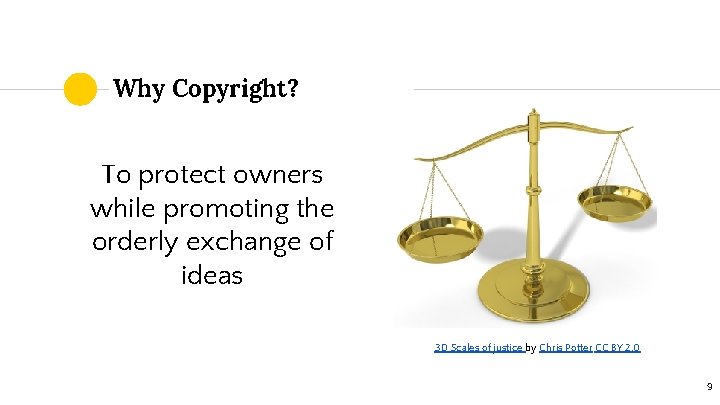
Why Copyright? To protect owners while promoting the orderly exchange of ideas 3 D Scales of justice by Chris Potter CC BY 2. 0 9
Duration of Copyright ◉ Generally, life of the creator + 50 years ◉ Notable exception: Sound recordings ○ 70 years after the release of the sound recording ◉ When copyright term ends, work is no longer protected and enters the public domain 10
2 Copyright Ownership 11
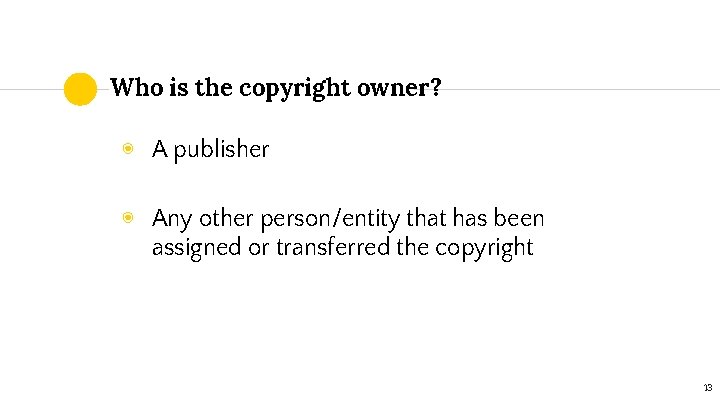
Who is the copyright owner? ◉ The creator(s) of the work ○ e. g. author, illustrator, photographer ◉ An employer, entity or organization ◉ As stated in a collective agreement or employment contract 12
Who is the copyright owner? ◉ A publisher ◉ Any other person/entity that has been assigned or transferred the copyright 13
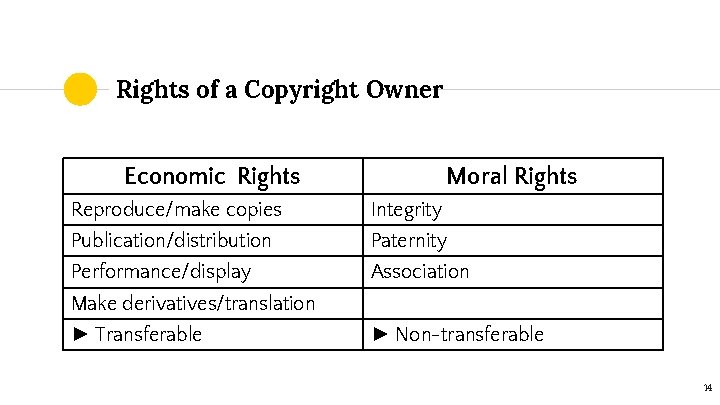
Rights of a Copyright Owner Economic Rights Moral Rights Reproduce/make copies Integrity Publication/distribution Paternity Performance/display Association Make derivatives/translation ► Transferable ► Non-transferable 14
3 Exceptions and Limits (“User Rights”) 15
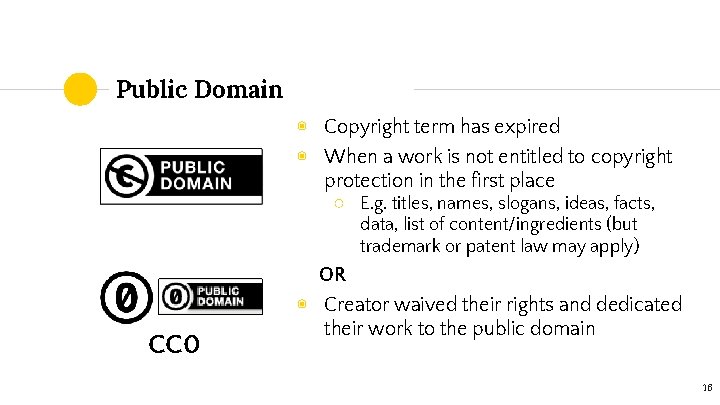
Public Domain ◉ Copyright term has expired ◉ When a work is not entitled to copyright protection in the first place ○ E. g. titles, names, slogans, ideas, facts, data, list of content/ingredients (but trademark or patent law may apply) CC 0 OR ◉ Creator waived their rights and dedicated their work to the public domain 16
Determining Public Domain in Canada ◉ Copyright Term and Canada’s Public Domain (flowchart) – Copyright Office, University of Alberta ○ https: //cloudfront. ualberta. ca/-/media/ualberta/faculty-and-staff/copyrightoffice/public-domain-chart-v 11 -revised. pdf ◉ Public Domain – Copyright Educational Resources Guide, Library, University of British Columbia ○ http: //guides. library. ubc. ca/c. php? g=698822&p=4961440 17
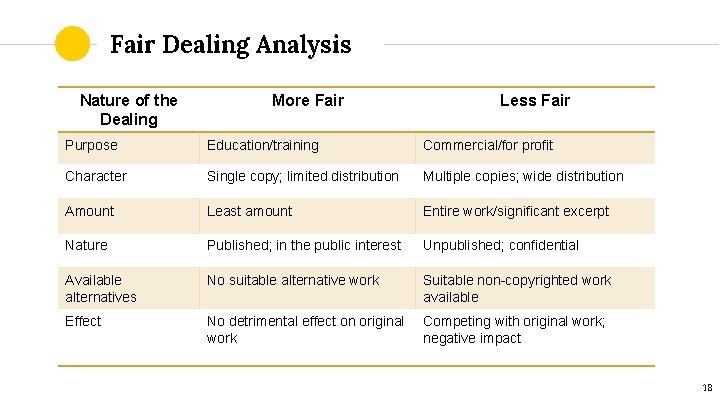
Fair Dealing Analysis Nature of the Dealing More Fair Less Fair Purpose Education/training Commercial/for profit Character Single copy; limited distribution Multiple copies; wide distribution Amount Least amount Entire work/significant excerpt Nature Published; in the public interest Unpublished; confidential Available alternatives No suitable alternative work Suitable non-copyrighted work available Effect No detrimental effect on original work Competing with original work; negative impact 18
Other Exceptions and Limits ◉ Linking ◉ Insubstantial use 19
4 Open Licensing 20
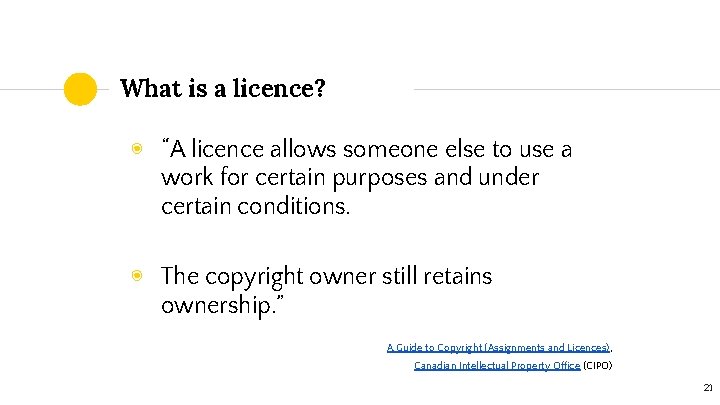
What is a licence? ◉ “A licence allows someone else to use a work for certain purposes and under certain conditions. ◉ The copyright owner still retains ownership. ” A Guide to Copyright (Assignments and Licences), Canadian Intellectual Property Office (CIPO) 21
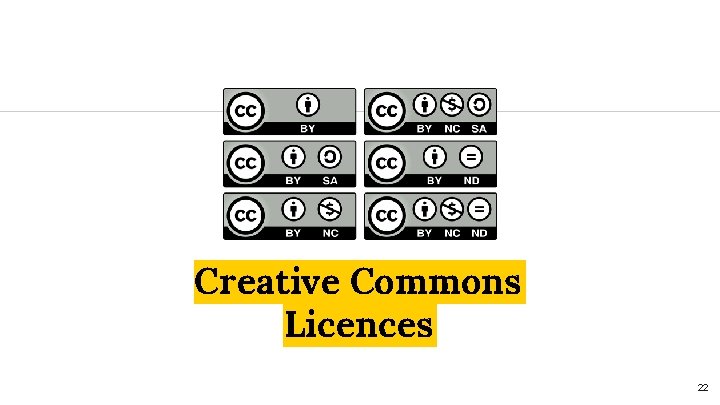
Creative Commons Licences 22
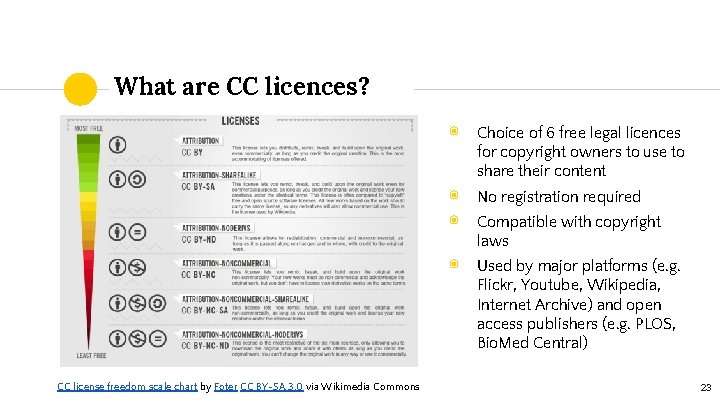
What are CC licences? CC license freedom scale chart by Foter CC BY-SA 3. 0 via Wikimedia Commons ◉ Choice of 6 free legal licences for copyright owners to use to share their content ◉ ◉ No registration required ◉ Used by major platforms (e. g. Flickr, Youtube, Wikipedia, Internet Archive) and open access publishers (e. g. PLOS, Bio. Med Central) Compatible with copyright laws 23
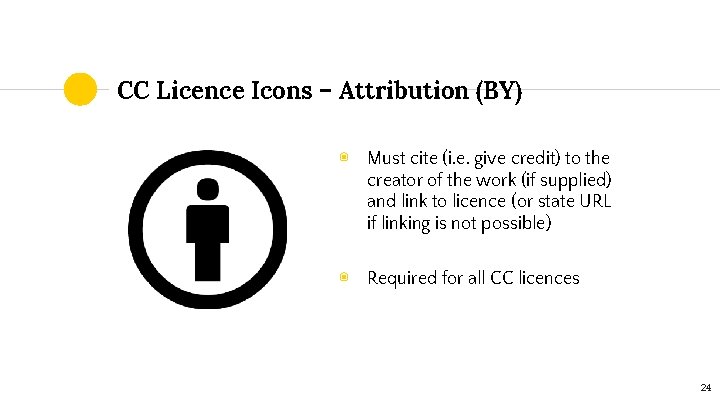
CC Licence Icons – Attribution (BY) ◉ Must cite (i. e. give credit) to the creator of the work (if supplied) and link to licence (or state URL if linking is not possible) ◉ Required for all CC licences 24
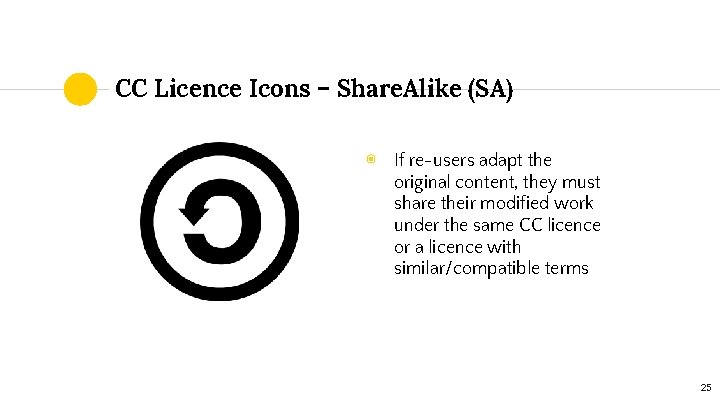
CC Licence Icons – Share. Alike (SA) ◉ If re-users adapt the original content, they must share their modified work under the same CC licence or a licence with similar/compatible terms 25
CC Licence Icons – Non. Commercial (NC) ◉ Material cannot be used for commercial purposes. ◉ “Commercial use refers to primarily intended for commercial advantage or monetary compensation” https: //creativecommons. org/licenses/by-nc/4. 0/legalcode 26
CC Licence Icons – No. Derivatives (ND) ◉ If re-users adapt the original works, they can use that adaptation privately, but they are not permitted to distribute the modified work publicly 27
Other types of open licences ◉ Open source licences for software ○ GNU General Public License (GLP) ○ More examples: https: //opensource. org/licenses ◉ Open Data Commons Licenses https: //opendatacommons. org/licenses/index. html ◉ Open Government Licence ○ Government of Canada, Statistics Canada Open Licence ○ Government of Ontario, Alberta Government ○ UK Government (for public sector information) 28
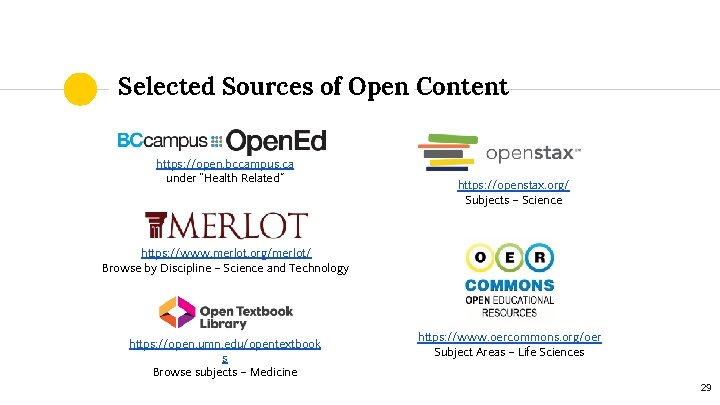
Selected Sources of Open Content https: //open. bccampus. ca under “Health Related” https: //openstax. org/ Subjects – Science https: //www. merlot. org/merlot/ Browse by Discipline – Science and Technology https: //open. umn. edu/opentextbook s Browse subjects – Medicine https: //www. oercommons. org/oer Subject Areas – Life Sciences 29
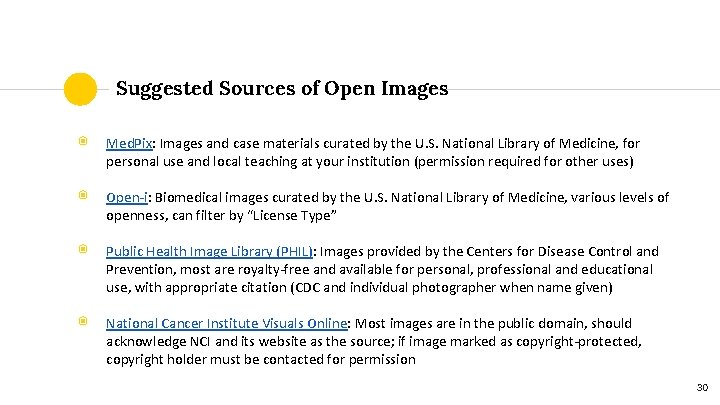
Suggested Sources of Open Images ◉ Med. Pix: Images and case materials curated by the U. S. National Library of Medicine, for personal use and local teaching at your institution (permission required for other uses) ◉ Open-i: Biomedical images curated by the U. S. National Library of Medicine, various levels of openness, can filter by “License Type” ◉ Public Health Image Library (PHIL): Images provided by the Centers for Disease Control and Prevention, most are royalty-free and available for personal, professional and educational use, with appropriate citation (CDC and individual photographer when name given) ◉ National Cancer Institute Visuals Online: Most images are in the public domain, should acknowledge NCI and its website as the source; if image marked as copyright-protected, copyright holder must be contacted for permission 30
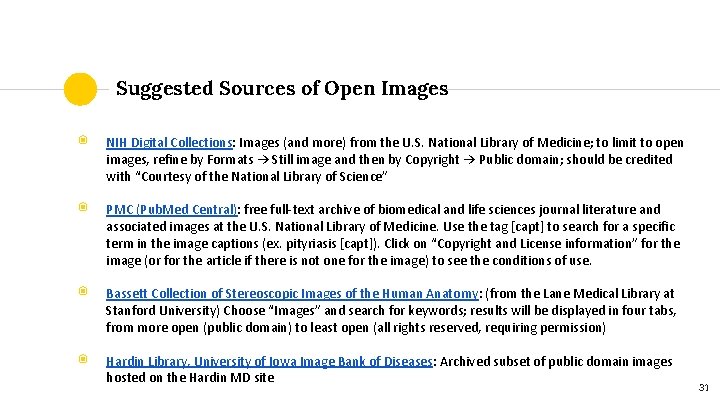
Suggested Sources of Open Images ◉ NIH Digital Collections: Images (and more) from the U. S. National Library of Medicine; to limit to open images, refine by Formats → Still image and then by Copyright → Public domain; should be credited with “Courtesy of the National Library of Science” ◉ PMC (Pub. Med Central): free full-text archive of biomedical and life sciences journal literature and associated images at the U. S. National Library of Medicine. Use the tag [capt] to search for a specific term in the image captions (ex. pityriasis [capt]). Click on “Copyright and License information” for the image (or for the article if there is not one for the image) to see the conditions of use. ◉ Bassett Collection of Stereoscopic Images of the Human Anatomy: (from the Lane Medical Library at Stanford University) Choose “Images” and search for keywords; results will be displayed in four tabs, from more open (public domain) to least open (all rights reserved, requiring permission) ◉ Hardin Library, University of Iowa Image Bank of Diseases: Archived subset of public domain images hosted on the Hardin MD site 31
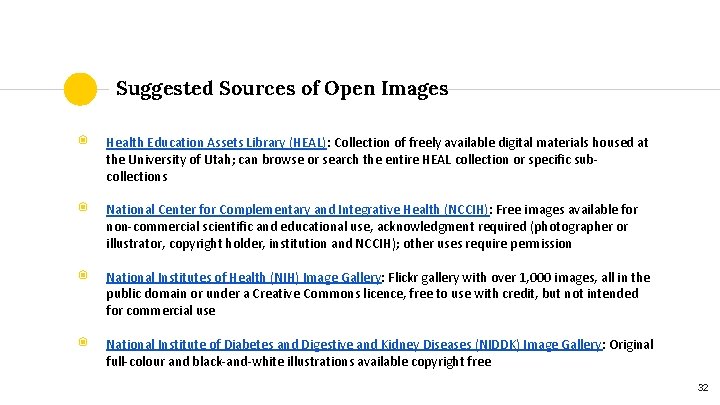
Suggested Sources of Open Images ◉ Health Education Assets Library (HEAL): Collection of freely available digital materials housed at the University of Utah; can browse or search the entire HEAL collection or specific subcollections ◉ National Center for Complementary and Integrative Health (NCCIH): Free images available for non-commercial scientific and educational use, acknowledgment required (photographer or illustrator, copyright holder, institution and NCCIH); other uses require permission ◉ National Institutes of Health (NIH) Image Gallery: Flickr gallery with over 1, 000 images, all in the public domain or under a Creative Commons licence, free to use with credit, but not intended for commercial use ◉ National Institute of Diabetes and Digestive and Kidney Diseases (NIDDK) Image Gallery: Original full-colour and black-and-white illustrations available copyright free 32
5 Licence Agreements & Terms of Use 33
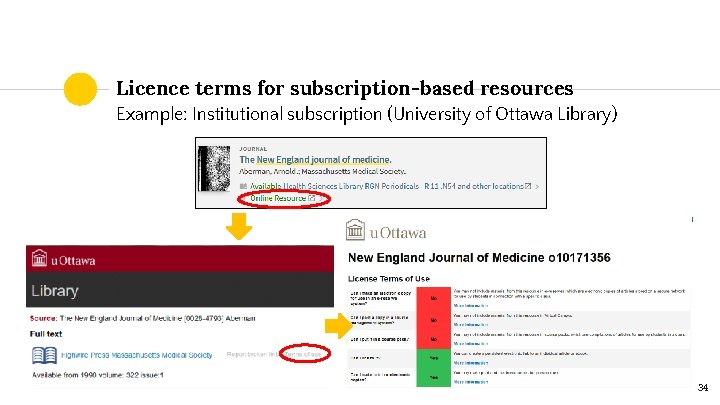
Licence terms for subscription-based resources Example: Institutional subscription (University of Ottawa Library) 34
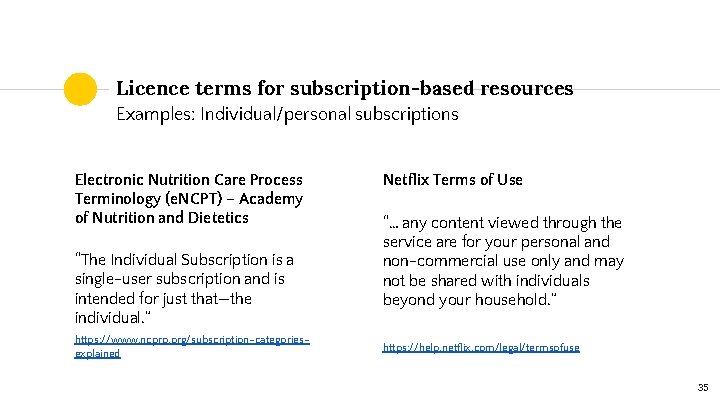
Licence terms for subscription-based resources Examples: Individual/personal subscriptions Electronic Nutrition Care Process Terminology (e. NCPT) – Academy of Nutrition and Dietetics “The Individual Subscription is a single-user subscription and is intended for just that—the individual. ” https: //www. ncpro. org/subscription-categoriesexplained Netflix Terms of Use “… any content viewed through the service are for your personal and non-commercial use only and may not be shared with individuals beyond your household. ” https: //help. netflix. com/legal/termsofuse 35
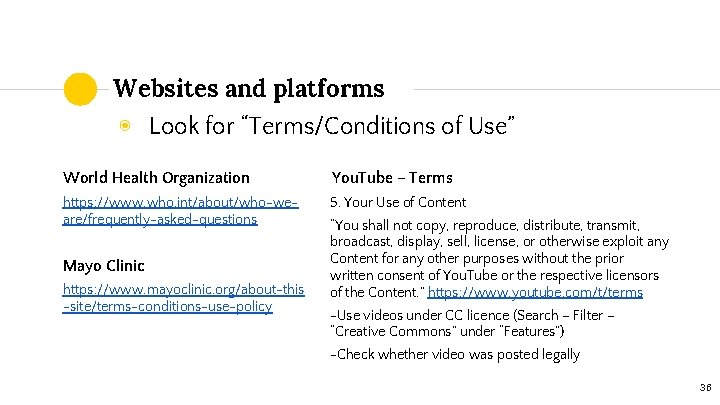
Websites and platforms ◉ Look for “Terms/Conditions of Use” World Health Organization You. Tube – Terms https: //www. who. int/about/who-weare/frequently-asked-questions 5. Your Use of Content Mayo Clinic https: //www. mayoclinic. org/about-this -site/terms-conditions-use-policy “You shall not copy, reproduce, distribute, transmit, broadcast, display, sell, license, or otherwise exploit any Content for any other purposes without the prior written consent of You. Tube or the respective licensors of the Content. ” https: //www. youtube. com/t/terms -Use videos under CC licence (Search – Filter – “Creative Commons” under “Features”) -Check whether video was posted legally 36
Thanks! Questions ? Contact us at: melanie. brunet@uottawa. ca obianuju. mollel@ahs. ca 37
Credits (other than specified on slides) Slide 2: Photos courtesy of instructors Slide 4: Icon from The Noun Project, Noun. Pro royalty-free licence Slides 16, 22, 24 -27: Creative Commons buttons and icons, CC BY 4. 0 Slide 29: BCcampus logo, CC BY 4. 0; Merlot logo, CC BY NC SA 4. 0; Open Textbook Library logo, CC BY 4. 0; Open. Stax logo, © Rice University; OER Commons logo, CC BY NC SA 3. 0 Slide 34: screen captures of University of Ottawa Library catalogue Viola slide template from Slides. Carnival, CC BY 4. 0 38
Scenarios 39
Scenario 1: The health promotions department creates consumer health handouts. The material they produce is adapted from patient handouts created by other organizations/institutions. Does this infringe copyright? 40
Scenario 2: A clinician takes photos during a patient interaction and consult. They want to use the pictures for a continuing education presentation to colleagues. What are important considerations to keep in mind and who owns the copyright to the photos? 41
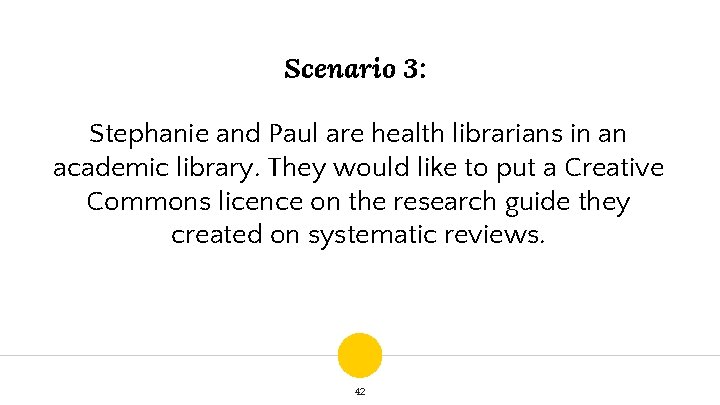
Scenario 3: Stephanie and Paul are health librarians in an academic library. They would like to put a Creative Commons licence on the research guide they created on systematic reviews. 42
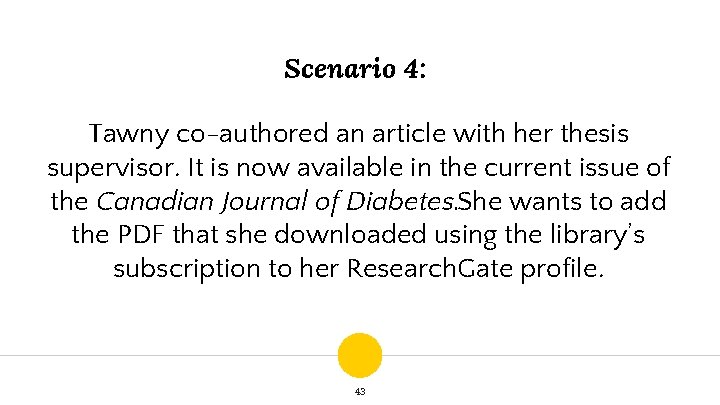
Scenario 4: Tawny co-authored an article with her thesis supervisor. It is now available in the current issue of the Canadian Journal of Diabetes. She wants to add the PDF that she downloaded using the library’s subscription to her Research. Gate profile. 43
Additional Scenarios 44
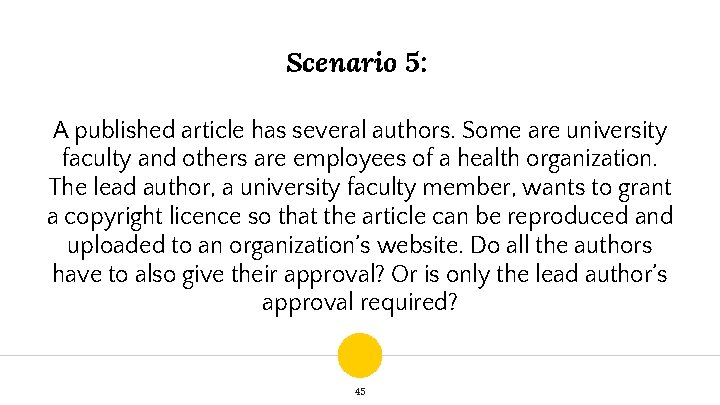
Scenario 5: A published article has several authors. Some are university faculty and others are employees of a health organization. The lead author, a university faculty member, wants to grant a copyright licence so that the article can be reproduced and uploaded to an organization’s website. Do all the authors have to also give their approval? Or is only the lead author’s approval required? 45
Scenario 6: When Pedro was a lecturer in human kinetics at a university, in his lectures he used the slides and images provided by the publisher of the textbook he adopted for his course, Fundamentals of Athletic Training(published by Human Kinetics). He now wants to use these slides for a presentation he is giving at coaching clinic at his local arena. 46