
Copyright 2008 Intel Corporation All rights reserved Intel
- Slides: 13
Copyright © 2008 Intel Corporation. All rights reserved. Intel, the Intel logo, Intel Education Initiative, and Intel Teach Program are trademarks of Intel Corporation in the U. S. and other countries. *Other names and brands may be claimed as the property of others. Slide #
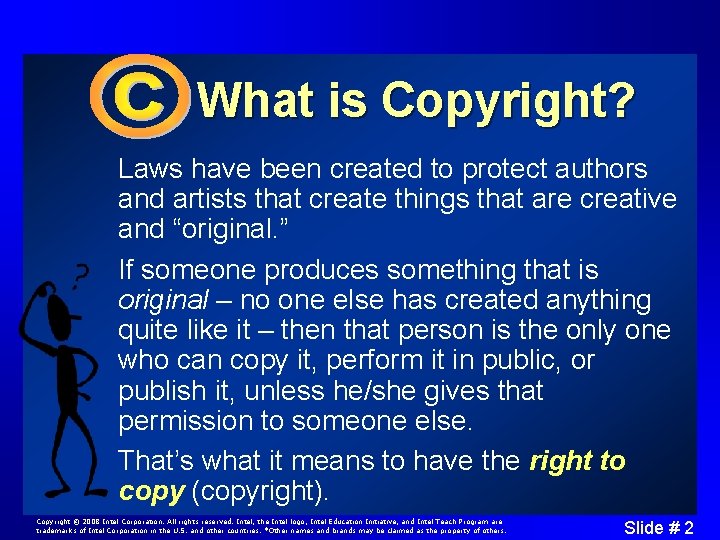
What is Copyright? Laws have been created to protect authors and artists that create things that are creative and “original. ” If someone produces something that is original – no one else has created anything quite like it – then that person is the only one who can copy it, perform it in public, or publish it, unless he/she gives that permission to someone else. That’s what it means to have the right to copy (copyright). Copyright © 2008 Intel Corporation. All rights reserved. Intel, the Intel logo, Intel Education Initiative, and Intel Teach Program are trademarks of Intel Corporation in the U. S. and other countries. *Other names and brands may be claimed as the property of others. Slide # 2
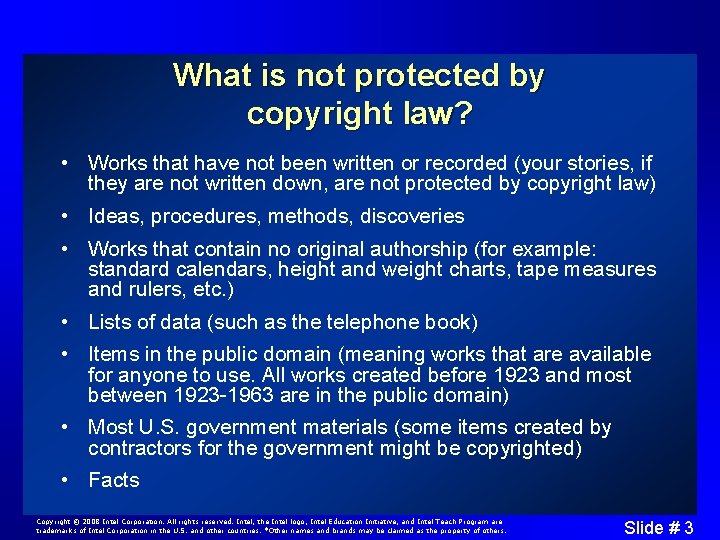
What is not protected by copyright law? • Works that have not been written or recorded (your stories, if they are not written down, are not protected by copyright law) • Ideas, procedures, methods, discoveries • Works that contain no original authorship (for example: standard calendars, height and weight charts, tape measures and rulers, etc. ) • Lists of data (such as the telephone book) • Items in the public domain (meaning works that are available for anyone to use. All works created before 1923 and most between 1923 -1963 are in the public domain) • Most U. S. government materials (some items created by contractors for the government might be copyrighted) • Facts Copyright © 2008 Intel Corporation. All rights reserved. Intel, the Intel logo, Intel Education Initiative, and Intel Teach Program are trademarks of Intel Corporation in the U. S. and other countries. *Other names and brands may be claimed as the property of others. Slide # 3
Copyright © 2008 Intel Corporation. All rights reserved. Intel, the Intel logo, Intel Education Initiative, and Intel Teach Program are trademarks of Intel Corporation in the U. S. and other countries. *Other names and brands may be claimed as the property of others. Slide # 4
What is “fair use”? Fair Use is a part of the United States Copyright law. It allows people to use and make copies of copyrighted works if they are using them for: – – – criticism, comment, news reporting, teaching, scholarship, or research Copyright © 2008 Intel Corporation. All rights reserved. Intel, the Intel logo, Intel Education Initiative, and Intel Teach Program are trademarks of Intel Corporation in the U. S. and other countries. *Other names and brands may be claimed as the property of others. Slide # 5
Copyright © 2008 Intel Corporation. All rights reserved. Intel, the Intel logo, Intel Education Initiative, and Intel Teach Program are trademarks of Intel Corporation in the U. S. and other countries. *Other names and brands may be claimed as the property of others. Slide # 6
Before using copyrighted work, ask yourself: • Is the copying for educational use? • Is the original material mainly facts and not very creative? • Are you using small amounts, not whole sections? • Is the original material freely available? (Meaning, the author is not trying to make money on it) If any answers are “no” – be careful! The use of that work might not fall under “fair use. ” Copyright © 2008 Intel Corporation. All rights reserved. Intel, the Intel logo, Intel Education Initiative, and Intel Teach Program are trademarks of Intel Corporation in the U. S. and other countries. *Other names and brands may be claimed as the property of others. Slide # 7
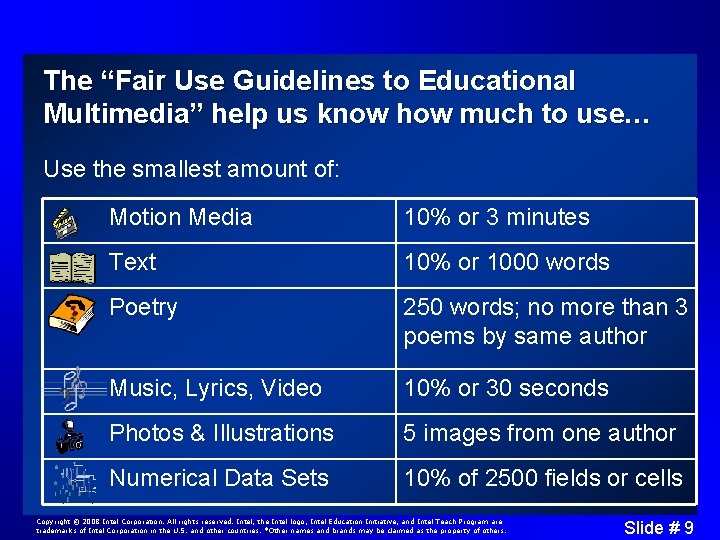
Sometimes, it is hard to know how much of a copyrighted work we can use. To help us know what is Fair Use, the “Fair Use Guidelines to Educational Multimedia” were created. Copyright © 2008 Intel Corporation. All rights reserved. Intel, the Intel logo, Intel Education Initiative, and Intel Teach Program are trademarks of Intel Corporation in the U. S. and other countries. *Other names and brands may be claimed as the property of others. Slide # 8
The “Fair Use Guidelines to Educational Multimedia” help us know how much to use… Use the smallest amount of: Motion Media 10% or 3 minutes Text 10% or 1000 words Poetry 250 words; no more than 3 poems by same author Music, Lyrics, Video 10% or 30 seconds Photos & Illustrations 5 images from one author Numerical Data Sets 10% of 2500 fields or cells Copyright © 2008 Intel Corporation. All rights reserved. Intel, the Intel logo, Intel Education Initiative, and Intel Teach Program are trademarks of Intel Corporation in the U. S. and other countries. *Other names and brands may be claimed as the property of others. Slide # 9
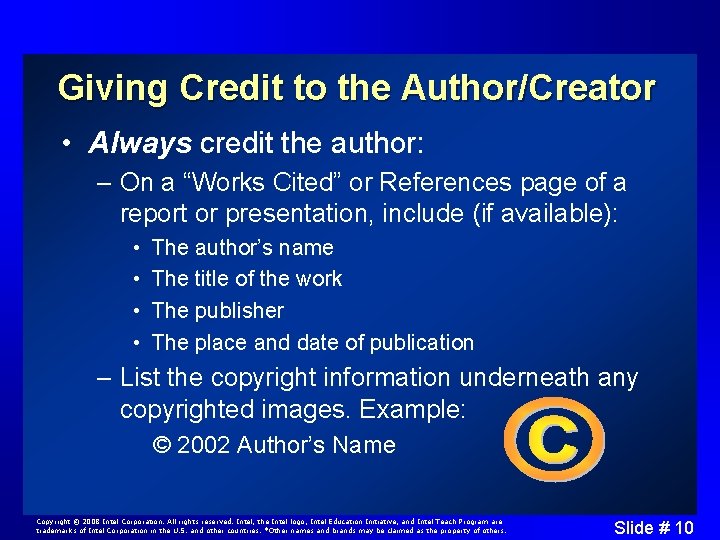
Giving Credit to the Author/Creator • Always credit the author: – On a “Works Cited” or References page of a report or presentation, include (if available): • • The author’s name The title of the work The publisher The place and date of publication – List the copyright information underneath any copyrighted images. Example: © 2002 Author’s Name Copyright © 2008 Intel Corporation. All rights reserved. Intel, the Intel logo, Intel Education Initiative, and Intel Teach Program are trademarks of Intel Corporation in the U. S. and other countries. *Other names and brands may be claimed as the property of others. Slide # 10
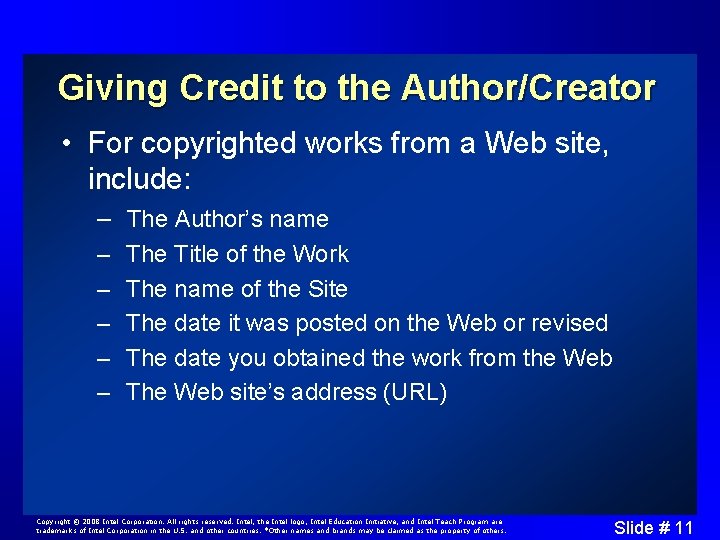
Giving Credit to the Author/Creator • For copyrighted works from a Web site, include: – The Author’s name – – – The Title of the Work The name of the Site The date it was posted on the Web or revised The date you obtained the work from the Web The Web site’s address (URL) Copyright © 2008 Intel Corporation. All rights reserved. Intel, the Intel logo, Intel Education Initiative, and Intel Teach Program are trademarks of Intel Corporation in the U. S. and other countries. *Other names and brands may be claimed as the property of others. Slide # 11
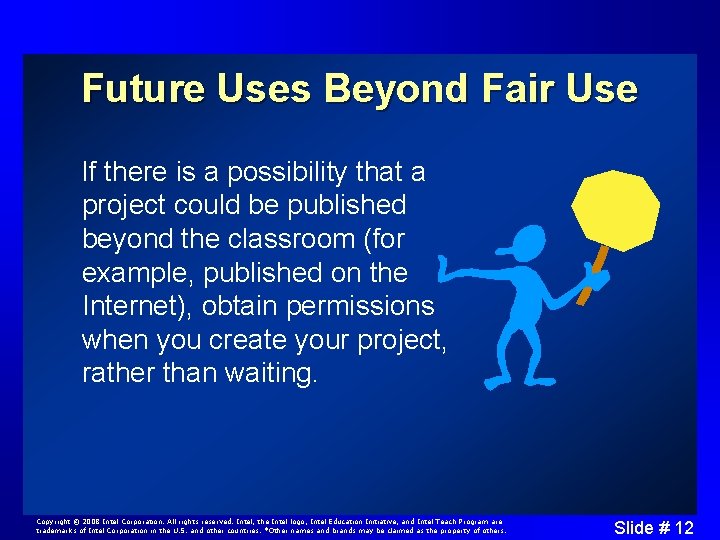
Future Uses Beyond Fair Use If there is a possibility that a project could be published beyond the classroom (for example, published on the Internet), obtain permissions when you create your project, rather than waiting. Copyright © 2008 Intel Corporation. All rights reserved. Intel, the Intel logo, Intel Education Initiative, and Intel Teach Program are trademarks of Intel Corporation in the U. S. and other countries. *Other names and brands may be claimed as the property of others. Slide # 12
Click here for Sources Copyright © 2008 Intel Corporation. All rights reserved. Intel, the Intel logo, Intel Education Initiative, and Intel Teach Program are trademarks of Intel Corporation in the U. S. and other countries. *Other names and brands may be claimed as the property of others. Slide # 13