
Copyright 2005 Pearson Education Inc Chapter 4 Graphs




- Slides: 45
Copyright © 2005 Pearson Education, Inc.
Chapter 4 Graphs of the Circular Functions Copyright © 2005 Pearson Education, Inc.
4. 1 Graphs of the Sine and Cosine Functions Copyright © 2005 Pearson Education, Inc.
Properties of Sine and Cosine Functions The graphs of y = sin x and y = cos x have similar properties: 1. The domain is the set of real numbers. 2. The range is the set of y values such that . 3. The maximum value is 1 and the minimum value is – 1. 4. The graph is a smooth curve. 5. Each function cycles through all the values of the range over an x-interval of. 6. The cycle repeats itself indefinitely in both directions of the x-axis. Copyright © 2005 Pearson Education, Inc. Slide 4 -4
Copyright © 2005 Pearson Education, Inc. Slide 4 -5
Copyright © 2005 Pearson Education, Inc. Slide 4 -6
Graph of the Cosine Function To sketch the graph of y = cos x first locate the key points. These are the maximum points, the minimum points, and the intercepts. x 0 cos x 1 0 -1 0 1 Then, connect the points on the graph with a smooth curve that extends in both directions beyond the five points. A single cycle is called a period. y = cos x y x Copyright © 2005 Pearson Education, Inc. Slide 4 -7
The amplitude of y = a sin x (or y = a cos x) is half the distance between the maximum and minimum values of the function. amplitude = |a| If |a| > 1, the amplitude stretches the graph vertically. If 0 < |a| < 1, the amplitude shrinks the graph vertically. If a < 0, the graph is reflected in the x-axis. y y = sin x x y= sin x y = – 4 sin x reflection of y = 4 sin x Copyright © 2005 Pearson Education, Inc. y = 2 sin x y = 4 sin x Slide 4 -8
Example: Graph y = 3 sin x compare to y = sin x. Copyright © 2005 Pearson Education, Inc. Slide 4 -9
The period of a function is the x interval needed for the function to complete one cycle. For b 0, the period of y = a sin bx is . For b 0, the period of y = a cos bx is also . y period: 2 period: x y period: 4 Copyright © 2005 Pearson Education, Inc. period: 2 x Slide 4 -10
Example: Graph y = sin 2 x Copyright © 2005 Pearson Education, Inc. Slide 4 -11
Example: Graph y = sin 2 x continued Copyright © 2005 Pearson Education, Inc. Slide 4 -12
Graph y = cos 2 x/3 over one period Copyright © 2005 Pearson Education, Inc. Slide 4 -13
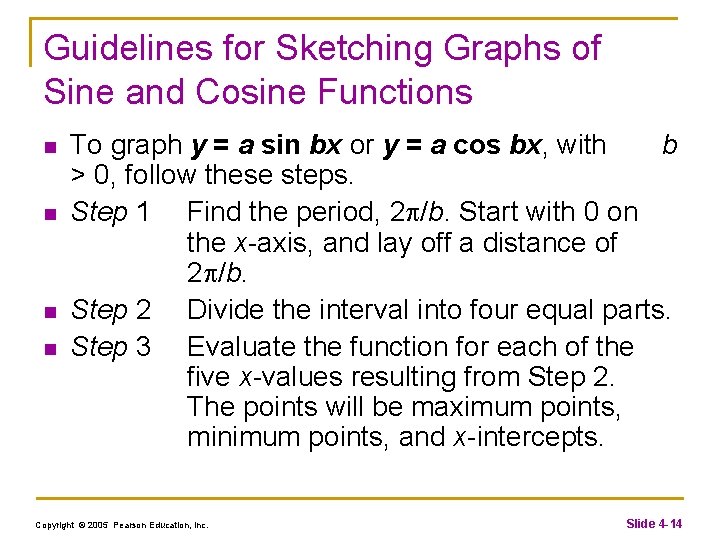
Guidelines for Sketching Graphs of Sine and Cosine Functions n n To graph y = a sin bx or y = a cos bx, with b > 0, follow these steps. Step 1 Find the period, 2 /b. Start with 0 on the x-axis, and lay off a distance of 2 /b. Step 2 Divide the interval into four equal parts. Step 3 Evaluate the function for each of the five x-values resulting from Step 2. The points will be maximum points, minimum points, and x-intercepts. Copyright © 2005 Pearson Education, Inc. Slide 4 -14
Guidelines for Sketching Graphs of Sine and Cosine Functions continued n Step 4 n Step 5 Plot the points found in Step 3, and join them with a sinusoidal curve having amplitude |a|. Draw the graph over additional periods, to the right and to the left, as needed. Copyright © 2005 Pearson Education, Inc. Slide 4 -15
Graph y = 2 sin 4 x Copyright © 2005 Pearson Education, Inc. Slide 4 -16
4. 2 Translations of the Graphs of the Sine and Cosine Functions Copyright © 2005 Pearson Education, Inc.
Translations n In trigonometric functions, a horizontal translation is called a phase shift. n In the equation the graph is shifted /2 units to the right. Copyright © 2005 Pearson Education, Inc. Slide 4 -18
Graph y = sin (x /3) n Find the interval for one period. n Divide the interval into four equal parts. Copyright © 2005 Pearson Education, Inc. Slide 4 -19
Graph Copyright © 2005 Pearson Education, Inc. Slide 4 -20
Graph y = 2 2 sin 3 x Copyright © 2005 Pearson Education, Inc. Slide 4 -21
Further Guidelines for Sketching Graphs of Sine and Cosine Functions n n Method 1: Follow these steps. Step 1 Find an interval whose length is one period 2 /b by solving the three part inequality 0 b(x d) 2. Step 2 Divide the interval into four equal parts. Step 3 Evaluate the function for each of the five x-values resulting from Step 2. The points will be maximum points, minimum points, and points that intersect the line y = c (middle points of the wave. ) Copyright © 2005 Pearson Education, Inc. Slide 4 -22
Further Guidelines for Sketching Graphs of Sine and Cosine Functions continued n n n Step 4 Plot the points found in Step 3, and join them with a sinusoidal curve having amplitude |a|. Step 5 Draw the graph over additional periods, to the right and to the left, as needed. Method 2 First graph the basic circular function. The amplitude of the function is |a|, and the period is 2 /b. Then use translations to graph the desired function. The vertical translation is c units up if c > 0 and |c| units down if c < 0. The horizontal translation (phase shift) is d units to the right if d > 0 and |d| units to the left if d < 0. Copyright © 2005 Pearson Education, Inc. Slide 4 -23
Graph y = 1 + 2 sin (4 x + ) Copyright © 2005 Pearson Education, Inc. Slide 4 -24
4. 3 Graphs of Other Circular Functions Copyright © 2005 Pearson Education, Inc.
Graph of the Cosecant Function To graph y = csc x, use the identity . At values of x for which sin x = 0, the cosecant function is undefined and its graph has vertical asymptotes. y Properties of y = csc x 1. domain : all real x 2. range: (– , – 1] [1, + ) 3. period: x 4. vertical asymptotes: where sine is zero. Copyright © 2005 Pearson Education, Inc. Slide 4 -26
Copyright © 2005 Pearson Education, Inc. Slide 4 -27
Graph of the Secant Function The graph y = sec x, use the identity . At values of x for which cos x = 0, the secant function is undefined and its graph has vertical asymptotes. y Properties of y = sec x 1. domain : all real x 2. range: (– , – 1] [1, + ) 3. period: 4. vertical asymptotes: Copyright © 2005 Pearson Education, Inc. x Slide 4 -28
Copyright © 2005 Pearson Education, Inc. Slide 4 -29
Guidelines for Sketching Graphs of Cosecant and Secant Functions n n To graph y = csc bx or y = sec bx, with b > 0, follow these steps. Step 1 Graph the corresponding reciprocal function as a guide, using a dashed curve. To Graph Copyright © 2005 Pearson Education, Inc. Use as a Guide y = a csc bx y = a sin bx y = a sec bx y = cos bx Slide 4 -30
Guidelines for Sketching Graphs of Cosecant and Secant Functions continued n Step 2 n Step 3 Sketch the vertical asymptotes. They will have equations of the form x = k, where k is an x-intercept of the graph of the guide function. Sketch the graph of the desired function by drawing the typical U-shapes branches between the adjacent asymptotes. The branches will be above the graph of the guide function when the guide function values are positive and below the graph of the guide function when the guide function values are negative. Copyright © 2005 Pearson Education, Inc. Slide 4 -31
Graph y = 2 sec x/2 Copyright © 2005 Pearson Education, Inc. Slide 4 -32
Graph of the Tangent Function To graph y = tan x, use the identity . At values of x for which cos x = 0, the tangent function is undefined and its graph has vertical asymptotes. y Properties of y = tan x 1. domain : all real x 2. range: (– , + ) 3. period: x 4. vertical asymptotes: period: Copyright © 2005 Pearson Education, Inc. Slide 4 -33
Copyright © 2005 Pearson Education, Inc. Slide 4 -34
Graph of the Cotangent Function To graph y = cot x, use the identity. At values of x for which sin x = 0, the cotangent function is undefined and its graph has vertical asymptotes. y Properties of y = cot x 1. domain : all real x 2. range: (– , + ) 3. period: 4. vertical asymptotes: x vertical asymptotes Copyright © 2005 Pearson Education, Inc. Slide 4 -35
Copyright © 2005 Pearson Education, Inc. Slide 4 -36
Guidelines for Sketching Graphs of Tangent and Cotangent Functions n n To graph y = tan bx or y = cot bx, with b > 0, follow these steps. Step 1 Determine the period, /b. To locate two adjacent vertical asymptotes solve the following equations for x: Copyright © 2005 Pearson Education, Inc. Slide 4 -37
Guidelines for Sketching Graphs of Tangent and Cotangent Functions continued n Step 2 n Step 3 n Step 4 n Step 5 Sketch the two vertical asymptotes found in Step 1. Divide the interval formed by the vertical asymptotes into four equal parts. Evaluate the function for the first-quarter point, midpoint, and third-quarter point, using the x-values found in Step 3. Join the points with a smooth curve, approaching the vertical asymptotes. Indicate additional asymptotes and periods of the graph as necessary. Copyright © 2005 Pearson Education, Inc. Slide 4 -38
Example: Find the period and asymptotes and sketch the graph of Copyright © 2005 Pearson Education, Inc. Slide 4 -39
Graph y = 2 + tan x n Every y value for this function will be 2 units more than the corresponding y in y = tan x, causing the graph to be translated 2 units up compared to y = tan x. Copyright © 2005 Pearson Education, Inc. Slide 4 -40
Graph y = cot ½x Copyright © 2005 Pearson Education, Inc. Slide 4 -41
4. 4 Harmonic Motion Copyright © 2005 Pearson Education, Inc.
Simple Harmonic Motion n The position of a point oscillating about an equilibrium position at time t is modeled by either n where a and are constants, with The amplitude of the motion is |a|, the period is and the frequency is Copyright © 2005 Pearson Education, Inc. Slide 4 -43
Example n n Suppose that an object is attached to a coiled spring such as the one shown (on the next slide). It is pulled down a distance of 5 in. from its equilibrium position, and then released. The time for one complete oscillation is 4 sec. a) Give an equation that models the position of the object at time t. b) Determine the position at t = 1. 5 sec. c) Find the frequency. Copyright © 2005 Pearson Education, Inc. Slide 4 -44
Example continued Now try 18 Copyright © 2005 Pearson Education, Inc. Slide 4 -45