
Copyright 2002 Mani Srivastava Mobile Wireless Systems EE
Copyright 2002 Mani Srivastava Mobile & Wireless Systems EE 206 A (Spring 2002): Lecture #1 Mani Srivastava UCLA - EE Department Room: 6731 -H Boelter Hall Email: mbs@ee. ucla. edu Tel: 310 -267 -2098 WWW: http: //www. ee. ucla. edu/~mbs
Copyright 2002 Mani Srivastava 1 Welcome to EE 206 A! n Course logistics n Course overview
Copyright 2002 Mani Srivastava 2 Course Logistics: Instructor Info n n Email: mbs@ee. ucla. edu Phone: 310 -267 -2098 Office: 6731 -H BH Office hours: Th 12 -2 PM, or by appointment I’m very responsive with email u Usually around on weekend u n Assistant: Letty Marr, 7440 D BH letty@ea. ucla. edu
Copyright 2002 Mani Srivastava 3 Course Logistics: Prerequisites and Status in Curriculum n No prerequisite graduate courses u n n n Knowledge of computer networking and digital communications at advanced undergraduate level Embedded Computing Systems elective Prelim question in Communications Related courses u Estrin’s CS 213 (Distributed Embedded Systems)
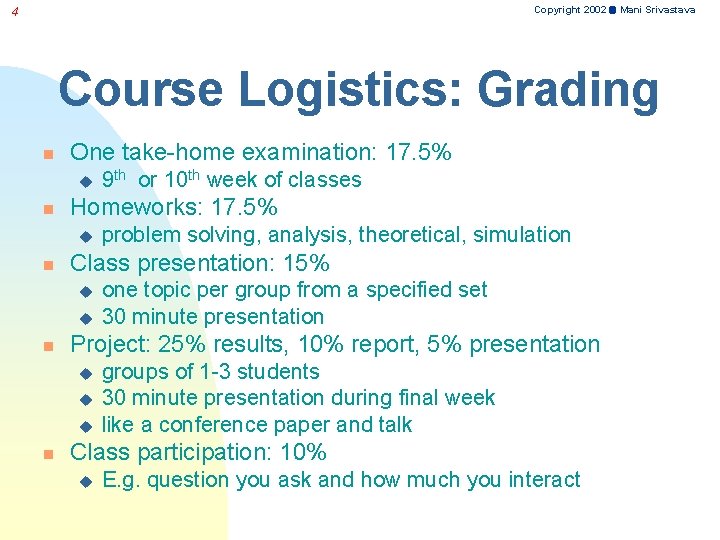
Copyright 2002 Mani Srivastava 4 Course Logistics: Grading n One take-home examination: 17. 5% u n Homeworks: 17. 5% u n u one topic per group from a specified set 30 minute presentation Project: 25% results, 10% report, 5% presentation u u u n problem solving, analysis, theoretical, simulation Class presentation: 15% u n 9 th or 10 th week of classes groups of 1 -3 students 30 minute presentation during final week like a conference paper and talk Class participation: 10% u E. g. question you ask and how much you interact
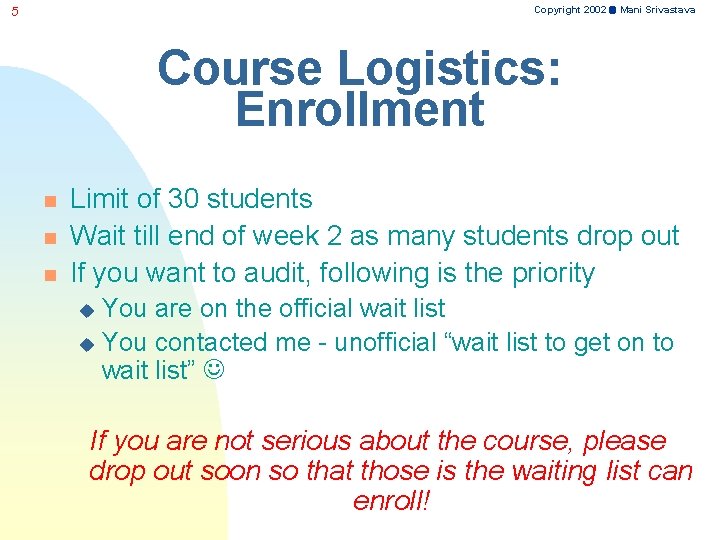
Copyright 2002 Mani Srivastava 5 Course Logistics: Enrollment n n n Limit of 30 students Wait till end of week 2 as many students drop out If you want to audit, following is the priority You are on the official wait list u You contacted me - unofficial “wait list to get on to wait list” u If you are not serious about the course, please drop out soon so that those is the waiting list can enroll!
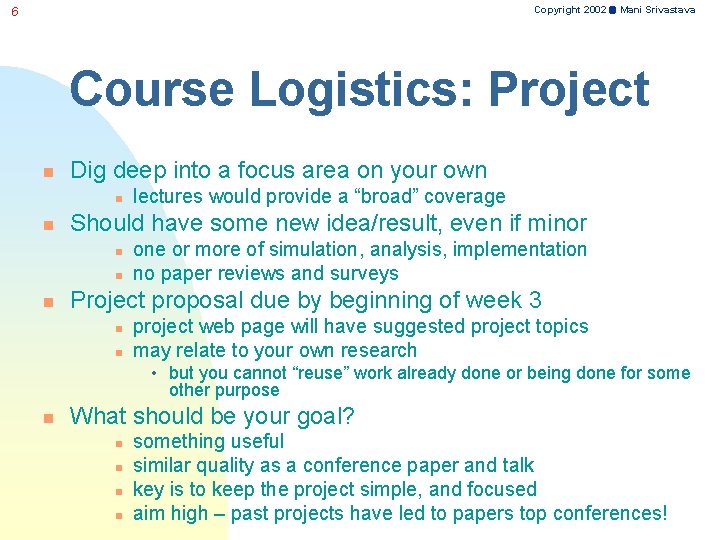
Copyright 2002 Mani Srivastava 6 Course Logistics: Project n Dig deep into a focus area on your own n n Should have some new idea/result, even if minor n n n lectures would provide a “broad” coverage one or more of simulation, analysis, implementation no paper reviews and surveys Project proposal due by beginning of week 3 n n project web page will have suggested project topics may relate to your own research • but you cannot “reuse” work already done or being done for some other purpose n What should be your goal? n n something useful similar quality as a conference paper and talk key is to keep the project simple, and focused aim high – past projects have led to papers top conferences!
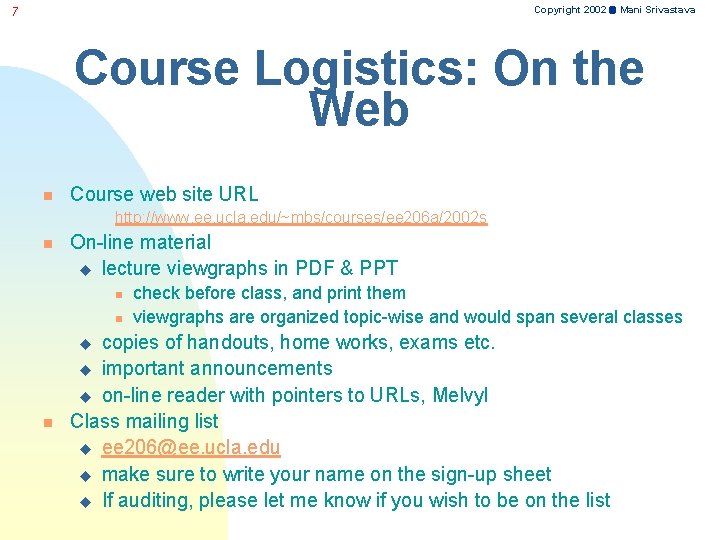
Copyright 2002 Mani Srivastava 7 Course Logistics: On the Web n Course web site URL http: //www. ee. ucla. edu/~mbs/courses/ee 206 a/2002 s n On-line material u lecture viewgraphs in PDF & PPT n n copies of handouts, home works, exams etc. u important announcements u on-line reader with pointers to URLs, Melvyl Class mailing list u ee 206@ee. ucla. edu u make sure to write your name on the sign-up sheet u If auditing, please let me know if you wish to be on the list u n check before class, and print them viewgraphs are organized topic-wise and would span several classes
Copyright 2002 Mani Srivastava 8 Course Logistics: Reader & Textbooks n n No books are required. A set of papers will be required reading n n average of 1 -2 paper lecture will relate to the core topic of that lecture you should read them before the lecture In addition, every student will present a talk n n cover alternate ideas or related topics lead discussion but every one is supposed to participate selected from a set of topics of my choosing I will give pointers to papers and web resources
Copyright 2002 Mani Srivastava 9 Course Logistics: Reader & Textbooks (contd. ) n No paper reader - an “on-line reader” is being maintained at the course web site n n bibliographic entries for various papers links to on-line versions if available – or, indication whether available through Melvyl’s INSPEC database n n hardcopies will be handed out for papers not available on-line Typically access on-line papers from Melvyl (http: //www. melvyl. ucop. edu)
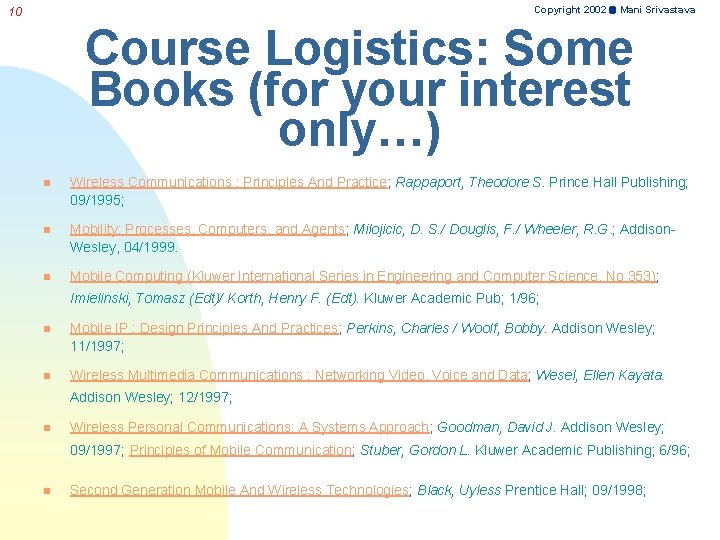
Copyright 2002 Mani Srivastava 10 Course Logistics: Some Books (for your interest only…) n Wireless Communications : Principles And Practice; Rappaport, Theodore S. Prince Hall Publishing; 09/1995; n Mobility: Processes, Computers, and Agents; Milojicic, D. S. / Douglis, F. / Wheeler, R. G. ; Addison. Wesley, 04/1999. n Mobile Computing (Kluwer International Series in Engineering and Computer Science, No 353); Imielinski, Tomasz (Edt)/ Korth, Henry F. (Edt). Kluwer Academic Pub; 1/96; n Mobile IP : Design Principles And Practices; Perkins, Charles / Woolf, Bobby. Addison Wesley; 11/1997; n Wireless Multimedia Communications : Networking Video, Voice and Data; Wesel, Ellen Kayata. Addison Wesley; 12/1997; n Wireless Personal Communications; A Systems Approach; Goodman, David J. Addison Wesley; 09/1997; Principles of Mobile Communication; Stuber, Gordon L. Kluwer Academic Publishing; 6/96; n Second Generation Mobile And Wireless Technologies; Black, Uyless Prentice Hall; 09/1998;
Copyright 2002 Mani Srivastava 11 Course Logistics: Conferences and Journals n Conferences & Workshops n n n Main: MOBICOM, MOBIHOC, INFOCOM Others: SIGCOM, Mo. Mu. C, ICUPC, PIMRC, Wo. WMo. M, ICC, Globecom, etc. Journals & Magazines n n Main: ACM/Baltzer WINET, ACM/Baltzer MONET, IEEE Personal Communications Others: IEEE Trans of N/W, JSAC etc.

Copyright 2002 Mani Srivastava 12 Cheating & Plagiarism n My apologies if you are one of the vast majority of students who don’t resort to academic dishonesty n n but unfortunate incidents in my previous grad and undergrad courses What is cheating & plagiarism? n n Acting dishonestly, practicing fraud Stealing or using (without my permission) other people’s writings or ideas • E. g. from other students, other sources such as web sites, solutions from previous offerings of this course etc. • Note that it doesn’t have to be literal copying – stealing ideas but presenting in a different style is still cheating and plagiarism. n n You are also guilty if you aid in cheating & plagiarism My policy: zero tolerance n n HWs, paper presentation: zero score + one level reduction in course grade Exam, project: “F” grade for the course + report to Dean More than 1 incident: : “F” grade for the course + report to Dean Moreover, please remember that you may have to face me in other exams (e. g. prelims, qualifiers) and professionally!
13 Copyright 2002 Mani Srivastava
Copyright 2002 Mani Srivastava 14 Growth in Wireless Systems n Rapid growth in cellular/PCS voice services over the last decade u n Cell phones everywhere! Wireless data still a small market, but a fast growing one with lots of exciting action u WLAN rapidly growing n u 802. 11 b, 802. 11 a, Bluetooth Wide area wireless data also growing n n Ricochet’s 128 kbps IP service support for data in 2. 5 G and 3 G wireless Wireless broadband Location-based services, WAP
Copyright 2002 Mani Srivastava 15 Why is Wireless Data Still a Small Market? n n n Lack of killer application Unsuitable terminal devices Lack of standard air interfaces and services Lack of universal coverage Poor performance of wireless WANs u n n due to low bit rates, high latencies, and high error rates of existing wide-area wireless air interfaces But, technology trends augur well. . . However, business factors u u high pricing and cost: offering voice service more lucrative spectrum shortage
Copyright 2002 Mani Srivastava 16 Favorable Technology Trends n n Availability of a pervasive data network (Internet) Innovative Internet-based applications and services particularly useful to mobile users u n Novel terminal devices u u n personalized information retrieval, access to airline reservations systems, online trading compact size, low power, ease of use next generation will have built-in wireless interfaces Emerging wide-area wireless packet data services u u aggregate data rates of several 100 kbps TCP/IP-friendly link layer protocols
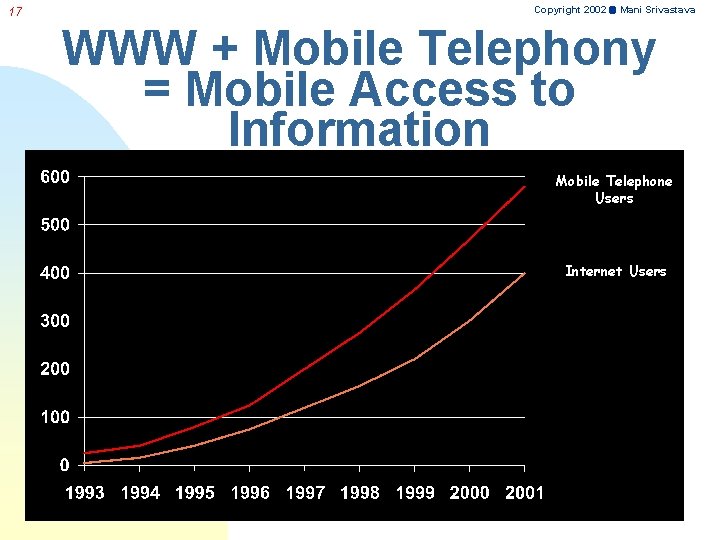
17 Copyright 2002 Mani Srivastava WWW + Mobile Telephony = Mobile Access to Information Mobile Telephone Users Internet Users
Copyright 2002 Mani Srivastava 18 Evolution in Information Systems n Wired wireless, e. g. wired phones cellular n n n Voice telephony, data multimedia Intelligent telecom n/w networked computing n n n intelligence at the edges of the network programmable servers intermixed with switching infrastructure for rapid service deployment Networked computing is becoming pervasive n n n more freedom of location and time personal networked mobile pervasive more flexible resource usage, more freedom of location and time, more efficient flow of information Moving beyond phones and PCs n embedded devices & sensor-based smart spaces
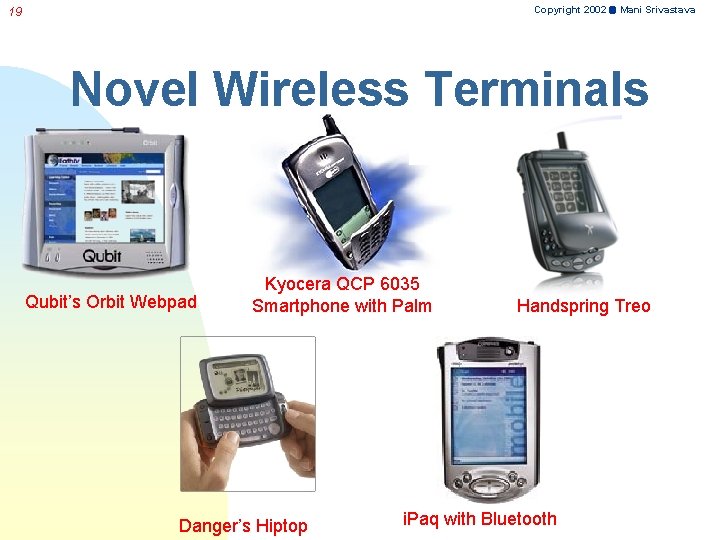
Copyright 2002 Mani Srivastava 19 Novel Wireless Terminals Qubit’s Orbit Webpad Kyocera QCP 6035 Smartphone with Palm Danger’s Hiptop Handspring Treo i. Paq with Bluetooth
Copyright 2002 Mani Srivastava 20 Network Infrastructure n Dynamic, programmatic creation/composition of scalable, highly available & customizable services n n n Diverse appliances beyond the phone and the PC n n automatic adaptation to end device characteristics and network connectivity dynamic composition of component services devices plus servers in the infrastructure Arbitrarily powerful services on arbitrarily small clients using an adaptive infrastructure n n computing resources mixed with switching fabric WAP: wireless application protocol
Copyright 2002 Mani Srivastava 24 What is this course about? n n Mobile and wireless networked computing and communication systems Emphasis on emerging systems u u u beyond traditional cellular telephone systems wireless packet-switched data and multimedia beyond network of phones and PCs n n networks of large # of wireless embedded systems Emphasis on interaction between layers of the system u u u not about radio design or communication theory link/network/transport, application, OS/middleware optimizations across layers
Copyright 2002 Mani Srivastava 25 Evolution of Mobile and RF Wireless Systems n 1 st generation: analog - voice n n AMPS with manual roaming cordless phones packet radio 2 nd generation: digital - voice, data n n n cellular & PCS with seamless roaming and integrated paging (IS-95, IS-136, GSM) multizone digital cordless wireless LANs (802. 11), MANs (Metricom), and WANs (CDPD, Ardis, RAM, Mobitext)
Copyright 2002 Mani Srivastava 26 Beyond the 2 nd Generation n Wide-area mobile voice/data n n n Fixed Point-to-multipoint broadband wireless access 802. 16 n n n 802. 11 b (2. 4 GHz, 11 Mbps), 802. 11 a (5 GHz, 54 Mbps & higher) Home. RF Personal area Networks n n LMDS (local multipoint distribution) 24 -28 GHz MMDS below 5 GHz Free space optics (Terabeam) Higher-speed WLAN n n 2. 5 G: GPRS 3 G standards: UMTS, /IMT 2000, wideband CDMA, CDMA 2000, EDGE Bluetooth, 802. 15 Wireless device networks n Sensor networks, wirelessly networked robots
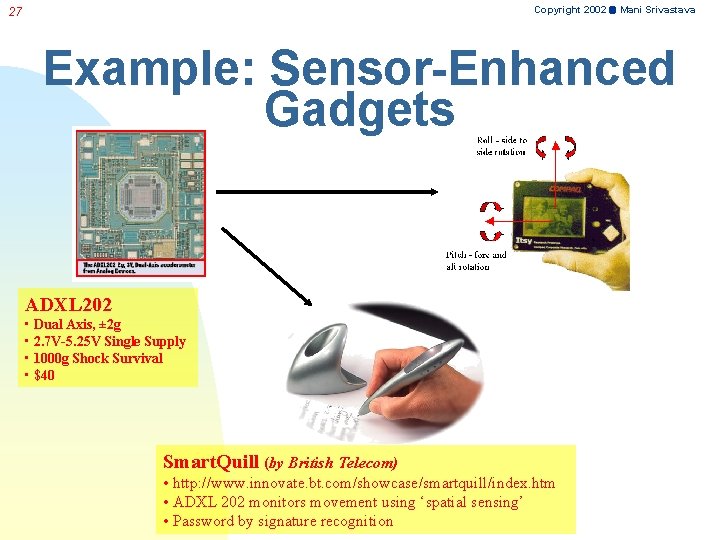
Copyright 2002 Mani Srivastava 27 Example: Sensor-Enhanced Gadgets ADXL 202 • Dual Axis, ± 2 g • 2. 7 V-5. 25 V Single Supply • 1000 g Shock Survival • $40 Smart. Quill (by British Telecom) • http: //www. innovate. bt. com/showcase/smartquill/index. htm • ADXL 202 monitors movement using ‘spatial sensing’ • Password by signature recognition
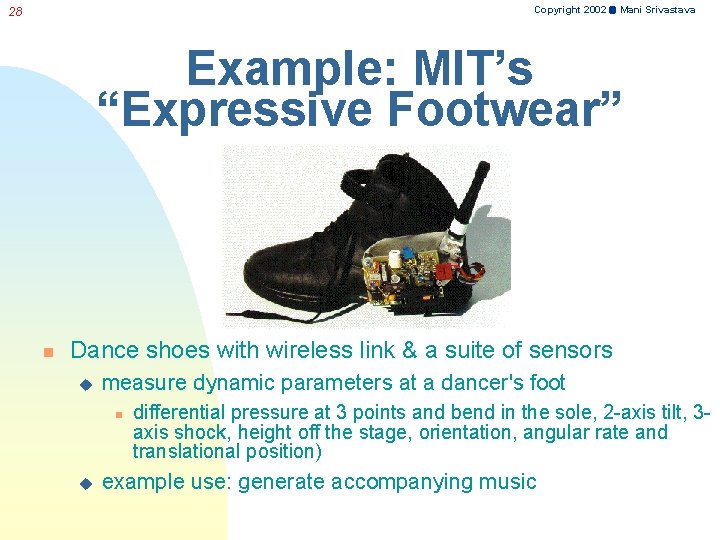
Copyright 2002 Mani Srivastava 28 Example: MIT’s “Expressive Footwear” n Dance shoes with wireless link & a suite of sensors u measure dynamic parameters at a dancer's foot n u differential pressure at 3 points and bend in the sole, 2 -axis tilt, 3 axis shock, height off the stage, orientation, angular rate and translational position) example use: generate accompanying music
29 Copyright 2002 Mani Srivastava Telecom View of the Future Information Systems People and their machines should be able to access information and communicate with each other easily and securely, in any medium or combination of media - voice, data, image, video, or multimedia - anytime, anywhere, in a timely, cost-effective way. George Heilmeier (CEO of Bellcore) IEEE Communication Magazine, 1992
30 Copyright 2002 Mani Srivastava Computing View of the Future Information Systems The most profound technologies are those that disappear. They weave themselves into the fabric of everyday life until they are indistinguishable from it. . . the idea of a “personal computer” itself is misplaced. . . the vision of laptop machines, dynabooks and “knowledge navigators” is only a transitional step. . . a new way of thinking about computers, one that takes into account the human world and allows the computers themselves to vanish into the background. Mark Weiser (Chief Technologist, Xerox PARC) Scientific American, September 1991
Copyright 2002 Mani Srivastava 31 Alternate Models of Mobile Computing Systems n Ubiquitous Information Access u u information distributed everywhere by the “net” terminal centric n n users carry wireless terminal is the universal service access device terminal adapts to location and services Ubiquitous Computing u cheap computers of different scales and types embedded everywhere n u 100 s of computer in every room in the form of common, dayto-day objects user centric n n n computers swapped among users computers dedicated to service computers adapt to location and users
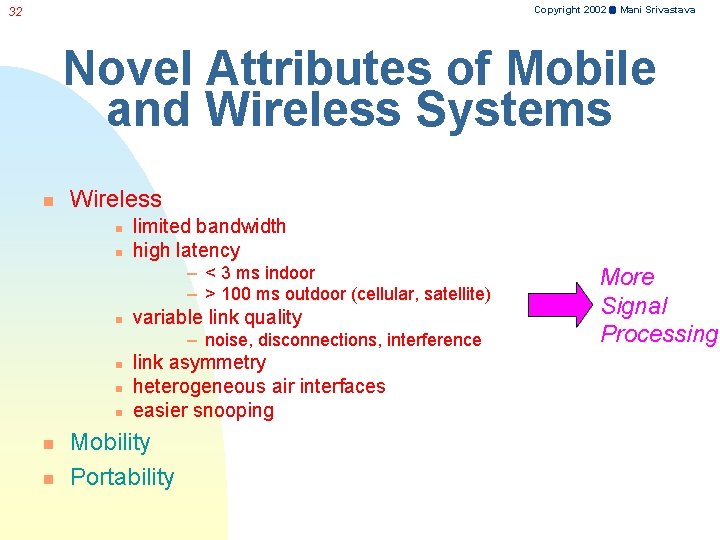
Copyright 2002 Mani Srivastava 32 Novel Attributes of Mobile and Wireless Systems n Wireless n n limited bandwidth high latency – < 3 ms indoor – > 100 ms outdoor (cellular, satellite) n variable link quality – noise, disconnections, interference n n n link asymmetry heterogeneous air interfaces easier snooping Mobility Portability More Signal Processing
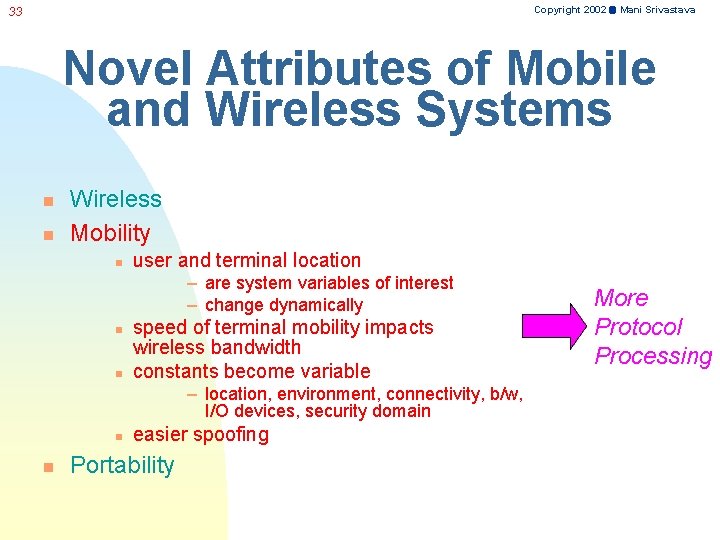
Copyright 2002 Mani Srivastava 33 Novel Attributes of Mobile and Wireless Systems n n Wireless Mobility n user and terminal location – are system variables of interest – change dynamically n n speed of terminal mobility impacts wireless bandwidth constants become variable – location, environment, connectivity, b/w, I/O devices, security domain n n easier spoofing Portability More Protocol Processing
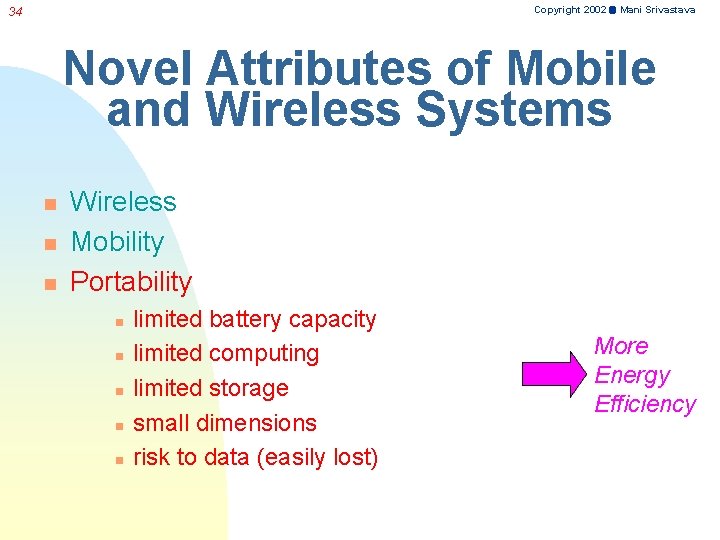
Copyright 2002 Mani Srivastava 34 Novel Attributes of Mobile and Wireless Systems n n n Wireless Mobility Portability n n n limited battery capacity limited computing limited storage small dimensions risk to data (easily lost) More Energy Efficiency
Copyright 2002 Mani Srivastava 35 Disconnections n n Planned vs. unplanned Choices? engineer to prevent disconnections u gracefully cope (adapt) to disconnections u n Mask disconnections and round-trip latencies u decouple communication from data production/consumption n n Tolerate by autonomous operation, caching/hoarding, local applications etc. u n asynchronous operation (multiple REQs before ACKs), prefetching, delayed write-back etc. disconnected filesystems, e. g. CMU’s CODA Good user interfaces to give feedback about disconnection
Copyright 2002 Mani Srivastava 36 Limited Bandwidth n Difference between indoor (1 -10 Mbps) and outdoor (10 s of Kbps) n n Right metric? n n bps vs. bps per user vs. bps per unit volume Cope by improving bandwidth usage n n n mobility, multipath compression, buffering techniques for disconnection (caching, delayed write-back) help Schedule link bandwidth to improve user satisfaction n n differentiate data according to quality of service fair allocation of bandwidth
Copyright 2002 Mani Srivastava 37 Bandwidth Variability n Variations due to change of network n n Variations due to changing wireless link condition n n ethernet vs. wavelan vs. CDPD fading How can applications cope? n n operate only when all bandwidth available design for worst case minimum bandwidth adapt to available bandwidth appropriate scheduling of packets on the link
Copyright 2002 Mani Srivastava 38 Time Varying Wireless Environment n Wired networks n n n problem is congestion… need to share resources resource reservation + scheduling can provide Qo. S Wireless networks n n sharing is only part of the problem available wireless link resource undergoes dramatic and rapid changes – multipath reflection, doppler fading, frequency collisions n n rapid signal fades and distortions as a receiver moves necessitates aggressive signal processing and adaptive protocols
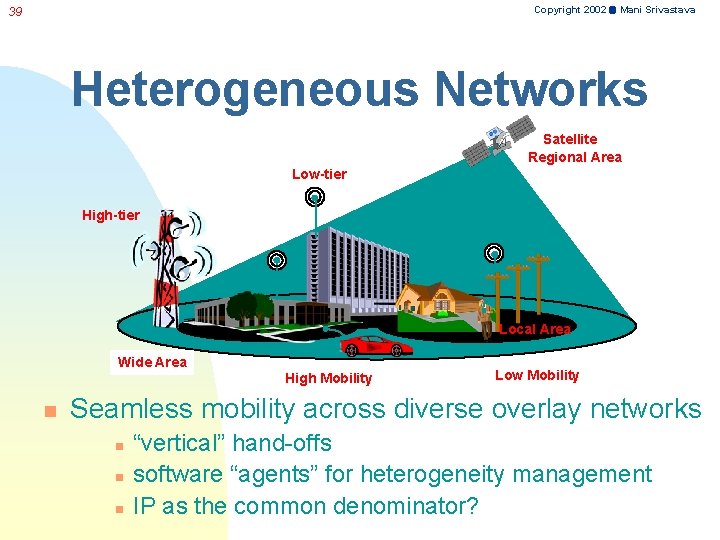
Copyright 2002 Mani Srivastava 39 Heterogeneous Networks Satellite Regional Area Low-tier High-tier Local Area Wide Area High Mobility n Low Mobility Seamless mobility across diverse overlay networks n n n “vertical” hand-offs software “agents” for heterogeneity management IP as the common denominator?
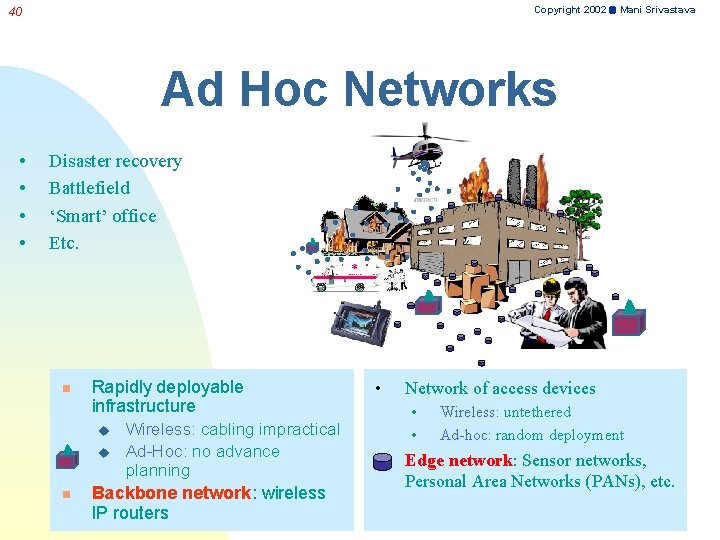
Copyright 2002 Mani Srivastava 40 Ad Hoc Networks • • Disaster recovery Battlefield ‘Smart’ office Etc. n Rapidly deployable infrastructure u u n Wireless: cabling impractical Ad-Hoc: no advance planning Backbone network: wireless IP routers • Network of access devices • • • Wireless: untethered Ad-hoc: random deployment Edge network: Sensor networks, Personal Area Networks (PANs), etc.
Copyright 2002 Mani Srivastava 41 Address Migration due to Mobility n n Dynamically changing network access point In current internet (and PSTN) address corresponds to the point of attachment to n/w n n n n applications/calls connect to a fixed address active connections cannot be moved to new address How to support changing network access point? How to find the current address? How to do rerouting? How to do route optimization? How to do multicast?
Copyright 2002 Mani Srivastava 42 Rethinking Naming and Addresses in Wireless Systems n Conventional networks u u u n Destination has a name represented by an id Name maps to an address represented by an id Routing done by id-based address Large ad hoc networks, e. g. sensor networks u u u Hard to name by an id Attribute based naming (“a sensor in the SW corner”) Map attributes to id, and then route using id Or, perhaps route using the attributes? How about no addresses? (get address for each transaction) Dynamically chosen addresses according to local density?
Copyright 2002 Mani Srivastava 43 Location-dependent Information n Location affects configuration parameters u n Location affects answer to user queries u n n e. g. where is the nearest taxi Privacy concerns due to location tracking Changing context u u u n e. g. where is the nearest printer More complex location-dependent queries u n DNS, timezone, printer etc. small movements may cause large changes caching may become ineffective dynamic transfer to nearest server for a service Localization
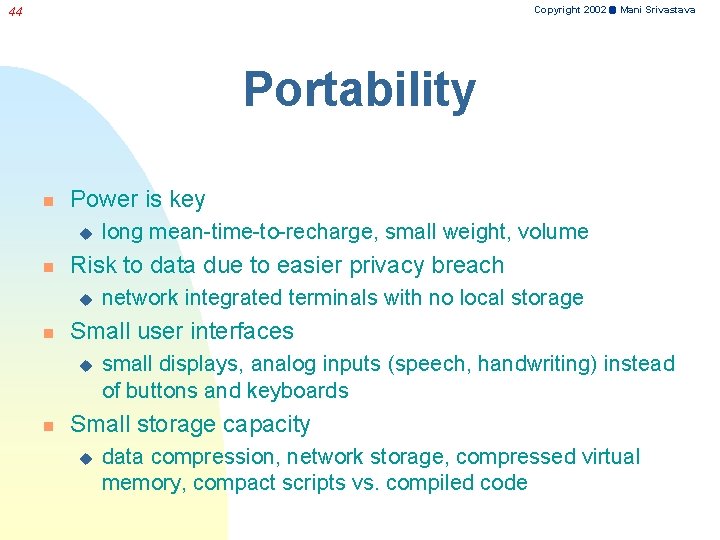
Copyright 2002 Mani Srivastava 44 Portability n Power is key u n Risk to data due to easier privacy breach u n network integrated terminals with no local storage Small user interfaces u n long mean-time-to-recharge, small weight, volume small displays, analog inputs (speech, handwriting) instead of buttons and keyboards Small storage capacity u data compression, network storage, compressed virtual memory, compact scripts vs. compiled code
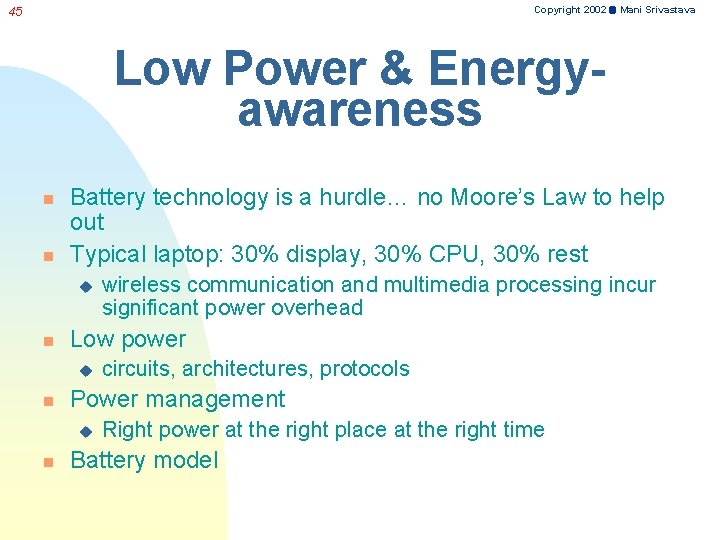
Copyright 2002 Mani Srivastava 45 Low Power & Energyawareness n n Battery technology is a hurdle… no Moore’s Law to help out Typical laptop: 30% display, 30% CPU, 30% rest u n Low power u n circuits, architectures, protocols Power management u n wireless communication and multimedia processing incur significant power overhead Right power at the right place at the right time Battery model
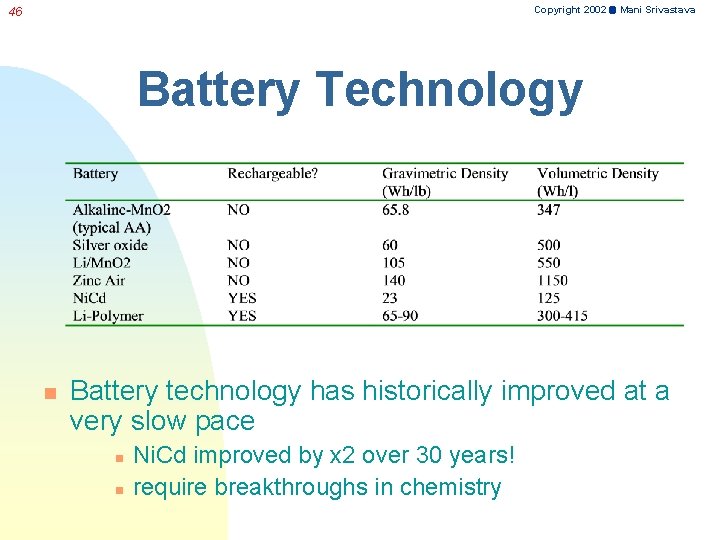
Copyright 2002 Mani Srivastava 46 Battery Technology n Battery technology has historically improved at a very slow pace n n Ni. Cd improved by x 2 over 30 years! require breakthroughs in chemistry
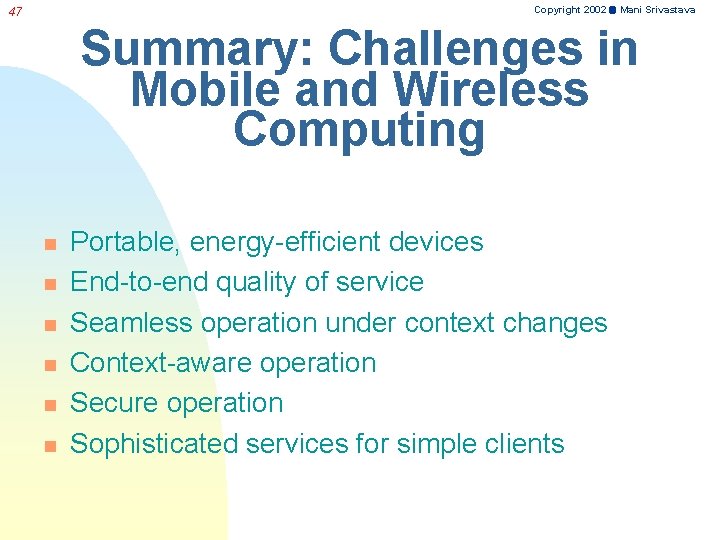
Copyright 2002 Mani Srivastava 47 Summary: Challenges in Mobile and Wireless Computing n n n Portable, energy-efficient devices End-to-end quality of service Seamless operation under context changes Context-aware operation Secure operation Sophisticated services for simple clients
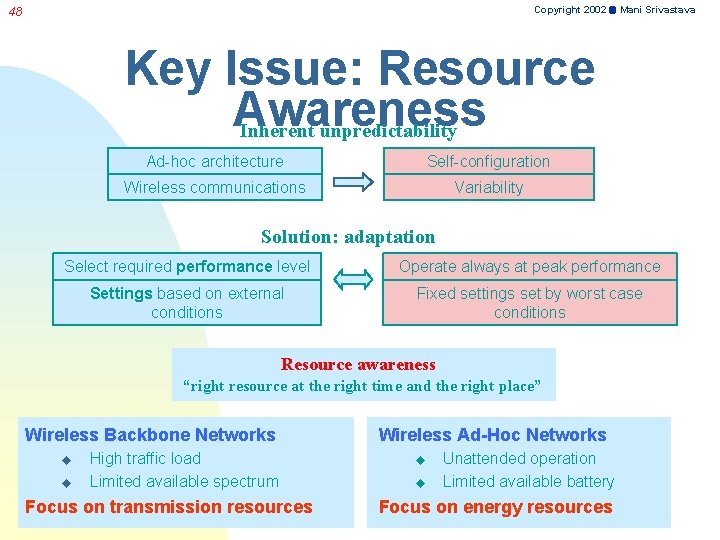
Copyright 2002 Mani Srivastava 48 Key Issue: Resource Awareness Inherent unpredictability Ad-hoc architecture Self-configuration Wireless communications Variability Solution: adaptation Select required performance level Operate always at peak performance Settings based on external conditions Fixed settings set by worst case conditions Resource awareness “right resource at the right time and the right place” Wireless Backbone Networks u u High traffic load Limited available spectrum Focus on transmission resources Wireless Ad-Hoc Networks u u Unattended operation Limited available battery Focus on energy resources
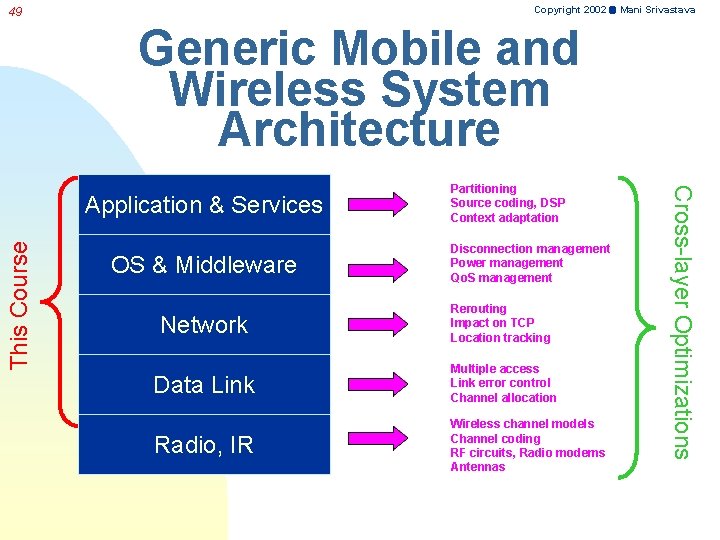
Copyright 2002 Mani Srivastava 49 Generic Mobile and Wireless System Architecture This Course OS & Middleware Disconnection management Power management Qo. S management Network Rerouting Impact on TCP Location tracking Data Link Multiple access Link error control Channel allocation Radio, IR Wireless channel models Channel coding RF circuits, Radio modems Antennas Cross-layer Optimizations Application & Services Partitioning Source coding, DSP Context adaptation
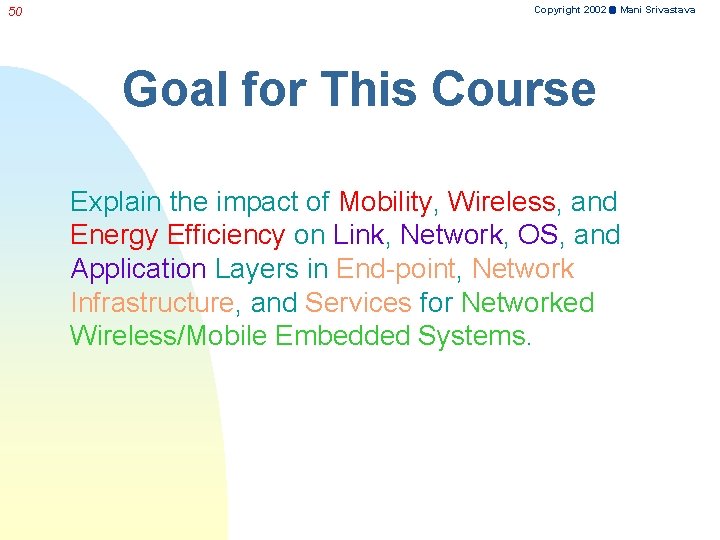
50 Copyright 2002 Mani Srivastava Goal for This Course Explain the impact of Mobility, Wireless, and Energy Efficiency on Link, Network, OS, and Application Layers in End-point, Network Infrastructure, and Services for Networked Wireless/Mobile Embedded Systems.
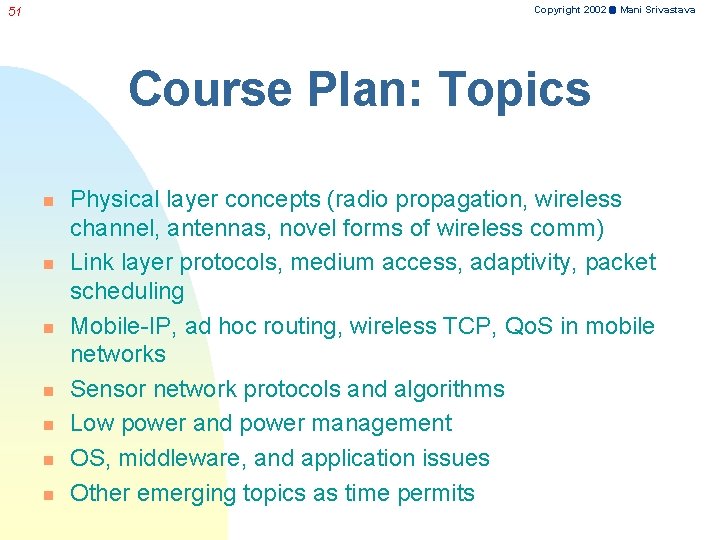
Copyright 2002 Mani Srivastava 51 Course Plan: Topics n n n n Physical layer concepts (radio propagation, wireless channel, antennas, novel forms of wireless comm) Link layer protocols, medium access, adaptivity, packet scheduling Mobile-IP, ad hoc routing, wireless TCP, Qo. S in mobile networks Sensor network protocols and algorithms Low power and power management OS, middleware, and application issues Other emerging topics as time permits
Copyright 2002 Mani Srivastava 52 Reading List for This Lecture n MANDATORY READING [Weiser 91] M. Weiser, "The Computer for the 21 st Century, " Scientific American, vol. 265, no. 3, pp. 94 -104, September 1991. (draft copy at http: //www. ubiq. com/hypertext/weiser/Sci. Am. Draft 3. html) n RECOMMENDED READING None.
- Slides: 50