
Copy the weeks schedule into your agenda Then




- Slides: 25
Copy the week’s schedule into your agenda. Then complete your Question of the Day
Journal set up Get a post-it note. Place it on Page 4. Make sure ½ inch is overhanging the edge Write “Light Years and Theories” on the edge so you can see it.
Words to Know Take another post it note Put it 5 pages from the back sticking out of the top. Write “Words to Know” on the top
Vast: (adj) of very great extent, immense, huge, very large
http: //janus. astro. umd. edu/astro/distance/
If you could travel to the closest star from the sun in a car traveling 60 mph, how long would it take you to get there? • http: //janus. astro. umd. edu/astro/distance/
48 million years
If you could travel to the closest star from the Earth in a space shuttle at 18, 000 mph, how long would it take you to get there?
160, 000 years
If you ride on a beam of light, how long would it take you to get there? It travels 300, 000 m/s • http: //janus. astro. umd. edu/astro/distance/
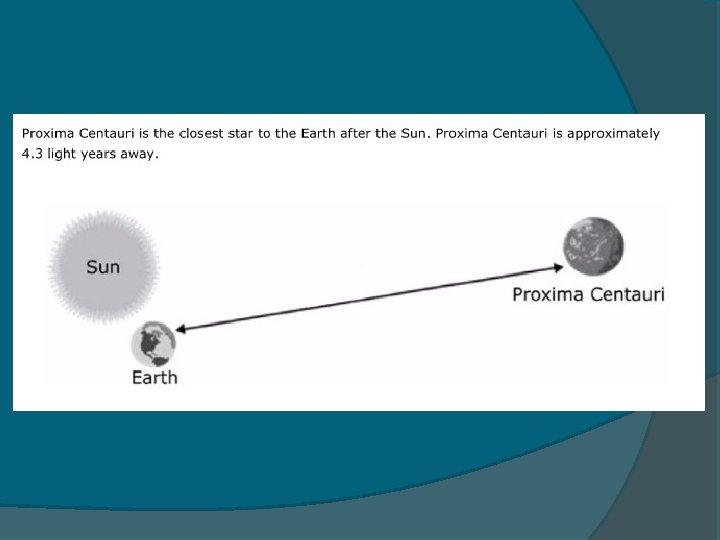
4. 29 years
Why do we use Light Years? Because distances in space are too vast (big), miles and kilometers are too small to be used. Scientists measure the distances in space outside our solar system in light years (ly)
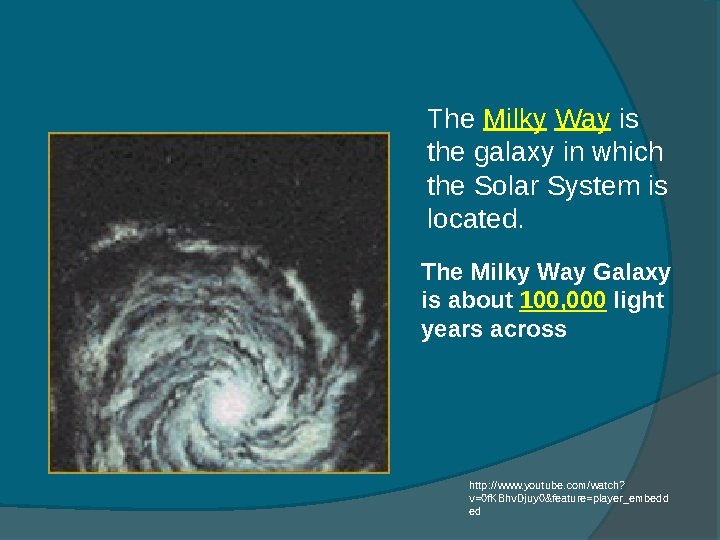
The Milky Way is the galaxy in which the Solar System is located. The Milky Way Galaxy is about 100, 000 light years across http: //www. youtube. com/watch? v=0 f. KBhv. Djuy 0&feature=player_embedd ed
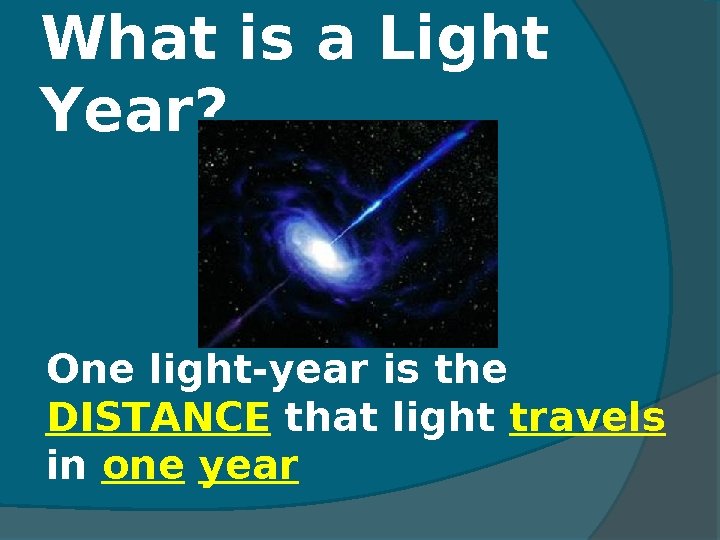
What is a Light Year? One light-year is the DISTANCE that light travels in one year
If we are going to find out HOW FAR a Light Year is, we need to know two things… 1. The speed of light, measured in meters per second and 2. The number of seconds in a year
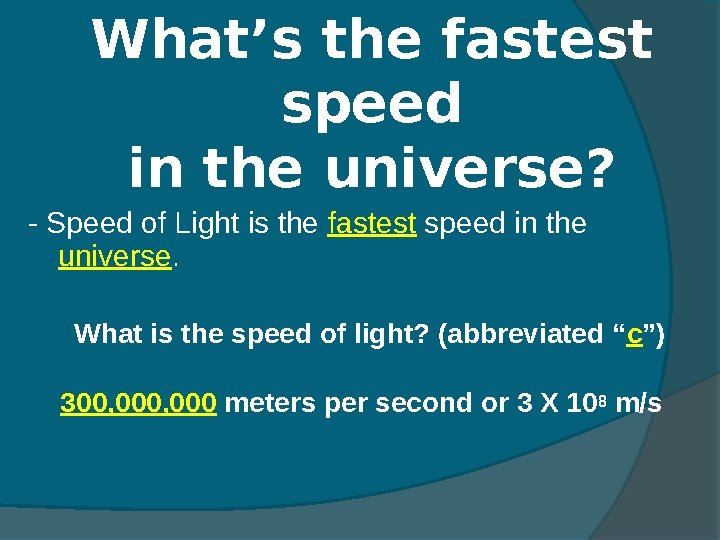
What’s the fastest speed in the universe? - Speed of Light is the fastest speed in the universe. What is the speed of light? (abbreviated “c”) 300, 000 meters per second or 3 X 10⁸ m/s
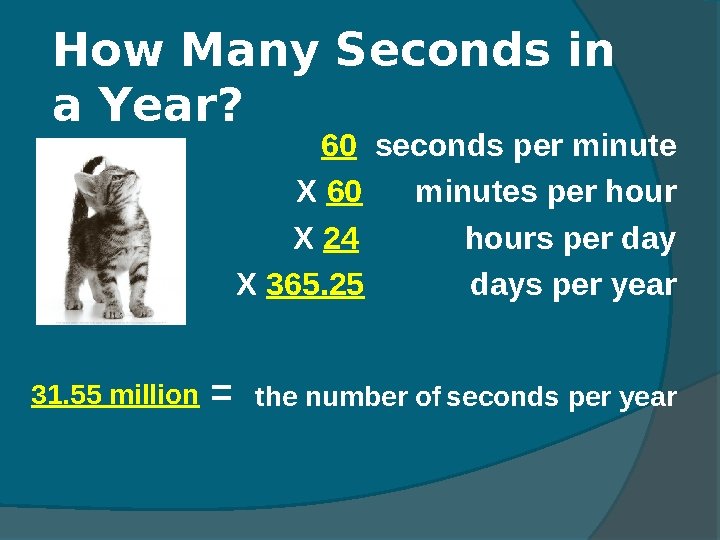
How Many Seconds in a Year? 60 seconds per minute X 60 minutes per hour X 24 hours per day X 365. 25 days per year 31. 55 million = the number of seconds per year
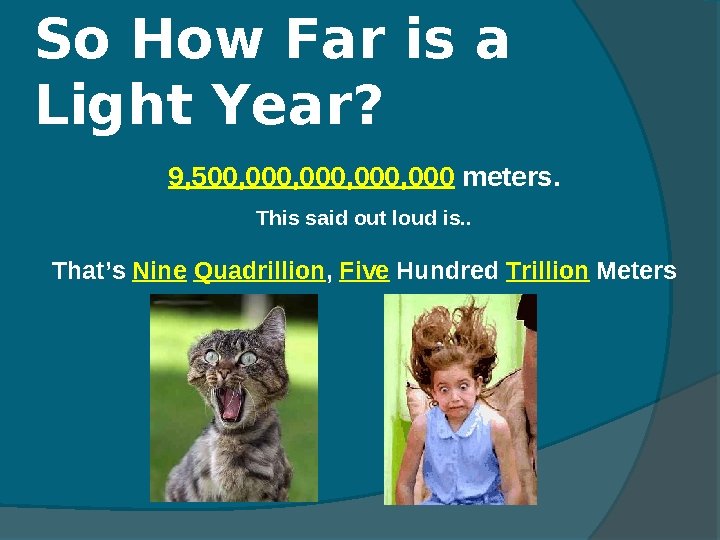
So How Far is a Light Year? 9, 500, 000, 000 meters. This said out loud is. . That’s Nine Quadrillion, Five Hundred Trillion Meters
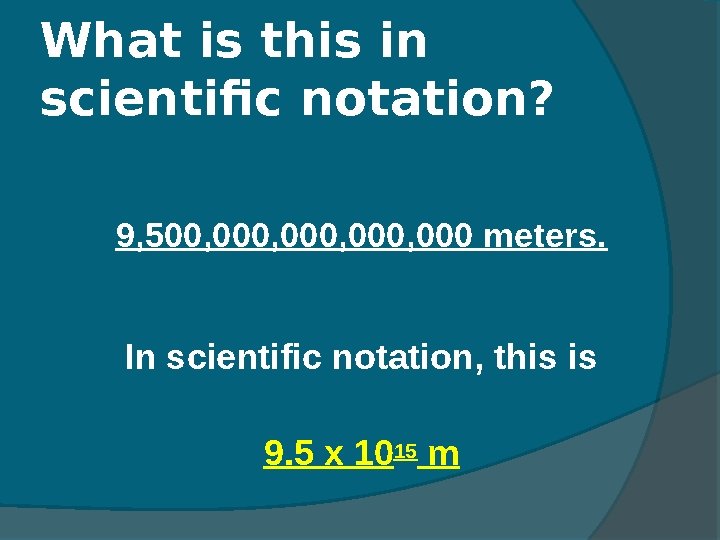
What is this in scientific notation? 9, 500, 000, 000 meters. In scientific notation, this is 9. 5 x 10¹⁵ m
Video Break https: //www. youtube. com/watch? v=Op 3 AYa. Jc 0 Xw
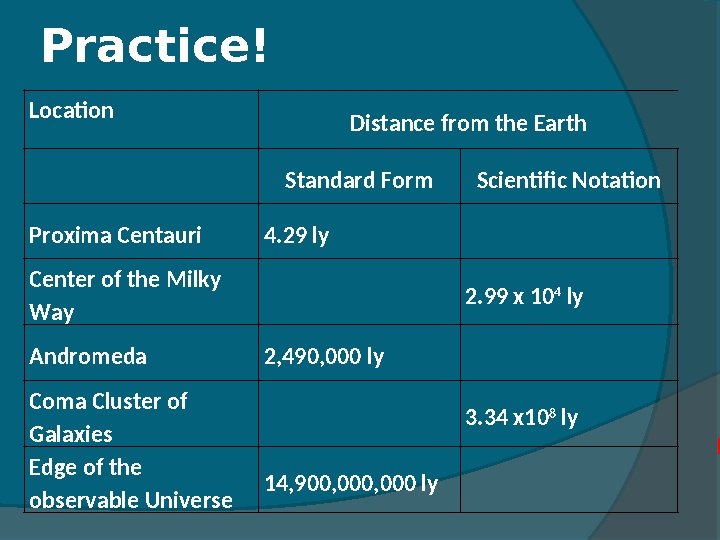
Practice! Location Distance from the Earth Standard Form Proxima Centauri 4. 29 ly Center of the Milky Way Andromeda Coma Cluster of Galaxies Edge of the observable Universe Scientific Notation 2. 99 x 104 ly 2, 490, 000 ly 3. 34 x 108 ly 14, 900, 000 ly
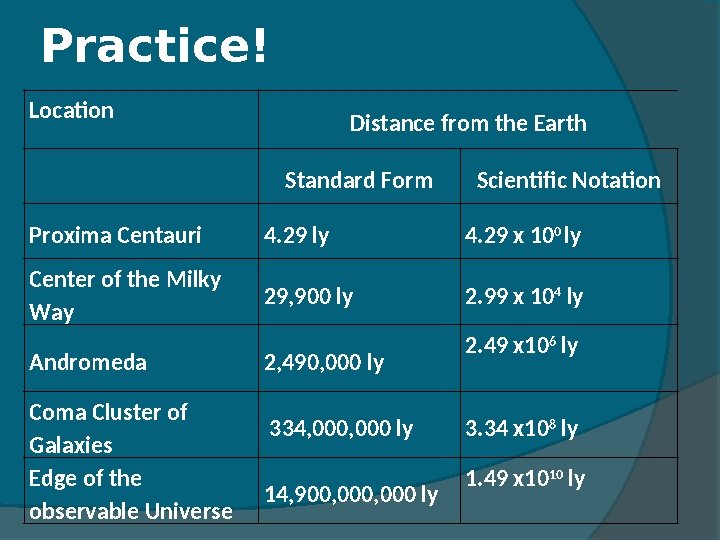
Practice! Location Distance from the Earth Standard Form Scientific Notation Proxima Centauri 4. 29 ly 4. 29 x 100 ly Center of the Milky Way 29, 900 ly 2. 99 x 104 ly Andromeda Coma Cluster of Galaxies Edge of the observable Universe 2, 490, 000 ly 334, 000 ly 14, 900, 000 ly 2. 49 x 106 ly 3. 34 x 108 ly 1. 49 x 1010 ly
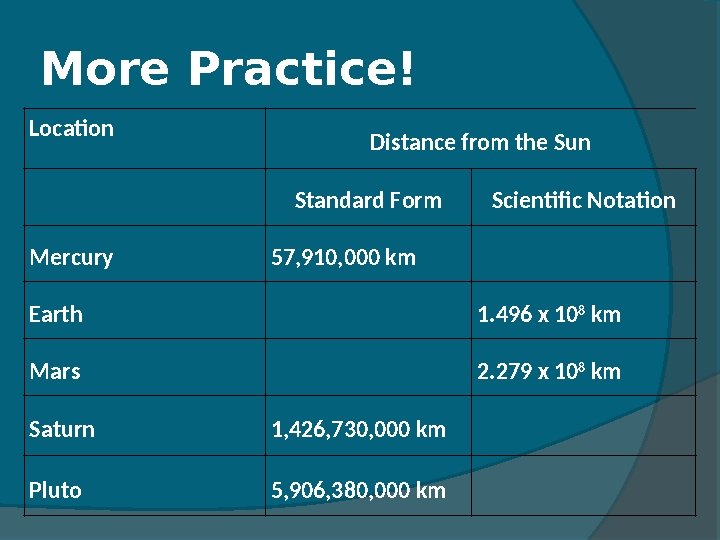
More Practice! Location Distance from the Sun Standard Form Mercury Scientific Notation 57, 910, 000 km Earth 1. 496 x 108 km Mars 2. 279 x 108 km Saturn 1, 426, 730, 000 km Pluto 5, 906, 380, 000 km