
Copy all info in the red boxes Projectile
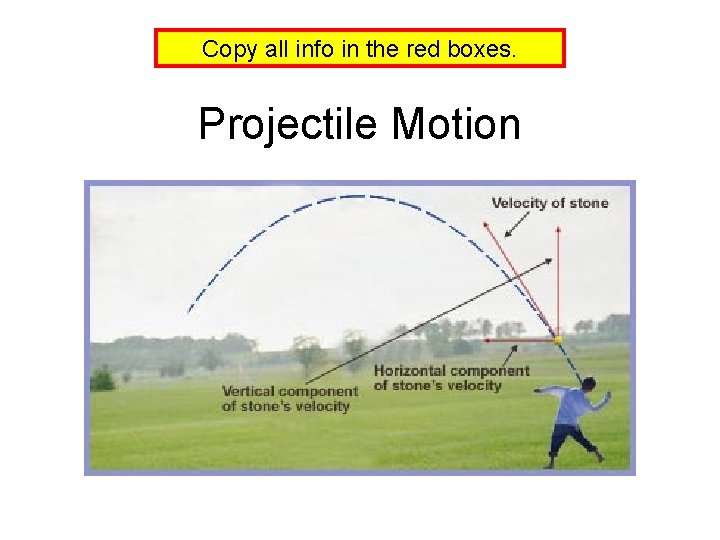
Copy all info in the red boxes. Projectile Motion
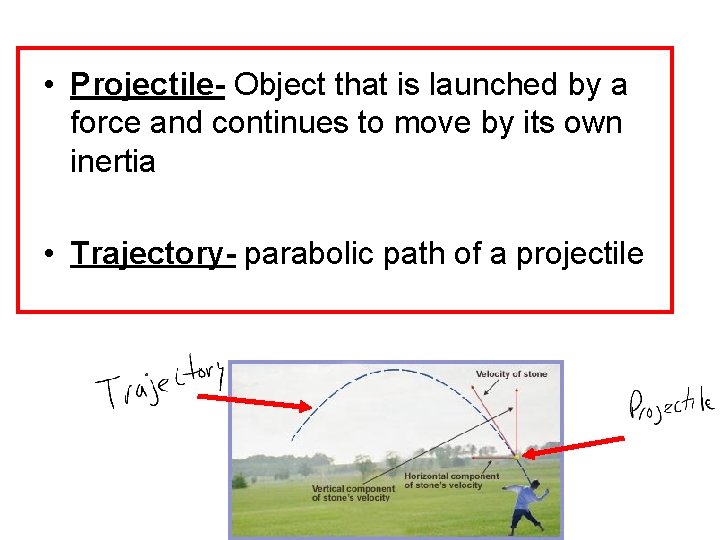
• Projectile- Object that is launched by a force and continues to move by its own inertia • Trajectory- parabolic path of a projectile
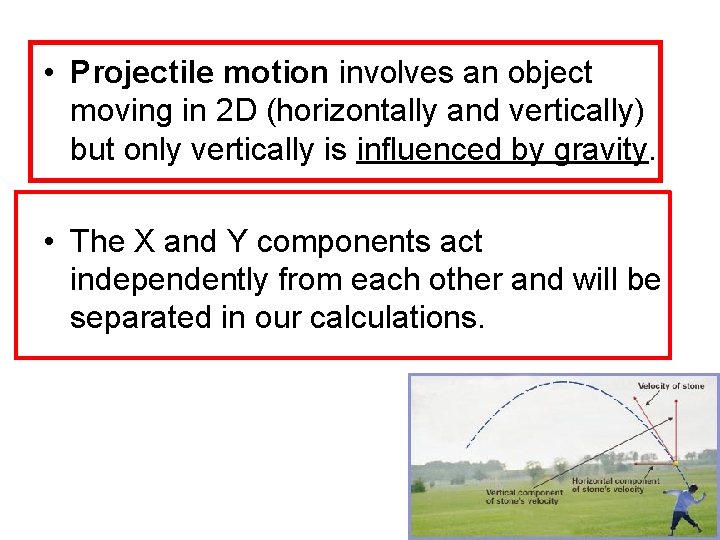
• Projectile motion involves an object moving in 2 D (horizontally and vertically) but only vertically is influenced by gravity. • The X and Y components act independently from each other and will be separated in our calculations.
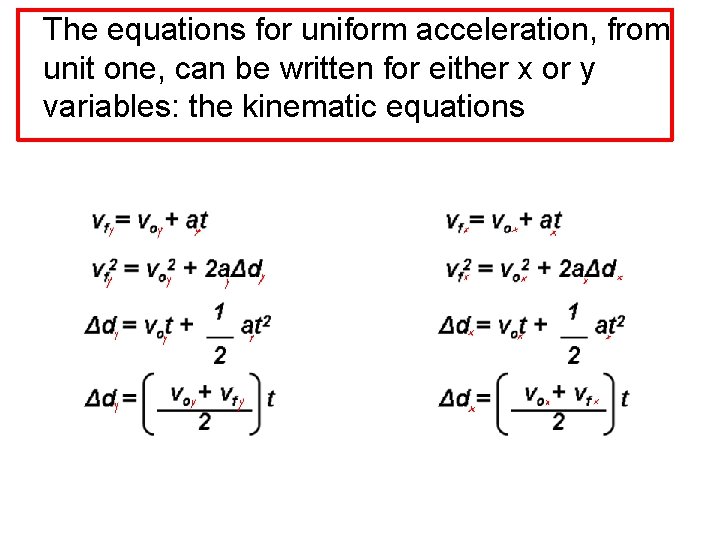
The equations for uniform acceleration, from unit one, can be written for either x or y variables: the kinematic equations
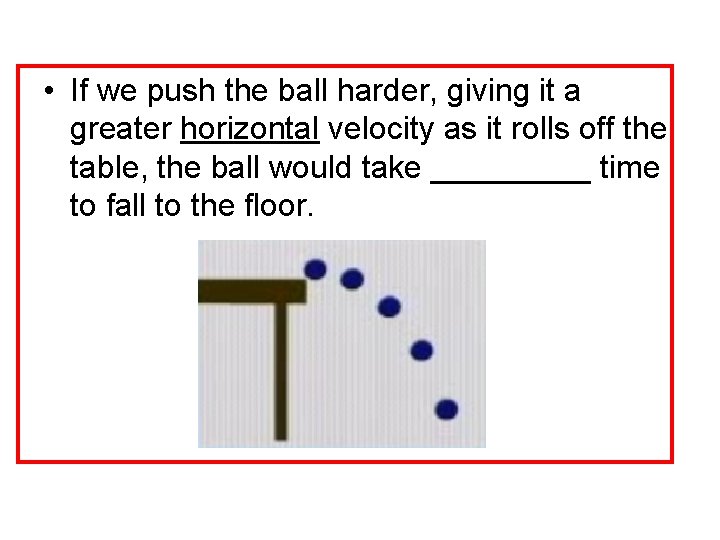
• If we push the ball harder, giving it a greater horizontal velocity as it rolls off the table, the ball would take _____ time to fall to the floor.
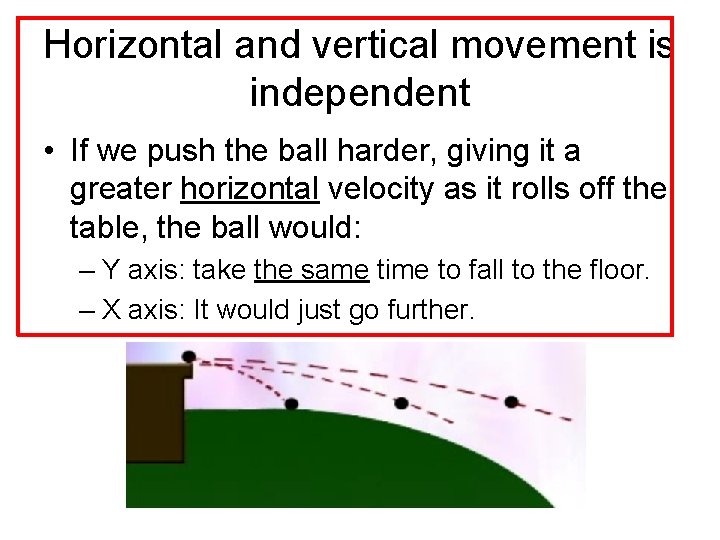
Horizontal and vertical movement is independent • If we push the ball harder, giving it a greater horizontal velocity as it rolls off the table, the ball would: – Y axis: take the same time to fall to the floor. – X axis: It would just go further.
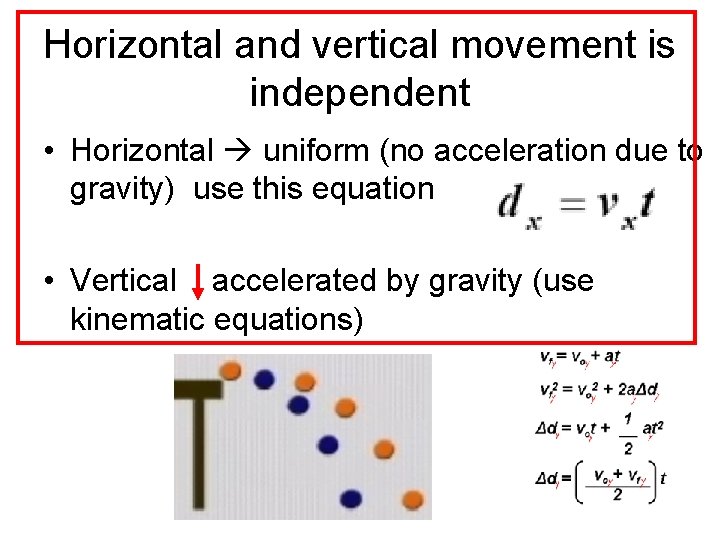
Horizontal and vertical movement is independent • Horizontal uniform (no acceleration due to gravity) use this equation • Vertical accelerated by gravity (use kinematic equations)
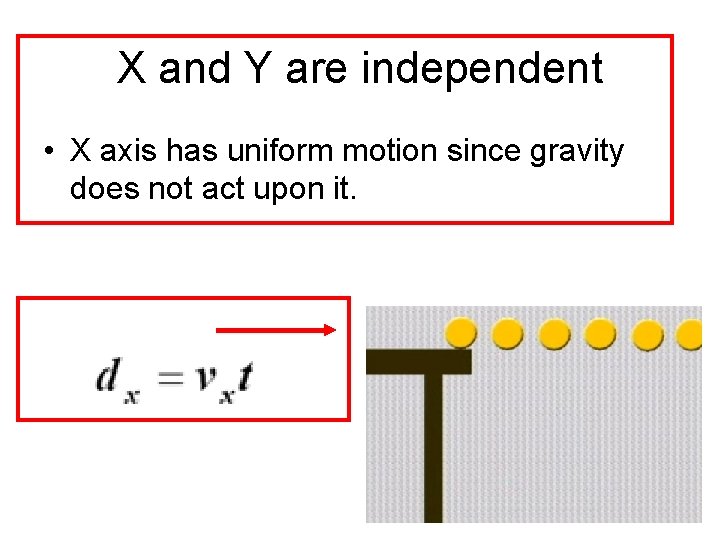
X and Y are independent • X axis has uniform motion since gravity does not act upon it.
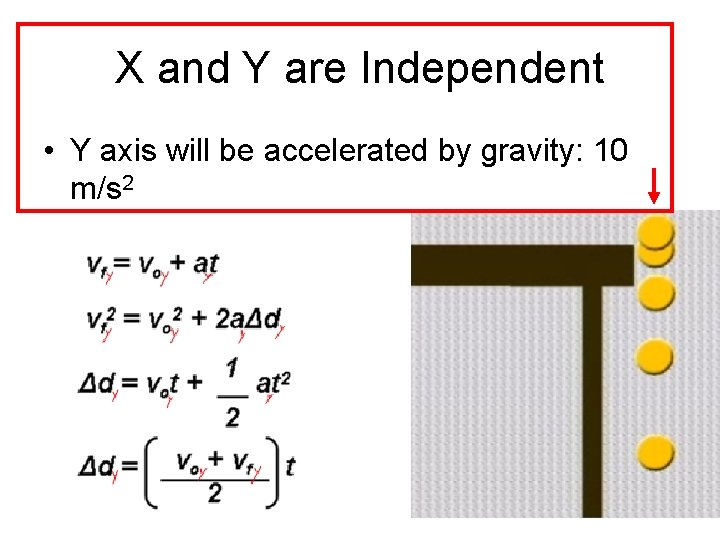
X and Y are Independent • Y axis will be accelerated by gravity: 10 m/s 2
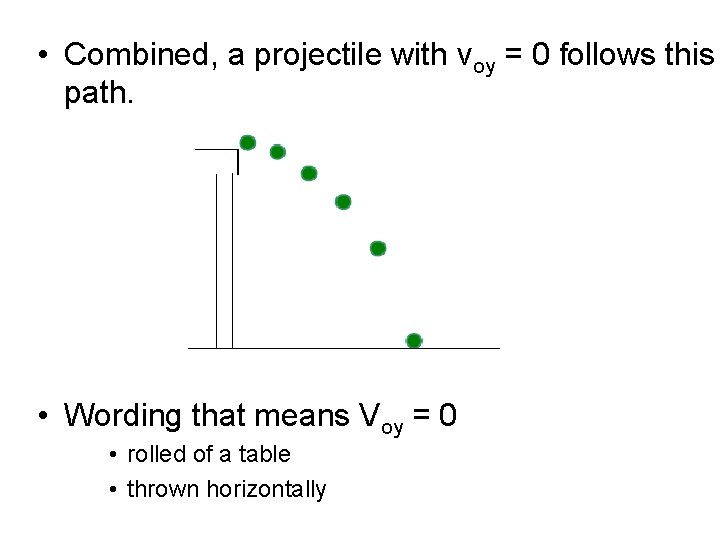
• Combined, a projectile with voy = 0 follows this path. • Wording that means Voy = 0 • rolled of a table • thrown horizontally
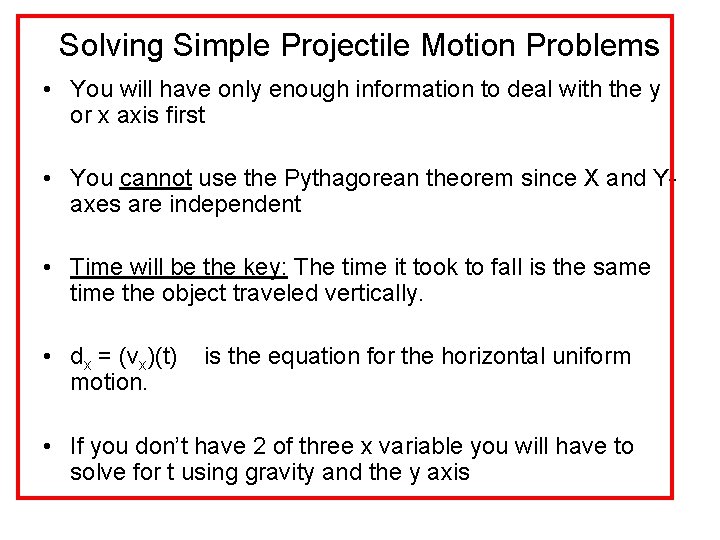
Solving Simple Projectile Motion Problems • You will have only enough information to deal with the y or x axis first • You cannot use the Pythagorean theorem since X and Yaxes are independent • Time will be the key: The time it took to fall is the same time the object traveled vertically. • dx = (vx)(t) motion. is the equation for the horizontal uniform • If you don’t have 2 of three x variable you will have to solve for t using gravity and the y axis
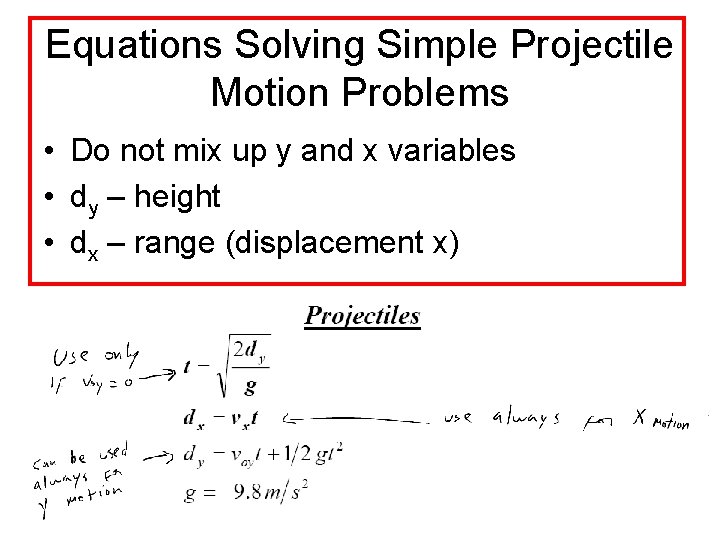
Equations Solving Simple Projectile Motion Problems • Do not mix up y and x variables • dy – height • dx – range (displacement x)
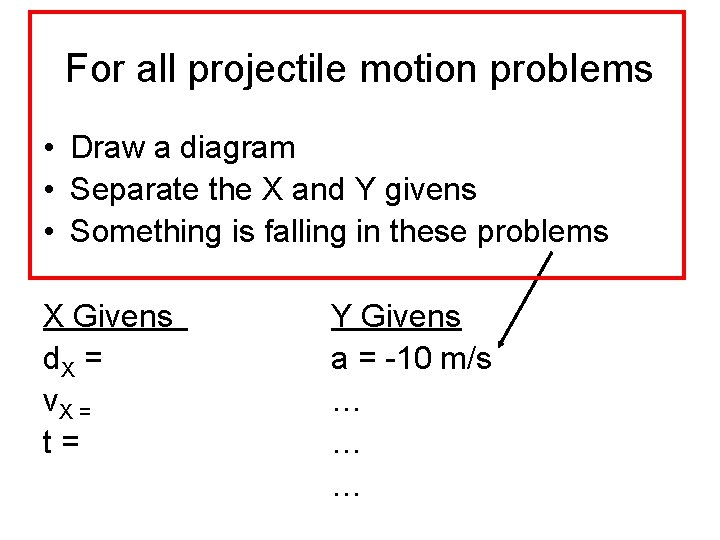
For all projectile motion problems • Draw a diagram • Separate the X and Y givens • Something is falling in these problems X Givens d. X = v. X = t= Y Givens a = -10 m/s … … …
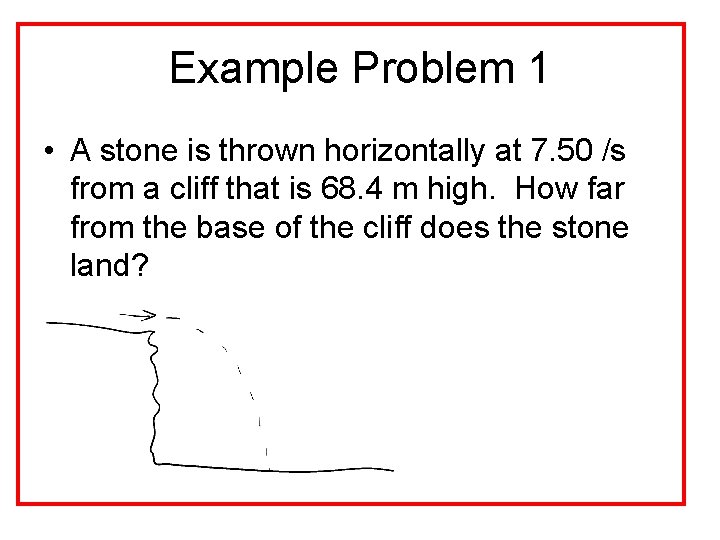
Example Problem 1 • A stone is thrown horizontally at 7. 50 /s from a cliff that is 68. 4 m high. How far from the base of the cliff does the stone land?
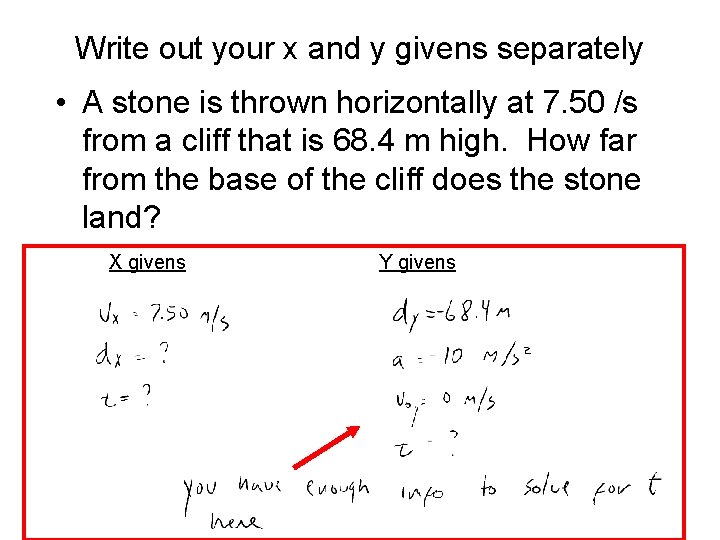
Write out your x and y givens separately • A stone is thrown horizontally at 7. 50 /s from a cliff that is 68. 4 m high. How far from the base of the cliff does the stone land? X givens Y givens
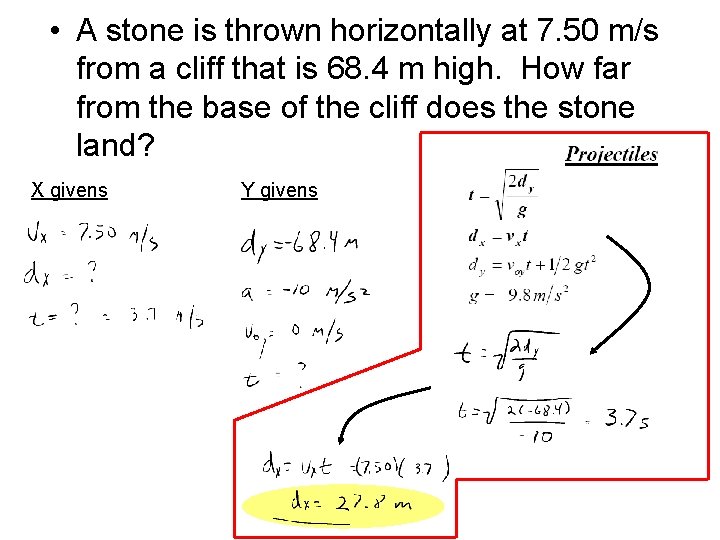
• A stone is thrown horizontally at 7. 50 m/s from a cliff that is 68. 4 m high. How far from the base of the cliff does the stone land? X givens Y givens
- Slides: 16