
Coordination Subordination and Conjunctive Adverbs 3 Types of
Coordination, Subordination, and Conjunctive Adverbs 3 Types of sentence fuses that delete common errors
Their function… • Used to join short, choppy sentences to form longer sentences • Provides variety to sentences in your writing • There are three ways to join ideas together • Coordinating conjunctions • Subordinating conjunctions • Conjunctive Adverbs
Coordinating conjunctions • These join 2 independent and complete ideas • Punctuate with a comma BEFORE the coordinating conjunction • Just remember F A N B O Y • • • For And Nor But Or Yet
Coordinating Conjunctions • You need to know which one to use based upon the relationship between the 2 independent, complete ideas and what you are trying to say • • • For means because And means in addition Nor means not either But means in contrast Or means either, a choice Yet means in contrast

Coordinating Conjunctions , for Independent idea , and , nor , but , or , yet independent idea.
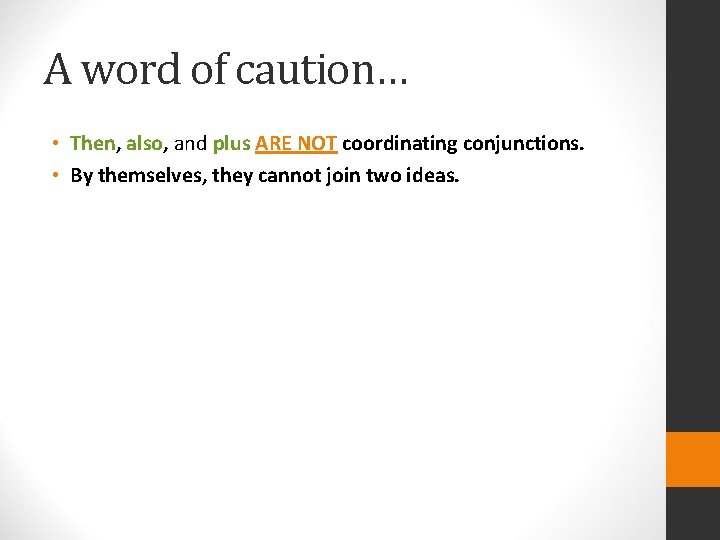
A word of caution… • Then, also, and plus ARE NOT coordinating conjunctions. • By themselves, they cannot join two ideas.
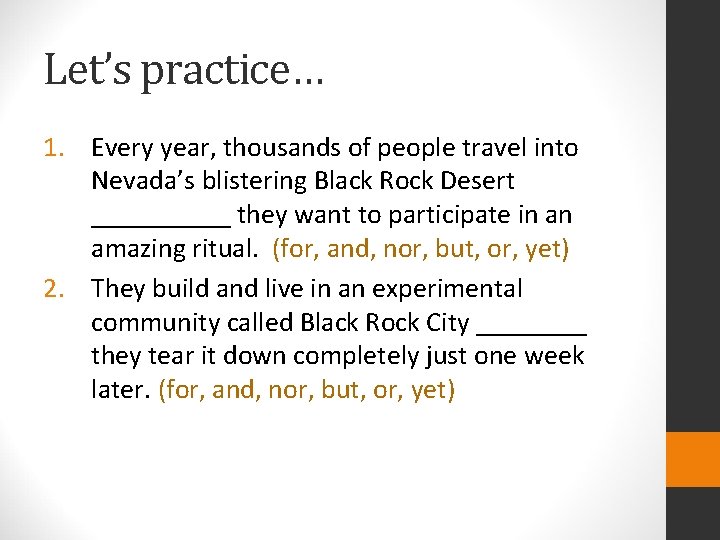
Let’s practice… 1. Every year, thousands of people travel into Nevada’s blistering Black Rock Desert _____ they want to participate in an amazing ritual. (for, and, nor, but, or, yet) 2. They build and live in an experimental community called Black Rock City ____ they tear it down completely just one week later. (for, and, nor, but, or, yet)
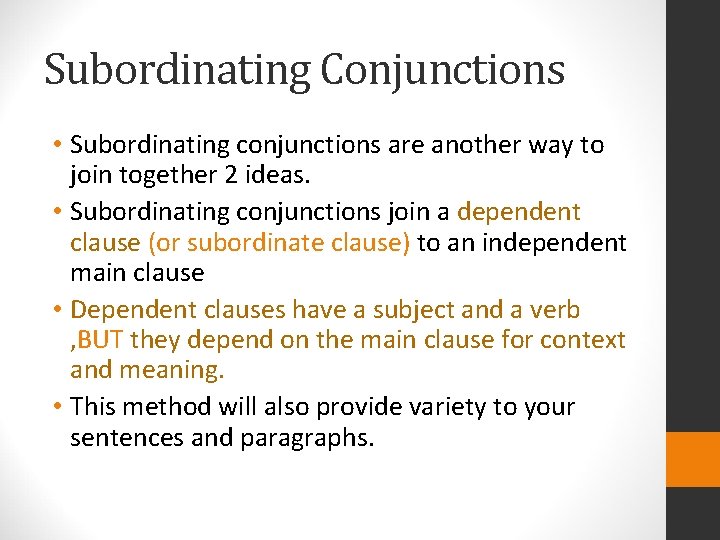
Subordinating Conjunctions • Subordinating conjunctions are another way to join together 2 ideas. • Subordinating conjunctions join a dependent clause (or subordinate clause) to an independent main clause • Dependent clauses have a subject and a verb , BUT they depend on the main clause for context and meaning. • This method will also provide variety to your sentences and paragraphs.
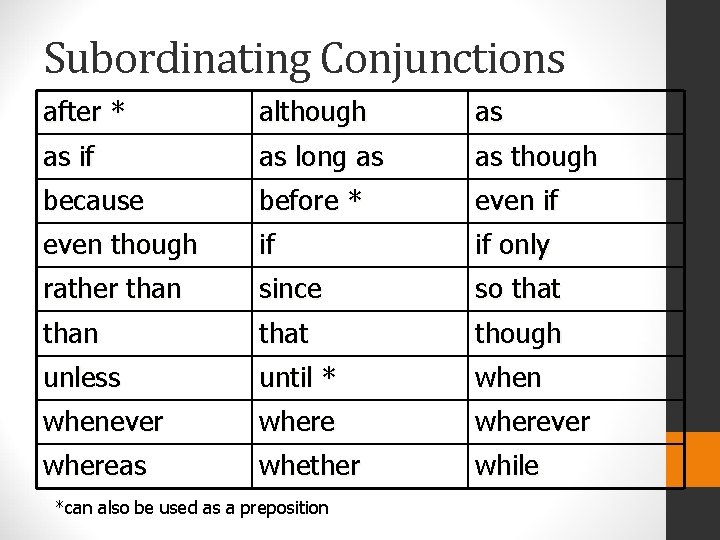
Subordinating Conjunctions after * although as as if as long as as though because before * even if even though if if only rather than since so that than that though unless until * whenever wherever whereas whether while *can also be used as a preposition
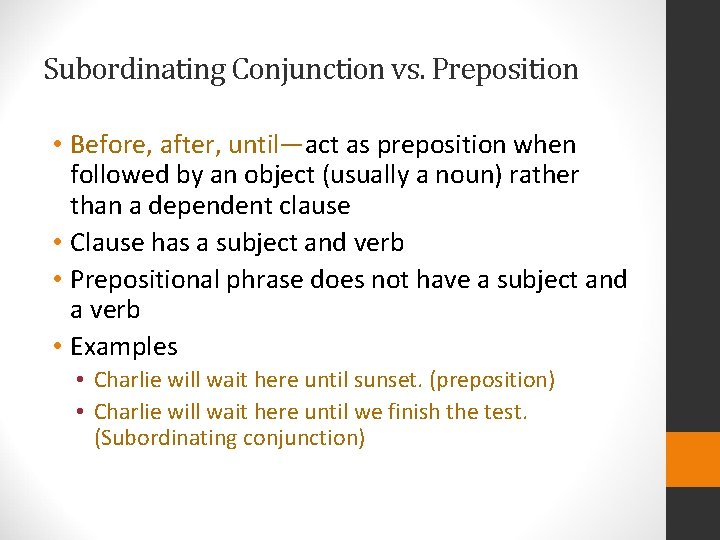
Subordinating Conjunction vs. Preposition • Before, after, until—act as preposition when followed by an object (usually a noun) rather than a dependent clause • Clause has a subject and verb • Prepositional phrase does not have a subject and a verb • Examples • Charlie will wait here until sunset. (preposition) • Charlie will wait here until we finish the test. (Subordinating conjunction)
Punctuating subordinating conjunctions • Sometimes you will use a comma, and sometimes you will not • It depends on the placement of the dependent clause and its subordinating conjunction
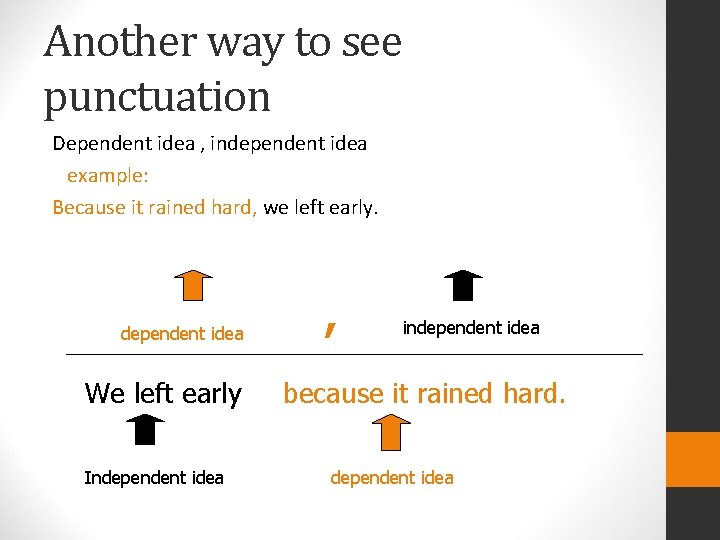
Another way to see punctuation Dependent idea , independent idea example: Because it rained hard, we left early. dependent idea We left early Independent idea , independent idea because it rained hard. dependent idea
Semicolons & Conjunctive Adverbs • A semicolon can join two related independent ideas without a conjunction; do not capitalize the first word after a semicolon. • The two ideas are CLOSELY related • Use only 2 or 3 semicolons in a paragraph • Caution: Do not use a semicolon between a dependent idea and an independent idea.
Conjunctive Adverbs • These are special kinds of adverbs because they are part conjunction and part adverb. • Conjunctive adverbs require a semicolon before and a comma after. • A conjunctive adverb may be used with a semicolon only when both ideas are independent and can stand alone.

Common Conjunctive Adverbs accordingly also afterwards consequently furthermore however indeed instead likewise meanwhile moreover nevertheless nonetheless similarly still therefore
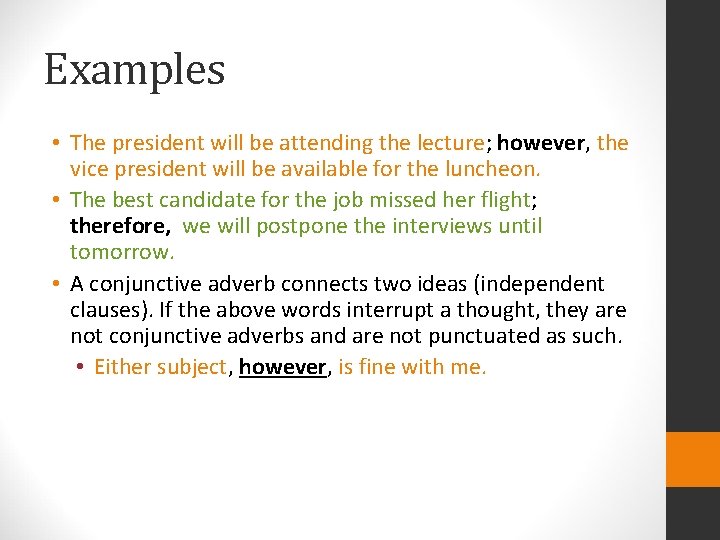
Examples • The president will be attending the lecture; however, the vice president will be available for the luncheon. • The best candidate for the job missed her flight; therefore, we will postpone the interviews until tomorrow. • A conjunctive adverb connects two ideas (independent clauses). If the above words interrupt a thought, they are not conjunctive adverbs and are not punctuated as such. • Either subject, however, is fine with me.
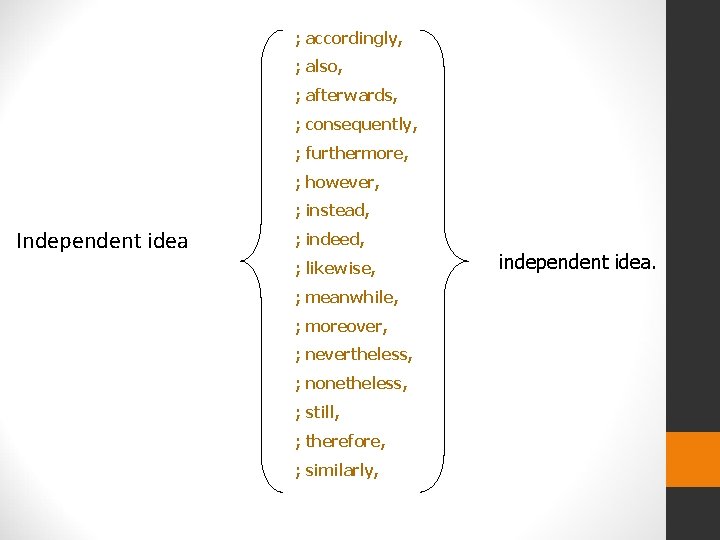
; accordingly, ; also, ; afterwards, ; consequently, ; furthermore, ; however, ; instead, Independent idea ; indeed, ; likewise, ; meanwhile, ; moreover, ; nevertheless, ; nonetheless, ; still, ; therefore, ; similarly, independent idea.
Final Thoughts • Learning how to properly use these types of conjunctions will improve your writing by eliminating those major errors (comma splice, fused sentence, fragment)
- Slides: 18