
Coordination Group for Meteorological Satellites CGMS The Status
- Slides: 15
Coordination Group for Meteorological Satellites - CGMS The Status of current and future CNSA Earth Observing System Presented to CGMS-40 plenary session, agenda item [III. 2] Lugano Switzerland CNSA, , Date Nov. 07 2012 1
Coordination Group for Meteorological Satellites - CGMS Outline Ø Introduction Ø Status of Current CNSA EOS Ø Status of Future CNSA EOS Ø HJ‐ 1 Ø HY‐ 2 Ø Conclusion CNSA, , Date Nov. 07 2012 2
Coordination Group for Meteorological Satellites - CGMS Introduction ØTechnology and application of satellite remote sensing has been extended rapidly in China. Ø CNSA’S EOS will be built up, including FY series satellites, ZY series satellites, HY series satellites, and environment and disaster small satellite constellation (HJ). Ø Meanwhile, China is also developing the ground receiving and processing system of EOS. CNSA, , Date Nov. 07 2012 3
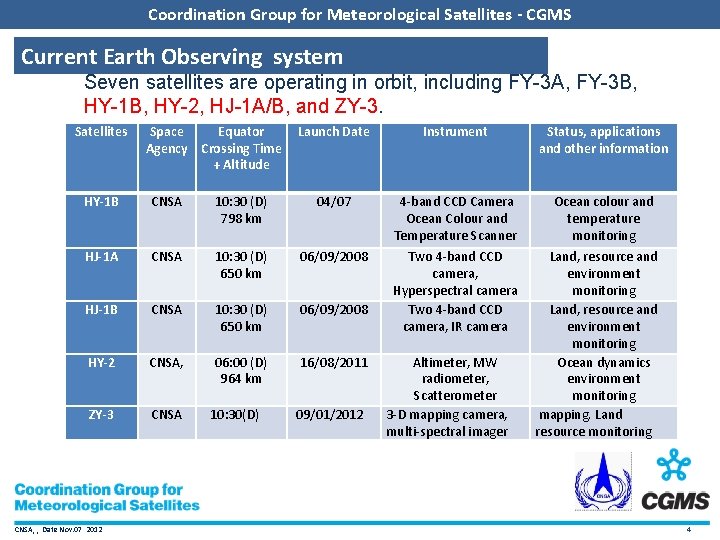
Coordination Group for Meteorological Satellites - CGMS Current Earth Observing system Seven satellites are operating in orbit, including FY-3 A, FY-3 B, HY-1 B, HY-2, HJ-1 A/B, and ZY-3. Satellites Space Equator Agency Crossing Time + Altitude Launch Date Instrument Status, applications and other information HY-1 B CNSA 10: 30 (D) 798 km 04/07 4‐band CCD Camera Ocean Colour and Temperature Scanner Ocean colour and temperature monitoring HJ-1 A CNSA 06/09/2008 HJ-1 B CNSA 10: 30 (D) 650 km Two 4‐band CCD camera, Hyperspectral camera Two 4‐band CCD camera, IR camera HY-2 CNSA, 06: 00 (D) 964 km 16/08/2011 ZY-3 CNSA Land, resource and environment monitoring Ocean dynamics environment monitoring mapping. Land resource monitoring CNSA, , Date Nov. 07 2012 10: 30(D) 06/09/2008 09/01/2012 Altimeter, MW radiometer, Scatterometer 3‐D mapping camera, multi‐spectral imager 4
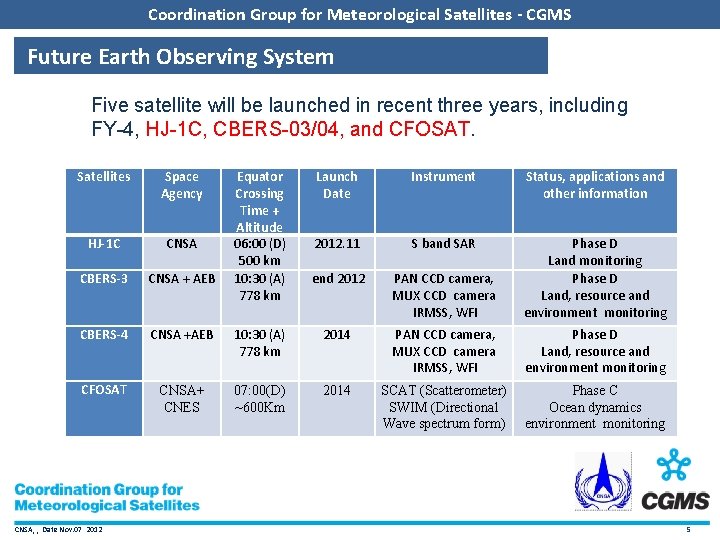
Coordination Group for Meteorological Satellites - CGMS Future Earth Observing System Five satellite will be launched in recent three years, including FY-4, HJ-1 C, CBERS-03/04, and CFOSAT. Satellites Space Agency HJ-1 C CNSA CBERS-3 CNSA + AEB CBERS-4 CNSA +AEB CFOSAT CNSA+ CNES CNSA, , Date Nov. 07 2012 Equator Crossing Time + Altitude 06: 00 (D) 500 km 10: 30 (A) 778 km Launch Date Instrument Status, applications and other information 2012. 11 S band SAR end 2012 PAN CCD camera, MUX CCD camera IRMSS, WFI Phase D Land monitoring Phase D Land, resource and environment monitoring 10: 30 (A) 778 km 2014 PAN CCD camera, MUX CCD camera IRMSS, WFI Phase D Land, resource and environment monitoring 07: 00(D) ~600 Km 2014 SCAT (Scatterometer) SWIM (Directional Wave spectrum form) Phase C Ocean dynamics environment monitoring 5
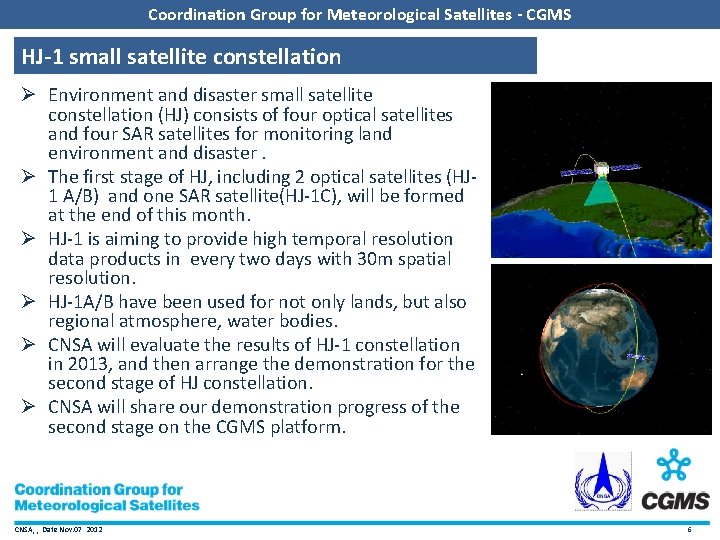
Coordination Group for Meteorological Satellites - CGMS HJ-1 small satellite constellation Ø Environment and disaster small satellite constellation (HJ) consists of four optical satellites and four SAR satellites for monitoring land environment and disaster. Ø The first stage of HJ, including 2 optical satellites (HJ‐ 1 A/B) and one SAR satellite(HJ‐ 1 C), will be formed at the end of this month. Ø HJ‐ 1 is aiming to provide high temporal resolution data products in every two days with 30 m spatial resolution. Ø HJ‐ 1 A/B have been used for not only lands, but also regional atmosphere, water bodies. Ø CNSA will evaluate the results of HJ‐ 1 constellation in 2013, and then arrange the demonstration for the second stage of HJ constellation. Ø CNSA will share our demonstration progress of the second stage on the CGMS platform. CNSA, , Date Nov. 07 2012 6
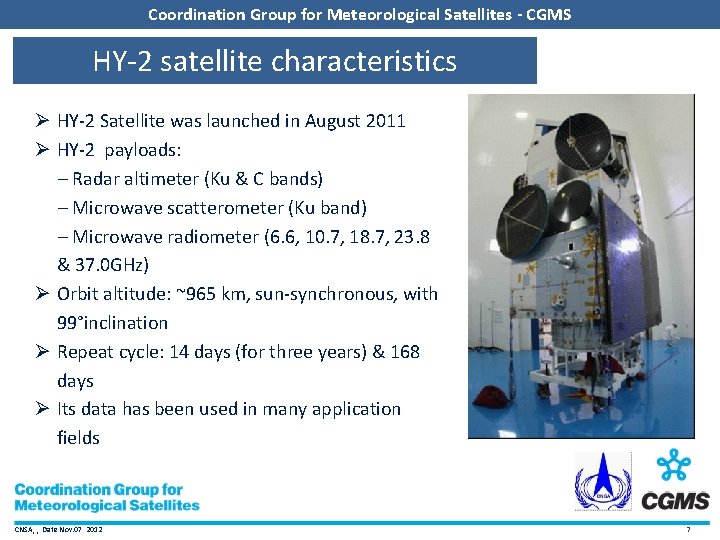
Coordination Group for Meteorological Satellites - CGMS HY‐ 2 satellite characteristics Ø HY‐ 2 Satellite was launched in August 2011 Ø HY‐ 2 payloads: – Radar altimeter (Ku & C bands) – Microwave scatterometer (Ku band) – Microwave radiometer (6. 6, 10. 7, 18. 7, 23. 8 & 37. 0 GHz) Ø Orbit altitude: ~965 km, sun‐synchronous, with 99°inclination Ø Repeat cycle: 14 days (for three years) & 168 days Ø Its data has been used in many application fields CNSA, , Date Nov. 07 2012 7
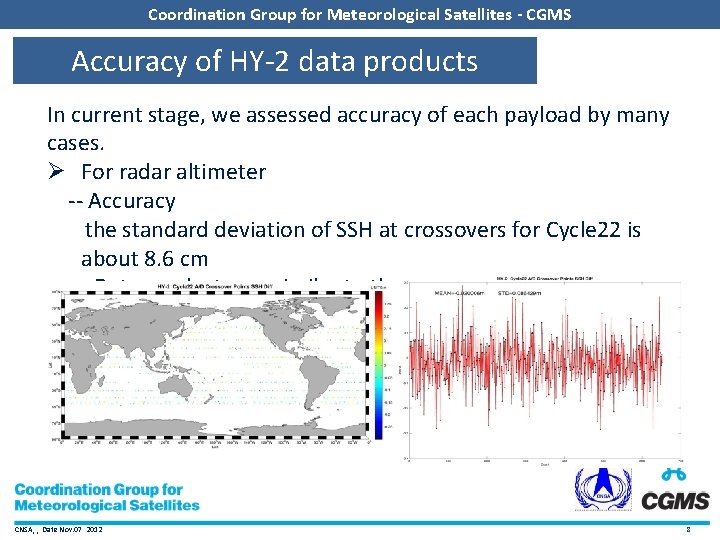
Coordination Group for Meteorological Satellites - CGMS Accuracy of HY‐ 2 data products In current stage, we assessed accuracy of each payload by many cases. Ø For radar altimeter ‐‐ Accuracy the standard deviation of SSH at crossovers for Cycle 22 is about 8. 6 cm ‐‐ Data products are similar to those of Jason‐ 2 CNSA, , Date Nov. 07 2012 8
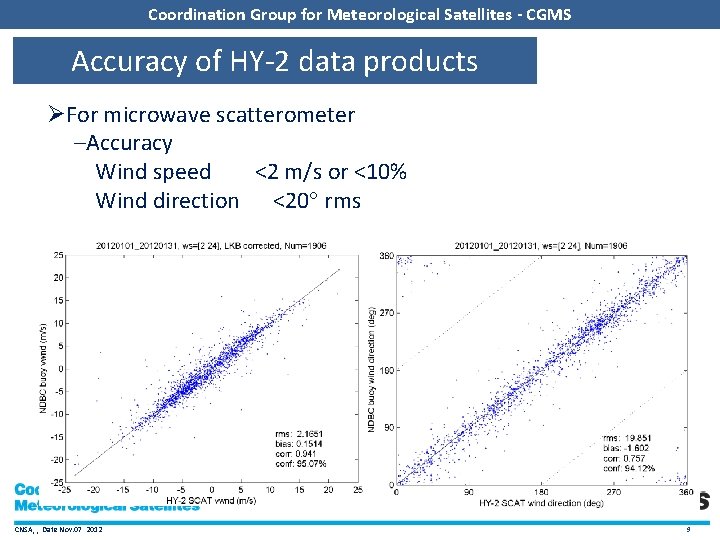
Coordination Group for Meteorological Satellites - CGMS Accuracy of HY‐ 2 data products ØFor microwave scatterometer –Accuracy Wind speed <2 m/s or <10% Wind direction <20 rms Comparison of meridional wind speed and wind direction between HY‐ 2 SCAT and NDBC, using after abnormal removal data in January 2012 CNSA, , Date Nov. 07 2012 9
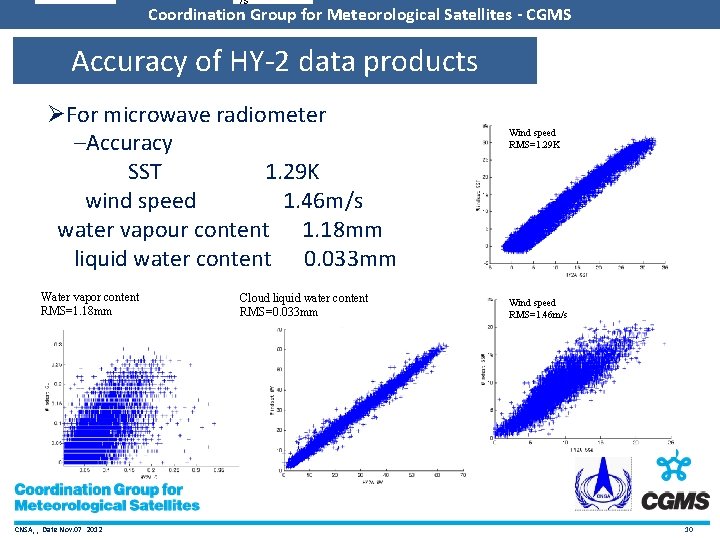
/s Coordination Group for Meteorological Satellites - CGMS Accuracy of HY‐ 2 data products ØFor microwave radiometer –Accuracy SST 1. 29 K wind speed 1. 46 m/s water vapour content 1. 18 mm liquid water content 0. 033 mm Water vapor content Cloud liquid water content RMS=1. 18 mm CNSA, , Date Nov. 07 2012 RMS=0. 033 mm Wind speed RMS=1. 29 K Wind speed RMS=1. 46 m/s 10
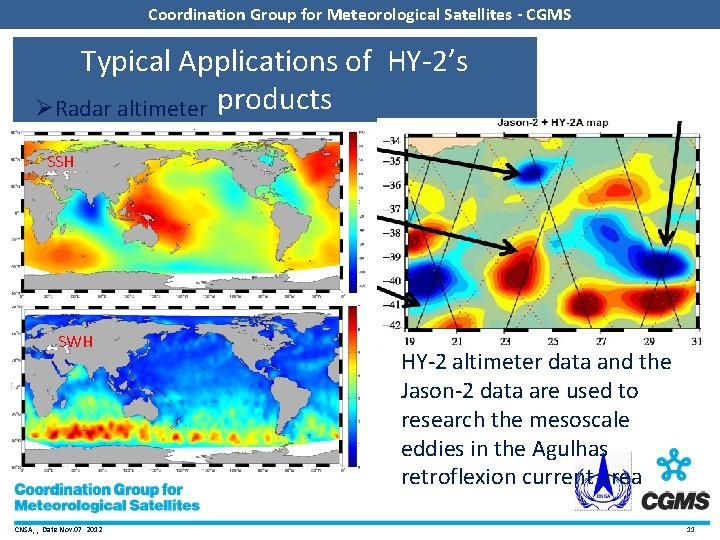
Coordination Group for Meteorological Satellites - CGMS Typical Applications of HY‐ 2’s ØRadar altimeter products SSH SWH CNSA, , Date Nov. 07 2012 HY‐ 2 altimeter data and the Jason‐ 2 data are used to research the mesoscale eddies in the Agulhas retroflexion current area 11
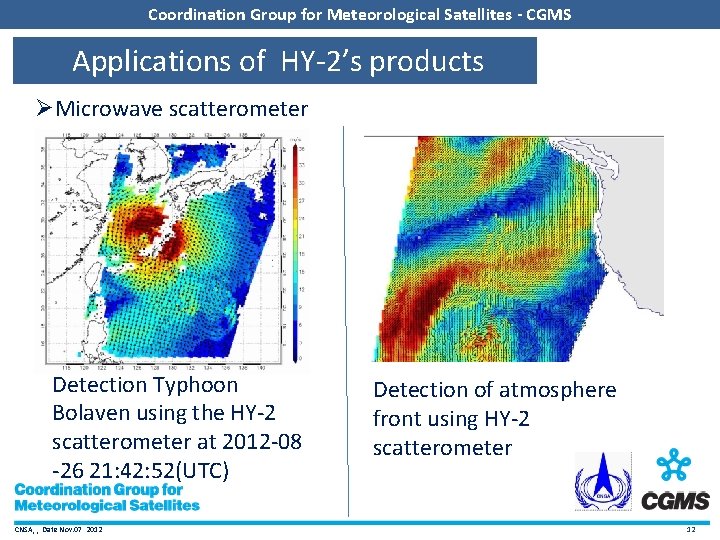
Coordination Group for Meteorological Satellites - CGMS Applications of HY‐ 2’s products ØMicrowave scatterometer Detection Typhoon Bolaven using the HY‐ 2 scatterometer at 2012‐ 08 ‐ 26 21: 42: 52(UTC) CNSA, , Date Nov. 07 2012 Detection of atmosphere front using HY‐ 2 scatterometer 12
Coordination Group for Meteorological Satellites - CGMS Current and future of HY‐ 2 Ø Data discovery, ordering, distribution channels, and channels specific to instruments and additional information can be found online through the National Satellite Oceanic Application Service(http: //www. nsoas. gov. cn). Ø HY-2 designed lifetime is 3 years. It will be benefit to remove the gap of sea surface dynamic environment monitoring. Ø CFOSAT is under developing with CNES, which is equipped with a directional wave spectrum form SWIM and a wind scatterometer SCAT. It will continue partly function of HY-2. Ø Meantime, HY-2 operational satellites are demonstrated by state oceanic administration(SOA). CNSA, , Date Nov. 07 2012 13
Coordination Group for Meteorological Satellites - CGMS Conclusion ---Recently, many R&D satellites , such as HY-2, will be launched and tested in-orbit, and become gradually into the operation mode. ---CNSA is devoted into the transformation from R&D satellite to operating satellite. And is jointly organizing some discussion about operational satellite system with other administrations ---CNSA will continue to share experience with CGMS members, and make more contribution for the optimization of Globe Earth Observing System. CNSA, , Date Nov. 07 2012 14
Coordination Group for Meteorological Satellites - CGMS Thanks for your attentions! CNSA, , Date Nov. 07 2012 15