
Coordination Chemistry dblock elements Incompletely filled dsubshell in
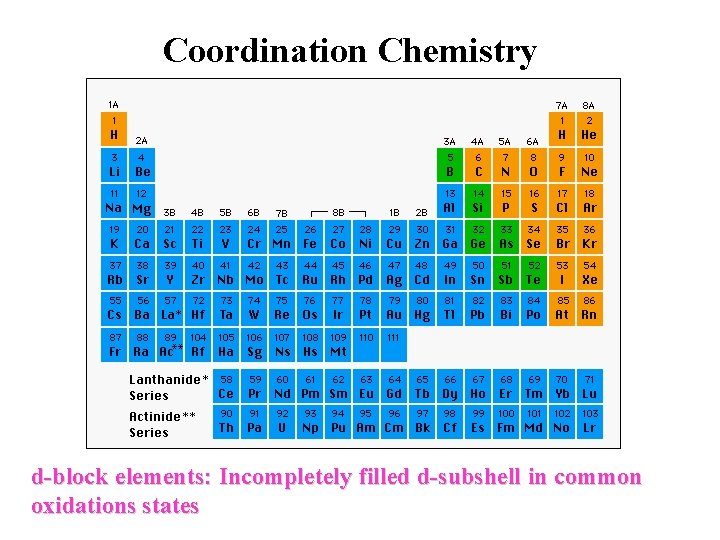
Coordination Chemistry d-block elements: Incompletely filled d-subshell in common oxidations states
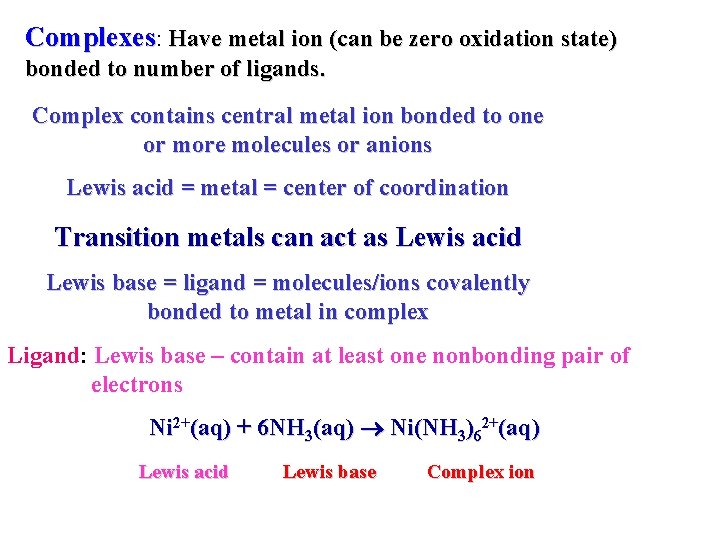
Complexes: Have metal ion (can be zero oxidation state) bonded to number of ligands. Complex contains central metal ion bonded to one or more molecules or anions Lewis acid = metal = center of coordination Transition metals can act as Lewis acid Lewis base = ligand = molecules/ions covalently bonded to metal in complex Ligand: Lewis base – contain at least one nonbonding pair of electrons Ni 2+(aq) + 6 NH 3(aq) Ni(NH 3)62+(aq) Lewis acid Lewis base Complex ion
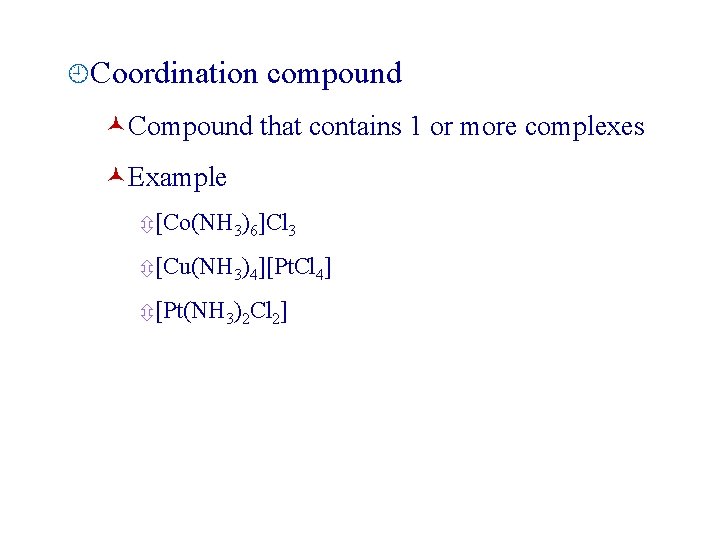
Coordination compound Compound that contains 1 or more complexes Example [Co(NH 3)6]Cl 3 [Cu(NH 3)4][Pt. Cl 4] [Pt(NH 3)2 Cl 2]
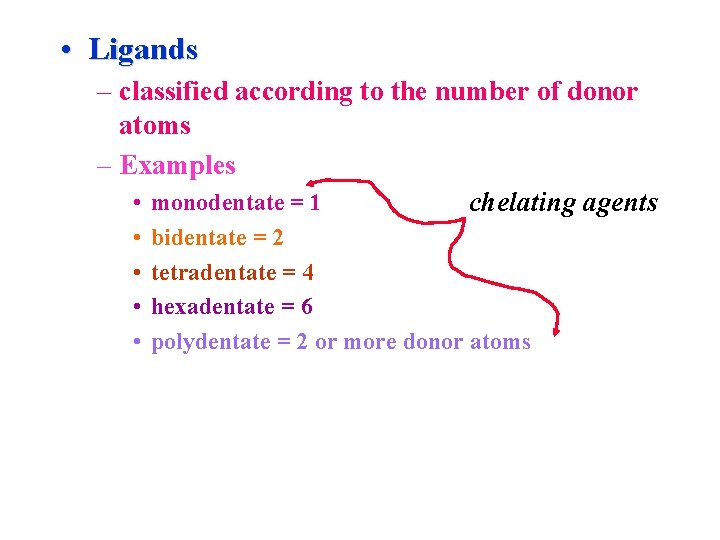
• Ligands – classified according to the number of donor atoms – Examples • monodentate = 1 chelating agents • • bidentate = 2 tetradentate = 4 hexadentate = 6 polydentate = 2 or more donor atoms
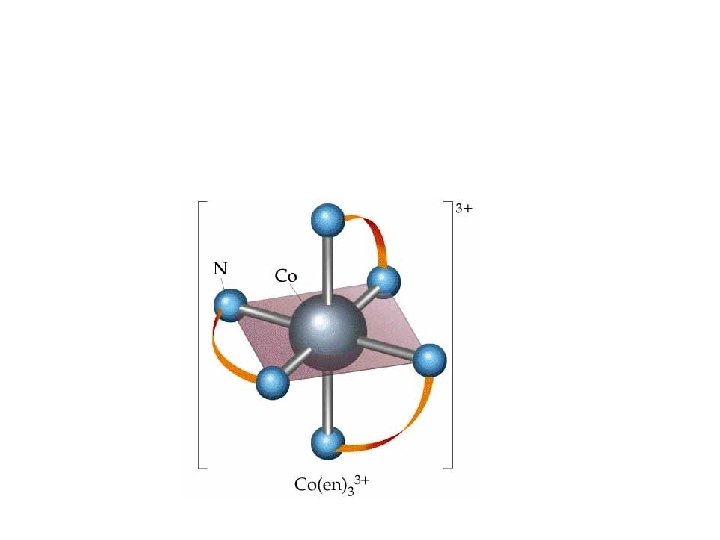
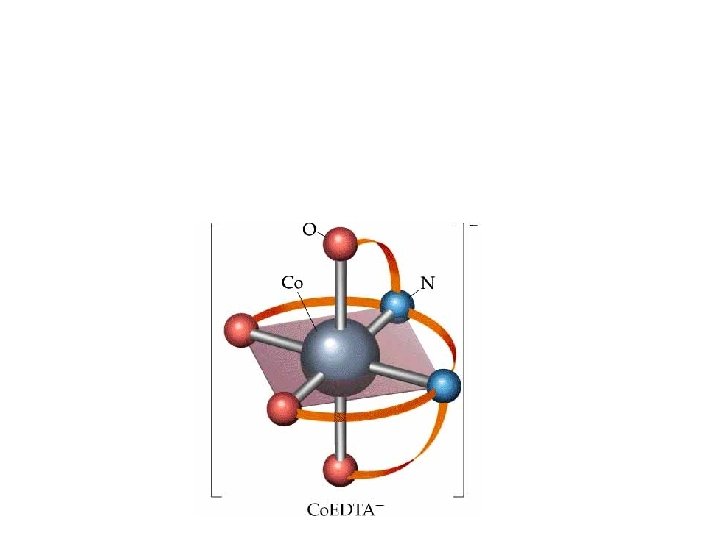
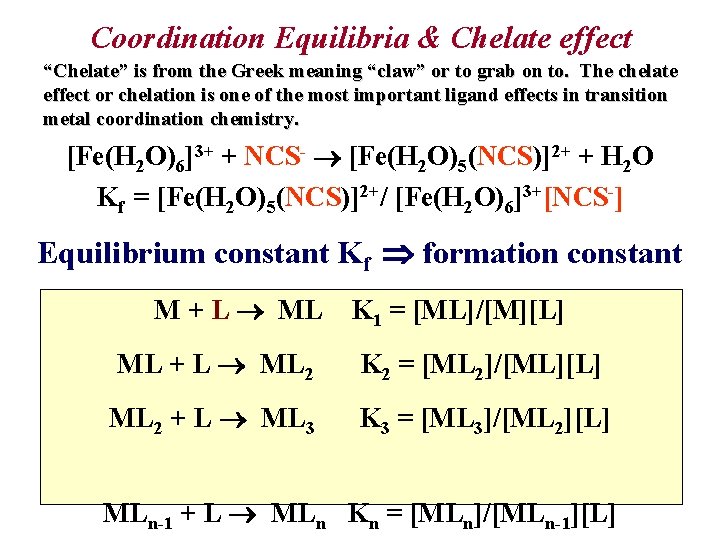
Coordination Equilibria & Chelate effect “Chelate” is from the Greek meaning “claw” or to grab on to. The chelate effect or chelation is one of the most important ligand effects in transition metal coordination chemistry. [Fe(H 2 O)6]3+ + NCS- [Fe(H 2 O)5(NCS)]2+ + H 2 O Kf = [Fe(H 2 O)5(NCS)]2+/ [Fe(H 2 O)6]3+[NCS-] Equilibrium constant Kf formation constant M + L ML K 1 = [ML]/[M][L] ML + L ML 2 K 2 = [ML 2]/[ML][L] ML 2 + L ML 3 K 3 = [ML 3]/[ML 2][L] MLn-1 + L MLn Kn = [MLn]/[MLn-1][L]
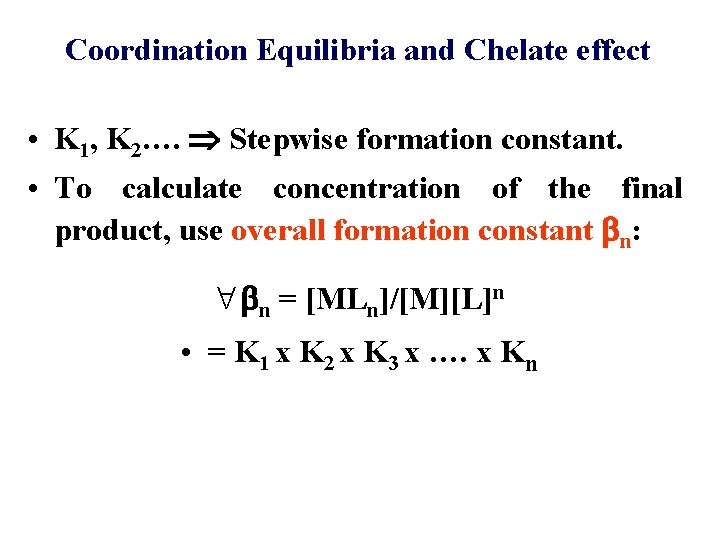
Coordination Equilibria and Chelate effect • K 1, K 2…. Stepwise formation constant. • To calculate concentration of the final product, use overall formation constant n: n = [MLn]/[M][L]n • = K 1 x K 2 x K 3 x …. x Kn
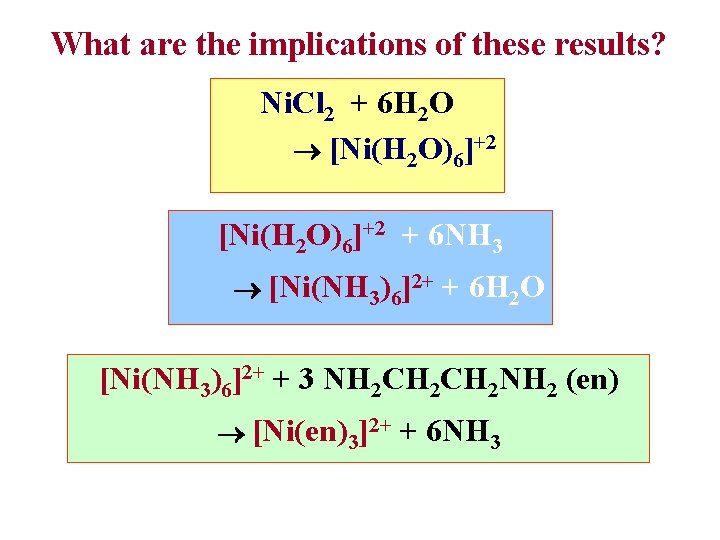
What are the implications of these results? Ni. Cl 2 + 6 H 2 O [Ni(H 2 O)6]+2 + 6 NH 3 [Ni(NH 3)6]2+ + 6 H 2 O [Ni(NH 3)6]2+ + 3 NH 2 CH 2 NH 2 (en) [Ni(en)3]2+ + 6 NH 3
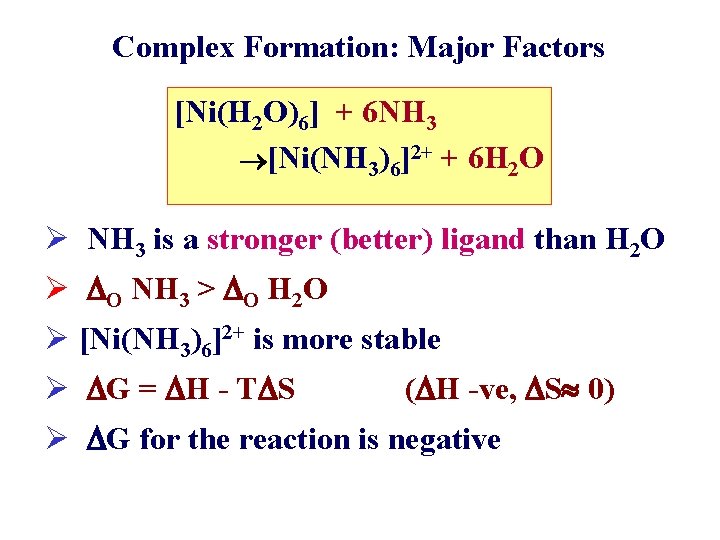
Complex Formation: Major Factors [Ni(H 2 O)6] + 6 NH 3 [Ni(NH 3)6]2+ + 6 H 2 O NH 3 is a stronger (better) ligand than H 2 O O NH 3 > O H 2 O [Ni(NH 3)6]2+ is more stable G = H - T S ( H -ve, S 0) G for the reaction is negative
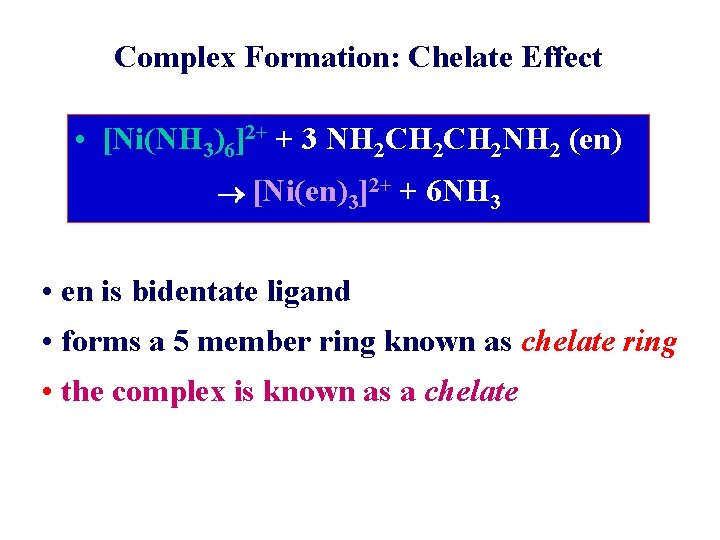
Complex Formation: Chelate Effect • [Ni(NH 3)6]2+ + 3 NH 2 CH 2 NH 2 (en) [Ni(en)3]2+ + 6 NH 3 • en is bidentate ligand • forms a 5 member ring known as chelate ring • the complex is known as a chelate
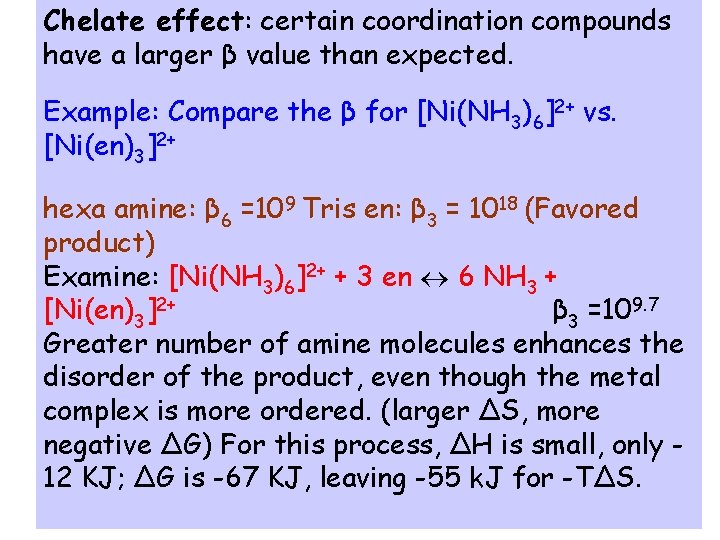
Chelate effect: certain coordination compounds have a larger β value than expected. Example: Compare the β for [Ni(NH 3)6]2+ vs. [Ni(en)3]2+ hexa amine: β 6 =109 Tris en: β 3 = 1018 (Favored product) Examine: [Ni(NH 3)6]2+ + 3 en 6 NH 3 + [Ni(en)3]2+ β 3 =109. 7 Greater number of amine molecules enhances the disorder of the product, even though the metal complex is more ordered. (larger ∆S, more negative ∆G) For this process, ∆H is small, only 12 KJ; ∆G is -67 KJ, leaving -55 k. J for -T∆S.
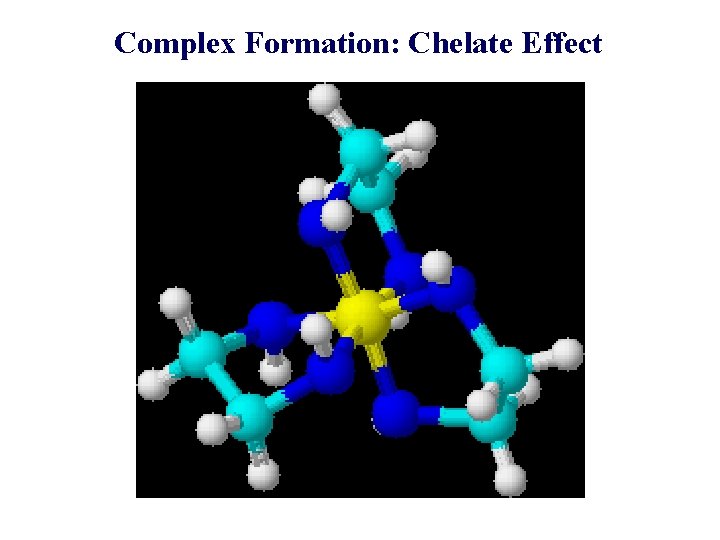
Complex Formation: Chelate Effect
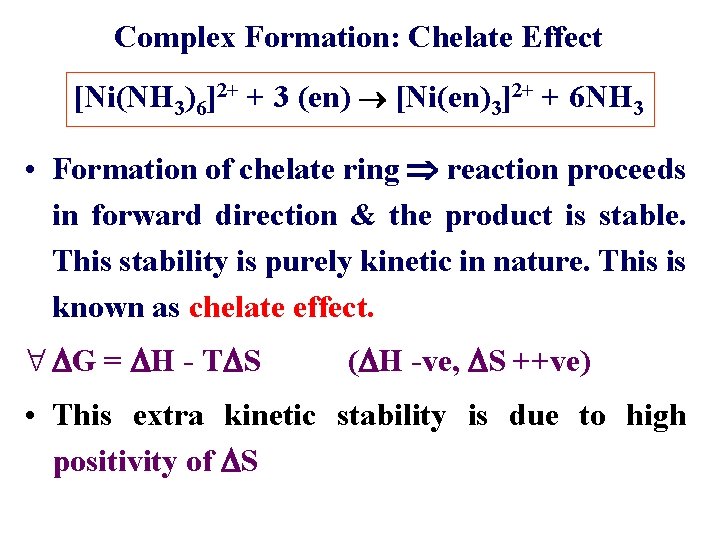
Complex Formation: Chelate Effect [Ni(NH 3)6]2+ + 3 (en) [Ni(en)3]2+ + 6 NH 3 • Formation of chelate ring reaction proceeds in forward direction & the product is stable. This stability is purely kinetic in nature. This is known as chelate effect. G = H - T S ( H -ve, S ++ve) • This extra kinetic stability is due to high positivity of S
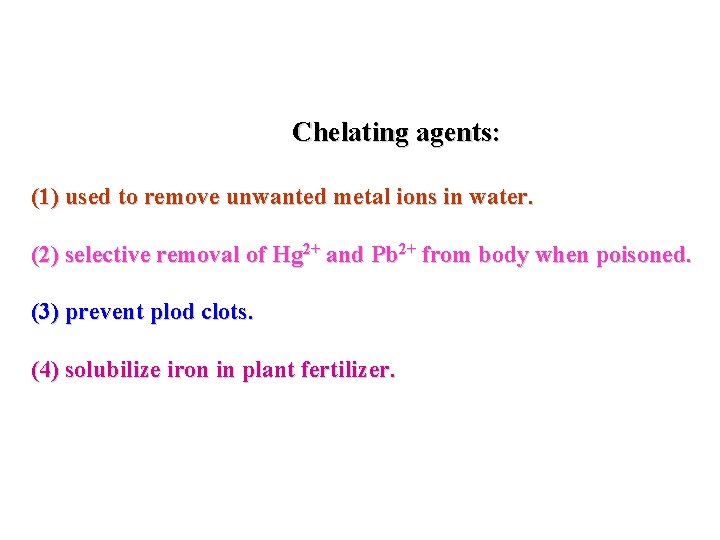
Chelating agents: (1) used to remove unwanted metal ions in water. (2) selective removal of Hg 2+ and Pb 2+ from body when poisoned. (3) prevent plod clots. (4) solubilize iron in plant fertilizer.
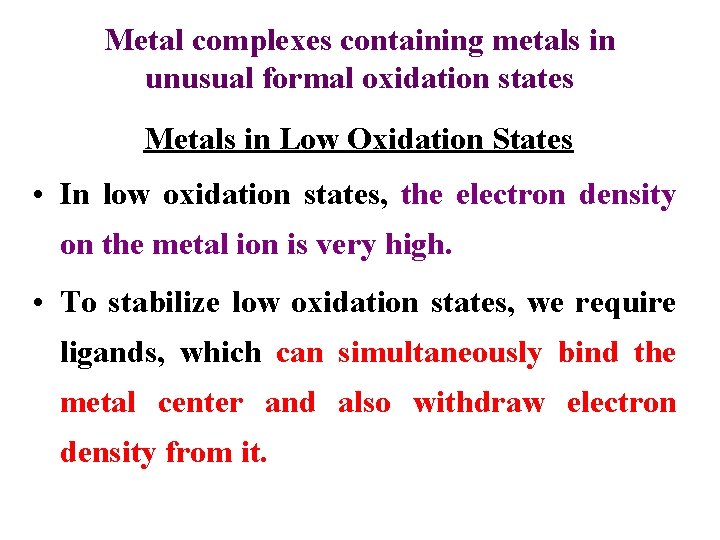
Metal complexes containing metals in unusual formal oxidation states Metals in Low Oxidation States • In low oxidation states, the electron density on the metal ion is very high. • To stabilize low oxidation states, we require ligands, which can simultaneously bind the metal center and also withdraw electron density from it.
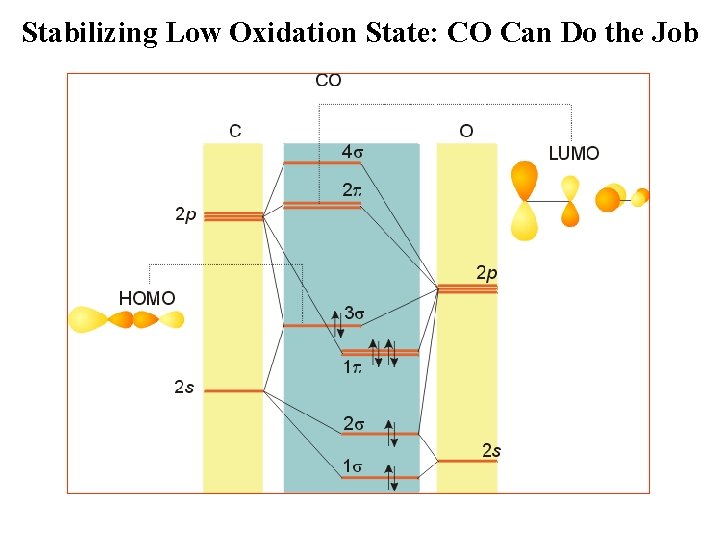
Stabilizing Low Oxidation State: CO Can Do the Job
![Stabilizing Low Oxidation State: CO Can Do the Job Ni(CO)4], [Fe(CO)5], [Cr(CO)6], [Mn 2(CO)10],](http://slidetodoc.com/presentation_image_h/1047179c7298168b68c6244bb72238e7/image-18.jpg "Stabilizing Low Oxidation State: CO Can Do the Job Ni(CO)4], [Fe(CO)5], [Cr(CO)6], [Mn 2(CO)10],")
Stabilizing Low Oxidation State: CO Can Do the Job Ni(CO)4], [Fe(CO)5], [Cr(CO)6], [Mn 2(CO)10], [Co 2(CO)8], Na 2[Fe(CO)4], Na[Mn(CO)5]
Metal complexes containing metals in unusual formal oxidation states Metals in High Oxidation States • High oxidation states highly electron deficient or hard acids. • To stabilize high oxidation states we require ligands which can form very strong bond as well as bond, i. e. strong as well as donor. • Ligands must be hard base.
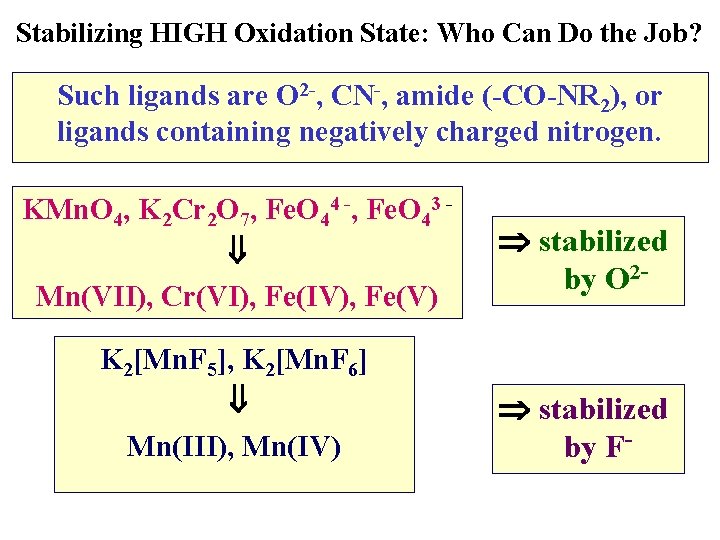
Stabilizing HIGH Oxidation State: Who Can Do the Job? Such ligands are O 2 -, CN-, amide (-CO-NR 2), or ligands containing negatively charged nitrogen. KMn. O 4, K 2 Cr 2 O 7, Fe. O 44 -, Fe. O 43 Mn(VII), Cr(VI), Fe(IV), Fe(V) K 2[Mn. F 5], K 2[Mn. F 6] Mn(III), Mn(IV) stabilized by O 2 - stabilized by F-
Bonding in coordination compounds • • Alfred Werner VBT Crystal Field Theory (CFT) Modified CFT, known as Ligand Field Theory • MOT
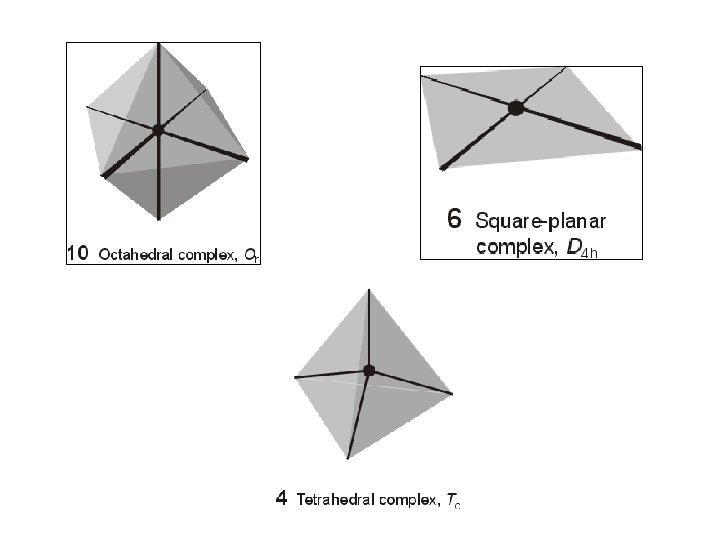
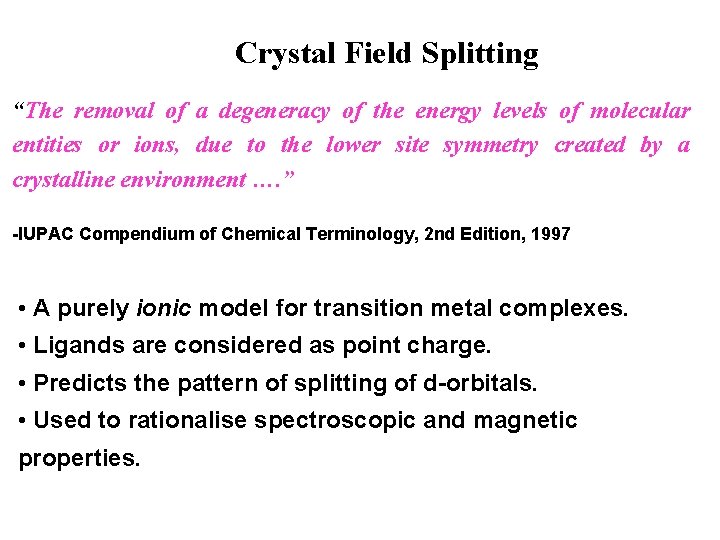
Crystal Field Splitting “The removal of a degeneracy of the energy levels of molecular entities or ions, due to the lower site symmetry created by a crystalline environment …. ” -IUPAC Compendium of Chemical Terminology, 2 nd Edition, 1997 • A purely ionic model for transition metal complexes. • Ligands are considered as point charge. • Predicts the pattern of splitting of d-orbitals. • Used to rationalise spectroscopic and magnetic properties.
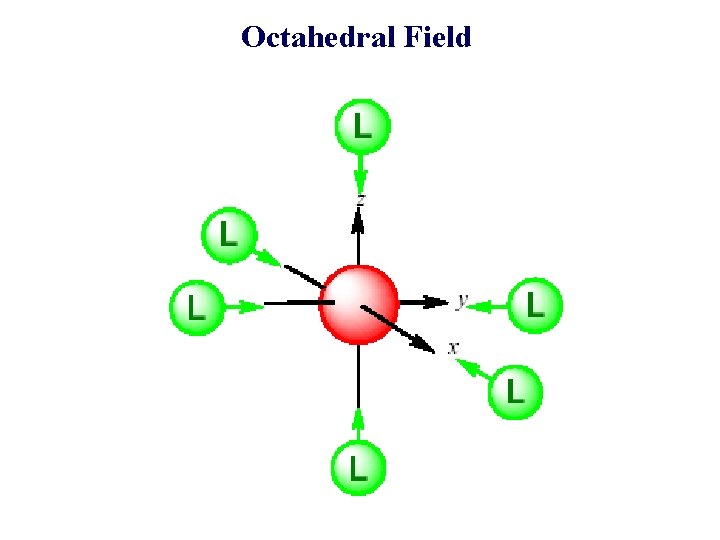
Octahedral Field
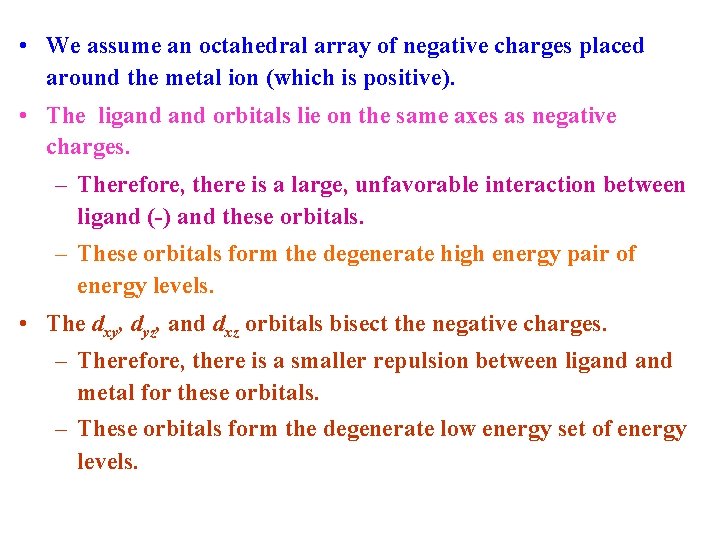
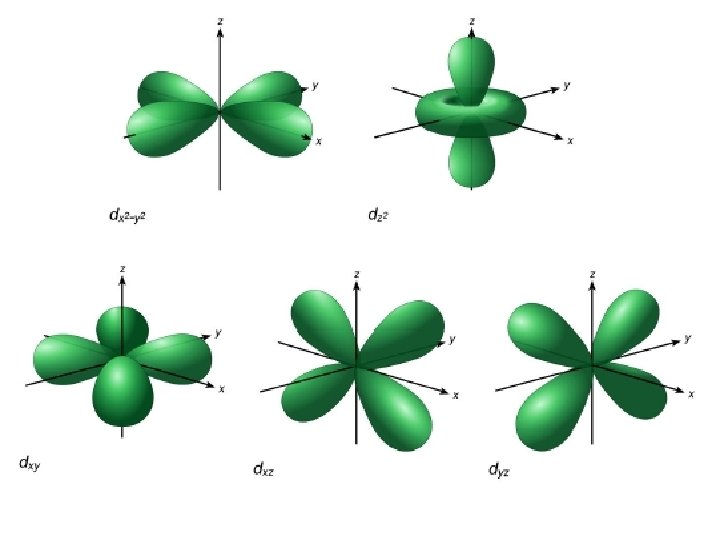
• We assume an octahedral array of negative charges placed around the metal ion (which is positive). • The ligand orbitals lie on the same axes as negative charges. – Therefore, there is a large, unfavorable interaction between ligand (-) and these orbitals. – These orbitals form the degenerate high energy pair of energy levels. • The dxy, dyz, and dxz orbitals bisect the negative charges. – Therefore, there is a smaller repulsion between ligand metal for these orbitals. – These orbitals form the degenerate low energy set of energy levels.
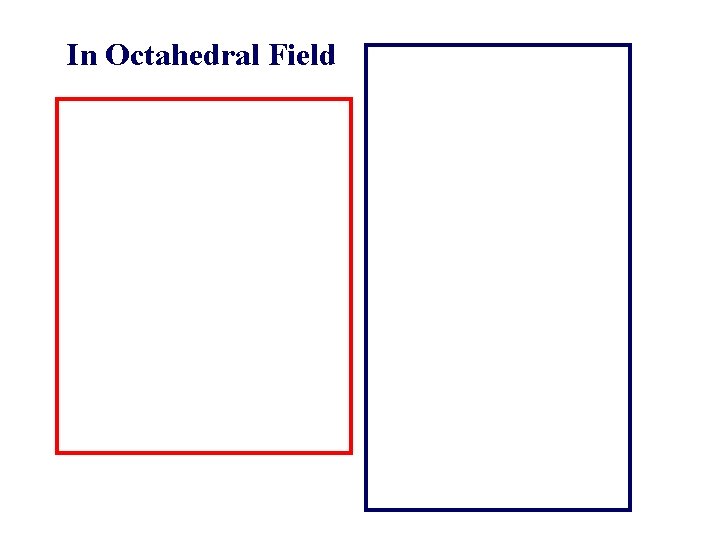
In Octahedral Field
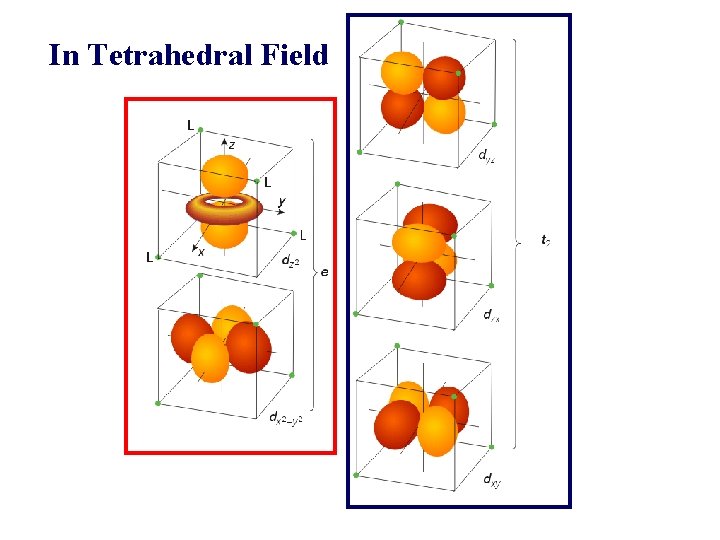
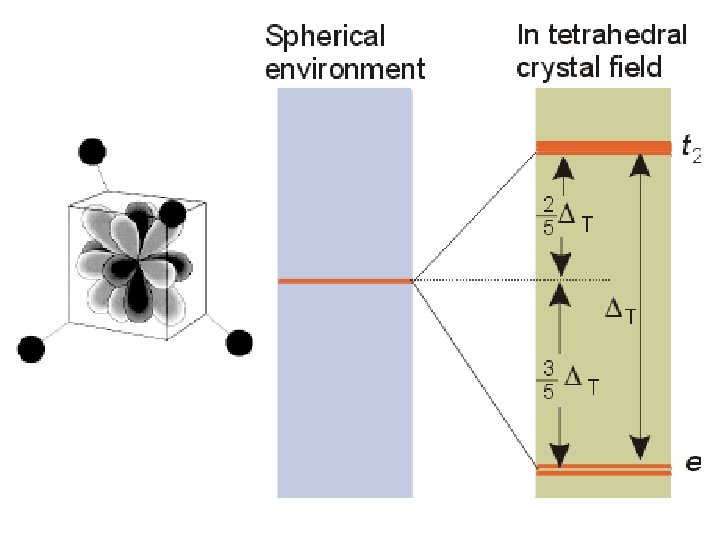
In Tetrahedral Field
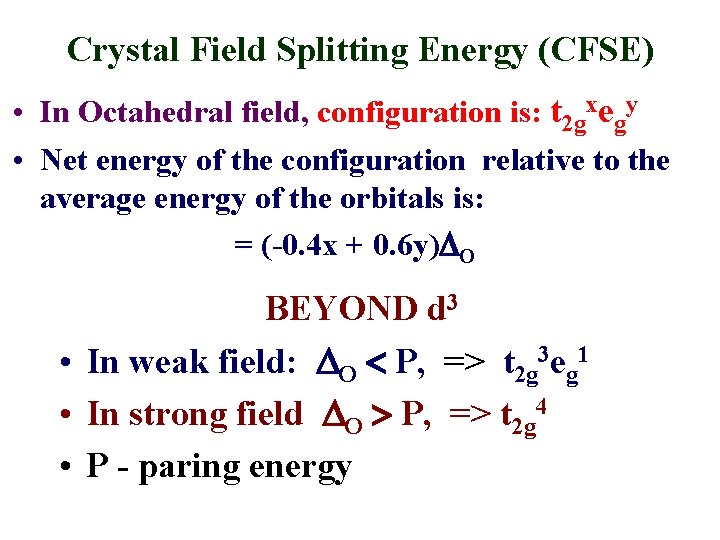
Crystal Field Splitting Energy (CFSE) • In Octahedral field, configuration is: t 2 gxegy • Net energy of the configuration relative to the average energy of the orbitals is: = (-0. 4 x + 0. 6 y) O BEYOND d 3 • In weak field: O P, => t 2 g 3 eg 1 • In strong field O P, => t 2 g 4 • P - paring energy
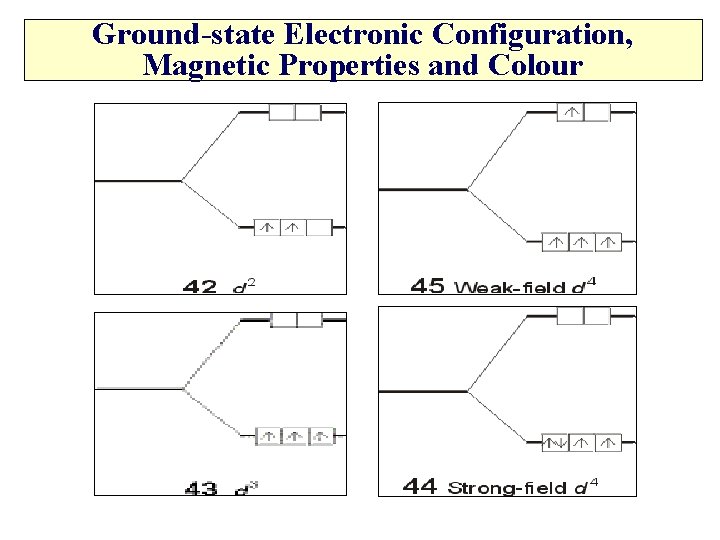
Ground-state Electronic Configuration, Magnetic Properties and Colour
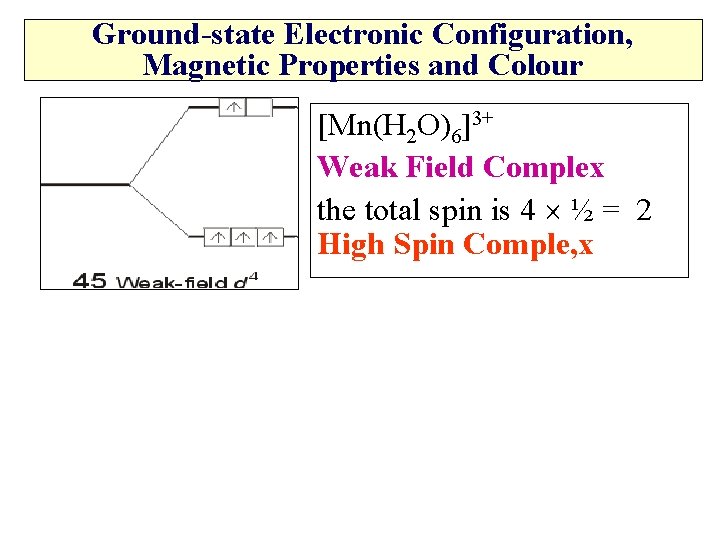
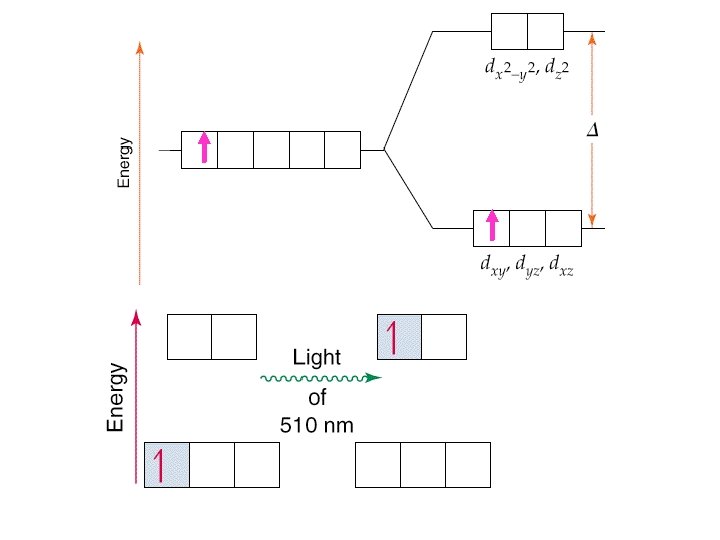
Ground-state Electronic Configuration, Magnetic Properties and Colour [Mn(H 2 O)6]3+ Weak Field Complex the total spin is 4 ½ = 2 High Spin Comple, x
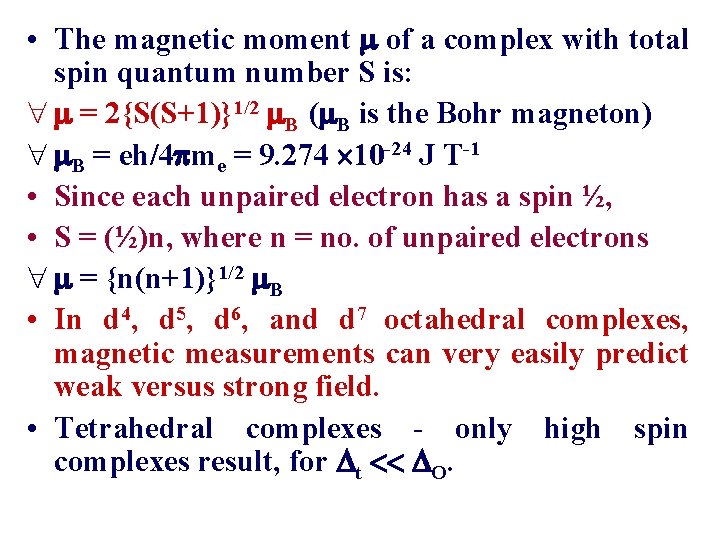
• The magnetic moment of a complex with total spin quantum number S is: = 2{S(S+1)}1/2 B ( B is the Bohr magneton) B = eh/4 me = 9. 274 10 -24 J T-1 • Since each unpaired electron has a spin ½, • S = (½)n, where n = no. of unpaired electrons = {n(n+1)}1/2 B • In d 4, d 5, d 6, and d 7 octahedral complexes, magnetic measurements can very easily predict weak versus strong field. • Tetrahedral complexes - only high spin complexes result, for t O.
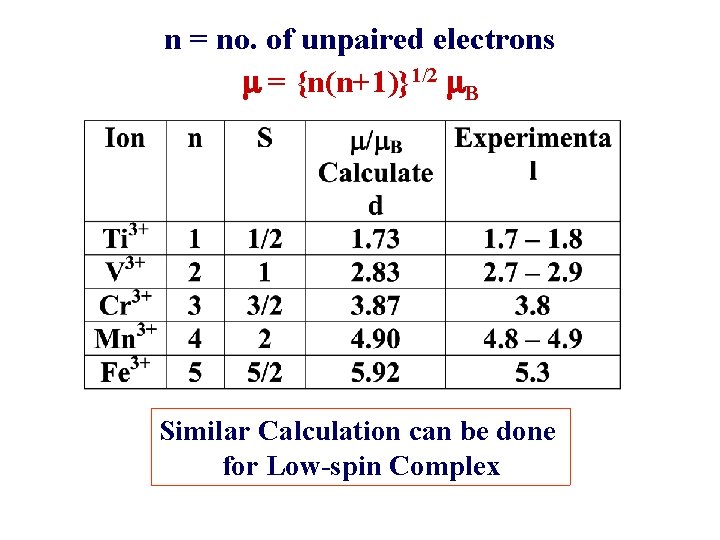
n = no. of unpaired electrons = {n(n+1)}1/2 B Similar Calculation can be done for Low-spin Complex
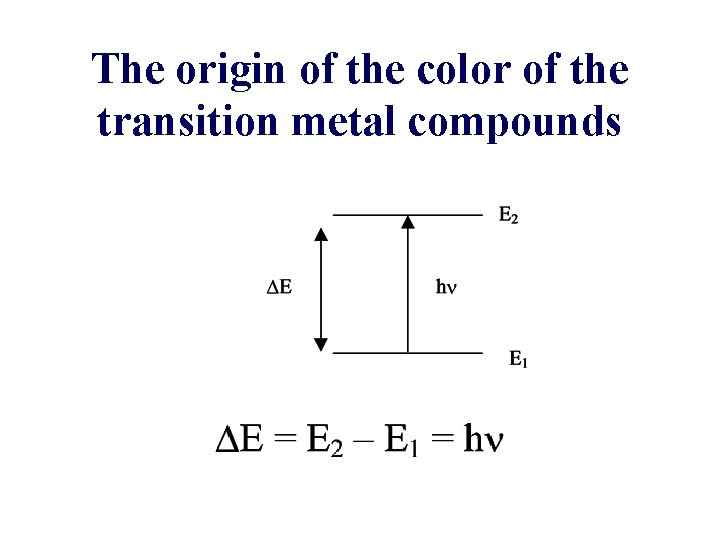
The origin of the color of the transition metal compounds
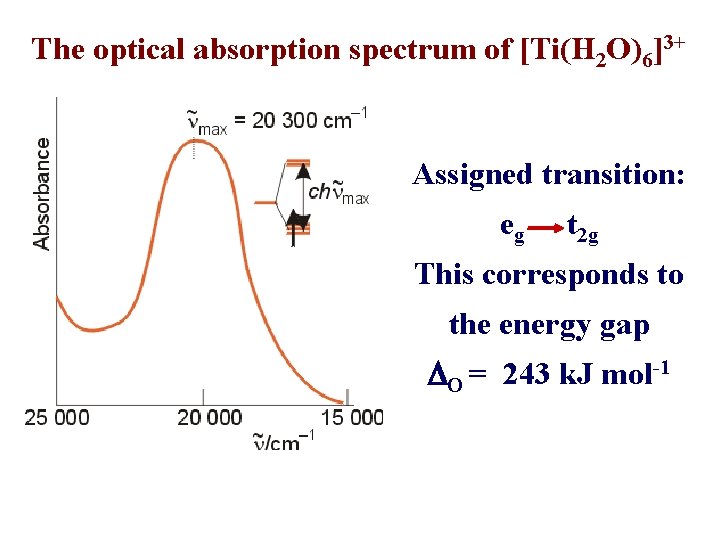
The optical absorption spectrum of [Ti(H 2 O)6]3+ Assigned transition: eg t 2 g This corresponds to the energy gap O = 243 k. J mol-1
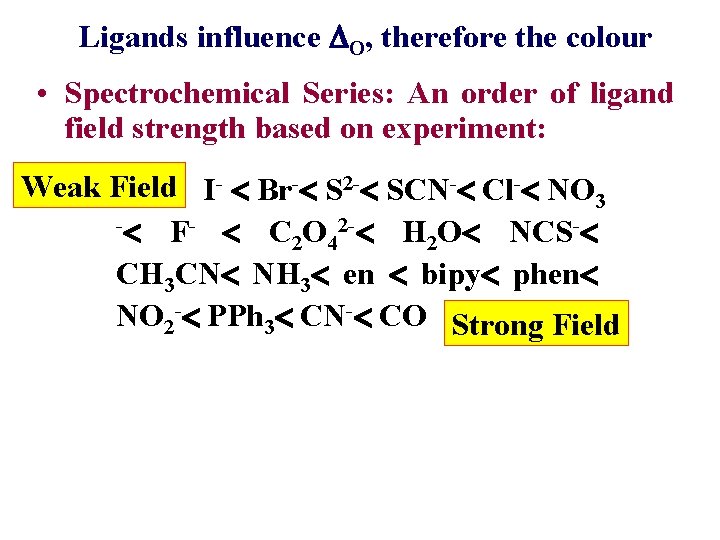
Ligands influence O, therefore the colour • Spectrochemical Series: An order of ligand field strength based on experiment: Weak Field I- Br- S 2 - SCN- Cl- NO 3 - F- C O 2 - H O NCS- 2 4 2 CH 3 CN NH 3 en bipy phen NO 2 - PPh 3 CN- CO Strong Field
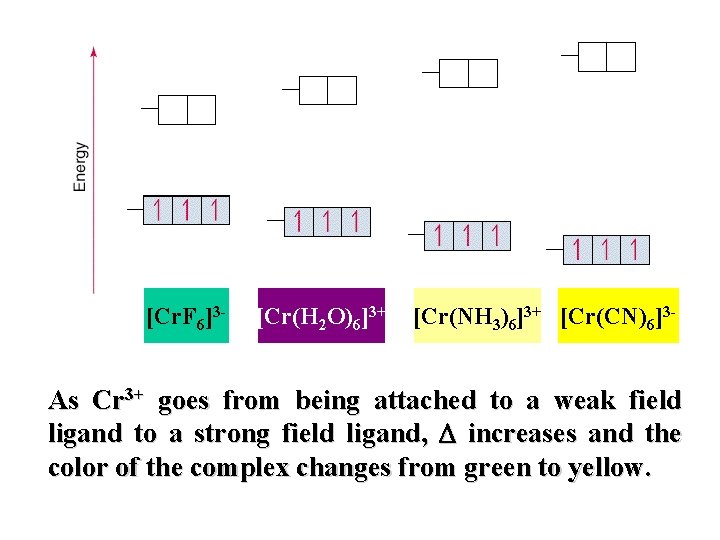
[Cr. F 6]3 - [Cr(H 2 O)6]3+ [Cr(NH 3)6]3+ [Cr(CN)6]3 - As Cr 3+ goes from being attached to a weak field ligand to a strong field ligand, increases and the color of the complex changes from green to yellow.
- Slides: 42