
Coordination and Response in Plants and Animals Receptors

- Slides: 15
Coordination and Response in Plants and Animals Receptors, Effectors and the Central Nervous System
Receptors, Effectors and the Central Nervous System n Syllabus Objectives q q q Define receptors and effectors Use a simple diagram to show the relationship between the receptors, the central nervous system and the effectors Distinguish between a cranial and a spinal reflex e. g. n n (i) the pupil reflex (ii) the knee jerk reflex
Receptors and effectors n Receptors are groups of cells or organs which detect changes in the internal or external environment. e. g. q q Groups of cells in blood vessels that detect changes in blood pressure levels or CO 2 in the blood The eyes and ears detect changes in light intensity and sound waves coming from outside the body
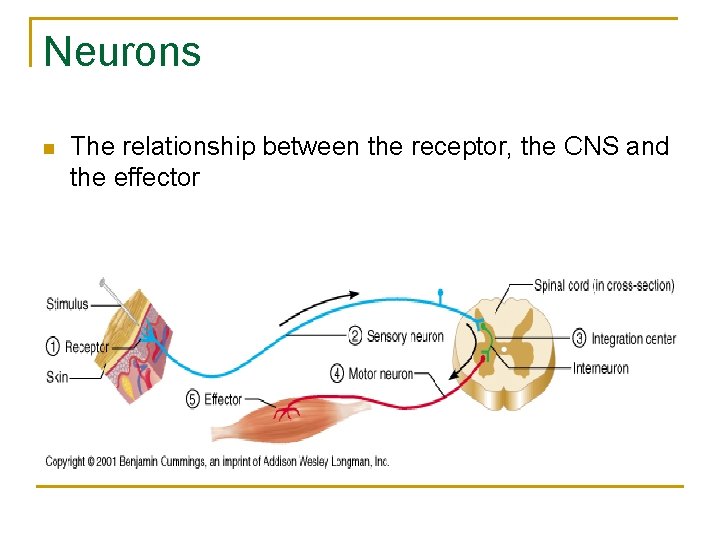
Receptors and effectors n n n In receptors, these stimuli cause changes that are converted to electrical or nerve impulses (messages) which are carried by sensory nerve cells to the central nervous system The impulses are then interpreted and other impulses are sent to the organs which produce a response The response is brought about by effectors which are either muscles or glands
Receptors and effectors n Sense organs (in Animals) q q specialized parts of the body which enable the animal to detect a particular stimulus Each sense organ is sensitive to certain types of stimuli n n Eyes – light Ears – sound Nose and tongue – chemical stimuli Skin – pressure and temperature
Receptors and effectors n n Plants LACK sense organs and nerves, yet they are able to respond to stimuli Certain parts of the plant receive stimuli q q n Tips of shoot – sensitive to light Tips of roots – sensitive to gravity, moisture, soil nutrients Most plant responses are slow growth movements brought about by growth substances or hormones (AUXINS)
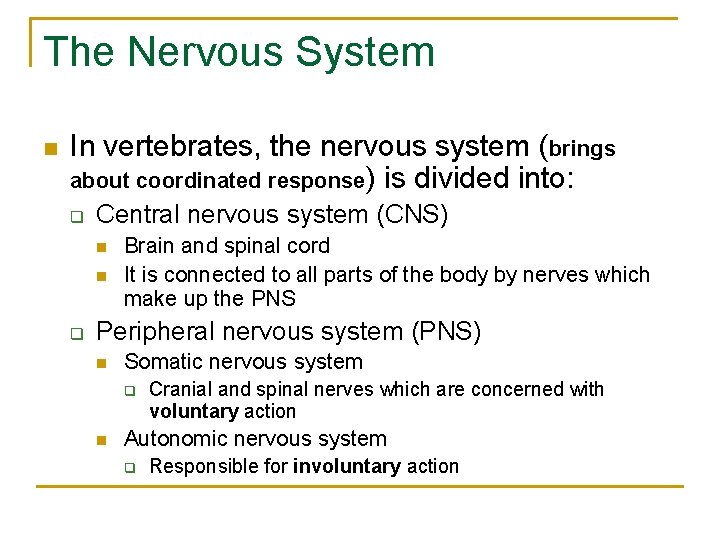
The Nervous System n In vertebrates, the nervous system (brings about coordinated response) is divided into: q Central nervous system (CNS) n n q Brain and spinal cord It is connected to all parts of the body by nerves which make up the PNS Peripheral nervous system (PNS) n Somatic nervous system q n Cranial and spinal nerves which are concerned with voluntary action Autonomic nervous system q Responsible for involuntary action
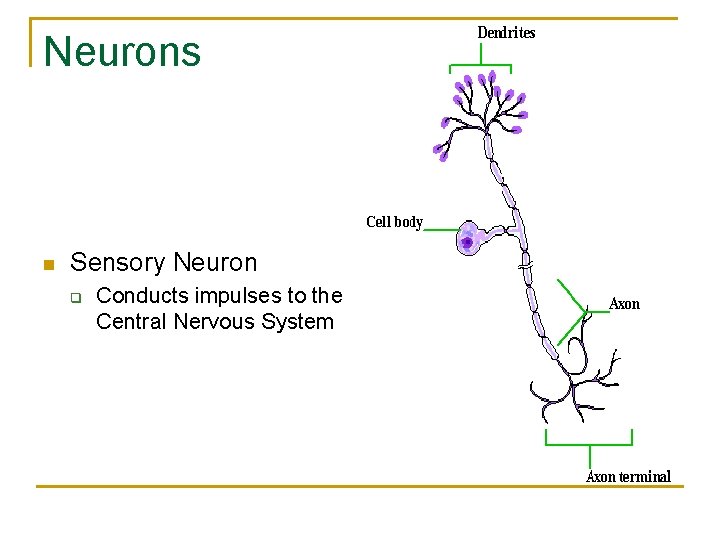
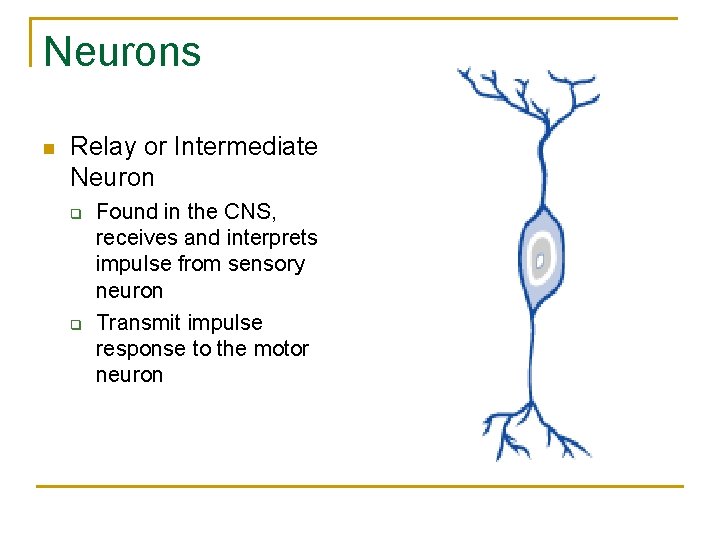
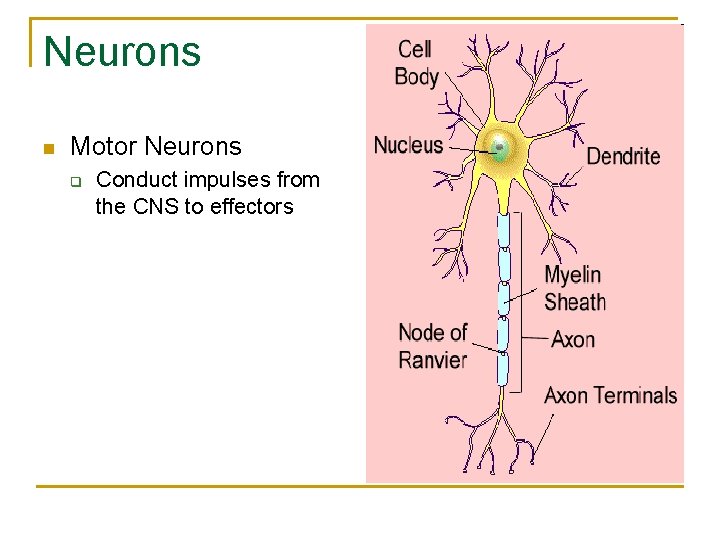
Neurones n n The nervous system is made up of neurones. Neurones are specialized cells which conduct impulses q Sensory neurones - conduct impulses to the CNS from sense organs q Relay or intermediate neurones – found in the CNS, receive and interpret messages from sensory neurones and transmit impulses to motor neurones q Motor neurones – conduct impulses from the CNS to effectors
Neurons n The relationship between the receptor, the CNS and the effector
Neuron n Each neuron consists of 3 basic parts: q A cell body – cytoplasm containing a nucleus and other cell organelles q Dendrons or dentrites – long thin fibres that conduct impulses towards the cell body q An axon – a long thin fibre that conducts impulses away from the cell body
Neurons n Sensory Neuron q Conducts impulses to the Central Nervous System
Neurons n Relay or Intermediate Neuron q q Found in the CNS, receives and interprets impulse from sensory neuron Transmit impulse response to the motor neuron
Neurons n Motor Neurons q Conduct impulses from the CNS to effectors
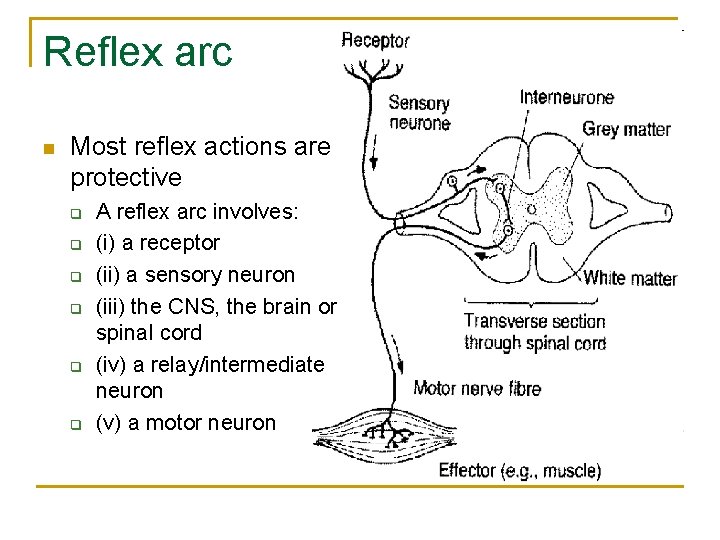
Reflex arc n Most reflex actions are protective q q q A reflex arc involves: (i) a receptor (ii) a sensory neuron (iii) the CNS, the brain or spinal cord (iv) a relay/intermediate neuron (v) a motor neuron
Questions n Using the information provided in the last slide describe and draw a reflex arc explaining what happens when q q q (i) someone walks out into the sunlight from a dark room (ii) someone gets a knee jerk (iii) someone touches a hot surface