
COORDINATING CONJUNCTIONS Parallel Structure One use of a
- Slides: 19
COORDINATING CONJUNCTIONS
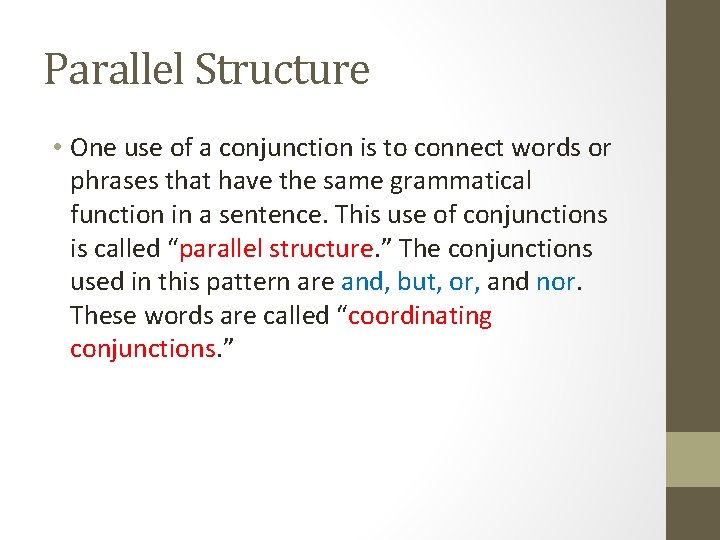
Parallel Structure • One use of a conjunction is to connect words or phrases that have the same grammatical function in a sentence. This use of conjunctions is called “parallel structure. ” The conjunctions used in this pattern are and, but, or, and nor. These words are called “coordinating conjunctions. ”
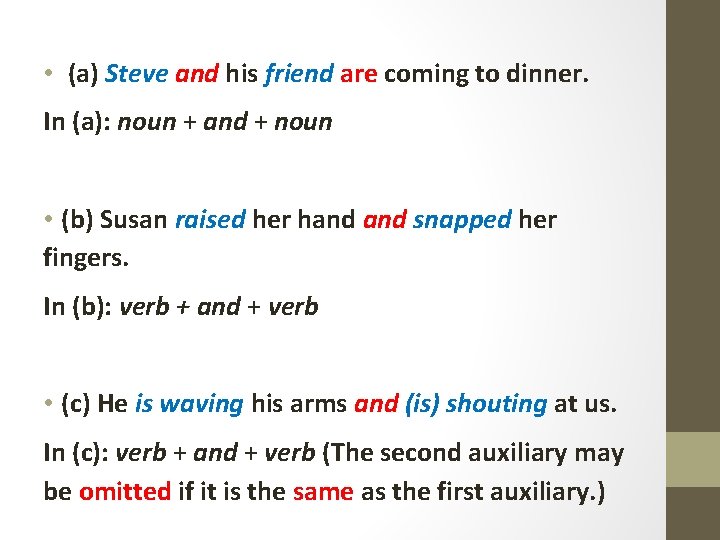
• (a) Steve and his friend are coming to dinner. In (a): noun + and + noun • (b) Susan raised her hand snapped her fingers. In (b): verb + and + verb • (c) He is waving his arms and (is) shouting at us. In (c): verb + and + verb (The second auxiliary may be omitted if it is the same as the first auxiliary. )
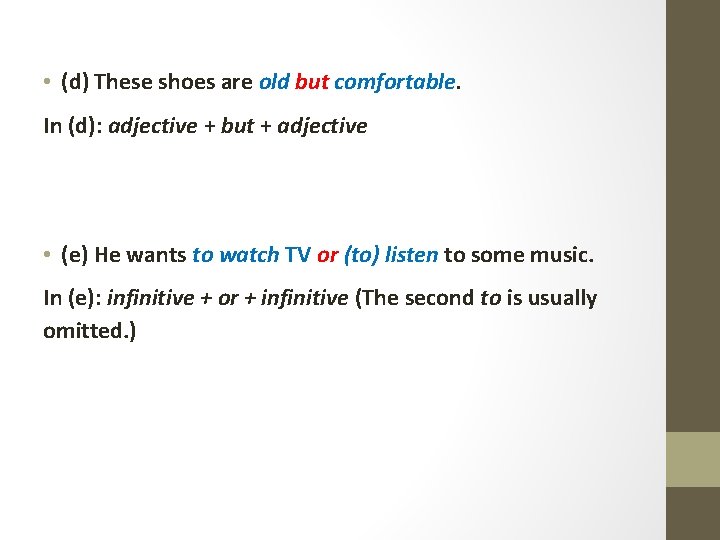
• (d) These shoes are old but comfortable. In (d): adjective + but + adjective • (e) He wants to watch TV or (to) listen to some music. In (e): infinitive + or + infinitive (The second to is usually omitted. )
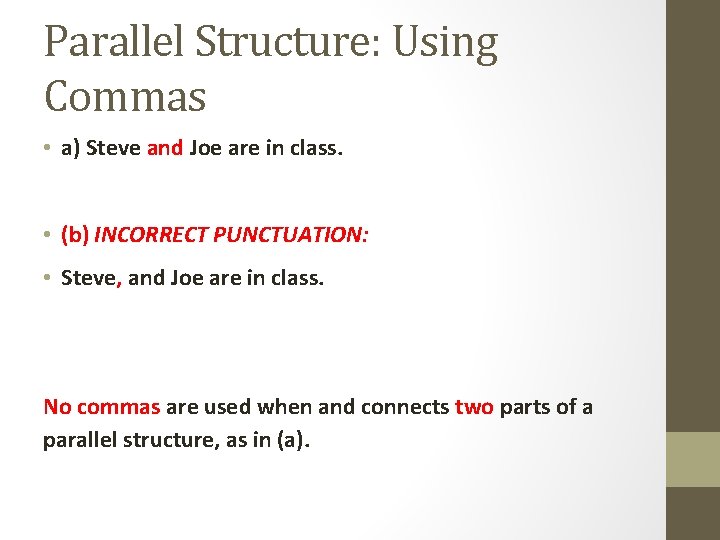
Parallel Structure: Using Commas • a) Steve and Joe are in class. • (b) INCORRECT PUNCTUATION: • Steve, and Joe are in class. No commas are used when and connects two parts of a parallel structure, as in (a).
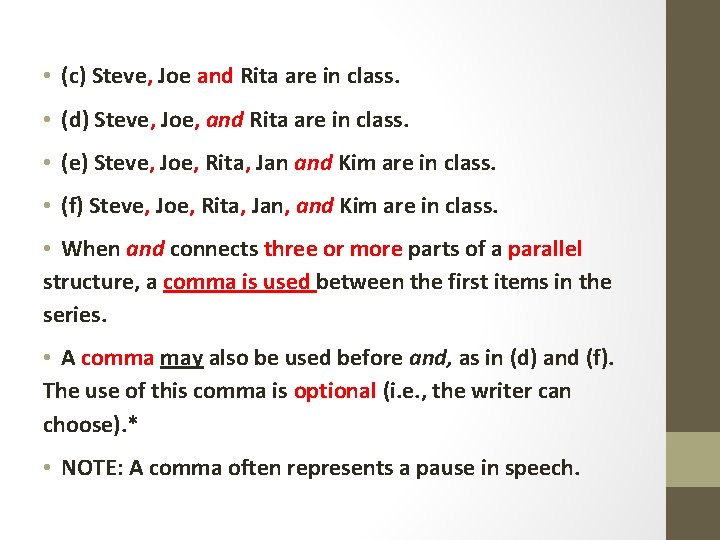
• (c) Steve, Joe and Rita are in class. • (d) Steve, Joe, and Rita are in class. • (e) Steve, Joe, Rita, Jan and Kim are in class. • (f) Steve, Joe, Rita, Jan, and Kim are in class. • When and connects three or more parts of a parallel structure, a comma is used between the first items in the series. • A comma may also be used before and, as in (d) and (f). The use of this comma is optional (i. e. , the writer can choose). * • NOTE: A comma often represents a pause in speech.
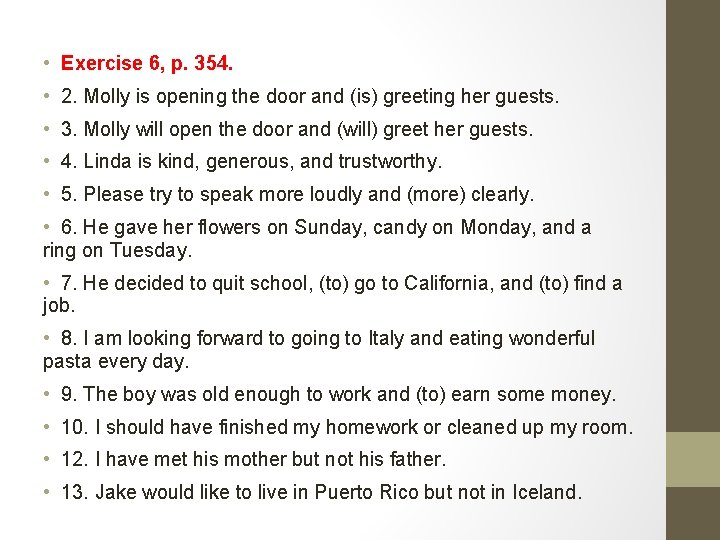
• Exercise 6, p. 354. • 2. Molly is opening the door and (is) greeting her guests. • 3. Molly will open the door and (will) greet her guests. • 4. Linda is kind, generous, and trustworthy. • 5. Please try to speak more loudly and (more) clearly. • 6. He gave her flowers on Sunday, candy on Monday, and a ring on Tuesday. • 7. He decided to quit school, (to) go to California, and (to) find a job. • 8. I am looking forward to going to Italy and eating wonderful pasta every day. • 9. The boy was old enough to work and (to) earn some money. • 10. I should have finished my homework or cleaned up my room. • 12. I have met his mother but not his father. • 13. Jake would like to live in Puerto Rico but not in Iceland.
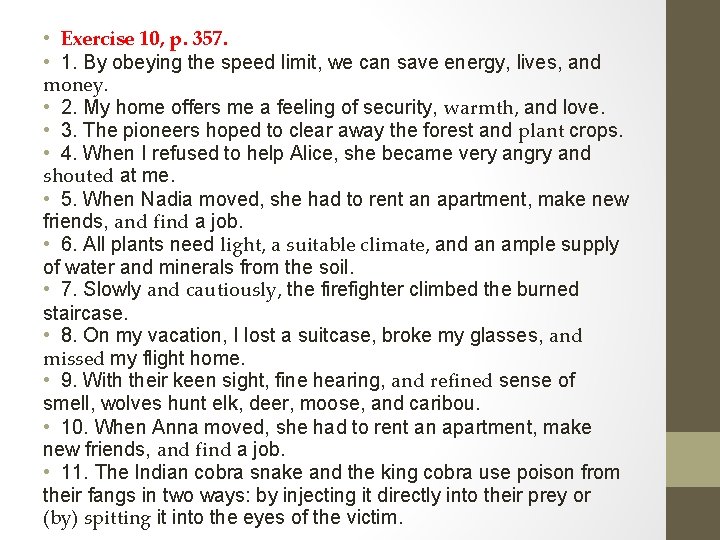
• Exercise 10, p. 357. • 1. By obeying the speed limit, we can save energy, lives, and money. • 2. My home offers me a feeling of security, warmth, and love. • 3. The pioneers hoped to clear away the forest and plant crops. • 4. When I refused to help Alice, she became very angry and shouted at me. • 5. When Nadia moved, she had to rent an apartment, make new friends, and find a job. • 6. All plants need light, a suitable climate, and an ample supply of water and minerals from the soil. • 7. Slowly and cautiously, the firefighter climbed the burned staircase. • 8. On my vacation, I lost a suitcase, broke my glasses, and missed my flight home. • 9. With their keen sight, fine hearing, and refined sense of smell, wolves hunt elk, deer, moose, and caribou. • 10. When Anna moved, she had to rent an apartment, make new friends, and find a job. • 11. The Indian cobra snake and the king cobra use poison from their fangs in two ways: by injecting it directly into their prey or (by) spitting it into the eyes of the victim.
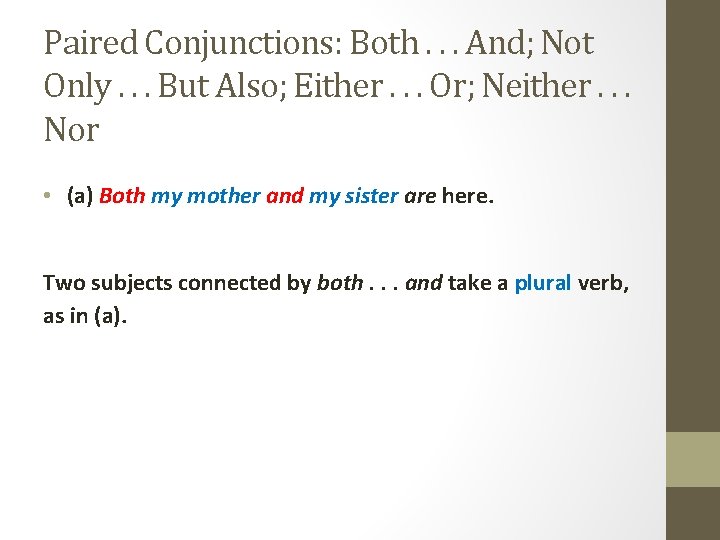
Paired Conjunctions: Both. . . And; Not Only. . . But Also; Either. . . Or; Neither. . . Nor • (a) Both my mother and my sister are here. Two subjects connected by both. . . and take a plural verb, as in (a).
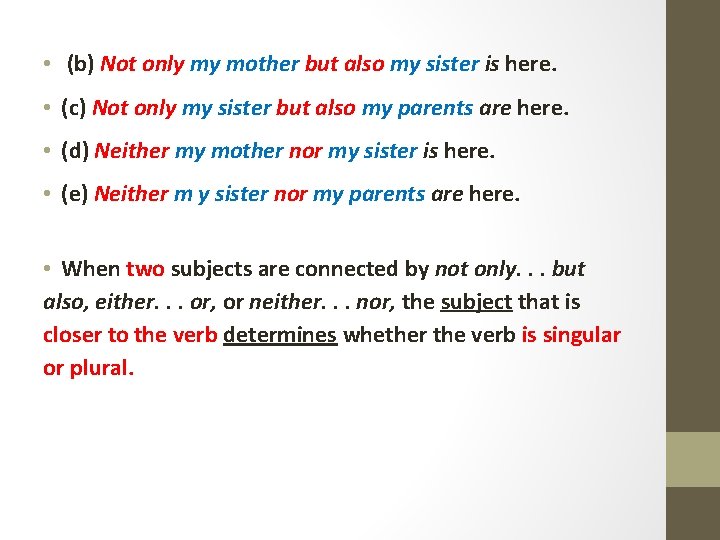
• (b) Not only my mother but also my sister is here. • (c) Not only my sister but also my parents are here. • (d) Neither my mother nor my sister is here. • (e) Neither m y sister nor my parents are here. • When two subjects are connected by not only. . . but also, either. . . or, or neither. . . nor, the subject that is closer to the verb determines whether the verb is singular or plural.
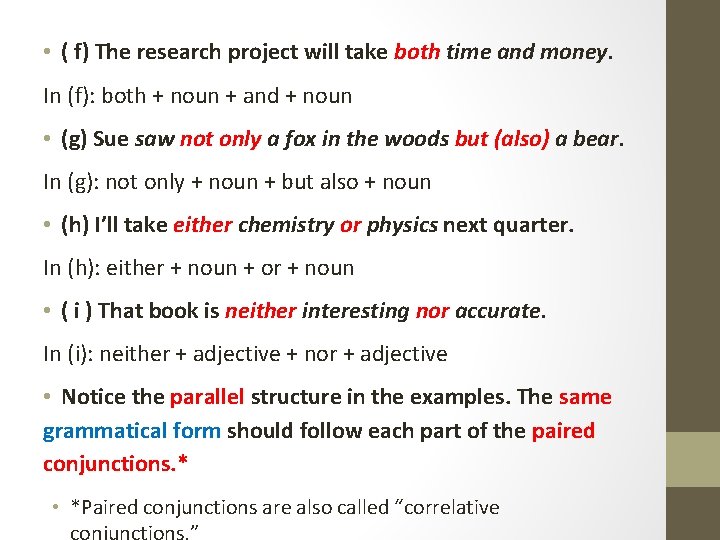
• ( f) The research project will take both time and money. In (f): both + noun + and + noun • (g) Sue saw not only a fox in the woods but (also) a bear. In (g): not only + noun + but also + noun • (h) I’ll take either chemistry or physics next quarter. In (h): either + noun + or + noun • ( i ) That book is neither interesting nor accurate. In (i): neither + adjective + nor + adjective • Notice the parallel structure in the examples. The same grammatical form should follow each part of the paired conjunctions. * • *Paired conjunctions are also called “correlative
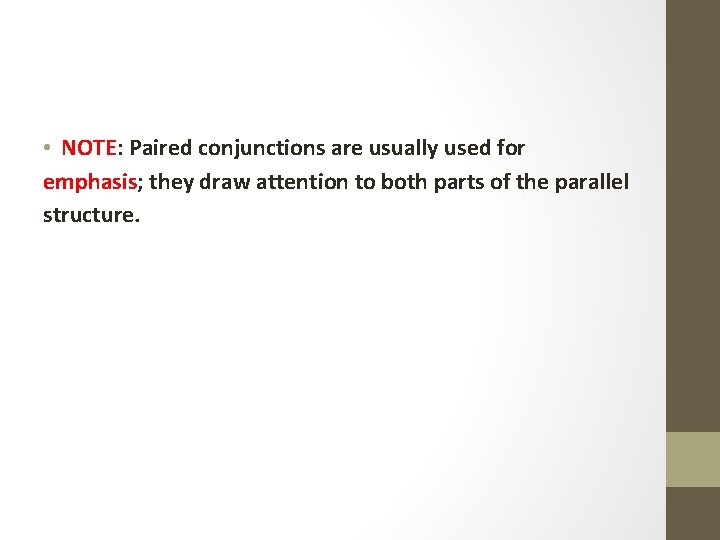
• NOTE: Paired conjunctions are usually used for emphasis; they draw attention to both parts of the parallel structure.
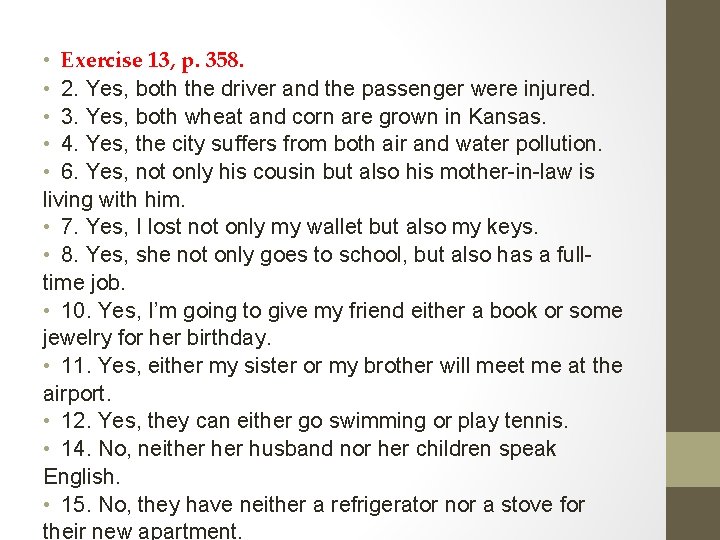
• Exercise 13, p. 358. • 2. Yes, both the driver and the passenger were injured. • 3. Yes, both wheat and corn are grown in Kansas. • 4. Yes, the city suffers from both air and water pollution. • 6. Yes, not only his cousin but also his mother-in-law is living with him. • 7. Yes, I lost not only my wallet but also my keys. • 8. Yes, she not only goes to school, but also has a fulltime job. • 10. Yes, I’m going to give my friend either a book or some jewelry for her birthday. • 11. Yes, either my sister or my brother will meet me at the airport. • 12. Yes, they can either go swimming or play tennis. • 14. No, neither husband nor her children speak English. • 15. No, they have neither a refrigerator nor a stove for their new apartment.
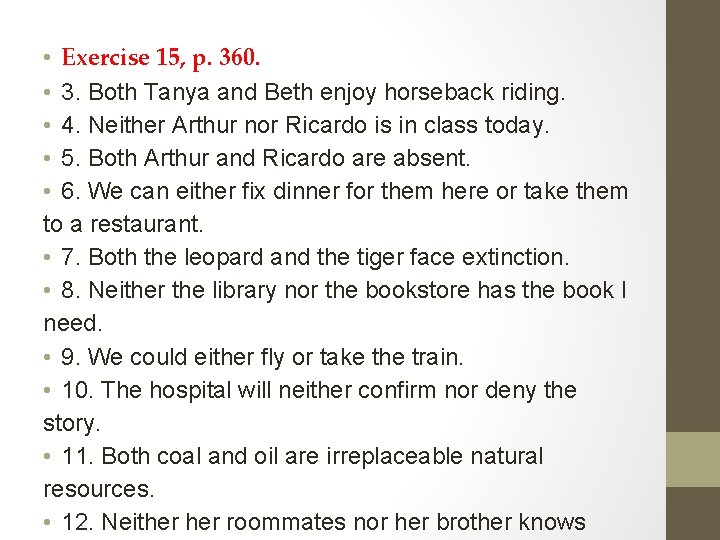
• Exercise 15, p. 360. • 3. Both Tanya and Beth enjoy horseback riding. • 4. Neither Arthur nor Ricardo is in class today. • 5. Both Arthur and Ricardo are absent. • 6. We can either fix dinner for them here or take them to a restaurant. • 7. Both the leopard and the tiger face extinction. • 8. Neither the library nor the bookstore has the book I need. • 9. We could either fly or take the train. • 10. The hospital will neither confirm nor deny the story. • 11. Both coal and oil are irreplaceable natural resources. • 12. Neither roommates nor her brother knows
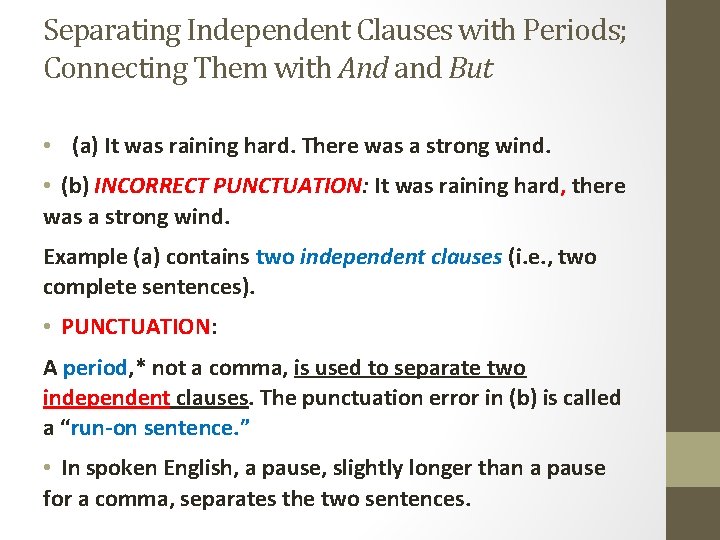
Separating Independent Clauses with Periods; Connecting Them with And and But • (a) It was raining hard. There was a strong wind. • (b) INCORRECT PUNCTUATION: It was raining hard, there was a strong wind. Example (a) contains two independent clauses (i. e. , two complete sentences). • PUNCTUATION: A period, * not a comma, is used to separate two independent clauses. The punctuation error in (b) is called a “run-on sentence. ” • In spoken English, a pause, slightly longer than a pause for a comma, separates the two sentences.
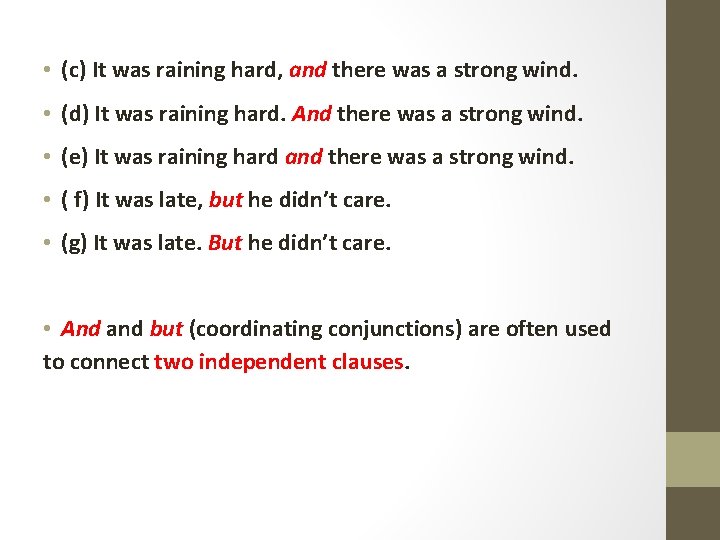
• (c) It was raining hard, and there was a strong wind. • (d) It was raining hard. And there was a strong wind. • (e) It was raining hard and there was a strong wind. • ( f) It was late, but he didn’t care. • (g) It was late. But he didn’t care. • And and but (coordinating conjunctions) are often used to connect two independent clauses.
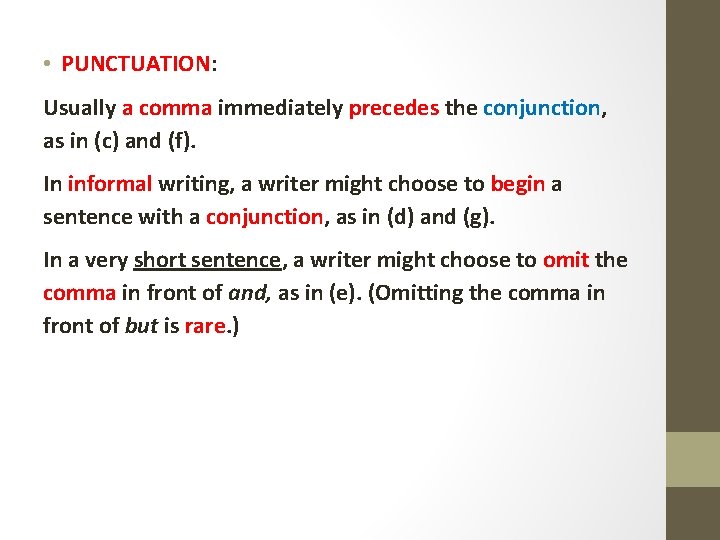
• PUNCTUATION: Usually a comma immediately precedes the conjunction, as in (c) and (f). In informal writing, a writer might choose to begin a sentence with a conjunction, as in (d) and (g). In a very short sentence, a writer might choose to omit the comma in front of and, as in (e). (Omitting the comma in front of but is rare. )
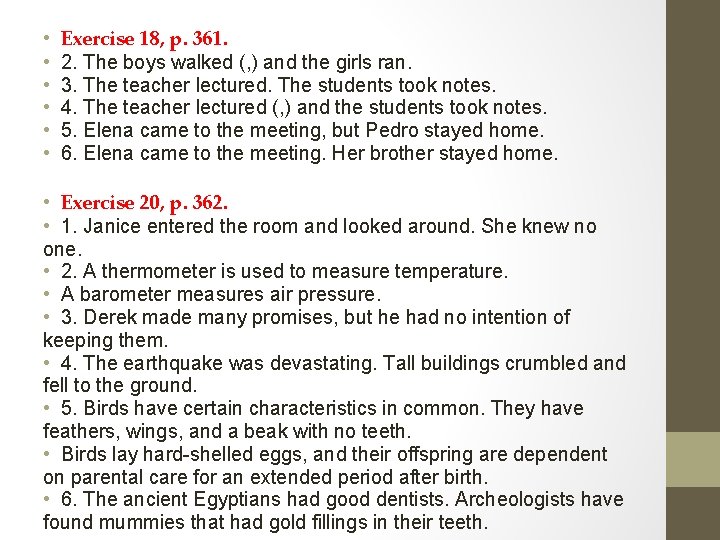
• • • Exercise 18, p. 361. 2. The boys walked (, ) and the girls ran. 3. The teacher lectured. The students took notes. 4. The teacher lectured (, ) and the students took notes. 5. Elena came to the meeting, but Pedro stayed home. 6. Elena came to the meeting. Her brother stayed home. • Exercise 20, p. 362. • 1. Janice entered the room and looked around. She knew no one. • 2. A thermometer is used to measure temperature. • A barometer measures air pressure. • 3. Derek made many promises, but he had no intention of keeping them. • 4. The earthquake was devastating. Tall buildings crumbled and fell to the ground. • 5. Birds have certain characteristics in common. They have feathers, wings, and a beak with no teeth. • Birds lay hard-shelled eggs, and their offspring are dependent on parental care for an extended period after birth. • 6. The ancient Egyptians had good dentists. Archeologists have found mummies that had gold fillings in their teeth.
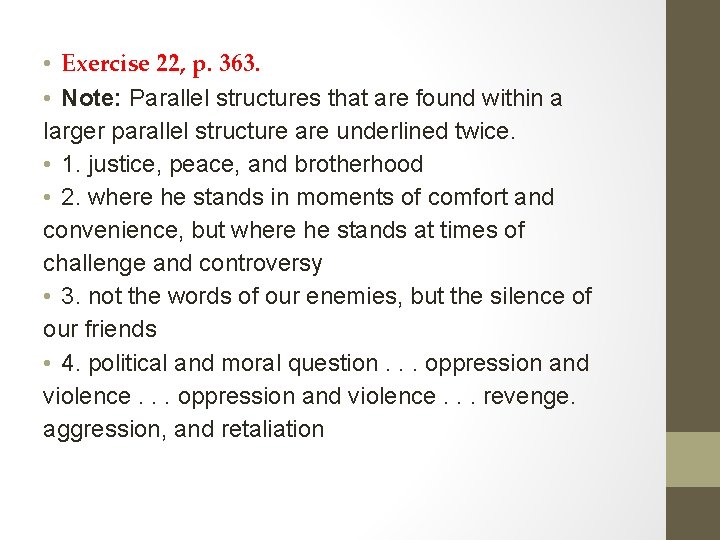
• Exercise 22, p. 363. • Note: Parallel structures that are found within a larger parallel structure are underlined twice. • 1. justice, peace, and brotherhood • 2. where he stands in moments of comfort and convenience, but where he stands at times of challenge and controversy • 3. not the words of our enemies, but the silence of our friends • 4. political and moral question. . . oppression and violence. . . revenge. aggression, and retaliation