
Coordinated Entry Building a homeless response system Meeting
Coordinated Entry: Building a homeless response system Meeting of HUD Region I Co. Cs Northern Region / Manchester, NH Robert Pulster, Regional Coordinator May 7, 2015
Opening Doors No one should experience homelessness and no one should be without a safe, stable place to call home. The Plan set forth four bold and ambitious goals: 1. Finish the job of ending chronic homelessness by 2017 2. Prevent and end homelessness among Veterans by 2015 3. Prevent and end homelessness for families, youth, and children by 2020 4. Set a path to ending all types of homelessness www. usich. gov 2
Themes of Opening Doors 1. Increase leadership, collaboration, and civic engagement 2. Increase access to stable and affordable housing 3. Increase economic security 4. Improve health and stability 5. Retool the homeless crisis response system www. usich. gov 3
USICH Roles § Coordinates the Federal response to homelessness § Maximizes the effectiveness of 19 Federal agency partners § Shares best practices § Drives collaborative solutions at the national and community level www. usich. gov 4
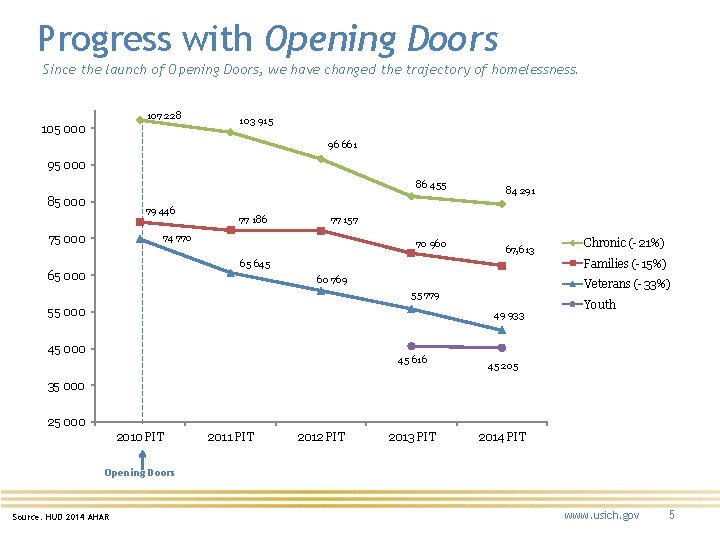
Progress with Opening Doors Since the launch of Opening Doors, we have changed the trajectory of homelessness. 107 228 105 000 103 915 96 661 95 000 86 455 85 000 79 446 77 186 77 157 74 770 75 000 84 291 70 960 67, 613 Families (-15%) 65 645 65 000 Chronic (-21%) 60 769 Veterans (-33%) 55 779 55 000 49 933 45 000 45 616 Youth 45 205 35 000 2010 PIT 2011 PIT 2012 PIT 2013 PIT 2014 PIT Opening Doors Source: HUD 2014 AHAR www. usich. gov 5
Keys to advancing progress § Using a Housing First orientation § Building a system of programs § Implementing Coordinated Entry § Being goal and data-driven § Collaborating with mainstream systems www. usich. gov 6
Housing First orientation § Everyone is ready for housing and can achieve stability in housing. § The ultimate goal is connection to permanent housing § Housing First recognizes “resistance” as ambivalence to change and requires persistent engagement to overcome ambivalence. § It has a practical focus on addressing barriers to housing entry. § It is connected to housing referral and placement systems (coordinated entry and assessment). www. usich. gov 7
Building a systems approach § Programs and services work together as a single system across organizational lines § Ensure full community coverage with overlapping catchment areas § Shared data and information on clients § Joint case conferencing on hard-to-engage clients § Complementing services and expertise (psychiatric assessment capacity, mobile medical services) www. usich. gov 8
Being goal and data-driven § Contributes to larger community goals of ending homelessness among Veterans by 2015 and individuals experiencing chronic homelessness by 2017 § Useful to set short-term (e. g. 100 day) housing placement goals § Allows monitoring of performance goals § Uses data for case finding and prioritization § HMIS - Longest term homeless § Data matching - High utilizers of hospitals, jails, detox, etc. § USICH SHOP tool – Uses PIT and HIC to target PSH to chronic clients www. usich. gov 9
Implementing Coordinated Entry § HUD is requiring all Co. Cs to establish a coordinated entry system § HUD published a Policy Brief in February 2015 § A coordinated entry process is a critical component to any community’s effort to meet the goals of Opening Doors. § Ensures that community assistance is allocated as effectively as possible and is easily accessible no matter where or how people present www. usich. gov 10
Current Crisis Response Systems: (Using Boston as an example) Street Outreach Day & Meal Programs Healthcare for the Homeless Youth Programs Staying with Friends/Family Boston VA Psychiatric & Mainstream Hospitals County Jail/Prison Detox/ Treatment Emergency shelters Pilgrim (Shelter) DV Shelters Pine Street Inn (Shelter) St. Francis House (Day and Overflow Shelter) New England Center (Shelter) Woods Mullen (Shelter) DMH Shelter Long Island (Shelter) DMH Safe Haven Transitional Housing Waitlists, screening criteria Screening criteria, financial barriers Permanent Supportive Housing Public Housing Affordable Housing Market Rate Housing 11 Access Houston: The Shift” Source: Boston Mayors Task Force on Individual Homelessness (modified from “Coordinated @USICHgov
Coordinated Entry Policy Brief An effective coordinated entry process is a critical component to any community’s efforts to meet the goals of Opening Doors: Federal Strategic Plan to Prevent and End Homelessness. This policy brief describes HUD’s views of the characteristics of an effective coordinated entry process. This brief does not establish requirements for Continuums of Care (Co. Cs), but rather is meant to inform local efforts to further develop Co. Cs’ coordinated entry processes. www. usich. gov 12
Clients face barriers & challenges § Difficult for individuals and families to access services and housing § Separate referral processes for each agency § Unique assessment at each agency § Questionable housing match accuracy § Difficult to know service and housing availability across the system § Challenge to evaluate effective utilization to manage to achievement of goals www. usich. gov 13
System building Programs Talented and committed providers using different methods and providing different services (program-centered model) Homeless Response System An integrated network of providers whose efforts are wellcoordinated to achieve a COLLECTIVE IMPACT (client-centered model) Source: From Boston Mayors Task Force on Individual Homelessness 4 (Modified from Houston’s Plan to End Chronic Homelessness) 1
Coordinated Entry The goals of building a coordinated entry system: § Reorient system to focus on those being served § Minimize time and frustration accessing help § Maximize use of system resources § Identify service gaps for planning www. usich. gov 15
Programs vs. system model Without Coordinated Assessment, programs use: § Program-centric decisions making § Different forms and assessments § Ad-hoc referral processes With Coordinated Assessment, systems use: § Client-centric decision making § Standard forms and assessments § Community agreement on where to refer § Coordinated referrals through regional/Co. C entity www. usich. gov 16
Community Example: Houston Operational philosophy: We need to do a better job of orienting our system toward housing and housing stabilization 1. Match resources with need 2. Remove barriers that keep people from getting the housing and services they need 3. Coordinate and simplify the process 4. Use data to drive decision making 5. Build capacity 6. Enhance collaboration among funders www. usich. gov 17
Community example: Houston Coordinated entry system operational as of 1/2014 § Three months test phase using paper to asses and place while building out workflow § Second phase began HMIS integration and continued system build out § Coordinated entry initial target for individuals that are experiencing chronic homelessness and Veterans § Incorporate reporting ability and performance measures www. usich. gov 18
Community example: Houston Roles and Responsibilities § CE Implentation Manager § Support all partners; develop project management workbook and action plans, facilitate workgroups, trouble shoot § Co. C Progam Manager § Support all partners, maintain oversight of manual processes, facilitate case conferences, develop all MOUs, managing ongoing operations www. usich. gov 19
Houston learned: 1. Electronic build-outs take longer than expected 2. Technology and staffing require repurposing and/or finding new funds 3. The shift in thinking is more challenging than the shift in operations 1. There is a housing option for everyone 2. This is community data, not agency data 3. The repurposed CE staff are not “helping out” a new system but they are the new system. 4. The clock starts from the moment of initial engagement – metrics matter www. usich. gov 20
Houston’s example shows Coordinated Access can: § Control access to units through sole referral source § Ensure housing placements – system cannot say “no” § Hold everyone accountable – denials get attention § Produce system-wide data on placement and utilization § Track collective impact – manage to achieve goal www. usich. gov 21

Join our networks Subscribe to our newsletter and visit our website www. usich. gov Follow us on Twitter @USICHgov Like us on Facebook Contact robert. pulster@usich. gov @Robert. Pulster www. usich. gov 22

www. usich. gov
- Slides: 23