
Coordinate Geometry in the x y plane Coordinate


- Slides: 32
Coordinate Geometry in the (x, y) plane
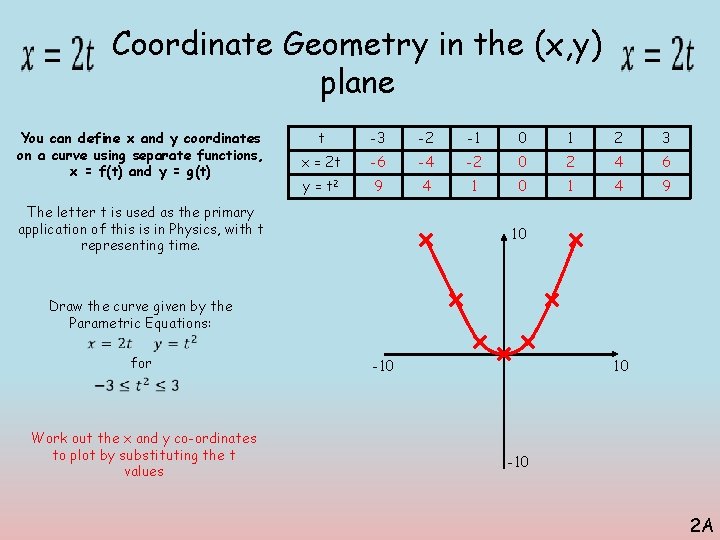
Coordinate Geometry in the (x, y) plane You can define x and y coordinates on a curve using separate functions, x = f(t) and y = g(t) t -3 -2 -1 0 1 2 3 x = 2 t -6 -4 -2 0 2 4 6 y = t 2 9 4 1 0 1 4 9 The letter t is used as the primary application of this is in Physics, with t representing time. 10 Draw the curve given by the Parametric Equations: for Work out the x and y co-ordinates to plot by substituting the t values -10 10 -10 2 A
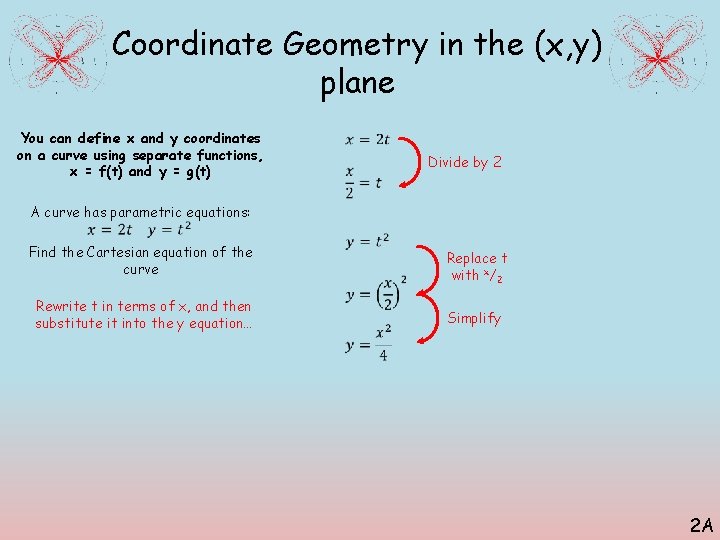
Coordinate Geometry in the (x, y) plane You can define x and y coordinates on a curve using separate functions, x = f(t) and y = g(t) Divide by 2 A curve has parametric equations: Find the Cartesian equation of the curve Replace t with x/2 Rewrite t in terms of x, and then substitute it into the y equation… Simplify 2 A
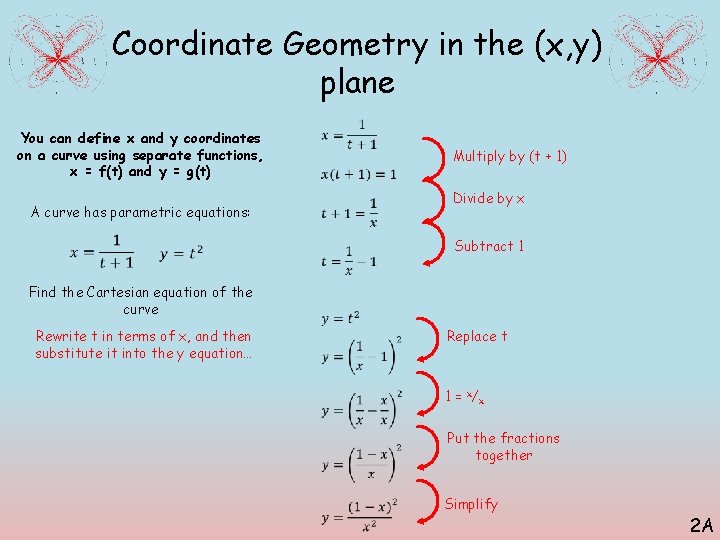
Coordinate Geometry in the (x, y) plane You can define x and y coordinates on a curve using separate functions, x = f(t) and y = g(t) A curve has parametric equations: Multiply by (t + 1) Divide by x Subtract 1 Find the Cartesian equation of the curve Rewrite t in terms of x, and then substitute it into the y equation… Replace t 1 = x /x Put the fractions together Simplify 2 A
Exercise 2 A
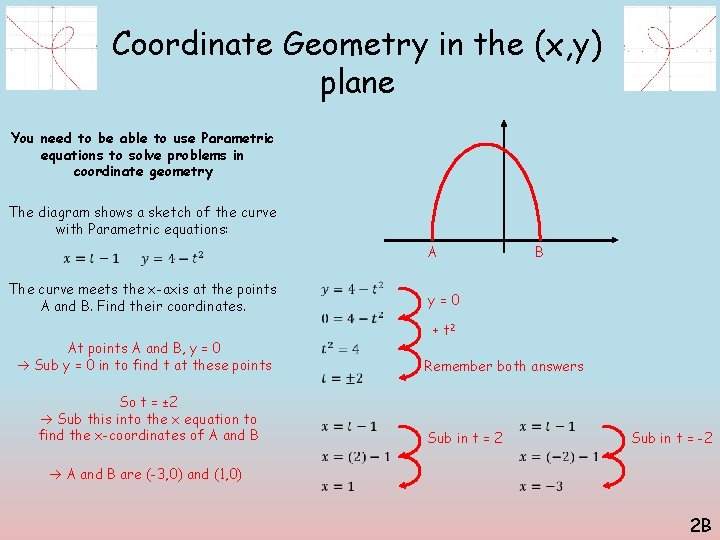
Coordinate Geometry in the (x, y) plane You need to be able to use Parametric equations to solve problems in coordinate geometry The diagram shows a sketch of the curve with Parametric equations: A The curve meets the x-axis at the points A and B. Find their coordinates. At points A and B, y = 0 Sub y = 0 in to find t at these points So t = ± 2 Sub this into the x equation to find the x-coordinates of A and B B y=0 + t 2 Remember both answers Sub in t = 2 Sub in t = -2 A and B are (-3, 0) and (1, 0) 2 B
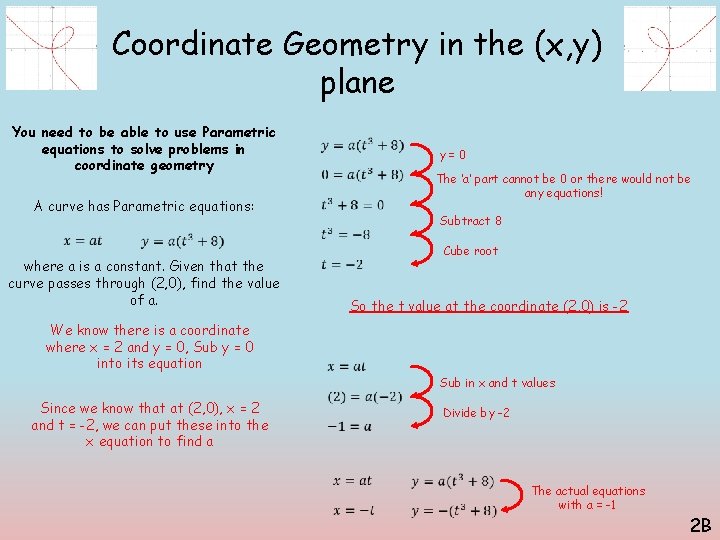
Coordinate Geometry in the (x, y) plane You need to be able to use Parametric equations to solve problems in coordinate geometry A curve has Parametric equations: where a is a constant. Given that the curve passes through (2, 0), find the value of a. y=0 The ‘a’ part cannot be 0 or there would not be any equations! Subtract 8 Cube root So the t value at the coordinate (2, 0) is -2 We know there is a coordinate where x = 2 and y = 0, Sub y = 0 into its equation Sub in x and t values Since we know that at (2, 0), x = 2 and t = -2, we can put these into the x equation to find a Divide by -2 The actual equations with a = -1 2 B
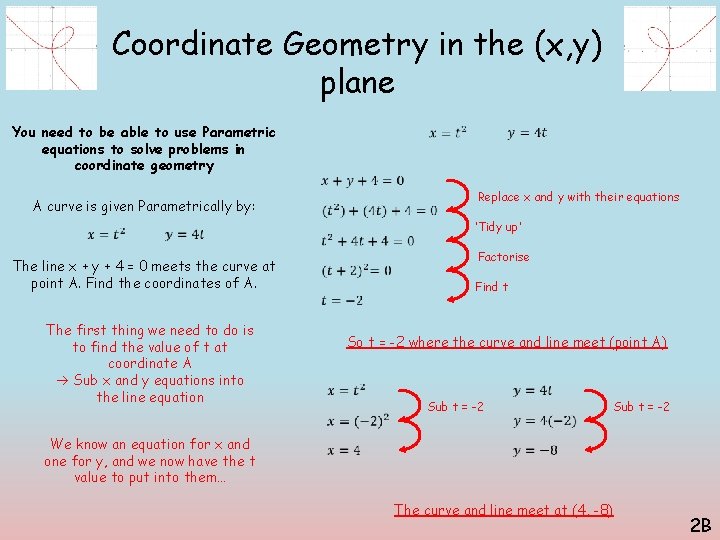
Coordinate Geometry in the (x, y) plane You need to be able to use Parametric equations to solve problems in coordinate geometry A curve is given Parametrically by: Replace x and y with their equations ‘Tidy up’ The line x + y + 4 = 0 meets the curve at point A. Find the coordinates of A. The first thing we need to do is to find the value of t at coordinate A Sub x and y equations into the line equation Factorise Find t So t = -2 where the curve and line meet (point A) Sub t = -2 We know an equation for x and one for y, and we now have the t value to put into them… The curve and line meet at (4, -8) 2 B
Exercise 2 B
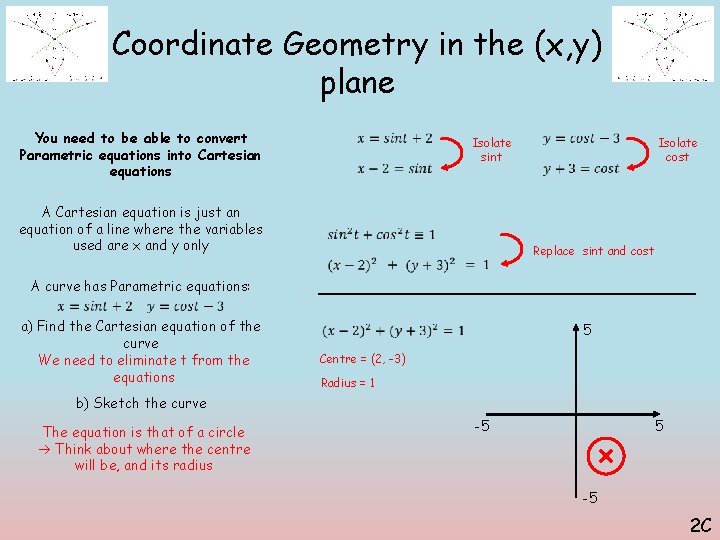
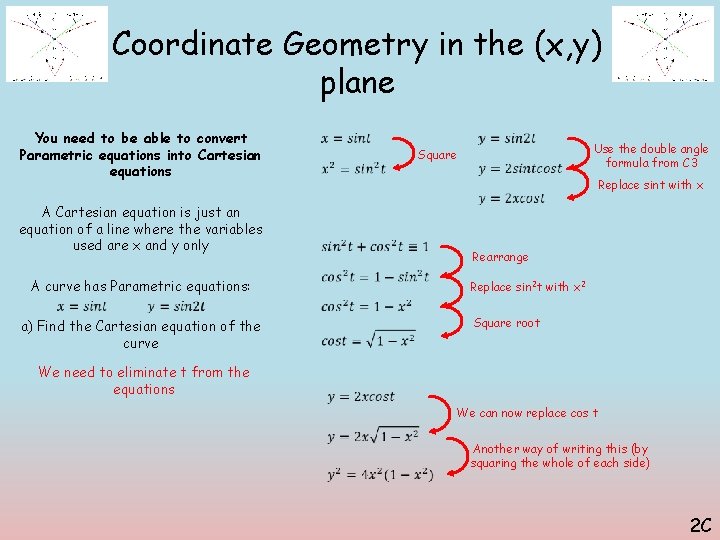
Coordinate Geometry in the (x, y) plane You need to be able to convert Parametric equations into Cartesian equations Isolate sint A Cartesian equation is just an equation of a line where the variables used are x and y only Isolate cost Replace sint and cost A curve has Parametric equations: a) Find the Cartesian equation of the curve We need to eliminate t from the equations 5 Centre = (2, -3) Radius = 1 b) Sketch the curve The equation is that of a circle Think about where the centre will be, and its radius -5 5 -5 2 C
Coordinate Geometry in the (x, y) plane You need to be able to convert Parametric equations into Cartesian equations A Cartesian equation is just an equation of a line where the variables used are x and y only A curve has Parametric equations: a) Find the Cartesian equation of the curve Use the double angle formula from C 3 Square Replace sint with x Rearrange Replace sin 2 t with x 2 Square root We need to eliminate t from the equations We can now replace cos t Another way of writing this (by squaring the whole of each side) 2 C
Exercise 2 C
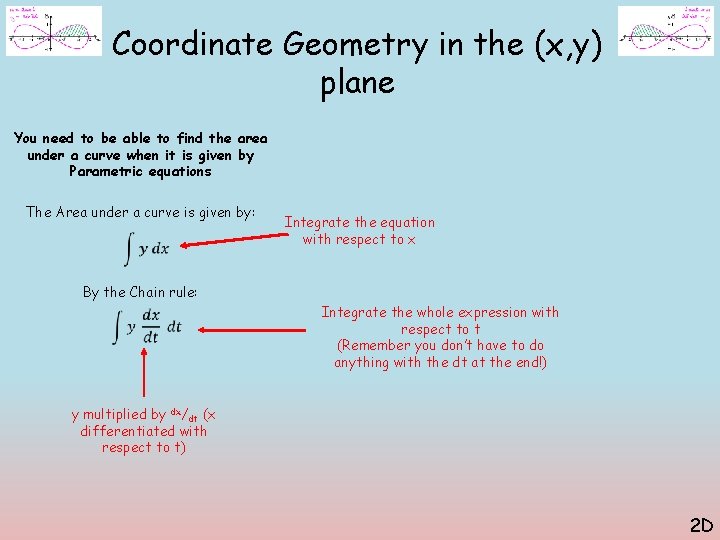
Coordinate Geometry in the (x, y) plane You need to be able to find the area under a curve when it is given by Parametric equations The Area under a curve is given by: By the Chain rule: Integrate the equation with respect to x Integrate the whole expression with respect to t (Remember you don’t have to do anything with the dt at the end!) y multiplied by dx/dt (x differentiated with respect to t) 2 D
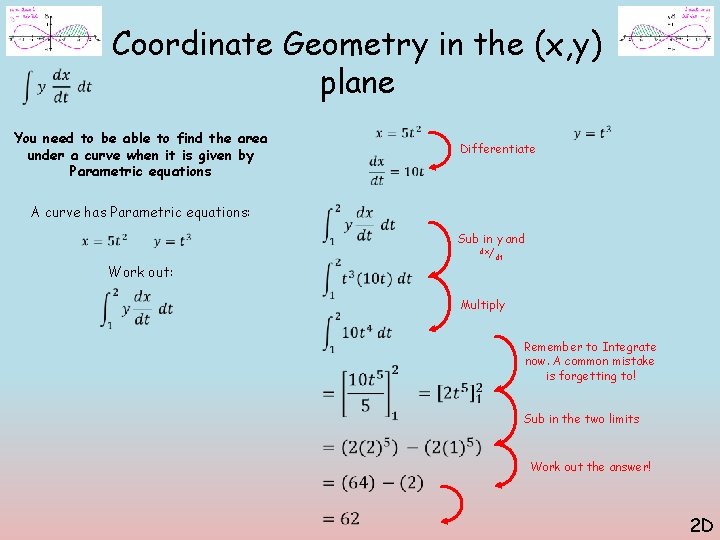
Coordinate Geometry in the (x, y) plane You need to be able to find the area under a curve when it is given by Parametric equations Differentiate A curve has Parametric equations: Work out: Sub in y and dx/ dt Multiply Remember to Integrate now. A common mistake is forgetting to! Sub in the two limits Work out the answer! 2 D
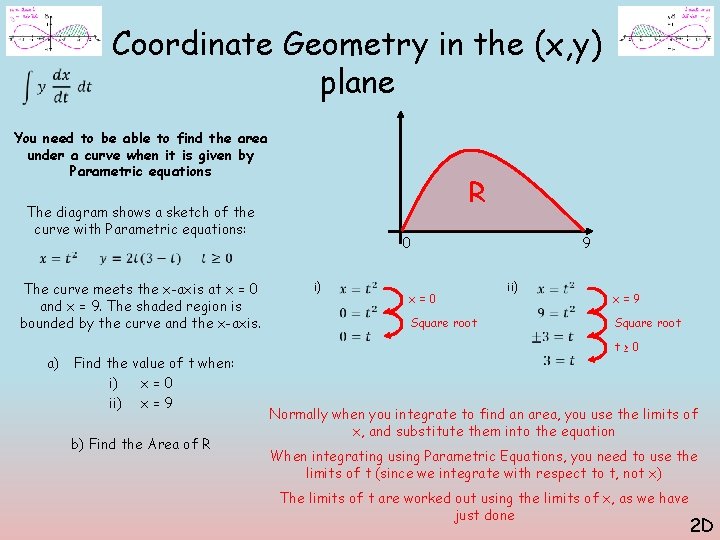
Coordinate Geometry in the (x, y) plane You need to be able to find the area under a curve when it is given by Parametric equations R The diagram shows a sketch of the curve with Parametric equations: The curve meets the x-axis at x = 0 and x = 9. The shaded region is bounded by the curve and the x-axis. a) Find the value of t when: i) x=0 ii) x = 9 b) Find the Area of R 0 i) 9 x=0 Square root ii) x=9 Square root t≥ 0 Normally when you integrate to find an area, you use the limits of x, and substitute them into the equation When integrating using Parametric Equations, you need to use the limits of t (since we integrate with respect to t, not x) The limits of t are worked out using the limits of x, as we have just done 2 D
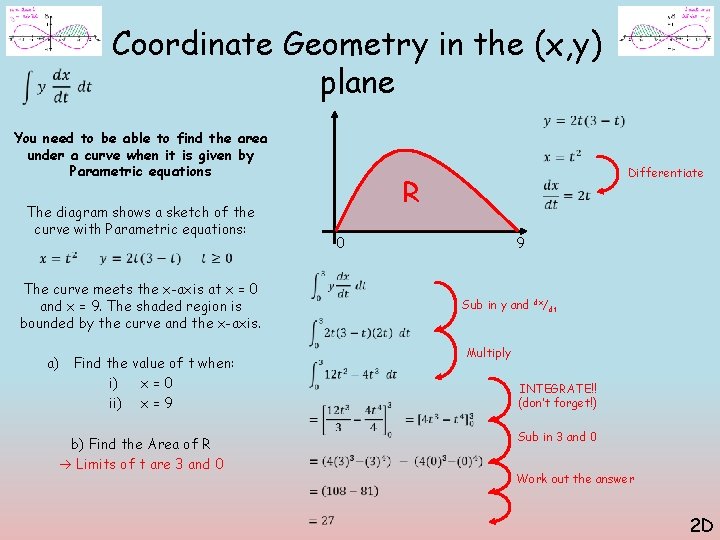
Coordinate Geometry in the (x, y) plane You need to be able to find the area under a curve when it is given by Parametric equations The diagram shows a sketch of the curve with Parametric equations: The curve meets the x-axis at x = 0 and x = 9. The shaded region is bounded by the curve and the x-axis. a) Find the value of t when: i) x=0 ii) x = 9 b) Find the Area of R Limits of t are 3 and 0 Differentiate R 0 9 Sub in y and dx/ dt Multiply INTEGRATE!! (don’t forget!) Sub in 3 and 0 Work out the answer 2 D
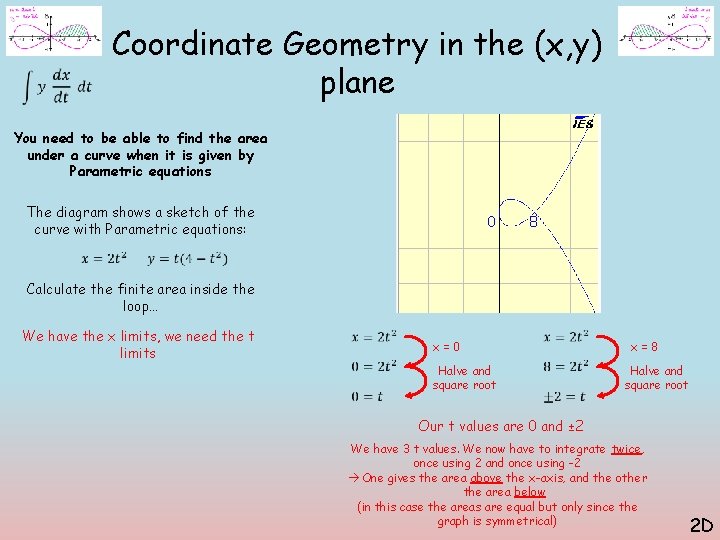
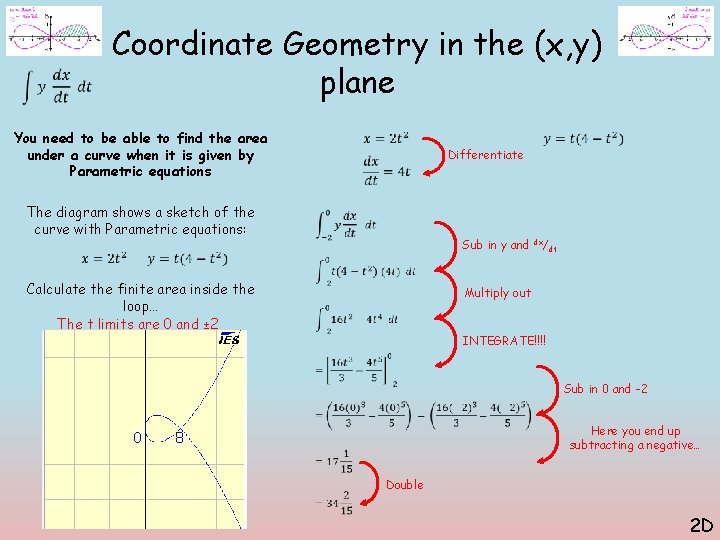
Coordinate Geometry in the (x, y) plane You need to be able to find the area under a curve when it is given by Parametric equations The diagram shows a sketch of the curve with Parametric equations: 0 8 Calculate the finite area inside the loop… We have the x limits, we need the t limits x=0 Halve and square root x=8 Halve and square root Our t values are 0 and ± 2 We have 3 t values. We now have to integrate twice, once using 2 and once using -2 One gives the area above the x-axis, and the other the area below (in this case the areas are equal but only since the graph is symmetrical) 2 D
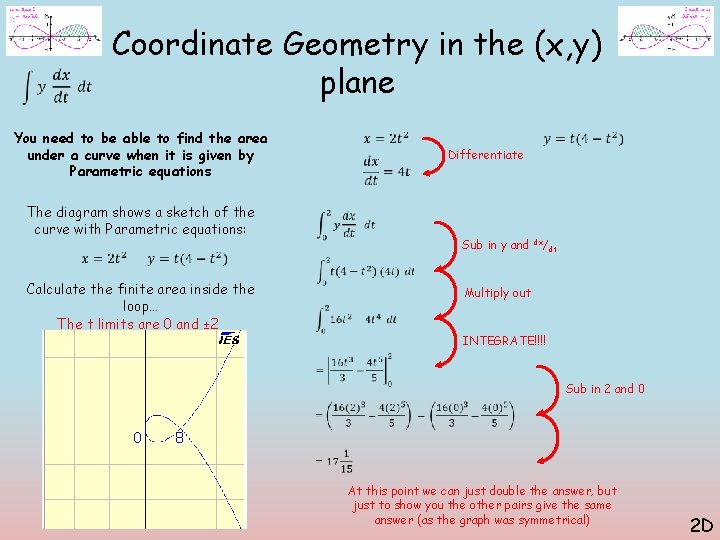
Coordinate Geometry in the (x, y) plane You need to be able to find the area under a curve when it is given by Parametric equations The diagram shows a sketch of the curve with Parametric equations: Calculate the finite area inside the loop… The t limits are 0 and ± 2 Differentiate Sub in y and dx/ dt Multiply out INTEGRATE!!!! Sub in 2 and 0 0 8 At this point we can just double the answer, but just to show you the other pairs give the same answer (as the graph was symmetrical) 2 D
Coordinate Geometry in the (x, y) plane You need to be able to find the area under a curve when it is given by Parametric equations Differentiate The diagram shows a sketch of the curve with Parametric equations: Sub in y and Calculate the finite area inside the loop… The t limits are 0 and ± 2 dx/ dt Multiply out INTEGRATE!!!! Sub in 0 and -2 0 Here you end up subtracting a negative… 8 Double 2 D
Exercise 2 D and 2 E
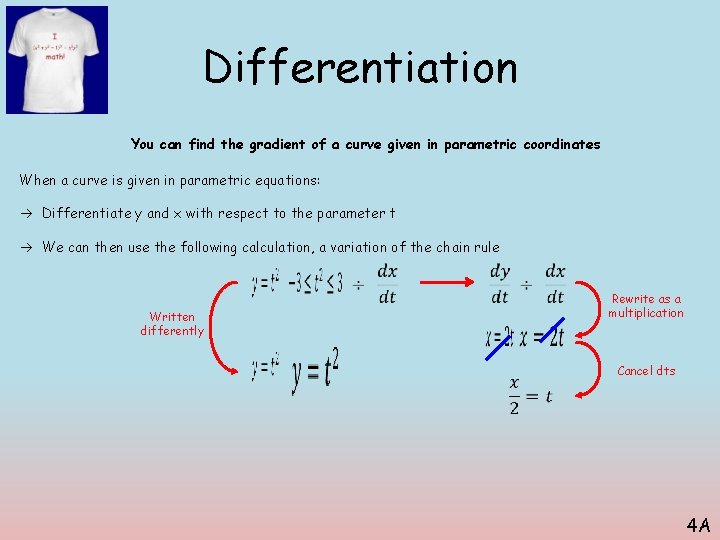
Differentiation You can find the gradient of a curve given in parametric coordinates When a curve is given in parametric equations: Differentiate y and x with respect to the parameter t We can then use the following calculation, a variation of the chain rule Written differently Rewrite as a multiplication Cancel dts 4 A
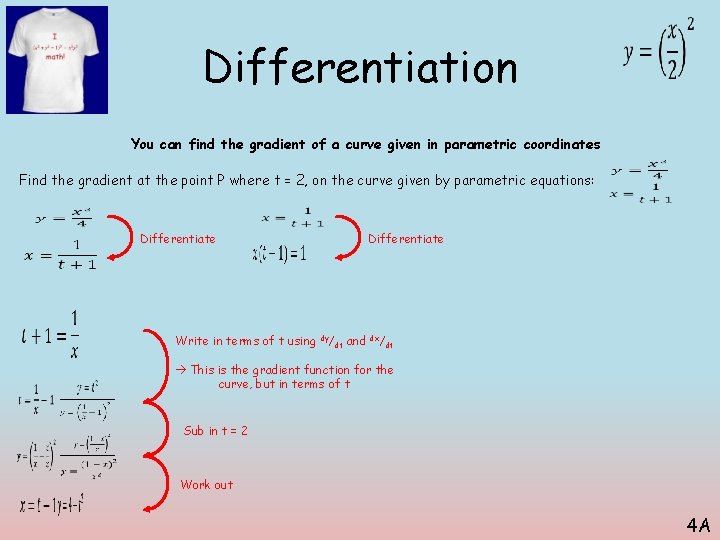
Differentiation You can find the gradient of a curve given in parametric coordinates Find the gradient at the point P where t = 2, on the curve given by parametric equations: Differentiate Write in terms of t using Differentiate dy/ dt and dx/dt This is the gradient function for the curve, but in terms of t Sub in t = 2 Work out 4 A
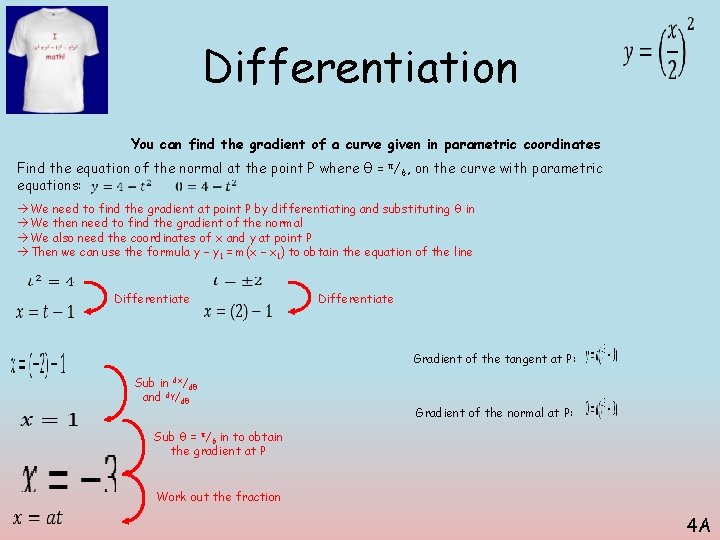
Differentiation You can find the gradient of a curve given in parametric coordinates Find the equation of the normal at the point P where θ = π/6, on the curve with parametric equations: We need to find the gradient at point P by differentiating and substituting θ in We then need to find the gradient of the normal We also need the coordinates of x and y at point P Then we can use the formula y – y 1 = m(x – x 1) to obtain the equation of the line Differentiate Gradient of the tangent at P: Sub in dx/dθ and dy/dθ Gradient of the normal at P: Sub θ = π/6 in to obtain the gradient at P Work out the fraction 4 A
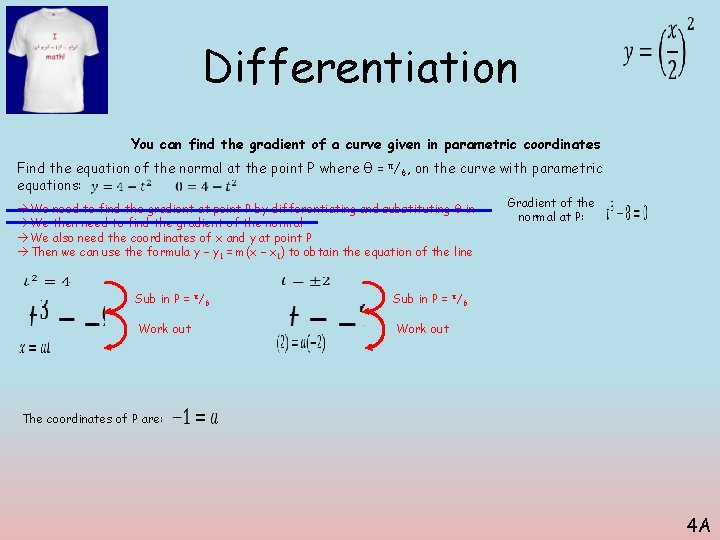
Differentiation You can find the gradient of a curve given in parametric coordinates Find the equation of the normal at the point P where θ = π/6, on the curve with parametric equations: We need to find the gradient at point P by differentiating and substituting θ in We then need to find the gradient of the normal We also need the coordinates of x and y at point P Then we can use the formula y – y 1 = m(x – x 1) to obtain the equation of the line Sub in P = π/6 Work out Gradient of the normal at P: The coordinates of P are: 4 A
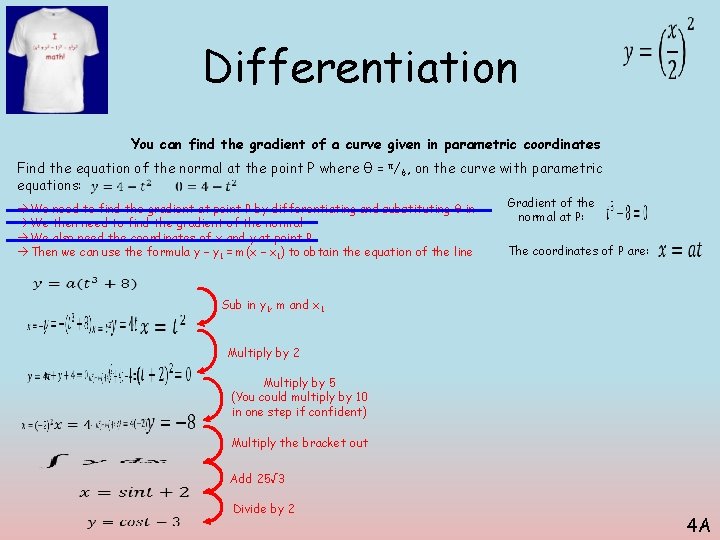
Differentiation You can find the gradient of a curve given in parametric coordinates Find the equation of the normal at the point P where θ = π/6, on the curve with parametric equations: We need to find the gradient at point P by differentiating and substituting θ in We then need to find the gradient of the normal We also need the coordinates of x and y at point P Then we can use the formula y – y 1 = m(x – x 1) to obtain the equation of the line Gradient of the normal at P: The coordinates of P are: Sub in y 1, m and x 1 Multiply by 2 Multiply by 5 (You could multiply by 10 in one step if confident) Multiply the bracket out Add 25√ 3 Divide by 2 4 A
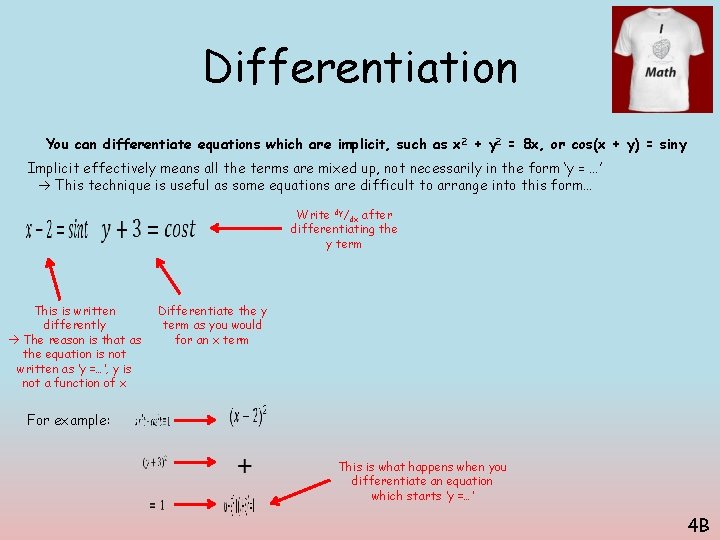
Differentiation You can differentiate equations which are implicit, such as x 2 + y 2 = 8 x, or cos(x + y) = siny Implicit effectively means all the terms are mixed up, not necessarily in the form ‘y = …’ This technique is useful as some equations are difficult to arrange into this form… Write dy/dx after differentiating the y term This is written differently The reason is that as the equation is not written as ‘y =…’, y is not a function of x Differentiate the y term as you would for an x term For example: This is what happens when you differentiate an equation which starts ‘y =…’ 4 B
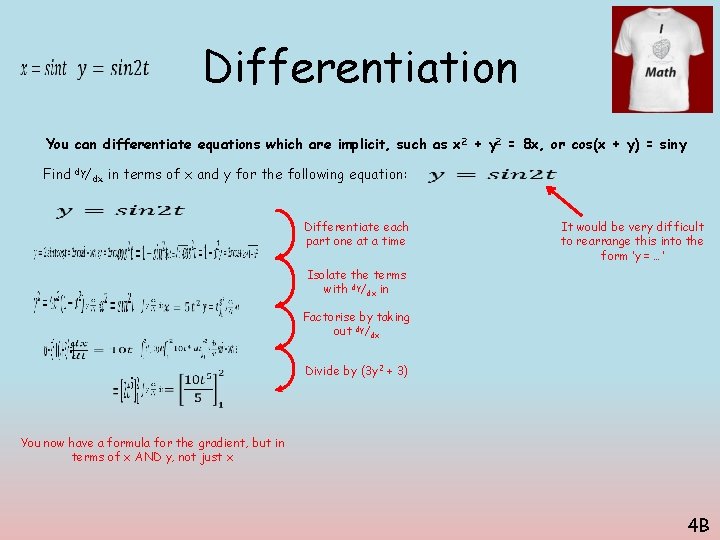
Differentiation You can differentiate equations which are implicit, such as x 2 + y 2 = 8 x, or cos(x + y) = siny Find dy/ dx in terms of x and y for the following equation: Differentiate each part one at a time It would be very difficult to rearrange this into the form ‘y = …’ Isolate the terms with dy/dx in Factorise by taking out dy/dx Divide by (3 y 2 + 3) You now have a formula for the gradient, but in terms of x AND y, not just x 4 B
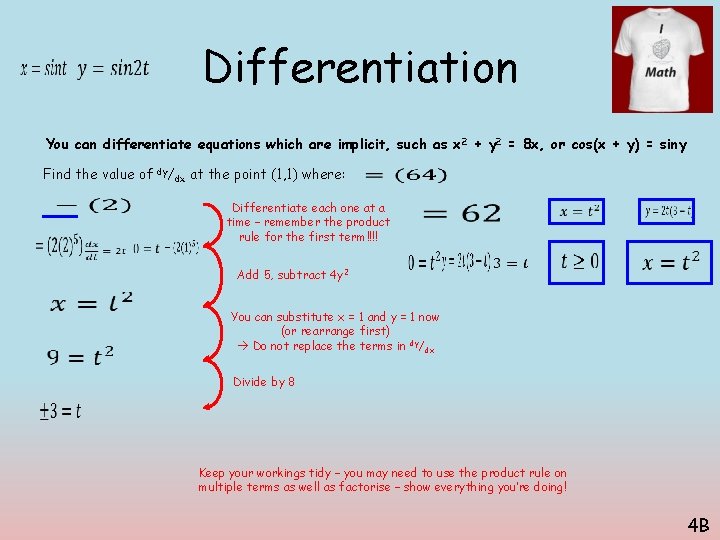
Differentiation You can differentiate equations which are implicit, such as x 2 + y 2 = 8 x, or cos(x + y) = siny Find the value of dy/ dx at the point (1, 1) where: Differentiate each one at a time – remember the product rule for the first term!!!! Add 5, subtract 4 y 2 You can substitute x = 1 and y = 1 now (or rearrange first) Do not replace the terms in dy/dx Divide by 8 Keep your workings tidy – you may need to use the product rule on multiple terms as well as factorise – show everything you’re doing! 4 B
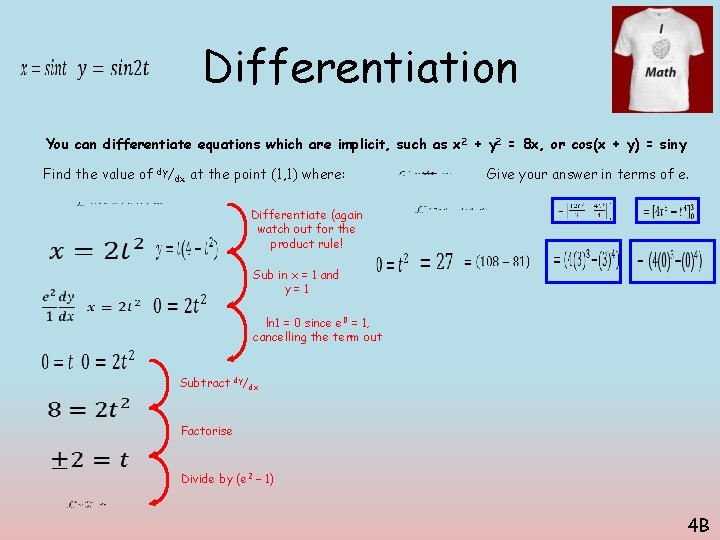
Differentiation You can differentiate equations which are implicit, such as x 2 + y 2 = 8 x, or cos(x + y) = siny Find the value of dy/ dx at the point (1, 1) where: Give your answer in terms of e. Differentiate (again watch out for the product rule! Sub in x = 1 and y=1 ln 1 = 0 since e 0 = 1, cancelling the term out Subtract dy/ dx Factorise Divide by (e 2 – 1) 4 B